A few weeks ago, I got to see the most miserable train station I’ve ever witnessed.
Houston sprawls across a metropolitan area of 7 million people, one of the fastest-populating regions in the United States and a longtime hub of innovation that helped humans reach the moon. But its only train station is a squat, morose shed that receives just three intercity trains a week.
I spent a day trying to get around car-centric Houston without a vehicle and was pleasantly surprised at the light-rail system in the city’s downtown. But venturing into the suburbs involved a grim, laborious patchwork of infrequent buses.
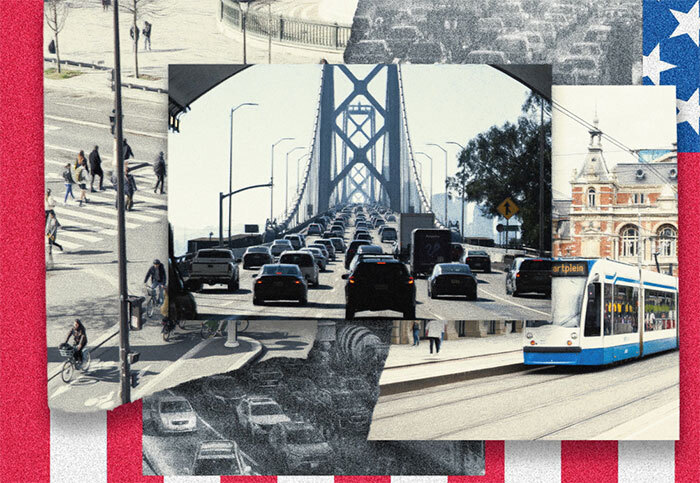
Cars are the exalted mode of transport here, as they are across almost all of the US. An American golden age of rail has faded—the soaring train terminuses in cities such as Detroit and St. Louis are now malls or apartments. Las Vegas hasn’t had any train service since 1997. Where other countries have high-speed rail, the US has highways.
For drivers, this often means plenty of traffic congestion, endless gas and maintenance costs, and the emission of planet-heating gases and other air pollutants that sicken communities. Transport is the leading cause of greenhouse gas emissions in the United States, and the lack of affordable, reliable public transit is a key impediment to tackling this.
For those without a car, meanwhile, life in America can seem second-rate. Every work commute, doctor’s appointment, or social activity has to be navigated without use of the thing almost every city here is built around—the car.
American cities compare badly to peers around the world when it comes to public transit access, a recent study found, and remedying this will take a dizzying amount of cash. But it doesn’t have to be this way. An even greater amount of money is now spent maintaining the nation’s vast highway system. Just a bit of redirected help for trains and buses could go a long way, quite literally.
I wrote a story for the Guardian this past week about how America fell so far behind its peers in the realm of public transportation, and how it can get out of the slow lane again. I hope you'll give it a read.
—Oliver Milman





No comments:
Post a Comment