

THE fascist "christian" nationalist corrupt drumpf / trump-vance administration continues to arm and support neo-nazi fascist illegal and immoral israeli settler and israeli defense forces ( idf ) violence against Christian and Muslim Palestinians in East Jerusalem, the West Bank and Gaza. American Palestinians are being physically attacked, sexually assaulted, their property and possessions stolen or destroyed and even murdered by neo-nazi fascist israeli settlers and the idf with the full support of the neo-nazi fascist bibi netanyahu government. Many Israelis and Jews around the world are horrified in the Israeli government's use of nazi style propaganda, nazi style policies, and nazi style warfare in the occupied territories, throughout the Middle East and Persian Gulf and in Israel itself. It is no surprise the neo-nazi fascist drumpf / trump-vance administration, the gop / gestapo over people-republican party and the apostates of Christianity, the "christian" nationalist support israeli nazism and fascism, they are one in the same. This from the Vatican and PBS NewsHour.....
***The saudis led by mbs are no better than the bibi netanyahu israelis or the drumpf / trump-vance "christian" nationalist magat cultist***
Saudi Prince Is Said to Push Trump to Continue Iran War in Recent Calls & SAUDI TIME BOMB / ANALYSIS-WAHHABISM & At Least Two Saudi Officials May Have Deliberately Assisted 9/11 Hijackers, New Evidence Suggests 24MAR26 & 9NOV01 & 11SEP24
Bishop Shomali: Let us not forget Gaza and the West Bank
In an interview with Vatican News, the vicar general of the Latin Patriarchate of Jerusalem calls for continued attention to Gaza and the West Bank as “two million people are still suffering.”
By Roberto Paglialonga
1 April 2026
“Gaza is forgotten. Today all attention is on Iran and southern Lebanon, but in the Strip, two million people are still suffering: the issue is unresolved.” Speaking by phone to Vatican News, Bishop William Shomali, vicar general of the Latin Patriarchate of Jerusalem since 2021, made an appeal to keep focus on what is still happening in the Strip.
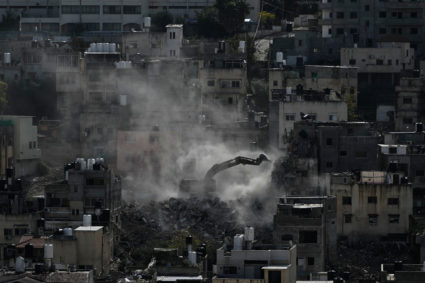
The economy there is collapsing, and many basic necessities remain scarce: medicines, antibiotics, medical equipment. “Security is lacking,” he warned. “Every day Palestinians in Gaza are killed, while the Rafah crossing does not function as it should.” The bishop lamented that in regards to reconstruction, “no one talks about it anymore.” Yet “80% of the infrastructure is still destroyed.” Those who can, and manage to, flee the enclave. He said many go to Australia, where around 50 families have been welcomed.
Settlements in the West Bank
Tensions are also high in the West Bank, in the State of Palestine, Bishop Shomali explained “a major problem: that of settlements.” Currently, there are 200, but the numbers continue to rise.
“Israel’s idea is to limit the presence of Palestinians to just three areas, build settlements around cities to occupy the land, and thereby move toward annexation of the West Bank under the name of Judea and Samaria,” he said.
“They want people to forget that there is a Palestinian population that will gradually become a minority. The whole purpose of this is to prevent the birth of a Palestinian state.”
No land available for building
The three areas where Israelis want to confine Palestinians, the Bishop explained, are Hebron-Bethlehem, Ramallah, and finally Nablus and Jenin. “Meanwhile, along the north-south corridor, settlements continue to multiply.” Israel then blocks “the growth of cities because it is difficult to find land for construction: 53% of Palestinian territories are in Area C, where building is prohibited,” Bishop Shomali said, “because it is occupied territory under full Israeli control. Settlers build wherever they want in this zone.”
Christian communities also targeted by settlers
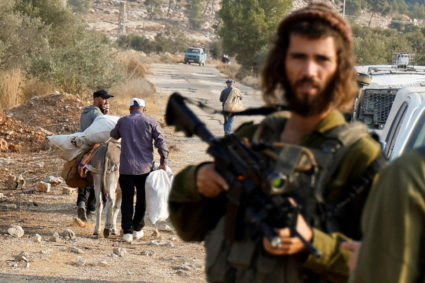
The Bishop also highlighted how Christian communities are at the center of violent incidents. In Taybeh, settlers “enter whenever they want, set fire to vehicles, and prevent farmers from working their fields” during the olive harvest.
But these are examples of abuses that have now become daily occurrences. “In other places they kill, like in the villages of Bir Zeit or Aboud.” In the West Bank and Jerusalem, the bishop described the Christian community as few, around 50,000. Settlers “use any pretext to provoke violence: a young person reporting to the police that someone threw a stone at them is enough. They are violent; people are afraid,” he recalled.
A “new settlement will now be built near Bethlehem, in Beit Sahour, in an area called Osh Ghrab, on land that belongs to Christian families. They cannot even approach it.” All of this “blocks the future of the emergence of a Palestinian state,” he concluded.
A declining Christian presence
Bishop Shomali also noted that “the percentage of Christians” shows an almost constant decline, which will likely continue: “We were a majority in the early centuries, from the 4th to the 7th,” but “afterward we began to decrease.”
After the fall of the city of Saint John of Acre to the Mamluks in 1291, there was no longer a patriarch in Jerusalem, and the title was gradually assigned to prelates of the papal court in Rome. Then in 1847 when the Latin Patriarchate was reestablished, “we were 10% of historic Palestine (about 21,000 people). In numbers we were few, but the percentage was high. Now we live a paradox in reverse: we are more numerous—Arab-speaking Christians across Israel, Gaza, and Palestine number at least 180,000—yet the percentage is low,” he explained.
Nevertheless, Bishop Shomali expressed his confidence that “the Lord will not allow the Church to disappear from the Holy Land, but we will be a small flock near the Holy Sites. This is my sense. We will remain, but at less than 1%.”
Easter celebrations will take place
Thanks to the agreement reached with Israeli authorities, after the “misunderstandings” of Palm Sunday, it will now be possible—within security limits—for Christians to celebrate the Triduum.
The vicar general clarified that “two weeks ago the Latin Patriarch of Jerusalem, Cardinal Pierbattista Pizzaballa, sent a letter requesting permission to celebrate even with small numbers. Now the police have said they intend to respond to that letter. No one can go against the Status Quo; it is a reality to be respected internationally.”
He shared that the Holy Week celebrations will take place with a maximum of 10 people. “They will open the door of the [Church of the] Holy Sepulchre and close it after entry. Once the ceremony is over, when people have left, the door will be closed again. The same will happen for the Oriental rites.”
Thank you for reading our article. You can keep up-to-date by subscribing to our daily newsletter. Just click here
Palestinians in occupied West Bank face growing violence from Israeli settlers
Human rights groups say a new Israeli law that expands the death penalty for killings classified as terrorism is expected to apply exclusively to Palestinian prisoners in the occupied West Bank. As Israel and the U.S. wage war in Iran, there has been a surge of violence there, mostly by Israeli settlers against Palestinians. Nick Schifrin visited to understand its impact on Palestinian families.
Read the Full Transcript
Notice: Transcripts are machine and human generated and lightly edited for accuracy. They may contain errors.
Amna Nawaz:
This week, Palestinians protested a new Israeli law that expands the death penalty for killings classified as acts of terrorism. Human rights groups say the law is expected to apply exclusively to Palestinian prisoners in the occupied West Bank.
The U.N. and international groups report that, as Israel and the U.S. are waging war in Iran, there's also been a surge of violence in the West Bank, mostly by Israeli settlers against Palestinians there.
Nick Schifrin recently visited Mukhmas in the occupied West Bank to understand the nature of that violence and its impact on Palestinian families.
Nick Schifrin:
In the hills outside of Jerusalem, a father and uncle walk a painful path. This is the first time that Mohamed Abu Siyam has visited his own son's grave.
Nasrallah Abu Siyam was 19 years old when he was killed six weeks ago. Nasrallah helped build his own grave. It was supposed to be for his grandfather.
Khaled Abu Siyam, Uncle of Nasrallah Abu Siyam: Nasrallah told him: "I wish my day before your day, my grandfather." At the end of the road, he's in it. Too early, man.
Nick Schifrin:
Khaled Abu Siyam is Nasrallah's uncle and is American, like his nephew.
Khaled Abu Siyam:
And we all wish, all wish to use the same grave of Nasrallah. We're proud of you. We're proud of what you have been.
Nick Schifrin:
For all his life, Nasrallah Abu Siyam was an avid horse rider and teacher of his little cousins, encouraging them not to be afraid. He led processions at local weddings. That's him in the gray suit on his horse.
His horse's name is Shams, Arabic for sun, as in the sun that shines. Today, the horse is still waiting for Mohamed's son.
Mohamed Abu Siyam, Father of Nasrallah Abu Siyam (through interpreter): He said: "Shams will stay with me for my whole life," and she remained.
Nick Schifrin:
She still remains without her rider.
This small town is more than 80 percent American. But they say Israel's wars in Iran, Gaza and Lebanon have made them as vulnerable as any Palestinians.
Anwar Mustafa, Friend of Nasrallah Abu Siyam: All people story, you know, every day in a different town. They just don't care.
Nick Schifrin:
Anwar Mustafa (ph) is 57 and also American. He and Nasrallah's other friends visit his grave to support a Palestinian community and family that feels under siege.
Anwar Mustafa:
Every town, they try to kick us out of our towns. They came to kill that day. They came to kill.
Nick Schifrin:
On February 18, residents say these Jewish settlers arrived on the high ground, some of them armed. They stole the Palestinians' livestock, which provides their lively hoods. And down the hill, Palestinians tried to hold their ground, some throwing stones. And, suddenly, one of the Palestinians was shot. Nasrallah tried to help.
Khaled Abu Siyam:
That's in his blood to help people. So he couldn't not to get involved. And him and a couple of guys trying to help this guy on the floor. They tried just to take him away, just to save him. And all of them get shot.
Nick Schifrin:
In the Abu Siyam family home, there is great grief. They believe Nasrallah could have been saved if not for Israeli military checkpoints in the occupied West Bank.
Khaled Abu Siyam:
He lost too much blood on the way. He was helpful until the last minute in his life. We're never going to forget. He tried to help people. Now he left us.
Nick Schifrin:
Mukhmas' population is about 13,000. Traditionally, many residents come here from the U.S. for the summer, but they're increasingly staying here year-round to help protect the village.
So, can you tell us what we're looking at up there?
On the edge of town, Mohamed Abu Siyam shows me the Israeli outpost where he believes his son's killers still live. The makeshift houses are illegal under Israeli and international law, but he says they have been there for five years.
Mohamed Abu Siyam (through interpreter):
The first thing they did when they came is to build a house or two. The army demolished the two houses. The next day they built three and the army demolished the three. But in around one year, they built 30 houses. After that, the army didn't care.
Nick Schifrin:
In a statement provided to "PBS News Hour," the Israeli Defense Forces says its mission is to safeguard the security of all residents in the area. And on the day Nasrallah was killed, life-endangering stone throwing occurred, and Israeli forces acted to disperse the disturbance without firing live ammunition.
Mohamed Abu Siyam says he, his father and grandfather have been shepherds on this land or nearby land for 90 years. In the last few years, he's taken to sleeping in this shack next to a sheep to defend them from settler attacks.
Mohamed Abu Siyam (through interpreter):
They want to take the land. If you attack them or even try to talk to them, they will immediately call for police or army, and the army will come and arrest you. So they started to expand towards the town until they became very close to the houses. And by the end, they have reached the boundaries of our houses, and you just can't do anything.
Nick Schifrin:
The U.N. and international human rights organizations say settler violence against Palestinians in the occupied West Bank has been rising. The U.N. says, already this year, settlers have displaced more Palestinians than in all of last year. And since the war with Iran began, settlers have averaged six attacks on Palestinians every day.
The violence has spiked, especially since Hamas' terrorist attacks in Israel on October the 7th, 2023. Since then, the U.N. says settlers and soldiers have killed more than 1,000 Palestinians in the occupied West Bank, nearly one-quarter of them children under 18.
The violence drew a rare rebuke from Israeli President Isaac Herzog, who called the attacks -- quote -- "a shameful crime against innocence."
Benjamin Netanyahu, Israeli Prime Minister:
They're talking about a handful of kids.
Nick Schifrin:
On FOX News late last year, Israeli Prime Minister Benjamin Netanyahu argued that Palestinians attacked Israelis living in the occupied West Bank, but he also vowed to reduce settler crime.
Benjamin Netanyahu:
When they do things like chopping olive trees and sometimes they try to burn a home, I can't accept that. That's vigilantism. I'm taking that out. But they claim -- they put a false symmetry between these teenagers and 1,000, actually over 1,000 terrorist attempts, terrorist attacks against the settlers.
I'm putting a special effort to stop this vigilantism. I can't accept that, even if it's not parallel, even if it's not symmetrical.
Nick Schifrin:
But critics call the violence state-sanctioned. Last month, 8-year-old Mustafa Odeh's and his 12-year-old brother, Khaled, were the only survivors of the war after Israeli border police fired at their family car. Both their parents and two younger brothers were killed.
Last week, the Israeli Parliament passed a law that expands the death penalty for killings classified as acts of terrorism. That will apply almost exclusively to the Israeli military's Palestinian prisoners in the occupied West Bank.
Far right National Security Minister Itamar Ben-Gvir celebrated with champagne. The violence and displacement has helped separate and isolate Palestinian communities in the West Bank and insert Israeli outposts or legal settlements on land that Palestinians hope will be their future state.
And it's affected Palestinian communities across the West Bank, including its most rural areas. While Palestinians describe increased violence as Israel wages war elsewhere, in villages across the West Bank, including those as small as this one, Palestinians describe decades of targeting and persecution and now violence that is unspeakable.
Suhaib Abualkebash, Victim of Israeli Settler Violence (through interpreter): I was 100 percent terrified. I thought, that's it. They will kill me.
Nick Schifrin:
Suhaib Abualkebash is still suffering from that terror. He says, last month, 20 settlers attacked his village, his family, and himself.
Suhaib Abualkebash (through interpreter):
I was outside. They grabbed me inside the tent and started hitting me. They tied me, tied my legs, and my hands with zip ties. They took my pants off and zip-tied my penis and started hitting me.
Nick Schifrin:
His family, his wife and children, tied together and made to watch. And he says the settlers showed them no mercy.
Suhaib Abualkebash (through interpreter):
Everyone was beaten, except a 4-month baby girl. She was asleep, but everybody was beaten, all the children. What will they understand? What will they know about these robbers or settlers? They were scared. They're still children, just children.
Nick Schifrin:
This kind of violence is obviously very personal. Why are you willing to talk about it to a reporter like me?
Suhaib Abualkebash (through interpreter):
To convey my voice to the world, to tell what's happening, what they are doing to people.
Nick Schifrin:
And what they are doing isn't only about violence, it's about land. This family has lived in this area for 70 years, three generations of shepherding. The family had 400 sheep, and Abualkebash says settlers stole all of them and vowed to maintain their pressure.
Suhaib Abualkebash (through interpreter):
They said to us: "If you will not leave from here the next day, we will come and burn you, rape your women, and we will take your children and make them live with us."
Nick Schifrin:
But some parents' children have already been taken and their land encroached by the very people he says, killed his son.
Mohamed Abu Siyam (through interpreter):
In what world does this happen? Someone kills your son and they say, hey, look at me, and he's not far from you. You see him every day.
Khaled Abu Siyam:
Not leaving him alone even too. He's coming back and forth, back and forth, the same guy, same people. And that make him more sad, more angry. That's killing him more.
Nick Schifrin:
And so, instead of justice, there is a hollowness that can never be filled.
For the "PBS News Hour," I'm Nick Schifrin in Mukhmas in the occupied West Bank.

No comments:
Post a Comment