NORTON META TAG

Showing posts with label citi group. Show all posts

01 December 2012

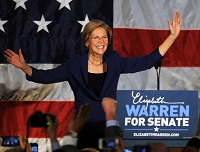
Tell Harry Reid; Don't block Elizabeth Warren from the Senate Banking Committee 1DEZ12

NOBODY HAS THE MORAL AUTHORITY TO SERVE ON THE SENATE BANKING COMMITTEE THAT SEN ELECT ELIZABETH WARREN D MA DOES. While the nation is still recovering from the great recession caused by the bank-financial cabal and wall street gop and democratic Senators bought by these groups are moving to exclude Ms Warren from the Senate Banking Committee. The American financial industry is terrified of her because they don't own her and because she knows all their dirty tricks. The SumOfUs has a petition calling on Senate Leader Harry Reid D NV to appoint her to the Senate Banking Committee, click the link to sign it, and pass this on to family and friends for them to sign it too.
Big banks are lobbying frantically to block Elizabeth Warren from the Senate Banking Committee.
Victorious Elizabeth Warren
Tell Harry Reid not to cave to Wall Street, and to let Elizabeth Warren on the Senate Banking Committee if she wants the position.
Sign the petition.
For years now, Wall Street has held sway over the Senate Banking Committee. The committee is stacked with industry-friendly Republicans and Democrats whose largest donors are big banks. Through this cozy influence, Wall Street has managed to ride out scandal after scandal relatively unscathed.
Which is exactly why Wall Street is terrified of Elizabeth Warren. After spending millions to defeat Senator-elect Warren, Wall Street is opening its purse again in a frantic attempt to block her from the Senate Banking Committee and prevent themselves from being held accountable for their greed. On this decision, Senate Majority Leader Harry Reid has the final say, which is why we need to get him to stand strong. Americans finally have someone in the Senate who will stand up to Wall Street, but first we need to make a stand for her.
Tell Majority Leader Harry Reid: Don’t block Elizabeth Warren from the Senate Banking Committee.
Senator-elect Warren is incredibly qualified for the position. She is a bankruptcy law expert, has served as Congress' lead watchdog overseeing the $700 billion bank bailout from 2008 to 2010, and she conceived of and helped launch the Consumer Financial Protection Bureau (CFPB). In the words of hedge fund manager Shah Gilani, "At exactly the time that big banks don't want more oversight—or another potentially activist regulator—that's what they're getting."
Currently, the Senate Banking Committee is chaired by Senator Tim Johnson, whose two biggest donors have been Citigroup and JP Morgan, and is stacked with a number of Republicans that are in big banks' back pocket. Together, we can let Harry Reid know that we voted for financial oversight, not for more of the same politicians bought out by Wall Street.
Sign our petition to ensure that Wall Street won't block Elizabeth Warren from the Senate Banking Committee.
Thank you,
Claiborne, Kaytee and the rest of us


*******************
Further information:
Forbes: Elizabeth Warren's Big Win Is A Crushing Defeat For Big Banks, 7 November, 2012
Mother Jones: Big Banks v. Elizabeth Warren: It's On (Again!), 19 November, 2012
SumOfUs is a world-wide movement of people like you, working together to hold corporations accountable for their actions and forge a new, sustainable path for our global economy. You can follow us on Twitter, and like us on Facebook.

Was this email forwarded to you? Click here to add yourself to SumOfUs.

10 February 2012

Yesterday's settlement with Wall Street, A BAD DEAL from CREDO & Settlement launches foreclosure reckoning from WASHINGTON POST 10FEB12

THE only good part of this deal is that wall street executives, directors of the financial-banking industry cabal, could still face criminal charges for their actions that caused the recession. Thanks to several strong, honest, progressive state AGs there is still a chance for justice. This from Credo, followed by an article on the deal from the Washington Post.....


Take action!
CREDO Action | more than a network, a movement.
Wall Street banks fraudulently and illegally foreclose on your house. You get $2,000. The bank gets let off the hook. We'd call that a bad deal.
And yet yesterday, at the urging of the White House, federal regulators along with 49 state attorneys general announced a settlement deal for mortgage servicer abuse that does essentially that. It lets banks off the hook for widespread foreclosure fraud.
Press releases have trumpeted a $26 billion deal which may sound like a lot, but it's a paltry sum when you break down the numbers.
With an average mortgage of $180,000, and loan instruments executed illegally, a family that lost their home will get a check for just over 1% of the value of the mortgage.1 That is not a victory. The amount of money this deal makes available to help homeowners is an order of magnitude too small and incommensurate with the harm done by the banks.
The estimated $10-$20 billion in the deal for principal reduction would reduce only about 2% of the $700 billion in equity destroyed during the financial crisis. And the banks themselves will only pay $5 billion out of their own pocket. By far the lion's share of the cost will be borne by investors and taxpayers, who had no part in the robo-signing scandal. 2
No doubt the deal is far better than the deal that was offered months ago. And this most certainly is a result of activism from members of CREDO and many of our allies in the progressive movement who worked with progressive attorneys general like New York's Eric Schneiderman, California's Kamala Harris, Delaware's Beau Biden, Massachusetts' Martha Coakley and Nevada's Catherine Cortez Masto to fight a bad deal.
But the final deal, while better, still can't be characterized as a good deal or even as a good first step towards real accountability for Wall Street banks.
The reported $26 billion settlement will not come close to inflicting any real pain on the banks all of which have already reserved the full amounts required from them under the deal. As Robert Reich said, the "$26 billion settlement with banks over mortgage fraud is far short of what they should pay and distressed home owners deserve."3
One in five Americans with mortgages owe the banks more than their homes are worth, and these home owners are underwater by an average of $50,000 each. This is a collective negative equity of nearly $700 billion.4
Consider the $700 billion bailout of Wall Street paid for by U.S. taxpayers5 and the more than $1.2 trillion in loans6 provided by the Federal Reserve to Wall Street banks. Or another way to put the deal in perspective is to compare it to the tobacco industry settlement in 1998 — the largest previous multi-state agreement. That deal was worth $350 billion in today's dollars — more than ten times the size of the mortgage deal.7
And that's not even all that's wrong with this deal. The federal government's track record for enforcing settlement terms with Wall Street banks is abysmal. Furthermore, even if the banks follow the terms of the deal, it's quite possible than when all is said and done, not only will the banks have suffered no pain, they may actually come out having profited from their illegal schemes to rip off homeowners. According to the Consumer Financial Protection Bureau, the largest mortgage banks saved $20 billion by taking illegal shortcuts — an amount far greater than the $5 billion out of pocket they will be required to pay in this deal.8
All of which adds up to a scenario in which this settlement does literally nothing to deter the banks from engaging in the same fraudulent behavior in the future.
Senator Dick Durbin famously said the Wall Street banks own the politicians in Washington, DC. Today, this could not be more clearly true as we closely examine the deal that the Obama administration cut with Wall Street and pressured state attorneys general to sign.
There has yet to be a full investigation of the robo-signing scandal despite what Reuters called "copious evidence" of "widespread forgery, perjury, obstruction of justice, and illegal foreclosures...." 9
By establishing settlement terms before there has been any meaningful investigation, the deal whitewashes the widespread lawlessness of the banks and virtually ensures that no bankers will be held criminally responsible for their part in the robo-signing scandal and foreclosure fraud.
Though the exact terms of the settlement have not been disclosed, we understand that it will not cut off other important avenues to hold the banks accountable. New York Attorney General Eric Schneiderman is co-chairing a federal task force that if fully resourced and left to operate unhindered by the White House could achieve hundreds of billions in reduced principal for underwater homeowners and criminal indictments for bankers who broke the law and helped drive our economy off a cliff. And other state attorneys general can continue investigating Wall Street's role in causing the housing crisis to ensure that the banks that caused the crisis are held accountable for their wrongdoing.
This is the biggest case of fraud in our history. Homeowners deserve justice for crimes committed against them by Wall Street banks that in many cases literally stole their homes from underneath them. Unfortunately, yesterday's settlement doesn't even provide anything close to a down payment on justice.
As the election season heats up, we must be insistent about real accountability for Wall Street crooks. Pressure from activists like us will be even more important in the days to come if we are to achieve any real measure of accountability for Wall Street bankers who profited from their crimes and left the 99% to pay to the price for their reckless disregard.
Becky Bond, Political Director
CREDO Action from Working Assets

1. "The Top Twelve Reasons Why You Should Hate the Mortgage Settlement," Yves Smith, Naked Capitalism, 02-09-12
2. "The Servicing Settlement: Banks 1, Public 0," Adam Levitin, Credit Slips, 02-09-12
3. Twitter, 02-09-12
4. "Mortgage Plan Gives Homeowners Bulk of the Benefits," Nelson D. Schwatz and Shaila Dewan, New York Times, 02-09-12
5. "Wall Street Aristocracy Got $1.2 Trillion in Secret Loans," Bradley Keoun and Phil Kuntz, Bloomberg, 08-22-11
6. "The Wall Street Bailout Plan Explained ," David Stout, New York Times, 09-20-08
7. "FAQ: The foreclosure settlement ," Sarah Halzack and Sarah Kliff, WashingtonPost.com, 02-09-12
8. "Big Banks Save Billions As Homeowners Suffer, Internal Federal Report By CFPB Finds," Huffington Post, 03-28-11.
9. "
U.S. AG Eric Holder, DoJ Head Lanny Breuer Linked To Banks Accused Of Foreclosure Fraud ," Reuters, 01-19-12.

Facebook
Twitter


© 2012 CREDO. All rights reserved. 

Settlement launches foreclosure reckoning

By and

The government’s $25 billion settlement Thursday with banks over fraudulent foreclosure practices begins a long-promised reckoning with the financial industry over its role in the worst economic crisis since the Great Depression, officials said.
The deal represents the largest industry settlement since an agreement with tobacco companies in 1998 and will force five of the nation’s largest banks to overhaul their mortgage-servicing practices and reduce loan balances for many borrowers who owe more than their houses are worth.
FAQ: The foreclosure settlement
Officials acknowledged that the final sum will reach only a fraction of homeowners across the country whose homes are collectively worth $750 billion less than what is owed on their mortgages. But they argued that it was a meaningful step in healing the housing market.
The priority of the settlement was not to punish banks, officials said. Another wave of punishment is on its way, they vowed.
“This is neither the beginning nor the end of our work to hold banks and other institutions accountable for the destruction they’ve caused families, communities and country,” said Illinois Attorney General Lisa Madigan. “Today’s settlement should serve as a warning.”
The deal was brought on by revelations that banks were using forged and shoddy paperwork to foreclose rapidly on struggling homeowners, a practice known as “robo-signing.” Outrage over those practices led to 16 months of settlement talks between state and federal officials and five large banks.
The officials who crafted Thursday’s settlement were careful to leave the door open to a wide range of future litigation, despite efforts by banks to shield themselves from such legal actions. It allows for future actions over fair-housing and fair-lending violations, as well as civil rights claims. It doesn’t bar individuals from joining class-action lawsuits. Nor does it limit the lawsuits that private investors can file in search of damages, some of which have already been launched.
That means the legal hangover from the mortgage bubble is probably far from over for many of the country’s largest banks.
Last September, federal regulators launched a broad legal assault on 17 big banks, claiming they sold nearly $200 billion in fraudulent mortgage investments to housing giants Fannie Mae and Freddie Mac.
Since then, as the housing slump has continued to weigh down the larger economy and movements as disparate as the tea party and Occupy Wall Street have raged against the lack of accountability for the crisis, the pressure for regulators to hold individuals and institutions accountable has only grown.
New investigative unit
President Obama announced in his recent State of the Union address a new unit that would would “expand our investigations into the abusive lending and packaging of risky mortgages that led to the housing crisis.” Days later, Attorney General Eric H. Holder Jr. said the Justice Department had issued civil subpoenas to 11 financial institutions.
Helping to lead the new investigative unit is New York Attorney General Eric Schneiderman, who for months had been critical of the foreclosure settlement because of concerns that it might prevent deeper investigations into mortgage misdeeds and could let banks off too easily.
Schneiderman, who ultimately signed on to Thursday’s settlement, last week filed lawsuits against several banks, claiming that they deceived homeowners and court officials by filing bogus documents through a popular electronic mortgage registry. He and his counterparts from states such as California, Delaware, Massachusetts and Nevada have vowed to press forward with their inquiries — an approach that has been cheered by liberal groups and consumer advocates.
Separately, the Securities and Exchange Commission is examining whether banks fully disclosed the risks to investors who bought packages of loans that financed the housing boom. The agency has continued digging for evidence that firms failed to disclose important information when selling the securities to investors, SEC enforcement director Robert Khuzami said recently. The SEC also has sent banks a flurry of requests for documents and interviews with witnesses.
Goldman Sachs settled an SEC complaint for $550 million in 2010, but its last quarterly report — like those of other banks — describes a variety of pending lawsuits and government investigations that the firm faces. “There remains significant uncertainty surrounding the nature and extent of any exposure for participants in this market,” Goldman said in the report.
The passage of time since the housing crash first hit could affect the government’s ability to impose penalties on financial firms. Generally speaking, under a statute of limitations, the SEC can only obtain penalties for fraud within the past five years. But the SEC and other agencies could argue that the clock didn’t start ticking until it was apparent that fraud occurred.
Thursday’s settlement, which would require a judge’s consent, won approval from 49 states. Oklahoma was the lone holdout.
Under the terms of the deal, banks would have three years to complete principal writedowns, refinancings and other relief. It provides incentives for actions taken within the first 12 months so that the aid can get to homeowners sooner rather than later.
The settlement also includes about $17 billion that would go toward foreclosure-prevention measures, such as lowering the loan balance for borrowers who owe more than their homes are worth. Other provisions would provide for lowering interest rates for homeowners who are current on their loans. In addition, as many as 750,000 borrowers who lost their homes to foreclosure since 2008 would be eligible for payouts of about $2,000 each.
The five banks at the heart of the settlement are Wells Fargo, Bank of America, J.P. Morgan Chase, Ally Financial and Citigroup. Ultimately, the amount of aid to homeowners could reach $40 billion, officials said, adding that they hope other banks will soon sign similar agreements and adopt the new standards set out by the deal.
Consumer impact uncertain
Several Washington area housing counselors said the deal would probably do little to help their clients but that they needed to learn the details of the aid to be sure.
Cherelle Silue, manager of housing services at United Communities Against Poverty in Prince George’s County, said her first impression is that a homeowner could wind up not getting much.
For homeowners who are trying to catch up on their mortgages, “we are talking thousands and thousands of dollars,” Silue said. “I am sure that it is going to be able to help someone, but I am not sure how many.”
In any case, the celebrations among state and government officials over a significant settlement for homeowners on Thursday included numerous reminders that the victory marked a beginning rather than an ending.
“This settlement also protects our ability to further investigate the practices that caused this mess. And this is important,” Obama said at White House, adding: “We’re going to keep at it until we hold those who broke the law fully accountable.”

Staff writers David S. Hilzenrath, Sarah Kliff, Luz Lazo and Jeremy Borden contributed to this report.

11 November 2011

Proof the big banks are terrified & Ten stories of people moving their money, despite bank efforts to stop them 11NOV11

FROM The Daily Kos, this shows just how greedy and a little scared they are. Keep the movement going and MOVE YOUR MONEY!!!!!!

"Brothers and sisters, do not be weary in doing what is right."
- 2 Thessalonians 3:13
"No one can serve two masters. If you try, you will wind up loving the first master and hating the second, or vice versa. People try to serve both God and money— but you can’t. You must choose one or the other."
- Matthew 6:24


DAILY KOS

Since September 29, at least 700,000 Americans have moved their money out of big banks and into credit unions.

The big banks are so freaked out by what's happening that some have locked their doors and even called the police on customers who tried to close their accounts.

Click here for ten amazing stories about big banks desperately trying to stop customers from closing their accounts.

Please share these stories with a friend, too. Everyone needs to know we have the big banks on the run.

Keep fighting,
Markos Moulitsas
Founder, Daily Kos


chopped up Bank of America cards
Trust me, it feels awesome!
Banks are shrugging off the (at least) 700,000 accounts they've lost the last six weeks and claim they don't want your business:
[T]he banks are going to be better off because they are getting rid of their least-profitable or not profitable clients. It helps them stem this tsunami of cash that’s been flowing in that they don’t know what to do with.
But not only do they relentlessly advertise for new business on billboards, TV, direct mail and other places, but they fight tooth and nail to prevent people from closing their accounts. The Daily Kos community and others have chronicled many such efforts, so follow me below the fold for ten of these awesome stories.
  1. "He has a right to speak," said the cop to the banker When Daily Kos community member marvinborg was distributing flyers outside of local Chase and Bank of America branches encouraging customers to move their money to credit unions, one of the managers called the police on him. When they arrived, the police promptly told the manager off:
    "He has the right to speak and the right to hand out flyers. Unless he blocks you or causes a disturbance, he has the right to be here - please don't call the police again if he is not bothering you. If you don't like free speech you should move to another country."
  2. "You can't be a customer and a protester at the same time." At a Bank of America branch in Santa Cruz, the manager locked two customers inside a branch as they were trying to close their accounts, and then called the police on them. Supposedly, this was because they were wearing signs. When the police showed up, they didn't arrest anyone, and were just as baffled as the customers:

  3. "They're arresting everyone?" At a Citibank in New York City, a customer actually was forcibly arrested when she tried to enter the bank to close her account:

  4. "Let them in!" At a Bank of America in St. Louis, security refused to allow customers who wanted to close their accounts inside:

  5. The bank said "You'll be back." Even when banks don't call the police, they can give customers sound like jilted boyfriends:
    At Wells Fargo, my sister walked up to the teller and politely asked to close her account. The teller said, “No problem.” She pulled up her account and saw the balance and told her that due to the amount she had to speak with the branch manager. The branch manager came out. He was probably 30 years old and was very arrogant. He asked my sister why she wanted to close her account and my sister told him she thought Wells Fargo was part of the problem with the economy. He went thru some talking points about why she shouldn’t move her money, but my sister didn’t back down. When he asked her where she was going she told him that she would be banking at the North Carolina State Employees Credit Union. She isn’t a state employee, but anyone can join if you are related to a state employee. It turns out her husband is. Anyway, the bankster told her “You’ll be back. Credit unions can’t provide the services you need.” We’ll see about that. She withdrew over $200k from Wells Fargo. [Emphasis added]
  6. "Management is nervous" In the midst of begging customers not to leave, every once in a while banks can let it slip just how scared they are:
    The manager was pleasant enough and very direct. After introducing herself she flat out asked "What can we do to change your mind?" "We don't want to see you go" she emphasized. This opened a door for me to further explain my decision to leave the bank and why I was doing it. Amazingly, it did not fall on deaf ears. She indicated that understood where I was coming from and actually showed genuine surprise at some of the facts I provided her about the less than consumer friendly policies and machinations of her employer. She did make some feeble counter-arguments and repeatedly asked me if I would change my mind (with a hint of desperation!). I stood firm and by the end of our conversation she asked if I would be willing to put it all in writing so she could send it up the chain. She shared that management is nervous, they are seeing money leaking out of the bank and realize that they have made mistakes.  She even hinted that there has been high-level discussion on reversing the new fess since there has been so much consumer push-back. [Emphasis added]
    The fees were reversed soon after this was posted.
  7. They're offering cash for customers to open up accounts It's silly to argue that they don't want cash deposits, yet they're offering cold, hard cash for those who will, well, deposit cash.
    There’s a lot of fine print involved, but basically, they will pay me $200 to move my checking account to them provided that: 1)    I make one bill payment through the account each month
    2)    The account has a balance of $10,000 as of 1/20/2012
    3)    I wait 'till April for the $200 (giving me about 4% interest on my $10k)
    4)    I don’t close my credit card account
    5)    I don’t violate of any of their nit-picky procedures in the fine print
    6)    They don’t decide to simply screw me and not pay up: “Bank of America may change or terminate this offer before this date without notice…”
    Well! I had been told that banks didn’t need deposits. I guess that’s not true, otherwise why would they be running (cough, cough) to sign me up – and offering cold hard cash as well?
  8. They're pretending it's no big deal You know there's something happening when they're circulating talking points.
    In a truly random set of circumstances I found myself stopping by three separate Wells Fargo locations yesterday [...] [Branch 1:] While we were making small talk, I casually asked, “So, how many people closed out accounts this weekend?”
    The cashier said, “Oh it was just two or three people.  Not many at all.” [...]
    [Wells Fargo embedded in Whole Foods:] While chatting it up, I asked, “So, how many people closed out their accounts here on Saturday? “
    The Teller said, “Just two or three people closed their accounts.  Only two said it was because of Bank Transfer Day.” [...]
    [Branch 2:] I was talking to Mr. Branch Manager2 while I was getting the passport, I casually said, “So, how many people closed their accounts on Saturday?”
    Mr. Branch Manager2 said, “Oh, it was just 2 or 3 people.  They had very small amounts of money with us.” [...]
    Was there a corporate wide memo with talking points?  I don’t have any proof but it does make me wonder how only “…2 or 3 people” closed their accounts at three different Wells Fargo…
  9. They'll fight tooth and nail for empty accounts It doesn't even matter if a checking account is in use. They'll do everything possible to keep people from closing them.
    I didn't even know he was talking with BoA, but when he had repeated the entire chain of circumstances for the fourth or fifth time, to the same person, getting louder each time, I knew something was definitely screwy. I mean, this is an account that had never held any actual balance. Had never had any checks written. For years. And never would. Why the hell would a bank want to keep it open?
    Eventually my schedule caught up with me and I had to leave, with Ed still bellowing the same story into the phone over and over. I was able to come back an hour or so later, after he was finally off the phone, and asked if that happened to be BoA.
    Well, yes, of course it was.
  10. Offering to refund obnoxious fees ... after the fact. They wouldn't be in this mess if they didn't try to bleed people in the first place.
    "Is everything OK with your account and service?" Well, yes, except for the fact that I'm charged ten dollars a month for the privilege of having a checking account here. (We used to have free checking, but Chase implemented the fee about a year ago if our balance went below $1500.  Man, we were lazy and complacent, but not today!)
    "Let me see, yes, it seems you paid a fee... 3 times?  So only $30."
    Yes, only $30... but it's the principle.  It's the greed that is annoying.
    "Well, you've been with us for many years, here is what I can do.  I can temporarily... uh, permanently waive any future fees.  We really value our relationship with you and want to keep you as a customer."
    It seems like if Chase had called me before I came down here to close my account and made that offer that it would seem genuine, but not only after I'm already here to close my account.  Which I would like to do.
    "Well, we could also refund those fees.  We would really like to retain your business."
    I'm going to be opening up an account with a local credit union.
And how do the banks respond? By lashing out angrily at its customers.
Bank of America CEO Brian Moynihan says the public needs to start thinking before they criticize his company.
People have given it plenty of thought. That's why hundreds of thousands are moving their money when really, doing so is a pain in the ass—you've got to deal with uncleared checks, automatic bill pays and recurring payments, direct deposits and old habits (whether it's navigating your banks online site, or knowing where the branches and ATMs are located).
Wall Street is out at least $60 billion and counting, and we can inflict more pain. Let's truly make Brian Moynihan and his CEO buddies squeal. Please share this post with your friends, and if you have not already done so, Move Your Money.

26 October 2011

Wall Street Is Still Out of Control -- Obama Should Call for Glass-Steagall and a Breakup of Big Banks 26OCT11

WELL written piece advocating bringing back Glass-Steagall and breaking up the big banks before they really destroy our economy and nation.
Next week President Obama travels to Wall Street where he'll demand -- in light of the Street's continuing antics since the bailout, as well as its role in watering-down the Volcker rule -- that the Glass-Steagall Act be resurrected and big banks be broken up.
I'm kidding. But it would be a smart move -- politically and economically.
Politically smart because Mitt Romney is almost sure to be the Republican nominee, and Romney is the poster child for the pump-and-dump mentality that's infected the financial industry and continues to jeopardize the American economy.
Romney was CEO of Bain & Company -- a private-equity fund that bought up companies, fired employees to save money and boost performance, and then resold the firms at a nice markups.
Romney also epitomizes the pump-and-dump culture of America's super rich. To take one example, he recently purchased a $3 million mansion in La Jolla, California (in addition to his other homes) that he's razing in order build a brand new one.
What better way for Obama to distinguish himself from Romney than to condemn Wall Street's antics since the bailout, and call for real reform?
Economically it would be smart for Obama to go after the Street right now because the Street's lobbying muscle has reduced the Dodd-Frank financial reform law to a pale reflection of its former self. Dodd-Frank is rife with so many loopholes and exemptions that the largest Wall Street banks -- larger by far then they were before the bailout -- are back to many of their old tricks.
It's impossible to know, for example, the exposure of the Street to European banks in danger of going under. To stay afloat, Europe's banks will be forced to sell mountains of assets - among them, derivatives originating on the Street -- and may have to renege on or delay some repayments on loans from Wall Street banks.
The Street says it's not worried because these assets are insured. But remember AIG? The fact Morgan Stanley and other big U.S. banks are taking a beating in the market suggests investors don't believe the Street. This itself proves financial reform hasn't gone far enough.
If you want more evidence, consider the fancy footwork by Bank of America in recent days. Hit by a credit downgrade last month, BofA just moved its riskiest derivatives from its Merrill Lynch unit to a retail subsidiary flush with insured deposits. That unit has a higher credit rating because the Federal Deposit Insurance Corporation (that is, you and me and other taxpayers) are backing the deposits. Result: BofA improves its bottom line at the expense of American taxpayers.
Wasn't this supposed to be illegal? Keeping risky assets away from insured deposits had been a key principle of U.S. regulation for decades before the repeal of Glass-Steagall.
The so-called "Volcker rule" was supposed to remedy that. But under pressure of Wall Street's lobbyists, the rule -- as officially proposed last week -- has morphed into almost 300 pages of regulatory mumbo-jumbo, riddled with exemptions and loopholes.
It would have been far simpler simply to ban proprietary trading from the jump. Why should banks ever be permitted to use peoples' bank deposits - insured by the federal government - to place risky bets on the banks' own behalf? Bring back Glass-Steagall.
True, Glass-Steagall wouldn't have prevented the fall of Lehman Brothers or the squeeze on other investment banks in 2007 and 2008. That's why it's also necessary to break up the big banks.
In the wake of the bailout, the biggest banks are bigger than ever. Twenty years ago the ten largest banks on the Street held 10 percent of America's total bank assets. Now they hold over 70 percent. And the biggest four have a larger market share than ever -- so large, in fact, they've almost surely been colluding. How else to explain their apparent coordination on charging debit card fees?
The banks aren't even fulfilling their fiduciary duties to investors. Last summer, after Groupon selected Goldman Sachs, Morgan Stanley, and Credit Suisse to underwrite its initial public offering, the trio valued it at a generous $30 billion. Subsequent accounting and disclosure problems showed this estimate to be absurdly high. Did the banks care? Not a wit. The higher the valuation, the fatter their fees.
Just last week Citigroup settled charges (without admitting or denying guilt) that it defrauded investors by selling them a package of mortgage-backed securities rife with mortgages it knew were likely to default, but didn't disclose the hazard. It then bet against the package for its own benefit -- earning fees of $34 million and net profits of at least $126 million. So what's Citi paying to settle this outrage? A mere $285 million. Its CEO at time (Charles Prince) doesn't pay a dime.
I doubt the president will be condemning the Street's antics, or calling for a resurrection of Glass-Steagall and a breakup of the biggest banks. Democrats are still too dependent on the Street's campaign money.
That's too bad. You don't have to be an occupier of Wall Street to conclude the Street is still out of control. And that's dangerous for all of us.

31 March 2011

Bernie Sanders' Top 10 Tax Avoiders 29MAR11

THE corporations and economic groups that are NOT paying taxes and getting away with it! From Mother Jones....
In a Sunday press release calling on wealthy individuals and corporations to pay their share, Senator Bernie Sanders of Vermont offered a list of what he calls "some of the 10 worst corporate income tax avoiders."
Sanders, you'll recall, made headlines for his epic 8.5-hour speech/filibuster this past December, dealing with how Obama's pending tax-cut deal with the GOP would be bad for America. The speech—published this month as a paperback simply titled The Speech—was in vain: Congress passed the deal, extending tax breaks not merely to the poor and middle-class, but to America's richest people.
It also slashed the estate tax from 55 percent to 35 percent and exempted the first $5 million of an estate's value ($10 million for a couple)—up from $1 million pre-Bush. In his speech, Sanders warned against this change, noting, "Let us be very clear: This tax applies only—only—to the top three-tenths of 1 percent of American families; 99.7 percent of American families will not pay one nickel in an estate tax. This is not a tax on the rich, this is a tax on the very, very, very rich. (Click here for our blockbuster charts showing just how rich the very, very, very rich actually are.)
If the estate tax—which Republicans have cleverly rebranded the "death tax"—were to be eliminated entirely (another GOP goal), Sanders says it would cost US taxpayers $1 trillion over 10 years. "Families such as the Walton family, of Walmart fame, would have received, just this one family, about a $30 billion tax break," he said in the speech.
As one of few voices in Congress calling seriously for balance between cuts and new revenues, Sanders wants to close corporate tax loopholes and get rid of tax breaks for Big Oil. He's put forth a bill that would impose a 5.4 percent surtax on household income north of $1 million, and earmark that money for deficit reduction. He estimates it would bring in $50 billion a year, whereas Congress' recent tax-cut deal will add around $700 billion to the deficit.
So, without further ado, here's Bernie's tax-avoiders list. In this case, one of his staffers informed me, "refund" means "negative federal income tax liability." If you have any quibbles with his facts, let us know in the comments.
1) ExxonMobil made $19 billion in profits in 2009. Exxon not only paid no federal income taxes, it actually received a $156 million rebate from the IRS, according to its SEC filings. [Note: Our post last April reported that ExxonMobil was owed $46 million by the IRS.]
2) Bank of America received a $1.9 billion tax refund from the IRS last year, although it made $4.4 billion in profits and received a bailout from the Federal Reserve and the Treasury Department of nearly $1 trillion.
3) Over the past five years, while General Electric made $26 billion in profits in the United States, it received a $4.1 billion refund from the IRS.
4) Chevron received a $19 million refund from the IRS last year after it made $10 billion in profits in 2009.
5) Boeing, which received a $30 billion contract from the Pentagon to build 179 airborne tankers, got a $124 million refund from the IRS last year.
6) Valero Energy, the 25th largest company in America with $68 billion in sales last year received a $157 million tax refund check from the IRS and, over the past three years, it received a $134 million tax break from the oil and gas manufacturing tax deduction.
7) Goldman Sachs in 2008 only paid 1.1 percent of its income in taxes even though it earned a profit of $2.3 billion and received an almost $800 billion from the Federal Reserve and U.S. Treasury Department.
8) Citigroup last year made more than $4 billion in profits but paid no federal income taxes. It received a $2.5 trillion bailout from the Federal Reserve and U.S. Treasury.
9) ConocoPhillips, the fifth largest oil company in the United States, made $16 billion in profits from 2007 through 2009, but received $451 million in tax breaks through the oil and gas manufacturing deduction.
10) Over the past five years, Carnival Cruise Lines made more than $11 billion in profits, but its federal income tax rate during those years was just 1.1 percent.

Michael Mechanic is a senior editor at Mother Jones. For more of his stories, click here. You can stalk him on Twitter here. Get Michael Mechanic's RSS feed.

If You Liked This, You Might Also Like...

08 March 2011

How to Put Wall Street CEOs in Prison from MOJO 8MAR11

BOHICA AMERICA! democrats, republicans and tea-baggers along with wall street and the banks are tag-teaming all of us.......
“Forgive me,’’ director Charles Ferguson said in receiving an Academy Award for his documentary Inside Job, "I must start by pointing out that three years after a horrific financial crisis caused by fraud, not a single financial executive has gone to jail — and that’s wrong.''
In New York, Tuesday marked the beginning of the long awaited trial of hedge fund manager Raj Rajaratnam, who ran the $7 billion Galleon Group and whose personal wealth is estimated at $1.3 billion. He is being prosecuted by the SEC for insider trade deals. Rajaratnam is said to have made $45 million in illegal profits. He has denied the charges and is free on $100 million bond. If he is convicted he could go to prison for as long as 20 years. The SEC historically has been such a handmaiden of the finance business that it's hard to imagine anything serious coming out of its prosecutions, but one never knows.
Whatever happens to Rajaratnam, it  would be simple enough to prosecute many of the high rollers on first civil, then criminal charges, fining them millions of dollars and taking them out of circulation for up to 20 years.
"Contrary to prevailing propaganda, there is a fairly straightforward case that could be launched against the CEOs and CFOs of pretty much every US bank with major trading operation," writes Yves Smith in her popular Naked Capitalism blog. "I'll call them 'dealer banks' or 'Wall Street firms' to distinguish them from very big but largely traditional commercial banks.’’ She proceeds to lay out the case, the key points of which I have excerpted below:
Since Sarbanes Oxley became law in 2002, Sections 302, 404, and 906 of that act have required these executives to establish and maintain adequate systems of internal control within their companies. In addition, they must regularly test such controls to see that they are adequate and report their findings to shareholders (through SEC reports on Form 10-Q and 10-K) and their independent accountants. “Knowingly” making false section 906 certifications is subject to fines of up to $1 million and imprisonment of up to ten years; “willful” violators face fines of up to $5 million and jail time of up to 20 years.
The officers in question must certify that, among other things, they "are responsible for establishing and maintaining internal controls" and making sure everyone concerned knows about them--and beyond that, for taking steps to have these controls evaluated and reported. Smith continues:
It’s almost certain that you can’t have an adequate system of internal controls if you all of a sudden drop multi-billion dollar loss bombs on investors out of nowhere. Banks are not supposed to gamble with depositors’ and investors’ money like an out-of-luck punter at a racetrack.
Readers may have better suggestions of where to start, but I’d target Lehman. First, it already has a smoking gun: a May 2008 letter written by former senior vice president Michael Lee to senior management, including the CFO Erin Callan. It describes numerous accounting shortcomings, none of which look to be new and many of which look to be Sarbanes Oxley violations. Second, its derivatives books were by all accounts an utter disaster at the time of its collapse: multiple non-intergrated systems, to the point where the bank did not even have a good tally of how many positions it had…
  Naked Capitalism concludes:
Will any of this happen? Of course not. The decision was made at the time of the TARP, and reaffirmed early in the Obama administration when there was serious talk of resolving Citigroup and Bank of America, that no one at the helm of the senior banks would be subject to serious scrutiny, much the less actually expected to be held accountable for actions that wrecked the economy and have imposed serious costs on ordinary Americans. The case we described above is relatively simple to explain to a jury and has the advantage of being the sort where the plaintiffs could build on their experience in one action in subsequent cases.
But that sort of truth, that most, probably all, of the major Wall Street banks were engaged in the same sort of misconduct and the violations extended to the very top of the firms, would expose numerous other parties as complicit. So we’ll permit the cancer in our society to metastasize rather than threaten the power structure. But at least we citizens can make it clear, even if we cannot change the outcome, that we are not buying the canard that nothing can be done to fight this disease.
In other words, the power structure forges ahead, while the poor and middle classes will pay for their own screwing with reduced social security, medical care, and social welfare services of all sorts. All this is being arranged by both Democrats and Republicans, in response to a recession that will only serve to deepen the already enormous divide between rich and poor in American society.
James Ridgeway is a senior correspondent at Mother Jones. For more of his stories, click here. Get James Ridgeway's RSS feed.

02 March 2011

Asked If Bank Of America Paying Nothing In Corporate Taxes Is Fair, Pawlenty Responds: Taxes Are ‘Too High’ 2MAR11

NO question here about who tim pawlenty represents, he is owned and controlled by corporate America. If you think things are bad now, just think what will happen to this country if he would be elected president! I just can't understand how people can support any politician who kow-tows to corporate masters and defends their not paying taxes. How do these people feel they are going to benefit from allowing this to continue? Where do they think the money for even the basic government services is going to come from? Can these people really be so ignorant to believe it is OK for these corporations to not pay taxes? Tea-baggers, how is supporting this attitude going to improve your lives? THINK ABOUT IT!!! From ThinkProgress....
ThinkProgress filed this report from the Tea Party Patriots Policy Summit in Phoenix, AZ.
Last weekend, Americans around the country organized “Main Street Movement” protests to stand in solidarity with organized labor and demand that corporate interests pay their fair share. As ThinkProgress has reported, many of the nation’s largest corporate interests pay literally nothing in corporate income taxes. ExxonMobil made nearly $20 billion in profits in 2009, but paid nothing in corporate income taxes. Other extremely profitable companies GE, CitiGroup, Wells Fargo, Bank of America, and Boeing similarly have had entire quarters or years without paying corporate income taxes.
At the Tea Party summit last weekend, we spoke to former Gov. Tim Pawlenty (R-MN), a prospective GOP presidential candidate, about corporate tax cheats. Asked about Bank of America, another wildly profitable American bank that paid nothing in corporate taxes in 2009, Pawlenty simply relied “Well actually the corporate tax rate in Minnesota and around the country is too high.” Reminded several times that Bank of America doesn’t pay it’s corporate taxes, regardless of rates, Pawlenty said that both exemptions and rates should be lowered. However, he again emphasized that he was not troubled, or even aware, of corporate tax dodging, and that corporate tax rates should be reduced:
FANG: Governor, today liberals are demonstrating all over the country in what CBS has called a liberal version of the Tea Party. Their main complaint is that a lot of corporations aren’t paying their fair share. For example, Bank of America, in 2009 paid nothing in corporate income taxes, same with ExxonMobil, GE, and a lot of other big corporations. Do you think corporations like Bank of America should pay their fair share? What are your thoughts on that?
PAWLENTY: Well actually the corporate tax rate in Minnesota and around the country is too high. And I think one thing we could and should do is–
FANG: You think zero is too high with Bank of America paying nothing?
PAWLENTY: We have the highest corporate tax rate, or one of them, in the world–
FANG: But they use loopholes and offshore bank accounts to pay nothing.
PAWLENTY: The things I’ve called for is reducing tax rates and looking at exemptions or special deals within the tax code that give certain companies privileges or benefits. I can’t speak individually to any country, company would get in that regard, but I think one goal or direction is to simplify and reduce tax rates and clean out as many of the special deals as possible.
FANG: To be clear, do you think Bank of America pays too much in taxes already?
PAWLENTY: I don’t know what Bank of America pays in taxes. I’ll just say, setting aside Bank of America, the corporate tax rate in America is too high compared to our competitor nations.
Watch it:

In 2009, as Bank of America made billions in untaxed profits, the firm’s top executives received pay “ranging from $6 million to nearly $30 million.”
Even Rep. Trent Franks (R-AZ), a Republican well to the right of Pawlenty on most issues, told us that corporate tax dodgers “broke the law.” As he prepares to run for president, Pawlenty has positioned himself close to the corporate right. Last year, we broke a story about how bailed out banks — still on the hook for taxpayer money — were funneling cash to the U.S. Chamber of Commerce to kill financial reform. We asked Pawlenty if he had any problem with taxpayer-owned banks secretly lobbying against reforms for their industry. He didn’t.

01 January 2011

Which of These Banks Was 2010's Most Shameless Corporate Outlaw? 30DEZ10

IF you have accounts with any of these banks you might want to consider leaving them, check out local alternatives at 
http://moveyourmoney.info/ 
and you should also check out my earlier post about the unwillingness of the Dept of Justice to bring charges against these bankers for crimes that brought our nations economy to it's knees at ARE WE GOING TO LET THE BIGGEST FINANCIAL FRAUDSTERS KEEP THEIR MONEY AND AVOID JAIL TIME? 30DEZ10


Bankers. The red carpet's still being rolled out for them in Washington, but if there's a stain on it they'll pout for days. Jason Linkins documents the latest set of cheap white whines from very wealthy white men. (Discrimination lawsuits are a routine part of their legal troubles, too.) This time they're upset because nobody from the six largest banks in America was invited to the president's CEO Roundtable.
They're offended because they didn't meet with the president? From the looks of things they're lucky not to be meeting with the warden. Their collective rap sheet includes fraud, sex discrimination, collusion to bribe public officials... even laundering drug money for Mexican drug cartels. One of them is accused of ripping off some nuns! None of this criminal behavior has stopped them from sulking over a presidential slight. Let's review the record for these corporate malefactors, and then decide:
Which of these six banks was "America's Most Shameless Corporate Outlaw" in 2010? (I mean, really: Nuns?)
1. Bank of America
Here are some recent headlines for the country's largest bank:
Here are some of the details:
Associated Press: "Attorneys general in Arizona and Nevada filed civil lawsuits Friday against Bank of America Corp., alleging that the lender is misleading and deceiving homeowners who have tried to modify mortgages in two of the nation's most foreclosure-damaged states."
Courthouse News Service: "Bank of America violated a consent judgment it signed almost 2 years ago to provide loan modifications and help relocate borrowers, the Arizona attorney general claims ... Bank of America has continued to misrepresent 'to Arizona consumers whether they were eligible for modifications of their mortgage loans, when Bank of America would make a decision on their modification requests ... and whether and when Bank of America would foreclose upon their homes.'"
Consumer Affairs: "The bank is also facing at least three suits claiming that it reneged on duties it undertook by accepting $25 billion under the Troubled Asset Relief Program (TARP)."
In total, Bank of America's last annual report lists 29 pending lawsuits against the company. Lawsuits are not proof of guilt, of course. But the bank has already paid a fine for illegally concealing $6 billion in payouts to employees, and another fine for concealing major losses at its Merrill Lynch subsidiary. (Both fines were low - not much more than a slap on the wrist - because Bank of America was on taxpayer-funded life support at the time.) BofA also confessed to committing fraud as part of a settlement this month, which the Justice Department noted was restitution "for its participation in a conspiracy to rig bids in the municipal bond derivatives market." The Bank was also ordered to pay Lehman $590 million for illegally seizing its deposits, in violation of bankruptcy law.
From the Associated Press:
A document obtained last week by the Associated Press showed a Bank of America official acknowledging in a legal proceeding that she signed thousands of foreclosure documents a month and typically didn't read them. The official, Renee Hertzler, said in a February deposition that she signed 7,000 to 8,000 foreclosure documents a month.
How generous has the taxpayer been to Bank of America? There was the TARP money, of course. And BofA, like other banks, has been suckling at the teat of Federal Reserve's discount money window throughout the crisis. And, as Zach Carter noted, the bank was also one of two institutions that were the main beneficiaries of a special Fed program called the Primary Reserve Credit Facility. There were those cushy settlements with the SEC.
BofA stock was trading at $53 at the end of 2006. As of this writing the stock is trading for $13.30. But its executives have been wasting corporate money and resources buying up 419 web URLs with insulting phrases and the names of their senior executives -- most of whom nobody's ever heard of - to protect their personal reputations. No company's ever done that before. Bob Scully "blows" (bobscullyblows.com) and Bill Boardman "sucks" (billboardmansucks.com)? Who knew?
Last year two senior executives received $9.9 million and two others received $6 million in total compensation. The guy who robbed a Bank of America branch in West Palm Beach is going to prison. The bank's senior executives are hurt that they didn't get invited to the Rose Garden for tea.
Rap Sheet: BofA has probably committed more foreclosure offenses than any other single institution. It deceived stockholders, and the public, about the $6 million in bonuses it paid out (during the rescue process), and was equally deceptive about Merrill Lynch's financial status. It has also been punished for rigging municipal bond derivative bids.
Shameless Quotes: CEO Brian Moynihan's response toward demands that his bank comply with HAMP's legal requirements? "Sure," he sneered," we'll go back and check our homework again." And he says he won't accept anything but "constructive criticism." Which sounds more constructive: "suck" or "blow"?
2. JPMorgan Chase
As we learned recently, JPMorgan Chase CEO Jamie Dimon doesn't feel loved or admired enough. Small wonder. It looks like he's running a pretty sleazy operation :
"At JPMorgan Chase & Company, they were derided as 'Burger King kids' -- walk-in hires who were so inexperienced they barely knew what a mortgage was... revelations that mortgage servicers failed to accurately document the seizure and sale of tens of thousands of homes have caused a public uproar ..."
Failure to accurately document home foreclosures is illegal. It's lousy management, too. Dimon oversaw a sloppy operation that's going to cost his shareholders a lot of money: "JPMorgan set aside $2.3 billion of reserves to cover mortgage repurchases or litigation expenses, including some for 'mortgage-related matters,' the lender said."
A whistleblower complaint alleges that the bank "sold to third party debt buyers hundreds of millions of dollars worth of credit card accounts... when in fact Chase Bank executives knew that many of those accounts had incorrect and overstated balances." According to the complaint, "Chase Bank executives routinely destroyed information and communications from consumers rather than incorporate that information into the consumer's credit card file ... and mass-executed thousands of affidavits in support of Chase Banks collection efforts ... (but) did not have personal knowledge of the facts set forth in the affidavits." It also claims that "when senior Chase Bank executives were made aware of these systemic problems, senior Chase Bank executives -- rather than remedy the problems -- immediately fired the whistleblower and attempted to cover up these problems."
There are also multiple lawsuits against Chase for allegedly manipulating the price of silver, and there is at least one report that the bank is being probed by several Federal agencies (including the Justice Department) over its trading activities in precious metals.
JPMorgan Chase "agreed to pay $25 million to settle allegations it sold unregistered securities, many of which defaulted, to the state of Florida," as the Orlando Sentinel reported. That's a crime. Chase was also one of several banks that paid to settle charges that it illegally propped up a failed mortgage lender. (These settlements have typically allowed the banks to "admit no wrongdoing" -- a practice which should be stopped. Crimes are crimes.)
JPMorgan Chase's behavior in Jefferson County, Alabama was pure Huey Long material. The Kingfish would've admired the way the bank spread more than $8 million around the county through local intermediaries so it could secure highly lucrative deals on municipal derivatives. As Bloomberg News put it, " JPMorgan, the second-largest U.S. bank by assets, used fees on the unregulated derivative contracts -- and a trip to a New York spa for one elected official -- to curry political favor, a decade after the SEC adopted rules to drive out pay-to-play from the $2.8 trillion municipal bond market."
The bank conducted this criminal behavior under Dimon's watch. And while it "neither admitted nor denied wrongdoing," as usual, it had to pay a three-quarters-of-a-billion dollar settlement to wrangle its way out of this snakepit of illegality.
Rap Sheet: Corruption in Alabama; widespread violation of foreclosure laws; sale of unregistered securities. Also under investigation for illegal manipulation of the precious metals market; mishandling of Madoff funds; deliberate lawbreaking in credit card processing, concealment of criminality.
Shameless quotes: "Judy Dimon says the crisis took a toll on him. He used to stand up to bullies who threatened his smaller twin; now he felt as if he, and bankers in general, were being bullied." (from a New York Times profile of Dimon)
3. Citigroup

Citi's being sued for gender discrimination by its own employees. Citi settled a class action lawsuit after illegally raising rates for credit card customers. The bank's being sued by an independent trustee for allegedly "aiding and abetting" a Ponzi schemer.
Citi executives were given slap-on-the-wrist fines for lying to investors about $40 billion in subprime exposures, which is a criminal act. It should also be remembered that Citigroup paid $2.65 billion in 2004 to settle class action lawsuits over its alleged illegal actions in propping up WorldCom stocks in return for enormous fees.
As Citi's annual report notes, "Citigroup and Related Parties have been named as defendants in numerous legal actions and other proceedings asserting claims for damages and related relief for losses arising from the global financial credit and subprime-mortgage crisis that began in 2007."
Citi is still being investigated by Italian courts for possible criminal behavior in the Parmalat case, and it's being sued by a Norwegian bank for misrepresenting its financial condition and failing to disclose material information. It's being sued by investors for misrepresenting its underwriting of mortgage backed securities.
Rap Sheet: Violation of SEC law regarding corporate disclosures; illegal rate activity toward credit card customers. Under investigation for aiding and abetting a Ponzi scheme.
Shameless quotes: "Almost all of us... missed the powerful combination of forces at work and the serious possibility of a massive crisis." (Robert Rubin) "On November 3, 2007, I sent an email to Mr. Robert Rubin and three other members of Corporate Management. In this email I outlined the business practices that I had witnessed... I specifically warned about the extreme risks that existed within the Consumer Lending Group." (Former Citi exec Richard Bowen)
4. Wells Fargo
They illegally laundered drug money for the Mexican cartels -- and nobody went to jail.
Here's a suggestion: Read stories like "War Torn Mexico: A Population in Terror," which begins: "Massacres, beheadings, YouTube videos featuring cartel torture sessions and even car bombs are becoming commonplace in Juarez." Study the statistics on the violent murders - which include Federal agents, children, and "penniless immigrants" -- and then remind yourself: These are Wells Fargo's business partners.
Rap Sheet: Mexican drug cartels. It makes the brain reel, doesn't it? There's more, but that's enough.
Shameless quotes:"We're more of a Main Street bank than a Wall Street bank." "Of all the decisions I've had to make, few have been as difficult as cutting the dividend." (Wells Fargo CEO John Stumpf)
5. Goldman Sachs
The SEC charged Goldman with fraud, and they settled the suit by admitting their marketing materials contained lies -- which they called "mistakes." They were fined by Great Britain for illegally concealing US fraud investigations. Goldman has its own gender discrimination lawsuit, too, and theirs comes complete with strippers and racist emails.
Goldman's being sued for deceiving its clients over an offering its own employee privately (and thanks to Sen. Levin, famously) bragged was "a shitty deal." Goldman separately paid $60 million in Massachusetts to settle charges of predatory loan practices.
After mismanagement drove Goldman into impending doom, the firm was saved by TARP funds and Federal Reserve's Emergency Liquidity Programs. Total taxpayer aid to Goldman exceeded three-quarters of a trillion dollars. Goldman also received $13 billion in backdoor payouts through the AIG liquidation (under Tim Geithner's supervision).
Rap Sheet: Fraudulent misrepresentation; predatory loan practices; illegal concealment of an investigation. And God know what else. They're Goldman, man!
Shameless Quotes: ""We're very important... We do God's work." (Goldman CEO Lloyd Blankfein) "If I whet My glittering sword, and Mine hand take hold on judgment; I will render vengeance to Mine enemies." (God)
6. Morgan Stanley
Earlier this year the Wall Street Journal reported that "U.S. prosecutors are investigating whether Morgan Stanley misled investors about mortgage-derivatives deals it helped design and sometimes bet against." The firm's also being sued by US Bank for fraudulently misleading it and other investors over a structured residential investment called "Tourmaline." A group of investors in Singapore is suing the firm for designing CDOs to fail and then selling them as "conservative investments."
The Financial Industry Regulatory Authority fined Morgan Stanley this year for failing to disclose material conflicts of interest to investors. The same agency hit the firm with a $12.5 million fine in 2007 for illegally concealing emails during customer arbitration hearings. In a particularly sleazy move, Morgan Stanley claimed that the emails had been lost on 9/11, when they were all safely stored in backup copies elsewhere.
MS was also sued by the EEOC for gender discrimination.
The firm was able to beat back an investors' lawsuit over bloated executive pay -- it set aside 62% of net revenue for employee compensation -- so its executives get to keep fat bonuses for driving the company into the ground. Greed and stupidity aren't illegal, after all.
On the other hand, their portfolio of lawsuits including one that says they defrauded nuns in Europe.

Rap Sheet: Despite numerous violations and charges, Morgan Stanley is a relatively minor player compared to its bigger colleagues. On the other hand, it illegally concealed evidence from arbitrators by using the World Trade Center attack as an excuse, and six of its own employees died in that attack. That's simply vile. On top of that, they're being sued by nuns.
Shameless Quotes: "When we think back on 2001, we are filled with deep sorrow and outrage over the events of September 11. Who among us will ever forget the shock and horror of that day?" (Morgan Stanley Annual Report, 2001) "When you come that close to really going out of business, call it near death, death experience, the end of the line, whatever you want to call it, your only focus is to make sure your company survives." (former CEO John Mack)

The American people rescued these six banks. (Dimon says his bank didn't need rescuing, but how would it have fared in a collapsed economy? And the government's willingness to go easy in its illegalities was pretty helpful, too.) They've all violated the law, and they're all suspected of even more possible illegalities. And yet they're all pouting because they weren't invited to the White House along with the other CEOs.
Which is our most shameless corporate lawbreaker? In any normal period of history they'd all be considered corrupt institutions, and their leaders would be ashamed to show their faces among respectable people. But these aren't normal times, are they?
Frankly I'm stumped. They all deserve the title as far as I'm concerned. Why don't we put it to a vote?
__________________________________
Richard (RJ) Eskow, a consultant and writer (and former insurance/finance executive), is a Senior Fellow with the Campaign for America's Future. This post was produced as part of the Curbing Wall Street project. Richard also blogs at A Night Light.
He can be reached at "rjeskow@ourfuture.org."
Website: Eskow and Associates

11 August 2010

The Rubin Con Goes On

ROBERT Rubin is a liar, a greedy pig who continues his campaign of deception of the American people and his corruption of politicians and the political system in his quest for more money and power. If anything, he should be facing criminal charges and fines for his role in causing this recession and profiting from it. Fareed Zakaria must have been neutered recently, I thought he was a better journalist than he showed himself to be in this interview.....as a matter of fact, he should just retire from journalism and become a full time political prostitute like so many of his colleagues...at least we would then know what to expect from him. Also note rubin's role in removing a honest and effective official from a government financial regulatory body so he and his cabal could commit their financial crimes against the nation and compare that with the current campaign by wall street and the financial community against getting Elizabeth Warren appointed and approved to head the CFPB.
 
The corruptions of journalism were on full display when CNN's Fareed Zakaria turned to Robert Rubin this past Sunday for advice on how to fix the financial crisis that he, as much as anyone, caused (full video below). I was trapped on a treadmill in front of an overhead television and unable to turn the thing off in time to avoid this assault on my mental and physical health.
As a result I was forced to hear Rubin, Bill Clinton's treasury secretary, insist that he always favored regulating toxic derivatives and is therefore not at all responsible for the ensuing economic meltdown. He was responding to the sole critical question from the CNN host, who quoted a question by New York Times columnist Paul Krugman: "Did all the senior members of the [Obama] economics team have to be protégés of Robert Rubin, the apostle of financial deregulation?" Unfortunately, Zakaria just rolled over when his guest simply lied in response:
"First of all, I am not the apostle of financial deregulation. Quite the contrary. On derivatives ... I developed a deep concern about the systemic problem that was created. When I was back at Goldman Sachs, it was a concern I had ... a concern I had when I was in government. And in fact, when I wrote my book in 2003, I was so concerned about it that I actually included that discussion in there."
Zakaria ended the show recommending it as his book of the week: "He wrote a great memoir that covered his two distinguished careers, both ... on Wall Street and in Washington. ... It was written with Jacob Weisberg, a great writer, the editor of Slate, and the two men weave a compelling tale that has many lessons for today."
To be charitable, I will assume that Zakaria has not actually read that book, which omits any discussion of the radical deregulation legislation that Rubin ushered through Congress and got the president to sign. Bill Clinton is on record stating that he got bad advice from Rubin and his handpicked successor, Lawrence Summers, on derivatives regulation: "On derivatives, yeah, I think they were wrong and I think I was wrong to take it," Clinton told ABC News last April 10.
Rubin and Summers were responsible for forcing Brooksley Born out of the Clinton administration because as chair of the Commodity Futures Trading Commission she had the temerity to suggest regulating the mortgage-backed securities that eventually proved to be so toxic. Instead, Rubin and Summers pushed the Commodity Futures Modernization Act, which Clinton signed into law in his last month in office, categorically exempting those suspect derivatives from any government regulation.
By then, Rubin had moved on to a $15-million-a-year job at Citigroup, which became a prime exploiter of the subprime housing market. As a result of its massive involvement with toxic securities, Citigroup, with Rubin in a leading role until early 2009, had to be bailed out by the federal government with a $45 billion direct investment and a guaranteed Fed protection for $306 billion in potentially toxic assets.
Citigroup, a merger of the old Citibank and Travelers insurance company, was made legal only by the Financial Services Modernization Act, which Rubin backed while treasury secretary. Then, in one of the most egregious conflicts of interest in U.S. history, he went to work for the new bank, which took advantage of the changes in the law to buy up the infamous subprime lenders, beginning with Associates First Capital. The Economist magazine wrote of that purchase that "it extends Citi's already huge credit card operation to a lucrative new niche (price insensitive, if default prone, borrowers)" and questioned whether investors would see Citi's bold new venture "as something smart, such as 'evolved credit extension,' or something seamy such as loan-sharking."
Rubin was a major proponent of the firm's seamy expansion into the mortgages that proved to be toxic, and by 2007 Citigroup was the second-largest subprime servicer, after the only slightly more infamous Countrywide. As the New York Times pointed out on Nov. 22, 2008, after a decade of flattering portraits of the man, finally acknowledging Rubin's role in Citi's disgrace: "The bank's downfall was years in the making and involved many in its hierarchy, particularly [CEO Charles O.] Prince and Robert E. Rubin, an influential director and senior adviser."
There is much more, and I haven't even touched on Rubin's shameful role in Enron's shenanigans. Enough said, though, to question not only Zakaria's journalism but, far more important, Barack Obama's leadership in first turning to Rubin as a key campaign adviser and then putting his disciples in charge of the U.S. economy.