NORTON META TAG

Showing posts with label Sen Banking Comm. Show all posts

08 April 2016

WATCH: Warren to bank regulator: "Did you have your eyes stitched closed?" 6APR16


+Senator Elizabeth Warren D MA has spent her political career working for, fighting for the poor and working and middle classes. Sen Warren is responsible for the establishment of the CFPB / Consumer Financial Protection Bureau and has to fight ever year to make sure it is not weakened by republican budget cuts and by republican legislation intended to lessen it's regulatory authority. Sen ted cruz r TX, republican presidential primary candidate wants to shut the CFPB down because citibank was fined $700 million for deceptive practices. She is not intimidated by anyone, is fearless when standing up for the American people. Watch this video of Sen Warren taking on a bank regulator for failing to do his job and playing a decisive role in allowing the 2008 recession to happen. Since Sen Warren decided not to run for president this year we need to keep hr in the US Senate. Click the link to donate to her campaign. From the +BoldProgressives /PCCC.....


This video of Elizabeth Warren roasting a bank regulator who refused to regulate banks has been viewed over a million times since yesterday afternoon. The regulator's failure has been cited as a "prime example" of the hands-off regulatory approach that led to the economic collapse in 2008.
If all Democrats were like Elizabeth Warren, people would think of Republicans the way they think of muskets and cotton gins -- things they've read about but never actually seen outside of a museum.
Republicans tried to use this hearing to show that regulating banks costs too much. Elizabeth Warren turned that on its head, opening her questions saying, "I want to focus on the other side of the equation, and that is the cost to American families of failing to regulate."

Senator Elizabeth Warren at Banking Hearing on Consumer Finance Regulations

Published on Apr 5, 2016
Senator Elizabeth Warren's Q&A at an April 5, 2016 Senate Banking Committee hearing titled, "Assessing the Effects of Consumer Finance Regulations."

More information about the hearing is available at http://1.usa.gov/1S2V1sQ.
Thanks for being a bold progressive.
-- Keith Rouda, PCCC organizer


Want to support the Warren wing? Senator Elizabeth Warren says, "When PCCC members donate millions in small-dollar donations and make millions of phone calls for progressive candidates, leaders in Washington, they take notice." Chip in $3 here.
FOLLOW US:

Follow on Facebook
Follow on Twitter
Follow on Instagram
Subscribe on YouTube

22 March 2014

Three Democrats seek audience with Eric Holder over FBI's making mortgage fraud a low priority 17MAR14

Foreclosures
AGAIN it is Sen Elizabeth Warren D MA, joined by Rep Elijah Cummings D MD and Rep Maxine D Waters, challenging the Obama administration and AG Eric Holder on the FBI deliberately NOT prosecuting the bank-financial cabal for the mortgage fraud that brought us the great recession we are still in. One of my senators, Tim Kaine D VA, serves on the Senate Banking Committee, but again, he is silent on this travesty of justice. My other senator, Mark Warner D VA is up for reelection this year. One has to wonder how much he is receiving from the bank-financial cabal in campaign contributions to remain silent on this issue. Democrats are concerned about loosing control of the US Senate and have given up plans for taking back the House this year. They should be supporting prosecution of mortgage fraud to achieve justice for the American people, but if they are able to bring the banks and their executives involved with mortgage fraud up on charges and vigorously prosecuted it may help with the 2014 congressional elections. From Daily Kos......

We have long suspected this, but now we have proof: according to the Justice Department’s own audit, the FBI has placed mortgage fraud as its LOWEST priority in criminal investigations.

The report also found that much of the data collected on mortgage fraud prosecutions was not accurate.

More than five years after Wall Street crashed our economy, the banksters continue to get a slap on the wrist—while families lose their homes.


Meteor Blades
Elizabeth Warren at Banking Committee hearing, May 22, 2013
Working for us. Again
Sen. Elizabeth Warren of Massachusetts, Rep. Elijah Cummings of Maryland and Rep. Maxine Waters of California, all Democrats, sent a letter to Attorney General Eric Holder Monday expressing their "deep concern" about an investigative report released last week that concluded the FBI placed mortgage fraud as its lowest priority for criminal investigations. The report by Office of the Inspector General of the Department of Justice also found that much of the data collected regarding mortgage fraud prosecutions was not accurate. Diane Olick reported Thursday:
One glaring example of inaccurate reporting was cited by the OIG. Specifically, it says, the Justice Department inflated the number of criminal defendants by five-fold during an October 2012 highly publicized press conference. The event was held to tout the success of the Distressed Homeowners Initiative, a mortgage fraud program involving the Justice Department and the Financial Fraud Enforcement Task Force. It took a year for the Justice Department to correct the mistake.
It's not exactly the first time anyone has called into question the lack of criminal prosecutions of mortgage fraud, but this is the highest-placed source of such an accusation so far. A DOJ spokeswoman implied the OIG report was misleading and said prosecutions for mortgage fraud had doubled under the Obama administration and convictions had risen by 100 percent. The DOJ itself has called mortgage fraud investigations a high priority, and the FBI was allocated $196 million to investigate such activities from 2009 through 2011. But the OIG report found that in the FBI offices it checked in the giant real estate markets of Los Angeles, Miami and New York City, mortgage fraud was a low priority or none at all. Read more about the OIG report below the fold.
The OIG report stated:
DOJ and its components have repeatedly stated publicly that mortgage fraud
is a high priority and during this audit we found some examples of DOJ-led efforts
that supported those claims. Two such examples are the Criminal Division’s
leadership of its mortgage fraud working group and the FBI and USAOs’
participation on more than 90 local task forces and working groups. However, we
also determined during this audit that DOJ did not uniformly ensure that mortgage
fraud was prioritized at a level commensurate with its public statements.
Warren is a member of the Senate Banking Committee, Cummings is the ranking Democrat on the House Oversight panel, and Waters is the ranking member on the House Financial Services Committee. This isn't the first time they have collaborated in such matters. In their letter to Holder, the three concluded:
For most Americans, a home purchase is the single largest investment they will ever make and the single largest source of intergenerational wealth transfer. According to CoreLogic, 4.9 million Americans have now lost their homes to foreclosure since the beginning of the financial crisis. The number of Americans who have been the victims of mortgage fraud is unknown and the Inspector General's report indicates that the Department's own data are unreliable indicators of the extent of the Department's efforts to identify and prosecute those responsible for illegal lending schemes. The report calls into question the Department's commitment to investigate and prosecute crimes such as predatory lending, loan modification scams, and abusive mortgage servicing practices. For that reason, we would appreciate the opportunity to meet with you to review the Inspector General's findings and discuss the steps the Department is taking to protect consumers from fraudulent mortgage lending practices.
Even a lowball calculation of mortgage fraud among those 4.9 million foreclosures, not to mention fraud that didn't result in foreclosure, has to put the number of illegal doings around mortgages in the tens of thousands. Good to see Warren and her two partners in the matter trying to get to the bottom of this. If only we had a couple of hundred making the same push.

Originally posted to Meteor Blades on Mon Mar 17, 2014 at 04:18 PM EDT.

Also republished by Maryland Kos, Massachusetts Kosmopolitans, and Daily Kos

http://www.dailykos.com/story/2014/03/17/1285493/-Three-Democrats-seek-audience-with-Eric-Holder-over-FBI-s-making-mortgage-fraud-a-low-priority?detail=action 


14 March 2014

10 Things Elizabeth Warren's Consumer Protection Agency Has Done For You 14MAR14

SEN Elizabeth Warren D MA was an advocate for all Americans way before she was elected to the Senate. She laid the groundwork for the CFPB, and then developed it into an activist agency advocating for the poor, students, vets and active duty military as well as the working in middle classes. Sen Warren, serving on the Senate Banking Committee, and the CFPB continue to vigorously challenge wall street and the bank-financial cabal and the other government agencies who are supposed to be monitoring and regulating them, much to the chagrin of Pres Obama and other third way democrats and much of the republican party. It must be noted the CFPB almost didn't make it but for the activism of hundreds of thousands of regular Americans across the country who forced Obama and congress to make it a reality. There are a lot of post on this blog on the CFPB, just do a search if interested. This list of accomplishments of the CFPB from Mother Jones.....
  The new Consumer Financial Protection Bureau is already shielding Americans from shady dealings by mortgage lenders, student loan servicers, and credit card companies.
| Fri Mar. 14, 2014 3:00 AM GMT
The Consumer Financial Protection Bureau (CFPB), the watchdog agency conceived of and established by Sen. Elizabeth Warren (D-Mass.) in the wake of the financial crisis, had a hard time getting on its feet. The GOP tried everything it could to hobble the bureau, but to no avail. Over the past couple of years, the CFPB has issued dozens of protections shielding consumers from shady practices by mortgage lenders, student loan servicers, and credit card companies. Here are ten things the CFPB, which was created in 2011, has done to protect the little guy:
1. Mortgage lenders can no longer push you into a high-priced loan: Until recently, lenders were allowed to direct borrowers toward high-interest loans, which are more profitable for lenders, even if they qualified for a lower-cost mortgage—a practice that helped lead to the financial crisis. In early 2013, the CFPB issued a rule that effectively ends this conflict of interest.
2. New homeowners are less likely to be hit by foreclosure: In the lead-up to the financial crisis, lenders also sold Americans "no doc" mortgages that didn't require borrowers to provide proof of income, assets, or employment. Last May, the bureau clamped down on this type of irresponsible lending, forcing mortgage lenders to verify borrowers' ability to repay.
3. If you are are delinquent on your mortgage payments, loan servicers have to try harder to help you avoid foreclosure: During the housing crisis, loan servicers—companies that collect payments from borrowers—were permitted to simultaneously offer a delinquent borrower options to avoid foreclosure while moving to complete that foreclosure. New CFPB rules force servicers to make a good faith effort to keep you out of foreclosure. That's not all: Loan servicers will now face civil penalties if they don't provide live customer service, maintain accurate mortgage records, and promptly inform borrowers whose loan modification applications are incomplete.
4. Millions of Americans get a low-cost home loan counselor: In Jan 2013, the CFPB required the vast majority of mortgage lenders to provide applicants with a list of free or low-cost housing counselors who can inform borrowers if they're being ripped off.
5. Borrowers with high-cost mortgages get an outside eye: Lenders who sell mortgages with high interest rates are now required to have an outside appraiser determine the worth of the house for the borrower. If a borrower is going to be paying sky-high prices for a fixer-upper, at least she'll know it beforehand.
6. Fly-by-night financial players will be held accountable: Part of the CFPB's mandate is to oversee debt collectors, payday lenders, and other under-regulated financial institutions that profit off low-income Americans. The bureau is preparing new restrictions on debt collectors, and considering new regs on payday loan industry. In the meantime, the bureau is cracking down on bad actors individually.
7. Folks scammed by credit card companies get refunds: In October 2012, the CFPB ordered three American Express subsidiaries to pay 250,000 customers $85 billion for illegal practices including misleading credit card offerings, age discrimination, and excessive late fees. This past September, the CFPB ordered JPMorgan Chase to refund $309 million to more than 2.1 million Americans for charging them for identity theft and fraud monitoring services they didn't ask for.
8. Student lenders face scrutiny: The CFPB oversees private student loan servicing at big banks to ensure compliance with fair lending laws. In December, the agency announced that it will also start supervising non-bank student loan servicers, which are companies that manage borrowers' accounts. Many of these servicers have been accused of levying unfair penalty fees and making it hard for borrowers to negotiate an affordable repayment plan.
9. Service members get extra protection: In June, the CFPB ordered US Bank and its non-bank partner Dealers' Financial Services to refund $6.5 million to service members for failing to disclose fees associated with a military auto loan program. In November, the CFPB ordered the payday lender Cash America to pay up to $14 million for illegally overcharging members of the military.
10. Consumers get a help center: If your bank or lender does anything you think is unfair, the bureau has a division dedicated to fielding consumer complaints. The agency promises to work with companies to try to fix consumers' problems.
 http://www.motherjones.com/politics/2014/02/elizabeth-warren-consumer-financial-protection-bureau

15 February 2013

MY E MAIL TO SEN KAINE D VA & Kaine: A moment to get budgeting right & Kaine Statement on Democratic Sequester Replacement Proposal 12&14FEB13

MY e mail to Sen Tim Kaine D VA on the federal budget, sequestration and the American Family Economic Protection Act. His Senate website with a contact page is at http://www.kaine.senate.gov/index.cfm

I read your statement on the American Family Economic Protection Act and your piece on the budget in the Richmond paper and realize you are a member of the US Senate Jellyfish Caucus. Spineless, you are waiting to be told by the party leadership and waiting to see how the political winds in Virginia are blowing before taking a position. This is leadership? Yes, there is a learning curve as a new member of the Senate, but as you often point out you were a mayor and governor. As a member of Senate Banking Committee you could learn a thing or two from Sen Elizabeth Warren, also a new member of the Senate on the Senate Banking Committee who is not afraid to lead. I donated to your campaign and handed out literature for your campaign and mentioned you when phone banking for Pres Obama. I voted for you to be a Senator, not a jellyfish. Take a position on the hard questions on the budget and sequestration, let the people of Virginia know where you stand on cuts to the Defense budget, corporate welfare, rich people's tax rates, capital gains, Medicare, Medicaid and Social Security and the social safety net programs so many in our nation are still depending on. Give the voters of Virginia more than milk toast and we'll let you know if you are right or wrong.


Press Release of Senator KaineKaine Statement on Democratic Sequester Replacement Proposal
Thursday, February 14, 2013

WASHINGTON, DC  - U.S. Senator Tim Kaine released the following statement on the American Family Economic Protection Act, the Democratic proposal to replace the first year of sequestration:
“The balanced proposal announced today is a step in the right direction to avert the devastating cuts set to take effect on March 1 – cuts that could cost Virginia up to 200,000 jobs, threaten national security and slash essential priorities like education and health care services. Inaction at this point is unacceptable. I urge leaders of both parties to work together to prevent the unnecessary impact of another self-imposed crisis and ultimately forge a path back to an orderly budget process where decisions about spending and revenue belong.”
###

Kaine: A moment to get budgeting right


12FEB13
As members of Congress start to sound resigned to the reality of sizable and nonstrategic spending cuts pursuant to the sequester on March 1 and on the day of the president’s State of the Union address, let me offer a few thoughts as a new senator learning how Capitol Hill works. I don’t yet know congressional procedure, but as a former mayor and governor, I do know something about budgets. And as a new member of the Senate Budget Committee, I’m working to get us back on track.
The past two years saw the following on Capitol Hill: the first-ever downgrade in America’s credit, the House’s repeated threat to repudiate American debt, the lack of any regular Senate budget and the creation of a sequester mechanism designed to self-inflict injury on the budget and economy as a means of forcing Congress to find a budget compromise — a mechanism then triggered when the supercommittee was unable to come to an agreement on a meaningful budget deal. With a new sequester deadline looming on March 1, too many members of Congress now signal a willingness to accept those self-inflicted wounds rather than find compromise to fix our budget.
And, to be fair, the blame isn’t all on Congress’ shoulders. There are good indications the White House’s fiscal year 2014 budget will be introduced in late March. That will be the fourth time in five years that the Obama administration has missed the requirement to submit a budget to Congress by the first Monday in February. And we can broaden the blame to interest groups, businesses, lobbyists and everyday citizens who preach austerity while fighting to protect every single expenditure and tax break that provides them a direct benefit.
So guess what? No one has clean hands, there’s blame to go around and finger-pointing won’t get us anywhere. But, instead of throwing up our hands and letting sequester happen — with massive layoffs and furloughs of governmental and private sector employees, indiscriminate cuts to important safety net programs and compromise of our national defense — let’s do things differently and give our economy a boost. The good news is that we have an immediate opportunity to do so.
Both houses recently agreed to return to a normal budget process for the first time since 2009. The president presents a budget, each house’s budget committee holds hearings and votes a budget to the floor. There’s floor debate and each house produces a budget by April (if not, we’ve just agreed that members don’t get paychecks until their respective houses pass a budget!). And then, conferees sit in a room, talk, listen and compromise and find a budget deal that gets voted on in both houses. This deal then sets the framework for deficit reduction, including changes in entitlements, revenues and appropriations levels that will help get our nation back on a sustainable fiscal path.
Some think the return to normal order is unlikely to succeed — there’s already a drumbeat of “there is little chance of agreement between House and Senate budget conferees.” But the process has worked before on Capitol Hill, it’s still the law, and the same process is used by governors and state legislators in every state in the country every year. Sure, the process can be messy. During my first year as governor of Virginia, my two Republican houses locked horns in a budget conference for months until the end of a fiscal year and potential shutdown led us to broker a deal. But we got a deal.
Even if you can’t get a deal in conference, at least the American public gets to see the budgetary philosophies of the president and each house. That has its own value — helping people decide which budgetary choices make the most sense.
So now back to sequester. Why would we impose one-off spending cuts on March 1, designed from the start as ugly and nonstrategic, when we’re in the midst of returning to a normal budget process? We should let the budget drive decisions about spending and revenue, including how to reduce our deficit. Congress and federal agencies should spend their energy right now working on the budget rather than on contorting their operations to meet a ridiculous sequester requirement. We can find a doable package of short-term deficit reduction while we get the FY2014 budget done. It’s this approach that will give us our best chance of getting our fiscal house in order and growing the economy for the long term.
Tim Kaine was elected to the U.S. Senate in 2012. Contact him through his website, www.kaine.senate.gov, or call his office
(202) 224-4024.

Elizabeth Warren Embarrasses Hapless Bank Regulators At First Hearing (VIDEO) 14FEB13

SEN ELIZABETH WARREN D MA fired another warning shot over the bow of the government financial industry regulators and I'll bet some of them almost shit their pants. She is giving fair warning that as long as she is serving on the Senate Banking, Housing and Urban Affairs Committee they are going to be held accountable for their actions and inaction in addressing the criminal actions of the U.S. bank-financial cabal. Watch the video, she is fair and firm without resorting to demeaning the members of the panel. From HuffPost, followed by a video on Bill Moyers interviewing Neil Barofsky on the need for banking reform. 
http://youtu.be/liaUFcjPTxo

WASHINGTON -- Bank regulators got a sense Thursday of how their lives will be slightly different now that Elizabeth Warren sits on a Senate committee overseeing their agencies.

At her first Banking, Housing and Urban Affairs Committee hearing, Warren questioned top regulators from the alphabet soup that is the nation's financial regulatory structure: the FDIC, SEC, OCC, CFPB, CFTC, Fed and Treasury.
The Democratic senator from Massachusetts had a straightforward question for them: When was the last time you took a Wall Street bank to trial? It was a harder question than it seemed.
"We do not have to bring people to trial," Thomas Curry, head of the Office of the Comptroller of the Currency, assured Warren, declaring that his agency had secured a large number of "consent orders," or settlements.
"I appreciate that you say you don't have to bring them to trial. My question is, when did you bring them to trial?" she responded.
"We have not had to do it as a practical matter to achieve our supervisory goals," Curry offered.
Warren turned to Elisse Walter, chair of the Securities and Exchange Commission, who said that the agency weighs how much it can extract from a bank without taking it to court against the cost of going to trial.
"I appreciate that. That's what everybody does," said Warren, a former Harvard law professor. "Can you identify the last time when you took the Wall Street banks to trial?"
"I will have to get back to you with specific information," Walter said as the audience tittered.
"There are district attorneys and United States attorneys out there every day squeezing ordinary citizens on sometimes very thin grounds and taking them to trial in order to make an example, as they put it. I'm really concerned that 'too big to fail' has become 'too big for trial,'" Warren said.
A Warren constituent, open-Internet activist Aaron Swartz, recently committed suicide after being hounded by federal prosecutors who reportedly said they wanted to "make an example" of him. Warren had met and said she admired Swartz and, after he died, expressed her concern by attending his memorial in Washington.
The financial regulators can blame, at least in part, Wall Street lobbyists (along with outgoing Treasury Secretary Tim Geithner and Senate Republicans) for their embarrassing turn at the hearing. Warren would have been on the panel herself representing the Consumer Financial Protection Bureau, instead of a sitting senator, if her nomination to head the agency hadn't been thwarted in 2011.
Published on Oct 26, 2012
Between President Obama's ineffectual proposals and Mitt Romney's loving embrace, bankers have little to fear from either administration, and that leaves the rest of America on perilously thin economic ice. Neil Barofsky, who held the thankless job of special inspector general in charge of policing TARP, the bailout's Troubled Asset and Relief Plan, joins Bill to discuss the critical yet unmet need to tackle banking reform and avoid another financial meltdown.

Currently a senior fellow and adjunct professor at the New York University School of Law, Barofsky is the author of Bailout: An Inside Account of How Washington Abandoned Main Street While Rescuing Wall Street

01 December 2012

Tell Harry Reid; Don't block Elizabeth Warren from the Senate Banking Committee 1DEZ12

NOBODY HAS THE MORAL AUTHORITY TO SERVE ON THE SENATE BANKING COMMITTEE THAT SEN ELECT ELIZABETH WARREN D MA DOES. While the nation is still recovering from the great recession caused by the bank-financial cabal and wall street gop and democratic Senators bought by these groups are moving to exclude Ms Warren from the Senate Banking Committee. The American financial industry is terrified of her because they don't own her and because she knows all their dirty tricks. The SumOfUs has a petition calling on Senate Leader Harry Reid D NV to appoint her to the Senate Banking Committee, click the link to sign it, and pass this on to family and friends for them to sign it too.
Big banks are lobbying frantically to block Elizabeth Warren from the Senate Banking Committee.
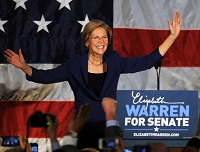
Victorious Elizabeth Warren
Tell Harry Reid not to cave to Wall Street, and to let Elizabeth Warren on the Senate Banking Committee if she wants the position.
Sign the petition.
For years now, Wall Street has held sway over the Senate Banking Committee. The committee is stacked with industry-friendly Republicans and Democrats whose largest donors are big banks. Through this cozy influence, Wall Street has managed to ride out scandal after scandal relatively unscathed.
Which is exactly why Wall Street is terrified of Elizabeth Warren. After spending millions to defeat Senator-elect Warren, Wall Street is opening its purse again in a frantic attempt to block her from the Senate Banking Committee and prevent themselves from being held accountable for their greed. On this decision, Senate Majority Leader Harry Reid has the final say, which is why we need to get him to stand strong. Americans finally have someone in the Senate who will stand up to Wall Street, but first we need to make a stand for her.
Tell Majority Leader Harry Reid: Don’t block Elizabeth Warren from the Senate Banking Committee.
Senator-elect Warren is incredibly qualified for the position. She is a bankruptcy law expert, has served as Congress' lead watchdog overseeing the $700 billion bank bailout from 2008 to 2010, and she conceived of and helped launch the Consumer Financial Protection Bureau (CFPB). In the words of hedge fund manager Shah Gilani, "At exactly the time that big banks don't want more oversight—or another potentially activist regulator—that's what they're getting."
Currently, the Senate Banking Committee is chaired by Senator Tim Johnson, whose two biggest donors have been Citigroup and JP Morgan, and is stacked with a number of Republicans that are in big banks' back pocket. Together, we can let Harry Reid know that we voted for financial oversight, not for more of the same politicians bought out by Wall Street.
Sign our petition to ensure that Wall Street won't block Elizabeth Warren from the Senate Banking Committee.
Thank you,
Claiborne, Kaytee and the rest of us


*******************
Further information:
Forbes: Elizabeth Warren's Big Win Is A Crushing Defeat For Big Banks, 7 November, 2012
Mother Jones: Big Banks v. Elizabeth Warren: It's On (Again!), 19 November, 2012
SumOfUs is a world-wide movement of people like you, working together to hold corporations accountable for their actions and forge a new, sustainable path for our global economy. You can follow us on Twitter, and like us on Facebook.

Was this email forwarded to you? Click here to add yourself to SumOfUs.