
BUCKNACKT'S SORDID TAWDRY BLOG We should not be a journey to the grave with the intention of arriving safely in an attractive & well preserved body, but rather to skid in sideways, chocolate, bier or wein in hand, body thoroughly used up, totally worn out and screaming "WHOO-HOO, WHAT A RIDE!!!!!!"
Showing posts with label jp morgan. Show all posts
Showing posts with label jp morgan. Show all posts
 bank

01 December 2012
Tell Harry Reid; Don't block Elizabeth Warren from the Senate Banking Committee 1DEZ12
NOBODY HAS THE MORAL AUTHORITY TO SERVE ON THE SENATE BANKING COMMITTEE THAT SEN ELECT ELIZABETH WARREN D MA DOES. While the nation is still recovering from the great recession caused by the bank-financial cabal and wall street gop and democratic Senators bought by these groups are moving to exclude Ms Warren from the Senate Banking Committee. The American financial industry is terrified of her because they don't own her and because she knows all their dirty tricks. The SumOfUs has a petition calling on Senate Leader Harry Reid D NV to appoint her to the Senate Banking Committee, click the link to sign it, and pass this on to family and friends for them to sign it too.

For years now, Wall Street has held sway over the Senate Banking Committee.
The committee is stacked with industry-friendly Republicans and
Democrats whose largest donors are big banks. Through this cozy
influence, Wall Street has managed to ride out scandal after scandal
relatively unscathed.
Which is exactly why Wall Street is terrified of Elizabeth Warren. After spending millions to defeat Senator-elect Warren, Wall Street is opening its purse again in a frantic attempt to block her from the Senate Banking Committee and prevent themselves from being held accountable for their greed. On this decision, Senate Majority Leader Harry Reid has the final say, which is why we need to get him to stand strong. Americans finally have someone in the Senate who will stand up to Wall Street, but first we need to make a stand for her.
Tell Majority Leader Harry Reid: Don’t block Elizabeth Warren from the Senate Banking Committee.
Senator-elect Warren is incredibly qualified for the position. She is a bankruptcy law expert, has served as Congress' lead watchdog overseeing the $700 billion bank bailout from 2008 to 2010, and she conceived of and helped launch the Consumer Financial Protection Bureau (CFPB). In the words of hedge fund manager Shah Gilani, "At exactly the time that big banks don't want more oversight—or another potentially activist regulator—that's what they're getting."
Currently, the Senate Banking Committee is chaired by Senator Tim Johnson, whose two biggest donors have been Citigroup and JP Morgan, and is stacked with a number of Republicans that are in big banks' back pocket. Together, we can let Harry Reid know that we voted for financial oversight, not for more of the same politicians bought out by Wall Street.
Sign our petition to ensure that Wall Street won't block Elizabeth Warren from the Senate Banking Committee.
Thank you,
Claiborne, Kaytee and the rest of us
*******************
Further information:
Forbes: Elizabeth Warren's Big Win Is A Crushing Defeat For Big Banks, 7 November, 2012
Mother Jones: Big Banks v. Elizabeth Warren: It's On (Again!), 19 November, 2012


 SumOfUs is a world-wide movement of people like you, working together to
hold corporations accountable for their actions and forge a new,
sustainable path for our global economy. You can follow us on Twitter, and like us on Facebook.
Was this email forwarded to you? Click here to add yourself to SumOfUs.
|
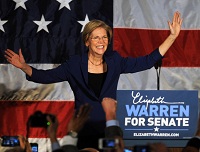

Which is exactly why Wall Street is terrified of Elizabeth Warren. After spending millions to defeat Senator-elect Warren, Wall Street is opening its purse again in a frantic attempt to block her from the Senate Banking Committee and prevent themselves from being held accountable for their greed. On this decision, Senate Majority Leader Harry Reid has the final say, which is why we need to get him to stand strong. Americans finally have someone in the Senate who will stand up to Wall Street, but first we need to make a stand for her.
Tell Majority Leader Harry Reid: Don’t block Elizabeth Warren from the Senate Banking Committee.
Senator-elect Warren is incredibly qualified for the position. She is a bankruptcy law expert, has served as Congress' lead watchdog overseeing the $700 billion bank bailout from 2008 to 2010, and she conceived of and helped launch the Consumer Financial Protection Bureau (CFPB). In the words of hedge fund manager Shah Gilani, "At exactly the time that big banks don't want more oversight—or another potentially activist regulator—that's what they're getting."
Currently, the Senate Banking Committee is chaired by Senator Tim Johnson, whose two biggest donors have been Citigroup and JP Morgan, and is stacked with a number of Republicans that are in big banks' back pocket. Together, we can let Harry Reid know that we voted for financial oversight, not for more of the same politicians bought out by Wall Street.
Sign our petition to ensure that Wall Street won't block Elizabeth Warren from the Senate Banking Committee.
Thank you,
Claiborne, Kaytee and the rest of us
*******************
Further information:
Forbes: Elizabeth Warren's Big Win Is A Crushing Defeat For Big Banks, 7 November, 2012
Mother Jones: Big Banks v. Elizabeth Warren: It's On (Again!), 19 November, 2012
SumOfUs is a world-wide movement of people like you, working together to
hold corporations accountable for their actions and forge a new,
sustainable path for our global economy. You can follow us on Twitter, and like us on Facebook.
Was this email forwarded to you? Click here to add yourself to SumOfUs.
13 July 2012
Stop the J.P. Morgan Loophole 13JUL12
THERE are a few in Congress not afraid to challenge the bank-financial cabal, Sen Merkley D OR is one of them. Hope you will add your name to his petition....
Below is an email from U.S. Senator Jeff Merkley, who is leading the charge for
a ban on high-risk trading by big Wall Street banks, including J.P. Morgan.
Sen. Merkley created a
petition on SignOn.org that's spreading like wildfire. Now, he's asking
for help from MoveOn members in Virginia and across
America.
Bankers on Wall Street wrecked our economy by taking reckless risks
in pursuit of massive paydays. And, as J.P. Morgan has made clear, Wall
Street learned nothing and is still gambling.
If you agree that big banks should not gamble with the federally insured deposits that
families and small businesses depend on, click here to sign my petition:
I successfully fought for a ban on
high-risk trading by big Wall Street banks. This rule, called the
Volcker rule firewall, is meant to ensure that when Wall Street's bad bets
blow up, you and I don't get burned again. But for the last two years, Wall Street's legion of lobbyists have
been trying to blow holes in that firewall.
Wall Street lobbyists want the Fed to
write the J.P. Morgan loophole into law. We can't let that happen. And with your help, we won't. Pleaseadd your name to my SignOn.org petition urging Ben Bernanke and the Fed to close down the J.P. Morgan loophole.
Thanks!
–U.S. Senator Jeff Merkley
This petition was created on SignOn.org, the progressive,
nonprofit petition site that will never sell your email address and will
never promote a petition because someone paid us to. SignOn.org is
sponsored by MoveOn Civic Action, which is not responsible for the
contents of this or other petitions posted on the site.
14 July 2011
America Needs a President Who Will Confront the Financial Industry's Hegemony Over Our Lives 14JUL11
THANK YOU SHEILA BAIR, we are already missing you! You are quite a lady for sure!!!!
No one in a position of authority in our government today seems to understand fully the threat to American institutions and ideals represented by the untrammeled clout the financial industry now holds permeating the halls of government through the power of influence and money. We are barreling toward a destabilizing schism in our society where one interest group, the finance world and its allies, are running the nation to their own economic benefit, oblivious of the pain and loss being endured by their fellow citizens on the Main Streets of our towns and villages and the neighborhoods and tenements of our cities
Our president, whose objectives are certainly sincere, has surrounded himself with men whose formation and ties run deep into the culture of Wall Street -- be it his Chief of Staff William Daley, formerly Midwest Chairman of JPMorgan Chase; Treasury Secretary Timothy Geithner, Former Chair of the New York Fed, or Gary Gensler, Chairman of the Commodity Futures Trading Commission and former Goldman Sachs partner -- while consulting freely with Warren Buffet, that champion of and investor in Goldman Sachs. In many ways very little has changed from the previous administration when the Treasury and virtually all government agencies responsible for financial oversight were in some manner beholden to Wall Street houses and banks, and when the crunch came in September 2008 it was their "club" members who were bailed, while the rest of the country sank into a miasma of recession and unemployment. As Sheila Bair was quoted in the New York Times Magazine saying to Joe Nocera: "You know, Wall Street barely missed a beat with their bonuses. Isn't that ridiculous?"
Nor has their been a serious effort made by prosecutors in the Obama administration and its agencies to hold individuals responsible nor to claw-back the billions of dollars paid out as bonuses for phony profits that were booked by creating and marketing fundamentally flawed financial instruments such as the now notorious C.D.O.'s. The Justice Department opted for a policy known as 'deferred prosecutions'. The guidelines left open a possibility other than guilty or not guilty, giving leniency all too often if companies investigated and reported their own wrongdoing. In return the government would enter agreements to delay or cancel prosecution if companies promised to change their behavior -- in other words, no punishment and little assurance that it wouldn't happen again.
Yet there was one player in government, that progressively rare breed, a moderate republican appointee holdover from the Bush Administration, who fought tooth and nail against the clubhouse fraternity that had taken over the fiscal soul of the nation. She was unflinching in defending the interests of the nation's citizens, becoming an equal opportunity irritant to Democrat and Republican alike. And she knew what she was talking about.
I personally have had the good fortune of hearing her speak at an Aspen Ideas Festival event just over a week ago. She was lucid, forthright, without hyperbole conveying a sense of reasoned indignation felt by too many of us, at the unfairness of the present structure. Where we, as citizens seem unable through our elected officials to stem the influence, the systematic 'heads I win, tails you lose' construct of our financial institutions and their growing impact on the functioning of our society.
Upon her retirement as Chairman of the FDIC (Federal Deposit Insurance Corporation) this July 8th Sheila Bair received this accolade from the Wall Street Journal's Deborah Salomon: "Sheila Bair, who is stepping down as Chairman of the Federal Deposit Insurance Corp. this week, leaves behind an agency transformed from a sleepy bank overseer into a financial regulatory powerhouse focused on preventing another financial crisis." The article goes on to report that at her last FDIC meeting the agency finalized a rule allowing the government to recover compensation from executives responsible for a financial firm's collapse. Only someone with the gumption of Bair could have achieved such a result given the opposition massed against her.
In an in-depth article by Joe Nocera, Nocera writes that Bair began sounding the alarm about the dangers posed by the explosive growth of subprime mortgage rates in June 2006. At the time, "Bair insisted that she and her agency have a seat at the table and fought Henry Paulson and Timothy Geithner, the President of the New York Federal Reserve, as they tried to cobble together solutions that would keep the financial world from going off a cliff: She and the F.D.I.C. managed a number of huge failing institutions during the crisis including Indy Mac, Wachovia, and Washington Mutual."
Of particular significance was Bair's belief in market discipline where, according to Nocera, she found herself at variance with Obama's Treasury Department, meaning she held that shareholders and debt holders should take losses ahead of depositors and taxpayers. "She was tough-minded and straight-forward." And as she would be quoted, "Our job is to protect bank customers, not banks."
She fought for increasing the capital requirements for banks in the face of banks who lobbied strenuously against her. Lower capital requirements allow for more risk, ergo larger bonuses. She fought against the United States' adoption of the bank boondoggle called Basel II which would have lowered bank capital requirements and worse, self selection of risk models thereby significantly exposing the system to even greater bank failures. Nocera would declare "I've long believed her opposition to Basel II has been a hugely underappreciated factor in helping to save the financial system when the crisis came."
And on it went. Geithner, in full Wall Street mode, wanted the F.D.I.C. to guarantee all debt issued by bank-holding companies (such as JPMorgan Chase, Goldman Sachs, Morgan Stanley). Sheila Bair said NO!
To Bair, her fight with the Treasury and the federal Reserve was ultimately about the bondholders. According to Bair "They did not want to impose losses on bondholders and we did...there is no insurance premium on bondholders... For the little guy on Main Street who has bank deposits, we charge the banks a premium for that, and it gets passed along to the customer. We don't have the same thing for bondholders, they're supposed to take losses."
And, most tellingly, she was clear in her displeasure that the government, by acting as if it was no one's fault, placed no responsibility where it should have been placed. For the many of us who have been wondering the same thing, what a breath of fresh air.
She has a stalwart fighter for mortgage modifications that would truly help homeowners. As Nocera explains that "what particularly galls her is that the Treasury under both Paulson and Geithner has been willing to take all sorts of criticism to help the banks. But it has been utterly unwilling to take any political heat to help homeowners."
All the while the Dodd-Frank Bill meant to prevent the too big to fail syndrome from ever rearing its head again, thereby making the largest banks accountable for their actions, is being lobbied into impotence by the financial brotherhood.
Here we have Sheila Bair, Kansas transplant to Washington, taking on the behemoths of the financial world, dogged in her defiance, "We always saw ourselves as the champion of the little guy. The other regulators never saw a bank closure, because that was our role. We were the ones that saw people losing their jobs when we had to shut down a little bank. They never understood the unfairness of the way little banks were treated versus the big banks...I've always thought that it was really important for everybody to have to play by the same set of rules."
Given the financial crisis in which our nation finds itself -- given the access and the power of the financial intuitions' hold, enabling them to play events to come to their own advantage -- would it not be better to have one of our own in the White House who understands the game? Who is on our side, and by virtue of her position and knowledge can stare down all the entreaties for special treatment because she inherently understands that this nation cannot flourish, nor overcome the obstacles that lie ahead and maintain its dignity if we do not all together play by the same set of rules?
Sheila Bair may not know it yet, but we need not only her kind, we need her to become our president. Her persona, her values, her experience would be a rare and welcome gift to the nation!
01 January 2011
Which of These Banks Was 2010's Most Shameless Corporate Outlaw? 30DEZ10
IF you have accounts with any of these banks you might want to consider leaving them, check out local alternatives at
http://moveyourmoney.info/
and you should also check out my earlier post about the unwillingness of the Dept of Justice to bring charges against these bankers for crimes that brought our nations economy to it's knees at ARE WE GOING TO LET THE BIGGEST FINANCIAL FRAUDSTERS KEEP THEIR MONEY AND AVOID JAIL TIME? 30DEZ10
Bankers. The red carpet's still being rolled out for them in Washington, but if there's a stain on it they'll pout for days. Jason Linkins documents the latest set of cheap white whines from very wealthy white men. (Discrimination lawsuits are a routine part of their legal troubles, too.) This time they're upset because nobody from the six largest banks in America was invited to the president's CEO Roundtable.
They're offended because they didn't meet with the president? From the looks of things they're lucky not to be meeting with the warden. Their collective rap sheet includes fraud, sex discrimination, collusion to bribe public officials... even laundering drug money for Mexican drug cartels. One of them is accused of ripping off some nuns! None of this criminal behavior has stopped them from sulking over a presidential slight. Let's review the record for these corporate malefactors, and then decide:
Which of these six banks was "America's Most Shameless Corporate Outlaw" in 2010? (I mean, really: Nuns?)
1. Bank of America
Here are some recent headlines for the country's largest bank:
Associated Press: "Attorneys general in Arizona and Nevada filed civil lawsuits Friday against Bank of America Corp., alleging that the lender is misleading and deceiving homeowners who have tried to modify mortgages in two of the nation's most foreclosure-damaged states."
Courthouse News Service: "Bank of America violated a consent judgment it signed almost 2 years ago to provide loan modifications and help relocate borrowers, the Arizona attorney general claims ... Bank of America has continued to misrepresent 'to Arizona consumers whether they were eligible for modifications of their mortgage loans, when Bank of America would make a decision on their modification requests ... and whether and when Bank of America would foreclose upon their homes.'"
Consumer Affairs: "The bank is also facing at least three suits claiming that it reneged on duties it undertook by accepting $25 billion under the Troubled Asset Relief Program (TARP)."
In total, Bank of America's last annual report lists 29 pending lawsuits against the company. Lawsuits are not proof of guilt, of course. But the bank has already paid a fine for illegally concealing $6 billion in payouts to employees, and another fine for concealing major losses at its Merrill Lynch subsidiary. (Both fines were low - not much more than a slap on the wrist - because Bank of America was on taxpayer-funded life support at the time.) BofA also confessed to committing fraud as part of a settlement this month, which the Justice Department noted was restitution "for its participation in a conspiracy to rig bids in the municipal bond derivatives market." The Bank was also ordered to pay Lehman $590 million for illegally seizing its deposits, in violation of bankruptcy law.
From the Associated Press:
BofA stock was trading at $53 at the end of 2006. As of this writing the stock is trading for $13.30. But its executives have been wasting corporate money and resources buying up 419 web URLs with insulting phrases and the names of their senior executives -- most of whom nobody's ever heard of - to protect their personal reputations. No company's ever done that before. Bob Scully "blows" (bobscullyblows.com) and Bill Boardman "sucks" (billboardmansucks.com)? Who knew?
Last year two senior executives received $9.9 million and two others received $6 million in total compensation. The guy who robbed a Bank of America branch in West Palm Beach is going to prison. The bank's senior executives are hurt that they didn't get invited to the Rose Garden for tea.
Rap Sheet: BofA has probably committed more foreclosure offenses than any other single institution. It deceived stockholders, and the public, about the $6 million in bonuses it paid out (during the rescue process), and was equally deceptive about Merrill Lynch's financial status. It has also been punished for rigging municipal bond derivative bids.
Shameless Quotes: CEO Brian Moynihan's response toward demands that his bank comply with HAMP's legal requirements? "Sure," he sneered," we'll go back and check our homework again." And he says he won't accept anything but "constructive criticism." Which sounds more constructive: "suck" or "blow"?
2. JPMorgan Chase
As we learned recently, JPMorgan Chase CEO Jamie Dimon doesn't feel loved or admired enough. Small wonder. It looks like he's running a pretty sleazy operation :
A whistleblower complaint alleges that the bank "sold to third party debt buyers hundreds of millions of dollars worth of credit card accounts... when in fact Chase Bank executives knew that many of those accounts had incorrect and overstated balances." According to the complaint, "Chase Bank executives routinely destroyed information and communications from consumers rather than incorporate that information into the consumer's credit card file ... and mass-executed thousands of affidavits in support of Chase Banks collection efforts ... (but) did not have personal knowledge of the facts set forth in the affidavits." It also claims that "when senior Chase Bank executives were made aware of these systemic problems, senior Chase Bank executives -- rather than remedy the problems -- immediately fired the whistleblower and attempted to cover up these problems."
There are also multiple lawsuits against Chase for allegedly manipulating the price of silver, and there is at least one report that the bank is being probed by several Federal agencies (including the Justice Department) over its trading activities in precious metals.
JPMorgan Chase "agreed to pay $25 million to settle allegations it sold unregistered securities, many of which defaulted, to the state of Florida," as the Orlando Sentinel reported. That's a crime. Chase was also one of several banks that paid to settle charges that it illegally propped up a failed mortgage lender. (These settlements have typically allowed the banks to "admit no wrongdoing" -- a practice which should be stopped. Crimes are crimes.)
JPMorgan Chase's behavior in Jefferson County, Alabama was pure Huey Long material. The Kingfish would've admired the way the bank spread more than $8 million around the county through local intermediaries so it could secure highly lucrative deals on municipal derivatives. As Bloomberg News put it, " JPMorgan, the second-largest U.S. bank by assets, used fees on the unregulated derivative contracts -- and a trip to a New York spa for one elected official -- to curry political favor, a decade after the SEC adopted rules to drive out pay-to-play from the $2.8 trillion municipal bond market."
The bank conducted this criminal behavior under Dimon's watch. And while it "neither admitted nor denied wrongdoing," as usual, it had to pay a three-quarters-of-a-billion dollar settlement to wrangle its way out of this snakepit of illegality.
Rap Sheet: Corruption in Alabama; widespread violation of foreclosure laws; sale of unregistered securities. Also under investigation for illegal manipulation of the precious metals market; mishandling of Madoff funds; deliberate lawbreaking in credit card processing, concealment of criminality.
Shameless quotes: "Judy Dimon says the crisis took a toll on him. He used to stand up to bullies who threatened his smaller twin; now he felt as if he, and bankers in general, were being bullied." (from a New York Times profile of Dimon)
3. Citigroup
Citi's being sued for gender discrimination by its own employees. Citi settled a class action lawsuit after illegally raising rates for credit card customers. The bank's being sued by an independent trustee for allegedly "aiding and abetting" a Ponzi schemer.
Citi executives were given slap-on-the-wrist fines for lying to investors about $40 billion in subprime exposures, which is a criminal act. It should also be remembered that Citigroup paid $2.65 billion in 2004 to settle class action lawsuits over its alleged illegal actions in propping up WorldCom stocks in return for enormous fees.
As Citi's annual report notes, "Citigroup and Related Parties have been named as defendants in numerous legal actions and other proceedings asserting claims for damages and related relief for losses arising from the global financial credit and subprime-mortgage crisis that began in 2007."
Citi is still being investigated by Italian courts for possible criminal behavior in the Parmalat case, and it's being sued by a Norwegian bank for misrepresenting its financial condition and failing to disclose material information. It's being sued by investors for misrepresenting its underwriting of mortgage backed securities.
Rap Sheet: Violation of SEC law regarding corporate disclosures; illegal rate activity toward credit card customers. Under investigation for aiding and abetting a Ponzi scheme.
Shameless quotes: "Almost all of us... missed the powerful combination of forces at work and the serious possibility of a massive crisis." (Robert Rubin) "On November 3, 2007, I sent an email to Mr. Robert Rubin and three other members of Corporate Management. In this email I outlined the business practices that I had witnessed... I specifically warned about the extreme risks that existed within the Consumer Lending Group." (Former Citi exec Richard Bowen)
4. Wells Fargo
They illegally laundered drug money for the Mexican cartels -- and nobody went to jail.
Here's a suggestion: Read stories like "War Torn Mexico: A Population in Terror," which begins: "Massacres, beheadings, YouTube videos featuring cartel torture sessions and even car bombs are becoming commonplace in Juarez." Study the statistics on the violent murders - which include Federal agents, children, and "penniless immigrants" -- and then remind yourself: These are Wells Fargo's business partners.
Rap Sheet: Mexican drug cartels. It makes the brain reel, doesn't it? There's more, but that's enough.
Shameless quotes:"We're more of a Main Street bank than a Wall Street bank." "Of all the decisions I've had to make, few have been as difficult as cutting the dividend." (Wells Fargo CEO John Stumpf)
5. Goldman Sachs
The SEC charged Goldman with fraud, and they settled the suit by admitting their marketing materials contained lies -- which they called "mistakes." They were fined by Great Britain for illegally concealing US fraud investigations. Goldman has its own gender discrimination lawsuit, too, and theirs comes complete with strippers and racist emails.
Goldman's being sued for deceiving its clients over an offering its own employee privately (and thanks to Sen. Levin, famously) bragged was "a shitty deal." Goldman separately paid $60 million in Massachusetts to settle charges of predatory loan practices.
After mismanagement drove Goldman into impending doom, the firm was saved by TARP funds and Federal Reserve's Emergency Liquidity Programs. Total taxpayer aid to Goldman exceeded three-quarters of a trillion dollars. Goldman also received $13 billion in backdoor payouts through the AIG liquidation (under Tim Geithner's supervision).
Rap Sheet: Fraudulent misrepresentation; predatory loan practices; illegal concealment of an investigation. And God know what else. They're Goldman, man!
Shameless Quotes: ""We're very important... We do God's work." (Goldman CEO Lloyd Blankfein) "If I whet My glittering sword, and Mine hand take hold on judgment; I will render vengeance to Mine enemies." (God)
6. Morgan Stanley
Earlier this year the Wall Street Journal reported that "U.S. prosecutors are investigating whether Morgan Stanley misled investors about mortgage-derivatives deals it helped design and sometimes bet against." The firm's also being sued by US Bank for fraudulently misleading it and other investors over a structured residential investment called "Tourmaline." A group of investors in Singapore is suing the firm for designing CDOs to fail and then selling them as "conservative investments."
The Financial Industry Regulatory Authority fined Morgan Stanley this year for failing to disclose material conflicts of interest to investors. The same agency hit the firm with a $12.5 million fine in 2007 for illegally concealing emails during customer arbitration hearings. In a particularly sleazy move, Morgan Stanley claimed that the emails had been lost on 9/11, when they were all safely stored in backup copies elsewhere.
MS was also sued by the EEOC for gender discrimination.
The firm was able to beat back an investors' lawsuit over bloated executive pay -- it set aside 62% of net revenue for employee compensation -- so its executives get to keep fat bonuses for driving the company into the ground. Greed and stupidity aren't illegal, after all.
On the other hand, their portfolio of lawsuits including one that says they defrauded nuns in Europe.
Rap Sheet: Despite numerous violations and charges, Morgan Stanley is a relatively minor player compared to its bigger colleagues. On the other hand, it illegally concealed evidence from arbitrators by using the World Trade Center attack as an excuse, and six of its own employees died in that attack. That's simply vile. On top of that, they're being sued by nuns.
Shameless Quotes: "When we think back on 2001, we are filled with deep sorrow and outrage over the events of September 11. Who among us will ever forget the shock and horror of that day?" (Morgan Stanley Annual Report, 2001) "When you come that close to really going out of business, call it near death, death experience, the end of the line, whatever you want to call it, your only focus is to make sure your company survives." (former CEO John Mack)
The American people rescued these six banks. (Dimon says his bank didn't need rescuing, but how would it have fared in a collapsed economy? And the government's willingness to go easy in its illegalities was pretty helpful, too.) They've all violated the law, and they're all suspected of even more possible illegalities. And yet they're all pouting because they weren't invited to the White House along with the other CEOs.
Which is our most shameless corporate lawbreaker? In any normal period of history they'd all be considered corrupt institutions, and their leaders would be ashamed to show their faces among respectable people. But these aren't normal times, are they?
Frankly I'm stumped. They all deserve the title as far as I'm concerned. Why don't we put it to a vote?
__________________________________
Richard (RJ) Eskow, a consultant and writer (and former insurance/finance executive), is a Senior Fellow with the Campaign for America's Future. This post was produced as part of the Curbing Wall Street project. Richard also blogs at A Night Light.
He can be reached at "rjeskow@ourfuture.org."
Website: Eskow and Associates
http://moveyourmoney.info/
and you should also check out my earlier post about the unwillingness of the Dept of Justice to bring charges against these bankers for crimes that brought our nations economy to it's knees at ARE WE GOING TO LET THE BIGGEST FINANCIAL FRAUDSTERS KEEP THEIR MONEY AND AVOID JAIL TIME? 30DEZ10
Bankers. The red carpet's still being rolled out for them in Washington, but if there's a stain on it they'll pout for days. Jason Linkins documents the latest set of cheap white whines from very wealthy white men. (Discrimination lawsuits are a routine part of their legal troubles, too.) This time they're upset because nobody from the six largest banks in America was invited to the president's CEO Roundtable.
They're offended because they didn't meet with the president? From the looks of things they're lucky not to be meeting with the warden. Their collective rap sheet includes fraud, sex discrimination, collusion to bribe public officials... even laundering drug money for Mexican drug cartels. One of them is accused of ripping off some nuns! None of this criminal behavior has stopped them from sulking over a presidential slight. Let's review the record for these corporate malefactors, and then decide:
Which of these six banks was "America's Most Shameless Corporate Outlaw" in 2010? (I mean, really: Nuns?)
1. Bank of America
Here are some recent headlines for the country's largest bank:
- "Bank of America Ends Year With Flurry of Lawsuits"
- "Arizona Wants Bank of America Held in Contempt"
- "Nevada, Arizona sue Bank of America over failed mortgage aid"
- "Allstate Sues Bank Of America For Selling 'Toxic' MBS"
- "Bank of America Hit With Missouri Class Action Over Loan Modifications"
Associated Press: "Attorneys general in Arizona and Nevada filed civil lawsuits Friday against Bank of America Corp., alleging that the lender is misleading and deceiving homeowners who have tried to modify mortgages in two of the nation's most foreclosure-damaged states."
Courthouse News Service: "Bank of America violated a consent judgment it signed almost 2 years ago to provide loan modifications and help relocate borrowers, the Arizona attorney general claims ... Bank of America has continued to misrepresent 'to Arizona consumers whether they were eligible for modifications of their mortgage loans, when Bank of America would make a decision on their modification requests ... and whether and when Bank of America would foreclose upon their homes.'"
Consumer Affairs: "The bank is also facing at least three suits claiming that it reneged on duties it undertook by accepting $25 billion under the Troubled Asset Relief Program (TARP)."
In total, Bank of America's last annual report lists 29 pending lawsuits against the company. Lawsuits are not proof of guilt, of course. But the bank has already paid a fine for illegally concealing $6 billion in payouts to employees, and another fine for concealing major losses at its Merrill Lynch subsidiary. (Both fines were low - not much more than a slap on the wrist - because Bank of America was on taxpayer-funded life support at the time.) BofA also confessed to committing fraud as part of a settlement this month, which the Justice Department noted was restitution "for its participation in a conspiracy to rig bids in the municipal bond derivatives market." The Bank was also ordered to pay Lehman $590 million for illegally seizing its deposits, in violation of bankruptcy law.
From the Associated Press:
A document obtained last week by the Associated Press showed a Bank of America official acknowledging in a legal proceeding that she signed thousands of foreclosure documents a month and typically didn't read them. The official, Renee Hertzler, said in a February deposition that she signed 7,000 to 8,000 foreclosure documents a month.How generous has the taxpayer been to Bank of America? There was the TARP money, of course. And BofA, like other banks, has been suckling at the teat of Federal Reserve's discount money window throughout the crisis. And, as Zach Carter noted, the bank was also one of two institutions that were the main beneficiaries of a special Fed program called the Primary Reserve Credit Facility. There were those cushy settlements with the SEC.
BofA stock was trading at $53 at the end of 2006. As of this writing the stock is trading for $13.30. But its executives have been wasting corporate money and resources buying up 419 web URLs with insulting phrases and the names of their senior executives -- most of whom nobody's ever heard of - to protect their personal reputations. No company's ever done that before. Bob Scully "blows" (bobscullyblows.com) and Bill Boardman "sucks" (billboardmansucks.com)? Who knew?
Last year two senior executives received $9.9 million and two others received $6 million in total compensation. The guy who robbed a Bank of America branch in West Palm Beach is going to prison. The bank's senior executives are hurt that they didn't get invited to the Rose Garden for tea.
Rap Sheet: BofA has probably committed more foreclosure offenses than any other single institution. It deceived stockholders, and the public, about the $6 million in bonuses it paid out (during the rescue process), and was equally deceptive about Merrill Lynch's financial status. It has also been punished for rigging municipal bond derivative bids.
Shameless Quotes: CEO Brian Moynihan's response toward demands that his bank comply with HAMP's legal requirements? "Sure," he sneered," we'll go back and check our homework again." And he says he won't accept anything but "constructive criticism." Which sounds more constructive: "suck" or "blow"?
2. JPMorgan Chase
As we learned recently, JPMorgan Chase CEO Jamie Dimon doesn't feel loved or admired enough. Small wonder. It looks like he's running a pretty sleazy operation :
"At JPMorgan Chase & Company, they were derided as 'Burger King kids' -- walk-in hires who were so inexperienced they barely knew what a mortgage was... revelations that mortgage servicers failed to accurately document the seizure and sale of tens of thousands of homes have caused a public uproar ..."Failure to accurately document home foreclosures is illegal. It's lousy management, too. Dimon oversaw a sloppy operation that's going to cost his shareholders a lot of money: "JPMorgan set aside $2.3 billion of reserves to cover mortgage repurchases or litigation expenses, including some for 'mortgage-related matters,' the lender said."
A whistleblower complaint alleges that the bank "sold to third party debt buyers hundreds of millions of dollars worth of credit card accounts... when in fact Chase Bank executives knew that many of those accounts had incorrect and overstated balances." According to the complaint, "Chase Bank executives routinely destroyed information and communications from consumers rather than incorporate that information into the consumer's credit card file ... and mass-executed thousands of affidavits in support of Chase Banks collection efforts ... (but) did not have personal knowledge of the facts set forth in the affidavits." It also claims that "when senior Chase Bank executives were made aware of these systemic problems, senior Chase Bank executives -- rather than remedy the problems -- immediately fired the whistleblower and attempted to cover up these problems."
There are also multiple lawsuits against Chase for allegedly manipulating the price of silver, and there is at least one report that the bank is being probed by several Federal agencies (including the Justice Department) over its trading activities in precious metals.
JPMorgan Chase "agreed to pay $25 million to settle allegations it sold unregistered securities, many of which defaulted, to the state of Florida," as the Orlando Sentinel reported. That's a crime. Chase was also one of several banks that paid to settle charges that it illegally propped up a failed mortgage lender. (These settlements have typically allowed the banks to "admit no wrongdoing" -- a practice which should be stopped. Crimes are crimes.)
JPMorgan Chase's behavior in Jefferson County, Alabama was pure Huey Long material. The Kingfish would've admired the way the bank spread more than $8 million around the county through local intermediaries so it could secure highly lucrative deals on municipal derivatives. As Bloomberg News put it, " JPMorgan, the second-largest U.S. bank by assets, used fees on the unregulated derivative contracts -- and a trip to a New York spa for one elected official -- to curry political favor, a decade after the SEC adopted rules to drive out pay-to-play from the $2.8 trillion municipal bond market."
The bank conducted this criminal behavior under Dimon's watch. And while it "neither admitted nor denied wrongdoing," as usual, it had to pay a three-quarters-of-a-billion dollar settlement to wrangle its way out of this snakepit of illegality.
Rap Sheet: Corruption in Alabama; widespread violation of foreclosure laws; sale of unregistered securities. Also under investigation for illegal manipulation of the precious metals market; mishandling of Madoff funds; deliberate lawbreaking in credit card processing, concealment of criminality.
Shameless quotes: "Judy Dimon says the crisis took a toll on him. He used to stand up to bullies who threatened his smaller twin; now he felt as if he, and bankers in general, were being bullied." (from a New York Times profile of Dimon)
3. Citigroup
Citi's being sued for gender discrimination by its own employees. Citi settled a class action lawsuit after illegally raising rates for credit card customers. The bank's being sued by an independent trustee for allegedly "aiding and abetting" a Ponzi schemer.
Citi executives were given slap-on-the-wrist fines for lying to investors about $40 billion in subprime exposures, which is a criminal act. It should also be remembered that Citigroup paid $2.65 billion in 2004 to settle class action lawsuits over its alleged illegal actions in propping up WorldCom stocks in return for enormous fees.
As Citi's annual report notes, "Citigroup and Related Parties have been named as defendants in numerous legal actions and other proceedings asserting claims for damages and related relief for losses arising from the global financial credit and subprime-mortgage crisis that began in 2007."
Citi is still being investigated by Italian courts for possible criminal behavior in the Parmalat case, and it's being sued by a Norwegian bank for misrepresenting its financial condition and failing to disclose material information. It's being sued by investors for misrepresenting its underwriting of mortgage backed securities.
Rap Sheet: Violation of SEC law regarding corporate disclosures; illegal rate activity toward credit card customers. Under investigation for aiding and abetting a Ponzi scheme.
Shameless quotes: "Almost all of us... missed the powerful combination of forces at work and the serious possibility of a massive crisis." (Robert Rubin) "On November 3, 2007, I sent an email to Mr. Robert Rubin and three other members of Corporate Management. In this email I outlined the business practices that I had witnessed... I specifically warned about the extreme risks that existed within the Consumer Lending Group." (Former Citi exec Richard Bowen)
4. Wells Fargo
They illegally laundered drug money for the Mexican cartels -- and nobody went to jail.
Here's a suggestion: Read stories like "War Torn Mexico: A Population in Terror," which begins: "Massacres, beheadings, YouTube videos featuring cartel torture sessions and even car bombs are becoming commonplace in Juarez." Study the statistics on the violent murders - which include Federal agents, children, and "penniless immigrants" -- and then remind yourself: These are Wells Fargo's business partners.
Rap Sheet: Mexican drug cartels. It makes the brain reel, doesn't it? There's more, but that's enough.
Shameless quotes:"We're more of a Main Street bank than a Wall Street bank." "Of all the decisions I've had to make, few have been as difficult as cutting the dividend." (Wells Fargo CEO John Stumpf)
5. Goldman Sachs
The SEC charged Goldman with fraud, and they settled the suit by admitting their marketing materials contained lies -- which they called "mistakes." They were fined by Great Britain for illegally concealing US fraud investigations. Goldman has its own gender discrimination lawsuit, too, and theirs comes complete with strippers and racist emails.
Goldman's being sued for deceiving its clients over an offering its own employee privately (and thanks to Sen. Levin, famously) bragged was "a shitty deal." Goldman separately paid $60 million in Massachusetts to settle charges of predatory loan practices.
After mismanagement drove Goldman into impending doom, the firm was saved by TARP funds and Federal Reserve's Emergency Liquidity Programs. Total taxpayer aid to Goldman exceeded three-quarters of a trillion dollars. Goldman also received $13 billion in backdoor payouts through the AIG liquidation (under Tim Geithner's supervision).
Rap Sheet: Fraudulent misrepresentation; predatory loan practices; illegal concealment of an investigation. And God know what else. They're Goldman, man!
Shameless Quotes: ""We're very important... We do God's work." (Goldman CEO Lloyd Blankfein) "If I whet My glittering sword, and Mine hand take hold on judgment; I will render vengeance to Mine enemies." (God)
6. Morgan Stanley
Earlier this year the Wall Street Journal reported that "U.S. prosecutors are investigating whether Morgan Stanley misled investors about mortgage-derivatives deals it helped design and sometimes bet against." The firm's also being sued by US Bank for fraudulently misleading it and other investors over a structured residential investment called "Tourmaline." A group of investors in Singapore is suing the firm for designing CDOs to fail and then selling them as "conservative investments."
The Financial Industry Regulatory Authority fined Morgan Stanley this year for failing to disclose material conflicts of interest to investors. The same agency hit the firm with a $12.5 million fine in 2007 for illegally concealing emails during customer arbitration hearings. In a particularly sleazy move, Morgan Stanley claimed that the emails had been lost on 9/11, when they were all safely stored in backup copies elsewhere.
MS was also sued by the EEOC for gender discrimination.
The firm was able to beat back an investors' lawsuit over bloated executive pay -- it set aside 62% of net revenue for employee compensation -- so its executives get to keep fat bonuses for driving the company into the ground. Greed and stupidity aren't illegal, after all.
On the other hand, their portfolio of lawsuits including one that says they defrauded nuns in Europe.
Rap Sheet: Despite numerous violations and charges, Morgan Stanley is a relatively minor player compared to its bigger colleagues. On the other hand, it illegally concealed evidence from arbitrators by using the World Trade Center attack as an excuse, and six of its own employees died in that attack. That's simply vile. On top of that, they're being sued by nuns.
Shameless Quotes: "When we think back on 2001, we are filled with deep sorrow and outrage over the events of September 11. Who among us will ever forget the shock and horror of that day?" (Morgan Stanley Annual Report, 2001) "When you come that close to really going out of business, call it near death, death experience, the end of the line, whatever you want to call it, your only focus is to make sure your company survives." (former CEO John Mack)
The American people rescued these six banks. (Dimon says his bank didn't need rescuing, but how would it have fared in a collapsed economy? And the government's willingness to go easy in its illegalities was pretty helpful, too.) They've all violated the law, and they're all suspected of even more possible illegalities. And yet they're all pouting because they weren't invited to the White House along with the other CEOs.
Which is our most shameless corporate lawbreaker? In any normal period of history they'd all be considered corrupt institutions, and their leaders would be ashamed to show their faces among respectable people. But these aren't normal times, are they?
Frankly I'm stumped. They all deserve the title as far as I'm concerned. Why don't we put it to a vote?
__________________________________
Richard (RJ) Eskow, a consultant and writer (and former insurance/finance executive), is a Senior Fellow with the Campaign for America's Future. This post was produced as part of the Curbing Wall Street project. Richard also blogs at A Night Light.
He can be reached at "rjeskow@ourfuture.org."
Website: Eskow and Associates
11 November 2010
Could Wall Street's Favorite Dem Head Obama's Consumer Bureau? from MOJO 8NOV10
HERE'S hoping this is just one of those ugly Capital Hill rumors.....but if it isn't then Pres. Obama has decided to create what will be an ugly fight with the progressive community, one we will be determined to win.


Not only is rumored CFPB candidate Melissa Bean as industry-friendly as they come, but her ex-chief of staff has lobbied for finance reform's biggest enemies.
Will President Barack Obama appoint Wall Street-friendly Rep. Melissa Bean (D-Ill.) to head the new Consumer Financial Protection Bureau? If so, that would be bad news for reformers, who are appalled by the prospect—but good news for John Michael Gonzalez, a leading lobbyist for Big Finance. Before becoming one of Washington's top influence peddlers on behalf of financial firms and trade groups, he was Bean's chief of staff.
According to Politico, Bean, a congresswoman representing northern Illinois who trails in the vote-counting in her close reelection race against Republican Joe Walsh, is under consideration by the White House for this new position, heading up the agency that consumer finance advocate Elizabeth Warren is now constructing.
Bean's campaign would neither confirm or deny whether she's under consideration for the CFBP job. "This race remains too close to call, and we are staying focused as this election process continues," says Bean spokeswoman Gabby Adler.
Bean, a member of the House financial services and small business committees, has a long history as a favorite of Wall Street. Her top donors hail from the finance, insurance, and real estate industries, which together have poured $2.5 million into her campaign coffers over her five-year career, according to the Center for Responsive Politics. In the 2008 elections, Bean bagged more money from the Chamber of Commerce, which vehemently opposed the Dodd-Frank bill, than any other House incumbent. And among the top contributors to her 2010 reelection campaign were JPMorgan Chase, Goldman Sachs, and Allstate Insurance, all of which sought to weaken aspects of the Dodd-Frank financial reform bill that established the Consumer Financial Protection Bureau.
"The White House needs to beat back the Bean idea, otherwise they'll look like fools," says one Democratic strategist. "This is the craziest thing I've ever seen. She's a tool of the financial industries."
Bean ultimately voted for the Dodd-Frank financial reform bill, but she tried to water down a crucial piece of the bill involving consumer protection laws. The bill initially gave state financial regulators the power to write tougher consumer protection statutes than those at the federal level. Bean, though, offered a provision backed by big banks and the Chamber of Commerce that would've exempted national banks from those tougher state laws, in effect neutering the states' new oversight powers. Bean was also one of six Democrats to oppose taxing bonuses at government-owned AIG, and she opposed auditing the Federal Reserve. "We're very connected to the business community and very much appreciate the importance of their success to our overall economic recovery," Bean said in March 2009. "We are trying to champion their issues and concerns."
And there's one more matter to anger reform advocates and liberal bloggers: her close connection to Gonzalez. From 2005 until last year, he was Bean's chief of staff. He flew through the revolving door and is now a lobbyist at Peck, Madigan, Jones, and Stewart, a major Washington lobbying firm. There, he's lobbied for such heavyweights as the Business Roundtable, a financial services trade association; Deutsche Bank; Mastercard; the International Swaps and Derivatives Association; and the Chamber of Commerce. For the Chamber, Gonzalez's firm worked to exempt national banks from tougher state consumer protection laws—the same issue Bean championed. Reform advocates would certainly not fancy Gonzalez helping Bean run the CFPB—or having the ear of its first chief.
According to federal lobbying records, Gonzalez has been registered to lobby House and Senate lawmakers on most major financial reform efforts of the past year that have been opposed by Big Finance: increasing regulation of the $600 trillion over-the-counter derivatives market; beefing up shareholder control of executive compensation; creating the new consumer protection agency; and preventing banks from becoming too big to fail. The companies and associations he's represented are hardly pro-reform types. All of Gonzalez's financial clients sought to water down, if not outright defeat, the Dodd-Frank financial reform bill and other consumer-friendly legislation.
Gonzalez's bio at the website for Peck, Madigan, Jones, and Stewart depicts him as a keen Democratic operative. In 2006, it notes, he "successfully planned and executed a winning reelection strategy, raising $4.3 million and earning the most support for any incumbent from the US Chamber of Commerce." This led the House leadership to tap him to work on its incumbent protection program. In 2007, he helped Bean coordinate a superdelegate operation in the House for the Obama campaign. National Journal cited him as a favorite of Rahm Emanuel, and he helped pass the TARP bailout in late 2008.
According to ProPublica, Gonzalez was the moderate Democrats' go-to guy when the financial sector was collapsing in 2008:
Three days after Lehman Brothers collapsed in September 2008, the New Democrats [coalition in the House] unveiled a financial-reform working group co-chaired by Melissa Bean. The group was piloted by John Michael Gonzalez, Bean's chief of staff, who left four months later to lobby for several banks and financial-services trade groups.Recently, Gonzalez—referring to lobbyists who work on campaign staffs—told Roll Call: "Nobody wants the Brooks Brothers Brigade out there campaigning for you." The question for the Obama White House is whether they want to put in charge of consumer financial protection a politician who has accepted large amounts of money from this brigade—and whose former chief of staff lobbies on the brigade's behalf.
12 August 2010
Elizabeth Warren Uncovered What the Govt. Did to 'Rescue' AIG, and It Ain't Pretty 9AUG10
THIS is why Elizabeth Warren MUST be appointed and approved as head of the Consumer Financial Protection Bureau, she is the only one who can be trusted to monitor and regulate wall street and the financial industry.
The government’s $182 billion bailout of insurance giant AIG should be seen as the Rosetta Stone for understanding the financial crisis and its costly aftermath.

Elizabeth Warren, chairs a Congressional Oversight Panel hearing on Capitol Hill, on May 26, 2010 in Washington, DC. Warren, an attorney and Harvard law professor, was named in November 2008 as chair of the Congressional Oversight Panel, a body of lawmakers set up to investigate the crisis and the government's bailout of the financial and auto industries.
Photo Credit: AFP/Getty Images/File - Mark Wilson The government’s $182 billion bailout of insurance giant AIG should be seen as the Rosetta Stone for understanding the financial crisis and its costly aftermath. The story of American International Group explains the larger catastrophe not because this was the biggest corporate bailout in history but because AIG’s collapse and subsequent rescue involved nearly all the critical elements, including delusion and deception. These financial dealings are monstrously complicated, but this account focuses on something mere mortals can understand—moral confusion in high places, and the failure of governing institutions to fulfill their obligations to the public.
Three governmental investigative bodies have now pored through the AIG wreckage and turned up disturbing facts—the House Committee on Oversight and Reform; the Financial Crisis Inquiry Commission, which will make its report at year’s end; and the Congressional Oversight Panel (COP), which issued its report on AIG in June.
The five-member COP, chaired by Harvard professor Elizabeth Warren, has produced the most devastating and comprehensive account so far. Unanimously adopted by its bipartisan members, it provides alarming insights that should be fodder for the larger debate many citizens long to hear—why Washington rushed to forgive the very interests that produced this mess, while innocent others were made to suffer the consequences. The Congressional panel’s critique helps explain why bankers and their Washington allies do not want Elizabeth Warren to chair the new Consumer Financial Protection Bureau.
The report concludes that the Federal Reserve Board’s intimate relations with the leading powers of Wall Street—the same banks that benefited most from the government’s massive bailout—influenced its strategic decisions on AIG. The panel accuses the Fed and the Treasury Department of brushing aside alternative approaches that would have saved tens of billions in public funds by making these same banks “share the pain.”
Bailing out AIG effectively meant rescuing Goldman Sachs, Morgan Stanley, Bank of America and Merrill Lynch (as well as a dozens of European banks) from huge losses. Those financial institutions played the derivatives game with AIG, the esoteric practice of placing financial bets on future events. AIG lost its bets, which led to its collapse. But other gamblers—the counterparties in AIG’s derivative deals—were made whole on their bets, paid off 100 cents on the dollar. Taxpayers got stuck with the bill.
“The AIG rescue demonstrated that Treasury and the Federal Reserve would commit taxpayers to pay any price and bear any burden to prevent the collapse of America’s largest financial institutions,” the COP report said. This could have been avoided, the report argues, if the Fed had listened to disinterested advisers with a less parochial understanding of the public interest.
Fed and Treasury officials dismiss this critique as second-guessing of tough decisions they had to make in the fall of 2008, amid the fast-moving global crisis. Yet two years later, those controversial decisions remain highly relevant. Public anger has not abated. It fuels the election turmoil that this year threatens to bring down incumbents in both parties who voted for bank bailouts.
Although the AIG bailout was carried out in the waning days of George W. Bush’s presidency, the popular sense of injustice has deeply scarred Barack Obama, since he too adopted a forgiving approach toward culpable financial interests. Obama came to office intent on restoring public trust in government. His indulgence of the mega-banks led to the opposite result.
More to the point, the AIG story raises real doubts and suspicions about how the government will respond next time. Or whether the new financial reform legislation actually corrects government’s deference to the pinnacles of private financial power. Massive federal intervention was certainly necessary, the Warren panel agrees, including quick action to forestall AIG’s bankruptcy. But government declined to demand anything in return.
The AIG rescue was done in ways that had “poisonous effects” on the financial marketplace and public opinion, the report concluded. Cynical expectations were confirmed, both for citizens and financial players. Some financial firms are simply “too big to fail,” it seems; Washington will not let them collapse, no matter what the president claims.
The most troubling revelation in this story is the astonishing weakness of the Federal Reserve and its incompetence as a faithful defender of the public interest. In the lore of central banking, the Fed is awesomely powerful and intimidating. As regulator of the banking system, it has life-and-death influence over banks. As manager of the economy, it has open-ended authority to intervene in the financial system to restore stability, as the central bank did massively during the crisis.
Yet the Fed was strangely passive and compliant when it came to demanding cooperation and sacrifice from the largest financial institutions. Timothy Geithner was then president of the New York Federal Reserve Bank, the lead regulator of Wall Street’s largest banks. He briefly insisted they must accept the burden of rescuing AIG. But the bankers called his bluff and blew him off—and Geithner deferred to their wishes. The taxpayer bailout followed. The episode is relevant to the future, because Geithner is now Obama’s Treasury Secretary and in charge of preventing the next taxpayer bailout.
In the early autumn of 2008, mayhem swept through global financial markets. It engulfed AIG on Monday morning, September 15. Lehman Brothers had just failed. Panicky credit markets were seizing up. American International Group, largest insurance company in the world, was hemorrhaging capital, rapidly sinking toward bankruptcy. At the New York Fed, Geithner had the problem covered, or so he thought.
Geithner informed top executives of Wall Street’s most important financial houses—Jamie Dimon of JPMorgan Chase and Lloyd Blankfein of Goldman Sachs—that the banking industry, not the Federal Reserve, must step up and do the rescue. Geithner told them it was “inconceivable that the Federal Reserve could or should play any role in preventing AIG’s collapse.”
That Monday morning, Geithner summoned representatives from Goldman and the JPMorgan bank to Fed offices and told them to organize a private-sector consortium of major lenders to provide the emergency liquidity loans that would keep AIG afloat until things settled down. It was presumed JPMorgan would be the lead lender; Goldman, as an investment bank, could help AIG sell off assets to raise capital. Given the Fed’s blessing, other banks were expected to cooperate.
The New York Fed president did not need to threaten anyone. This was the gentlemanly way in which the central bank can invoke its informal authority, with numerous precedents in the past. Prodded by the Fed and Treasury, major banks had done something similar back in 1998 to save the hedge fund Long Term Capital Management, whose collapse threatened a chain reaction on Wall Street. During the Latin American debt crisis of the 1980s, the Fed had used its overbearing influence to make leading US banks grant concessions and write down outstanding loans—a grudging “workout” that saved Mexico, Brazil and Argentina from default but also saved some famous New York banks from imploding.
This time, the entire system was at risk, so virtually everyone was vulnerable. Geithner expected the biggest banks to package a substantial bridge loan that would give AIG the time to sell assets and raise capital, an orderly resolution. After all, AIG was an insurance corporation, not a bank. The Fed had no direct regulatory authority over it. Geithner had gotten an early glimpse of AIG’s troubles in the summer, when its CEO approached him and asked for access to the Fed’s discount window, the place banks go for short-term liquidity loans. Geithner turned him down, but learned how deeply Wall Street and Europe’s leading banks were entwined in AIG’s troubles.
The problem was derivatives. During the housing bubble, AIG had reaped a fortune selling derivative contracts based on mortgage-backed securities—hedging devices that made investors feel safe holding these assets. When the bubble burst and housing securities plummeted in value, AIG’s derivatives became its instrument of self-destruction. The counterparties, as per their contract, demanded immediate payment to cover their losses—more and more capital, as housing prices continued to fall. Goldman Sachs, almost alone among big banks, had bet right on the housing bubble. Now it was aggressively collecting on its bet.
The bankers’ committee assembled at the Fed worked all day and into the night, joined by AIG, the New York State insurance regulators, with investment bank Morgan Stanley acting as Treasury’s new adviser. The group drafted a “term sheet” that toted up AIG’s exposure. It would need as much as $75 billion, they estimated.
In Washington, Treasury Secretary Henry Paulson kept his distance, while fighting other bonfires. Paulson assured reporters the meeting under way at the New York Fed had nothing to do with a government bailout for AIG. “What’s going on in New York is a private-sector effort,” Paulson said.
Sometime after midnight, the bankers called to say, sorry, they were not interested. There would be no private-sector rescue. According to Thomas Baxter, general counsel at the New York Fed, notification came on Tuesday morning, not from the principal executives of Goldman and JPMorgan but from a bankruptcy lawyer, Marshall Huebner, advising JPMorgan on AIG’s problems. The New York Fed immediately hired him as its own lawyer and proceeded to do what the bankers had refused to do—bail out AIG.
JPMorgan and Goldman offered no public explanation for rejecting Geithner’s proposal. The public wasn’t ever told the banks were asked to do their part. Nor did Federal Reserve officials argue with the decision or try to apply persuasive pressures. It did not put the squeeze on to convince the bankers they must accept some kind of sacrifice in the interest of sharing the pain. Nor did Geithner threaten to pursue an alternative strategy that could have forced the banks to negotiate the terms. This was considered out of the question, though the central bank has employed all these tools on past occasions.
In a subsequent hearing, Damon Silvers, the AFL-CIO policy director who is a member of Warren’s oversight panel, asked Baxter, “When you’re pulling together the private sector to solve a problem that they’ve created of the type that AIG represented, is it typical to accept no for an answer?” Baxter fudged. “Well, I started out by saying there was nothing typical about the crisis,” he replied. He talked in circles and never answered the question.
If the bankers refused to participate, the Fed had to move fast to stanch the bleeding. AIG faced another downgrade from credit rating agencies (the same agencies that had given triple-A blessings to mortgage securities). The Fed adopted the bankers’ “term sheet” as its operating guide and swiftly created a revolving credit fund of $85 billion.
Late on Tuesday, the central bank lent $12 billion to AIG. The next day, it lent another $12 billion. This was only the beginning. The AIG operation became a gigantic spigot for circuitously distributing public money to private banking interests. As the New York Fed pumped more money into AIG, the insurance giant pumped it right out the door to satisfy the demands from counterparties like Goldman Sachs. Having helped scuttle the private rescue, Goldman collected $13 billion from this backdoor public assistance. The Fed did not stop AIG’s hemorrhage. It began financing it, with no questions asked.
The Fed has always insisted this financial daisy chain was not designed to pump more capital into the leading banks. “This was not about the banks,” a senior vice president of the New York Fed told the New York Times. If not, then why did the Federal Reserve work so hard to keep their names secret? Fed lawyers labored for months to prevent disclosure of the beneficiaries. Ranking Federal Reserve governors coldly rejected as “inappropriate” the repeated Congressional demands to know the names. If it wasn’t about helping those banks, why did the Fed not pause to reconsider its initial decision and develop a less costly approach? It became instead the paymaster for AIG’s failed derivative contracts—conducting business as usual in the midst of national emergency.
This process continued for nearly two months and swelled to horrendous proportions before the Federal Reserve finally figured out a way to turn off the spigot. In November, it arranged a complex swap, known as “Maiden Lane,” in which the government paid off counterparties, acquired the remaining derivative contracts and extinguished them. The bankers again collected roughly full value on assets that were then selling in financial markets for less than 50 cents on the dollar.
The Fed claimed victory for the public, but in reality the game was already lost, despite the generous public financing. AIG was facing another downgrade, and everyone understood this one would probably be fatal—triggering the bankruptcy the Fed had tried to avoid. After the bankers had gotten the money, they graciously agreed to settle.
Back in September, when the Federal Reserve hired JPMorgan’s lawyer as its own, there was no public outcry because the public didn’t know about it. Marshall Huebner of the law firm Davis Polk & Wardwell was an expert in corporate bankruptcy and would help the Fed get up to speed quickly. The arrangement was not illegal and not unethical, given the precious distinctions the legal profession makes on ethics. JPMorgan gave its lawyer consent to switch sides, though Huebner’s firm continued to represent the Morgan bank (Davis Polk graciously gave the Fed a 10 percent discount of Huebner’s $1,000-an-hour billing rate). The Federal Reserve limited his advice to AIG matters. Huebner later also became Treasury’s lawyer when it added TARP funds to AIG, though the Fed and Treasury do not have identical interests.
What was troublesome about swapping lawyers? There was a “third client” in this matter—the American public—who faced huge exposure to losses but didn’t have its own lawyer in the room. The central bank, with its high sense of rectitude, would insist it represents the public interest. The Congressional Oversight Panel did not buy that.
The government, the Warren report said, “put the efforts to organize a private AIG rescue in the hands of only two banks, JPMorgan Chase and Goldman Sachs, institutions that had severe conflicts of interest as they would have been among the largest beneficiaries of taxpayer rescue.”
Once the immediate panic subsided, the Fed did not seek out alternative opinions and proposals on what to do next, either from independent debtor counsel or even from AIG’s bankruptcy lawyer. “By failing to bring in other players, the government neglected to use all of its negotiating leverage,” the report observed.
In fact, the Congressional Oversight Panel found an incestuous stew of private financial players in the AIG case, who switched their allegiance between public and private roles numerous times. Severely conflicted loyalties are commonplace on Wall Street. The Fed saw nothing wrong with it.
Goldman Sachs always claimed it was fully hedged against loss, even if AIG went bankrupt, but the oversight panel discovered a crucial gap in its protection. Goldman would have been more vulnerable if the Fed had succeeded in arranging a “voluntary” workout by the private banks. Such a deal could have compelled Goldman and other counterparties to make concessions—accept a “haircut,” as Wall Street financiers put it. Goldman helped dump that possibility.
Morgan Stanley, another investment bank that had its own near-death experience in the fall of 2008, got a similar though much smaller benefit while also acting as adviser to the Treasury Department. The Federal Reserve provided both Goldman and Morgan Stanley with shelter from the storm by designating each as a “bank holding company,” even though neither owned many retail banks. The status gave them access to emergency loans at the Fed’s discount window—just in case.
JPMorgan Chase was vulnerable in a different way. It was not a counterparty holding AIG derivatives, but the Morgan bank was itself the banking industry’s largest issuer of derivatives. It held $9.2 trillion in credit derivatives—four times its capital reserves—and many trillions more in other forms of derivatives. By its actions, the Fed greatly reduced the risks for the Morgan bank.
“The rescue of AIG distorted the marketplace by transforming highly risky derivative bets into fully guaranteed payment obligations,” the COP explained. “The result was that the government backed up the entire derivatives market, as if these trades deserved the same taxpayer backstop as savings deposits and checking accounts.”
Bankers will be bankers. But what about the Federal Reserve? The oversight panel expressed sympathy for the circumstances Fed officials faced, but drew a harsh conclusion: “By adopting the term sheet developed by the private sector consortium and retaining most of its terms and conditions, the Federal Reserve Bank of New York chose to act, in effect, as if it were a private investor in many ways, when its actions also had serious public consequences whose full extent it may not have appreciated.”
That summarizes the moral confusion of the Federal Reserve. In a state of national emergency, it was acting under the business-as-usual expectations of the private financial system, while skipping lightly over the public consequences. This quality was most clearly demonstrated in the choices it did not make. The oversight report explains in detail the alternative approaches the Fed did not even explore. The central bank has insisted that none of these were pursued because they were either unworkable or prohibited. The explanations tend to be legalistic and narrowly argued in the logic of Wall Street investors.
To put it crudely, the Fed could have taken some key players in a back room and discreetly banged their heads together. Central bankers do this on occasion with uncooperative bankers. In extreme circumstances, the Fed can apply formidable powers of persuasion. Most bankers do not wish to provoke the Fed’s disfavor, especially when the system is wobbly and they might need the central bank’s help to survive. This time the Fed did not even try.
Timothy Geithner told panel members he does not think it is the Federal Reserve’s role to use the tools at its disposal to induce the banks it regulates to do something they do not want to do. That posture implicitly gives the high ground to the regulated banks—their choice, not the government’s.
Baxter, general counsel at the New York Fed, testified that the Fed did not seek to pressure banks into compromising on their contract rights. “We see that as an abuse of regulatory power,” he said. Scott Alvarez, general counsel for the Federal Reserve Board in Washington, testified, “We had no legal authority to force anyone to take actions they did not want to take and at this time in this economic circumstance, they did not want to provide assistance to a struggling firm. So there was nothing more that we could do.”
The oversight panel did not accept these claims of regulatory impotence. Neither do many Wall Street veterans familiar with the Fed’s potential power. Given the scale of the crisis, the Fed could have decided to organize a joint public-private consortium to handle emergency lending for AIG. That inevitably pushes counterparties to make their share of concessions, like the “haircuts” creditors typically accept to settle corporate bankruptcy cases.
The Fed could not force them to accept, but it could make refusal very awkward. Any holdouts could be “named and shamed” and held up for public scorn—as bankers who accepted public bailouts but refused to do their part. There’s nothing irregular about that. Such “workouts” are standard practice when major creditors have to resolve problems of indebted companies. Typically they will settle for less to avoid the enormous costs and delay of long-running bankruptcy litigation. Martin Beinenstock of the law firm Dewey & LeBoeuf testified: “A fundamental principle of workouts is shared sacrifice, especially when creditors are being made better off than they would be if AIG were left to file bankruptcy.”
The alternatives described by the COP report are variations on this same theme of accountability—the equity of threatened bankers stepping up to “share the pain” alongside their public benefactors. Any of these other solutions would have been difficult and involved mind-bending legal complications. But the reality was that the largest financial players were far more vulnerable and dependent on the government than they or the Fed would acknowledge.
Instead of pumping out more billions, the central bank could have supplied short-term credit to AIG, while announcing that this was only a temporary measure to get through the storm. The Fed could then have declared it was preparing the insurance company to file for regular bankruptcy. This would put creditors on notice: they faced a long and expensive legal tangle in which they were unlikely to get everything they wanted. That would give them a strong incentive to negotiate a settlement for something less than 100 percent. As leading creditor, the Federal Reserve would have a lot of influence on the parties the bankruptcy judge helped or penalized.
This approach was roughly the strategy for bailing out General Motors. Government expended billions, but it also claimed the role as the lead player and asserted control—demanding new management and a thorough reorganization of the corporation. In this “managed bankruptcy,” every GM stakeholder took a hit—the workers and shareholders, but also the creditors. Fed defenders cite legal obstacles that made the AIG case different. And the Fed was also reluctant to take control of AIG, even after it became 80 percent owner.
Citing legal inhibitions seems a strange excuse for the Federal Reserve to invoke. During the larger crisis, the central bank dispensed trillions of dollars in imaginative and unprecedented ways, often with no explicit authority. The law is deliberately vague and says the Fed can lend to virtually anyone in “exigent circumstances.” The Fed itself gets to define what that vague phrase means.
The Federal Reserve proved to be a weak and unreliable regulator for the public interest, but blamed its weakness on inadequate laws. That excuse has now been taken away by the new financial-reform legislation, which gives the central bank more explicit legal authority to intervene and take control of troubled financial institutions. The Fed has always been able to do this—if it had the nerve to use its implicit powers in strong-armed ways. For longstanding reasons, it has lacked the will.
The Fed is now in the crosshairs and will be tested by future events. Officials may issue threats and warnings, but market players and the general public will remain skeptical until the central bank actually seizes an errant financial institution, disassembles its dangerous elements and shuts it down. That alone is needed to destroy the cynical assumption among investors, depositors and bankers that the unacknowledged doctrine of “too big to fail” still reigns. Taking this action would of course deliver a great shock to the financial system. That is why I doubt the Fed will do it.
The Congressional Oversight Panel did not address the new law and its potential effectiveness. What follows is my analysis, based on many years of observing the central bank during its turmoil of the past generation. The Fed is weak for many reasons, some revealed in the AIG story, but like any proud institution, it dares not speak candidly about its predicament. The political system is likewise still too intimidated to challenge the myth and mystery, but sharp questions have been raised since the financial crisis. If I am right, a stronger reform critique will be forthcoming when the Fed fails again to put its public obligations ahead of the banks.
One weakness is embedded in the institutional culture of the Fed—its chummy relations with the most powerful institutions and the moral confusion between public purpose and private returns. In some ways, these traits date back to the Federal Reserve’s origins in 1913, when this hybrid government agency was created, melding public and private interests. Regulated bankers participate side by side with their regulators. The central bank’s obligation to protect the “safety and soundness” of the financial system often becomes a euphemism for defending bank profitability. These qualities might conceivably be bleached away with fundamental reform of the venerable institution. Ideally, it could start with the conflicted loyalties so obvious at the powerful New York Fed.
Even in that unlikely event, the Federal Reserve will still be handicapped by the other great source of its weakness—the structural imbalance of power in which the banking giants can easily outgun their principal regulator. We saw how that happened in the AIG story when the bankers called Geithner’s bluff, after which he retreated obediently.
The awkward secret, understood by savvy Fed governors, is that the central bank has been steadily weakened by the deregulation of banking and finance over the past generation. As the Fed was deprived of various control levers with which it used to discipline the banking system, private financial power accordingly became stronger—more reckless and more concentrated at the top. As the mega-banks allied themselves with unregulated hedge funds and leverage was multiplied through off-balance-sheet gimmicks, the system became more powerful yet also more fragile, a dangerous combination. Some leaks have been plugged, but not all of them. And bankers are good at finding new ones.
Savvy bankers understand what Fed officials understand—the central bankers are trapped in a game of chicken with important banks that can call their bluff. If the Fed acts in a prompt fashion to curb or punish reckless behavior before it get dangerous, the bankers will accuse it of stifling profit and progress. Bank examiners are chastened, told to back off.
If the Fed waits too long to intervene, as it regularly did during the past twenty-five years, then it may be faced with a far more dangerous situation: given the globalization of financial markets, the system now operates with a hair-trigger response to threatening rumors or disclosures. We saw it happen in the fall of 2008. A broad panic raced around the world, freezing credit markets, collapsing financial assets and bringing down major institutions.
This discreet power struggle is never candidly acknowledged by the governing institutions (who fear it would weaken them further), but it has fed the growing instability for several decades. Fed regulators have lacked the nerve (or the hard evidence) to stop dangerous practices by banks before they reach the crisis stage. Yet once calamity appears imminent, it’s feared that taking action might provoke a wider disaster—a global “run” by investors—since other banks are engaged in similar behavior.
We might feel more sympathy for the Federal Reserve, except its leaders have actively contributed to their predicament. Paul Volcker, Fed chairman in the Carter and Reagan era, privately grumbled that removing ceilings on interest rates would weaken the central bank’s hand, but he reluctantly supported it. His successor, Alan Greenspan, led cheers for liberating the banks from government regulation. The consequences are now fully visible.
The first “too big to fail” bailout, of Continental Illinois Bank in 1984, was supervised by Volcker in circumstances that would lead to other bailouts in later years. Volcker knew the Chicago bank was drowning in bad loans, so he demanded that the board of directors fire its go-go chairman, Roger Anderson, and start writing off the bad debt. The directors called Volcker’s bluff and did the opposite. At the climax, Volcker arranged a federal rescue because he feared several other major banks were similarly vulnerable. If the Fed didn’t rescue Continental, that could touch off something worse.
“Yeah, maybe we should have nailed them,” Michael Bradfield, Volcker’s general counsel, acknowledged afterward (reported in my book Secrets of the Temple). “What are you going to say? Goddamn it, as long as Roger Anderson is chairman of your bank, we’re not going to lend any money at the discount window? You can say it and it’s pretty intimidating, but the directors can call your bluff…. as a practical matter, you can’t. The consequences of refusing to supply liquidity support to a bank are too severe.”
In other words, the AIG case was not only about weak regulators. Geithner was weak and easily spun around by the bankers, but Volcker was a monumentally tough regulator, and he made similar decisions when his bluff was called. That comparison is my evidence for the structural causes beneath politics and personalities. Those deeper causes have not been fixed.
Lots of ordinary citizens have figured this out. If some banks are too big to fail, then government should compel them to become smaller banks. The harsh reality is that our bloated financial sector is too large for the economy it serves, its power too concentrated at the top. Neither the president nor either political party is yet ready to face the imperative of breaking up the mega-banks. Until they do, the system will remain unstable and prone to excesses, maybe worse.
Meanwhile, the Federal Reserve’s dilemma has been made much larger. It has been given broad discretion to enforce many structural changes on the financial system. But discretion can be fatal for regulators, as AIG illustrated. It asks Fed leaders to get tough with their principal clients, when Congress didn’t have the nerve to do the same. Congress needs to write hard-nosed laws with concrete prohibitions and specific enforcement triggers, not wishful requests. If the Fed again fails to act, as I fear, another crisis becomes more likely. If that occurs, the Federal Reserve will be the next big subject for reform.
03 June 2010
Offshore Corporate Tax Havens: Why Are They Still Allowed? 1JUN10
The American people have a choice. One can choose to bitch about this situation and do nothing, or choose to contact their Senators and Representative in D.C. and demand something be done. Democracy is not a spectator sport....DO SOMETHING!
The bracing reality that America has two sets of rules -- one for the corporate class and another for the middle class -- has never been more indisputable.
The middle class, by and large, plays by the rules, then watches as its jobs disappear -- and the Senate takes a break instead of extending unemployment benefits. The corporate class games the system -- making sure its license to break the rules is built into the rules themselves.
One of the most glaring examples of this continues to be the ability of corporations to cheat the public out of tens of billions of dollars a year by using offshore tax havens. Indeed, it's estimated that companies and wealthy individuals funneling money through offshore tax havens are evading around $100 billion a year in taxes -- leaving the rest of us to pick up the tab. And with cash-strapped states all across the country cutting vital services to the bone, it's not like we don't need the money.
You want Exhibit A of two sets of rules? According to the White House, in 2004, the last year data on this was compiled, U.S. multinational corporations paid roughly $16 billion in taxes on $700 billion in foreign active earnings -- putting their tax rate at around 2.3 percent. Know many middle class Americans getting off that easy at tax time?
In December 2008, the Government Accounting Office reported that 83 of the 100 largest publicly-traded companies in the country -- including AT&T, Chevron, IBM, American Express, GE, Boeing, Dow, and AIG -- had subsidiaries in tax havens -- or, as the corporate class comically calls them, "financial privacy jurisdictions."
Even more egregiously, of those 83 companies, 74 received government contracts in 2007. GM, for instance, got more than $517 million from the government -- i.e. the taxpayers -- that year, while shielding profits in tax-friendly places like Bermuda and the Cayman Islands. And Boeing, which received over $23 billion in federal contracts that year, had 38 subsidiaries in tax havens, including six in Bermuda.
And while it's as easy as opening up an island P.O. Box, not every big company uses the dodge. For instance, Boeing's competitor Lockheed Martin had no offshore subsidiaries. But far too many do -- another GAO study found that over 18,000 companies are registered at a single address in the Cayman Islands, a country with no corporate or capital gains taxes.
America's big banks -- including those that pocketed billions from the taxpayers in bailout dollars -- seem particularly fond of the Cayman Islands. At the time of the GAO report, Morgan Stanley had 273 subsidiaries in tax havens, 158 of them in the Cayman Islands. Citigroup had 427, with 90 in the Caymans. Bank of America had 115, with 59 in the Caymans. Goldman Sachs had 29 offshore havens, including 15 in the Caymans. JPMorgan had 50, with seven in the Caymans. And Wells Fargo had 18, with nine in the Caymans.
Perhaps no company exemplifies the corporate class/middle class double standard more than KBR/Halliburton. The company got billions from U.S. taxpayers, then turned around and used a Cayman Island tax dodge to pump up its bottom line. As the Boston Globe's Farah Stockman reported, KBR, until 2007 a unit of Halliburton, "has avoided paying hundreds of millions of dollars in federal Medicare and Social Security taxes by hiring workers through shell companies based in this tropical tax haven."
In 2008, the company listed 10,500 Americans as being officially employed by two companies that, as Stockman wrote, "exist in a computer file on the fourth floor of a building on a palm-studded boulevard here in the Caribbean." Aside from the tax advantages, Stockman points out another benefit of this dodge: Americans who officially work for a company whose headquarters is a computer file in the Caymans are not eligible for unemployment insurance or other benefits when they get laid off -- something many of them found out the hard way.
This kind of sun-kissed thievery is nothing new. Indeed, back in 2002, to call attention to the outrage of the sleazy accounting trick, I wrote a column announcing I was thinking of moving my syndicated newspaper column to Bermuda:
The battle is once again afoot. On Friday, the House passed the American Jobs and Closing Tax Loopholes Act. The bill, in addition to extending unemployment benefits, clamps down on some of they ways corporations hide their income offshore to avoid paying U.S. taxes. Even though practically every House Republican voted against it, the bill passed 215 to 204.
The bill's passage in the Senate, however, remains in doubt, with lobbyists gearing up for a furious fight to make sure America's corporate class can continue to profitably enjoy the largess of government services and contracts without the responsibility of paying its fair share.
The bill is far from perfect -- it leaves open a number of loopholes and would only recoup a very small fraction of the $100 billion corporations and wealthy individuals are siphoning off from the U.S. Treasury. And it wouldn't ban companies using offshore tax havens from receiving government contracts, which is stunning given the hard times we are in and the populist groundswell at the way average Americans are getting the short end of the stick.
But the bill would end one of the more egregious examples of the double standard between the corporate class and the middle class, finally forcing hedge fund managers to pay taxes at the same rate as everybody else. As the law stands now, their income is considered "carried interest," and is accordingly taxed at the capital gains rate of 15 percent.
The issue was famously brought up in 2007 by Warren Buffett when he noted that his receptionist paid 30 percent of her income in taxes, while he paid only 17.7 percent on his taxable income of $46 million dollars.
As Robert Reich points out, the 25 most successful hedge fund managers earned $1 billion each. The top earner clocked in at $4 billion. And all of them paid taxes at about half the rate of Buffett's receptionist.
Closing this outrageous loophole would bring in close to $20 billion dollars in revenue -- money desperately needed at a time when teachers and nurses and firemen are being laid off all around the country.
Hedge fund lobbyists are currently hacking away at the Senate's resolve with, not surprisingly, some success. And it's not just Republicans who are willing to do their bidding, but a number of Democrats as well. Indeed, it was a Democrat -- Chuck Schumer -- who led the fight against closing the loophole in 2007.
"I don't know how members of Congress can return home and look an office manager, a nurse, a court clerk in the eye and say 'I chose hedge fund managers instead of you and your family'," said Lori Lodes of the SEIU.
Nicole Tichon, of the U.S. Public Interest Research Group, framed the debate in similar terms:
The bracing reality that America has two sets of rules -- one for the corporate class and another for the middle class -- has never been more indisputable.
The middle class, by and large, plays by the rules, then watches as its jobs disappear -- and the Senate takes a break instead of extending unemployment benefits. The corporate class games the system -- making sure its license to break the rules is built into the rules themselves.
One of the most glaring examples of this continues to be the ability of corporations to cheat the public out of tens of billions of dollars a year by using offshore tax havens. Indeed, it's estimated that companies and wealthy individuals funneling money through offshore tax havens are evading around $100 billion a year in taxes -- leaving the rest of us to pick up the tab. And with cash-strapped states all across the country cutting vital services to the bone, it's not like we don't need the money.
You want Exhibit A of two sets of rules? According to the White House, in 2004, the last year data on this was compiled, U.S. multinational corporations paid roughly $16 billion in taxes on $700 billion in foreign active earnings -- putting their tax rate at around 2.3 percent. Know many middle class Americans getting off that easy at tax time?
In December 2008, the Government Accounting Office reported that 83 of the 100 largest publicly-traded companies in the country -- including AT&T, Chevron, IBM, American Express, GE, Boeing, Dow, and AIG -- had subsidiaries in tax havens -- or, as the corporate class comically calls them, "financial privacy jurisdictions."
Even more egregiously, of those 83 companies, 74 received government contracts in 2007. GM, for instance, got more than $517 million from the government -- i.e. the taxpayers -- that year, while shielding profits in tax-friendly places like Bermuda and the Cayman Islands. And Boeing, which received over $23 billion in federal contracts that year, had 38 subsidiaries in tax havens, including six in Bermuda.
And while it's as easy as opening up an island P.O. Box, not every big company uses the dodge. For instance, Boeing's competitor Lockheed Martin had no offshore subsidiaries. But far too many do -- another GAO study found that over 18,000 companies are registered at a single address in the Cayman Islands, a country with no corporate or capital gains taxes.
America's big banks -- including those that pocketed billions from the taxpayers in bailout dollars -- seem particularly fond of the Cayman Islands. At the time of the GAO report, Morgan Stanley had 273 subsidiaries in tax havens, 158 of them in the Cayman Islands. Citigroup had 427, with 90 in the Caymans. Bank of America had 115, with 59 in the Caymans. Goldman Sachs had 29 offshore havens, including 15 in the Caymans. JPMorgan had 50, with seven in the Caymans. And Wells Fargo had 18, with nine in the Caymans.
Perhaps no company exemplifies the corporate class/middle class double standard more than KBR/Halliburton. The company got billions from U.S. taxpayers, then turned around and used a Cayman Island tax dodge to pump up its bottom line. As the Boston Globe's Farah Stockman reported, KBR, until 2007 a unit of Halliburton, "has avoided paying hundreds of millions of dollars in federal Medicare and Social Security taxes by hiring workers through shell companies based in this tropical tax haven."
In 2008, the company listed 10,500 Americans as being officially employed by two companies that, as Stockman wrote, "exist in a computer file on the fourth floor of a building on a palm-studded boulevard here in the Caribbean." Aside from the tax advantages, Stockman points out another benefit of this dodge: Americans who officially work for a company whose headquarters is a computer file in the Caymans are not eligible for unemployment insurance or other benefits when they get laid off -- something many of them found out the hard way.
This kind of sun-kissed thievery is nothing new. Indeed, back in 2002, to call attention to the outrage of the sleazy accounting trick, I wrote a column announcing I was thinking of moving my syndicated newspaper column to Bermuda:
I'll still live in America, earn my living here, and enjoy the protection, technology, infrastructure, and all the other myriad benefits of the land of the free and the home of the brave. I'm just changing my business address. Because if I do that, I won't have to pay for those benefits -- I'll get them for free!Washington has been trying to address the issue for close to 50 years -- JFK gave it a go in 1961. But time and again Corporate America's game fixers -- aka lobbyists -- and water carriers in Congress have managed to keep the loopholes open.
The battle is once again afoot. On Friday, the House passed the American Jobs and Closing Tax Loopholes Act. The bill, in addition to extending unemployment benefits, clamps down on some of they ways corporations hide their income offshore to avoid paying U.S. taxes. Even though practically every House Republican voted against it, the bill passed 215 to 204.
The bill's passage in the Senate, however, remains in doubt, with lobbyists gearing up for a furious fight to make sure America's corporate class can continue to profitably enjoy the largess of government services and contracts without the responsibility of paying its fair share.
The bill is far from perfect -- it leaves open a number of loopholes and would only recoup a very small fraction of the $100 billion corporations and wealthy individuals are siphoning off from the U.S. Treasury. And it wouldn't ban companies using offshore tax havens from receiving government contracts, which is stunning given the hard times we are in and the populist groundswell at the way average Americans are getting the short end of the stick.
But the bill would end one of the more egregious examples of the double standard between the corporate class and the middle class, finally forcing hedge fund managers to pay taxes at the same rate as everybody else. As the law stands now, their income is considered "carried interest," and is accordingly taxed at the capital gains rate of 15 percent.
The issue was famously brought up in 2007 by Warren Buffett when he noted that his receptionist paid 30 percent of her income in taxes, while he paid only 17.7 percent on his taxable income of $46 million dollars.
As Robert Reich points out, the 25 most successful hedge fund managers earned $1 billion each. The top earner clocked in at $4 billion. And all of them paid taxes at about half the rate of Buffett's receptionist.
Closing this outrageous loophole would bring in close to $20 billion dollars in revenue -- money desperately needed at a time when teachers and nurses and firemen are being laid off all around the country.
Hedge fund lobbyists are currently hacking away at the Senate's resolve with, not surprisingly, some success. And it's not just Republicans who are willing to do their bidding, but a number of Democrats as well. Indeed, it was a Democrat -- Chuck Schumer -- who led the fight against closing the loophole in 2007.
"I don't know how members of Congress can return home and look an office manager, a nurse, a court clerk in the eye and say 'I chose hedge fund managers instead of you and your family'," said Lori Lodes of the SEIU.
Nicole Tichon, of the U.S. Public Interest Research Group, framed the debate in similar terms:
It's hard to imagine anyone campaigning on protecting hedge fund managers, Wall Street banks and companies that ship jobs and profits overseas. It's hard to imagine telling constituents that somehow they should continue to subsidize these industries. We're anxious to see whose side the Senate is on and what story they want to tell the American people.Up until now, the story has been a familiar narrative of Two Americas, with one set of rules for those who can afford to hire a fleet of K Street lobbyists and a different set for everybody else. It's time to give this infuriating tale a different -- and far more just and satisfying -- ending.
01 April 2010
JPMorgan’s War on Nature from MOJO 30MAR10
Click the header for the story at MOJO and cancel your Chase credit card if you have one.
How the Wall Street darling underwrites environmental Armageddon.
— By Andy Kroll
Unlike virtually all of its competitors, JPMorgan Chase steeled itself early for the collapse of the subprime market and emerged from the rubble of the global financial meltdown with both its balance sheet and reputation intact. But the storied firm stands alone among its Wall Street rivals in another area, too. JPMorgan backstops one of the most destructive mining practices in the world: mountaintop removal coal mining. And it continues to do so even as other major banks have cut ties to this practice.
"Chase is the single largest remaining player in this game," says Scott Edwards, advocacy director for the Waterkeeper Alliance, an environmental advocacy group comprised of lawyers, scientists, and activists, among others. "They just absolutely refuse to take responsibility for their role in this absolutely devastating industry."
Mountaintop removal (MTR) mining, focused in Appalachian states like West Virginia, Tennessee, and Kentucky, involves deforesting huge swaths of land and blasting the summits off of mountains to expose the black veins of coal underneath. The waste and rubble from the demolition is then dumped into nearby rivers and streams, burying local water sources in toxic byproducts, choking off tributaries that feed into larger rivers, and wiping out plants and wildlife, according to numerous scientific studies. Despite the mining industry's claims, there are no successful ways to mitigate the effects of MTR, according to Margaret Palmer of the University of Maryland Center for Environmental Science. The effects on the nearby environment, she says, are long lasting and often irreversible.
The impact of MTR mining is global, too. When mining companies deforest a mountaintop before demolition, they engage in a practice that overall contributes 25 to 30 percent of greenhouse gas emissions each year. Between 1992 and 2012, MTR will have leveled 7 percent of Appalachian forests in areas studied by the Environmental Protection Agency (EPA).
Nonetheless, over the past 17 years, JPMorgan Chase has helped to underwrite nearly 20 bond or loan deals, worth a combined $8.5 trillion, for some of the biggest players in the MTR mining business, according to data from Bloomberg. Other large banks have either halted financing companies engaging in the practice outright or signaled their intent to do so. In December 2008, for instance, Bank of America publicly announced plans to "phase out financing of companies whose predominant method of extracting coal is through mountain top removal." Wells Fargo has cut ties with coal giant Massey Energy. And a Credit Suisse official says the bank has a "global mining policy" that ensures "we explicitly do not finance the extraction of coal in a mountaintop removal setting." But JPMorgan continues to back the practice.
By underwriting MTR, JPMorgan ties itself to some of the nation's biggest polluters. Take Massey Energy, which leads the nation in MTR mining. In 2008, the company extracted more than 21 million tons of coal using mountaintop removal mining, according to opensourcecoal.org, an online database for coal production statistics. That same year, JPMorgan acted as lead manager on a $690 million bond offering by Massey, according to financial records.
Over the past decade, Massey has mined nearly 190 million tons of coal in Appalachia using mountaintop removal, according to opensourcecoal.org—and it has essentially disregarded the law and surrounding landscape to do so. Between 2000 and 2006, Massey violated the Clean Water Act more than 4,500 times by dumping sediment and leftover mining waste into rivers in Kentucky and West Virginia, the EPA said in 2008. (Environmental groups say the EPA's tally is a lowball figure; they estimate that the true number of violations is more than 12,000.) As a result of these breaches of the law, the company agreed to pay the EPA a $20 million settlement.
Don Blankenship, Massey's CEO and an avowed climate change denier, even admitted in a January debate that it's practically impossible to engage in MTR mining without violating the Clean Water Act.
Another major client of JPMorgan's is Arch Coal, the second-biggest American coal company and a powerful opponent of climate change regulation. In 2009 alone, Chase helped finance $600 million for the Missouri-based company, which that same year mined 4.7 million tons of coal using MTR. Arch has had its run-ins with the EPA, too: It's currently locked in a decades-long battle with the EPA and Army Corps of Engineers, which issues MTR mining permits, over the fate of its Spruce No. 1 mine. As first envisioned back in 1998, the MTR mine would have been the largest ever, but environmental activists fought the project, and the Army scaled back the permit in 2007 so that the mine would bury eight miles of nearby streams instead of 10. (Activists are still fighting the permit, and a new court ruling is expected later this month.)
All of this begs the trillion-dollar question: Why has JPMorgan remained in the MTR business? It's hard to know with any certainty: Like most banks, JPMorgan keeps its decision-making private. Public financial filings offer little insight, either. The bank's environmental guru, Jim Fuschetti, a managing director who oversees its Office of Environmental Affairs, declined to be interviewed for this story. Several groups, including Rainforest Action Network and JPMorgan shareholder Boston Common Asset Management, a socially responsible investment firm, say they've met with the bank about its MTR financing, but members of both groups declined to discuss negotiations other than to say JPMorgan is actively examining its backing of MTR mining.
There's no doubt growth and profit underpin much, if not all, of JPMorgan's MTR activities. Coal is still a top energy source for the US and the developing world, and companies like Massey and Arch play a role in providing that coal for power companies here and abroad.
But even the economics of MTR are up for debate. A 2009 report by West Virginia University found that while the coal industry generates $8 billion a year for the state and other Appalachian areas in earnings and taxes, the estimated cost of excess deaths attributable to MTR mining is $42 billion a year—more than five times the economic benefit. And the authors of that report considered it a conservative estimate.
For years, environmental activists have highlighted the economic and environmental impacts of MTR in an effort to ban the practice, a goal that has the public's backing, polls show. San Francisco-based Rainforest Action Network in particular has zeroed in on JPMorgan. The group launched a social media campaign day—using blogs, Twitter, Facebook, etc.—to protest JPMorgan, and delivered letters to branch banks calling on CEO Jamie Dimon to end the bank's MTR support. The Sierra Club produced a video specifically singling out Dimon—a media darling and frequent visitor to the White House—for JPMorgan financing policies, contrasting Dimon's statements about the importance of sustainability with the bank's financing. "Tell Jamie Dimon," the video's narrator says, "that if he's going to talk the talk, JPMorgan Chase needs to walk the walk."
In mid-March, members from a progressive ministry called The Church of Life After Shopping placed mounds of allegedly toxic mud from West Virginia outside JPMorgan's New York headquarters as well near other branch banks in New York. The Church's Reverend Billy Talen said his group was launching an "as long as it takes" campaign to shift JPMorgan financing away from MTR mining.
Some JPMorgan shareholders have similarly protested the bank's backing of mountain top removal mining. At least two shareholder groups have filed resolutions in 2010 highlighting JPMorgan's support for the practice. One of them, Loyola University Chicago, called on the bank to publicly report on the impact of MTR mining by its clients, like Massey and Arch Coal, as well as the financial impact on JPMorgan if it banned MTR financing. The pushback from the university grew out of a visit to MTR sites in Appalachia by Loyola students, who were shocked at the devastation wrought on the landscape and surrounding communities, says Elaine Lehman, secretary of Loyola's shareholder advocacy committee and a director of corporate relations at the school.
Another resolution, filed by Boston Common Asset Management, a firm focusing on sustainable and responsible investing, demands that JPMorgan adhere to a 2008 agreement called the "Carbon Principles," an effort among big banks—and which JPMorgan has signed—to improve environmental disclosures and ultimately shift more funding into green, sustainable projects. (Boston Common recently withdrew its resolution due to ongoing negotiations with JPMorgan officials, a Boston Common official, Dawn Wolfe, says.)
Environmental groups also point to JPMorgan's membership in the "Equator Principles," a voluntary set of guidelines (and predecessor to the Carbon Principles) calling for more disclosure on project financing and urging a shift toward greater investment in sustainable energy sources. If JPMorgan honored its participation in the Equator Principles, these groups say, the firm would better document its MTR financing.
Ultimately, however, environmental groups want JPMorgan to stop financing mountaintop removal mining altogether. Amanda Starbuck, who leads the Rainforest Action Network's global finance campaign, says that if the bank is to satisfy its critics, "Nothing less than a blanket ban of mountaintop removal by Chase will suffice."
Correction appended: A previous version of this story misstated the resolutions filed by two JPMorgan Chase shareholders. The story has been corrected to reflect the nature of each organization's resolution.
Subscribe to:
Posts (Atom)