NORTON META TAG

Showing posts with label financial meltdown. Show all posts

17 June 2012

Icelanders force accountability for banks — why can’t we? 5JUN12


Protests at the Icelandic parliament in January 2009. By OddurBen, via Wikimedia Commons.
Ever since Iceland’s economy collapsed in 2008, the country has been busy reinventing itself. The first step was to restore democracy through a turbulent nonviolent struggle, then to force resignations in the financial sector and secure a criminal conviction of their prime minister for dereliction of duty. Now they are exploring getting a new currency: the Canadian dollar.
If Icelanders think their traditional money has lost its legitimacy, why not adopt the euro or the U.S. dollar? Too much influence from the big banks of Europe and the U.S., they believe. Better to risk interference from the smaller and much better-regulated banks of Canada. (Canada, like the publicly-owned state bank of North Dakota, did far better in the 2008 crisis than most of the U.S. and Europe.)
For decades, Iceland was part of the “Nordic model” of social democracy, with the high standards of living, free university education, universal health care, full employment and other benefits. Like Norway and Sweden, in the late 1980s the Icelanders flirted with neoliberalism, but unlike their Viking cousins they went all the way. The right-wing party privatized banks, cut regulations and lowered the corporate tax rate. The banks, in turn, created a bubble through hysterical foreign borrowing, and the bubble broke in September 2008. Banks failed. Unemployment and inflation shot up, and crisis reigned.
In mid-October, the singer/songwriter Hörður Torfason stood in the public square in the capitol of Reykjavik with an open microphone, inviting passersby to speak. Every Saturday people gathered to speak and protest, to the point where 2,000 people gathered outside the parliament building on January 20. They banged pots and pans to disrupt the meeting of parliament – the “Kitchenware Revolution,” they called it.
The crowds grew to 10,000 — out of a total population of 320,000! — and the increasing turbulence forced Prime Minister Geir H. Haarde to announce that he and his cabinet would resign and new elections would be held. Although politicians responsible for Iceland’s financial life were resigning, the campaigners didn’t stop there; they demanded — and won — the resignation of the governing board of the Central Bank.
The social democrats came back into power and started to clean up the mess, with help from Sweden and Norway. Iceland was hurt and people had tough times. However, the social democrats refused to do what capitalist wizards expected. Instead of trying to pacify international investors, Iceland created controls on the movement of capital. Instead of initiating an austerity program, the government expanded its social safety net.
According to The New York Times, “Some economists have argued that the collapse of its banks forced the country to deal with its problems faster and aided a swifter recovery.” Iceland’s economy is expected to grow 2.5 percent this year and next.
But the mood of the cheated Icelanders was not, “Let’s move on.”
In March, Iceland opened a criminal trial against its former prime minister. Continues the same Times article:
Mr. Haarde was charged, in effect, with doing too little to protect the country against the depredations of its bankers as they pursued wildly expansionary lending that resulted in financial disaster for the country.
Haarde was found guilty. Former executives of the failed Kaupthing Bank have also been indicted.
The movement of Icelanders that rejected a European Union-style austerity program and instead put accountability where it belonged did not come out of thin air. Even while some Icelanders were trying to buy glamour through neoliberalism, others spent the years between 2000 and 2006 protesting the Karahnjukar hydropower project that the Icelandic 1 percent sponsored along with the Alcoa and Bechtel corporations.
Decades before that eco-justice campaign, Icelandic women shut down most of the nation for a day in 1975 to force passage of a civil-rights bill for women’s equality.
I see two big lessons that the rest of us can learn from the painful Icelandic experience. First, avoid assuming that activism is a “sometimes thing,” to be put aside after major victories are won. Icelandic activists achieved much but then almost lost it. As Canadian labor unions are fond of pointing out, “The struggle continues.”
Second, it is possible to take your country back from the mismanagement of the economic elite if your campaign’s strategy generates broad participation. Iceland mobilized no less than 3 percent of its population in direct action. For U.S. activists, that implies giving serious attention to campaign organizing and generating allies. The model of just occasional “mass bashes” doesn’t cut it.
http://wagingnonviolence.org/2012/06/icelanders-force-accountability-for-banks-why-cant-we/?utm_source=feedburner&utm_medium=feed&utm_campaign=Feed%3A+WagingNonviolence+%28Waging+Nonviolence%29 

14 May 2012

Jamie Dimon's JPMorgan Chase: Why It's the Scandal of Our Time 14MAI12

IT isn't amazing jamie dimon of jp morgan chase hasn't been charged with financial crimes, nobody else from wall street since the great recession began has either. These people and the banks and financial companies they run are untouchable and they know it. They control the congress as well as the federal agencies who are supposed to be regulating them. I believe the jamie dimons of the bank-financial cabal of wall street are as evil as al qaeda. Both struck near fatal blows to the financial heart and the economy of the nation. Both are responsible for the deaths of Americans because of their actions (I believe thousands of Americans have died because of the recession. Many have committed suicide, many more have died of stress related illness and disease aggravated by and caused by the severity of the recession, families have been damaged and destroyed). Both have used, and continue to threaten terrorism against the American people, only the methods are different. bin laden and about 30 of his leadership minions have been brought to justice. The military tribunal of ksm and his associates is underway at Gitmo now. Will the ceo's and boards of directors of wall street ever be brought to justice, will they ever be held accountable for their crimes? This from HuffPost.....
They're missing the point. When CEO Jamie Dimon announced that JPMorgan Chase had incurred at least $2 billion in losses from risky, unsecured, derivatives-types trading, it uncovered the scandal of our time once and for all.
The Chase disaster gives us a much-needed a glimpse into our corrupt political system, its Wall Street paymasters, and the media voices that allow people like Dimon to escape scrutiny.
The JPMorgan Chase story is the story behind the financial crisis that has thrown millions of people out of work. It's the story behind our ever-growing wealth inequity. It's the story behind Washington's inability to prosecute criminal bankers, regulate reckless ones, and propose the economic solutions the rest of us urgently need.
Predictably, the pundits who aid and abet people like Jamie Dimon are dismissing this story's importance, pointing out that $2 billion (it could become much more) pales against the $19 billion in profit Chase reported last year.
But it was potentially $2 billion earned through crime. And more importantly, this story isn't just about Chase's errors and crimes. It's much bigger than that.
Besides, $19 billion in a single year? That's a big part of the story, too.
The Case Against Chase, its CEO, and its accomplices is too big to cover all at once. Here are the aspects of this under-reported story we plan to address in the days and weeks to come.
The Firm
Depending on the day and the measurement used, JPMorgan Chase is now the largest or second-largest bank in the world. Its Japan operation alone has been cited by that nation's regulators as a systemic risk because of its size.
If Chase began to collapse because of risky betting, the government would be forced to step in again.
Jamie Dimon knows that. It's a lot easier to gamble when you know somebody else will be forced to bail you out if you lose too much.
Chase, like the other mega-banks, has systematically engaged in criminal activity for years. At the same time, it has used its vast wealth to corrupt our political and regulatory systems. And it has been aided and abetted by willing collaborators in the media, every step of the way. It gave up nearly three quarters of a billion dollars in settlements and surrendered fees to settle one case alone -- that of bribery and corruption in Jefferson County, Alabama.
Chase has paid out billions to settle charges that include perjury and forgery (in its systemic foreclosure fraud and abuse), investor fraud, and sale of unregistered securities. And these charges were for actions that took place while Jamie Dimon was the CEO.
The first of Dimon's executives have offered their resignations in this latest scandal. But investigations of everyone from Lucky Luciano onward have focused on the boss, not just the underlings. Laws like the Securities Act and Sarbanes-Oxley provide strict legal guidelines for corporate CEOs and their staff. There's strong evidence to suggest those laws have been stretched to the breaking point -- and beyond.
The Boss
We may someday look back at Jamie Dimon's increasingly shrill cries of persecution as a cry for help or a plea to be caught. He has not only fought the regulation of Wall Street banks. He's used extreme language to characterize criticisms of bank activities as a) mean, b) an attack on all forms of business, and c) bigotry that is no different from racism.
Dimon has used his visibility -- and his lavish public relations budget -- to obtain highly flattering profiles of himself in major U.S. publications. And he's used that public platform for, among other things, arguing for unwise ideas in public policy areas where he has no expertise. Most of those ideas involve forcing the American people to suffer additional financial hardship in order to pay for the damage caused by Dimon and his colleagues.
Just last week Dimon was arguing for the "Simpson/Bowles plan" authored by two private individuals, which would impose the same kind of austerity on the United States as that which is currently wreaking economic and political havoc on Europe.
If nothing else, Dimon is consistent: He can't respond to reality any more effectively in the policy arena than he can in the banking sector.
Dimon argues against regulation by saying that bankers are moral and sophisticated enough to manage their businesses without oversight. But he's been making those arguments to a nation that's standing in the wreckage his colleagues left behind the last time they were allowed to play with trillions without adult supervision.
And he has somehow managed to argue simultaneously that no other bankers are as smart as he is, and that nevertheless they should be unregulated because guys like him are so smart. That doesn't make sense.
The Flacks
Despite Dimon's illogic and the criminal track record of his organization, he has been flattered, quoted, and profiled in major news publications at roughly the same frequency as Lindsay Lohan has been in entertainment mags, and for the same reason: He makes good copy if you don't dig too deeply.
The day before the scandal broke, in fact, Dimon punked CBS host David Gregory on Meet the Press by pontificating on political and other matters in a pre-taped interview, knowing that this story was about to break tomorrow. We won't knock Dimon for not breaking the story (there are rules about handling information at a publicly traded company, although Dimon never seems to have cared much about them before.)
But it was an embarrassment to Gregory just the same.
The flackery didn't start after this story broke. The supposedly 'hardball' coverage of this '"error" typically amounted to little more than the kind of damage control Dimon and his PR team were no doubt hoping they'd get. The incident was described as an "embarrassment," a "mistake," an "error."
Few news outlets discussed the size of JPMorgan Chase and other too-big-to-fail banks, which continued to grow even after the passage of a financial reform law. They failed to discuss what would happen if the bank got into serious trouble.
And they glided lightly over the fact that crimes may have been committed. When they did, they were quick to characterize this scandal as the work of overzealous or crooked underlings.
That's what they said in Alabama, too.
The Influence Peddlers

Banks have paid Washington lobbyists $50-60 million per year for the last few years -- and they've gotten their money's worth.
Real financial reform was hamstrung under Dodd/Frank by behind-the-scenes wheeling and dealing. Even that bill's modest reforms are being undercut by Republicans from Mitt Romney downward, who are determined to avoid even the pretense of regulating the nation's reckless and criminal bank enterprises.
The White House had yet to indict a single banker for the events leading up to the financial crisis, although billions have been paid out it settlement fees for criminal activity.
When you look at it in context, $150-200 million over three years is one of the best investments Wall Street has ever made.
The Watchdogs
The Federal Reserve rescues failed bank executives -- often breaking its own rules to do it -- and yet cites the same rules when it refuses to help other businesses, or individual consumers, in ways that would do much more to restore the economy. No wonder: The Fed's board includes many of the same bankers who broke the economy -- including Jamie Dimon.
Intransigent pro-bank regulators refuse to carry out their own agencies' mandates if it would discommode Wall Street.
And Administration officials meet routinely with double-dealing bankers like Lloyd Blankfein from Goldman Sachs, according to visitor logs, while rarely laying eyes on foreclosed homeowners or other ordinary citizens.
Some of the bank executives they meet with are their own colleagues. There are so many people moving from Wall Street jobs to high government positions -- and back again -- that our country's center of economic power now resides somewhere on the Amtrak route between New York and Washington. (I'm guessing Metropark, NJ.)
The Solutions
Some people have called for reasonable steps in the wake of this scandal: Tighten banking regulations. Strengthen the Volcker rule. Restore Glass-Steagall.
Each of these moves would be a start -- but they would only be a start. But the story of Jamie Dimon and JPMorgan Chase illustrates a far deeper, far more systemic problem. They highlight the broken and corrupt matrix of relationships between rich (and often lawbreaking) bankers, politicians and regulators in Washington, and supplicating figures in the national media.
This is an opportunity to explain what's wrong with our system and pursue ways of fixing it. Let's seize the moment now -- before it's too late and they break the economy again.
http://www.huffingtonpost.com/rj-eskow/jamie-dimons-jpmorgan-cha_b_1515185.html?utm_source=Alert-blogger&utm_medium=email&utm_campaign=Email%2BNotifications

03 February 2012

Sen. Rick Santorum says he warned 'of a meltdown and a bubble in the housing market' 27JAN12

INSTEAD of talking about his support for affordable housing while he was in the senate (a laudable action on his part) rick santorum feels it necessary to lie and deceive and manipulate the public's fears and anger about the recession and those responsible for it, directing voter anger towards "government" agencies and the bogey man of big government while repeating falsehoods about his role in warning of the coming economic disaster. One has to wonder why this Christian presidential candidate has to do this over and over and over???? From PolitiFact, where you can find all the other examples of rick santorums campaign lies.

Santorum

"In 2006, I went out and authored a letter with 24 other senators asking for major reform of Freddie and Fannie, warning of a meltdown and a bubble in the housing market."

Rick Santorum on Thursday, January 26th, 2012 in a Republican presidential debate in Jacksonville, Fla.

Sen. Rick Santorum says he warned 'of a meltdown and a bubble in the housing market'

As Republican presidential candidates battled over mortgage giants Fannie Mae and Freddie Mac in a debate in Jacksonville, Fla., Rick Santorum sought the high ground.

"In 2006, I went out and authored a letter with 24 other senators asking for major reform of Freddie and Fannie, warning of a meltdown and a bubble in the housing market," the former Pennsylvania senator he said. "I stood out, I stood tall and tried to get a reform, and we couldn't do it."

We wondered, did Santorum sign such a letter, "warning of a meltdown and a bubble in the housing market" before its collapse?

The claim

In the Jan. 26, 2012, debate, Fannie and Freddie came up in a question contributed by the public. "How would you phase out Fannie Mae and Freddie Mac? Does the private mortgage industry need additional regulation?"

That degenerated into a mudfest. Newt Gingrich, who once had a consulting contract with Freddie Mac, accused Mitt Romney of holding investments in the government-chartered entities. Romney accused Gingrich of also holding mutual funds that invest in them.

Moderator Wolf Blitzer asked Ron Paul and Rick Santorum a followup question.

"It seems they both acknowledge they both made money from Fannie and Freddie," he said "Should they return that money?"

Santorum said:

"Well, I would just say, in answer to the question, that as I mentioned last debate, in 2006, I went out and authored a letter with 24 other senators asking for major reform of Freddie and Fannie, warning of a meltdown and a bubble in the housing market. I stood out, I stood tall and tried to get a reform, and we couldn't do it. The reform we'd need is to gradually decrease the amount of mortgage that can be financed by Freddie -- or underwritten by Freddie and Fannie over time, keep reducing that until we get rid of Fannie and Freddie."

The letter

Santorum's campaign didn't answer our request for the letter, but we tracked it down. (Update: Santorum spokesman Matt Beynon sent us a copy about 20 minutes after this item published. It matched the May 5, 2006, letter we found.)
In fact, we've heard something like this claim before, from GOP presidential candidate John McCain in 2008. He said then that he had warned in 2006 "that the Fannie and Freddie thing was a very serious problem, and we had to work on it."
We rated the claim Mostly False, noting, "We give McCain some credit for weighing in on problems surrounding Fannie Mae, even though he got involved after a comprehensive government report issued a loud alarm to anyone watching. However, his attempts to depict those efforts as some sort of early warning that could have lessened the current credit crisis just don't wash. All McCain was talking about then was the potential fallout of accounting troubles in Fannie Mae and Freddie Mac. He didn't say anything about a freewheeling climate among creditors that had major financial institutions becoming badly leveraged on bad loans."

We might say something similar about Santorum's letter.

He did sign, along with 19 others, correspondence on May 6, 2006, to Senate Majority Leader Bill Frist, R-Tenn., and Sen. Richard Shelby, R-Ala., chairman of the Banking, Housing and Urban Affairs Committee. It noted that government-sponsored enterprises Fannie Mae and Freddie Mac — "mammoth financial institutions" — held almost $1.5 trillion of debt.

It warned: "We are concerned that if effective regulatory reform legislation for the housing-finance government sponsored enterprises (GSEs) is not enacted this year, American taxpayers will continue to be exposed to the enormous risk that Fannie Mae and Freddie Mac pose to the housing market, the overall financial system and the economy as a whole. Therefore, we offer you our support in bringing the Federal Housing Enterprise Regulatory Reform Act (S. 190) to the floor and allowing the Senate to debate the merits of this bill, which was passed by the Senate Banking Committee. ...

"Congress has the opportunity to recommit itself to the housing mission of the GSEs while at the same time making sure the GSEs operate in a manner that does not expose our financial system, or taxpayers, to unnecessary risk."
The letter, in other words, warned of the risk Fannie and Freddie might pose to the financial system if they couldn't cover their obligations.
America's housing crisis in many ways functioned the other way around: By the summer of 2008 the effects of a deflating housing bubble — especially foreclosures and mortgage delinquencies — were affecting Fannie and Freddie, and the agencies didn't have enough money to meet their financial obligations. The U.S. government took them over on Sept. 7, 2008. (We've talked to an expert who said that Fannie and Freddie contributed to that bubble — though he acknowledged there were other players — and another who found it "absurd" they would be blamed for the crisis. "They were followers, not leaders," one said. Similarly, Columbia Journalism Review recently highlighted news organizations who exposed "the big lie of the crisis" — blaming Fannie and Freddie for the housing crisis instead of banks.)

So, did the letter warn of "a meltdown and a bubble in the housing market," as Santorum put it? Not so much. It warned not of the danger of a housing bubble but of the danger of poorly regulated housing finance entities.

Santorum, Fannie & Freddie

Want more evidence that it wasn't a housing bubble Santorum was worried about?

Santorum, who served in the Senate from 1995 to 2007 after a stint in the U.S. House, gets credit for supporting the Federal Housing Enterprise Regulatory Reform Act in 2005, the year before senators' letter to their colleagues. The goal of the legislation, according to its official summary, was to set up stronger congressional oversight of Fannie and Freddie and other housing entities by a new Federal Housing Regulatory Agency.

Santorum bucked a strong covert lobbying effort by Freddie Mac to kill the legislation, supporting it in committee — though he was not one of its co-sponsors. (The lobbying effort ultimately kept the bill from reaching the Senate floor.)

But he didn't voice any concern over "a meltdown" or "a bubble" that we saw in news clips, press releases or transcripts of related hearings from 2005 or 2006.

He focused his energy instead on an amendment to strengthen the entities' affordable housing goals. As National Mortgage News reported at the time, "Sen. Santorum supports the concept of an (affordable housing) fund that could pump billions of dollars into the construction and renovation of affordable housing."

In Congress, Sen. Elizabeth Dole, R-N.C., a co-sponsor of the legislation, thanked Santorum in August 2005 "for taking a leadership role in addressing the need for a better focus by Fannie and Freddie on affordable housing."

No word about a housing bubble.

Our ruling
Santorum said he "went out and authored a letter with 24 other senators asking for major reform of Freddie and Fannie, warning of a meltdown and a bubble in the housing market."

Indeed, he signed a letter along with a group of colleagues asking for reform of Freddie Mac and Fannie Mae. But it didn't warn of a meltdown and a bubble in the housing market. And we couldn't find evidence that Santorum voiced that concern in 2005 or 2006 in press releases, transcripts or news clips. Instead, he sponsored a successful amendment of a reform bill to boost the entities' commitment to affordable housing, a very different concern.

We rate his statement Mostly False.
About this statement:
Published: Friday, January 27th, 2012 at 6:46 p.m.
Subjects: Candidate Biography, Economy, Financial Regulation, Housing
Sources:
Rick Santorum, comments during the Republican presidential debate in Jacksonville, Fla., Jan. 26, 2012 (transcript via CQ, subscribers only)
Email interview with Matt Beynon, spokesman for Rick Santorum, Jan. 27, 2011
ProPublica, "What Letter Was McCain Referring to?" Oct. 9, 2008 | May 5, 2006, letter

THOMAS, "Federal Housing Enterprise Regulatory Reform Act of 2005," accessed Jan. 27, 2012

CQ.com, CQ Member Profiles, Sen. Rick Santorum, R-Pa., accessed Jan. 27, 2012 (subscription only)

Internet Archive WaybackMachine, Senate website for Rick Santorum, updated May 9, 2006

PolitiFact GOP Pledge-O-Meter, "End government control of Fannie Mae and Freddie Mac," Aug. 26, 2011

PolitiFact, "Ringing an alarm, not averting a crisis," Sept. 17, 2008

PolitiFact, "Fannie, Freddie and John, at odds in 2006," Sept. 30, 2008

PolitiFact, "Fannie and Freddie contributed to wider problem," Oct. 13, 2008

John McCain, "McCain Statement on Co-Sponsorship of the Federal Housing Enterprise Regulatory Reform Act of 2005," May 26, 2006

Radio Iowa, "Santorum: I wouldn’t have worked for Freddie Mac," Dec. 12, 2011

New York Times, "Taking on the mortgage giants," Sept. 25, 2008

Associated Press via MSNBC, "Freddie Mac lobbied against regulation bill," Oct. 19, 2008

CQ Transcriptions, "U.S. Senator Richard C. Shelby (R-Al) Holds Hearing on Government Sponsored Enterprises Reform," April 21, 2005, via Nexis

American Banker, "Differences Widening in Congress Over GSE Reform," June 24, 2005, via Nexis

Mortgage Line, "GSE Reform Headway Slow," July 15, 2005, via Nexis

National Mortgage News, "Shelby Readies GSE Oversight Bill," July 25, 2005, via Nexis

Mortgage Banking, "GSE Reform Bill Clears Senate Committee Along Party-Line Vote," September 2005, via Nexis
American Banker, "Legislative Update," Aug. 11, 2005. via Nexis

Political Transcript Wire, "U.S. Senator Wayne Allard (R-Co) Holds Markup Hearing On Federal Housing Enterprise Reform," Aug. 1, 2005, via Nexis

Congressional Quarterly Today, "Affordable Housing Issues Take Center Stage at Markup of Fannie, Freddie Bill," July 27, 2005, via Nexis

MarketWatch, "Senate panel tightens rules on Freddie, Fannie," July 28, 2005, via Nexis

Columbia Journalism Review, "The Big Lie of the Crisis, Called Out By the Press," Nov. 10, 2011
Written by: Becky Bowers
Researched by: Becky Bowers
Edited by: Martha M. Hamilton

18 November 2011

Snatching defeat from the jaws of victory? NO IMMUNITY FOR WALL STREET BANKS 18NOV11

THE local, state and federal governments have not hesitated to arrest and prosecute nonviolent Occupy Wall Street protesters across the country for demanding those responsible for the recession be held accountable, including the arrest and prosecution of some of the "leaders" of the banking-financial cabal. NOW the U.S. Justice Dept is considering granting civil and criminal immunity to these same people on Wall Street. Rep Tammy Baldwin D WI has introduced a resolution 
"Congressional Resolution: Banks "who engaged in fraudulent behavior should not be granted criminal or civil immunity for potential wrongdoing related to illegal mortgage and foreclosure practices...the Federal Government and State attorneys general should proceed with full investigations into claims of fraudulent behavior by the banks". So far only 27 members of the House are co-sponsors. We, the 99%, have the right to demand accountability for those who have committed the financial crimes that have devastated our nation. Click the link to sign the petition demanding no immunity for wall street banks.


Progressive Change Campaign Committee


We recently achieved a big victory for Wall Street accountability.
Over 100,000 of us took action with friends across the progressive community, and we killed a proposed 50-state deal that would give criminal and civil immunity to Wall Street banks.
But now, top Justice Department officials are trying to snatch defeat from the jaws of victory. They have been pushing hard to bring the Wall Street immunity deal back from the dead.
Fortunately, Rep. Tammy Baldwin (D-Wisconsin) leaped into action with a congressional resolution opposing Wall Street immunity. Within days, 27 of her colleagues signed on -- and the more co-sponsors we get, the more pressure the Justice Department will feel to back off.
Can you sign on as a citizen signer of Baldwin's resolution against Wall Street immunity? Click here to sign.
We'll deliver these signatures to local congressional offices -- and make calls to Representatives like Frank Wolf urging them to sign on to Baldwin's resolution.
As more members of Congress join Rep. Baldwin in speaking out, the Justice Department will increasingly realize that a backroom deal with Wall Street is impossible -- and undesirable. This fight is happening in public view, and the public demands real accountability.
Click here to be a citizen signer of Tammy Baldwin's resolution.
Thanks for being a bold progressive.
-- Adam Green, Stephanie Taylor, Kristiane Skolmen, Conor Kennedy, Jordan Krueger, and the rest of the PCCC team.


Named The Nation's "Most Valuable Online Activism of 2010"—thanks to you. Help us continue our effective, independent progressive activism. Chip in here.

22 September 2011

DNC Chair: Social Security Plans Of GOP Candidates Look Dicey After Stock Market Plunge & Stocks Close Sharply Down Amid Recession Fears 22SEP11

THE repiglicans and tea-baggers want to destroy Social Security. They are intent on fulfilling the goal of the extreme right wing and eliminating government agencies and programs so the federal government becomes, as expressed by grover norquist,  "small enough to fit in a bathtub".  The threat is real, and they have become bold enough to make their positions on Social Security known in print and in their debates. Woe to the nation if we fall for their lies and propaganda and then loose Social Security as we know it today...From HuffPost & NPR...
WASHINGTON -- The massive drop in the stock market Thursday afternoon provides an ominous, albeit politically inviting, backdrop for the Republican debate later in the night. A GOP field that has bashed the president for his economic stewardship has, as its freshest data point, a 390-point loss in the Dow Jones Industrial Average.
But the market volatility can cut both ways. In an interview with The Huffington Post just hours before the GOP candidates took center stage, Rep. Debbie Wasserman Schultz, chairwoman of the Democratic National Committee, made the argument that the stock market fall exposed the political hazards of the Republican presidential field's broad call to privatize Social Security.
"What would my constituent's Social Security account look like if that were the law of the land after a day like today," asked the Florida representative. "That would have caused a lot of people that I represent to fall through the floor because there would be no safety net."
The wide appeal of Social Security rests largely on the perception that it is a stable social safety net. And Democrats in the past (most notably when President George W. Bush tried to privatize the program in 2005) have been successful in using the unpredictability of markets to undermine efforts to change Social Security.
This year's Republican presidential field is unique, however, in that one of its primary fault lines is whether a successful candidate needs to be restrained in his tone on entitlement reform. Mitt Romney, in particular, has gone so far as to call Rick Perry unelectable for insisting that Social Security is a "Ponzi scheme" based on a "monstrous lie."
"Mitt Romney is a wolf in sheep's clothing," Wasserman Schultz said when asked about the former Massachusetts governor's more moderate pitch. "He is trying to mask his true beliefs, which he has repeatedly said over the years, which is he believes in private accounts for Social Security. He believes in letting people invest their Social Security in the stock market."
Romney has, indeed, argued as much in the books he has written.
As for that unstable stock market, the DNC chairwoman did her best to downplay the stain it might leave on perceptions of the president's economic record.
"The backdrop is obviously unfortunate, but it is a day-to-day proposition," Wasserman Schultz said. "When it comes to the work we are doing under President Obama to continue to create jobs and get the economy turned around and pick up the pace of recovery, there are ups and downs. But my job is to, I think, show people where we have been and where we are now thanks to President Obama's policies. And if you look at that, it stacks up pretty well."

Stocks Close Sharply Down Amid Recession Fears


A trader works on the floor of the New York Stock Exchange on Thursday.
Enlarge Louis Lanzano/AP A trader works on the floor of the New York Stock Exchange on Thursday.
Stocks closed sharply lower Thursday after investors sold stocks with abandon, convinced that the U.S. and the world are headed for a new recession.
The Dow Jones industrial average fell as much as 527 points, the second consecutive plunge since the Federal Reserve announced a change in strategy for fighting the economic slowdown.
At the close of trading, the Dow was down 391.01 points, or 3.5 percent, at 10,733.83. The Standard & Poor's 500 index fell 37.18, or 3.2 percent, to 1,129.58. The Nasdaq composite fell 82.52, or 3.3 percent, to 2,455.67.
Nineteen stocks fell for every one that rose. Trading volume was high on the New York Stock Exchange, at 6.9 billion.
Oil and metals prices, which rely on economic demand, sank. Traders sought the safety of Treasury bonds.
One financial indicator after another shows that investors are losing hope that the economy can keep growing. Thursday's plunge comes a day after the Federal Reserve announced a change in strategy for fighting the economic slowdown but warned that it saw "significant downside risks to the economic outlook."
"Markets rely on confidence and certainty. Right now there is neither," said John Canally, an economic strategist at LPL Financial, an investment firm in Boston.
Economic news was bad around the world. A closely watched survey in Europe indicated a recession could be on the way there, and a manufacturing survey suggested a slowdown in China, which has been one of the hottest economies.
"The probability of going back into recession is higher now than at any point in the recovery," said Tim Quinlan, an economist at Wells Fargo. He put his odds of a recession at 35 percent, the highest yet.
Christine Lagarde, the head of the International Monetary Fund, said the world economy was "entering a dangerous phase." She told an annual meeting of the IMF and World Bank that nations need credible plans to get their debt under control.
On Thursday, investors looking for a safe place to put their money bought American government debt, which they see as less risky than stocks even as the nation wrestles with its long-term budget.
NPR's John Ydstie tells Melissa Block, host of All Things Considered, the market's reaction may be a judgment that the Fed's action isn't enough to ensure the U.S. doesn't slide back into recession.
"But the Fed's announcement to both buy longer-term U.S. debt and to buy U.S.-backed mortgage securities did certainly help to push long-term U.S. interest rates lower today," he said.
The interest rate on the 10-year bond, a benchmark for many mortgages, is 1.71 percent, a level last seen in the 1940s. Rates on the 30-year bond are now below 3 percent. Yields fall as investors buy bonds and send their prices higher.
The Fed, adopting a new strategy to try to get the U.S. economy going, announced Wednesday that it would shuffle $400 billion of its own holdings in hopes of reducing interest rates on long-term loans.
The central bank hopes that allowing people and businesses to borrow money more cheaply will encourage them to spend it throughout the economy, providing a lift that could turn it around.
The Fed statement troubled investors. It offered a bleak assessment of the future of the U.S. economy, saying it sees "significant downside risks to the economic outlook," including volatility in overseas markets.
"In financial markets, the thinking seems to be: If the Fed is worried, the rest of us ought to be really worried," said Brian Gendreau, senior investment strategist at Cetera Financial Group.
Economists say the Fed action may help, but probably not much. The only thing that will help is for people and businesses to start spending more money, said Uri Landesman, president of Platinum Partners, a hedge fund.
"Counting on the Fed to get us out of this is a mistake," he said.
Earlier Thursday, the Conference Board said its index of leading economic indicators rose 0.3 percent in August, the fourth consecutive increase. Still, the improvement in August wasn't broad-based and mostly stemmed from an improvement in financial conditions, such as low interest rates.
And the number of people applying for unemployment benefits fell last week, but the four-week average rose for the fifth straight week, the Labor Department said.
Weekly applications dropped by 9,000 to a seasonally adjusted 423,000. The four-week average, a less volatile figure, rose slightly to 421,000.
Applications typically need to fall below 375,000 to significantly lower the unemployment rate. They haven't been that low since February.
http://www.npr.org/2011/09/22/140713662/stocks-in-deep-slide-amid-recession-fears?sc=nl&cc=brk-20110922-1609


Stand With the Progressive Change Campaign Committee Against Wall Street Immunity 22SEP11

IF the banks hadn't done anything wrong they wouldn't be seeking immunity.....join this petition campaign calling on the states not to give them immunity for the economic crimes they have committed against the nation....


Progressive Change Campaign Committee


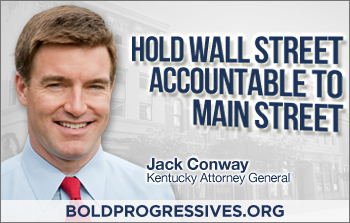
Join Jack Conway and hold Wall Street accountable.
https://s3.amazonaws.com/s3.boldprogressives.org/images/ConwayFight.jpg
Click here to sign the statement.
 
Hi, this is Kentucky Attorney General Jack Conway. I wanted to make sure you heard about an important issue.
The same Wall Street banks whose irresponsible actions led to our nation's economic collapse are now pressuring all 50 states to give them legal immunity. The banks want to block any criminal or civil accountability for actions that have yet to be investigated.
Attorneys General from Delaware, Minnesota, Nevada and New York have been fighting back. Today, I want to make a clear statement in support of Wall Street accountability and against immunity for banks -- and I ask you to join me on this statement:
"Today's economic crisis was caused by Wall Street acting improperly. Every American has paid the price -- with families losing their homes, investors losing their money, and many Americans losing their jobs. There should be absolutely no criminal or civil immunity given to banks for activity that has not yet been investigated." 
Frankly, all elected leaders owe it to their constituents to take this position. If we speak up together, more and more of them will. Sign here.
Today, by adding my voice to this issue, along with the Progressive Change Campaign Committee, we are adding momentum to the fight for Wall Street accountability.
These next couple weeks are critical. Key meetings and discussions will determine if Wall Street banks get immunity -- regardless of what they may or may not have done.
Together, we can hold Wall Street accountable to Main Street. Thanks for being a bold progressive.
-- Kentucky Attorney General Jack Conway


Named The Nation's "Most Valuable Online Activism of 2010"—thanks to you. Help us continue our effective, independent progressive activism. Chip in here.


Paid for by the Progressive Change Campaign Committee PAC (www.BoldProgressives.org) and not authorized by any candidate or candidate's committee. Contributions to the PCCC are not deductible as charitable contributions for federal income tax purposes.

18 August 2011

Rick Santorum Has Some Interesting Theories About The 'Moral Failings' That Led To The Economic Collapse 18AUG11

rick santorum is such a hypocritical puke. His record as a US Senator is one of voting against strengthening families, not supporting them. He is against the minimum wage, the children's insurance program, extending unemployment benefits, the Affordable Care Act, and every other social safety net program or government policy benefiting the poor, working class and middle class. He serves those with money and power and could give a damn about the rest of us. More on his hypocrisy from HuffPost....
I can't say that I find much mutual agreement with former Pennsylvania senator and presidential aspirant Rick Santorum, but for a brief, mad moment yesterday, I thought that we had finally found some cause in common. My momentary ecstacy occurred last night, when I happened upon this ThinkProgress headline: "Santorum: ‘Huge Moral Failings’ Are The ‘Root Cause’ Of Our Economic Problems."
Immediately, I thought, "Huzzah, Rick Santorum, you are absolutely right!" And you'll find a lot of others who agree. Take David Francis, of the Christian Science Monitor, who in May of 2010 opined:
At the heart of the financial crisis lay a moral failing. Too many financial-industry officials, and often their customers, lacked the ethical training and guts to refuse to sell or buy "liar's loans" and other toxic mortgages. Too many were willing to operate a massive casino that traded financial derivatives of little constructive value.
Francis went on to cite Elizabeth Warren's criticism, that this moral failing "led to 'ripping the heart' out of the economic security of millions of middle-class Americans." And you know, the entire concept of a "middle class" has yet to even come up in the GOP debates. So, yeah! Rick Santorum! Run with the ball, brother!
Oh, what's that now? You're telling me that this isn't what Santorum was talking about?
SANTORUM: Letting the family break down and in fact encouraging it and inciting more breakdown through this whole redefinition of marriage debate, and not supporting strong nuclear families and not supporting and standing up for the dignity of human life. Those lead to a society that’s broken. If you think that we can be a society that kills our own, and that disregards the family and the important role it plays, and doesn’t teach moral values and the important role of faith in the public square, and then expect people to be good, decent and moral when they behave economically, if you look at the root cause of the economic problems that we’re dealing with on Wall Street and Main Street I might add, from 2008, they were huge moral failings. And you can’t say that we’re gonna take morality out of the public square, morality out of our schools, God out of our schools, and then expect people to behave decently in a country that requires, capitalism requires some strong modicum of moral consciousness if it’s gonna be successful.
So there you have it: "capitalism requires some strong modicum of moral consciousness if it’s gonna be successful," and if it hadn't been for gay marriage and abortion, that whole "predatory lending-to-toxic derviatives-to-betting against your own clients" scheme would have worked out just fine.

25 July 2011

11 (now 8) days until disaster, three options to prevent from WASHINGTON POST 22JUL11it


(Andrew Harrer - BLOOMBERG)
It always feels different in the room. In the room, everyone wants a deal. They want their name on legislation, in history books. They want to do the big things and make the hard choices. Then they leave the room and they learn their supporters don’t want the choices made if they’re going to be hard. They learn their colleagues know their names won’t be in the history books, and so they’re more concerned with making sure their names are on their desks in the next congress.
But you can’t get a deal unless you can get the votes. And what’s been clear for some time is Speaker John Boehner cannot get the votes. If you need more evidence, look at the letter Boehner sent his caucus, which is more about pretending that he supports Cut, Cap and Balance -- an absurd and unpassable policy that includes a constitutional amendment making tax increases nearly impossible and capping spending at levels not seen since 1957 -- than it is about informing them as to what’s happened in the negotiations. It’s as if the president walked away from the table and sent out a letter saying that Boehner wouldn’t agree to single-payer health care, and so the negotiations are over.
But that’s what made the latest round of interest in the $4 trillion deal so peculiar. The policy was essentially unchanged from the $4 trillion deal that Boehner and Majority Leader Eric Cantor walked away from two weeks ago -- a deal that included about half as much in tax increases as Simpson-Bowles or the Gang of Six . When they walked away, it was because they couldn’t find the votes for a compromise, even one tilted towards conservative interests. Despite all the excitement about them returning to the table this week, no one had ever answered the first question that needed to be asked: Had they found the votes? And if so, how?
We now know the answer.
It’s easy to get caught up in the political machinations. It’s easy to begin speculating about the hopes, constraints, and hidden agendas of the players. It’s easy to sound like an insider and say that the House GOP cannot accept a deal until the very last minute, or unleash some long analysis of how the president’s evident frustration will play with the voters, or say that the real story here is the relationship between Boehner and Cantor. But here’s the bottom line: We have 11 calendar days to raise the debt ceiling. Already, there’s some evidence that our dithering is hurting the economy. If we truly fail to raise the debt ceiling, however, we will unleash a market panic that will, at the least, return us to recession, and if it’s not quickly quelled, metastasize into a financial crisis that we will not soon recover from.
Earlier today, I spoke with David Beers, director of Standard Poor’s sovereign debt department. He explained that it wasn’t economic factors that had put America’s credit rating at risk, nor world events. It was credit-rating agency’s increasing fears that our political system was no longer up to the challenges that face it. “What we’re saying now,” said Beers, “is we question whether despite all the discussions and intense negotiations, if they can’t reach this agreement, will they be able to reach it after the election?”
If we convince Standard Poor’s that our political system has failed, they will downgrade our credit within three months. If they do that, interest rates on our debt will spike, perhaps by 50 basis points, perhaps by more. An easy rule of thumb is that if interest rates rise by 50 basis points, we will lose 600,000 jobs in this country.
At this point, there are three serious options on the table. A $4 trillion deal that includes some revenues, a $1 trillion-$2 trillion deal that’s all spending cuts but leaves much of the job until after the election, and a deal in which Republicans don’t come to a negotiated agreement with President Obama but they grant him the authority -- and let him take the blame -- for raising the debt ceiling. Those are our three options, and Congress needs to pick one. Time is running short.
Related: Everything you need to know about the debt ceiling in one post.
ALSO ON THE WASHINGTON POST:
Obama-Boehner talks collapse with blame on both sides
READ: Boehner’s letter to House Republicans
The Fix: A lose-lose proposition
PHOTOS: The clock ticks down
By  |  07:18 PM ET, 07/22/2011

14 July 2011

America Needs a President Who Will Confront the Financial Industry's Hegemony Over Our Lives 14JUL11

THANK YOU SHEILA BAIR, we are already missing you! You are quite a lady for sure!!!!
No one in a position of authority in our government today seems to understand fully the threat to American institutions and ideals represented by the untrammeled clout the financial industry now holds permeating the halls of government through the power of influence and money. We are barreling toward a destabilizing schism in our society where one interest group, the finance world and its allies, are running the nation to their own economic benefit, oblivious of the pain and loss being endured by their fellow citizens on the Main Streets of our towns and villages and the neighborhoods and tenements of our cities
Our president, whose objectives are certainly sincere, has surrounded himself with men whose formation and ties run deep into the culture of Wall Street -- be it his Chief of Staff William Daley, formerly Midwest Chairman of JPMorgan Chase; Treasury Secretary Timothy Geithner, Former Chair of the New York Fed, or Gary Gensler, Chairman of the Commodity Futures Trading Commission and former Goldman Sachs partner -- while consulting freely with Warren Buffet, that champion of and investor in Goldman Sachs. In many ways very little has changed from the previous administration when the Treasury and virtually all government agencies responsible for financial oversight were in some manner beholden to Wall Street houses and banks, and when the crunch came in September 2008 it was their "club" members who were bailed, while the rest of the country sank into a miasma of recession and unemployment. As Sheila Bair was quoted in the New York Times Magazine saying to Joe Nocera: "You know, Wall Street barely missed a beat with their bonuses. Isn't that ridiculous?"
Nor has their been a serious effort made by prosecutors in the Obama administration and its agencies to hold individuals responsible nor to claw-back the billions of dollars paid out as bonuses for phony profits that were booked by creating and marketing fundamentally flawed financial instruments such as the now notorious C.D.O.'s. The Justice Department opted for a policy known as 'deferred prosecutions'. The guidelines left open a possibility other than guilty or not guilty, giving leniency all too often if companies investigated and reported their own wrongdoing. In return the government would enter agreements to delay or cancel prosecution if companies promised to change their behavior -- in other words, no punishment and little assurance that it wouldn't happen again.
Yet there was one player in government, that progressively rare breed, a moderate republican appointee holdover from the Bush Administration, who fought tooth and nail against the clubhouse fraternity that had taken over the fiscal soul of the nation. She was unflinching in defending the interests of the nation's citizens, becoming an equal opportunity irritant to Democrat and Republican alike. And she knew what she was talking about.
I personally have had the good fortune of hearing her speak at an Aspen Ideas Festival event just over a week ago. She was lucid, forthright, without hyperbole conveying a sense of reasoned indignation felt by too many of us, at the unfairness of the present structure. Where we, as citizens seem unable through our elected officials to stem the influence, the systematic 'heads I win, tails you lose' construct of our financial institutions and their growing impact on the functioning of our society.
Upon her retirement as Chairman of the FDIC (Federal Deposit Insurance Corporation) this July 8th Sheila Bair received this accolade from the Wall Street Journal's Deborah Salomon: "Sheila Bair, who is stepping down as Chairman of the Federal Deposit Insurance Corp. this week, leaves behind an agency transformed from a sleepy bank overseer into a financial regulatory powerhouse focused on preventing another financial crisis." The article goes on to report that at her last FDIC meeting the agency finalized a rule allowing the government to recover compensation from executives responsible for a financial firm's collapse. Only someone with the gumption of Bair could have achieved such a result given the opposition massed against her.
In an in-depth article by Joe Nocera, Nocera writes that Bair began sounding the alarm about the dangers posed by the explosive growth of subprime mortgage rates in June 2006. At the time, "Bair insisted that she and her agency have a seat at the table and fought Henry Paulson and Timothy Geithner, the President of the New York Federal Reserve, as they tried to cobble together solutions that would keep the financial world from going off a cliff: She and the F.D.I.C. managed a number of huge failing institutions during the crisis including Indy Mac, Wachovia, and Washington Mutual."
Of particular significance was Bair's belief in market discipline where, according to Nocera, she found herself at variance with Obama's Treasury Department, meaning she held that shareholders and debt holders should take losses ahead of depositors and taxpayers. "She was tough-minded and straight-forward." And as she would be quoted, "Our job is to protect bank customers, not banks."
She fought for increasing the capital requirements for banks in the face of banks who lobbied strenuously against her. Lower capital requirements allow for more risk, ergo larger bonuses. She fought against the United States' adoption of the bank boondoggle called Basel II which would have lowered bank capital requirements and worse, self selection of risk models thereby significantly exposing the system to even greater bank failures. Nocera would declare "I've long believed her opposition to Basel II has been a hugely underappreciated factor in helping to save the financial system when the crisis came."
And on it went. Geithner, in full Wall Street mode, wanted the F.D.I.C. to guarantee all debt issued by bank-holding companies (such as JPMorgan Chase, Goldman Sachs, Morgan Stanley). Sheila Bair said NO!
To Bair, her fight with the Treasury and the federal Reserve was ultimately about the bondholders. According to Bair "They did not want to impose losses on bondholders and we did...there is no insurance premium on bondholders... For the little guy on Main Street who has bank deposits, we charge the banks a premium for that, and it gets passed along to the customer. We don't have the same thing for bondholders, they're supposed to take losses."
And, most tellingly, she was clear in her displeasure that the government, by acting as if it was no one's fault, placed no responsibility where it should have been placed. For the many of us who have been wondering the same thing, what a breath of fresh air.
She has a stalwart fighter for mortgage modifications that would truly help homeowners. As Nocera explains that "what particularly galls her is that the Treasury under both Paulson and Geithner has been willing to take all sorts of criticism to help the banks. But it has been utterly unwilling to take any political heat to help homeowners."
All the while the Dodd-Frank Bill meant to prevent the too big to fail syndrome from ever rearing its head again, thereby making the largest banks accountable for their actions, is being lobbied into impotence by the financial brotherhood.
Here we have Sheila Bair, Kansas transplant to Washington, taking on the behemoths of the financial world, dogged in her defiance, "We always saw ourselves as the champion of the little guy. The other regulators never saw a bank closure, because that was our role. We were the ones that saw people losing their jobs when we had to shut down a little bank. They never understood the unfairness of the way little banks were treated versus the big banks...I've always thought that it was really important for everybody to have to play by the same set of rules."
Given the financial crisis in which our nation finds itself -- given the access and the power of the financial intuitions' hold, enabling them to play events to come to their own advantage -- would it not be better to have one of our own in the White House who understands the game? Who is on our side, and by virtue of her position and knowledge can stare down all the entreaties for special treatment because she inherently understands that this nation cannot flourish, nor overcome the obstacles that lie ahead and maintain its dignity if we do not all together play by the same set of rules?
Sheila Bair may not know it yet, but we need not only her kind, we need her to become our president. Her persona, her values, her experience would be a rare and welcome gift to the nation!

10 June 2011

Wall Street's Latest Manufactured Outrage 10JUN11

MORE proof wall street and the banking / financial industry can not be trusted. The propaganda campaign they are launching is not for the benefit, and offers no help or protection for the American home buyer. It DOES make mortgage lenders accept responsibility and risk for the loans they make, and so reduces the chance of another financial meltdown because of the shameless greed of wall street and the banking / financial industry. This from Mother Jones....
The Fed and other regulators have proposed a set of rules that would put new limits on home mortgages: Borrowers would have to put 20 percent down and would have to show that their mortgage payments would amount to no more than 28 percent of their gross monthly income. The Washington Post makes this sound like doomsday:
Nearly three out of every five U.S. borrowers who bought homes last year would not have met the proposed restriction on total debt, according to an analysis by mortgage research firm CoreLogic....If the rules were in effect now, Todd Pearson of Ashburn predicts he'd be shut out of the market. Pearson wants to sell his house and buy another in Chevy Chase. He says he has no debts other than his mortgage. But he figures his mortgage payment alone would exceed the threshold proposed by the new rules.
You have to admit, these rules do sound pretty tough. In fact, they'd pretty much shut down the entire mortgage industry. So what's going on?
Answer: Lots of financial industry whining. As it turns out, regulators aren't saying that mortgage originators can't make any kind of loan they want. 20 percent down, 10 percent down, 5 percent down, whatever. Go to town. What they are saying is that if mortgage loans are bundled up into securities and resold, they want the issuer of the security to retain 5 percent of the total offering. That's part of Dodd-Frank, and it's designed to give issuers an incentive to make sure their mortgage securities aren't full of toxic waste. If they have to keep a piece of the action on their own books, they'll want to make sure their securities are safe and sound.
However, there's an exception: If your mortgages all conform to the new rules, you don't have to retain that 5 percent chunk. That's all that's happening. You can make any kind of loan you want, but if it's anything other than super safe, you have to keep a piece of it on your books.
The financial industry is in an uproar over this, claiming that it would shut millions of people out of the housing market. That's nonsense. Neither Todd Pearson nor anyone else is being denied a loan on whatever terms they can get one. All that's happening is that when their mortgages get bundled up and resold, the ABS issuer has to keep a 5 percent stake. The mortgage industry is on a rampage over this, claiming that it will dramatically raise the cost of mortgages, but that's nonsense too. Being forced to keep a 5 percent stake probably will have an impact on ABS issuers—that's the whole intent, after all—but the financial impact is almost certainly pretty minuscule. Tom Lawler at Calculated Risk roughly estimates it at perhaps 20 basis points at most on a nonconforming loan. In other words, the rate on nonconforming mortgages might go up 0.2 percentage points. At most. Something on the order of 0.1 percentage points or less is probably closer to reality.
This is yet another case of the financial industry biting the hand that's trying to help it out. The truth is that it would probably be a good idea to require ABS issuers to retain a 5 percent stake in every mortgage bundle they sell. But Dodd-Frank threw them a bone in the form of an exemption for loans that were transparently high quality and virtually certain not to default. And the result? Endless whining, a massive lobbying effort, and glossy four-color demagoguery about hardworking middle-class families being shut out of the mortgage market. Welcome to Wall Street.
Front page image: A GS/Fotopedia

09 June 2011

Third World America 2011: Forget "Fast Tracking to Anarchy" We've Arrived 8JUN11

NOTHING excuses the violent actions reported in this article from HuffPost, but it is unfortunately the reality of the time as our nation continues it's slide into Third World status, a slide that will become a fall if the gop and tea-baggers get their way in D.C. and in local and state governments.
Last summer I wrote about Arianna Huffington's latest book, Third World America: How Our Politicians are Abandoning the Middle Class and Betraying the American Dream and talked about the Great Recession, the Great Bailout, and the Great Cover-Up of financial crimes.
I also wrote that municipal financial problems spelled a lower quality of life. Downtown Chicago crime escalated, along with attacks on officers in the Chicago Police Department. An officer who spoke up about the low morale of the undermanned and rudderless police force endured official retaliation. ("Third World America: 'Fast Tracking to Anarchy")
This year, all hell has broken loose in downtown Chicago. Years of under-hiring have resulted in a police force that is unprepared for wildings and gang violence. Moreover, concealed carry in Chicago is illegal, unless one follows the Constitution.
Tourists and residents have been attacked by mobs of youths on buses, on beaches, on bicycle paths, near the shops of the Magnificent Mile, and outside their homes. Mobs of shoplifters plagued "Mug Mile" stores. The irony is that these disenfranchised youths are turning to crime -- and if justice is done, prison sentences --against innocent targets. Their focus is misdirected. Participating in a peaceful five million man march -- a true show of force and power -- against elected culprits in Washington would get them better results for lasting change.
The Spring of Anarchy: "A City At War With Itself"
It is still technically spring in Chicago, and wildings have made Chicago and its beaches unsafe. Poorer neighborhoods have long been war zones. The murder rate and gang violence in Chicago has been unacceptable for years.
Yet the police force was gutted, handcuffed, and muzzled. ("In Third World America Expect to be Investigated, as Lt. John Andrews Is Being Investigated, for Speaking Up") Police officers -- some off duty and still in uniform -- have been gunned down in the streets. Their crime-fighting abilities are severely hampered by years of irrational policies and genuflecting to politically power hungry special interest groups.
Of course, we want police officers to follow proper procedures at all times, but we also want them to make fast decisions in violent chaotic circumstances, defend themselves, and get home safely to their families and friends. Local media hounds come out in force against police work. It's time they came out in favor of superior training and hiring.
Mayor Rahm Emanuel, with less than a month in office, has called for the arrest of all the youths involved in last weekend's mob attack that included an attack on a shopper and on two middle-aged doctors -- in separate incidents -- visiting for an oncology convention. Yet there have been ongoing incidents of wildings that didn't make the front page of local papers as did this last attack on tourists.
The woefully undermanned police force plans to recruit and train 300 new officers when some estimates indicated it needed more than 3,000 new officers before the outbreak of the new-pattern crime wave.
Acting Police Superintendent has to Stop Lying to Citizens*
Mainstream media has finally started to report crime in the more fashionable parts of town, but only because it has spun out of control into anarchy. The most reliable source of crime-wave information has been Second City Cop, a blog started by a member of the Chicago police force.
Based on my conversations with friends and neighbors, citizens of Chicago feel lied-to by Acting Police Superintendent Garry McCarthy.* On Memorial Day, North Avenue beach, in one of Chicago's more affluent areas, was closed after gang violence. This is unprecedented. McCarthy repeatedly told the media it was due to people succumbing to the hot weather. Not true. Violence was out of control as beach-goers were harassed by mobs and cyclists were pulled off their bikes and beaten.
Mainstream media now contradicts McCarthy's feeble spin. One police officer told the media that 500 youths exited public transportation for the lakefront and while they were there, citizens were harassed.
CBS reported wilding incidents at this beach earlier in May, and police patrols had already been stepped-up. Two bike riders on the North Avenue Beach path had been mobbed by about 100 teens. They were knocked off their bikes and then thrown into Lake Michigan. Yet Near North District commander Kenneth Angarone said police responding at the scene did not find a "bona fide incident."
Mobs have swarmed local businesses, shoplifted and intimidated shoppers at high-end stores, attacked bus riders, attacked shoppers near Michigan Avenue, attacked tourists and more. Shortly after Mayor Rahm Emanuel said he would round up perpetrators of last week's mob attack, NBC reported that a mob of 15 to 20 youths beat and robbed two people in Chicago's downtown shopping area.
Memorial Day Mobs: Boston, Nashville, Long Island, Miami, Rochester, and Charlotte
Wildings occurred in other cities on Memorial Day weekend in what may have been coordinated flash wildings. Gangs swarmed beaches in Boston, Nashville, Long Island, Miami, Rochester, and Charlotte in what some believe was a social media coordinated effort. (Hat tip: Second City Cop)
And Stop Lying to My Friends
In response to the weekend violence, my network of friends emailed around news articles. Mary McCarthy (no relation to Police Superintendent McCarthy), a friend of a friend, emailed local papers about a mob pulling people from cars and taxis right outside her upscale apartment building. When the police arrived 15 minutes later, the crowd had scattered. Here's an excerpt:
"At about 11pm last Friday night, June 3rd, I heard shouting, screaming, horns blaring and tires screeching from my apartment...When I looked out my window to the street below I saw a crowd of about 20 young people...directly across the street from the entrance to my building. They were leaning on parked cars and clogging the street. They were screaming at people walking and driving by. I watched them stop vehicles, including taxi cabs, and pull people from the vehicles...It was a frightening scene and I was sure someone was going to be hurt."
The Sun-Times wrote of Mary McCarthy's report and Police Near North District commander Kenneth Angarone said that police responded but did not find a "bona fide incident.'' I believe Ms. McCarthy.
It's Not a Race War; It's a Class War
It's much too easy to let politicians divide the nation, make this about race, and ignore the underlying causes. It's true that many of the mobs in downtown Chicago are comprised of African Americans, but Oprah Winfrey isn't into wilding. Mary McCarthy didn't get a close up look at the mob outside her window, but they appeared white -- definitely not African American.
Last year, I never mentioned race in my post about Chicago violence, but a few commenters brought up race and made unwarranted assumptions. Some commenters assumed "wildings" only involve black youths. Chicago is a city with a lot of diversity and gangs of every race. I mentioned a separate incident of an armed intruder being shot and killed by an off duty police officer; the armed intruder was not African American. I also mentioned three police officers were shot and killed within a two month period. Two were African American, one was not.
U.S. Downward Mobility
The destruction of the middle class has accelerated. Housing values have plummeted, and investors earn negative real rates of inflation adjusted returns on "safe" investments like money market funds. Food, fuel, and medical costs have skyrocketed. Essential civil services are underfunded while taxes escalate. The middle class is sinking fast as saved wealth is destroyed and its standard of living erodes.
After being subjected to a national financial crime wave with no meaningful consequences for white collar criminals, the middle class, the core of many cities and communities, is being subjected to a physical crime wave.
The U.S. escalated its debt to fund the ongoing bailout of the banking system. TARP was a small part of it. The Fed now owns over a trillion in suspect assets it bought from banks, and it daily provides them with almost zero cost money so high spreads help them earn their way out of the financial hole in their balance sheets. No one went to jail, and bankers reward themselves with billions in bonuses.
Banks broke their TARP agreement to lend to small and medium sized businesses. They lent to large businesses that outsource a lot of labor. The iPads stolen by Chicago gangs are mostly made in Asia. Banks and their enablers in Washington starved the U.S. of the biggest source of sustainable job growth: capital investment in the United States.
Elected Citizen-on-Taxpayer Financial Crime
Illinois and Chicago are ground zero for the consequences of our local and national fiscal folly. Pension funds are woefully underfunded. Last minute sweetheart deals to crony-connected retirees have contributed to the problem along with bad investment decisions. In general, though, civil servants are blameless. Some are being asked to increase contributions from 8 percent of pay to 12 percent of pay. The State of Illinois is behind on many of its bills. Chicago's city budget is in dire straits.
The suburb of Bellwood provides an example of how graft and corruption have contributed to municipal project debt. A train station project was hijacked by local officials who paid millions above appraisals for properties, and in at least one instance dealt with a mob-linked company. According to the Chicago Tribune, taxpayers of the small suburb have a $40 million hole and investigations revealed "questionable players," with laughable financial analysis.
Chicago's unemployment rate and mortgage delinquency rates are among the highest in the country, and home prices have slumped to 10-year lows. The S&P Case -Shiller index shows that Chicago area housing prices have fallen to April 2001 levels. From the housing bubble's November 2006 peak, prices are off 34 percent.
Illinois state income taxes rose this year from 3 percent to 5 percent, a 66.7 percent increase. That is in addition to sales taxes, utility taxes, phone taxes, various automobile taxes.
Chicago is not alone. Cities throughout the country recently experienced wildings, and it will get worse for them as it did for Chicago. Illinois may have the most severe budget crisis in the country, but states like California, New York, New Jersey and more are troubled.
Ongoing Mugging by Wall Street Banks
After the largest bank bailout in world history, we now have a national epidemic of foreclosure fraud. In March, Judge Moshe Jacobius stayed 1,700 foreclosures due to altered documents in Illinois' Cook County.
A complaint of alleged fraud on the part of Goldman Sachs detailed its close relationships with Countrywide, New Century, and Fremont. The complaint showed Goldman knew of "an accelerating meltdown for subprime lenders such as New Century and Fremont." Despite known serious loan problems, Goldman continued to securitize the loans and sell them in packages of residential mortgage backed securities. Goldman Sachs Alternative Mortgage Products (GSAMP) was "garbage sold at mythical prices."
The complaint alleged that Countrywide employees in a Chicago office inflated incomes on 90 percent of reduced documentation loans, also known as "liars' loans." One of Countrywide's mortgage brokerage arms "routinely doubled the amount of the potential borrower's income ... so that borrowers could qualify for loans they could not afford." The complaint alleged that brokers, not borrowers, engaged in massive fraud to push loans through the system and earn commissions. Illinois Attorney General Lisa Madigan told First Business Morning News: "Countrywide broke the law, homeowners did not."
Arianna Huffington explained that our elected officials allowed banks to thwart usury laws:
"Every day, Americans, faced with layoffs and tough economic times, are forced to use their credit cards to pay for essentials such as food, housing, and medical care -- the costs of which continue to escalate. But, as their debt rises, they find it harder to keep up with their payments. When they don't, banks, trying to offset losses in other areas, turn around, hike interest rates, and impose all manner of fees and penalties." Third World America, P. 77.
Even when banks initiated foreclosure fraud, they refuse to bear the costs of delays and bad deals of their own making. After pumping up appraisals and falsifying borrowers' income on applications, banks are walking away from abandoned homes and sticking taxpayers with the bill to clean up the mess they left behind.
Banks claim that it is mortgage lenders or mortgage servicers who are guilty, but these are bank affiliates and business partners funded by the banks.
Banks supplied the money (via private label phony securitizations) that fueled this problem. Banks engaged in widespread massive mortgage securitization fraud. As underwriters, banks were responsible for doing adequate due diligence on the underlying loans. Banks were responsible for making sure the representations about risk in their financial products were accurate. Instead, the representations were materially misleading.
According to a local study by the Woodstock Institute, the mortgage servicers and trustees most often associated with abandoned properties are Bank of America, Wells Fargo, U.S. Bank, Deutsche Bank, and JPMorgan Chase.
We Need the Mother of All Reforms
Doing nothing ensures a relentless downward slide into financial and social chaos for great swaths of the country. Washington's political corruption and mismanagement has the same roots as Chicago's. As Arianna points out, on a national level, we need "the mother of all reforms:
"That is why the first step toward stopping our relentless transformation into Third World America has to be breaking the choke hold that special interest money has on our politicians." (Third World America, 172)
Money isn't the only way to sway politicians. One can take away the power politicians try to buy with that money. Among voters, a show of numbers is as effective as money. The middle class needs to make its voice heard in the media and in direct contact with their local and national elected officials.
On a national level, we need a Constitutional amendment requiring full public financing for political campaigns (for starters). Too many politicians are owned by special interest groups that buy votes, finance campaigns, employ their relatives, or just buy them off. As Arianna explained: "If someone's going to own the politicians, it might as well be the American people."
Endnote in response to comments: I use "wilding," since that is the term used by our local mainstream media news articles, including articles at NBC and the Sun-Times. This is the definition given by the free online dictionary: "Slang: The act or practice of going about in a group threatening, robbing, or attacking others."
* Update: Garry McCarthy was approved by the full City Council and named Superintendent of the Chicago Police Department on Wednesday, June 8, 2011.

02 June 2011

U.S. economy: Manufacturing slowdown the latest sign the recovery is faltering 1JUN11

SO continuing the bush era tax breaks was supposed to be the fuel for creating jobs to bring us out of recession.....well, the wealthy and corporations have their money, WHERE ARE THE JOBS???? It would seem only those with money are getting more of it and they, along with the political whores of both parties they control in the federal and state governments, are the only ones laughing all the way to the bank.....for the rest of us, it is just another BOHICA moment! From the Washington Post.....

By , Published: June 1

The economic recovery is faltering, and Washington is running out of ways to get it back on track.
Two bright spots over the past few months — manufacturing and job creation by private companies — both slowed in May, according to new reports Wednesday. The data come amid other reports of falling home prices, declining auto sales, weaker consumer spending and a rising pace of layoffs.
Stocks tumbled Wednesday on the discouraging economic news, with the Standard & Poor’s 500-stock index off 2.3 percent. It was the index’s steepest decline since August.
Just a few months ago, the economy seemed poised to finally strengthen. Business confidence was rising, and extensive government efforts to foster growth were underway. But those hopes are being dashed. Forecasters who once projected economic growth of 3.5 to 4 percent for the year have slashed their estimates with each round of disappointing numbers.
Instead of accelerating, the U.S. economy is puttering along at a growth rate of 2 to 3 percent — barely enough to bring down joblessness slowly, if at all.
“The recovery continues, but at a disturbingly slow pace,” said Diane Swonk, chief economist for Mesirow Financial.
The weak growth comes despite government efforts to boost it: a payroll tax cut that took effect in January and an initiative by the Federal Reserve to pump $600 billion into the ailing economy. But the Fed is unlikely to take further action, and Congress is focused on reducing the budget deficit, not tax cuts or new spending that might spur economic activity.
The worsening economic prospects reflect, in part, the effects of a spike in oil prices this year and of the Japanese earthquake in March, which caused disruptions for some U.S. manufacturers. But it is the underlying weakness of the U.S. economy that may have allowed these developments to knock the recovery off course.
“We’re structurally in a place where we’re going to be more vulnerable to downside risks than if the economy was growing strongly, and that’s what we’re seeing right now,” said Robert A. Dye, senior economist at PNC Financial Services Group. “We’re not far above stall speed.”
The signs are not all bad. The stock market has held up well in recent weeks, aside from Wednesday’s decline. Prices for oil and other globally traded commodities are down substantially since the end of April, a decline that will eventually mean lower prices for gasoline and other goods, and the impact of the earthquake will subside as factories in Japan reopen. Moreover, U.S. businesses this year have been cutting inventories that they will eventually need to rebuild, spurring economic activity.
But the outlook, as projected by economic forecasters and implied in government data, is clearly dimming. Economists at J.P. Morgan Chase on Wednesday lowered their projection for 2011 growth in gross domestic product to 2 percent. A week ago, those same economists had reduced the figure to 2.5 percent.
Reflecting rising pessimism, the interest rate that the Treasury Department must pay to borrow money for 10 years fell to 2.95 percent Wednesday, from 3.06 percent on Tuesday and 3.74 percent in February. As investors grow anxious, they are moving money into the safety of government bonds. Investors are also anticipating that the Federal Reserve will seek to support the recovery by keeping interest rates low for longer than previously expected.
Among the economic information that unsettled markets was a report by the Institute for Supply Management, which said that its index of manufacturing activity fell to 53.5 in May from 60.4 in April. Numbers above 50 indicate expansion, and analysts had expected a more modest pullback to 57.1. The new numbers showed the slowest rate of factory expansion since September 2009.
New orders and production fell the most. This was probably caused by disruptions in automobile and other production after the Japanese disaster, which hurt supply chains around the world.
“Elevated commodity prices, slowing global growth and an increasingly questionable outlook for the U.S. economy are creating head winds for the factory sector, which thus far has been the one strong element in an otherwise sluggish U.S. economic rebound,” said Cliff Waldman, economist at the Manufacturers Alliance/MAPI, a trade group.
Also Wednesday, ADP, the payroll processing company, said that the rate of job creation at private businesses slowed sharply last month. Firms added 38,000 jobs, ADP estimated, compared with 179,000 jobs added in April.
On Friday, the Labor Department will release its report on May job growth and the unemployment rate. Economists expect that about 180,000 jobs were created last month, dropping from 244,000 in April, and that the unemployment rate has edged down to 8.9 percent from 9 percent.
The U.S. economy has sputtered several times while recovering from the trauma of the financial crisis. Last summer, as growth slowed and analysts began to fear a dip back into recession, the government swung into action. The Fed began discussing what would become known as QE2, or the second round of quantitative easing — a $600 billion bond-purchase program aimed at fueling growth. And by the end of the year, the Obama administration had reached an accord with Congress to temporarily cut payroll taxes to boost growth.
But the prospects for another round of government help are slim. The Fed had undertaken its massive bond-buying program last year in large part because leaders of the central bank were worried about the risk of deflation, or falling prices. By contrast, prices today are edging up. The bond market is pricing in inflation of just under 2 percent a year over the coming five years, exactly the level the Fed seeks.
Moreover, Fed officials believe that further efforts could have less bang for the buck than previous ones.
The administration and Congress, meanwhile, are now more concerned with cutting the federal budget deficit than with supporting the recovery through government spending and tax breaks.