BUCKNACKT'S SORDID TAWDRY BLOG
We should not be a journey to the grave with the intention of arriving safely in an attractive & well preserved body, but rather to skid in sideways, chocolate, bier or wein in hand, body thoroughly used up, totally worn out and screaming "WHOO-HOO, WHAT A RIDE!!!!!!"
Forward this email to someone you know who would like it! Did someone forward this email to you? Sign up here to receive this newsletter in your inbox every weekday.
Verse of the day
No one can serve two masters, for a slave will either hate the one and love the other or be devoted to the one and despise the other. You cannot serve God and wealth. - Matthew 6:24
Voice of the day
When morality comes up against profit, it is seldom that profit loses. - Shirley Chisholm
Prayer of the day
God, help us choose you over profit, and give us the courage to serve justice when wealth tempts us to look away.
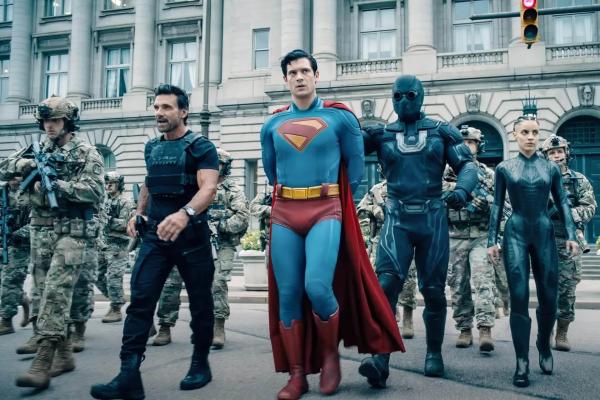
As our nation plunges further into fear of the other, Yanan Rahim Navarez Melo findsthatJames Gunn’s new movie makes one thing clear: This is a job for Superman.
Inspired by historian Kristin Kobes Du Mez’s bestselling book, indie artists Googly Eyes, Joy Oladokun, and Allison Ponthier released the track in June.
Public broadcasting belongs to all of us. It’s how millions stay connected to the truth, especially in areas where commercial media won’t go. Tell Congress: Protect funding for NPR and PBS now. Keep democracy and accurate news on the airwaves.
Looking for your next great read? Check out Sojourners' Bookshop page for curated selections of books on social justice and living your faith. When you buy through our Bookshop link, part of the proceeds support Sojourners and independent bookstores throughout the country.
The signs say STAND WITH UKRAINE / WE STAND WITH UKRAINE / UKRAINE STRONG / STOP RUSSIA
DO NOT equate NOT MY president drumpf's / trump's and NOT MY vice-pres vance's perverse and twisted "morals" with my morals. The only thing we have in common is we were all born Americans but after last Friday's scene in the corrupt oval office drumpf / trump especially made it very clear again they are not true Americans. Pres Zelensky showed the world what true leadership and real patriotism looks like. The drumpf / trump-vance administration's actions in the oval office with Zelensky and then voting the same as Russia, Iran and N Korea and other authoritarian states at the U.N. shows just how un-American, how anti-American they have become. Ukrainians are proud of Pres Zelensky. Most Americans are embarrassed by and ashamed of NOT MY pres drumpf / trump and NOT MY vice-pres vance.
President Trump’s actions make one question whether America is still a force for good in the world.
President Donald Trump and Ukrainian President Volodymyr Zelensky in the Oval Office on Friday. (Jabin Botsford/The Washington Post)
Over America’s long history, Americans have often hesitated to support foreign wars and international machinations. George Washington’s Farewell Address warning against entangling alliances cast a long shadow. But from the nation’s beginnings, Americans have usually known whom to root for — those who seek freedom — and whom to condemn — those who try to crush liberty.
Across the United States, you will find statues honoring people such as the 18th-century Polish patriot Thaddeus Kosciuszko and the 19th-century Hungarian freedom fighter Lajos Kossuth, who sought liberation for their people from the Russian and Habsburg empires — and who found enthusiastic support in an America that was still a young and weak nation. When Germany invaded Belgium in 1914, even though it initially stayed out of the war, America organized what was then the largest food aid effort in history to help the victim of aggression. During the Cold War, though it could not help militarily, Washington refused to recognize the Soviet annexation of the three Baltic republics, which are now proud and independent nations. America as a superpower sometimes acted unwisely — in places such as Vietnam, Iraq and Afghanistan — but even in those cases, it saw its involvement as the protection of freedom and democracy.
Not anymore. The strangest aspect of the past few weeks of American diplomacy — which culminated in the disaster at the White House on Friday — is that the president of the United States has seemed utterly unwilling to say plainly that he supports the victim of aggression against the aggressor who started the war. Or that he admires Ukrainian democracy more than Russian dictatorship. Instead, he and Vice President JD Vance spent Friday’s photo op at the White House publicly scolding Ukrainian President Volodymyr Zelensky, telling him to say thank you (which he has repeatedly) and accusing him of being disrespectful. Zelensky’s fault was simply to point out that Ukraine had in fact signed a ceasefire deal with Russian President Vladimir Putin in 2015 but that Putin had continually violated it. President Donald Trump used the occasion to remind all that he felt a special bond with Putin.
Zelensky did not handle himself well. He got emotional, responded too often and took the bait that Vance laid for him. He should have studied how French President Emmanuel Macron and British Prime Minister Keir Starmer handled Trump: constant flattery and deference. Churchill said of his relationship with his American counterpart, “No lover ever studied every whim of his mistress as I did those of President Roosevelt.”
But Zelensky is leading a nation at war that has lost tens of thousands of people. He is fighting for his survival. And he and his nation are fighting for the values of freedom and democracy that America has supported since its founding — against a rapacious dictatorship that actively seeks to undermine the United States, its interests and its allies at every turn. It should not be hard to figure out where your sympathies lie.
Friday’s turn of events took place after weeks of diplomacy in which the Trump administration has bullied U.S. neighbors, asked Canada to cease to exist as a country, pressured Denmark to sell Greenland and Panama to hand over the Panama Canal. It has threatened to impose higher tariffs on its allies than its foes. And it has shuttered almost all the food and medicine programs it promised to the poorest people in the world. Conservative former British cabinet minister Rory Stewart asks on X, “Was it for this that the US spent 80 years building power and alliances? Not to be a force for good. But instead to impoverish neighbours, threaten those it protected, rob minerals from war-torn countries, and break its promises to 100s of millions of the poorest in the world?”
Trump is not just changing American foreign policy. He is reorienting America’s moral compass, a compass that has been firmly set since the country’s founding almost 250 years ago.
63% of Republicans say moral leadership is very important
Down from 86% under Clinton
59% of U.S. adults say Trump provides weak moral leadership
WASHINGTON, D.C. -- Republicans are much less likely now than they were during the Bill Clinton years to say it is very important for the president to provide moral leadership for the U.S. Democrats, on the other hand, are more likely to believe moral leadership is important now, with Donald Trump in office, than they were under Clinton.
Importance of President Providing Moral Leadership for the Country, by Political Party, During the Clinton and Trump Administrations
How important do you think it is for the president to provide moral leadership for the country -- very important, somewhat important, only slightly important or not at all important?
Clinton administration (1994-1999)
Trump administration (2018)
Change
%
%
pct. pts.
U.S. adults
72
66
-6
Republicans
86
63
-23
Independents
69
62
-7
Democrats
64
77
+13
Figures are the percentage who say it is "very important." Clinton data based on an average of four polls conducted between 1994 and 1999. Trump data based on May 1-10, 2018, poll.
GALLUP
Across four polls conducted during the Clinton administration, an average of 72% of U.S. adults said it was very important for the president to provide moral leadership for the country. A May 1-10 update of the question finds 66% of Americans holding that view.
The modest change at the national level obscures more significant shifts among partisans -- a 23-percentage-point decline among Republicans and a 13-point increase among Democrats.
Both Clinton, a Democrat, and Trump, a Republican, faced substantial controversy during their presidential campaigns, and it followed them after they were elected president. It appears that some partisans may discount the importance of the president providing moral leadership when a sitting president from their own party is under scrutiny. At the same time, some supporters of the opposition party may magnify the importance of moral leadership when this is a weak area for the incumbent.
This turning of the tables is evident in the flip in Republican and Democratic views about the importance of the president providing a good moral role model between the Clinton and Trump eras. Republicans, by 22 points, were much more likely than Democrats to say it was very important for the president to be a moral leader when Clinton was in office. Now with Trump in office, Democrats are more likely than Republicans to hold this view, by 14 points.
Independents are slightly less likely now (62%) than during the Clinton years (69%) to regard presidential leadership on morals as important.
Americans Say Trump Provides Weak Moral Leadership
By 59% to 40%, Americans believe Trump provides weak rather than strong moral leadership. Republicans and Democrats diverge greatly on this question, with 77% of Republicans believing Trump provides strong moral leadership and 91% of Democrats saying he provides weak leadership. Seventy-eight percent of Democrats believe his moral leadership is "very weak." Independents are much more negative than positive about Trump's leadership on morals.
Overall, what kind of moral leadership do you think Donald Trump provides as president -- [ROTATED: very strong, somewhat strong, somewhat weak (or) very weak]?
Very strong
Somewhat strong
Somewhat weak
Very weak
Total strong
Total weak
%
%
%
%
%
%
U.S. adults
11
29
18
41
40
59
Republicans
22
55
14
8
77
22
Independents
9
29
24
36
38
60
Democrats
2
6
13
78
8
91
May 1-10, 2018
GALLUP
The partisan difference could result from Democrats being convinced that any questions about Trump's moral character are true, while Republicans would tend to be more skeptical. To the extent that people's conceptions of a president's moral leadership are related to his policy positions, Republicans would likely be satisfied with Trump's positions on such ethics-related issues as abortion, immigration and the environment, while Democrats would find his views and actions on these highly objectionable. It is also possible partisans may just more superficially respond positively to any question about a president of their own party and negatively to a question about a president of the opposing party.
Gallup asked U.S. adults to assess Bill Clinton's moral leadership twice during his presidency, and the results varied. In 1996, more Americans regarded his leadership in this area as strong (53%) rather than weak (45%). Two years later, when Clinton's affair with former White House intern Monica Lewinsky was the focus of a federal investigation, 30% said the president provided strong moral leadership and 68% weak leadership.
Democrats' opinions about Clinton's moral leadership in 1996 were similar to Republicans' views of Trump today. Seventy-eight percent of Democrats thought Clinton was a strong moral leader in 1996, while Republicans and independents were more likely to regard him as weak.
After the Lewinsky scandal, all party groups' opinions of Clinton worsened, including a 32-point drop in the percentage of Democrats regarding him as a strong moral leader.
Overall, what kind of moral leadership do you think Bill Clinton provides as president -- [ROTATED: very strong, somewhat strong, somewhat weak (or) very weak]?
Very strong
Somewhat strong
Somewhat weak
Very weak
Total strong
Total weak
%
%
%
%
%
%
1996 May 9-12
U.S. adults
11
42
27
18
53
45
Republicans
4
25
31
39
29
70
Independents
6
40
34
16
46
50
Democrats
22
56
17
4
78
21
1998 Sep 14-15
U.S. adults
10
20
23
45
30
68
Republicans
4
9
13
72
13
85
Independents
8
23
24
43
31
67
Democrats
19
27
30
22
46
52
GALLUP
Gallup has asked this moral leadership question only during the Clinton and Trump administrations, as it was less of an issue for presidents whose administrations were far less consumed by scandal.
Implications
On the whole, Americans believe the president should provide moral leadership for the country. However, Republicans' and Democrats' commitment wavers when moral leadership is a point of concern for their own party's president.
Arguably, Trump and Clinton have had more character concerns than other recent presidents, but their political allies stood by them. Doing so may have forced their supporters to minimize the importance of having a president who is a strong moral leader. At the same time, those who opposed the president may have played up the importance of that presidential responsibility.
Partisans also find ways to regard scandal-plagued presidents as exhibiting strong moral leadership, either because they discount the moral charges against them or because they focus more on the president's issue positions.
These findings underscore the degree to which partisanship colors views of the president, but also how extensively opinions on seemingly normative questions are subject to change, depending on the prevailing political conditions.
SURVEY METHODS
Results for this Gallup poll are based on telephone interviews conducted May 1-10, 2018, with a random sample of 1,024 adults, aged 18 and older, living in all 50 U.S. states and the District of Columbia. For results based on the total sample of national adults, the margin of sampling error is ±4 percentage points at the 95% confidence level. All reported margins of sampling error include computed design effects for weighting.
Each sample of national adults includes a minimum quota of 70% cellphone respondents and 30% landline respondents, with additional minimum quotas by time zone within region. Landline and cellular telephone numbers are selected using random-digit-dial methods.
CHECK out these ads from the Perriello campaign, they give you an introduction to the man we need to elect as our next governor. Then go to Tom Perriello's campaign website, check out his issues page, you will be impressed with his bold, progressive views and campaign platform. Donate if you can, and please vote for Tom this coming Tuesday, 13 JUN 17 in the Democratic primary. The polls are open from 0600 / 6:00 AM to 1900 / 7:00 PM. Remember, DEMOCRACY IS NOT A SPECTATOR SPORT!
Tom Perriello Releases Two New TV Ads, Featuring Sen. Elizabeth Warren, Outlining His Vision for Virginia, and Urging Voters to Believe ‘Progress is Possible’
Today, Tom Perriello is releasing the fourth and fifth ads of his Democratic campaign for Virginia governor. The ads will air across Virginia in the final eight days of the primary campaign.
In the first ad, “Make Change,” U.S. Senator Elizabeth Warren, who has endorsed Tom, speaks about Tom’s values, saying, “He’s somebody who says: I am going to make change — and I’m gonna make change not for the richest, not for the most powerful. I’m gonna make change to make this economy work better for hard-working families. That’s who he is.” The ad features footage from Tom’s rally with U.S. Senator Bernie Sanders this spring and his 2010 rally with President Barack Obama in Charlottesville, before closing with Tom speaking about his vision to leave no race or region behind in giving Virginians opportunities to succeed. Finally, Virginians are urged to vote June 13 as Tom says, “Let’s prove that Donald Trump’s values are not Virginia values.”
The second ad, “Progress is Possible,” features Tom speaking directly to Virginians, urging them to believe that progress is possible, despite threats to our values by President Donald Trump. “We’re not a nation of hate,” Tom says, before speaking of his family’s immigrant history. He then goes on to outline his agenda and vision for Virginia as governor, saying, “I’m running for governor because every Virginian deserves a shot, regardless of race or region. That means higher wages, good jobs in forgotten communities, and lower student debt. It won’t happen overnight, but we can never stop believing progress is possible.”
The ads will air statewide, joining previously released ads on air, until primary day, June 13.
U.S. Senator Elizabeth Warren on Tom Perriello: He’s a guy with values. He’s somebody who says: I am going to make change — and I’m gonna make change not for the richest, not for the most powerful. I’m gonna make change to make this economy work better for hard-working families. That’s who he is.
Tom Perriello: I’m Tom Perriello, and as governor, I’ll fight to make sure every Virginian gets a fair shot, that leaves no region or race behind. Let’s prove that Donald Trump’s values are not Virginia values.
Full ad transcript for ‘Progress is Possible’:
We’re not a nation of hate. My immigrant grandfather came to America with a dream, and my dad lived it as a pediatrician here in Virginia. But these values are threatened by President Trump and an economy where too many struggle to get by.
I’m Tom Perriello, and I’m running for governor because every Virginian deserves a shot, regardless of race or region. That means higher wages, good jobs in forgotten communities, and lower student debt.
It won’t happen overnight, but we can never stop believing progress is possible.