BUCKNACKT'S SORDID TAWDRY BLOG
We should not be a journey to the grave with the intention of arriving safely in an attractive & well preserved body, but rather to skid in sideways, chocolate, bier or wein in hand, body thoroughly used up, totally worn out and screaming "WHOO-HOO, WHAT A RIDE!!!!!!"
The signs say STAND WITH UKRAINE / WE STAND WITH UKRAINE / UKRAINE STRONG / STOP RUSSIA
DO NOT equate NOT MY president drumpf's / trump's and NOT MY vice-pres vance's perverse and twisted "morals" with my morals. The only thing we have in common is we were all born Americans but after last Friday's scene in the corrupt oval office drumpf / trump especially made it very clear again they are not true Americans. Pres Zelensky showed the world what true leadership and real patriotism looks like. The drumpf / trump-vance administration's actions in the oval office with Zelensky and then voting the same as Russia, Iran and N Korea and other authoritarian states at the U.N. shows just how un-American, how anti-American they have become. Ukrainians are proud of Pres Zelensky. Most Americans are embarrassed by and ashamed of NOT MY pres drumpf / trump and NOT MY vice-pres vance.
President Trump’s actions make one question whether America is still a force for good in the world.
President Donald Trump and Ukrainian President Volodymyr Zelensky in the Oval Office on Friday. (Jabin Botsford/The Washington Post)
Over America’s long history, Americans have often hesitated to support foreign wars and international machinations. George Washington’s Farewell Address warning against entangling alliances cast a long shadow. But from the nation’s beginnings, Americans have usually known whom to root for — those who seek freedom — and whom to condemn — those who try to crush liberty.
Across the United States, you will find statues honoring people such as the 18th-century Polish patriot Thaddeus Kosciuszko and the 19th-century Hungarian freedom fighter Lajos Kossuth, who sought liberation for their people from the Russian and Habsburg empires — and who found enthusiastic support in an America that was still a young and weak nation. When Germany invaded Belgium in 1914, even though it initially stayed out of the war, America organized what was then the largest food aid effort in history to help the victim of aggression. During the Cold War, though it could not help militarily, Washington refused to recognize the Soviet annexation of the three Baltic republics, which are now proud and independent nations. America as a superpower sometimes acted unwisely — in places such as Vietnam, Iraq and Afghanistan — but even in those cases, it saw its involvement as the protection of freedom and democracy.
Not anymore. The strangest aspect of the past few weeks of American diplomacy — which culminated in the disaster at the White House on Friday — is that the president of the United States has seemed utterly unwilling to say plainly that he supports the victim of aggression against the aggressor who started the war. Or that he admires Ukrainian democracy more than Russian dictatorship. Instead, he and Vice President JD Vance spent Friday’s photo op at the White House publicly scolding Ukrainian President Volodymyr Zelensky, telling him to say thank you (which he has repeatedly) and accusing him of being disrespectful. Zelensky’s fault was simply to point out that Ukraine had in fact signed a ceasefire deal with Russian President Vladimir Putin in 2015 but that Putin had continually violated it. President Donald Trump used the occasion to remind all that he felt a special bond with Putin.
Zelensky did not handle himself well. He got emotional, responded too often and took the bait that Vance laid for him. He should have studied how French President Emmanuel Macron and British Prime Minister Keir Starmer handled Trump: constant flattery and deference. Churchill said of his relationship with his American counterpart, “No lover ever studied every whim of his mistress as I did those of President Roosevelt.”
But Zelensky is leading a nation at war that has lost tens of thousands of people. He is fighting for his survival. And he and his nation are fighting for the values of freedom and democracy that America has supported since its founding — against a rapacious dictatorship that actively seeks to undermine the United States, its interests and its allies at every turn. It should not be hard to figure out where your sympathies lie.
Friday’s turn of events took place after weeks of diplomacy in which the Trump administration has bullied U.S. neighbors, asked Canada to cease to exist as a country, pressured Denmark to sell Greenland and Panama to hand over the Panama Canal. It has threatened to impose higher tariffs on its allies than its foes. And it has shuttered almost all the food and medicine programs it promised to the poorest people in the world. Conservative former British cabinet minister Rory Stewart asks on X, “Was it for this that the US spent 80 years building power and alliances? Not to be a force for good. But instead to impoverish neighbours, threaten those it protected, rob minerals from war-torn countries, and break its promises to 100s of millions of the poorest in the world?”
Trump is not just changing American foreign policy. He is reorienting America’s moral compass, a compass that has been firmly set since the country’s founding almost 250 years ago.
THIS traitorous bastard provides Covid test to putin while there weren't enough for Americans who wanted them. That is PROOF POSITIVE he is putin's bitch, as rude as it may sound to some I actually believe he would perform fellatio or analingus on putin if putin told him to. drumpf's / trump's obsession with putin goes beyond a bromance, I don't think there is anything drumpf / trump would not do if putin told him to. From the Washington Post.....
“War,” by Bob Woodward, traces how Trump and Biden responded to international crisis and concludes that Trump is worse than Nixon, the president exiled by the Watergate scandal.
As the coronavirus tore through the world in 2020, and the United States and other countries confronted a shortage of tests designed to detect the illness, President Donald Trump secretly sent coveted teststo Russian President Vladimir Putin for his personal use.
Putin, petrified of the virus, accepted the supplies but took pains to prevent political fallout — not for him, but for his American counterpart. He cautioned Trump not to reveal that he had dispatched the scarce medical equipment to Moscow, according to a new book by Washington Post associate editor Bob Woodward.
Putin, according to the book, told Trump, “I don’t want you to tell anybody because people will get mad at you, not me.”
Four years later, the personal relationship between the two men appears to have persisted, Woodward reports, as Trump campaigns to return to the White House and Putin orchestrates his bloody assault on Ukraine. In early 2024, the former president ordered an aide away from his office at Mar-a-Lago, his private club and residence in Florida, so he could conduct a private phone call with the Russian leader, according to Woodward’s account.
The book does not describe what the two men purportedly discussed, and it quotes a Trump campaign official casting doubt on the supposed contact. But the unnamed Trump aide cited in the book indicated that the GOP standard-bearer may have spoken to Putin as many as seven times since Trump left the White House in 2021.
“Trump was the most reckless and impulsive president in American history and is demonstrating the very same character as a presidential candidate in 2024,” Woodward writes in the book, “War,” which is set to be released Oct. 15.
Trump campaign spokesman Steven Cheung said, “None of these made-up stories by Bob Woodward are true,” issuing a string of personal attacks on the author and saying Trump didn’t give him an interview for the book. Cheung argued that the book “either belongs in the bargain bin of the fiction section of a discount bookstore or used as toilet tissue.”
With publication on the eve of the presidential election, Woodward, who has chronicled the successes and failures of U.S. presidents for 50 years, concludes that Trump is unfit for office while President Joe Biden and his team, mistakes notwithstanding, exhibited “steady and purposeful leadership.” Vice President Kamala Harris, the Democratic presidential nominee, makes several appearances in the narrative, with Woodward presenting her as a shrewd and loyal No. 2 to Biden but not an influential voice in his administration’s foreign policy.
The book is Woodward’s fourth since Trump’s upset victory in 2016. It focuses principally on the twin wars consuming Biden’s national security team — Russia’s all-out war in Ukraine, which began in February 2022, and Israel’s campaign against Hamas and other Iranian-backed proxies since the Hamas attacks of Oct. 7, 2023.
The book also examines the long shadow cast by Trump over the foreign conflicts of the past four years and over the bitter U.S. political environment in which they have unfolded. And it includes candid assessments by Biden of his own missteps, including his decision to make Merrick Garland attorney general. Reacting to the prosecution of his son Hunter — by a special prosecutor named by Garland amid partisan recriminations over the Justice Department’s prosecution of Trump — the president told an associate, “Should never have picked Garland.”
Woodward reveals how Biden weighed his fate before exiting the presidential race in July, including over lunch earlier that month with Antony Blinken, his secretary of state. Blinken, reports Woodward, warned Biden in the private dining room off the Oval Office that everyone’s legacy is reduced to a single sentence — and that, if he continued to campaign and lost to Trump, that would be his legacy.
Still, Blinken believed at the end of the meal that the president was leaning toward staying in the race, underscoring how unpredictable Biden’s decision-making remained until the final moment.
“War” illuminates the frantic, and often failed, effort by Biden’s team to prevent escalation of fighting in the Middle East — fighting that the president came to see as inseparable from Israeli Prime Minister Benjamin Netanyahu’s political fortunes, and from political dynamics in the United States, too.
According to Woodward, one of Trump’s national security advisers, Keith Kellogg, secretly met with Netanyahu during a trip to Israel earlier this year. Upon his return, Kellogg publicly circulated a memo effectively blaming Biden for the Hamas-led attack on Israel, writing, “This visit reinforced that the Biden Administration’s erosion of U.S. deterrence globally and its failed policies vis-à-vis Iran have opened America up to a regional war in the Middle East with devastating consequences for our ally Israel.”
At the time, Biden advisers were pushing Israel’s leaders to agree to a cease-fire deal as part of an effort to head off an invasion of Rafah, in the southern Gaza Strip. Their entreaties were futile; the Rafah offensive began in May. No one felt the limits of the administration’s ability to restrain Israel more acutely than Blinken. “It was obvious Blinken had no influence,” Woodward writes.
On Ukraine, too, Trump’s influence was pronounced, even from his home at Mar-a-Lago. The former president’s resistance to funding Kyiv’s war effort created a blockade on GOP support in the House. This past spring, House Speaker Mike Johnson (R-La.) was able to persuade Trump to soften his stance, according to Woodward, not by showing him that Ukraine’s cause was just, but by convincing him that the aid package would help the Republican conference’s electoral chances and thus benefit him personally in the run-up to the November election.
“War” offers several snapshots of Harris, always in a supporting role to Biden and hardly determining foreign policy herself.
The book recounts how Harris sought to spur French President Emmanuel Macron into action in the fall of 2021, in preparation for what the U.S. intelligence community indicated would be a significant Russian military action against Ukraine. So, too, the vice president made her case to Ukrainian President Volodymyr Zelensky at the Munich Security Conference in February 2022, going so far as to press him to develop a succession plan ensuring stability “if you’re captured or killed,” as she put it.
And the book reveals how her forceful public tone following a meeting in July with Netanyahu — pledging that she would “not be silent” about Palestinian suffering — contrasted with her more amicable approach in private. The difference, according to Woodward, infuriated Netanyahu, who was taken aback by her public remarks.
From the Israeli viewpoint, however, Harris had little responsibility for the administration’s approach to the conflict.
“Until now, I didn’t feel that Vice President Harris had any impact on our issues,” Michael Herzog, the Israeli ambassador in Washington, is quoted as saying about the period before Harris replaced Biden on the ticket. “She was in the room, but she never had an impact.”
As for Trump’s own decision-making process on foreign affairs when he was commander in chief, the book shows how he took in a wide range of viewpoints, including from people without relevant expertise. During a high-level meeting about Afghanistan held at one point in the Situation Room, Trump went around the table to ask everyone’s opinion.
“Mr. President, I’m the notetaker,” one person deflected.
“Oh, no,” Trump replied, “if you’re in this room, you’re talking.” The notetaker briefly shared her views.
“War” presents the withdrawal from Afghanistan, in the summer of 2021, as a wound for the Biden administration that would shape its response to other international flash points. The debacle, in which U.S. intelligence failed to foresee how quickly the Taliban would seize power, elicited sympathy from the architect of the initial 2001 invasion, George W. Bush, who told Biden, according to the book: “Oh boy, I can understand what you’re going through. I got [expletive] by my intel people, too.”
Woodward contrasts the intelligence failure in Afghanistan to the remarkable insight gained by American spies into Russian plans ahead of its full-scale invasion of Ukraine in 2022. U.S. capabilities, Woodward reports, included a human source inside the Kremlin.
The book shows how Biden’s early decisions, which were sometimes in conflict with the judgments of his closest advisers, shaped the course of the war. Foremost was his public vow that Washington would not commit troops to the conflict, which took a key bargaining chip off the table but laid down a marker for the American public wary of new foreign entanglements. Biden, according to Woodward, felt past Russian aggression had been badly mismanaged by his predecessors, including the one he had served, Barack Obama.
“Barack never took Putin seriously,” Biden told a close friend.
Biden’s own blunders were costly, the book reveals. In January 2022, he seemed to undercut American resolve by raising the possibility that Russia might seek only a “minor incursion.” Hisnational security adviser, Jake Sullivan, had to do damage control with counterparts in nine NATO countries, in addition to Japan, Woodward reveals.
Woodward writes that Biden’s most delicate diplomacy, however, involved seeking to foreclose Russia’s nuclear option. In the fall of 2022, that option seemed like a live one, as U.S. intelligence agencies reported that Putin was seriously weighing use of a tactical nuclear weapon — at one point assessing the likelihood at 50 percent. An especially frantic quest to bring Moscow back from the brink came in October of that year, when Russia appeared to be laying the groundwork for escalation by accusing Ukraine of preparing to detonate a dirty bomb.
Biden’s team confronted similar hair-raising moments with the Israelis, Woodward reports, foreshadowing Netanyahu’s recent campaign against Hezbollah, the Lebanon-based militant group and Iranian proxy, in an explicit rejection of U.S. calls for a cease-fire. In a parallel of unsubstantiated Russian claims of Ukraine’s intention to use a dirty bomb, the Israelis seemed poised, in the days after Oct. 7, 2023, to launch a preemptive strike against Hezbollah based on what American experts deemed “phantom” warnings of Hezbollah mobilization along Israel’s northern border.
“The Israelis always do this,” was the reaction of Brett McGurk, Biden’s Middle East coordinator, according to the book. “They claim ‘We got the intel! You’ll see it. You’ll see it.’ But like 50 percent of the time the so-called intel doesn’t actually show up.” Apparent drones reported by the Israelis turned out to be birds.
Yet the book also shows how the Biden administration did little to alter its policy toward Israel even as senior U.S. officials abandoned their belief that the government in Jerusalem was operating in good faith. Already in the days after Oct. 7, Blinken’s impression of Defense Minister Yoav Gallant’s approach was: “It doesn’t matter how many people die. I have a mission to eradicate Hamas and it doesn’t matter how many Palestinians die. It doesn’t matter how many Israelis die.”
Biden, according to Woodward, was cautious about setting limits on Israel’s conduct lest Netanyahu blow past them. In a one-on-one call in April, Netanyahu promised Biden that the Rafah offensive would take only three weeks, a vow the American president never took seriously. “It’ll take months,” Biden replied.
To associates, Biden complained that Netanyahu was a liar only interested in his political survival. And he concluded the same of the prime minister’s associates, saying that 18 out of 19 people who work for Netanyahu are “liars.”
At the same time, support for the Biden administration’s Middle East policy came from unexpected places, the book reveals. Before the Oct. 7 attacks, Sen. Lindsey Graham (R-S.C.), a loyal Trump lieutenant and shape-shifter who went from an outspoken critic of Saudi Crown Prince Mohammed bin Salman to a trusted interlocutor, had relayed information to Biden about prospects for the normalization of relations between Saudi Arabia and Israel. Graham believed normalization was best completed under Biden, arguing that congressional Democrats would be reluctant to lend support to a Trump-sponsored initiative. Graham promised he could deliver the Republican votes.
After Oct. 7, Graham continued to engage with the crown prince. During a March visit by the senator to Riyadh, which is recounted by Woodward, Graham proposed a phone call with Trump, so the crown prince pulled out a burner phone labeled “TRUMP 45.” In earlier meetings, the crown prince had brandished other such devices, including one labeled “JAKE SULLIVAN” for Biden’s national security adviser.
During the March call with Trump, conducted by the crown prince over speakerphone while Graham was present, the former president teased the senator for once calling for the Saudi royal’s ouster over the assassination of Washington Post columnist Jamal Khashoggi, which the CIA concluded Mohammed had ordered. Graham brushed it off, professing to have been wrong about the autocrat.
The royal court in Riyadh, however, is not the comparison Graham uses when describing visits to Trump’s residence at Mar-a-Lago. According to Woodward, the senator invokes an even more brutal form of authoritarianism.
“Going to Mar-a-Lago is a little bit like going to North Korea,” the book quotes Graham as saying. “Everybody stands up and claps every time Trump comes in.”
Americans Paul Whelan, Alsu Kurmasheva, Evan Gershkovich, and others are freed from Russian prisons in a deal involving 16 political prisoners exchanged for eight individuals requested by the Kremlin. With Liam Scott and Cristina Caicedo Smit, Jessica Jerreat reports. Patsy Widakuswara contributed. Cameras: Martin Bubenik, Krystof Maixner, Hoshang Fahim.
THANK God these hostages held by Russia have been freed! Thank God for the commitment of the Biden-Harris administration, the others in multiple government agencies and our allies involved in getting these people released! It is unfortunate there are still so many Americans and other innocents who are being held in captivity by Russia, Syria, Iran and other countries, we pray for their safety and release soon. AND people need to heed Pres Biden's and the government's warnings and not go to countries who do not honor people's universal human rights and civil liberties. From NPR and VOA.....
Wall Street Journal reporter Evan Gershkovich stands in a glass cage in a courtroom in Yekaterinburg, Russia, June 26.
/AP
In one of the largest prisoner swaps between the United States, its allies and Russia since the end of the Cold War, Wall Street Journal reporter Evan Gershkovich and former U.S. Marine Paul Whelan are among more than a dozen prisoners released by Russia in exchange for Russian prisoners held by the United States and countries throughout Europe, U.S. officials said Thursday.
In all, under the deal, 16 political prisoners, journalists and others, including five Germans, are being exchanged for eight Russians jailed in the U.S., Germany, Norway, Slovenia and Poland. Among the Russians is Vadim Krasikov, a convicted Russian state assassin in German custody, as well as three other Russians in U.S. custody.
President Biden said the swap deal was “a feat of diplomacy” and thanked allies who worked with the United States on the deal. “This is a powerful example of why it’s vital to have friends in this world whom you can trust and depend on,” he said in a statement.
“Not since the Cold War has there been a similar number of individuals exchanged in this way,” said U.S. national security adviser Jake Sullivan, adding the exchange was the “culmination of many rounds of complex painstaking negotiations over many, many months.” Later on Thursday, Sullivan said President Biden would seek to build on the success to try to free Marc Fogel, a U.S. citizen still held in Russia, and other Americans held in Syria, Afghanistan and elsewhere.
Those returning to the U.S. from Russia include Gershkovich, Whelan, Russian-American journalist Alsu Kurmasheva, who works for U.S.-funded Radio Free Europe, and Russian journalist and dissident Vladimir Kara-Murza, a U.S. permanent resident.
Secretary of State Antony Blinken expressed appreciation to the Turkish government for "providing a location for the safe return of these individuals to the United States and Germany."
The Turkish government said in a statement that it had played a key role and “conducted the most extensive prisoner exchange operation of recent times in Ankara,” involving not only Whelan and Gershkovich, but also Rico Krieger, whom it identified as a German mercenary imprisoned in Belarus; Russian dissident Ilya Yashin; and Vadim Krasikov, whom it identified as a colonel in the FSB, Russia’s internal security service.
The statement said the operation was conducted by MIT, the Turkish intelligence service.
Gershkovich was arrested in Moscow in March 2023 and became the first U.S. journalist since the Cold War to be charged with espionage. Last month, a Russian court sentenced him to 16 years in prison, after he was accused by the Russian prosecutor of working with the CIA to collect information on a Russian arms company. Gershkovich, his employer and the U.S. government strenuously denied the allegations, and the U.S. considered Gershkovich wrongfully detained.
In a statement, Wall Street Journal editor in chief Emma Tucker said, "We can finally say, in unison, 'Welcome home, Evan.'”
Whelan, a Marine Corps veteran who holds U.S., British, Irish and Canadian citizenship, was arrested in Russia in December 2018 on charges of espionage he strongly denied. On June 15, 2020, a Moscow court sentenced Whelan to 16 years in prison.
In a statement on Thursday, his family said: "Paul was held hostage for 2,043 days. His case was that of an American in peril, held by the Russian Federation as part of their blighted initiative to use humans as pawns to extract concessions ... While Paul was wrongfully imprisoned in Russia, he lost his home. He lost his job. We are unsure how someone overcomes these losses and rejoins society after being a hostage. We are grateful for everyone’s efforts to help Paul while he was away. We hope you will continue to help him by providing Paul the space and privacy he needs as he rebuilds his life. It is Paul's story to tell and he will tell it when he is able."
Britain's Foreign Secretary David Lammy welcomed the release of Whelan and Kara-Murza, both of whom are British nationals. “Mr Kara-Murza is a dedicated opponent of Putin’s regime," Lammy said in a statement. "He should never have been in prison in the first place: the Russian authorities imprisoned him in life-threatening conditions because he courageously told the truth about the war in Ukraine."
Stephen Capus, the president and CEO of Radio Free Europe/Radio Liberty, Alsu Kurmasheva's employer, said in a statement: "Alsu was targeted because she was an American journalist who was simply trying to take care of a family member inside Russia. She did nothing wrong and certainly did not deserve the unjust treatment and forced separation from her loving family members and colleagues. Alsu’s release makes us even more determined to secure the freedom of three other RFE/RL journalists, cruelly imprisoned in Belarus and Russian-occupied Crimea. We will not rest until all our unjustly detained journalists are home safe. Journalism is not a crime."
President Biden's national security adviser Jake Sullivan said that the president spoke to the freed prisoners from the tarmac at Ankara, where they were waiting to board their flight back. He said both Biden and Vice President Kamala Harris would be present at Joint Base Andrews Thursday night, when a plane is due to land with Whelan, Gershkovich and Kurmasheva.
Evan Gershkovich, left, Paul Whelan, second-right, and Alsu Kurmasheva, right, are seen on board a plane in a photo posted by President Joe Biden on X Aug. 1, 2024. The individuals next to and behind Gershkovich are not identified.
WASHINGTON-The U.S. on Thursday confirmed a historic prisoner swap with Russia that included the release of American journalists Evan Gershkovich and Alsu Kurmasheva, former U.S. Marine Paul Whelan, and permanent resident Vladimir Kara-Murza.
In total, the U.S. secured the release of 16 individuals, including five wrongfully detained Germans and seven Russian citizens, in return for eight Russians held in the U.S., Germany, Poland, Norway and Slovenia.
It marked the largest prisoner swap between the United States and Russia since the Cold War.
“Today’s exchange will be historic. Not since the Cold War has there been a similar number of individuals exchanged in this way,” national security adviser Jake Sullivan told reporters at a briefing. “It’s the culmination of many rounds of complex, painstaking negotiations over many, many months.”
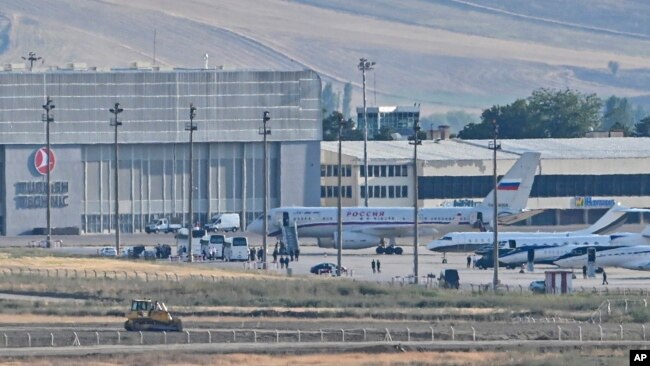
A Russian plane, rear center, believed to be carrying released Russian prisoners, is seen at Ankara Airport, Turkey, Aug. 1, 2024.
Sullivan said the deal also marks the first time so many countries and allies worked together to secure the release of wrongfully detained individuals.
Alongside the Americans, the deal secures the release of German nationals and Russian political prisoners, including Dieter Voronin, Kevin Lick, Rico Krieger, Patrick Schoebel, Herman Moyzhes, Ilya Yashin, Liliya Chanysheva, Kseniya Fadeyeva, Vadim Ostanin, Andrey Pivovarov, Oleg Orlov, and Sasha Skochilenko.
“Some of these women and men have been unjustly held for years. All have endured unimaginable suffering and uncertainty. Today, their agony is over,” U.S. President Joe Biden said in a statement. “The deal that secured their freedom was a feat of diplomacy.”
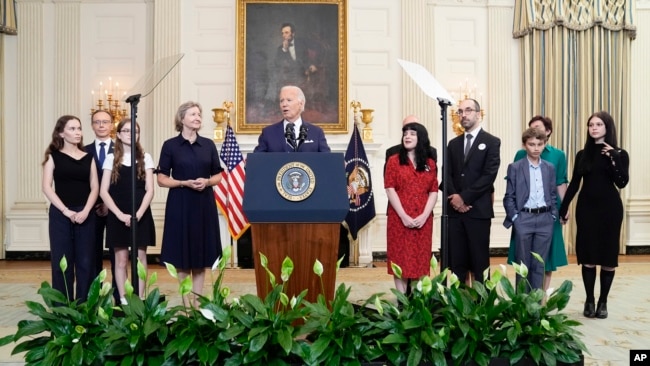
President Joe Biden, center, delivers remarks on a prisoner exchange with Russia, at the State Dining Room of the White House in Washington, Aug. 1, 2024, as family members of some of those swapped look on.
However, former President Donald Trump criticized the deal, saying on Truth Social, “Our ‘negotiators’ are always an embarrassment to us!” He had previously said he would be able to quickly get Gershkovich freed, but without specifying how.
Of the Americans, the longest held was Paul Whelan, a former U.S. Marine, who was arrested in Moscow in 2018. In 2020, he was sentenced to 16 years in a penal colony on spying charges that he and the U.S. government deny.
Wall Street Journal reporter Gershkovich and Radio Free Europe/Radio Liberty journalist Kurmasheva were both detained in 2023 and were convicted in separate closed trials on July 19, which were widely decried as shams.
And Kara-Murza, an activist and columnist for The Washington Post detained since April 2022, was also freed. The politician and historian won a Pulitzer for his letters written from prison.
On the Russian side, the Kremlin negotiated for the release of Vadim Krasikov, a Russian serving life in prison in Germany.
Sullivan told reporters: “It became clear that the Russians would not agree to the release of these individuals without an exchange that included Vadim Krasikov.”
Krasikov was convicted in the 2019 murder of a Chechen dissident in Berlin. He had previously been in the running to be exchanged for opposition leader Alexey Navalny, who died in February 2024.
Other individuals returning to Russia include Artem Viktorovich Dultsev and Anna Valerevna Dultseva from Slovenia; Mikhail Valeryevich Mikushin from Norway; Pavel Alekseyevich Rubtsov from Poland; and Roman Seleznev, Vladislav Klyushin and Vadim Konoshchenok from the United States.
Paul Beckett, an assistant editor at the Journal, who led the newspaper’s campaign to secure Gershkovich’s release, told VOA earlier this year that his colleague’s jailing highlights the dangers facing journalists around the world.
“It’s certainly a reminder for all of our reporters who are in dangerous places that journalism is a risky business,” Beckett said. “It is a noble and valued endeavor that some governments in the world really don’t like.”
Learning that Gershkovich had officially been released brought an array of emotions for Beckett, he told VOA on Thursday.
“Joy, gratitude, tears, smiles — everything at once,” he said. “We’re just delighted for Evan.”
After working on Gershkovich’s case for 16 months, Beckett said he’s looking forward to finally meeting the journalist for the first time. “I’m going to say, ‘Nice to meet you,’” Beckett said.
Gershkovich was jailed in March 2023 on espionage charges that are widely viewed as baseless and politically motivated.
“We are overwhelmed with relief and elated for Evan and his family, as well as for the others who were released,” The Journal’s publisher, Almar Latour, and editor in chief Emma Tucker said in a statement. “Unfortunately, many journalists remain unjustly imprisoned in Russia and around the world.”
Kurmasheva, meanwhile, is a Prague-based editor on the Tatar-Bashkir Service of VOA’s sister outlet Radio Free Europe/Radio Liberty. The dual U.S.-Russian national traveled to Russia in May of 2023 to care for her ailing mother.
When Kurmasheva tried to leave the country in June 2023, authorities confiscated her passports, and she was waiting for them to be returned when she was detained in October 2023.
Kurmasheva had not been designated by the U.S. State Department as wrongfully detained. A senior administration official told VOA, however, that Kurmasheva became part of the negotiations shortly after she was detained, and the U.S. is glad to bring her home.
A similar deal in 2022 led to American basketball player Brittney Griner being freed in exchange for Russian arms dealer Viktor Bout, who was serving a 25-year sentence in the United States.
RFE/RL welcomed Kurmasheva’s release in a statement.
“Alsu was targeted because she was an American journalist who was simply trying to take care of a family member inside Russia. She did nothing wrong and certainly did not deserve the unjust treatment and forced separation from her loving family members and colleagues,” RFE/RL’s president and CEO Stephen Capus said in the statement.
“Alsu’s release makes us even more determined to secure the freedom of three other RFE/RL journalists,” Capus added. Two RFE/RL journalists are currently jailed in Belarus, and one is jailed in Russian-occupied Crimea.
The U.S. Agency for Global Media, which oversees RFE/RL and VOA, also welcomed Kurmasheva’s release.
“This is such incredible news, and I am tremendously thankful to everyone who supported and advocated for Alsu’s release in the wake of Russia's callous injustice,” USAGM CEO Amanda Bennett said in a statement. “Journalism is not a crime. I am elated that Alsu is finally able to go home to her loved ones and close this painful chapter.”
Kurmasheva’s husband, Pavel Butorin, said that since her arrest, his primary concern has been the couple’s daughters.
“They’re old enough to understand the brutality of the regime that captured their mother,” he told VOA in early July at their Prague home. “We dream of our family being reunited after this ordeal.”
The couple’s eldest daughter, Bibi, said she missed the little moments with her mother, like when they blasted music together on the car ride to school in the morning.
“And on the way back home from school, she would always bring snacks, and we would always talk about our day. I really miss that,” the 16-year-old said.
The Biden administration has now helped secure the release of more than 70 Americans who were held hostage or unjustly jailed around the world, Biden said in his statement.
“I will not stop working until every American wrongfully detained or held hostage around the world is reunited with their family,” he said.
At a midday press conference, Biden spoke about the significance of the prisoner swap as the families of the newly released Americans stood behind him. Toward the end, people in the room sang happy birthday to Miriam Butorin, Kurmasheva’s youngest daughter, who will celebrate her 13th birthday on Friday.
“Now she gets to celebrate with her mom,” Biden said. “That’s what this is all about — families, able to be together again, like they should have been all along.