NORTON META TAG

Showing posts with label banks. Show all posts

28 January 2012

Obama Administration And Banks Near Deal On Mortgage Fraud Legal Liability

THE bankers and financial industry leaders that brought the recession to us should not get away with the destruction done to the U.S. and world economy brought on by their greed. no immunity, no slaps on the wrist. They are entitled to fair trials, and the public is entitled to justice. Punishments should be stern, with no pandering to the lifestyle those found guilty of financial crimes are used to. Send them to prison, not "country club" confinement, and fine them to the extent that they are not able to return to their previous wealthy lives. Make them pay for their crimes so it hurts as much as they hurt tens of millions of regular people. Is this agreement a step in that direction, or an out for these criminals? We shall see.....

WASHINGTON -- The Obama administration, state attorneys general, and, perhaps, the nation's largest banks are close to a final settlement on the years-long struggle over allegations of massive foreclosure fraud, according to several sources familiar with the talks. And the final details of the arrangement, according to the source who revealed them, will apparently not preclude prosecutors and regulators from taking legal action against many of the common abuses during the house bubble. It remains to be seen whether all parties will ultimately sign off on the language.
The settlement is worth $25 billion, a sum which will be distributed to homeowners who were wrongfully foreclosed on as well as those who remain underwater. In addition, banks could still face future legal action over 12 specific violations.
According to someone intimate with the negotiations, there will be no legal release of the banks with respect to:
  1. Criminal liability.
  2. Tax liability
  3. Fair lending, fair housing, or any other civil rights claim.
  4. Federal Housing Finance Agency or the GSEs [Fannie Mae and Freddie Mac]
  5. CFPB claims for the period after they came into existence in July 2011
  6. SEC claims
  7. National Credit Union Association Claims
  8. FDIC claims
  9. Federal Reserve Board claims
  10. MERS claims
In addition, the source said, there will be preservation of the vast majority of securitization claims including all claims regarding state pension funds as well as the vast majority of the origination fraud claims from HUD, the VA and the USDA.
According to Mike Lux, who originally reported the settlement for The Huffington Post, the release will be "almost entirely confined to robosigning cases" -- meaning that banks will likely not see further punishment from the states for foreclosure fraud. Robosigning fraud is perhaps the easiest type of misconduct for prosecutors to target.
That said, their legal liabilities on the federal level remain vast, even after handing over $25 billion for homeowner relief.
The announcement is, in some regards, a victory for the few state attorneys general who, over the course of several months, refused to sign off on a quick and limited settlement with the big banks.
"I think it is fair to give [New York Attorney General] Eric Schneiderman and the other progressive attorneys general a lot of credit for holding the line," said a source intimate with the negotiations. "This is a big victory for them."
The announcement comes just two days after President Obama announced the creation of a mortgage crisis unit to be headed by Schneiderman and other prosecutors. Federal claims, such as those that will be permissible under the negotiated settlement, have not been aggressively pursued over the last three years despite widespread evidence of abusive lending. The emergence of the unit as well as the final language of the settlement suggests that the administration is refiguring its approach to future litigation.
The lingering question is whether the banks will sign off on the final language. Agreement from all 50 state attorneys general has also not been finalized. Schneiderman was not the only attorney general who spent months unhappy with the deal, and after Obama's State of the Union speech, Delaware's Beau Biden and California's Kamala Harris reiterated their opposition to the deal as it stood.
Tom Kelly of Chase's media relations office declined to comment. "No input from us," he said.
Schneiderman's office did not immediately respond to a request for comment from The Huffington Post.

24 January 2012

Weekly Wrap: Greece and American banks 20JAN12 & IMF sees rising recession risk from euro credit crisis 24JAN12

HERE is a frightening warning about what may be on the way for the American and world economies. Listen to the story (click the link below the picture) from Marketplace from APR / NPR about the very possible Greek default / bankruptcy and then read the story about the world economy slowing down from the Washington Post......

Weekly Wrap: Greece and American banks


John Carney from CNBC and Felix Salmon from Reuters discuss this week's news on Wall Street and beyond.
If Greece doesn't get a deal:
John Carney: So Greece has, on March 20th, a tremendous amount of debt that's coming due. They do not have the money to pay it off. This will be a gigantic default that would put several European banks in trouble, and we would have an enormous international financial calamity.
Felix Salmon: I don't think it would be that bad, to be honest. Well, it is a default, there's no two ways about it. If you don't pay back $14 billion when it's due, that's a default. The only question is: Will you replace that amount that you owed with something else and keep on paying that, or will you just owe that $14 billion and have that paper be in default?
For more analysis, listen to the full audio above.

About the author

Kai Ryssdal is the host and senior editor of Marketplace, public radio’s program on business and the economy. Follow Kai on Twitter @kairyssdal

IMF sees rising recession risk from euro credit crisis

By

The global economy is slowing sharply and is at far greater risk of recession than was thought just months ago with Europe’s debt crisis creating “fertile ground” for a rapid collapse, the International Monetary Fund warned on Tuesday.
In a sobering trio of reports on growth, public debt and financial stability, the agency described global trade and investment as waning and depicted the world as perhaps one shock away from a serious downturn. The epicenter of the economic turmoil remains the euro zone, where political leaders have not committed the money needed to prop up weakened governments and banks, thereby threatening to create a cycle of “self-perpetuating pessimism” that could undermine the recovery, the IMF said.
Whether the trigger is a government default in Greece, a bank failure or some other traumatic event, “the world could be plunged into another recession,” said Olivier Blanchard, the IMF’s economic counselor. “The world recovery, which was weak in the first place, is in danger of stalling.”
The agency’s latest forecasts suggest the process may be underway. Projected worldwide economic growth for 2012 was trimmed to 3.25 percent from the 4 percent rate forecast in September. China and India, which have become major engines of global growth, are forecast to cool to around 8.2 percent and 7 percent respectively. The IMF projects that the euro zone will fall into recession and contract by about 0.5 percent this year.
The U.S. economy’s projected growth rate has been holding steady at 1.8 percent since September, the IMF said.
The new reports suggest that the world economy is being undermined by some of the policies the IMF has recommended in recent months to address government debt and strengthen Europe’s banking system. Along with other recent reports issued by the World Bank and private organizations, the IMF studies underscore the major quandry facing policymakers in the United States, Europe and elsewhere as they confront high unemployment rates, slow growth and in some cases the threat of public unrest.
Growth is now so precarious, the agency said, that deficit reduction in the United States and stronger European nations such as Germany should take a back seat.
The IMF said the “accident prone” U.S. political system is at risk of pushing too hard on the brakes. If Congress does not renew payroll tax cuts and extend unemployment benefits that are set to expire in February, government spending this year would drop by more than 2 percent of the country’s annual output, “with negative repercussions for the still unsettled economic outlook,” the agency said.
The Obama administration and Republicans in Congress have been battling over whether and how to extend the payroll tax cuts and jobless benefits. IMF officials say they worry that these political fights are distracting the U.S. government from developing a plan to address chronic problems of long-term spending on health care and retirement.
The IMF has begun pushing countries in Europe and beyond to gird for the worst. The agency wants euro zone nations to commit hundreds of billions of dollars to potential bailouts of Italy and Spain. Those countries are forecast to contract sharply next year, with a downturn of more than 2 percent in Italy making it that much harder for its government to meet its spending targets and retain the faith of investors on world bond markets. The IMF also wants to boost its own war chest and is pressing world economic powers to make an additional $500 billion available should it be needed.
The IMF is one of several organizations offering downbeat assessments. The World Bank last week projected even slower worldwide growth, of just 2.5 percent, and also forecast a euro zone recession.
In a separate study released Tuesday, the Institute of International Finance said that the flow of capital into developing nations dropped by nearly 20 percent last year — a worrisome decline that also occurred during the 2008 financial crisis.
The IIF attributed much of that drop to European banks pulling out of investments and lending in Eastern Europe and Asia. This is one of the most direct ways in which Europe’s troubles are affecting the rest of the world. The decline poses particular problems for Eastern European nations such as Hungary and Ukraine which, unlike some countries in Asia, do not have access to local sources of money when French, Italian or German investors disappear.
The downturn in investment is partly the consequence of policies enacted in Europe to try to cope with its crisis. In this instance, European banks are retreating from other parts of the world to comply with stiffer regulations the European Union imposed last year — partly at the urging of the IMF — that require the firms to maintain larger capital buffers against possible losses.
The requirements are combining with government austerity measures to crimp growth.
The speed with which Europe demanded its banks meet the new requirements “is having a drastic negative impact,” said IIF chief economist Philip Suttle. The IIF, which represents the world’s major financial institutions, has been fighting to soften the impact of financial industry regulations crafted after the 2008 crisis.
In its new reports, the IMF shared the concern that Europe’s move to recapitalize its banking system could be damaging.
To limit the fallout, the agency said the euro zone should use taxpayer money from around the region to bolster banks that need help as well — just as euro zone countries are pooling resources to back troubled governments.

21 January 2012

We did it! BB&T bank backs down 17JAN12

HERE is a good news story that shows that when people are united for a just cause victory is possible. BB&T has reached an agreement with the Higher Ground Empowerment Center and renegotiated the church's mortgage to a rate they can afford to pay! Because of a massive public outcry against foreclosure on the church BB&T backed down (see my post on this blog IS NOTHING SACRED? 13JAN12). Thank you to everyone that signed the petition to BB&T!
Rebuild the Dream

Incredible news! More than 65,000 Rebuild the Dream members like you signed a petition to help save a community church from an unfair foreclosure and eviction by BB&T, one of the ten biggest banks in the country. And we did it!
After an intense, 3-hour negotiation today, BB&T backed down and agreed to a fair deal with the Higher Ground Empowerment Center church. This victory was a complete turnaround, led heroically by local activists at Occupy Atlanta and Rainbow PUSH Coalition. The sudden groundswell of media coverage, local community action, and our national petition forced BB&T's hand.
This outcome shows: when we're united, we can stop big banks in their tracks and get them to treat people with dignity. The more banks that have public re-negotiations like this, the bigger the momentum will be for millions of other struggling homeowners who are in the same boat.
Can you let your friends and family know about this victory? It's important to spread the word that when we work together, we can accomplish great things.
Share with Friends and Family
Facebook Twitter Email
This morning, the church met with bank executives at their high-rise office building in downtown Atlanta. After hours of negotiation, the bank agreed to modify the loan to make it possible for the church to pay it back over time. Just as importantly, the bank agreed to transfer the deed of the property back to the church. (The bank had seized ownership of the property last year. This was a critical issue for the church, which could not bear to "rent" a property they had owned for longer than a century.) The bank even agreed to meet with community members in the surrounding Vine City neighborhood next month to discuss ways in which BB&T can invest in the local community.
"Today was a triumph for Higher Ground!" said Senior Pastor Dexter Johnson. "Thank God for Occupy Atlanta! Thank God for Brother Joe Beasley [of Rainbow PUSH Coalition]!"
"BB&T has done the right thing, and we're grateful for that," said Tim Franzen of Occupy Atlanta. "Today is an overwhelming victory for the Occupy Movement and the Vine City Community. We couldn’t have done it without Rebuild the Dream. And this is just the start of a lot of work we must all do for struggling underwater homeowners and property owners across the country."

Thank you to everyone who signed the petition and took a stand for justice and dignity! The petition showed that people across the country were paying attention to BB&T's actions, and added important leverage during the negotiation today.
Tell your friends!
On Facebook | On Twitter | By Email
Rebuild the Dream applauds BB&T's decisions. They should treat all of their customers -- especially those with underwater mortgages -- with the same kind of common sense they showed today. And all banks across the country should do the same, even when the media spotlight is NOT shining on them. Rebuild the Dream will keep campaigning for homeowners and property owners everywhere. The banks got their bailout; NOW LET'S BAIL OUT THE PEOPLE. It will take all of us acting together to win, just like we did with the Higher Ground Empowerment Center church.
Thanks for taking a stand,
Van and the Rebuild the Dream team

22 September 2011

Stand With the Progressive Change Campaign Committee Against Wall Street Immunity 22SEP11

IF the banks hadn't done anything wrong they wouldn't be seeking immunity.....join this petition campaign calling on the states not to give them immunity for the economic crimes they have committed against the nation....


Progressive Change Campaign Committee


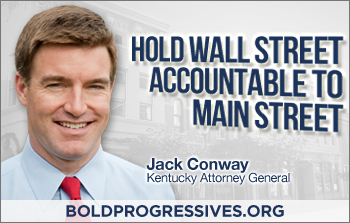
Join Jack Conway and hold Wall Street accountable.
https://s3.amazonaws.com/s3.boldprogressives.org/images/ConwayFight.jpg
Click here to sign the statement.
 
Hi, this is Kentucky Attorney General Jack Conway. I wanted to make sure you heard about an important issue.
The same Wall Street banks whose irresponsible actions led to our nation's economic collapse are now pressuring all 50 states to give them legal immunity. The banks want to block any criminal or civil accountability for actions that have yet to be investigated.
Attorneys General from Delaware, Minnesota, Nevada and New York have been fighting back. Today, I want to make a clear statement in support of Wall Street accountability and against immunity for banks -- and I ask you to join me on this statement:
"Today's economic crisis was caused by Wall Street acting improperly. Every American has paid the price -- with families losing their homes, investors losing their money, and many Americans losing their jobs. There should be absolutely no criminal or civil immunity given to banks for activity that has not yet been investigated." 
Frankly, all elected leaders owe it to their constituents to take this position. If we speak up together, more and more of them will. Sign here.
Today, by adding my voice to this issue, along with the Progressive Change Campaign Committee, we are adding momentum to the fight for Wall Street accountability.
These next couple weeks are critical. Key meetings and discussions will determine if Wall Street banks get immunity -- regardless of what they may or may not have done.
Together, we can hold Wall Street accountable to Main Street. Thanks for being a bold progressive.
-- Kentucky Attorney General Jack Conway


Named The Nation's "Most Valuable Online Activism of 2010"—thanks to you. Help us continue our effective, independent progressive activism. Chip in here.


Paid for by the Progressive Change Campaign Committee PAC (www.BoldProgressives.org) and not authorized by any candidate or candidate's committee. Contributions to the PCCC are not deductible as charitable contributions for federal income tax purposes.

15 May 2011

Has Elizabeth Warren Won Over the Banks? 6MAI11

THE appointment of Elizabeth Warren to head the CFPB, and her approval by the Senate will be one of the shinning moments of the Obama administration because it will be an example of government doing what is needed for the people and the banking industry without the influence of of politics. Elizabeth Warren is nobody's puppet, she is actually committed to doing the best she possibly can for the nation. Oh that her morals and courage and commitment could be cloned!!!! From Mother Jones....
Industry reps who once thought she was "akin to the Antichrist" now can't stop praising the consumer protection chief. What gives?
On her first day running the new Consumer Financial Protection Bureau (CFPB), Elizabeth Warren met with a group of bankers from her home state, Oklahoma. Going into that meeting, Roger Beverage, president of the Oklahoma Bankers Association, feared the havoc Warren, who had developed a reputation as a fierce consumer champion, would soon wreak upon his state's banks. He and his colleagues in the banking industry, he recalls, "had this vision that she was akin to the Antichrist."
Today, Beverage considers himself a Warren convert. He openly praises Warren—who was appointed by the White House to get the bureau up and running but has not been nominated to head it—saying she is "far and away" the most qualified person to become the bureau's permanent director. "Ms. Warren has demonstrated that she is willing to work as hard as possible for the benefit of consumers, consumers' families, and community banks," Beverage says. "She would be an outstanding director, and I have encouraged both of our US senators to look past political rhetoric and look at what the woman has done."
Beverage's reversal reflects a noticeable thaw in relations between Warren and parts of the banking industry. This week, Camden Fine, president and CEO of the influential Independent Community Bankers Association, told a gathering of 1,000 bankers that the odds Obama would nominate Warren were "better than even," later remarking to American Banker that "you would have to look favorably on a [Warren] nomination because clearly she understands our model." Frank Keating, the head of the American Bankers Association, told a reporter that the ABA would support Warren if she were confirmed as CFPB director by the Senate. And Robert Palmer, who heads the Community Bankers Association of Ohio, captured the mood of small banks when he told Bloomberg Businessweek that if Warren "leaves, and the direction changes, we're not going to be very receptive."
While Warren's nomination was too-toxic-to-touch mere months ago, the momentum of the past few weeks could be enough to convince the White House to tap her for the job. Whomever Obama picks, he'll need to do it soon: The deadline for having a permanent CFPB director in place is July 21, according to the Dodd-Frank financial reform law. But no matter who the nominee is, he or she faces massive opposition in Congress, with Republicans maneuvering to block not just Warren but any CFPB nominee if their demands to weaken the bureau are not met.
The warming to Warren is due, in large part, to a months-long outreach campaign aimed at members of the banking industry. According to calendars posted on the CFPB's website, Warren's schedule has included 150 appointments with industry officials since her first day in September—phone calls, in-person meetings, industry conference speeches, even visits to local bank branches. She's spoken with everyone from Bank of America CEO Brian Moynihan to the head of the American Bankers Association to community bankers in states from Maine to Texas.
The charm offensive appears to be paying off—and at precisely the right time.
Michael Grant, president of the National Bankers Association, which represents more than 100 minority- and women-owned banks throughout the country, is another fan. He met with Warren in February and says he would support her as the nominee to run the CFPB because of her "genuine concern for protecting the rights for consumers and for her appreciation of the role banks play in the financial infrastructure of this country." Grant adds, "She's a win-win both for our industry and for the consumer if she is nominated and made permanent chief."
Paul Hickman, president and CEO of the Arizona Bankers Association, says he, too, came away impressed after he and a group of Arizona bankers and business leaders met with Warren in Washington. A former staffer for Sen. John McCain (R-Ariz.), Hickman says Warren went a long way toward allaying the industry's fears of a consumer bureau run amok that would slap banks with new regulations and bury them in paperwork. "I thought Elizabeth Warren did a really good job of letting the members of that meeting know, and the business people of Arizona know, that her mission was not to somehow suppress community banks," Hickman recalls.
But for some state banking chiefs, Warren's outreach has changed their mind about her but not about the CFPB itself. George Beattie, president and CEO of the Nebraska Bankers Association, told Mother Jones last fall that, in his view, Warren simply didn't understand community banks. Today, he's more positive about Warren, noting her "better appreciation for what banks in this country do for their communities." He worries more about having a single director run the CFPB, whether that's Warren or not. Beattie says he'd prefer a panel of directors run the bureau, like the Securities and Exchange Commission, though he ultimately thinks the bureau should be scrapped altogether. "The congress has created an exceedingly strong governmental agency with little oversight," he says. "I think that's a bad thing for this country regardless of who runs it."
House Republicans agree with Beattie. On Thursday, a House financial services subcommittee passed a trio of bills that would replace the single director with a bipartisan five-person commission, give a separate council of financial regulators veto power on new regulations by the bureau, and restrict the CFPB's power until the Senate confirms Obama's nominee to be director. So, too, do Senate Republicans. Earlier this week, they sent a letter to Obama saying they'd oppose any CFPB nominee until the bureau's power was scaled back.
To be sure, huge hurdles remain between Warren and the nomination. Republicans in Congress almost universally oppose her nomination. (She has, however, earned tepid praise in the past from Senate GOPers including Chuck Grassley of Iowa and Bob Corker of Tennessee.) At this point, Senate GOPers appear to willing to do anything to undermine the CFPB and prevent a strong consumer advocate like Warren from becoming its director, and it's becoming increasingly difficult to see how GOPers' demands will be met and a nominee confirmed before the July deadline. And of course on Wall Street, she has no shortage of enemies among the nation's largest banks.
But even if Warren only wins over some bankers and not others, leaving the industry conflicted on her nomination, that could actually be a victory. "There was universal opposition to Dodd-Frank," says a person who's worked closely with Warren in the past. "There was universal opposition to Warren getting the bureau started. At the end of the day, if the banking industry is fractured on her nomination, that's just fine."
Andy Kroll is a reporter at Mother Jones. For more of his stories, click here. Email him with tips and insights at akroll (at) motherjones (dot) com. Follow him on Twitter here. Get Andy Kroll's RSS feed.

07 January 2011

The Great Middle Class Swindle 7JAN11

IF you're like me then you are more than a little disgusted over the increasing wealth of the already very rich and the stagnation and even decreasing income of the poor, the working class, and the middle class in this country.....and you are frustrated because you aren't quite sure who is responsible. In my opinion start first by looking in a mirror.....too many lower and middle class Americans are ignorant by choice about the real motives of the politicians they elect to their local, state and federal governments. They choose to believe the propaganda of these people playing on individual fears, prejudice and greed, hiding the fact that their real loyalty is not to the electorate but to the greedy wealthy and corporate interest who pay for their campaigns and who own them in office. Once elected they continue their manipulation and propaganda campaigns, doing their best to keep the American people divided, fearful of their neighbors or those other people who don't really want to work to get what they have but want it handed to them....you know, those other people who don't look like most of us, who don't speak like most of us, who don't worship like most of us.......And while running these propaganda campaigns, spreading the fear and anger against those other people who want to take away the hard earned gains of the working class and middle class, these politicians have and are attacking and destroying  the labor laws and pay scales as well as the government regulations that created, nurtured and protected the once growing (now shrinking) middle class and gave hope to the poor and working class in our nation. This will continue as long as people continue their self destructive voluntary ignorance and continue to elect politicians bought and paid for by the wealthy and corporate America. From Mother Jones....
Matt Yglesias isn't buying my story that skyrocketing Wall Street earnings—and the skyrocketing incomes of the super-rich in general—are basically coming out of the pockets of the working and middle classes:
I think what Kevin’s story keeps missing is a plausible causal account of how a tiny number of financiers have been able to hoover up money from the median wage earner....I can tell you a story about how a tiny number of financiers have been able to hoover up money from the broad class of rich people in the 80th-99th percentile who own the bulk of the financial assets in the country by swindling them. I can tell you a story about how a tiny number of financiers have been able to hoover up money from the broad class of rich people via the income tax and “bailouts.” But the median wage earner seems harder to me.
....Here’s another story. A lot of the median wage earner’s money has been hoovered up by the health care system. If we had single payer health insurance in the United States then increases in per capita health care spending would exhibit themselves as higher taxes....The last part of my story is monetary policy. It used to be the case that monetary policy errors were two-sided. Sometimes wages grew too fast (inflation) and sometimes they grew too slowly (recession), but since 1980 we’ve only ever erred in one direction and experienced three labor market recessions and zero outbursts of inflation.
As it happens, swelling health care benefits aren't enough to account for more than a small amount of middle class income stagnation over the past three decades. The arithmetic just doesn't work out. But Matt is right that the weakest part of my story is coming up with a good causal account of how the top 1% sucked up so much money from the middle classes. But I think it's a mistake to get overly wonky and look for some kind of geometric proof of how this happened. You're just never going to get that. You're never going to be able to point to a specific policy at time X that caused a specific transfer of income share at time Y.
As another blogger put it, "It’s as if the major banks have tapped a hole in the social till and they are drinking from it with a straw." Except it's not just the banks. It's their super-rich clients, too.
Still, I don't think that a plausible story of causation is really all that hard. First, take a look at middle class income stagnation. What caused that? Matt already pointed to one cause: monetary policy since the late 70s that's kept inflation low at the cost of keeping labor markets persistently loose. To that, I'd add several other trends that have marked the past three decades: trade policies that accelerated the decline of U.S. manufacturing; domestic deregulation policies that squeezed workers; stagnation in the minimum wage; immigration policies that reduced wages at the low end; and a 30-year war against labor that devastated unions and reduced the bargaining power of the working class.
On the merits, you can argue for or against any of these individual policies. But there's very little question that collectively they are (a) policies strongly promoted by business interests and the rich, and (b) they suppressed middle class wages. Note that a few of these policies are global in nature, which explains why some other advanced countries also saw a certain amount of middle-class wage stagnation, but that all of them were promoted very aggressively in America, which explains why we saw more of it than most countries.
Now, if these policies hadn't been in place, middle class wages would likely have grown at about the same rate as the overall economy—just as they did in the postwar era. But they didn't, and that meant that every year the money that would have gone to middle class wage increases instead went somewhere else. It was a vast and steadily growing pool of money, and the chart on the right gives you an idea of its size by 2005. It comes from Jacob Hacker and Paul Pierson, and it shows how much income would have gone to different groups if their income had grown at the same rate as the broad economy. The bottom 80% lost $743 billion by growing more slowly. The top 1% gained $673 billion by growing more quickly. That's a pretty close match. And the upper middle class, in the 80th-99th percentile? They did OK but not great, posting a net gain of $126 billion. In other words, the well off mostly don't seem to have suffered at the hands of the super rich. Instead, the money gained by the top 1% seems to have come largely from the bottom 80%.
But what's the mechanism? What are the policies that allowed this pool of money to flow into their hands? Again, you can point to several things. Just to name a few: reduced high-end marginal tax rates on income and capital gains; relentless financial deregulation; weak antitrust enforcement leading to industry consolidation; the emergence of high-speed trading profits available only to well-connected financial firms; crippling of the IRS's ability to audit high earners; and the ability of the rich to make big financial bets backstopped by government bailouts. All of these are policies promoted largely by business interests and the rich.
There's no indisputable smoking gun here. As I said, you're just never going to get that. What we have, however, is still very, very suggestive. The argument goes like this. (1) For three decades we've had wage suppression in the middle classes, largely as a result of policies promoted by the rich. (2) Conversely, the well off in the 80th-99th percentile have mostly kept up. Their incomes haven't skyrocketed, but they've done fine. (3) The aggregate pool of money lost by the middle class is suggestively similar to the amount gained by the super-rich. (4) A wide variety of policies have coalesced that have allowed the super-rich to funnel this money in their own direction. As Tyler Cowen put it, "It’s as if the major banks have tapped a hole in the social till and they are drinking from it with a straw." Except it's not just the banks. It's the banks and all their super-rich clients.
 

30 December 2010

Wall Street's Ten Biggest Lies for 2010 29DEZ10

BROUGHT TO YOU BY THE GOP, TEA-BAGGERS AND THE GREEDY PIGS OF REPUBLICORP AND THE MILITARY-INDUSTRIAL COMPLEX....
What a great year for Wall Street: profits up, bonuses up and, best of all, criticism down, especially from Washington. Somehow Wall Street has much of America believing its lies and rationalizations. We're even beginning to forget that Wall Street is largely responsible for the economic mess we're in.
So before we're completely overtaken by financial Alzheimer's, let's revisit Wall Street's greatest fabrications for 2010. (For the full story, please see The Looting of America.)

1."Honest, we didn't do it!"
Two years ago Wall Street's colossal greed crashed our economy. Our financial elites created and spewed highly leveraged toxic assets around the globe. These poisonous "innovations" pumped up the housing bubble and Wall Street grew insanely rich in the process. When it all burst, we learned that the big Wall Street institutions that had caused the crash were far too big to fail -- and too connected. High government officials came to their rescue with trillions in cash and guarantees -- underwritten, of course, by we taxpayers. Everyone knew this at the time. But if you asked just about anyone on "The Street" they denied all culpability and pointed the finger everywhere else: Fannie, Freddie, the Fed, the Community Reinvestment Act, tax deductions for home buying, bad regulations, not enough regulations, too many regulations, too much consumer debt, the rating agencies, the Chinese -- and on and on. Sadly, their blame-shifting strategy worked, bamboozling the media and people across the political spectrum. The GOP members of the Financial Crisis Commission are so drunk with this Kool-Aid that in their minority report, they refuse even to use the words "Wall Street" or "speculation" in assessing the causes of the crash. Hypocrites? Crooks? Morons? Take your pick.
2."The overall costs will be incredibly small in comparison to almost any experience we can look at in the United States or around the world."
Ever since Treasury Secretary Timothy Geithner screwed up his tax returns we knew he was numerically challenged. But his statement to Congress on December 16, 2010, on the cost of the bailout shows a willful inability to count. Yes, Wall Street has paid back most of our bailout funds. Whoopee! Our economy is in shambles, and millions of people are suffering. With his offensive "no big deal" analysis, Geithner glosses over all this human misery, and sidesteps the hidden costs of the bailout, including the financial insurance we taxpayers provided to every giant financial company in the country via the Fed. On the open market, that insurance -- which guarantees trillions of dollars in toxic assets -- would come at a very steep price. We coughed it up for free. But that's still chump change compared to the human costs of the worst employment crisis since the Great Depression -- the lost income, the depleted savings, the ravaged neighborhoods. Then there's the capsized state and local budgets, the public service reductions, the laid off teachers, firefighters and police officers -- all resulting from a plunge in public revenues caused by Wall Street's crash. Why aren't these costs on Geithner's balance sheet? A cynic might think Tim was priming us to accept the latest round of Wall Street bonuses. Hey -- they paid us back, so why should we care how much they earn?
3. "It's a war. It's like when Hitler invaded Poland in 1939."
Steven Schwarzman is supposed to be brilliant. After all, he made billions as head of the Blackstone Group, a private equity company and hedge fund. But last August, as some members of Congress mulled about eliminating a very lucrative tax loophole, he suffered a mental meltdown and saw an impending Nazi invasion. But the awful attack never happened. Schwartzman and his fellow hedge fund honchos all held onto their unbelievable tax break: Hedge fund and private equity income is still only taxed at 15 percent rather than at the top income tax rate of 35 percent. (That's because, inexplicably, it's considered "capital gains," not income.) Taxing Schwartzman's income as income would cost him hundreds of millions of dollars -- and the prospect of this apparently triggered a shock spasm that catapulted his foot into his mouth. I'm sure my IQ isn't high enough to keep up with the genius logic behind Steve's analogy. But just who is Hitler and who is Poland in his scenario? Maybe in his grandiose conceit, his firm is as big as Poland? Or it would require a Blitzkrieg to wipe out his tax loophole? In reality, even if Schwarzman had to pay a 90 percent tax rate (as he would have under Eisenhower), it would hardly have been a hardship -- let alone World War 3. He'd still have more money than he could ever spend in his lifetime. Schwarzman should be proud though: He gets 2010's Dumbest Wall Street Quote of the Year Award. Bravo! (In 2009 the honor went to Lloyd Blankfein, CEO of Goldman Sachs, who claimed he was "doing God's work."
4. "The hard truth is that getting this deficit under control is going to require some broad sacrifice, and that sacrifice must be shared by employees of the federal government."
But not by Wall Street. President Obama words of November 29th came only days before he "compromised" with the Republicans to continue the Bush tax cuts for the super-rich and to bestow an enormous estate tax gift to the 6,600 richest families in America. Mr. President, the "hard truth" is that you're slapping around public sector workers because you don't have the nerve to take on Wall Street. If you had the guts, you could raise real money by going to war with Steven Schwartzman and eliminating the hedge fund tax loophole. By the way, closing that loophole for just the top 25 hedge fund managers would raise twice the revenue than you'll get by freezing the wages of all two million federal workers! (See "The Wall Street Tax Debate that Never Was" )
5. "25 hedge fund managers are worth 658,000 teachers."
Nearly everyone on Wall Street sincerely believes that they are "worth" the enormous sums they "earn." You see, their pay is determined by the market, and markets don't lie. They reflect the high value our skilled elites bring to the economy. So we shouldn't be shocked that the top 25 hedge fund managers together "earn" $25 billion a year, even at a moment when more than 29 million Americans can't find full-time work. The outrageous economic logic of Wall Street compensation has those 25 moguls taking home as much as 658,000 entry level teachers (they earn about $38,000 per year). How can that be justified? It can't. These obscene "earnings" are the product of 30 years of financial deregulation, as well as the tax cuts and tax loopholes that our government has just extended. The hedge fund honchos get most of their money by siphoning off wealth from the rest of us, not by creating new value. I dare Wall Street to prove otherwise.
6. "To bolster the economy we need .... an improvement in the relationship between business and government (the current antagonism, even if not the primary explanation for slow hiring and sluggish investment, does seem to be affecting hiring and other business behavior)."
In this op-ed, Peter Orszag, Obama's former budget director, parrots the Wall Street line that employers aren't hiring because of "regulatory uncertainty." Mother of God, how much more certainty do they want? The Republicans and Blue Dog Democrats aren't about to let Obama seriously regulate Wall Street, even if he wanted to, which he doesn't. The truth is that employers aren't hiring because there's insufficient consumer demand for goods and services. But at least Peter Orszag is a man of his word. He personally plans to "improve the relationship between business and government" by tapping his government contacts at his new fat job at Citigroup, the nearly failed mega-bank that he helped to save at taxpayer expense. Orszag could have landed a coveted professorship at just about any university in the world. But apparently the 42-year-old wiz kid prefers Citigroup's multi-million dollar compensation package. Any bets on how long it takes for Larry Summers to cash in?
7. "Lengthened availability of jobless benefits has raised the unemployment rate by 1.5 percentage points."
You see, the unemployed cause their own unemployment, at least if you believe this assessment from a March 17th research note from JP Morgan Chase. (Next, Wall Street will call for a return of the Poor Houses.) The theory is simple -- you give people money not to work and they won't look for jobs. Still, it takes chutzpah for JP Morgan Chase, the beneficiary of billions of dollars in taxpayer largess, to criticize the unemployed for not finding jobs that aren't there, precisely because JP Morgan Chase helped to destroy them! Dear JP Morgan research staff: Five to six workers are now competing for every available job. If that's too complicated for you quants to grasp, maybe you should try a game of musical chairs in the trading room.
8. "Private employers, led by our revitalized financial sector, will create the jobs we need -- that is, if the government would just stay out of the way."
We now need 22 million new jobs to get us back to full employment (5 percent unemployment). In addition, each month the economy must generate another 105,000 jobs just to keep up with new entrants into the workforce. To get to full employment, the private sector would have to create about 630 firms the size of Apple (35,000 employees each). These numbers don't lie. Does anyone on Wall Street really believe that the private sector alone can pull off this miracle? But really, why should they care? They've got theirs, thank you very much. The painful truth that both Wall Street and Washington refuse to face is that if the big, bad government doesn't fund or create millions of new jobs, we'll face crippling unemployment for decades to come.
9. "Tim Geithner extolled 'the benefits of financial innovation' to the American economy." (Wall Street Journal, August 4, 2010)
Sorry to beat up on Tim again, but it's sometimes hard to tell who he's working for. Whenever you hear the phrase "financial innovation" put your hand on your wallet. That's the phrase Wall Street uses to justify its casinos and its outlandish profits and bonuses. People who talk about "financial innovation" are either getting big bucks on Wall Street, want more bucks on Wall Street, or hope to get a job on Wall Street the nano-second their public service ends. My question for Tim is: If Apple creates iPhones, what does Wall Street create? Warren Buffett says it creates "financial weapons of mass destruction." Paul Volcker, Reagan's Fed Chair, said there is not a "shred of evidence" that "financial innovation" is beneficial. Volcker also believes that the economy "was quite good in the 1980s without credit-default swaps and without securitization and without CDOs." Volcker gets the Smartest Wall Street Quote of the Year Award: "The most important financial innovation I've seen in the last 25 years is the automatic teller machine." How could Tim get it so wrong?
10. "I'm shocked, shocked to find that gambling is going on in here." Okay, okay, Claude Raines said that in Casablanca, not on Wall Street. But Wall Street and its defenders say exactly the same thing about their opaque derivatives games. Louise Story's excellent piece in The New York Times shows how a handful of banks have cornered the market clearinghouses for derivatives - entities that are supposed to make derivatives less risky. The big banks are limiting competition, according to Story, because they "want to preserve their profit margins, and they are the ones who helped write the membership rules." Meanwhile, Wall Street is quietly pushing to exempt its most profitable derivatives from even these rigged exchanges. So don't be "shocked, shocked" when Wall Street crashes again and we're asked to foot the bill. And that's when, not if.
*****
Dear Readers, here's to a Happy New Year and a more just 2011. Many thanks for all your support.
Les Leopold is the author of The Looting of America: How Wall Street's Game of Fantasy Finance destroyed our Jobs, Pensions and Prosperity, and What We Can Do About It Chelsea Green Publishing, June 2009. He is currently working on a new book, How to Earn $900,000 an Hour: The Rise of Wall Street Billionaires and the New Class War, (hopefully to be published in 2011).

11 November 2010

Could Wall Street's Favorite Dem Head Obama's Consumer Bureau? from MOJO 8NOV10

HERE'S hoping this is just one of those ugly Capital Hill rumors.....but if it isn't then Pres. Obama has decided to create what will be an ugly fight with the progressive community, one we will be determined to win.
Not only is rumored CFPB candidate Melissa Bean as industry-friendly as they come, but her ex-chief of staff has lobbied for finance reform's biggest enemies.
Will President Barack Obama appoint Wall Street-friendly Rep. Melissa Bean (D-Ill.) to head the new Consumer Financial Protection Bureau? If so, that would be bad news for reformers, who are appalled by the prospect—but good news for John Michael Gonzalez, a leading lobbyist for Big Finance. Before becoming one of Washington's top influence peddlers on behalf of financial firms and trade groups, he was Bean's chief of staff.
According to Politico, Bean, a congresswoman representing northern Illinois who trails in the vote-counting in her close reelection race against Republican Joe Walsh, is under consideration by the White House for this new position, heading up the agency that consumer finance advocate Elizabeth Warren is now constructing.
Bean's campaign would neither confirm or deny whether she's under consideration for the CFBP job. "This race remains too close to call, and we are staying focused as this election process continues," says Bean spokeswoman Gabby Adler.
Bean, a member of the House financial services and small business committees, has a long history as a favorite of Wall Street. Her top donors hail from the finance, insurance, and real estate industries, which together have poured $2.5 million into her campaign coffers over her five-year career, according to the Center for Responsive Politics. In the 2008 elections, Bean bagged more money from the Chamber of Commerce, which vehemently opposed the Dodd-Frank bill, than any other House incumbent. And among the top contributors to her 2010 reelection campaign were JPMorgan Chase, Goldman Sachs, and Allstate Insurance, all of which sought to weaken aspects of the Dodd-Frank financial reform bill that established the Consumer Financial Protection Bureau.
"The White House needs to beat back the Bean idea, otherwise they'll look like fools," says one Democratic strategist. "This is the craziest thing I've ever seen. She's a tool of the financial industries."
Bean ultimately voted for the Dodd-Frank financial reform bill, but she tried to water down a crucial piece of the bill involving consumer protection laws. The bill initially gave state financial regulators the power to write tougher consumer protection statutes than those at the federal level. Bean, though, offered a provision backed by big banks and the Chamber of Commerce that would've exempted national banks from those tougher state laws, in effect neutering the states' new oversight powers. Bean was also one of six Democrats to oppose taxing bonuses at government-owned AIG, and she opposed auditing the Federal Reserve. "We're very connected to the business community and very much appreciate the importance of their success to our overall economic recovery," Bean said in March 2009. "We are trying to champion their issues and concerns."
And there's one more matter to anger reform advocates and liberal bloggers: her close connection to Gonzalez. From 2005 until last year, he was Bean's chief of staff. He flew through the revolving door and is now a lobbyist at Peck, Madigan, Jones, and Stewart, a major Washington lobbying firm. There, he's lobbied for such heavyweights as the Business Roundtable, a financial services trade association; Deutsche Bank; Mastercard; the International Swaps and Derivatives Association; and the Chamber of Commerce. For the Chamber, Gonzalez's firm worked to exempt national banks from tougher state consumer protection laws—the same issue Bean championed. Reform advocates would certainly not fancy Gonzalez helping Bean run the CFPB—or having the ear of its first chief.
According to federal lobbying records, Gonzalez has been registered to lobby House and Senate lawmakers on most major financial reform efforts of the past year that have been opposed by Big Finance: increasing regulation of the $600 trillion over-the-counter derivatives market; beefing up shareholder control of executive compensation; creating the new consumer protection agency; and preventing banks from becoming too big to fail. The companies and associations he's represented are hardly pro-reform types. All of Gonzalez's financial clients sought to water down, if not outright defeat, the Dodd-Frank financial reform bill and other consumer-friendly legislation.
Gonzalez's bio at the website for Peck, Madigan, Jones, and Stewart depicts him as a keen Democratic operative. In 2006, it notes, he "successfully planned and executed a winning reelection strategy, raising $4.3 million and earning the most support for any incumbent from the US Chamber of Commerce." This led the House leadership to tap him to work on its incumbent protection program. In 2007, he helped Bean coordinate a superdelegate operation in the House for the Obama campaign. National Journal cited him as a favorite of Rahm Emanuel, and he helped pass the TARP bailout in late 2008.
According to ProPublica, Gonzalez was the moderate Democrats' go-to guy when the financial sector was collapsing in 2008:
Three days after Lehman Brothers collapsed in September 2008, the New Democrats [coalition in the House] unveiled a financial-reform working group co-chaired by Melissa Bean. The group was piloted by John Michael Gonzalez, Bean's chief of staff, who left four months later to lobby for several banks and financial-services trade groups.
Recently, Gonzalez—referring to lobbyists who work on campaign staffs—told Roll Call: "Nobody wants the Brooks Brothers Brigade out there campaigning for you." The question for the Obama White House is whether they want to put in charge of consumer financial protection a politician who has accepted large amounts of money from this brigade—and whose former chief of staff lobbies on the brigade's behalf.
David Corn is Mother Jones' Washington bureau chief. For more of his stories, click here. He's also on Twitter and Facebook. Get David Corn's RSS feed.
Andy Kroll is a reporter at Mother Jones. For more of his stories, click here. Email him with tips and insights at akroll (at) motherjones (dot) com. Follow him on Twitter here. Get Andy Kroll's RSS feed.

05 November 2010

Banks and Populism 4NOV10 from MOJO

REPUBLICORP'S TAKEOVER OF THE GOVERNMENT BEGINS...This should not be a surprise to anyone, after all, gop and tea-bagger supporters voted to protect the shareholders of the banks and financial institutions of wall street, didn't they? See my earlier postings on this blog, 'ARE THE TEA PARTIERS BEING TAKEN FOR A RIDE?' 30OKT10, 'REPUBLICORP, BUYING DEMOCRACY ONE RACE AT A TIME' 23OKT10, 'OFFICIAL REPUBLICORP MERGER' 12OKT10. This from MOJO.....
Spencer Bachus, who's likely to be the new chairman of the House financial services committee, wants to go through the financial reform bill "page by page" and gut its toughest provisions, including the Volcker rule, which bans proprietary trading. The Financial Times explains:
Underlining the change in Congress, Mr Bachus, who as ranking Republican on the committee could replace Barney Frank as chairman of the panel, expressed concern that shareholders of Goldman Sachs and JPMorgan Chase will be hurt because the banks will be less profitable.
Kudos for honesty, I guess. No shilly shallying here about how this is bad for consumers or bad for America or anything like that. It might hurt Goldman Sachs shareholders, so the Volcker Rule has to go.
This is one of the great political triumphs of our day. Right-wing opposition to healthcare reform I get. Liberals and conservatives have been fighting over national healthcare for a century. But opposition to modest banking reform? In the wake of the most catastrophic financial failure since the Great Depression? It's mind boggling. Somehow, all those tea partiers who are mad as hell at Wall Street and aren't going to take it anymore have been persuaded to believe that financial reform is a gigantic socialist/statist conspiracy to....what? I'm not even sure. But they're mad about it and think Bachus is doing the Lord's work by trying to repeal it. If you ever needed any evidence that the tea party movement is largely in thrall to all the usual Republican power centers, this is it. How else can you explain why a plumber in Dubuque is convinced that a bill to rein in Wall Street excesses is really a socialist ruse to allow Barack Obama to take over the banks?

09 October 2010

Good TARP News Doesn't Fit; Media Are Flummoxed 4OKT10

HERE'S an update on TARP, actually the end of the TARP program, and the facts about what it did and how much it actually cost. Too bad the gop and the tea-baggers continue to deceive the American electorate about who brought about the need for the TARP program, who voted for the program and who benefited from it. 
Sept. 10, 2009: A protester holds a sign as Treasury Secretary Timothy Geithner testifies about TARP
Mark Wilson/Getty Images A year ago, TARP was a clear villain -- as when this protester appeared on Capitol Hill when Treasury Secretary Timothy Geithner was preparing to testify. Many in the news media haven't caught up with the more recent better news about the program.
What do we do with the end of TARP?
And what do we do with the news that TARP will not have cost anything like the $700 billion we thought it would? What if it really cost $50 billion, or less?
What if, in the end, the Troubled Asset Relief Program so controversial at birth and vilified throughout its two years of life turns out to have turned a profit for the government and the taxpayer?
We — most of the news media this is — simply don't know what to do with this news.
  The suggestion that TARP did not blow a hole in the federal budget potentially blows a hole in some other presumptions as well. Economists will argue for years over the necessity of TARP, and the rest of us can argue over the bonuses investment bankers still got (and continue to get).
But we won't argue about whether the government could or should have done more to prevent the collapse of the credit markets and the mass failure of banks in 2008. Because the government did do TARP, and those other things did not happen. We did not go back to 1929 or worse. And, unlovely as it may be, TARP remains the closest thing we have to an explanation for that.
Still, the expiration of the program as Sunday turned to Monday passed largely unremarked. And insofar as the media have noticed the story of TARP's apparently much-reduced cost, that tale has been anything but ballyhooed.
(For an exception, see the package offered Sunday evening by Guy Raz and the crew at Weekend All Things Considered.)
On the last business day before TARP expired, The New York Times and The Washington Post did report the much-reduced cost figures — mentioning the potential for the program to actually make money for taxpayers in the final accounting.  But the Times put the story in the Business Section, and the Post played it on the Federal Page.
Their judgment may well have been affected by the fact that the numbers available were coming from the White House, which is obviously interested in defending a program President Obama voted to create and administered once in office.
But it's also apparent that the TARP-as-hero story does not fit well with the TARP-as-Beelzebub narrative that has been so strong throughout this election year.
And narratives matter. Nothing is more central to journalistic practice than the telling of stories. Stories are how we capture, comprehend, explain and deliver the news. Without stories, we would be wandering lost across the landscape of events and sensations. We need a narrative, or we have no organizing idea.
This imperative applies not only to each day's events, but to the broader sweep of occurrences in succession. We need a narrative for each week, each month and each fiscal year. We need a narrative for every electoral cycle.
And once we have established such a narrative, everything is under control.  Everything, that is, except whatever fails to fit the narrative.
And in 2010, there's been no clearer story line than the toxicity of the Toxic Asset Relief Program. It's a burden for many a Democrat, of course, but its weight is being borne by many Republicans as well.
Lifelong conservatives with careers of faithful adherence to free market principles have seen those careers wrecked this year, and no issue looms larger in their downfall than TARP. We are not just talking about moderate Republicans like Rep. Mike Castle in Delaware, or moderate-to-conservatives such as Sen. Lisa Murkowski in Alaska. We are talking orthodox conservatives such as Sen. Robert Bennett of Utah and South Carolina Reps. Bob Inglis and J. Gresham Barrett.
Thus we are confronted with a problematic moment just now in the telling of the tale of the 2010 elections. We know we have a firm grasp on our narrative, which has been fixed for months: The Democrats are in deep, deep trouble because of high unemployment and a perception of government overreach and government interventionism — symbolized by the health care law and the bailouts. And it all started with TARP.
Part and parcel of this overarching narrative is the anger of the populace at the persistent effects of the recession. Even if economic growth has resumed — at least in a stingy and stubborn sort of way — the recovery is not sprouting jobs the way a good recovery should. And while Ronald Reagan held down his party's losses in the 1982 midterms by blaming that year's persistent unemployment on his predecessor, Barack Obama and his majority Democrats have not been nearly so effective in pushing the same message.
Right now, the narrative is running so strong that when a coalition of unionists and other activists on the left marches in Washington — as happened this weekend — the media characterize the gathering largely by comparing its size and tone to Glenn Beck’s Tea-flavored rally of a month earlier. "Marchers say we're angry too," shouted one headline.
There you have it.  In the year of the Tea Party you must be angry or be forgotten. That's how you make yourself part of the narrative.

Related NPR Stories

09 September 2010

Elizabeth Warren Makes Another White House Visit 9SEP10

WE can only hope this is a good sign, and that Pres. Obama is going to stand up to the greedy bankers and financial institutions and appont Elizabeth Warren for the good of the people and the nation.
 
WASHINGTON — Elizabeth Warren, a popular but polarizing consumer advocate, met with President Barack Obama at the White House Tuesday, adding to speculation she could be named to head a new consumer protection agency.
Warren also met with senior administration officials last month. However, White House spokeswoman Amy Brundage said other candidates are still being considered and that no decision has been made on who will lead the agency, which was created under terms of the financial overhaul bill Obama signed into law earlier this year.
The agency will have vast powers to enforce regulations covering mortgages, credit cards and other financial products. Consumer advocates and labor groups want Obama to nominate Warren to lead the agency, but she has little support within the financial community and her nomination could set the stage for a divisive Senate confirmation hearing.
Warren now heads the Congressional Oversight Panel, which has been a watchdog over the Treasury Department's bank bailout fund.
Others mentioned as contenders to lead the consumer agency are Michael Barr, an assistant treasury secretary who was a key architect of the administration's financial regulatory plans, and Eugene Kimmelman, a deputy assistant attorney general in the Justice Department's antitrust division.

Elizabeth Warren slipped quietly into Washington on Tuesday to talk with President Obama about the possibility of leading the new Bureau of Consumer Financial Protection, according to people familiar ...
Related News On Huffington Post:
 

21 August 2010

Elizabeth Warren or Bust! from MOJO 18AUG10

BankBusters_300x200.jpg
I've been out of Washington for a little while—escaping the heat and the disheartening politics. I've even managed to go for more than a week without tweeting (with a few lapses). But it's hard to escape people who want to talk about what's happening back within the Beltway. What's edifying is discovering what folks outside Washington focus on.
Those of us who follow politics and policy for a living often have numerous matters on our to-watch lists. People outside the politerati usually have a truncated list, and often imbue a particular issue or controversy with special significance. A highly unscientific survey—based on comments made to me by highly-educated, self-identified, vacationing liberals who feel let down by President Barack Obama—shows that a top priority for Obama's base these days is Elizabeth Warren.
Can DC's top bailout cop beat the finance lobby—and Larry Summers?
BY HER OWN reckoning, Elizabeth Warren had two transformative experiences on the way to becoming official Washington's most unconventional expert on the financial industry. Let's start with the second. It was 2003, and Warren, an earnest-sounding and ever enthusiastic Harvard law professor who specializes in bankruptcy, was on the set of Dr. Phil. She had written a book with her daughter called The Two-Income Trap: Why Middle-Class Mothers & Fathers Are Going Broke, and she'd expected to sit next to the host and explain its key points. Instead, Dr. Phil was interviewing a stressed-out couple with serious medical and financial troubles. After they mentioned they had obtained a second mortgage to pay off their credit card debt, the lights went up on Warren, and Dr. Phil asked her if this had been a smart step. No, she declared, because now they could lose their home if they defaulted.
As soon as her turn was over, Warren found herself thinking, "You've been doing this work for 20 years now, and it is unlikely that any of it has had as direct an impact as these 45 seconds." She had reached millions, some of whom might actually pay attention to her advice. "So here you are, Miss Fancy-Pants Professor at Harvard. What do you plan to do now? Is it all about writing more academic articles, or is it about making a difference for the families you study? I made a decision right then: It was for the families, not the self-aggrandizement of scholarship."
Six years later, Warren is applying that people-first philosophy by simultaneously running the Congressional Oversight Panel, which monitors the $700 billion TARP bailout program on behalf of the taxpayers, and pushing for a new agency to protect consumers from predatory lenders. Now, as Congress seriously considers her proposal (and lobbyists maneuver to kill it), the question is: Can a middle-class populist in Ivy League garb change the world—or at least Big Finance?
Warren, 60, grew up in Oklahoma in what she terms "modest circumstances." Her father was a maintenance man; her mother worked for Sears. After graduating early from high school, she headed to college on a debate scholarship. Eventually she landed at Rutgers' law school, where she admits starting out somewhat clueless: When a fellow student asked if she would try out for the law review, she didn't know if he meant a magazine or a theatrical show. "All I knew was, if the smart kids were doing it, count me in."
She graduated in 1976, with no job lined up and nine months pregnant with her second child. Soon she'd started her own practice, handling wills, real estate closings, and the like. Later she taught nights at Rutgers, and then found a position at the University of Houston's law school—one of the first women ever hired there, she says, and the first who was not married to a faculty member. She began teaching bankruptcy law. "Bankruptcy," she says, "is about economic death and rebirth, a story of failure but survival, how people come back, how businesses come back. It's an American story."
It was around this time that Warren had her other epiphany. Conventional wisdom held that bankruptcy law was too friendly to debtors, and she shared that view. So she teamed up with two other academics to conduct research that, she thought, "would expose those crafty debtors exploiting loopholes in the law." To her surprise, the study—one of the largest of its kind—demonstrated that most bankruptcies were filed by struggling workers dealing with the loss of a job, a medical problem, or a family breakup. "It changed my vision not only of the bankruptcy system, but of the American economy," she says. "It put me face-to-face with hundreds of thousands of people who worked hard and played by the rules, but a pink slip, a bad diagnosis, or a spouse who ran off had left them in economic shambles." From that point on, Warren focused on how financial policy and law affected folks at the kitchen-table level, and by 2005 she was testifying on the Hill against legislation sought by credit card companies and the financial sector—and eventually passed by Congress—that made it tougher to file for bankruptcy.
Her passionate advocacy for family-friendly economic policies caught the eye of Sen. Harry Reid (D-Nev.), who'd disagreed with her on the bankruptcy bill. "He was struck by her articulate views on pro-consumer issues," a spokesman says, and so, last November, Reid appointed Warren to the TARP panel.
Shuttling between Cambridge and the panel's offices in DC—tucked away in a corner of the Government Printing Office—Warren broke the mold of the typical government commission. Instead of endlessly studying the issue before producing a bland, predictable doorstop of a report, the panel would publish a to-the-point, easy-to-comprehend assessment of a different slice of TARP each month. One of the reports revealed that the Treasury Department had paid $78 billion more than market value for the assets it purchased from banks. Another said that despite the hundreds of billions of dollars spent on the bailouts, the financial system is still polluted by toxic assets that could trigger another meltdown. And the September report found that taxpayers might not recover up to $23 billion in TARP funds doled out to Chrysler and GM. Warren herself has done her part to publicize her panel's work, delivering testimony to Congress and appearing widely in the media (on The Daily Show, Jon Stewart inquired whether she had "powers to crush" companies that had gotten sweetheart deals from TARP), often bluntly taking Treasury to task for failing to make its programs transparent. At one point she told lawmakers that "Congress and the American public have no clear answer" from Treasury regarding its overall TARP strategy.
"She's done a great job calling attention to the Treasury's failing in ensuring that the taxpayers get a fair deal," says Dean Baker, codirector of the Center for Economic and Policy Research. "That really is extraordinary in DC." Nobel Prize-winning economist Joseph Stiglitz remarks, "What she is doing is making a lot of people very uncomfortable."
Indeed. In April, Thomas Cooley, a Forbes columnist, blasted Warren for politicizing the oversight panel to advance an anti-bank agenda, and one of the five-person panel's two Republican members, Jeb Hensarling, has criticized her for focusing the commission's work "on issues not central to our mandate." He also pushed for releasing the transcripts of the panel's private meetings, a move that Warren resisted because, a spokesman says, the members need to have "candid discussions" about their ongoing investigations.
Beyond monitoring how the government is mopping up after the financial crisis, Warren is pushing a proposal that could help prevent the next one: creating a Financial Product Safety Commission to protect consumers from abusive lenders. Mortgages and credit cards, she wrote in a 2007 journal article about the proposal, "should be subject to the same routine safety screening that now governs the sale of every toaster, washing machine, and child's car seat."
Straightforward as that sounds, it would represent a fundamental shift. "Regulating financial products based on fairness, simplicity, and appropriate risk is an entirely new paradigm," notes Reid Cramer, director of the New America Foundation's asset building program. In the wake of the financial meltdown, the idea has gained traction in Washington, thanks in part to Warren's plainspoken advocacy. "Almost unique among people with deep financial insight, Professor Warren speaks a language that ordinary people can easily comprehend," says Laurence Tribe, a colleague at Harvard Law. For example, when testifying before a congressional committee in June, Warren summed up the shift in banking this way: "Today's business model is about making money through tricks and traps."
Warren's proposal, of course, terrifies the finance industry, and with the White House vowing to push for it and Congress expected to start hammering out legislation, lobbyists have been preparing for battle. The American Bankers Association has proclaimed its opposition. Bill Himpler, executive vice president of the American Financial Services Association, says Warren's commission would "take us essentially back to the 1970s, where we had double-digit interest rates...and one-third the consumer credit available that we have now." Earlier this year, the Republicans on the Congressional Oversight Panel, Hensarling and former Sen. John Sununu, dissented from a panel report that called for the new watchdog, arguing that it "could well undermine the health of banks." In June, financial policy analyst Jaret Seiberg said that the industry's worst nightmare is that should Congress create such an agency, Warren would run it.
Does she want the position? "I have a job I love," she says. And while Warren would be a natural choice, she may not be a shoo-in. One senior Obama economic adviser told me that Lawrence Summers, the national economic adviser, "has a thing about her"—meaning he's not a fan. (The White House did not respond to a request for comment from Summers.) For her part, Warren says that she and Summers are friends, and a source familiar with their relationship characterizes them as sparring partners. "They're like two tennis players at Wimbledon: energetic, uncompromising. But they're adversaries, not enemies. When they put down the tennis rackets, they can still go out for a drink."
But a Warren colleague at Harvard (who admires her) notes that Summers—who as Harvard president speculated that women may not have the same innate math and science ability as men—might share the sentiments of fellow Harvard economists who dismiss Warren as insufficiently theoretical. "They think she shouldn't be talking about bankruptcy except as someone in the economics department would—that is, with formulas and theorems, not about how it affects real people." In Washington, though, that skill—explaining how grand financial concepts affect real-world families—may prove Warren's greatest asset. As she once put it on The Rachel Maddow Show, her rule for financial products is very basic: "If you can't explain it so the person on the other side can understand it, then you shouldn't sell it to them."
David Corn is Mother Jones' Washington bureau chief. For more of his stories, click here. He's also on Twitter.