NORTON META TAG

Showing posts with label income stagnation. Show all posts

04 March 2019

Fact-checking Bernie Sanders on a $15 minimum wage 1MAR19


I would have given it a Mostly True rating, but the facts are the facts and here they are from PolitiFact......

Fact-checking Bernie Sanders on a $15 minimum wage
By Louis Jacobson 
Supporting a $15 minimum wage has become something of a litmus test for Democratic candidates these days -- strikingly so, since as recently as his 2013 State of the Union address, President Barack Obama supported a far more modest increase, a raise from $7.25 to $9. Later that year, he increased his proposal to $10.10.
In a Feb. 26 tweet, Sen. Bernie Sanders, I-Vt. -- who had recently announced his second presidential bid -- touted the benefits of raising the minimum wage to $15.
"We must follow cities and states across the country and raise the federal minimum wage to $15 an hour and index it to median wage growth thereafter," he wrote. "Doing so would give more than 40 million low-wage workers a raise, more than 25 percent of the U.S. workforce."
We found that Sanders was close on describing a study released Feb. 5 by the Economic Policy Institute, a left-of-center think tank. But it’s important to note that this study assumes that no net jobs will be lost as a result of a minimum wage -- an assumption that is speculative and, in some corners, controversial.
Analyzing the EPI report
The report looks at the potential impact of the Raise the Wage Act of 2019, which was sponsored by Sanders and other Democrats. The bill would phase in increases to the minimum wage so that it reaches $15 by 2024. It would also index future minimum wage increases to median wage growth.
The study took into account the projected natural growth of wages between now and 2024 and only counted as gains the amount above that baseline wage growth. It also excluded workers who would not be affected by a minimum wage hike, such as self-employed workers.
We should note that Sanders said "more than 40 million low-wage workers" would benefit, but the study itself said 39.7 million, which is slightly less than 40 million.
In addition, the tweet glosses over the fact that the study looked at the bill’s full phase-in period, from 2019 to 2024. The study does say that 39.7 million Americans will benefit once the $15 level is reached by 2024, but prior to that, the numbers are smaller.


As the chart above shows, the study referred to workers who are "directly" impacted by the minimum wage hike as well as workers who are "indirectly" affected by it. Indirectly affected workers were defined as having a wage rate just above the new minimum wage. The study assumes that these workers will receive a raise as employers adjust their pay scales upward to reflect the new minimum wage.
Will there be job losses?
The biggest concern with the Economic Policy Institute study, though, is that it assumes no net change in employment status as a result of the minimum wage increase.
For years, some economists have expressed caution about raising the minimum wage to $15, saying it could raise employers’ costs so much that it leads to higher unemployment.
Supporters of a higher minimum wage point to a recent study that indicated that minimum wages between $10 and $13 did not generally lead to negative labor-force impacts. The study didn’t test a $15 minimum wage, however, since that level hasn’t been enacted anywhere yet.
We reached out to several economists who had told us in 2016 that they were at least somewhat wary of increasing the wage that high.
Timothy Smeeding, a professor of public affairs and economics at the University of Wisconsin, said the study is incomplete because it only counts the benefits and not the drawbacks.
While conservatives "look only at job losses," liberals "look only at higher pay. The truth is that both will happen."
A particular problem is that a national minimum wage will pack a bigger wallop -- and potentially harm employment levels more -- in states with lower wage scales. In 2016, three states had median wages below $15, another 11 had median wages between $15 and $16, and another nine had median wages between $16 and $17.
In these states, mandating a $15 minimum wage could immediately raise wages for close to half of workers, with some seeing their pay roughly double overnight. This could have untold impacts on employment, consumer prices and other aspects of the economy.
"I can’t see how a rapid increase of the minimum to $15 would be in the best interest of such areas, since I’m afraid employment opportunities for the low-skilled might suffer real harm," said Gary Burtless, a senior fellow at the Brookings Institution.
One of the economists we checked back with, Henry Aaron of the Brookings Institution, said he finally ended his opposition to a $15 minimum wage this week, because Sanders’ bill phases in the increase over several years and because it indexes future increases, removing it from the realm of politics.
"In the past, we have had a minimum wage, adjusted for inflation, as high as the one that is proposed at a period when real labor productivity was lower, on average, than it is today or will be five years hence," Aaron said. "Will there be some employment effects in some places from establishing a $15 minimum wage in 2024? Probably. But the effects will be small and the boost in earnings for relatively low-wage workers will be high."
Ultimately, it’s impossible to know how many jobs will be lost due to a minimum wage hike to $15. What we do know is that Sanders’ tweet focuses on the benefits but not the potential downside, expressing certainty where uncertainty prevails.
Our ruling
Sanders said that raising the federal minimum wage to $15 "would give more than 40 million low-wage workers a raise, more than 25 percent of the U.S. workforce."
That sticks closely to the top-line findings of a study by the Economic Policy Institute, a liberal group. Still, it’s important to note that the study assumed no change in unemployment. That’s a big assumption, and one that is not certain to pan out.
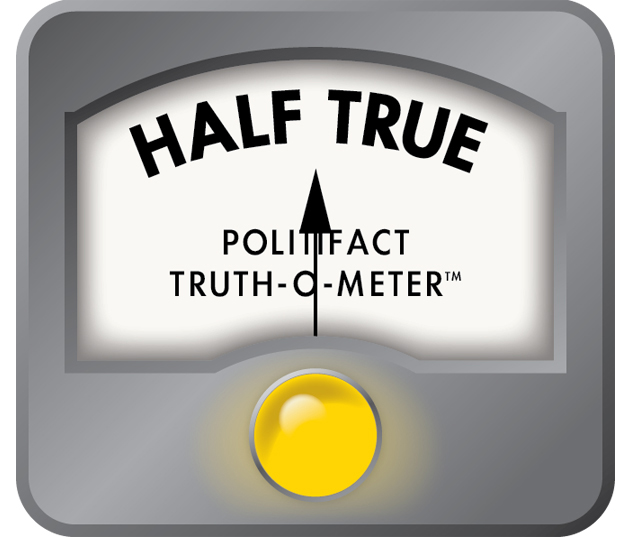
We rate the statement Half True.

About this statement:

Published: Friday, March 1st, 2019 at 2:15 p.m.
Researched by: Louis Jacobson
Edited by: Angie Drobnic Holan
Subjects: EconomyJobsWorkers

Sources:

Bernie Sanders, tweet, Feb. 26, 2019
Institute for Research on Labor and Employment, "The New Wave of Local Minimum Wage Policies: Evidence from Six Cities," Sept. 6, 2018
Governing, Median Wages by State, accessed March 1, 2019
PolitiFact, "Fact-checking a $15 minimum wage," May 9, 2016
Email interview with Gary Burtless, senior fellow at the Brookings Institution, Feb. 28, 2019
Email interview with Ben Zipperer, economist with the Economic Policy Institute, Feb. 28, 2019
Email interview with Timothy Smeeding, professor of public affairs and economics at the University of Wisconsin, March 1, 2019
Email interview with Henry Aaron, senior fellow at the Brookings Institution, March 1, 2019
Email interview with Josh Orton, spokesman for Bernie Sanders, Feb. 28. 2019

02 July 2018

How a new aristocracy's segregation puts stress on society & Upper-Class Warfare in the Hamptons 28JUN18

Class Warfare, crowd, occupy movement, occupy wall street
I am very close to someone who works for people like those in the 9.9%, those who do nothing to address income inequality and economic stagnation, do nothing to address the devolution of America to a Third World country. Their religion is the gospel of greed, and their attitude is they got theirs and that is all that matters. Well, Karma can be a real bitch and someday all these greedy people will get theirs. This from PBS NewsHour followed by video from  NBR and an article from Mother Jones about the trials and tribulations of the rich in the Hamptons, East Hampton that is.....

How a new aristocracy's segregation puts stress on society


Growing class division is destabilizing our society, argues author and philosopher Matthew Stewart in a provocative Atlantic magazine cover story. He says there's a group in between the top 0.1 percent and bottom 90 percent that plays an important role in running the economy, while setting up barriers that prevent most from realizing the American dream. Economics correspondent Paul Solman reports.

Read the Full Transcript

  • Judy Woodruff:
    Now a look at a group that one writer is dubbing a new American aristocracy and the problems it poses for our society.
    No, it’s not the billionaires in the top 0.1 percent of the population, but the group that sits right below them, the 9.9 percent.
    Our economics correspondent, Paul Solman, has more.
    It’s part of our weekly series Making Sense, which airs Thursdays on the “NewsHour.”
  • Matthew Stewart:
    The United States is going down a path. It’s a path of class stratification, growing inequality. And the consequences of that are more potentially damaging than I think most people appreciate.
  • Paul Solman:
    In a provocative “Atlantic” magazine cover story, “The Birth of a New Aristocracy,” author and philosopher Matthew Stewart argues that growing class division is destabilizing our society.
  • Matthew Stewart:
    All right, so it turns out that the concentration of wealth in the United States has really been focused on the top 0.1 percent, not the top 1 percent. But that doesn’t mean that everybody below them lost money.
    In fact, only the bottom 90 percent did. So there’s this group in between, the 9.9 percent, that have managed to keep pace. They play a very important role in on the one hand positively running the economy, on the other hand basically setting up barriers that prevent people from below to realize the American dream.
  • Paul Solman:
    So how much wealth do the people in the 9.9 percent have?
  • Matthew Stewart:
    Right now, you need roughly $1.2 million to make it into the 9.9 percent. And the median is around $2.4 million.
  • Paul Solman:
    Net worth, this is?
  • Matthew Stewart:
    Yes, I’m sorry. This is all net worth. And it includes all forms of assets. So that would include homes. In the numbers I have seen, it also includes things like cars.
    It’s very important to understand that our wealth is not just financial. We — in the 9.9 percent, we all enjoy better health. We tend to live in better neighborhoods, which means we have less crime to deal with. We have better education.
    So, all of these non-financial forms of wealth turn out to be critical. They don’t only make us basically able to generate more economic wealth, but they also consolidate our position. We can then pass them down to our kids.
  • Paul Solman:
    It’s obviously not good for people who are stuck below, but your argument is, it’s not good for people who are lucky enough to be above.
  • Matthew Stewart:
    Yes, that’s right, because, as the classes pull apart, the people on the upper strata have to work harder to keep their position.
    They have farther to fall if they make a mistake. So they invest more in preserving their position. And I don’t think we have appreciated how that ramifies throughout society, the way it locks them in place, draws battle lines, creates distrust.
  • Paul Solman:
    And what’s driving this?
  • Matthew Stewart:
    The basic driver is something that we’re all familiar with. We all know the story of rising inequality.
    It creates a kind of rigidity, an instability. It also removes fact and reason from our discussions, that we’re not able to have a meaningful basis for discussion among all Americans.
    Inequality feeds on itself to some degree. So the greater the concentration of wealth, the more that the people with that wealth can use it to consolidate their position by investing it in non-financial forms of wealth.
  • Paul Solman:
    I have heard this referred to as transactional capital now.
  • Matthew Stewart:
    It can also be just physiological capital in a certain sense.
    So it turns out that not only are the wealthier getting healthier, but the people in the lower deciles are actually getting less healthy in many respects. So, for example, for white, middle-aged people with high school education and less, life expectancy has gone down.
  • Paul Solman:
    Part of what’s driving this is something that you and others call assortative mating.
  • Matthew Stewart:
    So, assortative mating is just when like marries like.
    In the past 50 years, we have seen a significant increase in this kind of marriage pattern. There are some studies that suggest that as much as a third of the growth in concentration of wealth is due to decisions connected with mating, essentially.
  • Paul Solman:
    Just like in the olden days, noble families, kings, queens, they would intermarry to consolidate their power or their wealth.
  • Matthew Stewart:
    Well, it reminds me of Jane Austen, to be honest, because we are returning to a world in which individuals seeking mates are frankly frantic. They can’t find true love in someone who is of the adequate social status.
    The benefit that you get from matching social status is tremendous, and the price you pay for failing to do that, for failing to find a high-status mate has gone up. It’s gone up dramatically.
    If you’re low-status and you marry a low-status mate, marriage is actually harder. It’s harder because you’re working harder probably, or you have greater risks, greater stresses. You have worse health. And, consequently, you, statistically, are much less likely to have a stable household.
  • Paul Solman:
    So, what do you want the 9.9 percent to do?
  • Matthew Stewart:
    We have to start thinking about how we can live in integrated communities that are open to everybody, where geography is not an economic and class barrier.
    Our geography is killing us. We are setting up a system where we concentrate educational resources, the schools in a particular area. We concentrate economic power.
  • Paul Solman:
    That’s why people move to areas like where you live, Brookline, Massachusetts, which has this great educational system, right?
  • Matthew Stewart:
    Yes. It’s great. We have a quasi-private system of education that we call public. Right?
    I move to Brookline, I send my kids to public schools, they’re terrific schools. That’s why you move there. And you can too. You just have to buy a home that’s worth $2 million. Now, that’s a colossal, colossal blunder.
    In American history, public education was absolutely essential in building the middle class. That’s how we got the productive economy in which everyone participates, and we had a reasonable degree of stability.
    We’re now setting up a system where we — you get the education you pay for. And that means you get a bunch of citizens who are uneducated. And that’s a recipe for disaster.
  • Paul Solman:
    I think that’s what’s so difficult for somebody like myself to hear or people in our audience. What we’re doing is what comes absolutely naturally to us, that is, investing in our kids, moving to a neighborhood with a good school for our children or grandchildren.
    You don’t want me to stop doing that, right?
  • Matthew Stewart:
    Just because our individual actions are blameless when we look at them very narrowly, that doesn’t mean it’s all going to work out for the best.
    I lived in Mexico, I lived in the U.K. for a number of years. I have seen versions of this process going on. Everybody involved is nice. But at the end of the day, they participate in this thing that leads you to a point where you have got a distinct class of wonderful people that a lot of other people are very unhappy with.
  • Paul Solman:
    And the people in that distinct class, at least in places like Mexico, they have actual gunmen in their big, fancy houses. Right?
  • Matthew Stewart:
    Right.
    And there’s a natural progression from gated communities to armed and gated communities. And we’re sort of working through that now. And if we keep going down this path, yes, we will have the armed and gated communities. And none of us will have done anything wrong.
    But that’s where we will be.
  • Paul Solman:
    For the “PBS NewsHour,” this is economics correspondent Paul Solman outside Boston.
  • Upper-Class Warfare in the Hamptons

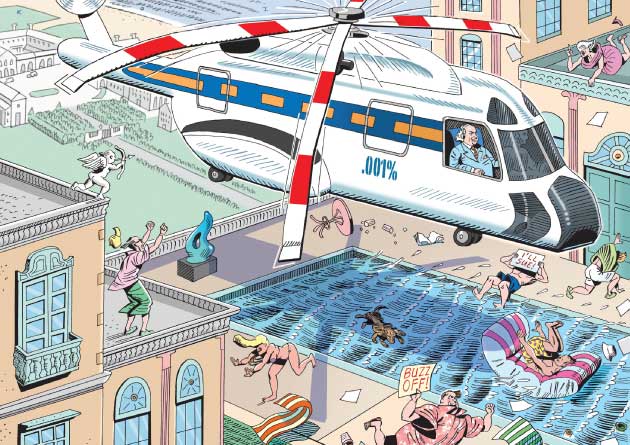
  • Helicopters from hell and a lead-smelting tycoon’s mega-mansion—just another day of millionaires versus billionaires in America’s toniest summer spot.


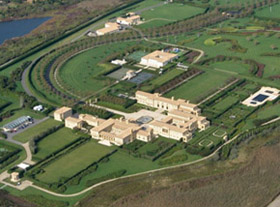
  • With twin 2,520-horsepower engines and up to 19 seats, the Sikorsky S-92 is among the world’s most powerful civilian helicopters. “Helibuses” typically service offshore oil platforms and the like, but two years ago billionaire industrialist Ira Rennert acquired a posh version to shuttle himself between Manhattan and Long Island’s exclusive Hamptons, where he owns a 63-acre, 110,000-square-foot villa complex. One of the first to notice the giant bird was Frank Dalene, founder and CEO of a successful luxury homebuilding company, who lives on a ridge along Rennert’s flight path. Its whumping rotor was like “a lightning bolt striking nearby,” says Dalene, a fast-talking 58-year-old with a long nose and narrow-set eyes. He blames the vibrations for “literally damaging my home.”
  • Dalene and his neighbors near the East Hampton Airport might have abided Rennert’s choppers—he owns two—had they been an anomaly. But the situation has become intolerable over the past few years, Dalene says, thanks to a whirlybird craze among the investment bankers and hedge fund gurus who weekend in Sagaponack and Southampton. On Friday afternoons the tiny airport is a beehive. Come summer, some CEOs commute daily between their beach chalets and Manhattan’s East 34th Street Heliport. “They don’t give a crap about nobody,” Dalene gripes.
    Last year, he founded the Quiet Skies Coalition, an anti-helicopter group that has become one of the most potent political forces in the Hamptons. Its wealthy members north of the Montauk Highway launched what Dalene describes as a “knock-down, drag-out battle” against “ultra-wealthy” helicopter owners who largely live on the south side, accusing them of shattering the island’s tranquillity, contributing to climate change, and poisoning the air with leaded fuel. “I am beginning to think Mr. Rennert is practicing class warfare,” Dalene wrote Rennert’s Manhattan secretary in an email that likened the noise assaults to “throwing their garbage on the other side of the tracks for us poor folks to live with.”
    Over on the poor side of the tracks, Dalene owns side-by-side properties assessed at around $2.1 million. On one wall of the potato barn he’s converted into an office is a photo of him with Newt Gingrich. On another wall hangs a framed “Republican of the Year” award from the National Republican Congressional Committee. But having deemed local Republicans too pro-helicopter, Dalene says he intends to register as an independent. (Mitt Romney attended a trio of fundraisers in the Hamptons this weekend, including a $50,000-a-person event at the estate of David Koch.)
    We climb into his Toyota Tundra and head across the highway for a tour of the third most expensive zip code in America. We pass by some hedgerows and take a bridge over Sag Pond, rechristened “Goldman Pond” by the locals. “This is one of the first ones that we built for one of the Goldman Sachs partners,” Dalene observes, gesturing at a shingled manse with a second-story deck framed by a reverse gambrel and doghouse dormers. Dalene’s company renovated the priciest home ever sold in the Hamptons: a $60 million, 13,000-square-footer originally commissioned by banking tycoon J.P. Morgan. “People actually complain that these 10,000-square-feet houses are the mega-mansions,” he says, incredulously.
  • By the early aughts Rennert had found another winner in AM General, maker of the Humvee. The company has spent more than $3.5 million on defense lobbying and made a killing off the wars in Iraq and Afghanistan. In 2004, after the novelty of the popular Hummer H2 civilian model began to fade, Rennert sold a majority stake to Ronald Perelman, the billionaire owner of Revlon, whose heavily guarded estate on Georgica Pond is described as the “cynosure of Hamptons nouvelle society” by local author Steven Gaines in his book Philistines at the Hedgerow. (The New York Times reported that the recent Romney fundraiser hosted by Perelman at his “home, er, palace”might have brought in $3 million.)
  • Rennert and Perelman, both Orthodox Jews, are members of the Fifth Avenue Synagogue, a stronghold of Israel hardliners. Rennert, a friend of Prime Minister Benjamin Netanyahu, has helped fund restoration of an ancient tunnel system near Jerusalem’s Wailing Wall, where the 1996 opening of a long-blocked route set off deadly riots. (Suspecting an Israeli plot to dig under the al-Aqsa mosque, Arabs faced off against security forces, and at least 70 were killed.) More recently, Rennert has provided cash and support for groups like the Elad Association and Ateret Cohanim, which promote the construction of Jewish homes in Arab sections of Jerusalem.
    But nothing Rennert has touched is as controversial as his lead smelters, Dickensian monuments to human misery. In 2001, tests revealed that more than half of the children living near the smelter owned by Renco’s Doe Run Resources in Herculaneum, Missouri, had enough lead in their blood to cause brain damage. Last year, it finally settled a lawsuit filed on behalf of kids affected by the pollution.
    Clouds of sulfur dioxide from Doe Run Peru’s La Oroya smelter have scalded the surrounding Andean hills. Rather than cleaning up its mess, Renco has spent $305,000 over the past two years lobbying the US government to help convince Peru not to expropriate the plant. Renco is also suing Peru for $800 million, arguing that its demands for a timely cleanup violate the US-Peru free trade agreement. “This is a man who does not have a heart,” says the father of three lead-poisoned children in La Oroya, who requested anonymity because he fears reprisals. “As soon as we speak out, the following day they are already accusing us, harassing us…I don’t think our voices are being heard.”
    Dalene figures the specter of pollution-spewing copters will compel his fellow Hamptonites to pay heed. “This is real,” he insists. His cause has the support of Sen. Chuck Schumer (D-N.Y.), who in 2009 issued a statementcomplaining that noisy helicopters have “tortured and tormented Long Island communities for far too long.” More recently, the coalition took on the East Hampton Aviation Association—a nonprofit Dalene accuses of being a dark-money front for billionaires—with a campaign of dueling newspaper ads that helped get a pair of anti-chopper Democrats elected to the town board.
    Dalene now expects new federal aviation regulations to drive more copter traffic to a southerly route that passes over the estate of Rennert’s pal Perelman. He is confident that the new crop of NIMBYs poking up around Georgica Pond can help bring Rennert down to earth.
    But he’s not leaving it to chance. Armed with a federal database of tail numbers, he has identified the owners of 162 helicopters that have buzzed his house—”everybody from Mayor Daley in Chicago all the way to celebrities you can’t believe”—and has photographed passengers at the airport by means of a huge telephoto lens. He’s entertaining the notion of publishing his celebrity shame list and staging protests at the airport this summer. But “we will be respectful,” Dalene assures me. “This is not an Occupy thing.”

    THANK YOU!

    The Mother Jones community is amazing: You stepped up and we hit our stretch fundraising goal of $350,000 so we can bring on a full-time reporter and a data scientist to combat disinformation.
    It's incredibly inspiring to have such committed, generous readers. For 41 years now, support from readers has allowed Mother Jones to charge hard after the stories that need to be told—and we're grateful that you just helped us build an entire new beat that we couldn't have invested in otherwise. Thank you!
    Now it's time to get to work. We'll keep you updated as we go, and here are some ways to get involved in our coverage.
  • Josh Harkinson
    Josh Harkinson is a staff reporter at Mother Jones. For more of his stories, click here. Email him with tips at jharkinson (at) motherjones (dot) com. PGP public key.