NORTON META TAG

Showing posts with label NY AG Eric Schneiderman. Show all posts

02 September 2017

Mueller teams up with New York attorney general in Manafort probe 30AUG17


THE investigation of the  drumpf/trump-pence 2016 Pres election campaign and the current administration continues to grow. This is a really smart move by Robert Mueller and his team because if New York state AG Eric Schneiderman charges and convicts manafort of a crime related to Muller's investigation drumpf/trump will not be able to pardon him. This may be the motivation manafort and others involved in the collusion and corruption of the drumpf/trump-pence administration, putin and his russian oligarchs need to provide the infomation and evidence Special Counsel Muller and his team needs to start charging members of the drumpf/trump-pence administration and hopefully bring about the impeachment of NOT MY pres drumpf/trump. From Politico.....

Mueller teams up with New York attorney general in Manafort probe

The cooperation is the latest sign that the investigation into Trump's former campaign chairman is intensifying.
 
08/30/2017 07:26 PM EDT
 
Updated 
Special counsel Robert Mueller’s team is working with New York Attorney General Eric Schneiderman on its investigation into Paul Manafort and his financial transactions, according to several people familiar with the matter.
The cooperation is the latest indication that the federal probe into President Donald Trump’s former campaign chairman is intensifying. It also could potentially provide Mueller with additional leverage to get Manafort to cooperate in the larger investigation into Trump’s campaign, as Trump does not have pardon power over state crimes.
The two teams have shared evidence and talked frequently in recent weeks about a potential case, these people said. One of the people familiar with progress on the case said both Mueller’s and Schneiderman’s teams have collected evidence on financial crimes, including potential money laundering.
No decision has been made on where or whether to file charges. “Nothing is imminent,” said one of the people familiar with the case.
Manafort has not been accused of any wrongdoing and has previously denied it. A spokesman for Manafort didn’t return phone calls seeking comment.
A representative for Mueller’s office declined to comment, as did the New York attorney general’s office.
People close to Manafort say the team has pressured him by approaching family members and former business partners. A number of other firms and people who have worked with him have received subpoenas.
Federal agents also conducted an early-morning raid at Manafort’s home in late July, seizing documents and other items.
Manafort did not resist the search, his spokesman Jason Maloni said at the time of the raid.
State and federal prosecutors believe the prospect of a presidential pardon could affect whether Manafort decides to cooperate with investigators in the federal Trump investigation, said one of the people familiar with the matter.
While Trump has not signaled any public intention to pardon Manafort or anyone else involved in the Russia investigations, the president has privately discussed his pardon powers with his advisers.
Mueller’s team has been looking into Manafort’s lobbying work and financial transactions, including real estate deals in New York.
Schneiderman has a contentious history with Trump. The president has mocked him relentlessly on social media and TV, denouncing him as a “hack” and “lightweight.”
The attorney general won a $25 million settlement last November after a lengthy investigation into allegedly fraudulent practices at Trump University. The president said he settled just to have the matter behind him, though his previous mantra was to never settle cases.
The New York prosecutor’s office also is looking into some of Trump’s business transactions and could potentially share those records with Mueller’s team, one of these people said. Those inquiries are in the preliminary stage. 

26 April 2012

Burden of Proof: Geithner, the President, and Wall Street's Unpunished Crimes 26APR12

I was naive, I thought that N.Y. AG Eric Schneiderman was going to go after the greedy wall street financiers and bankers that caused the "Great" recession that began in 2008 over the objections of the Treasury Dept. Now it seems, unless he moves quickly, the skeptics will be right, the bank-financial cabal and wall street corporations own a controlling majority of our elected officials and Schneiderman is a eunuch. Anyone wanna bet the winning word in the 2012 national spelling bee will be plutocracy? From HuffPost.....
Forgery. Perjury. Investor fraud. Bribery. Money laundering. The body of evidence against individuals at the nation's biggest banks is overwhelming. Nothing speaks louder about the banks' guilt than this evidence -- nothing, that is, except the billions they've paid to settle the charges.
The Administration reacted indignantly this week to suggestions it's still slow-walking its investigation. And then, despite all this evidence, the Treasury Secretary of the United States proclaimed that no laws had been broken. And the White House wonders why its word is no longer enough?
A source in the office of a key figure in the investigation has denied a new story that they've ruled out criminal prosecutions. But the burden of proof has shifted. Nothing will convince the public now except action.
Straw Men

Whether it's JPMorgan Chase settling bribery charges in Alabama, Wells Fargo settling charges of laundering drug-cartel money in Mexico, or the nation's five largest banks buying their way out of widespread foreclosure fraud and tax evasion, never in history has so much evidence led to so little action. Investigators pinpointed the fraudulent activity of individual accountants in GE Capital's settlement with the SEC, only to be dumbfounded to discover that no criminal indictments were handed down.
So it was nothing short of astonishing to hear the Secretary of the Treasury assert yesterday that no crimes were committed by America's banks, saying that "most financial crises are caused by a mix of stupidity and greed and recklessness and risk-taking and hope" and adding "you can't legislate away stupidity and risk-taking and greed and recklessness."
That's a straw-man argument, since nobody has suggested outlawing character traits. The Administration's critics are pointing to a mound of evidence implicating bankers in criminal activity and asking the simple question: Where are the prosecutions?
Free Pass

Geithner was doubling down on an assertion his boss made last December, when President Obama told 60 Minutes that "Some of the most damaging behavior on Wall Street -- in some cases some of the least ethical behavior on Wall Street -- wasn't illegal."
Deliberately or not, that sent a message to bankers that they could stop worrying about indictments -- that is, if they ever had worried. Why would they? There's been no investigation, no grilling, no subpoenaing of bank executives' emails or phone records. And as far back as 2010, Eric Holder and his Justice Department were trying to pass off long-standing investigations as part of a major assault against financial fraud called "Operation Blind Trust."
The DoJ's claims were quickly debunked and "Blind Trust" was shown to be nothing more than a deception which a Bloomberg columnist said used "trumped-up numbers." The Columbia Journalism Review summed up their recap of "Blind Trust" coverage with the headline, "Obama Administration's Financial Fraud Task Force Stunt Misfires."
Burden of Proof
But we were told those days are over. Now the President's really cracking down on Wall Street, we were told. In the face of widespread criticism for his proposed foreclosure fraud settlement with five top banks, the President eventually accompanied that deal with a promise of tougher enforcement. He appointed New York State Attorney General Eric Schneiderman, who had been pursuing banks and resisting previous deals, to his previously-lethargic mortgage fraud group.
"The mortgage fraud task force I announced in my State of the Union address retains its full authority to aggressively investigate the packaging and selling of risky mortgages that led to this crisis," the President said on February 9. "Working closely with state attorneys general, we're going to keep at it until we hold those who broke the law fully accountable."
But then there were stories that the task force's proposed staff, whose proposed numbers were already absurdly low when compared to those used to pursue criminal behavior under Reagan after the much smaller savings and loan scandal of the 1980s, hadn't even been hired.
The Administration responded swiftly. Unnamed Justice Department employees joined Schneiderman's press secretary in telling The Nation's George Zornick that the task force's five co-chairs are in "constant communication" and "meet regularly." Fifty attorneys and other employees were already working on the project, Zornick was told. (It was not made clear whether they were assigned to the task force full-time.)
The Candidate

Yesterday Zornick published a piece quoting former Democratic Rep. Brad Miller, an outspoken advocate for bank investigations, as saying he was strung along by the task force after being led to believe he was a leading candidate by Schneiderman's office. What's more, he made the explosive suggestion that, in Zornick's words, "the working group was afraid of Wall Street."
Miller told Zornick that he knew "Republicans were watching the work of the task force very closely and very critically, and that they would oppose my playing that role." Most explosively, he said he had been told that "People being indicted and looking at the possibility of prison sentences -- they were saying they did not expect any of that. They expect civil litigation or civil enforcement but not criminal prosecution."
If the task force had abandoned any thoughts of criminal prosecution with Schneiderman's assent, it would be a political and legal bombshell. But a source in Schneiderman's office who said he was Miller's point of contact denies that suggestion -- "vehemently," he added.
The source said Miller was a candidate for the job, but that some felt he lacked prosecutorial experience. In addition, I was told, concerns were expressed about appointing someone with a political background. "That would give Republicans another avenue of attack against the whole task force," the source said. (The Republicans have already been harrassing the group at every opportunity.) Schneiderman's office recognizes that statutes of limitation present a real problem.
"But abandon prosecutions altogether," the source added, "and let the word get out that everybody's off the hook? How silly would that be?"
The Problem

The real problem isn't that they haven't appointed the right Executive Director for the task force,although that's extremely important. The real problem is that the Administration didn't take more aggressive action in 2009 or 2010 to investigate criminal behavior on Wall Street. Now the wrongdoers -- and their political sympathizers -- are trying to run out the clock.
The real problem is that the senior officials in the same Administration are making public proclamations about the innocence of people who should, by all rights, be suspects in a criminal investigation.
The real problem isn't that somebody's lust for vengeance isn't being fulfilled. It's not even the fact that senior officials find it understandably difficult to contemplate criminal investigations of people they've known for years as colleagues, friends... and yes, as donors.
The real problem is this: As long as bankers know they won't be prosecuted for committing crimes they'll commit them again. Officials in the Justice Department and elsewhere privately express fears that it will be difficult to obtain convictions after so much time has passed, or in cases where intent is difficult to prove.
But they don't even look like they're trying. Comments like Mr. Geithner's only add to the perception that bankers have a free pass to commit crimes without fear of prosecution. That's not just an injustice. It's also a threat to our economic security.
This perception can only be changed if the Administration moves aggressively to hire and staff this Task Force with the best people and best managers possible. The public needs to see action, and it needs to see it now.
http://www.huffingtonpost.com/rj-eskow/burden-of-proof-geithner_b_1456951.html?utm_source=Alert-blogger&utm_medium=email&utm_campaign=Email%2BNotifications

19 April 2012

The White House And Mortgage Fraud: So Far It's All Talk, No Action 19APR12

PUNDITS like to point out how the gop / tea-baggers keep shooting themselves in the foot with the war on women and attacks on immigrants and minorities this election year but the Obama campaign is doing the same with issues like this. The Pres has the authority to force the A.G. to bring charges against the bankers who have destroyed our economy and caused so many to loose their homes. Talking the talk while not walking the walk is not the way to get re-elected. If the plan is to let these criminals avoid prosecution (just like the gop / tea-baggers position) what is the difference between a repiglican and Democratic administration? Call the White House or e mail the President at http://www.whitehouse.gov/contact/submit-questions-and-comments
and demand the President follow through on his promise of justice for victims of illegal foreclosure. This from HuffPost.....
The Obama Administration worked for months on a deal that would have let America's biggest banks off the hook for a crime wave of runaway mortgage fraud. All they had to do in return was pledge a negligible sum of money, to be paid by their shareholders and not themselves, and which they would dispense themselves. In return, crooked bankers received immunity from prosecution - and even from investigation.
After the deal came under attack from a number of its allies, the Administration settled with the banks anyway. But it promised millions of wronged homeowners - and the nation as a whole - that it would move "aggressively" to investigate criminal misdeeds and prosecute bankers and anyone else who broke the law.
That was then, this is now. Two and half months later the Administration hasn't even started to take the inadequate steps it promised it would take. The clock is running out on the statute of limitations and there's no sign that the Administration has lifted a finger to investigate criminal bankers.
Talk vs. Action
hThe New York Daily News did something simple and smart today - so simple and smart, in fact, that some of us wish we'd thought of it first. It called the Justice Department switchboard and asked for the "Mortgage Fraud Task Force." The operators didn't know what they were talking about. As of a couple weeks ago Eric Schneiderman, the New York State Attorney General who was appointed to the Task Force as the homeowner's champion, didn't even have a phone yet.
The contrast between the talk and the action - or lack thereof - couldn't be clearer. Look at some of the statements made by the President and members of his team when this deal was signed, and compare them to this week's Daily News report:
"The mortgage fraud task force I announced in my State of the Union address retains its full authority to aggressively investigate the packaging and selling of risky mortgages that led to this crisis."
- President Obama, February 9
"On March 9 -- 45 days after the speech and 30 days after the announcement -- we met with Schneiderman in New York City and asked him for an update. He had just returned from Washington, where he had been personally looking for office space. As of that date, he had no office, no phones, no staff and no executive director."
- Daily News
"This investigation is already well underway."
- President Obama, February 9
"None of the 55 staff members promised by Holder had materialized."
- Daily News
"And working closely with state attorneys general, we're going to keep at it until we hold those who broke the law fully accountable."
- President Obama, February 9
"On April 2, we bumped into Schneiderman on a train leaving Washington for New York and learned that the situation was the same."
- Daily News
"[The deal] benefits struggling homeowners now, not some time in the future when the help they need may be too late."
- Senior Justice Department official Bob Ryan, February 9
"Tuesday (April 17), calls to the Justice Department's switchboard requesting to be connected with the working group produced the answer, 'I really don't know where to send you.'"
- Daily News
"This action, while significant, is only one step of many. But this action is momentous."
- Spokesperson for the Department of Housing and Urban Development, February 9
"After being transferred to the attorney general's office and asking for a phone number for the working group, the answer was, "'I'm not aware of one.'"
- Daily News
Small Talk
The Administration only promised 55 staffers for the Task Force, despite the fact that the much smaller Savings and Loan scandal was investigated by roughly 1,000 staffers. But they haven't even met that meager goal. An anonymous Justice Department official told David Dayen, for example, that "at least 50" people were working on mortgage fraud.
Yet when I spoke with David at length on The Breakdown (a great conversation - check out the whole hour) it seemed that a clarification was needed: Did the official say specifically that these 50 people were working full-time on the investigation? No, said Dayen. Did he say whether they were professional staff, support people, or another type of employee? No. (They clearly weren't telephone operators.)
And let's not mince words: There's a reason why a judge in Louisiana recently called Wells Fargo "highly reprehensible" as she slapped it with a $3.1 million judgement. As her ruling makes perfectly clear, the bank cheated its customers, broke its contracts, and then spent a fortune in court trying to wear the plaintiff down.
That's how they all operate. An audit in San Francisco found that 84 percent of foreclosures were performed illegally,reports Reuters, while 4500 out of 6100 mortgage documents studied in North Carolina showed "signature irregularities" (a clear warning sign for fraud).
As we were saying, there's a reason for the judge's outrage: These guys are slime balls.
In the face of such wanton crookedness and downright evil, the Administration's overall handling on bank fraud is quickly moving from disappointing to disillusioning even for some of its most diehard supporters. After all, it's been three years since the banks' crimes have come to light. Where are the prosecutions?
Watchdogs
And fraud isn't the only area where the White House is failing. Here's what President Obama said on February 9:
"We're going to make sure that the banks live up to their end of the bargain.  If they don't, we've set up an independent inspector, a monitor, that has the power to make sure they pay exactly what they agreed to pay, plus a penalty if they fail to act in accordance with this agreement."
Unfortunately it looks like monitor Joseph Smith isn't being given much of a staff, either, although he tried to put a positive spin on it. American Banker interviewed Smith and reported that "Smith said he wants to keep his own staff small and rely heavily on contractors to help him review the self-monitoring work that must be done."
But the pool of contractors is small. Although Smith says he wants to avoid hiring the "usual suspects," most of the candidate firms will have a built-in conflict of interest. They all depend on the big banks themselves for a large chunk of their revenue. Smith's role is temporary but Wall Street's is permanent - and they all know it.
What's more, all of the large accounting firms have signed off on inaccurate (if not downright fraudulent) financials for the big banks in the past. (See some reflections on bad accounting firms and our own work experience in "Law and Order: AIG.") Are these firms really expected to police dishonest bankers?
Pyramid of Failure
The Administration has already retreated on key elements of Dodd/Frank, the financial reform bill which was already too weak to protect the world's economy from crooked behavior and too-big-to-fail banks. (Here's one recent example; Here's another. ) Its HAMP program was a cruel disappointment, and now we've learned that its "Hardest Hit Fund" has only paid out 2 percent of the money that was allocated to help unemployed homeowners. The only real action seems to be taking place on the state level, but most local officials and state Attorneys General have also been asleep at the switch.
The enforcement failure is dramatic, it is systemic, and it is taking place at every level of government. The chain of failure leads straight to the top. We heard a lot of talk in February but there's been no perceptible action since then. The only concrete thing to come out of this settlement so far is that the banks got a cheap ticket out of the litigation death trap brought on by their own criminality.
This settlement was always profoundly flawed, but it provided some opportunities for further action - or we were told it did. But there's very little evidence anybody's acting on these opportunities - and time is running out.
________
The coalition of progressive groups that worked to improve the original settlement (disclosure: I work for one of them) is now urging people to contact the White House to let them know what they think about the Administration's lack of action.(The White House comment line is  202-456-1111, by the way.) Attorneys General in each state should also get a call, too, and a question: What are you doing to investigate crooked bankers?
Richard (RJ) Eskow, a consultant and writer (and former insurance/finance executive), is a Senior Fellow with the Campaign for America's Future and the host of The Breakdown, broadcast Saturdays nights from 7-9 pm on WeAct Radio, AM 1480 in Washington DC.
http://www.huffingtonpost.com/rj-eskow/the-white-house-and-mortg_b_1436353.html?utm_source=Alert-blogger&utm_medium=email&utm_campaign=Email%2BNotifications 

10 February 2012

Yesterday's settlement with Wall Street, A BAD DEAL from CREDO & Settlement launches foreclosure reckoning from WASHINGTON POST 10FEB12

THE only good part of this deal is that wall street executives, directors of the financial-banking industry cabal, could still face criminal charges for their actions that caused the recession. Thanks to several strong, honest, progressive state AGs there is still a chance for justice. This from Credo, followed by an article on the deal from the Washington Post.....


Take action!
CREDO Action | more than a network, a movement.
Wall Street banks fraudulently and illegally foreclose on your house. You get $2,000. The bank gets let off the hook. We'd call that a bad deal.
And yet yesterday, at the urging of the White House, federal regulators along with 49 state attorneys general announced a settlement deal for mortgage servicer abuse that does essentially that. It lets banks off the hook for widespread foreclosure fraud.
Press releases have trumpeted a $26 billion deal which may sound like a lot, but it's a paltry sum when you break down the numbers.
With an average mortgage of $180,000, and loan instruments executed illegally, a family that lost their home will get a check for just over 1% of the value of the mortgage.1 That is not a victory. The amount of money this deal makes available to help homeowners is an order of magnitude too small and incommensurate with the harm done by the banks.
The estimated $10-$20 billion in the deal for principal reduction would reduce only about 2% of the $700 billion in equity destroyed during the financial crisis. And the banks themselves will only pay $5 billion out of their own pocket. By far the lion's share of the cost will be borne by investors and taxpayers, who had no part in the robo-signing scandal. 2
No doubt the deal is far better than the deal that was offered months ago. And this most certainly is a result of activism from members of CREDO and many of our allies in the progressive movement who worked with progressive attorneys general like New York's Eric Schneiderman, California's Kamala Harris, Delaware's Beau Biden, Massachusetts' Martha Coakley and Nevada's Catherine Cortez Masto to fight a bad deal.
But the final deal, while better, still can't be characterized as a good deal or even as a good first step towards real accountability for Wall Street banks.
The reported $26 billion settlement will not come close to inflicting any real pain on the banks all of which have already reserved the full amounts required from them under the deal. As Robert Reich said, the "$26 billion settlement with banks over mortgage fraud is far short of what they should pay and distressed home owners deserve."3
One in five Americans with mortgages owe the banks more than their homes are worth, and these home owners are underwater by an average of $50,000 each. This is a collective negative equity of nearly $700 billion.4
Consider the $700 billion bailout of Wall Street paid for by U.S. taxpayers5 and the more than $1.2 trillion in loans6 provided by the Federal Reserve to Wall Street banks. Or another way to put the deal in perspective is to compare it to the tobacco industry settlement in 1998 — the largest previous multi-state agreement. That deal was worth $350 billion in today's dollars — more than ten times the size of the mortgage deal.7
And that's not even all that's wrong with this deal. The federal government's track record for enforcing settlement terms with Wall Street banks is abysmal. Furthermore, even if the banks follow the terms of the deal, it's quite possible than when all is said and done, not only will the banks have suffered no pain, they may actually come out having profited from their illegal schemes to rip off homeowners. According to the Consumer Financial Protection Bureau, the largest mortgage banks saved $20 billion by taking illegal shortcuts — an amount far greater than the $5 billion out of pocket they will be required to pay in this deal.8
All of which adds up to a scenario in which this settlement does literally nothing to deter the banks from engaging in the same fraudulent behavior in the future.
Senator Dick Durbin famously said the Wall Street banks own the politicians in Washington, DC. Today, this could not be more clearly true as we closely examine the deal that the Obama administration cut with Wall Street and pressured state attorneys general to sign.
There has yet to be a full investigation of the robo-signing scandal despite what Reuters called "copious evidence" of "widespread forgery, perjury, obstruction of justice, and illegal foreclosures...." 9
By establishing settlement terms before there has been any meaningful investigation, the deal whitewashes the widespread lawlessness of the banks and virtually ensures that no bankers will be held criminally responsible for their part in the robo-signing scandal and foreclosure fraud.
Though the exact terms of the settlement have not been disclosed, we understand that it will not cut off other important avenues to hold the banks accountable. New York Attorney General Eric Schneiderman is co-chairing a federal task force that if fully resourced and left to operate unhindered by the White House could achieve hundreds of billions in reduced principal for underwater homeowners and criminal indictments for bankers who broke the law and helped drive our economy off a cliff. And other state attorneys general can continue investigating Wall Street's role in causing the housing crisis to ensure that the banks that caused the crisis are held accountable for their wrongdoing.
This is the biggest case of fraud in our history. Homeowners deserve justice for crimes committed against them by Wall Street banks that in many cases literally stole their homes from underneath them. Unfortunately, yesterday's settlement doesn't even provide anything close to a down payment on justice.
As the election season heats up, we must be insistent about real accountability for Wall Street crooks. Pressure from activists like us will be even more important in the days to come if we are to achieve any real measure of accountability for Wall Street bankers who profited from their crimes and left the 99% to pay to the price for their reckless disregard.
Becky Bond, Political Director
CREDO Action from Working Assets

1. "The Top Twelve Reasons Why You Should Hate the Mortgage Settlement," Yves Smith, Naked Capitalism, 02-09-12
2. "The Servicing Settlement: Banks 1, Public 0," Adam Levitin, Credit Slips, 02-09-12
3. Twitter, 02-09-12
4. "Mortgage Plan Gives Homeowners Bulk of the Benefits," Nelson D. Schwatz and Shaila Dewan, New York Times, 02-09-12
5. "Wall Street Aristocracy Got $1.2 Trillion in Secret Loans," Bradley Keoun and Phil Kuntz, Bloomberg, 08-22-11
6. "The Wall Street Bailout Plan Explained ," David Stout, New York Times, 09-20-08
7. "FAQ: The foreclosure settlement ," Sarah Halzack and Sarah Kliff, WashingtonPost.com, 02-09-12
8. "Big Banks Save Billions As Homeowners Suffer, Internal Federal Report By CFPB Finds," Huffington Post, 03-28-11.
9. "
U.S. AG Eric Holder, DoJ Head Lanny Breuer Linked To Banks Accused Of Foreclosure Fraud ," Reuters, 01-19-12.

Facebook
Twitter


© 2012 CREDO. All rights reserved. 

Settlement launches foreclosure reckoning

By and

The government’s $25 billion settlement Thursday with banks over fraudulent foreclosure practices begins a long-promised reckoning with the financial industry over its role in the worst economic crisis since the Great Depression, officials said.
The deal represents the largest industry settlement since an agreement with tobacco companies in 1998 and will force five of the nation’s largest banks to overhaul their mortgage-servicing practices and reduce loan balances for many borrowers who owe more than their houses are worth.
FAQ: The foreclosure settlement
Officials acknowledged that the final sum will reach only a fraction of homeowners across the country whose homes are collectively worth $750 billion less than what is owed on their mortgages. But they argued that it was a meaningful step in healing the housing market.
The priority of the settlement was not to punish banks, officials said. Another wave of punishment is on its way, they vowed.
“This is neither the beginning nor the end of our work to hold banks and other institutions accountable for the destruction they’ve caused families, communities and country,” said Illinois Attorney General Lisa Madigan. “Today’s settlement should serve as a warning.”
The deal was brought on by revelations that banks were using forged and shoddy paperwork to foreclose rapidly on struggling homeowners, a practice known as “robo-signing.” Outrage over those practices led to 16 months of settlement talks between state and federal officials and five large banks.
The officials who crafted Thursday’s settlement were careful to leave the door open to a wide range of future litigation, despite efforts by banks to shield themselves from such legal actions. It allows for future actions over fair-housing and fair-lending violations, as well as civil rights claims. It doesn’t bar individuals from joining class-action lawsuits. Nor does it limit the lawsuits that private investors can file in search of damages, some of which have already been launched.
That means the legal hangover from the mortgage bubble is probably far from over for many of the country’s largest banks.
Last September, federal regulators launched a broad legal assault on 17 big banks, claiming they sold nearly $200 billion in fraudulent mortgage investments to housing giants Fannie Mae and Freddie Mac.
Since then, as the housing slump has continued to weigh down the larger economy and movements as disparate as the tea party and Occupy Wall Street have raged against the lack of accountability for the crisis, the pressure for regulators to hold individuals and institutions accountable has only grown.
New investigative unit
President Obama announced in his recent State of the Union address a new unit that would would “expand our investigations into the abusive lending and packaging of risky mortgages that led to the housing crisis.” Days later, Attorney General Eric H. Holder Jr. said the Justice Department had issued civil subpoenas to 11 financial institutions.
Helping to lead the new investigative unit is New York Attorney General Eric Schneiderman, who for months had been critical of the foreclosure settlement because of concerns that it might prevent deeper investigations into mortgage misdeeds and could let banks off too easily.
Schneiderman, who ultimately signed on to Thursday’s settlement, last week filed lawsuits against several banks, claiming that they deceived homeowners and court officials by filing bogus documents through a popular electronic mortgage registry. He and his counterparts from states such as California, Delaware, Massachusetts and Nevada have vowed to press forward with their inquiries — an approach that has been cheered by liberal groups and consumer advocates.
Separately, the Securities and Exchange Commission is examining whether banks fully disclosed the risks to investors who bought packages of loans that financed the housing boom. The agency has continued digging for evidence that firms failed to disclose important information when selling the securities to investors, SEC enforcement director Robert Khuzami said recently. The SEC also has sent banks a flurry of requests for documents and interviews with witnesses.
Goldman Sachs settled an SEC complaint for $550 million in 2010, but its last quarterly report — like those of other banks — describes a variety of pending lawsuits and government investigations that the firm faces. “There remains significant uncertainty surrounding the nature and extent of any exposure for participants in this market,” Goldman said in the report.
The passage of time since the housing crash first hit could affect the government’s ability to impose penalties on financial firms. Generally speaking, under a statute of limitations, the SEC can only obtain penalties for fraud within the past five years. But the SEC and other agencies could argue that the clock didn’t start ticking until it was apparent that fraud occurred.
Thursday’s settlement, which would require a judge’s consent, won approval from 49 states. Oklahoma was the lone holdout.
Under the terms of the deal, banks would have three years to complete principal writedowns, refinancings and other relief. It provides incentives for actions taken within the first 12 months so that the aid can get to homeowners sooner rather than later.
The settlement also includes about $17 billion that would go toward foreclosure-prevention measures, such as lowering the loan balance for borrowers who owe more than their homes are worth. Other provisions would provide for lowering interest rates for homeowners who are current on their loans. In addition, as many as 750,000 borrowers who lost their homes to foreclosure since 2008 would be eligible for payouts of about $2,000 each.
The five banks at the heart of the settlement are Wells Fargo, Bank of America, J.P. Morgan Chase, Ally Financial and Citigroup. Ultimately, the amount of aid to homeowners could reach $40 billion, officials said, adding that they hope other banks will soon sign similar agreements and adopt the new standards set out by the deal.
Consumer impact uncertain
Several Washington area housing counselors said the deal would probably do little to help their clients but that they needed to learn the details of the aid to be sure.
Cherelle Silue, manager of housing services at United Communities Against Poverty in Prince George’s County, said her first impression is that a homeowner could wind up not getting much.
For homeowners who are trying to catch up on their mortgages, “we are talking thousands and thousands of dollars,” Silue said. “I am sure that it is going to be able to help someone, but I am not sure how many.”
In any case, the celebrations among state and government officials over a significant settlement for homeowners on Thursday included numerous reminders that the victory marked a beginning rather than an ending.
“This settlement also protects our ability to further investigate the practices that caused this mess. And this is important,” Obama said at White House, adding: “We’re going to keep at it until we hold those who broke the law fully accountable.”

Staff writers David S. Hilzenrath, Sarah Kliff, Luz Lazo and Jeremy Borden contributed to this report.

28 January 2012

Obama Administration And Banks Near Deal On Mortgage Fraud Legal Liability

THE bankers and financial industry leaders that brought the recession to us should not get away with the destruction done to the U.S. and world economy brought on by their greed. no immunity, no slaps on the wrist. They are entitled to fair trials, and the public is entitled to justice. Punishments should be stern, with no pandering to the lifestyle those found guilty of financial crimes are used to. Send them to prison, not "country club" confinement, and fine them to the extent that they are not able to return to their previous wealthy lives. Make them pay for their crimes so it hurts as much as they hurt tens of millions of regular people. Is this agreement a step in that direction, or an out for these criminals? We shall see.....

WASHINGTON -- The Obama administration, state attorneys general, and, perhaps, the nation's largest banks are close to a final settlement on the years-long struggle over allegations of massive foreclosure fraud, according to several sources familiar with the talks. And the final details of the arrangement, according to the source who revealed them, will apparently not preclude prosecutors and regulators from taking legal action against many of the common abuses during the house bubble. It remains to be seen whether all parties will ultimately sign off on the language.
The settlement is worth $25 billion, a sum which will be distributed to homeowners who were wrongfully foreclosed on as well as those who remain underwater. In addition, banks could still face future legal action over 12 specific violations.
According to someone intimate with the negotiations, there will be no legal release of the banks with respect to:
  1. Criminal liability.
  2. Tax liability
  3. Fair lending, fair housing, or any other civil rights claim.
  4. Federal Housing Finance Agency or the GSEs [Fannie Mae and Freddie Mac]
  5. CFPB claims for the period after they came into existence in July 2011
  6. SEC claims
  7. National Credit Union Association Claims
  8. FDIC claims
  9. Federal Reserve Board claims
  10. MERS claims
In addition, the source said, there will be preservation of the vast majority of securitization claims including all claims regarding state pension funds as well as the vast majority of the origination fraud claims from HUD, the VA and the USDA.
According to Mike Lux, who originally reported the settlement for The Huffington Post, the release will be "almost entirely confined to robosigning cases" -- meaning that banks will likely not see further punishment from the states for foreclosure fraud. Robosigning fraud is perhaps the easiest type of misconduct for prosecutors to target.
That said, their legal liabilities on the federal level remain vast, even after handing over $25 billion for homeowner relief.
The announcement is, in some regards, a victory for the few state attorneys general who, over the course of several months, refused to sign off on a quick and limited settlement with the big banks.
"I think it is fair to give [New York Attorney General] Eric Schneiderman and the other progressive attorneys general a lot of credit for holding the line," said a source intimate with the negotiations. "This is a big victory for them."
The announcement comes just two days after President Obama announced the creation of a mortgage crisis unit to be headed by Schneiderman and other prosecutors. Federal claims, such as those that will be permissible under the negotiated settlement, have not been aggressively pursued over the last three years despite widespread evidence of abusive lending. The emergence of the unit as well as the final language of the settlement suggests that the administration is refiguring its approach to future litigation.
The lingering question is whether the banks will sign off on the final language. Agreement from all 50 state attorneys general has also not been finalized. Schneiderman was not the only attorney general who spent months unhappy with the deal, and after Obama's State of the Union speech, Delaware's Beau Biden and California's Kamala Harris reiterated their opposition to the deal as it stood.
Tom Kelly of Chase's media relations office declined to comment. "No input from us," he said.
Schneiderman's office did not immediately respond to a request for comment from The Huffington Post.

25 January 2012

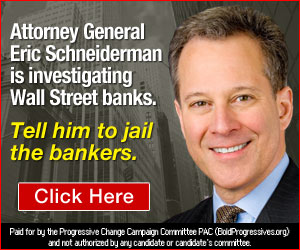
Urge Eric Schneiderman: Jail bankers who broke the law. from PCCC 25JAN12

WE have all paid dearly for the recession, all of us except the 1% and the greedy bankers and financiers of wall street. Now Pres Obama has appointed NY Attorney General Eric Schneiderman to head a Special Unit to prosecute wall street illegality. Now with any luck we will see some, hopefully many, of these greedy, manipulative pigs charged, tried, and if found guilty sentenced to prison and heavily fined for the damage they have done to our economy. Click the link to let AG Schneiderman know you support his mandate AND expect him and his staff to investigate and prosecute wall street to the MAX!!!! 


Progressive Change Campaign Committee


Bankers should go to jail -- Sign the statement
Please forward this action alert to your friends!
BIG NEWS: President Obama announced last night that our friend Eric Schneiderman, New York's progressive Attorney General, will lead a new Special Unit to prosecute Wall Street illegality.
Let's show Eric that if he's willing to jail Wall Street bankers who broke the law and wrecked our economy, the American people will have his back.
Join over 25,000 others on our statement stating: "Bankers who broke the law must go to jail." Click here.
We'll deliver this statement directly to Eric -- to let him know that thousands of progressives across the country support bold action.
Even the banks themselves have confirmed Wall Street fraud and illegality existed. But there hasn't been any accountability -- only bailouts.
Eric Schneiderman single-handedly blocked a bad 50-state deal that would have given banks massive criminal and civil immunity for their lawbreaking.
And he's launched numerous hard-hitting investigations of Wall Street in New York. This new federal position gives him even more power to get the job done!
Click here to encourage Eric Schneiderman to be bold and jail Wall Street bankers who broke the law and destroyed lives.
Jailing the bankers would be a historic moment. We need to create the momentum to make it happen -- so please pass this email to others.
Thanks for being a bold progressive.
-- Adam Green, Jason Rosenbaum, Kristiane Skolmen, Jeff Budd, and the PCCC team