NORTON META TAG

Showing posts with label autonomy. Show all posts

09 October 2014

Washington's Secret Back-Channel Talks With Syria's Kurdish 'Terrorists' 7OKT14

THERE is much discussion about the way we (America) is being and will be played by all those involved in the war against isis/isil. We should not be so naive, so self-righteous to believe we (the American government) isn't doing the same. With our government controlled by the rich, by wall street, by the military-industrial complex we are not taking action against isis/isil because we care about the suffering of the common masses and are outraged about the bloody atrocities being committed against them. We are involved because corporate profits in some businesses are at risk and because war profiteers are are taking advantage of the death and destruction across Syria and Iraq. Consider our duplicitous relationship with Iraqi Kurds. From +Foreign Policy .....

Washington's Secret Back-Channel Talks With Syria's Kurdish 'Terrorists'

As the town of Kobani appears poised to fall to the Islamic State, exclusive, previously classified, State Department cables show how U.S. officials tried to both engage and undermine its Kurdish defenders.


Every day, the jihadists of the Islamic State (IS) advance closer to Kobani, a predominantly Kurdish town in northern Syria, close to the Turkish border. As the Islamic State rains down mortars on the town, the vastly outgunned People's Protection Units (YPG), a Kurdish militia, are attempting to resist the weeks-long assault. While Turkish troops watch from across the border and the U.S.-led air campaign continues, none of the powerful forces in the region have intervened decisively -- leaving the YPG to face the jihadist advance on its own.
The United States has rejected formal relations with the Democratic Union Party (PYD), the party that is essentially the political wing of the YPG. The PYD, which has ruled Kobani and other Kurdish enclaves inside Syria since President Bashar al-Assad's forces withdrew in July 2012, is affiliated with the Kurdistan Workers Party (PKK), a militant organization that has fought Turkey since 1984 -- and has consequently been listed as a terrorist organization by both Turkey and the United States. But interviews with American and Kurdish diplomats show that Washington opened indirect talks with the PYD years ago, even as it tried to empower the group's Kurdish rivals and reconcile them with the Free Syrian Army (FSA).
Though Washington has declined PYD requests for formal talks, the United States opened indirect talks with the group in 2012, former U.S. Ambassador to Syria Robert Ford told Foreign Policy. "We did meet someone who was an intermediary between the U.S. and the PYD. We met him on several occasions: myself once, and other diplomats on other occasions," Ford said. The talks happened "maybe once every six months" and were mediated by a "Syrian citizen in Europe," according to Ford.
The talks have continued since Ford's departure and are conducted through the U.S. Embassy in Paris, two Kurdish sources familiar with the meetings told Foreign Policy. "They're just briefing each other [on developments in Syria]. We're not sure if the contact is going further, to the top of the administration in the U.S.," one of the Kurdish sources said. Both Ford and the Kurds declined to identify the intermediary.
Concerns about a possible backlash from Ankara shaped Washington's approach to the talks. "We had to be very careful because of the Turkish sensitivities.
We made sure that the Turks knew that we had passed messages," Ford said. "They had two requests. One, they appreciated that we were being transparent with them. Sometimes, I think, they knew about the contact and the messages going back and forth. The second is, they had their own direct contact underway with the PYD. They asked us to go very slow on our own contacts with the PYD, because they didn't want the PYD to be able to play us off against the Turks. They said, 'If you rush in, it will diminish our leverage with the PYD.'" At roughly the same time, Washington tried to empower the Kurdish National Council (KNC), a fractious coalition of Syrian Kurdish parties backed by Iraqi Kurdish leader Massoud Barzani that has good relations with Turkey, as a counterweight to the PYD. In May 2012, a KNC delegation led by its chairman at the time, Abdul Hakim Bashar, visited Washington and met with Ford, Assistant Secretary for Near East Affairs Jeffrey Feltman, and Frederic Hof, the U.S. envoy to the Syrian opposition.
The priority for the Americans was to fold the KNC into the exiled Syrian opposition, then headed by the Syrian National Council (SNC). Ford and Hof urged the KNC to "concentrate on bridging the group's differences with the SNC and focus on the removal of [Assad] as the most urgent goal," according to a previously undisclosed State Department record of the meeting obtained by Foreign Policy through the Freedom of Information Act.
In Washington's reckoning, that required the KNC to drop its precondition that the SNC recognize Kurdish political demands, and revisit the matter only when Assad had been toppled. "The Ambassadors advised that the appropriate time would come, perhaps during the constitutional drafting process, where the Kurds could then debate the issue of political decentralization," the document says.
The United States would eventually get its wish in November 2013, when the KNC joined the Istanbul-based Syrian Opposition Coalition. But at the May 2012 meeting, the KNC had concerns of its own: The party, according to the meeting record, complained about the Syrian opposition's "intransigence and perceived domination by the Syrian Muslim Brotherhood (SMB) and Turkey." Its meetings with the SNC, said Kurdish officials, were "no different than they were with the Baathists."
Although the KNC is backed by Barzani and his Turkish allies, the party was also harshly critical of Ankara and its support for Islamists within the Arab opposition. When one KNC official, whose name is redacted in the State Department cables, described Turkey's position as "not good," the "entire delegation nodded in agreement." Turkey's vision for Syria was a centralized "Islamist government" backed by a constitution "without mention of the Kurds," according to a KNC official quoted in the document. By contrast, the KNC called for a decentralized Syrian state with guarantees for Kurdish rights.
The KNC again voiced concerns about Turkey and Islamists within the Syrian opposition during a December 2012 meeting with Ford in the Iraqi Kurdish capital of Erbil. "The extremists in the opposition were getting support from governments, such as Turkey, that wanted to ensure that the Kurds would not have special rights," the State Department cable quoted a KNC official, whose name was redacted, as saying. "[KNC officials] were distrustful of Turkish support for the FSA, which they saw as a way for Turkey to keep the Syrian-Kurdish population in check." On some points, the U.S. position was less than prescient. In December 2012, Ford pressured the KNC to join the opposition without any guarantees on Kurdish rights, because Assad "would be gone soon" and "commitments about rights would mean little if the Kurds were too isolated within a transitional government to ensure that the commitments were implemented." Ford acknowledged the presence of extremists in the FSA, but encouraged the KNC to reach out to the "moderate elements, of which there were many."
The Americans also shared some of the Kurds' concerns about Turkey's stance toward extreme Islamist factions. Speaking to Foreign Policy, Ford said he spoke with Turkish officials "many times" about the flow of jihadists into Syria through Turkish territory. "I raised it personally with the head of Turkish intelligence," Ford said, referring to Hakan Fidan, a confidant of President Recep Tayyip Erdogan who has played in a key role in Turkey's policy on Syria.
"The Turks' basic talking point was: If you share information about individuals you want, we will be helpful blocking their transit of Turkish territory," Ford said. "To me, that's kind of a cop-out answer. A lot of times we don't know the names. And so cutting access means -- and I said this to them -- doing what we do on the Mexican border: putting a lot more resources into guarding the border, blocking movement flows."
KNC officials approached the Americans with requests for assistance that would allow them to challenge the PYD as the preeminent force in Syria's Kurdish areas. In May 2012, the KNC asked Washington for megaphones, equipment for home hospitals, generators, satellite phones, and help setting up satellite TV channels. In December 2012, a KNC delegation told Ford that "KNC parties were not receiving outside support or arms, and could not compete with the PYD," according to a State Department document. When asked by Foreign Policy if the KNC ever asked for American weapons, Ford said, "Of course they did" -- but added that Washington never provided any.
The KNC's appeals for American support also came in the context of its struggle for influence with Islamist factions within the Syrian opposition. Reflecting the Kurds' weak position compared to Islamists, a "disturbed" KNC member "blurted out" to U.S. officials that Syrian Muslim Brotherhood leaders "are buying their votes and we need to do the same."
In response, the United States provided the KNC with political and media training under the Middle East Partnership Initiative, Ford said, adding that much of it took place in Turkey. "We brought in activists from Syrian Kurdish areas, and it involved things like how to organize grassroots work, how to explain viewpoints to a mass media audience, other sorts of media training. It also involved some issues related to organization building -- how to think about structures instead of everything being run by one guy," Ford told Foreign Policy. "We were trying to build a network among people that the Syrian government couldn't monitor necessarily."
If anything, the KNC's appeals for assistance underlined its own lack of influence compared to the PYD. The idea that megaphones and TV channels would weaken the PYD's grip is dubious at best. The Americans seemingly realized the KNC's relative weakness at some point in 2012, and chose to open the back channel to the PYD.
"The PYD-YPG is a Syrian group that is moving on the ground, so we had an interest in understanding their viewpoint and ideas even if we didn't see an immediate value in meeting them face to face," Ford told Foreign Policy. "The main thing is we believed there needed to be a political solution that had to be negotiated. The Kurds needed to be involved in that, even if we didn't think the PYD was fully representative of the Kurds. We wanted to understand why they continued to work with the regime and why they were hostile to Kurdish activists in the KNC. We wanted to get a sense of how this crisis and Kurdish infighting all could end."
Since IS intensified its attacks on Kurdish areas, the PYD has requested Western military support. Kurdish sources familiar with the indirect U.S.-PYD talks told Foreign Policy that Washington is currently pushing the PYD to distance itself from the Assad regime by joining the Syrian Coalition, working with the FSA, and improving ties with the KNC and Barzani. For its part, the PYD denies working with the regime, and says the Istanbul-based opposition refuses to work with them. The recent agreement between the YPG and FSA factions to fight IS together might reflect a PYD eagerness to meet preconditions for U.S. assistance.
As IS threatens a massacre in Kobani, many experts are calling on Washington to reassess its stance toward Syrian Kurds. "Imagine if last year the U.S. had channeled some support to the YPG in its fight -- it's quite possible this would have helped stop IS from its sweep across Syria into Iraq," said Aliza Marcus, author of Blood and Belief: The PKK and the Kurdish Fight for Independence. "The U.S. needs to accept that its best allies in the region are the Kurds. They are uniformly pro-Western, pro-secular, and are much more united in their fight against the radical Islamists than the Syrian opposition." 
Ford agreed that the United States should expand contacts with the PYD. "Right now, the PYD is up to its eyeballs in Islamic State alligators," he said. "I think we have a common enemy in the Islamic State." 

04 October 2014

Hong Kong Protesters Call Off Talks After Mobs Attack Their Camps & Some Residents Turn Against Hong Kong Protesters & IN IMAGES: A Violent Day For Hong Kong's Occupiers 3&4OKT14

MORE and more it seems the prc is activating pro communist agitators in Hong Kong to attack pro democracy protestors and encourage strife between Hong Kong's citizens. If this doesn't stop the protest the violence on the streets will get worse and Beijing will use the civil strife as justification to send in the pla. From +NPR .....
Updated at 12:55 p.m. ET
Hong Kong's main democracy groups called off planned talks with the territory's government after several hundred pro-Beijing demonstrators attacked activists who have staged a week of protests calling for greater freedom.
View image on Twitter
We strongly condemn such atrocity! Stop violence against peaceful protesters at once! Credits: AppleDaily
Occupy Central, one of the main groups organizing protests against Beijing's effort to tightly control the selection of Hong Kong's leader, tweeted today:
Occupy Central 和平佔中 @OCLPHK
Students call off talks with the govt over political reform after police failed to halt violence against supporters @HKFS1958

As we reported Thursday, Hong Kong Chief Executive Leung, speaking at a news conference Thursday, said he would stay in the job but appointed his deputy, Chief Secretary Carrie Lam, to meet with protesters to discuss "constitutional development."
But hours later, as the South China Morning Post reports, "A group of mostly male anti-Occupy protestors appeared to be taking commands from a middle-aged Putonghua-speaking [Mandarin-speaking] woman wearing a face mask using a loud hailer at the junction of Argyle Street and Nathan Road [in Mong Kok district]. The thin line of police separating opposing sides was stretched to breaking point, and finally gave way shortly after 5pm. Soon after more police arrived as the tense stand-off continued."
View image on Twitter
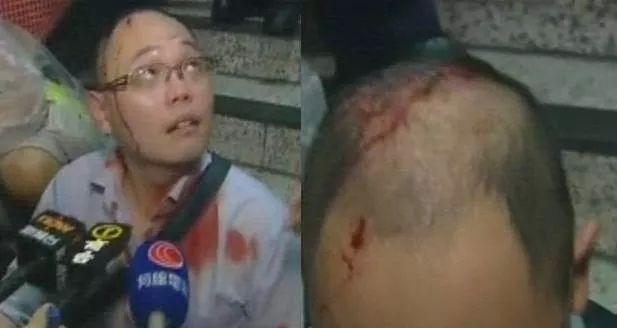
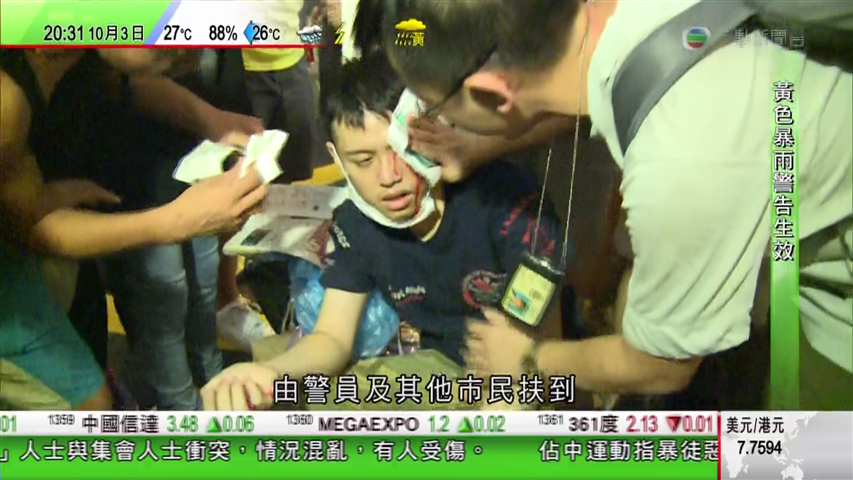
Another young student got injured during pro- thugs riot.

Mong Kok, located on Kowloon Peninsula, is one of three main protest areas, which also include the central Admiralty area and Causeway Bay on Hong Kong island.
The Associated Press describes the counterprotesters as Hong Kong residents and pro-Beijing supporters.
NPR's Anthony Kuhn, reporting from Mong Kok, says there's a lot of anger and shouting and that police have established a human chain "to escort Occupy Central protesters to safety.
"It's been a very tense scene for the past several hours," he says.
Anthony spoke to several of the anti-Occupy protesters: "Most of these people tend to be businessmen. They say they want democracy in Hong Kong too, but they think the way the Occupy Central people are going about it is the wrong way."
It was not immediately clear whether the attack on the protesters was spontaneous or part of a coordinated effort to break up the demonstrations, but student activists issued a statement calling them "organized attacks" and threatened to call off the planned dialogue with authorities if the government did not immediately stop the assaults.
The New York Times notes:
"The Mong Kok area is notorious for organized gangs known as triads that extort payments from the many small businesses there, or indeed own the businesses, and some of the protesters suggested that the men were connected to them. Asked if he was a member of such a group, another man who joined in tearing down the tents there, Steve Lin, 48, responded: 'I'm not a triad. I'm a Hong Konger.' "
The AP says: "The scuffles in Kowloon's crowded Mong Kok district were the most chaotic since police used tear gas and pepper spray on Sunday in an unsuccessful attempt to disperse protesters pressing for greater electoral reforms."
"Police were hard-pressed to keep order as the two sides tussled in a tense standoff. The visibly older people trying to force the vastly outnumbered protesters out were yelling, shoving and at times trying to drag the younger protesters away."
Elsewhere, in Causeway Bay, locals angered by the days of protests that brought the neighborhood to a halt confronted pro-democracy protesters. Three men were "shouting loudly, using vulgar language against protesters." Later, the SCMP says, "[an] organised group of about 30 men wearing masks broke through Hennesy Road and reached Jardine's Bazaar and began removing barricades there."
Occupy Central protesters were angered that police did not stop the attack on their camp, some chanting "shame on you" at officers, the newspaper says.
In Admiralty, where some of the largest protests have taken place, Ian Mo, 28, tells the Post that he had been planning to join the demonstrations but changed his mind after seeing the violence.
"The atmosphere here in Admiralty has changed a lot. The people here were so peaceful over the past few nights," Mo said. "People feel angry because of tonight's violence and are standing up again."
Mo said he had walked past protests in Mong Kok and seen the violence there. "There were some police standing by in the crowd but they simply did nothing," he told the SCMP.
On Friday, Hong Kong Financial Secretary John Tsang urged the Occupy Central protesters to consider the long-term interest of the territory. According to a government website:
"Speaking to the media today, Mr Tsang said everyone - protesters, Police officers and every citizen of Hong Kong - felt exhausted by the current events. Many in society feel deeply worried about the current situation.
"He said he was also worried that violence incidents might happen, especially after watching the conflicts in Mongkok."

Activists in Hong Kong have spent a week protesting for democracy. The situation is escalating, with police using tear gas. NPR's Scott Simon speaks with correspondent Anthony Kuhn in Hong Kong.
Tensions are flaring in Hong Kong, where young activists have been staging pro-democracy acts of civil disobedience for the past week.
As Scott reported earlier, what appeared to be a coordinated group of pro-Beijing protesters clashed with members of the Occupy Central movement. It's a story best told through images. We'll start with video from the South China Morning Post, and then we'll leave you with a series of images from the wires.
http://youtu.be/ujuWPZ7Vfw4
Pro-democracy demonstrators look on as they protect a barricade from opponents in an occupied area of Hong Kong on Friday.
Philippe Lopez /AFP/Getty Images
Policemen try to get a man to let go of a fence guarded by pro-democracy demonstrators.
Philippe Lopez /AFP/Getty Images
A group of men in masks rough up a man who tried to stop them from removing barricades from a pro-democracy protest area in the Causeway Bay district of Hong Kong on Friday.
Alex Ogle /AFP/Getty Images
A man is held back by police as he screams at pro-democracy protesters to stop occupying an area of the Causeway Bay district.
Alex Ogle /AFP/Getty Images
Student protesters are overwhelmed with emotions as they hold onto their tent while being threatened by residents and pro-Beijing supporters in Kowloon's crowded Mong Kok district.
Wong Maye-E/AP
Angry locals confront pro-democracy student protesters, demanding that they remove the barricades blocking local streets in Causeway Bay.
Wally Santana/AP
A student protester is injured after being pulled off and hit by residents and pro-Beijing supporters.
Wong Maye-E/AP
Police are trying to control the crowds in the Mong Kok neighborhood as residents of Kowloon who are pro-Beijing clash with pro-democracy protesters, screaming at them to "get out."
Paula Bronstein/Getty Images
Police stand guard outside the government headquarters Friday in Hong Kong.
Thomas Campean/Getty Images

03 October 2014

面临着竞争对手和中国政府的“难以想象”的后果发出警告,如果香港继续抗议和和平抗议停止在香港的交通香港的示威者,测试中国的治理与威尔香港的抗议活动引发暴力镇压?证明民主在香港及公安消防催泪瓦斯在香港及民运人士的亲民主示威者在中国收购3,2OKT&30,29,28SEP&1JUL14周年云集香港

一天中的语音

革命性的变革的真正焦点是永远不会仅仅是压迫性的情况下,我们试图逃跑,但这块我们内心深深的埋下了压迫者

-Audre Lorde

香港和平的亲民主抗议活动继续下去,但“局部反弹”今天开始与当地人暴力攻击示威者和警方无法停止攻击。听起来很熟悉?它应该,认为乌克兰的克里米亚。一个和平,有利于民主抗议运动在基辅和整个乌克兰,暴力,腐败的政府被推翻,然后猛烈的少数民族叛乱的外观并不比前俄罗斯侵略和普京的愿望,恢复苏联帝国更多。对亲民主的香港会继续和扩大暴力,香港政府将宣布他们再也不能维持和平,法律和秩序,北京将派出解放军,还记得1989年天安门大屠杀?北京获得它的方式,而不必等待来实现它的选举“改革”2017年,消灭前1997香港最后一丝都应该由英国和中国之间的条约来保护的。虚伪的西方将继续照常营业用铅习近平的杀气暴徒和西方的虚伪的人会继续购买在中国,资金和配套的否定民主和人权所做的一切。从+半岛电视台频道- قناةالجزيرةالفضائية其次是  + PBS新闻时间的周赛事报导.....

面临的竞争对手香港抗议者


警方努力保持和平的混战中明显反弹爆发反对静坐在带来城市瘫痪。

最后更新:2014年10月3日11:35

抗议者反对,要求考生针对2017选举由北京[法新社]批准一项改革
示威者要求选举改革已经扭打与对手在两家香港最繁华的购物区,与警察插手,试图平息混乱,
大约200名示威者面临的开始拆除旺角路障了明显的反弹较大的组反对示威,这带来了城市的部分瘫痪了好几天。
“给我们旺角回来了,我们香港人要吃饭!” 喊一个人除去路障那里。
半岛电视台记者目击警察拼命地保持双方的对手除了和抗议者从现场被护送。
麻烦也爆发了规模较小的竞争对手群体之间在铜锣湾
的示威者要求北京保证完全民主,而不是谁想要站在行政长官的工作在2017年选举候选人审查的前英国殖民地。
数千名抗议者填补了商圈的抗议活动的高峰期。学校已经停课,交通堵塞,公务员已经下班了。
其中一些面临的抗议者似乎这样做,因为示威活动打乱了他们的企业和商店。“风出帆” 不过,抗议活动似乎已经失去了动力和人群已减少,上周五中国领土的领导人拒绝下台,而是提供对话。 学生示威者扬言要包围或占领政府大楼,如果行政长官梁振英没有下台午夜周四。 政务司司长林郑月娥谁一直负责安排讲座,上周五呼吁抗议者结束他们在法律和秩序的名义采取行动。她说,与学生的谈判还没有开始,而细节仍有待制定。 半岛电视台的法兹雅·易卜拉欣,在抗议现场外梁的办公室汇报的细雨下,表示没有任何迹象表明,当第一次对话会议,会发生的,而且已经“采取了风出来抗议的风帆”。 学生的香港协会在一份声明中说,早在周五,他们计划参加与政府的会谈中,特别注重政治改革。他们重申,梁下台,说他“已经失去了他的诚信。” 这已经加入了游行示威,占领中环较宽的亲民主团体,欢迎洽谈,并坚持认为,梁退出。

中国政府的“难以想象”的后果发出警告,如果香港继续抗议

Ashira莫里斯  2014年10月2日在上午11时46 EDT
亲民主示威者举行伞和9月28日戴在靠近政府总部设在香港警察行前的防护服,2014年警方发射催泪瓦斯,作为亲民主示威数万到中央提出香港的部分停顿周日,在已经笼罩着半自治的中国城市天的抗议活动的急剧升级。 AFP PHOTO / ALEX OGLE
亲民主示威者举行伞和9月28日戴在靠近政府总部设在香港警察行前的防护服,2014年的照片由Alex奥格尔/法新社
中国政府拒绝妥协,在香港亲民主示威者的示威者威胁在不断升级的中国南方周四自治岛屿地区的行动。
示威者扬言阻止更多的政府建筑物和移动自己的职业到政府总部。由于持续示威,警察被视为携带东西似乎是防暴装备,包括橡皮子弹和催泪瓦斯,并承诺如果这样的威胁进行了回应。
在不断升级的紧张局势面前,中国政府发表了社论威胁周三在人民日报,并警告说,如果抗议活动继续下去,“其后果将不堪设想。”
的报纸,刊登了中国共产党,是同一个电源插座政府用来警告抗议者在天安门广场即将镇压25年前,
“事到如今,也有少数人在香港坚持在性和挑衅,并在结束时,他们将遭受的缘故吧,”2014年编辑阅读。同样,在1989年,政府试图贬低示威者为“极少数别有用心的目的。”
以前,好像政府计划在等待游行示威,平静下来并最终消散。然而,中国的国庆节周三带来了更大的人群的抗议
抗议者要求全市行政长官梁振英,下台午夜今晚,本地时间(美国东部时间中午)。

和平抗议阻止流量在香港,考验中国的治理 - 第1部分

二○一四年九月三十日下午6:45 EDT
香港部分地区陷于瘫痪的第五天,没有迹象表明民运,学生领导的示威活动将很快停止。独立电视新闻露西·沃森的成长群众的积极性和什么部门会做响应的问题报告。

成绩单

JUDY半圆:抗议在香港长大,并带来了城市的部分瘫痪的第五天。并没有任何迹象的独立电视新闻的民运学生领导的示威将随时停止soon.Lucy屈臣氏已经在香港这个报告。露西华生:还有一点,这个庞大的人群不会持久。伞革命和自由的斗争是无情的。这是蔑视了前所未有的显示,人们在每一个方向接管的城市。有人多力量大,而且在个人。三天前,加里·李是一名普通的学生。现在,他扶正祛邪一个历史性的人群。加里,抗议者主办单位:大家把你的手机灯,手机,上了灯。露西沃森: “为了实现我们的梦想,我们会牺牲一切,”他们唱。他们希望自己的现任领导人,梁振英,下台,自由选择另一个,要求他们拒绝放弃。加里:永远看不到尽头。从来没有看到最后,因为这场战斗将-永远。露西沃森:这是人强悍的身体与自己的生活,没有人确切知道什么方向将采取下一步。但是,香港政府和北京不会容忍这种大规模的公民不服从长期。这是目前神经的考验。 而作为中国国家主席习近平准备为国家的国庆日明天,这是一个直接挑战他的管治。利敏贞,政治分析家:他们没想到的占领中环运动的反对就成,我的意思是,现在的人民起义。他们担心人们会模仿的。露西沃森:威胁共产党是不可能应对好。不过,虽然有持续性,有希望在这里。

将香港的抗议活动引发暴力镇压? - 第2部分

二○一四年九月三十日于下午6时35 EDT
中国当局和香港的自治之间的模糊的线条已经掀起亲民主示威抗议者似乎谁也不能退缩。朱迪·伍德拉夫会谈伊恩·布雷默欧亚集团是什么引发了这些抗议活动,他们是如何挑战中国国家主席习近平和当局可能如何应对。

成绩单 

JUDY半圆:欲了解更多关于什么引起这些抗议者,以及如何中国大陆很可能会做出反应,我们就转向伊恩布雷默。他是欧亚集团的总裁和创始人。这是一个政治风险研究和咨询公司。

伊恩·布雷默,欢迎节目。
这些都是前所未有的抗议活动?中国是否见过像这样的东西吗?我猜天安门浮现在脑海。IAN伯瑞默,欧亚集团:是的。我的意思是,天安门是我们已经看到这样的事情在中国国内的最后一次。 当然,香港也没有出现像这样的,因为从英国在1997年香港回归而且,最重要的是,这是迄今为止第一次严重国内挑战习近平。这真的是直接的合法性的问题,什么是到目前为止一直是非常受欢迎的,非常有魅力,非常变革性规则的支持。茱蒂半圆:嗯,怎么了挑战,很多是他和政权,政府在北京?这些学生已经有五天。他们没有表现出让步的迹象。伊恩伯瑞默:序号 而且,事实上,明天,你所听到的,你有国庆。已经有一些呼吁支持示威占领中环运动,不只是在美国和发达国家,但我们也看到,他们很可能会发生在澳门。他们将发生在台北和台湾 ,它不会让我感到吃惊的是,尽管中国政府真的尽力了严厉打击任何人摸索中国大陆范围内,香港的抗议活动相关的社交媒体方面,以看到一些形式的慰问那里。 这就是为什么我认为习近平,谁一直非常愿意从事对大陆经济转型政策的原因之一,但绝对必须在政治改革没有兴趣-这不是一个公开性男人-他是不太可能概不表现出任何灵活性,是香港政府在回应这些抗议 占领中环,现已成为占领香港。由于明天很可能成为占据较大。而如果-如果当地警方,通过威胁和选择性逮捕,无法驱散这些示威活动中,我们很可能会看到一个非常显著暴力镇压。茱蒂半圆:嗯,你是什么意思?因为这是-这是自然的问题。如果这些示威者不会消失,政府,中央政府是不会弯曲,这是什么意思?伊恩伯瑞默:好了,第一步是来自香港本身。我们已经看到了香港的领导完全拒绝,甚至在占领中环运动的领导人会晤,没关系不容什么普选在香港挑选一名首席执行官的可能类似于2017年。任何妥协 ,我认为接下来的步骤清楚包括警察,谁一直相对平静,在过去几天。他们当然可以采取措施尽量去除谁,他们看到的是运动的头目,而且,他们已经做了后,要尽量压的更广泛的群体,给他们-给他们夫妇奏,让他们驱散,一旦他们的领导人已经采取托管, 但是,再说一次,如果我们继续看到这间构成了中国企业与他们的权力的合法性更大威胁学生这种类型的动员,他们的权力发挥在香港,我想回应并不仅止于香港警方。那么解放军确实进来,他们在香港驻军。 我怀疑他们会被使用。当然,国际社会可以抱怨,但目前还没有潜在的制裁或惩罚将是对中国政府施加什么,他们在香港内部事情。这不像俄罗斯与乌克兰。茱蒂半圆:所以,只要速度非常快,你所提到的国际社会-英国首相卡梅伦今天抗议。当然,他们曾于香港。你是说有一个在外面做什么人?伊恩伯瑞默:哦,我想,卡梅伦和奥巴马会做潘基文的一大模拟。我想他们会表达出极大的关注,对香港发生的事情的, 但是,如果你问我,我们在谈论制裁他们的潜力,我会只想回到前国务卿希拉里·克林顿说的话,这是它的一般不会批评你的银行家人权是个好主意。这将是非常,非常困难的事情多字回应发生的事情在香港地面。茱蒂半圆:伊恩·布雷默与欧亚集团,我们感谢你。伊恩伯瑞默:我的荣幸。

展示了香港民主

2014年9月29日在下午6时35 EDT
抗议者成千上万的充满香港街头被北京当地的政治要求更多的民主,反对干涉。独立电视新闻露西·沃森报告。
JUDY半圆:接管香港的街头这个周末引发了今天的镇压警察部队继续在抗议活动。成千上万的人今晚,抗议他们在挑选地方领导候选人呼吁民主和干扰的遏制北京。中国政府表示,示威illegal.We有从独立电视新闻露西·沃森的报告。
http://youtu.be/WNZqeir7190
露西沃森:这是一个年轻的一代团结有权再次在这里激发亲民主思想在战斗维护其权利和自由城以和平的方式。
催泪弹和胡椒喷雾面对他们昨晚,因为他们的要求威胁到他们自己的政府,而中国大陆的。
亚历克斯周先生为他而被拘捕入狱,但他认为这是唯一的途径。亚历克斯议员,抗议者: 你们谈判。你投票。您演示。你要求政府回应,但你可以看到所有的方法都失去了他们的权力。然后,你就没有办法,但把公民抗命行动。露西沃森:英国移交香港到中国的主权于1997年,北京同意在一个国家,两种制度的原则。但现在人们认为,自主性正在稀释不会被允许通过充分的民主进程,选举政府的下一任。有担心中国的铁腕收紧其抓地力。城域网(通过翻译): 我希望中国共产党不会重复他们做了什么,1989年的天安门大屠杀,并让自己的历史罪人。露西沃森:这家人看,经历昨天的暴力事件,但在这里,有希望的。甚至他们的女儿怀孕了想回来。女:我想让我的女儿,现在他们在这里看到。我们为自由而战。露西沃森:有一个决然不同的氛围今天晚上,有示威者高喊和平,爱和团结,在没有任何警察在场。 那是因为他们认为这个运动的声势越来越大的数字增加。它认为30万左右的人在这里,今晚,这证明代在香港都来自他们的目标吓倒。 障碍依然磨这个资本主义枢纽停下让声音可以听到,希望这预示着未来的变化。

公安消防催泪瓦斯在香港亲民主示威者

BY 凯里里德龙丽  2014年9月28日下午3:20 EDT
一名示威者的手势对面的警察在9月28日亲民主抗议活动在香港,2014年警方发射催泪瓦斯,作为亲民主示威者数万人在有抗议活动的急剧升级带来了香港的中心部分地区陷入瘫痪笼罩着半自治的中国城市为天。 AFP PHOTO / XAUME OLLEROS(信息来源应为XAUME OLLEROS /法新社/盖蒂图片社)
一名示威者的手势对面的警察在对9月28日信贷支持民主的抗议活动在香港:Xaume Olleros /法新社/盖蒂图片社
警方发射催泪瓦斯周日驱散数千名亲民主示威者,谁封锁了主要通道通往香港的金融区,聚集在政府总部门前的这个周末,路透社报道
在Twitter上查看图片

通过催泪瓦斯踩在通过幻灯片|香港@ LamYikFeiHTTP:// bit.ly/1t7yUCl 
这次抗议活动,这被接管民运团体,“占领中环与和平与爱”,遵循了为期一周的罢工,学生,根据美联社
大学的学生开始逃课9月22日北京的中央政府,以表达他们的不满了8月底的裁决对香港下一任领导人一个完全民主的选举在2017年,纽约时报报导,
这些抗议是和平的,直到周五,当学生领导的示威者冲破了警戒线,并迈上了一个栅栏,进入城市的主要政府大院,报告路透社
超过60人被逮捕,30多名已经受了轻伤,据英国广播公司
在其Facebook页面,在学生联会 呼吁人们以退为进,是因为他们担心警方会用橡皮子弹驱散人群。他们请人组中,以节省自己的能量为未来的抗议活动。

民运人士云集香港对中国收购的周年
BY 露丝谭  2014年7月1日在下午3时37 EDT
在香港活动人士在游行中更大的投票权的需求。 照片来自Flickr用户larique
在香港活动人士在游行中更大的投票权的需求。照片来自Flickr用户larique
在令人窒息的炎热周二的高峰期,香港活动家的一个历史性号,以支持选举,从中国监督游行超过3英里免费。
示威者聚集在维多利亚公园,在那里每年守夜的天安门受难者举行,并向西走城市的中央金融区。几个活跃分子是在787767参加一个非官方公投,呼吁候选人为香港的领导人市民,而不是中国官员提名之中。
北京盟军当局有特点的公投为非法。对此,民运团体扬言静坐在城市的金融区,如果现有的政府未能提供基本的投票权。
法在中国的“一个国家,两种制度”的规定,香港移植到中国,1997年,但允许自治。但“白皮书”从北京最近澄清了这种自主权是不是“完全”自主性:
今天的游行是和平的,但挫折就香港行政长官已酝酿多年。2012年,北京支持的梁振英赢得689票 ,从1193社会代表,成为香港特区行政长官。这些代表大部分是企业负责人,并与连接中国大陆现有的政客,
对于数以万计的香港活动家,这种授权的自主权,远低于真正的民主。虽然参与者(从98,000,根据警察,51万,据主办方)希望他们能够通过中国的收购在2017年20周年之际选择自己的领导人,中国大陆代表断言,只有领导谁“爱国爱港“应当在选票上。

Hong Kong protesters confronted by rivals & Chinese government warns of ‘unimaginable’ consequences if Hong Kong protests continue & Peaceful protests halt traffic in Hong Kong, test China’s governance & Will Hong Kong’s protests lead to violent crackdown? Demonstrating for democracy in Hong Kong & Police fire tear gas on pro-democracy protesters in Hong Kong & Pro-democracy activists swarm Hong Kong on anniversary of Chinese takeover 3,2OKT&30,29,28SEP&1JUL14

 voice of the day


The true focus of revolutionary change is never merely the oppressive situations which we seek to escape, but that piece of the oppressor which is planted deep within us.

-Audre Lorde
THE peaceful pro democracy protest in Hong Kong continue, but a "local backlash" started today with the locals violently attacking the protestors and the police unable to stop the attacks. Sound familiar? It should, think Ukrainian Crimea. A peaceful, pro democracy protest movement in Kiev and throughout Ukraine, the overthrow of a violent, corrupt government and then the appearance of a violent minority rebellion that is no more than a front for Russian aggression and putin's desire to restore the soviet empire. The violence against the pro democracy Hong Kong will continue and expand, the Hong Kong government will declare they can no longer maintain peace, law and order and Beijing will send in the pla. Remember the 1989 Tiananmen Square Massacre? Beijing gets it's way without having to wait to implement it's election "reforms" for 2017, wiping out the last vestiges of pre 1997 Hong Kong that were supposed to be protected by the treaty between the U.K. and the prc. The hypocritical West will continue business as usual with the murderous thugs lead by xi jinping and the hypocritical people of the West will continue to buy everything made in the prc, funding and supporting the denial of democracy and human rights. From +Al Jazeera Channel - قناة الجزيرة الفضائية followed by the +PBS NewsHour coverage of the weeks events.....

Hong Kong protesters confronted by rivals

Police struggle to keep peace as scuffles erupt in apparent backlash against sit-in that has brought city to standstill.

Last updated: 03 Oct 2014 11:35


Protesters are opposed to a reform that requires candidates for 2017 elections to be approved by Beijing [AFP]
Demonstrators calling for electoral reform have scuffled with opponents in two of Hong Kong's busiest shopping districts, with police stepping in to try to calm the chaos.
Around 200 demonstrators were confronted by a larger group that started to dismantle barricades in Mong Kok in an apparent backlash against the demonstrations, which have brought parts of the city to a standstill for days.
"Give us Mong Kok back, we Hong Kongers need to eat!" shouted one man removing the barricades there.
Al Jazeera reporters witnessed police desperately trying to keep the rival sides apart and protesters being escorted from the scene.
Trouble also broke out between smaller rivals groups in Causeway Bay.
The demonstrators are calling on Beijing to guarantee full democracy to the former British colony, instead of vetting candidates who want to stand for the chief executive's job in 2017 elections.
Thousands of protesters filled the business district at the peak of protests. Schools have been closed, traffic blocked, and civil servants have been off work.
Some of those confronting the protesters appeared to do so because demonstrations disrupted their businesses and shops.
'Wind out of the sails'
However, the protests seemed to have lost steam and crowds had dwindled on Friday after the leader of the Chinese territory refused to step down and instead offered dialogue.
Student protesters had threatened to surround or occupy government buildings if Chief Executive Leung Chun-ying did not step down by midnight on Thursday.
Chief Secretary Carrie Lam, who has been tasked with arranging the talks, on Friday appealed to protesters to end their action in the name of law and order. She said negotiations with students had not started and that details were still to be worked out.
Al Jazeera's Fauziah Ibrahim, reporting from the protest site outside Leung's office as rain drizzled down, said there was no indication of when the first dialogue meeting would happen, and that had "taken the wind out of the sails of the protest".
The Hong Kong Federation of Students said in a statement early on Friday that they planned to join the talks with the government, focused specifically on political reforms. They reiterated that Leung step down, saying he "had lost his integrity".
A wider pro-democracy group that had joined the demonstrations, Occupy Central, welcomed the talks and also insisted that Leung quit.

Chinese government warns of ‘unimaginable’ consequences if Hong Kong protests continue

BY Ashira Morris  October 2, 2014 at 11:46 AM EDT
Pro-democracy protesters hold umbrellas and wear protective clothing in front of a police line near the government headquarters in Hong Kong on September 28, 2014. Police fired tear gas as tens of thousands of pro-democracy demonstrators brought parts of central Hong Kong to a standstill Sunday, in a dramatic escalation of protests that have gripped the semi-autonomous Chinese city for days. AFP PHOTO / ALEX OGLE
Pro-democracy protesters hold umbrellas and wear protective clothing in front of a police line near the government headquarters in Hong Kong on September 28, 2014. Photo by Alex Ogle/AFP
China’s government is refusing to compromise with pro-democracy demonstrators in Hong Kong as protesters threatened escalated action in the autonomous island region of south China Thursday.
The protesters threatened to block more government buildings and move their occupation into the central government offices. As the demonstration continued, police were seen carrying what appeared to be riot gear, including rubber bullets and tear gas, promising to respond if such a threat were carried out.
In the face of escalating tensions, the Chinese government published a threatening editorial Wednesday in the People’s Daily, warning that if the protest continues, “the consequences will be unimaginable.”
The newspaper, a publication of the Chinese Communist Party, is the same outlet the government used to warn protesters in Tiananmen Square of an impending crackdown 25 years ago.
“By now, a small number of people in Hong Kong are insistent on resistance and provocation, and in the end they will suffer because of it,” the 2014 editorial read. Similarly, in 1989, the government tried to belittle the protestors as “an extremely small number of people with ulterior purposes.”
Previously, it seemed as if the government was planning on waiting for the demonstrations to die down and eventually dissipate. However, China’s National Day Wednesday brought even larger crowds to the protest.
The protesters are demanding that the city’s chief executive, Leung Chun-ying, step down by midnight tonight, local time (noon EDT).

Peaceful protests halt traffic in Hong Kong, test China’s governance – Part 1

September 30, 2014 at 6:45 PM EDT
Parts of Hong Kong came to a standstill for a fifth day, with no sign that pro-democracy, student-led demonstrations will stop anytime soon. Lucy Watson of Independent Television News reports on the enthusiasm of the growing crowds and the question of what authorities will do in response.

TRANSCRIPT

JUDY WOODRUFF: Protests grew in Hong Kong and brought parts of the city to a standstill for a fifth day. And there was no sign that the pro-democracy student-led demonstrations will stop anytime soon.Lucy Watson of Independent Television News has this report from Hong Kong.
LUCY WATSON: There is little that this huge crowd won’t endure. The umbrella revolution and the fight for freedom is unrelenting. It’s an unprecedented display of defiance, people in every direction taking over a city. There is strength in numbers, but also in individuals. Three days ago, Gary Lee was an ordinary student. Now he’s rousing an historic crowd.
GARY LEE, Protester Organizer: Everybody put your cell phone lights on, cell phone, the lights on.
LUCY WATSON: “To fulfill our dream, we will sacrifice everything,” they sing. They want their current leader, C.Y. Leung, to step down and to elect another freely, demands they refuse to give up on.
GARY LEE: Never see the end. Never see the end, because this fight will — forever.
LUCY WATSON: This is a powerful body of people with a life of its own, and nobody quite knows what direction it will take next. But the Hong Kong government and Beijing won’t tolerate this mass civil disobedience for long. It’s now a test of nerves.
And as China’s President Xi Jinping prepares for the country’s National Day tomorrow, this is a direct challenge to his governance.
ELIZA LEE, Political Analyst: They were not expecting the Occupy Central movement opposition to become, I mean, what is now a popular uprising. And they worry that people are going to imitate this.
LUCY WATSON: Threats the Communist Party is unlikely to respond well to. But while there is persistence, there is hope here.

Will Hong Kong’s protests lead to violent crackdown? – Part 2

September 30, 2014 at 6:35 PM EDT
The blurred lines between Chinese authority and Hong Kong’s autonomy has set off pro-democracy demonstrations by protesters who don’t seem to be backing down. Judy Woodruff talks to Ian Bremmer of the Eurasia Group about what provoked these protests, how they have challenged Chinese President Xi Jinping and how authorities are likely to respond.

TRANSCRIPT 

JUDY WOODRUFF: For more on what provoked these protesters and how mainland China is likely to respond, we turn to Ian Bremmer. He’s the president and founder of Eurasia Group. It’s a political risk, research and consulting company.

Ian Bremmer, welcome to the program.
Are these protests unprecedented? Has China ever seen anything like this? And I guess Tiananmen comes to mind.
IAN BREMMER, Eurasia Group: Yes. I mean, Tiananmen’s the last time we have seen this sort of thing within China itself.
Certainly, Hong Kong, there has been nothing like this since the handover from Great Britain in 1997. And, most importantly, it is by far the first serious challenge domestically to President Xi Jinping. It really is directly a question of the legitimacy and the support of what’s so far been a very popular, very charismatic and very transformative rule.
JUDY WOODRUFF: Well, how much of a challenge is it to him and to the regime, the government in Beijing? These students have been there for five days. They don’t show any signs of backing down.
IAN BREMMER: No.
And, in fact, tomorrow, as you have heard, you have the National Day. There have been a number of calls for demonstrations in support of the Occupy Central movement, not just in the United States and in the developed countries, but we also see that they’re likely to happen in Macau. They’re going to happen in Taipei and Taiwan.
And it wouldn’t surprise me at all, despite the fact the Chinese government has really tried the crack down on anyone searching relevant social media terms around the Hong Kong protests within mainland China, to see some forms of sympathy there.
And that’s one of the reasons why I think Xi Jinping, who has been very willing to engage in policies of economic transformation on the mainland, but has absolutely had no interest in political reform — this is not a Glasnost guy — he’s very unlikely to show any flexibility whatsoever, as is the Hong Kong government in responding to these protests.
Occupy Central has now become Occupy Hong Kong. As of tomorrow it’s likely to become Occupy larger than that. And if the — if local police, through threat and selective arrests, are unable to disperse these demonstrations, we’re likely to see a very significant violent crackdown.
JUDY WOODRUFF: Well, what do you mean by that? Because that’s the — that’s the natural question. If these protesters not going away and the government, the central government isn’t going to bend, what does that mean?
IAN BREMMER: Well, the initial step comes from Hong Kong itself. We have seen the Hong Kong leadership completely refusing to even meet with the leaders of the Occupy Central movement, never mind brook any compromise about what suffrage in selection of a chief executive in Hong Kong might look like in 2017.
I think the next steps clearly involve the police, who have been relatively quiet over the last couple of days. They can certainly take steps to try to remove who they see as the ringleaders of that movement, and, after they have done that, to try to pressure the broader groups, give them — give them a couple of outs, let them disperse once their leaders have been taken under custody.
But, again, if we continue to see this type of mobilization among the students that poses a much greater threat to the legitimacy of the Chinese enterprise and to their power, their exertion of power in Hong Kong, I think the response goes beyond just Hong Kong police. Then the People’s Liberation Army does indeed come in. They have garrisons in Hong Kong.
I suspect they would be used. Certainly, the international community can complain, but there is no potential that sanctions or punishment is going to be exerted against the Chinese government for what they do internally in Hong Kong. This is not like Russia vs. Ukraine.
JUDY WOODRUFF: So, just very quickly, you mentioned the international community — Britain’s Prime Minister Cameron protesting today. Of course, they previously held Hong Kong. You’re saying there’s nothing anybody on the outside can do?
IAN BREMMER: Oh, I think that Cameron and Obama will do a great impersonation of Ban Ki-Moon. I think they will express a great deal of concern over what happens for Hong Kong.
But, if you ask me are we talking about the potential of sanctioning them, I would want to just go back to what former Secretary of State Hillary Clinton said, which is that it’s generally not a good idea to criticize your banker on human rights. It’s going to be very, very difficult for anything more than words in response to what’s happening on the ground in Hong Kong.
JUDY WOODRUFF: Ian Bremmer with the Eurasia Group, we thank you.
IAN BREMMER: My pleasure.

Demonstrating for democracy in Hong Kong

September 29, 2014 at 6:35 PM EDT
Hundreds of thousands of protesters filled the streets of Hong Kong to demand more democracy and oppose interference by Beijing in local politics. Lucy Watson of Independent Television News reports.
JUDY WOODRUFF: The protests which took over the streets of Hong Kong this weekend and sparked a crackdown by police continued today in force. Hundreds of thousands were out tonight to protest what they call a curbing of democracy and interference by Beijing in picking local leadership candidates. The Chinese government says the demonstrations are illegal.We have a report from Lucy Watson of Independent Television News.
http://youtu.be/WNZqeir7190
LUCY WATSON: This is a young generation empowered by unity once again here to galvanize pro-democracy thought in a peaceful way in a city that is fighting to maintain its rights and liberties.
Tear gas and pepper spray confronted them last night, because their demands pose a threat to their own government and that of mainland China.
Alex Chow was arrested for his involvement, but believes this is the only way.
ALEX CHOW, Protester: You negotiate. You vote. You demonstrate. You ask the government to respond, but you can see all the methods were losing their power. And then you have no way but turn to civil disobedience action.
LUCY WATSON: Britain handed over sovereignty of Hong Kong to China in 1997, with Beijing agree to a one country, two systems principle. But people now believe that autonomy is being diluted by not being allowed to elect their next head of government through a fully democratic process. There’s fear the iron hand of China is tightening its grip.
MAN (through interpreter): I hope the Chinese Communist Party won’t repeat what they did in 1989, the Tiananmen Square massacre, and make themselves criminals of history.
LUCY WATSON: This family watched and experienced yesterday’s violence but are here again, hopeful. Even their pregnant daughter wanted to return.
WOMAN: I want to let my girl to see now they were here. We are to fight for freedom.
LUCY WATSON: There’s a decidedly different atmosphere here this evening, with protesters chanting peace, love and unity, in the absence of any police presence.
And that’s because they believe the momentum of this movement is growing as the numbers increase. It’s thought around 300,000 people are here tonight, proving that generations in Hong Kong are undeterred from their goals.
Barriers still grind this capitalist hub to a halt so voices can be heard, in the hope it heralds a future for change.

Police fire tear gas on pro-democracy protesters in Hong Kong

BY Carey Reed and Long Li  September 28, 2014 at 3:20 PM EDT
A demonstrator gestures opposite policemen during a pro-democracy protest in Hong Kong on September 28, 2014. Police fired tear gas as tens of thousands of pro-democracy demonstrators brought parts of central Hong Kong to a standstill in a dramatic escalation of protests that have gripped the semi-autonomous Chinese city for days. AFP PHOTO / XAUME OLLEROS        (Photo credit should read XAUME OLLEROS/AFP/Getty Images)
A demonstrator gestures opposite policemen during a pro-democracy protest in Hong Kong on Sept. 28. Credit: Xaume Olleros/AFP/Getty Images
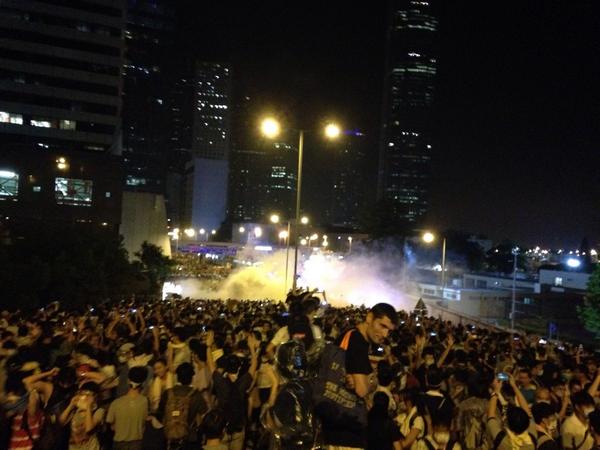
Police fired tear gas on Sunday to disperse thousands of pro-democracy protesters, who had blocked the main thoroughfare leading to Hong Kong’s financial district and assembled in front of government headquarters this weekend, Reuters reports.
View image on Twitter

Treading through tear gas at in Kong | Slideshow by @LamYikFei: http://bit.ly/1t7yUCl 
The protest, which was taken over by pro-democracy group, “Occupy Central with Peace and Love”, follows a week-long strike by students, according to the Associated Press.
University students began skipping classes on Sept. 22 to show their disapproval for the late-August ruling by Beijing’s central government against a fully democratic election for Hong Kong’s next leader in 2017, The New York Times reported.
The protests were peaceful up until Friday, when student-led demonstrators broke through a cordon and scaled a fence to enter the city’s main government compound, reports Reuters.
More than 60 people have been arrested and more than 30 have suffered minor injuries, according to the BBC.
On its Facebook page, the Hong Kong Federation of Students called for people to retreat, because they feared that police would use rubber bullets to break up the crowds. They asked people in the group to save their energy for future protests.

Pro-democracy activists swarm Hong Kong on anniversary of Chinese takeover
BY Ruth Tam  July 1, 2014 at 3:37 PM EDT
Activists in Hong Kong march in demand of greater voting rights. Photo by Flickr user larique
At the peak of a stifling hot Tuesday, a historic number of Hong Kong activists marched more than three miles in support of elections free from Chinese oversight.
Protesters gathered at Victoria Park, where annual vigils for the Tiananmen Square victims are held, and walked west to the city’s central financial district. Several of the activists were among the 787,767 participants of an unofficial referendum calling for candidates for Hong Kong’s leader be nominated by the public instead of Chinese officials.
Beijing-allied authorities have characterized the referendum as unlawful. In response, the pro-democracy group threatened a sit-in of the city’s financial district if the existing government fails to provide basic voting rights.
Under China’s “one country, two systems” rule of law, Hong Kong was grafted into China in 1997, yet allowed autonomy. But a “white paper” from Beijing has recently clarified that this autonomy is not “full” autonomy:
Today’s march was peaceful, but frustrations over Hong Kong’s Chief Executive have been simmering for years. In 2012, Beijing-backed Leung Chun-ying won 689 votes from 1,193 society representatives to become Hong Kong’s Chief Executive. These representatives are largely business executives and existing politicians with connections to mainland China.
For the tens of thousands of Hong Kong activists, this authorized autonomy falls far short of real democracy. While participants (ranging from 98,000, according to police, and 510,000, according to organizers) hope they will be able to choose their own leadership by the 20th anniversary of China’s takeover in 2017, mainland China representatives assert that only leaders who “love the country and love Hong Kong” should be on the ballot.