BUCKNACKT'S SORDID TAWDRY BLOG
We should not be a journey to the grave with the intention of arriving safely in an attractive & well preserved body, but rather to skid in sideways, chocolate, bier or wein in hand, body thoroughly used up, totally worn out and screaming "WHOO-HOO, WHAT A RIDE!!!!!!"
It has been common knowledge the murderous regime in Beijing slaughtered thousands of pro-democracy Chinese in Tiananmen Square on 3-4 JUN 89, this recently released cable from the British ambassador to the prc, Sir Alan Donald. I am still ashamed the American government of george h w bush (R) and corporate America refused to take any significant action against the prc in response to their actions in Tiananmen Square as profit margins were (and still are) considered more important than human lives. This policy was reinforced during bush's (41) presidency as corporate greed was the justification for the Kuwait War / Gulf War in 1990-1991. From the BBC.....
It has become the defining image of China's Tiananmen Square protests in 1989 - one man standing in the way of a column of tanks, a day after hundreds, possibly thousands, had been shot dead.
But 30 years on, the Chinese authorities continue to try to erase all memory of the time when they almost lost their grip on power.
To test the effectiveness of the censorship, the BBC's John Sudworth took to the streets of Beijing to find out how many people recognise Tank Man today.
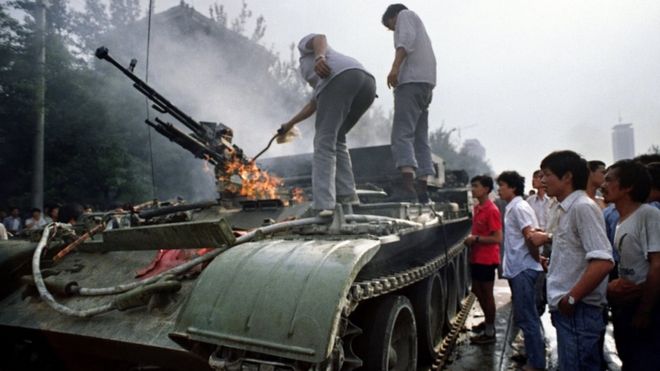
Image copyrightGETTY IMAGESImage captionA burning armoured personnel carrier (APC) on 4 June 1989, near Tiananmen Square
The Chinese army crackdown on the 1989 Tiananmen Square protests killed at least 10,000 people, according to newly released UK documents.
The figure was given in a secret diplomatic cable from then British ambassador to China, Sir Alan Donald.
The original source was a friend of a member of China's State Council, the envoy says.
Previous estimates of the deaths in the pro-democracy protests ranged from several hundred to more than 1,000.
China's statement at the end of June 1989 said that 200 civilians and several dozen security personnel had died in Beijing following the suppression of "counter-revolutionary riots" on 4 June 1989.
Sir Alan's telegram is from 5 June, and he says his source was someone who "was passing on information given him by a close friend who is currently a member of the State Council".
The council is effectively China's ruling cabinet and is chaired by the premier.
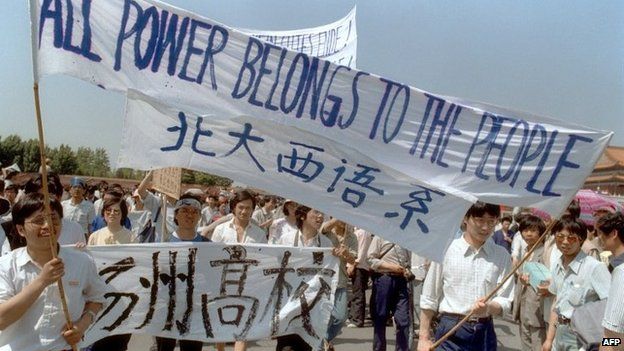
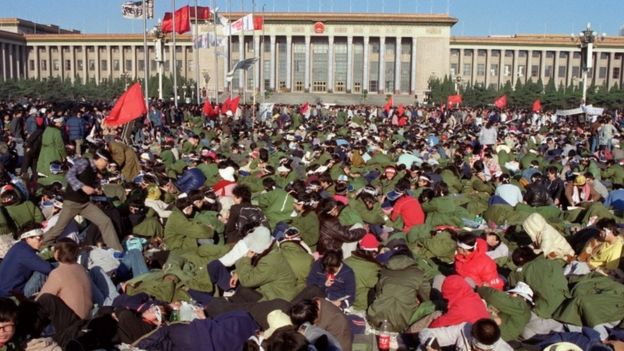
Image copyrightAFPImage captionStudent hunger strikers in Tiananmen Square on 14 May 1989
Sir Alan said the source had been reliable in the past "and was careful to separate fact from speculation and rumour".
The envoy wrote: "Students understood they were given one hour to leave square but after five minutes APCs attacked.
"Students linked arms but were mown down including soldiers. APCs then ran over bodies time and time again to make 'pie' and remains collected by bulldozer. Remains incinerated and then hosed down drains.
"Four wounded girl students begged for their lives but were bayoneted."
Sir Alan added that "some members of the State Council considered that civil war is imminent".
China bans all activists' commemorations and highly regulates online discussion of the incident, including censoring criticism. But it is marked annually by activists elsewhere in the world, particularly in Hong Kong and Taiwan.
voice of the day
The true focus of revolutionary change is never merely the oppressive
situations which we seek to escape, but that piece of the oppressor
which is planted deep within us.
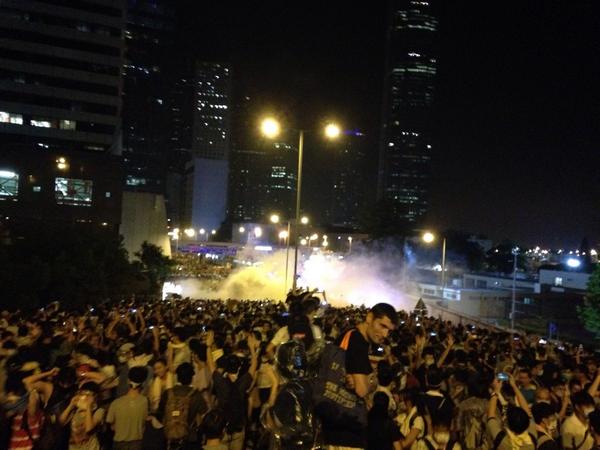
-Audre Lorde THE peaceful pro democracy protest in Hong Kong continue, but a "local backlash" started today with the locals violently attacking the protestors and the police unable to stop the attacks. Sound familiar? It should, think Ukrainian Crimea. A peaceful, pro democracy protest movement in Kiev and throughout Ukraine, the overthrow of a violent, corrupt government and then the appearance of a violent minority rebellion that is no more than a front for Russian aggression and putin's desire to restore the soviet empire. The violence against the pro democracy Hong Kong will continue and expand, the Hong Kong government will declare they can no longer maintain peace, law and order and Beijing will send in the pla. Remember the 1989 Tiananmen Square Massacre? Beijing gets it's way without having to wait to implement it's election "reforms" for 2017, wiping out the last vestiges of pre 1997 Hong Kong that were supposed to be protected by the treaty between the U.K. and the prc. The hypocritical West will continue business as usual with the murderous thugs lead by xi jinping and the hypocritical people of the West will continue to buy everything made in the prc, funding and supporting the denial of democracy and human rights. From +Al Jazeera Channel - قناة الجزيرة الفضائية followed by the +PBS NewsHour coverage of the weeks events.....
Police struggle to keep peace as scuffles erupt in apparent backlash against sit-in that has brought city to standstill.
Last updated: 03 Oct 2014 11:35
Protesters are opposed to a reform that requires candidates for 2017 elections to be approved by Beijing [AFP]
Demonstrators calling for electoral reform have
scuffled with opponents in two of Hong Kong's busiest shopping
districts, with police stepping in to try to calm the chaos.
Around 200 demonstrators were confronted by a larger group that
started to dismantle barricades in Mong Kok in an apparent backlash
against the demonstrations, which have brought parts of the city to a
standstill for days.
"Give us Mong Kok back, we Hong Kongers need to eat!" shouted one man removing the barricades there.
Al Jazeera reporters witnessed police desperately trying to keep the
rival sides apart and protesters being escorted from the scene.
Trouble also broke out between smaller rivals groups in Causeway Bay.
The demonstrators are calling on Beijing to guarantee full democracy
to the former British colony, instead of vetting candidates who want to
stand for the chief executive's job in 2017 elections.
Thousands of protesters filled the business district at the peak of
protests. Schools have been closed, traffic blocked, and civil servants
have been off work.
Some of those confronting the protesters appeared to do so because demonstrations disrupted their businesses and shops. 'Wind out of the sails'
However, the protests seemed to have lost steam and crowds had
dwindled on Friday after the leader of the Chinese territory refused to
step down and instead offered dialogue.
Student protesters had threatened to surround or occupy
government buildings if Chief Executive Leung Chun-ying did not step
down by midnight on Thursday.
Chief Secretary Carrie Lam, who has been tasked with arranging the
talks, on Friday appealed to protesters to end their action in the name
of law and order. She said negotiations with students had not started
and that details were still to be worked out.
Al Jazeera's Fauziah Ibrahim, reporting from the protest site outside
Leung's office as rain drizzled down, said there was no indication of
when the first dialogue meeting would happen, and that had "taken the
wind out of the sails of the protest".
The Hong Kong Federation of Students said in a statement early on
Friday that they planned to join the talks with the government, focused
specifically on political reforms. They reiterated that Leung step down,
saying he "had lost his integrity".
A wider pro-democracy group that had joined the demonstrations,
Occupy Central, welcomed the talks and also insisted that Leung quit.
Pro-democracy
protesters hold umbrellas and wear protective clothing in front of a
police line near the government headquarters in Hong Kong on September
28, 2014. Photo by Alex Ogle/AFP
China’s government is
refusing to compromise with pro-democracy demonstrators in Hong Kong as
protesters threatened escalated action in the autonomous island region
of south China Thursday.
The protesters threatened to block more
government buildings and move their occupation into the central
government offices. As the demonstration continued, police were seen
carrying what appeared to be riot gear, including rubber bullets and tear gas, promising to respond if such a threat were carried out.
In the face of escalating tensions, the Chinese government published a threatening editorial Wednesday in the People’s Daily, warning that if the protest continues, “the consequences will be unimaginable.”
The newspaper, a publication of the Chinese Communist Party, is the same outlet the government used to warn protesters in Tiananmen Square of an impending crackdown 25 years ago.
“By
now, a small number of people in Hong Kong are insistent on resistance
and provocation, and in the end they will suffer because of it,” the
2014 editorial read. Similarly, in 1989, the government tried to
belittle the protestors as “an extremely small number of people with
ulterior purposes.”
Previously, it seemed as if the government was
planning on waiting for the demonstrations to die down and eventually
dissipate. However, China’s National Day Wednesday brought even larger crowds to the protest.
The protesters are demanding that the city’s chief executive, Leung Chun-ying, step down by midnight tonight, local time (noon EDT).
Parts
of Hong Kong came to a standstill for a fifth day, with no sign that
pro-democracy, student-led demonstrations will stop anytime soon. Lucy
Watson of Independent Television News reports on the enthusiasm of the
growing crowds and the question of what authorities will do in response.
JUDY WOODRUFF: Protests
grew in Hong Kong and brought parts of the city to a standstill for a
fifth day. And there was no sign that the pro-democracy student-led
demonstrations will stop anytime soon.Lucy Watson of Independent Television News has this report from Hong Kong. LUCY WATSON: There
is little that this huge crowd won’t endure. The umbrella revolution
and the fight for freedom is unrelenting. It’s an unprecedented display
of defiance, people in every direction taking over a city. There is
strength in numbers, but also in individuals. Three days ago, Gary Lee
was an ordinary student. Now he’s rousing an historic crowd. GARY LEE, Protester Organizer: Everybody put your cell phone lights on, cell phone, the lights on. LUCY WATSON:
“To fulfill our dream, we will sacrifice everything,” they sing. They
want their current leader, C.Y. Leung, to step down and to elect another
freely, demands they refuse to give up on. GARY LEE: Never see the end. Never see the end, because this fight will — forever. LUCY WATSON: This
is a powerful body of people with a life of its own, and nobody quite
knows what direction it will take next. But the Hong Kong government and
Beijing won’t tolerate this mass civil disobedience for long. It’s now a
test of nerves.
And as China’s President Xi Jinping prepares for
the country’s National Day tomorrow, this is a direct challenge to his
governance. ELIZA LEE, Political Analyst: They were not
expecting the Occupy Central movement opposition to become, I mean, what
is now a popular uprising. And they worry that people are going to
imitate this. LUCY WATSON: Threats the Communist Party is unlikely to respond well to. But while there is persistence, there is hope here.
The
blurred lines between Chinese authority and Hong Kong’s autonomy has
set off pro-democracy demonstrations by protesters who don’t seem to be
backing down. Judy Woodruff talks to Ian Bremmer of the Eurasia Group
about what provoked these protests, how they have challenged Chinese
President Xi Jinping and how authorities are likely to respond.
JUDY WOODRUFF: For
more on what provoked these protesters and how mainland China is likely
to respond, we turn to Ian Bremmer. He’s the president and founder of
Eurasia Group. It’s a political risk, research and consulting company.
Ian Bremmer, welcome to the program.
Are these protests unprecedented? Has China ever seen anything like this? And I guess Tiananmen comes to mind. IAN BREMMER, Eurasia Group: Yes. I mean, Tiananmen’s the last time we have seen this sort of thing within China itself.
Certainly,
Hong Kong, there has been nothing like this since the handover from
Great Britain in 1997. And, most importantly, it is by far the first
serious challenge domestically to President Xi Jinping. It really is
directly a question of the legitimacy and the support of what’s so far
been a very popular, very charismatic and very transformative rule. JUDY WOODRUFF: Well,
how much of a challenge is it to him and to the regime, the government
in Beijing? These students have been there for five days. They don’t
show any signs of backing down. IAN BREMMER: No.
And,
in fact, tomorrow, as you have heard, you have the National Day. There
have been a number of calls for demonstrations in support of the Occupy
Central movement, not just in the United States and in the developed
countries, but we also see that they’re likely to happen in Macau.
They’re going to happen in Taipei and Taiwan.
And it wouldn’t
surprise me at all, despite the fact the Chinese government has really
tried the crack down on anyone searching relevant social media terms
around the Hong Kong protests within mainland China, to see some forms
of sympathy there.
And that’s one of the reasons why I think Xi
Jinping, who has been very willing to engage in policies of economic
transformation on the mainland, but has absolutely had no interest in
political reform — this is not a Glasnost guy — he’s very unlikely to
show any flexibility whatsoever, as is the Hong Kong government in
responding to these protests.
Occupy Central has now become Occupy
Hong Kong. As of tomorrow it’s likely to become Occupy larger than
that. And if the — if local police, through threat and selective
arrests, are unable to disperse these demonstrations, we’re likely to
see a very significant violent crackdown. JUDY WOODRUFF: Well,
what do you mean by that? Because that’s the — that’s the natural
question. If these protesters not going away and the government, the
central government isn’t going to bend, what does that mean? IAN BREMMER: Well,
the initial step comes from Hong Kong itself. We have seen the Hong
Kong leadership completely refusing to even meet with the leaders of the
Occupy Central movement, never mind brook any compromise about what
suffrage in selection of a chief executive in Hong Kong might look like
in 2017.
I think the next steps clearly involve the police, who
have been relatively quiet over the last couple of days. They can
certainly take steps to try to remove who they see as the ringleaders of
that movement, and, after they have done that, to try to pressure the
broader groups, give them — give them a couple of outs, let them
disperse once their leaders have been taken under custody.
But,
again, if we continue to see this type of mobilization among the
students that poses a much greater threat to the legitimacy of the
Chinese enterprise and to their power, their exertion of power in Hong
Kong, I think the response goes beyond just Hong Kong police. Then the
People’s Liberation Army does indeed come in. They have garrisons in
Hong Kong.
I suspect they would be used. Certainly, the
international community can complain, but there is no potential that
sanctions or punishment is going to be exerted against the Chinese
government for what they do internally in Hong Kong. This is not like
Russia vs. Ukraine. JUDY WOODRUFF: So, just very quickly,
you mentioned the international community — Britain’s Prime Minister
Cameron protesting today. Of course, they previously held Hong Kong.
You’re saying there’s nothing anybody on the outside can do? IAN BREMMER: Oh,
I think that Cameron and Obama will do a great impersonation of Ban
Ki-Moon. I think they will express a great deal of concern over what
happens for Hong Kong.
But, if you ask me are we talking about the
potential of sanctioning them, I would want to just go back to what
former Secretary of State Hillary Clinton said, which is that it’s
generally not a good idea to criticize your banker on human rights. It’s
going to be very, very difficult for anything more than words in
response to what’s happening on the ground in Hong Kong. JUDY WOODRUFF: Ian Bremmer with the Eurasia Group, we thank you. IAN BREMMER: My pleasure.
Hundreds
of thousands of protesters filled the streets of Hong Kong to demand
more democracy and oppose interference by Beijing in local politics.
Lucy Watson of Independent Television News reports.
JUDY WOODRUFF: The
protests which took over the streets of Hong Kong this weekend and
sparked a crackdown by police continued today in force. Hundreds of
thousands were out tonight to protest what they call a curbing of
democracy and interference by Beijing in picking local leadership
candidates. The Chinese government says the demonstrations are illegal.We have a report from Lucy Watson of Independent Television News.
http://youtu.be/WNZqeir7190 LUCY WATSON: This
is a young generation empowered by unity once again here to galvanize
pro-democracy thought in a peaceful way in a city that is fighting to
maintain its rights and liberties.
Tear gas and pepper spray
confronted them last night, because their demands pose a threat to their
own government and that of mainland China.
Alex Chow was arrested for his involvement, but believes this is the only way. ALEX CHOW, Protester:
You negotiate. You vote. You demonstrate. You ask the government to
respond, but you can see all the methods were losing their power. And
then you have no way but turn to civil disobedience action. LUCY WATSON: Britain
handed over sovereignty of Hong Kong to China in 1997, with Beijing
agree to a one country, two systems principle. But people now believe
that autonomy is being diluted by not being allowed to elect their next
head of government through a fully democratic process. There’s fear the
iron hand of China is tightening its grip. MAN (through interpreter):
I hope the Chinese Communist Party won’t repeat what they did in 1989,
the Tiananmen Square massacre, and make themselves criminals of history. LUCY WATSON: This
family watched and experienced yesterday’s violence but are here again,
hopeful. Even their pregnant daughter wanted to return. WOMAN: I want to let my girl to see now they were here. We are to fight for freedom. LUCY WATSON: There’s
a decidedly different atmosphere here this evening, with protesters
chanting peace, love and unity, in the absence of any police presence.
And
that’s because they believe the momentum of this movement is growing as
the numbers increase. It’s thought around 300,000 people are here
tonight, proving that generations in Hong Kong are undeterred from their
goals.
Barriers still grind this capitalist hub to a halt so voices can be heard, in the hope it heralds a future for change.
A
demonstrator gestures opposite policemen during a pro-democracy protest
in Hong Kong on Sept. 28. Credit: Xaume Olleros/AFP/Getty Images
Police
fired tear gas on Sunday to disperse thousands of pro-democracy
protesters, who had blocked the main thoroughfare leading to Hong Kong’s
financial district and assembled in front of government headquarters
this weekend, Reuters reports.
Police using a lot of teargas and pepper spray to push back protesters from PLA barracks to legco. #OccupyAdmiralty
The
protest, which was taken over by pro-democracy group, “Occupy Central
with Peace and Love”, follows a week-long strike by students, according
to the Associated Press.
University
students began skipping classes on Sept. 22 to show their disapproval
for the late-August ruling by Beijing’s central government against a
fully democratic election for Hong Kong’s next leader in 2017, The New York Times reported.
The
protests were peaceful up until Friday, when student-led demonstrators
broke through a cordon and scaled a fence to enter the city’s main
government compound, reports Reuters.
More than 60 people have been arrested and more than 30 have suffered minor injuries, according to the BBC.
On its Facebook page, the Hong Kong Federation of Students
called for people to retreat, because they feared that police would use
rubber bullets to break up the crowds. They asked people in the group
to save their energy for future protests.
Activists in Hong Kong march in demand of greater voting rights. Photo by Flickr user larique
At
the peak of a stifling hot Tuesday, a historic number of Hong Kong
activists marched more than three miles in support of elections free
from Chinese oversight.
Protesters gathered at Victoria Park,
where annual vigils for the Tiananmen Square victims are held, and
walked west to the city’s central financial district. Several of the
activists were among the 787,767 participants of an unofficial
referendum calling for candidates for Hong Kong’s leader be nominated by
the public instead of Chinese officials.
Beijing-allied
authorities have characterized the referendum as unlawful. In response,
the pro-democracy group threatened a sit-in of the city’s financial
district if the existing government fails to provide basic voting
rights.
Under China’s “one country, two systems” rule of law, Hong Kong was grafted into China in 1997, yet allowed autonomy. But a “white paper” from Beijing has recently clarified that this autonomy is not “full” autonomy:
Today’s
march was peaceful, but frustrations over Hong Kong’s Chief Executive
have been simmering for years. In 2012, Beijing-backed Leung Chun-ying won 689 votes
from 1,193 society representatives to become Hong Kong’s Chief
Executive. These representatives are largely business executives and
existing politicians with connections to mainland China.
For the
tens of thousands of Hong Kong activists, this authorized autonomy falls
far short of real democracy. While participants (ranging from 98,000,
according to police, and 510,000, according to organizers) hope they
will be able to choose their own leadership by the 20th anniversary of
China’s takeover in 2017, mainland China representatives assert that only leaders who “love the country and love Hong Kong” should be on the ballot.

 GETTY IMAGES
 AFP
AFP