NORTON META TAG

Showing posts with label govt brutality. Show all posts

04 October 2014

Hong Kong Protesters Call Off Talks After Mobs Attack Their Camps & Some Residents Turn Against Hong Kong Protesters & IN IMAGES: A Violent Day For Hong Kong's Occupiers 3&4OKT14

MORE and more it seems the prc is activating pro communist agitators in Hong Kong to attack pro democracy protestors and encourage strife between Hong Kong's citizens. If this doesn't stop the protest the violence on the streets will get worse and Beijing will use the civil strife as justification to send in the pla. From +NPR .....
Updated at 12:55 p.m. ET
Hong Kong's main democracy groups called off planned talks with the territory's government after several hundred pro-Beijing demonstrators attacked activists who have staged a week of protests calling for greater freedom.
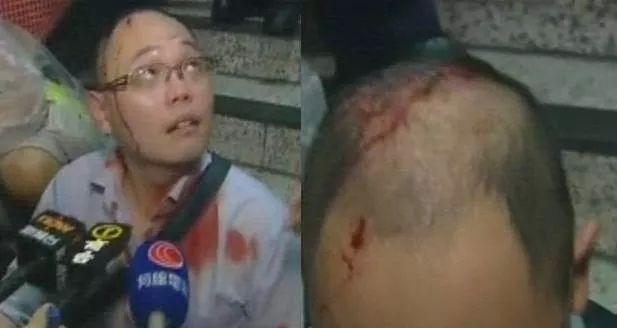
View image on Twitter
We strongly condemn such atrocity! Stop violence against peaceful protesters at once! Credits: AppleDaily
Occupy Central, one of the main groups organizing protests against Beijing's effort to tightly control the selection of Hong Kong's leader, tweeted today:
Occupy Central 和平佔中 @OCLPHK
Students call off talks with the govt over political reform after police failed to halt violence against supporters @HKFS1958

As we reported Thursday, Hong Kong Chief Executive Leung, speaking at a news conference Thursday, said he would stay in the job but appointed his deputy, Chief Secretary Carrie Lam, to meet with protesters to discuss "constitutional development."
But hours later, as the South China Morning Post reports, "A group of mostly male anti-Occupy protestors appeared to be taking commands from a middle-aged Putonghua-speaking [Mandarin-speaking] woman wearing a face mask using a loud hailer at the junction of Argyle Street and Nathan Road [in Mong Kok district]. The thin line of police separating opposing sides was stretched to breaking point, and finally gave way shortly after 5pm. Soon after more police arrived as the tense stand-off continued."
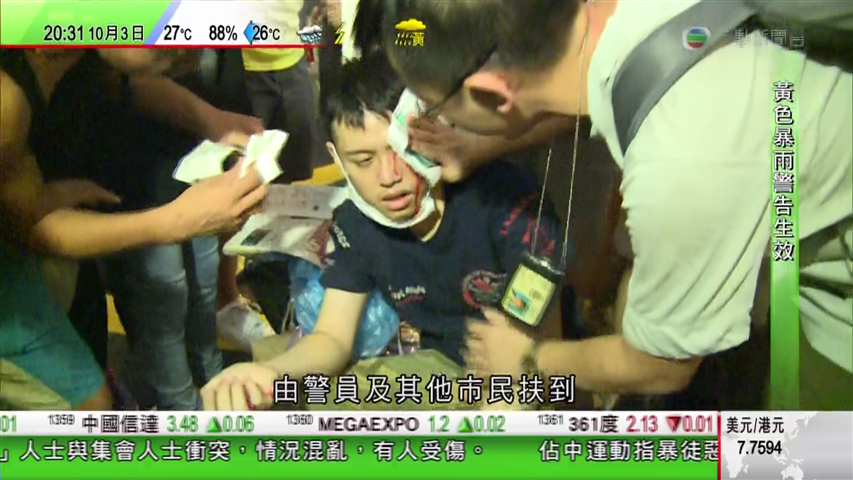
View image on Twitter
Another young student got injured during pro- thugs riot.

Mong Kok, located on Kowloon Peninsula, is one of three main protest areas, which also include the central Admiralty area and Causeway Bay on Hong Kong island.
The Associated Press describes the counterprotesters as Hong Kong residents and pro-Beijing supporters.
NPR's Anthony Kuhn, reporting from Mong Kok, says there's a lot of anger and shouting and that police have established a human chain "to escort Occupy Central protesters to safety.
"It's been a very tense scene for the past several hours," he says.
Anthony spoke to several of the anti-Occupy protesters: "Most of these people tend to be businessmen. They say they want democracy in Hong Kong too, but they think the way the Occupy Central people are going about it is the wrong way."
It was not immediately clear whether the attack on the protesters was spontaneous or part of a coordinated effort to break up the demonstrations, but student activists issued a statement calling them "organized attacks" and threatened to call off the planned dialogue with authorities if the government did not immediately stop the assaults.
The New York Times notes:
"The Mong Kok area is notorious for organized gangs known as triads that extort payments from the many small businesses there, or indeed own the businesses, and some of the protesters suggested that the men were connected to them. Asked if he was a member of such a group, another man who joined in tearing down the tents there, Steve Lin, 48, responded: 'I'm not a triad. I'm a Hong Konger.' "
The AP says: "The scuffles in Kowloon's crowded Mong Kok district were the most chaotic since police used tear gas and pepper spray on Sunday in an unsuccessful attempt to disperse protesters pressing for greater electoral reforms."
"Police were hard-pressed to keep order as the two sides tussled in a tense standoff. The visibly older people trying to force the vastly outnumbered protesters out were yelling, shoving and at times trying to drag the younger protesters away."
Elsewhere, in Causeway Bay, locals angered by the days of protests that brought the neighborhood to a halt confronted pro-democracy protesters. Three men were "shouting loudly, using vulgar language against protesters." Later, the SCMP says, "[an] organised group of about 30 men wearing masks broke through Hennesy Road and reached Jardine's Bazaar and began removing barricades there."
Occupy Central protesters were angered that police did not stop the attack on their camp, some chanting "shame on you" at officers, the newspaper says.
In Admiralty, where some of the largest protests have taken place, Ian Mo, 28, tells the Post that he had been planning to join the demonstrations but changed his mind after seeing the violence.
"The atmosphere here in Admiralty has changed a lot. The people here were so peaceful over the past few nights," Mo said. "People feel angry because of tonight's violence and are standing up again."
Mo said he had walked past protests in Mong Kok and seen the violence there. "There were some police standing by in the crowd but they simply did nothing," he told the SCMP.
On Friday, Hong Kong Financial Secretary John Tsang urged the Occupy Central protesters to consider the long-term interest of the territory. According to a government website:
"Speaking to the media today, Mr Tsang said everyone - protesters, Police officers and every citizen of Hong Kong - felt exhausted by the current events. Many in society feel deeply worried about the current situation.
"He said he was also worried that violence incidents might happen, especially after watching the conflicts in Mongkok."

Activists in Hong Kong have spent a week protesting for democracy. The situation is escalating, with police using tear gas. NPR's Scott Simon speaks with correspondent Anthony Kuhn in Hong Kong.
Tensions are flaring in Hong Kong, where young activists have been staging pro-democracy acts of civil disobedience for the past week.
As Scott reported earlier, what appeared to be a coordinated group of pro-Beijing protesters clashed with members of the Occupy Central movement. It's a story best told through images. We'll start with video from the South China Morning Post, and then we'll leave you with a series of images from the wires.
http://youtu.be/ujuWPZ7Vfw4
Pro-democracy demonstrators look on as they protect a barricade from opponents in an occupied area of Hong Kong on Friday.
Philippe Lopez /AFP/Getty Images
Policemen try to get a man to let go of a fence guarded by pro-democracy demonstrators.
Philippe Lopez /AFP/Getty Images
A group of men in masks rough up a man who tried to stop them from removing barricades from a pro-democracy protest area in the Causeway Bay district of Hong Kong on Friday.
Alex Ogle /AFP/Getty Images
A man is held back by police as he screams at pro-democracy protesters to stop occupying an area of the Causeway Bay district.
Alex Ogle /AFP/Getty Images
Student protesters are overwhelmed with emotions as they hold onto their tent while being threatened by residents and pro-Beijing supporters in Kowloon's crowded Mong Kok district.
Wong Maye-E/AP
Angry locals confront pro-democracy student protesters, demanding that they remove the barricades blocking local streets in Causeway Bay.
Wally Santana/AP
A student protester is injured after being pulled off and hit by residents and pro-Beijing supporters.
Wong Maye-E/AP
Police are trying to control the crowds in the Mong Kok neighborhood as residents of Kowloon who are pro-Beijing clash with pro-democracy protesters, screaming at them to "get out."
Paula Bronstein/Getty Images
Police stand guard outside the government headquarters Friday in Hong Kong.
Thomas Campean/Getty Images

04 May 2012

Chinese Dissident Chen Guangcheng's Fate Remains Uncertain & Chen Guangcheng Asks Congress Via Phone to Come to U.S. 3MAI12

TRUE to form the government of the prc is violating the agreement to protect Chen Guangcheng and his family. The U.S. should insist he, with his family, be allowed to leave the prc with Sec of State Clinton, that is the right and moral action for our government to take. This update from PBS NewsHour...
SUMMARY

"The government officials came into my home, wanted to beat my family to death," Chinese dissident Chen Guangcheng said Thursday, indicating he now wants to leave China. Ray Suarez discussed the fast-moving saga of the blind activist with the AP's Charles Hutzler, the ChinaAid Association's Bob Fu and professor Susan Shirk.

JEFFREY BROWN: Earlier this afternoon, late at night in China, I spoke with Associated Press Beijing bureau chief Charles Hutzler.
Charles Hutzler, thanks for joining us.
So, is the situation any clearer tonight, at least as far as Mr. Chen's desire to leave China, including expressing a desire to leave on Hillary Clinton's plane?
CHARLES HUTZLER, Associated Press: Well, pretty much over the last 24 hours, he has been in touch with friends and foreign media, intermittently turning a cell phone on that was given to him, and he's said repeatedly that he wants to leave. He feels very cut off in the hospital, and he feels his family's life is in danger.
Now, it seemed to have taken the State Department quite some time to get that message, but this evening, they said that they, indeed, had confirmed his desire to leave and they were seeking additional information from him as to how to go forward.
JEFFREY BROWN: And what is his status now? He's not simply a patient in a hospital, presumably. Is he a prisoner? Is that clear at all?
CHARLES HUTZLER: It's not terribly clear.
He is confined to the hospital. He seems to be unable to leave. The State Department said that officials had spoken with him by phone twice today. His wife and his two children who joined him upon his release in the hospital yesterday, his wife has been able to come out and meet with U.S. officials to talk about the family's situation.
JEFFREY BROWN: Just to be clear, have U.S. officials said one way or another if they support his idea of leaving the country?
CHARLES HUTZLER: They have not said that clearly. They have said that they understand it's his intention to leave with his family and they're seeking more information about where to go from here.
They have also said that they have had some contact with Chinese officials over the situation, but no elaboration on the content of those talks.
JEFFREY BROWN: Well, that's what I want to ask you next, because you have got these formal meetings on the one hand, and then you have all of this happening behind the scenes. So it's not clear how much negotiating is going on at this point between the U.S. and Chinese officials?
CHARLES HUTZLER: Well, yes, his change of mind really seemed to throw a spanner in the works.
Before an agreement was reached on his leaving the embassy, we were being told by activists who were in touch with -- with some of the negotiators that a deal had to be made before these high-level strategic and economic talks began, or there just wasn't going to be enough time to deal with it until afterwards.
Of course, their plan to kind of quietly reach a solution has now come undone, and it really is not clear how much energy is being expended -- perhaps a lot -- we just don't know -- on trying to resolve the situation.
JEFFREY BROWN: Charles Hutzler of the AP, thanks for joining us.
CHARLES HUTZLER: Thank you.
JEFFREY BROWN: And two added perspectives now on the story creating a clamor in Beijing and Washington.
Bob Fu, whom we saw at that congressional hearing, is president of the ChinaAid Association, a Christian human rights organization. He has worked with Chen to promote religious freedom and the rule of law in China. Susan Shirk was deputy assistant secretary of state dealing with China issues during the Clinton administration. She is now a professor at the University of California at San Diego.
Bob Fu, you have known Mr. Chen a long time. You talked to him today. How did he sound today? Did he sound as committed as it sounds that he wants to leave?
BOB FU, ChinaAid: He's very clear to me last night when I had phone call and today at the congressional hearing. He and his family does not feel safe in China. They want to leave as soon as possible.
JEFFREY BROWN: And there was the suggestion in that clip that he was suggesting there are wider dangers to his family, to neighbors, to other people?
BOB FU: That's right. He's concerned his family members are being arrested or really threatened. So that's his concern.
JEFFREY BROWN: Is it your sense that he had a change of heart? There still is confusion about what he told U.S. officials and then what he later said when he left the embassy.
BOB FU: Apparently, he said he wasn't getting the full picture for the threat, the length of threat his family member had received before he walked out of the U.S. Embassy.
So he was -- he felt some sort of threat before he walked out of the embassy already when the message came to him that basically said, if you don't walk today, walk out today, then your family will be in danger. Your wife and your children will not be able to see you anymore.
So he walked out of that, of course, with some of the assurance by the U.S. Embassy and the U.S. officials that his freedom will be protected. And at the end of the day, even the first day, the deal was broken, and, yes, as we see today.
JEFFREY BROWN: Now, Susan Shirk, of course, this has led to some second-guessing about how this was handled by the U.S. delegation there.
And we heard that it sounds as though they were clearly taken by surprise. What's your take on that now?
SUSAN SHIRK, director, Institute on Global Conflict and Cooperation, University of California: Well, if you look at the interviews that Ambassador Locke has given and other senior officials who were trying to achieve the result that Chen Guangcheng had requested, which is to live as a free citizen in Chinese society, go to law school, have his family with him, they really left it up to him.
They offered time alternative of staying in the embassy for a period of time. And, in fact, on Monday evening, that's where things were. He -- if you talked -- he talked with Professor Jerome Cohen, professor at NYU Law School, who was giving him independent advice as a highly respected China expert and human rights lawyer. And as of Monday night, it looked like he was going to stay in the embassy and the embassy was making preparations to house him for some period of time.
On Tuesday, his thinking changed. And he asked that his family be brought to Beijing by the Chinese government as a sign of goodwill and credible commitment. And the Chinese government did that. And once he spoke with his wife several times, once she had gotten to the hospital, he decided to leave.
But, of course, once he reentered Chinese society, I think his feelings of vulnerability very much came to the surface, and he became uncertain about the risks he now faces.
JEFFREY BROWN: All right.
Well, Bob Fu, you have raised some questions I think about how the U.S. handled this, or some concerns. But what is your thinking now? And what kind of negotiations -- what should happen now?
BOB FU: I think Secretary Clinton should make an appointment with the Chinese and allow her at least to meet with Mr. Chen and his wife in a safe environment to listen to what do they really want to do, and I think to reassess the agreement.
And, honestly, he already made it very clear to the whole world and even today to Secretary Clinton that he wants help, and he feels in danger. He wants his family to come to the U.S.
JEFFREY BROWN: But do you see the U.S. as having the leverage to do that, given the Chinese, no doubt, feel very aggrieved at this point? We have seen it.
BOB FU: Yes, I think, technically, you know, Mr. Chen and his family, they are not criminals, and they are supposed to be free citizens.
And normal Chinese citizens are guaranteed with constitutional rights. They should be allowed to at least get a passport and to apply a visa. I think if the two governments reach that agreement, just treat him as he is, I think that's not a big deal.
JEFFREY BROWN: Susan Shirk, do you see this the U.S. as having leverage here? What should happen?
SUSAN SHIRK: Well, in the last couple of hours, Mr. Chen has indicated that he would like to remain in China as a free citizen, but he would like to leave for a period of time, say, as a visiting scholar or international student at an American university.
This might be a very good solution, which would be a lot easier for the Chinese government to accept than a case of political asylum.
JEFFREY BROWN: All right, we will leave it there for now.
Susan Shirk and Bob Fu, thank you both very much.
BOB FU: Thank you.
JEFFREY BROWN: And one further note: We have posted online all of Mr. Chen's cell phone conversation with members of Congress this afternoon. You can find the video on our home page.
http://www.pbs.org/newshour/bb/world/jan-june12/china2_05-03.html

Chen Guangcheng Asks Congress Via Phone to Come to U.S.

During a live U.S. congressional hearing Thursday afternoon, Chinese dissident Chen Guangcheng made a dramatic telephone appeal to come to the United States.
"I want to come to the U.S. to rest. I have not had a rest in 10 years," the blind dissident said.
His remarks were broadcast via the speaker on an iPhone held up to a microphone at the hearing and interpreted by a translator.
"I'm concerned most right now with the safety of my mother and brothers. I really want to know what's going on with them."
On Wednesday's NewsHour broadcast, Jeffrey Brown, Xiao Qiang of The China Digital Times and The New Yorker's Evan Osnos discussed the blind activist's unclear fate and how his saga has affected U.S.-China relations.


15 March 2012

Defiant Russia vows to keep arming Syria from AMNESTY INTERNATIONAL

THE neo-fascist government of Russia has no problems with government slaughter of civilians, nor do they have a problem with torture and other human rights abuses of civilians by the government. That is why they have no problem being allied with the prc and assad of Syria. Please participate in the Amnesty International campaign to pressure Russia to end it's support of assad and end the torture, abuse and slaughter of Syrian civilians....
Amnesty International
Syria bleeds. Will ally Russia stand in silence or solidarity with Syria's people?


When will Russia do right by the people of Syria?

In the six weeks since Russia and China blocked a UN Security Council resolution condemning Syria's bloody crackdown, 1,179 Syrians have been killed. Amnesty International has received the names of well over 6,500 people killed since March 2011.

On Tuesday Russia vowed to keep pumping arms into the country -- arms used to massacre civilians. Russia claims Syrian president Bashar al-Assad needs them to defend against opposition fighters.

The reality is that the overwhelming majority of human rights abuses have been committed by state security forces. Amnesty has documented an extremely disturbing -- near medieval -- pattern of torture and humiliation of anyone merely suspected of opposing the government.

Satellite imagery from Homs and Hama show civilian neighborhoods pocked with artillery impact craters. Field guns are still trained on residential areas and armed forces have not been removed from cities, in direct defiance of a UN General Assembly resolution from mid-February.

It's time for Russia to stop opposing strong action by the UN Security Council to end the violence in Syria.

Urge Russia to help end the human rights catastrophe in Syria.

While Russia defies international pleas for cooperation, evidence mounts of widespread crimes against humanity committed by security forces.

Amnesty's new report "'I Wanted to Die': Syria's Torture Survivors Speak Out" details systemic and horrific abuses committed in Syria's detention centers. Former detainees (men and women) interviewed by Amnesty said that they had either experienced or witnessed 31 methods of torture and other ill-treatment:
"I was very badly beaten. They used pincers to remove flesh from my legs." - Karim

"We were hung from wood -- crucified -- while blindfolded and handcuffed, and then beaten mercilessly for several hours." - Musleh

"I could hear people screaming from the torture, which was worse than physical torture." - Abd al-Baset
Russia can make a difference in Syria. It must.

Join Amnesty as we ratchet up the pressure on the Russian government. Sign our petition urging Russia to use its influence to bring an end to the grave human rights violations being committed in Syria.

Thank you for all you do to stand up for human rights.

Sanjeev Bery
Advocacy Director, Middle East & North Africa
Amnesty International USA


  It's Russia's move.


In Syria, new evidence of crimes against humanity is emerging. The price of Russia's silence is sharply increasing. Urge Russia to use its influence to help bring an end to the humanitarian crisis in Syria.


Share on Facebook
Share on Twitter
Take Action DonateVisit Blog

© 2012 Amnesty International USA | 5 Penn Plaza, New York, NY 10001 | 212.807.8400  

11 February 2012

Saudi Arabian protester, second in two days, reportedly shot dead by security forces 10FEB12

THE Saudi Arabian king has condemned Syrian dictator bashir-al-assad for his violence against pro-democracy protesters and then unleashes his own security forces to kill unarmed pro-democracy protesters in his country. mahmoud ahmedinajad was spot on in his ridicule of Middle Eastern leaders who are condemning Syria's assad while never holding free elections in their own countries.
"Iranian President Mahmoud Ahmadinejad, one of Assad’s top allies, warned Arab countries on Saturday not to give aid to the opposition.
Speaking to tens of thousands of supporters in Tehran on the anniversary of the 1979 Islamic Revolution, Ahmadinejad said countries in the region that have never held free elections are trying to write a “prescription for freedom and elections for others” with the help of the United States.
“This is the most bitter and ridiculous joke of history,” Ahmadinejad said"
As an American I am ashamed of my government's hypocrisy in the support provided to the governments of Saudi Arabia, Bahrain, Kuwait, and others in the region as they brutally and violently repress their own people through imprisonment, torture and death. This from the Washington Post, a warning, the videos of the deaths of these two young men are disturbing (click the header to go to the RevolutionEast facebook page).......
http://www.washingtonpost.com/blogs/blogpost/post/saudi-arabian-protester-for-second-day-in-a-row-reportedly-shot-dead-by-security-forces/2012/02/10/gIQA7Lml4Q_blog.html
For the second day in a row, a protester in Saudi Arabia has been shot dead by security forces during demonstrations, the Lede blog reports, citing activists.

(YouTube)
Protester Zohair al-Saad died of gunshot wounds after security forces opened fire in a tiny town north of Qatif, according to an activist Facebook page for videographers, Revolution East.
Video of the protester from that page shows Saad just before he died, as a group of men attempt to stop the bleeding. (WARNING: Graphic images inside.)

Three others were injured in the gunfire, Ahmed Hamad Al Rebh, 46, who maintains the Revolution East page, told the Lede.
On Thursday in Qatif, another man, identified as Muneer al-Meedani, was reportedly killed in clashes with the police. Three others were injured. Graphic video shows protesters trying to stop the bleeding from Meedani’s wounds, too.

A number of disturbing videos have emerged out of Saudi Arabia in recent weeks, including footage purporting to show the abuses happening inside Bremain prison, and protesters running for cover as gunfire sounds:
Saudi police confirmed that a man was killed Thursday, but said security forces had been attacked by masked men and were simply returning fire, the state-run Saudi Press Agency reported.
Saudi blogger Ahmed Al-Omran didn’t buy this statement:


While Saudi Arabia has managed to squelch protests over political rights from spreading in the country, largely by spending billions on welfare, there are indications those efforts may no longer be working.
On the Revolution East page, activists said protests were planned for Qatif Saturday.
 Video from Bremain prison in Saudi Arabia

Second Protester Is Reported Killed in Saudi Arabia

Activists posted video of protests said to be from the city of Qatif on Friday. Several people waved flags of nearby Bahrain, where Saudi forces assisted in a brutal crackdown last year.
Activists in Saudi Arabia said that for the second day in a row, a protester was shot dead Friday by security forces during demonstrations in the country’s oil-rich eastern region.
The state-run Saudi Press Agency confirmed the killing of a man on Friday by security forces following “an illegal gathering,” Reuters reported. The state news report said security officers came under fire and “dealt with the situation by firing back, which resulted with the death of one.”
The violence occurred in a small town north of the city of Qatif, said Ahmed Hamad Al Rebh, a 46-year-old Saudi Arabian activist who maintains a main Facebook page for a network of activist videographers in eastern Saudi Arabia.
The page, Revolution East, included video of the protester, identified as Zohair Al Saad, shortly before activists said he died from gunshot wounds. A group of men can be seen carrying his limp body and attempting to stanch a wound just below his belt as he lay on the ground. Blood can be seen dripping onto the pavement.
[Warning, disturbing video.]
Three others were wounded in the clash, Mr. Al Rebh said in a telephone interview from Beirut. He said he had lived outside Saudi Arabia since early last year for safety.
“In Saudi Arabia there are no rubber bullets, no water hoses, no birdshot,” he said, referring to the less lethal methods used to quell protests in many countries. “There is only live ammunition that is used against peaceful protesters.”
The demonstrations followed the death of another man on Thursday in clashes with the police on a central avenue in Qatif. Graphic video showing gaping wounds on the blood-covered torso of the man, identified as Muneer al-Meedani, also appeared on activist Web sites.
The crackling sound of gunfire can be heard as a small group of men search for cover down an alley near a central intersection in another video said to be from the city on Thursday and posted by Revolution East. One protester carries the flag of the nearby kingdom of Bahrain, where Saudi military forces assisted in a brutal crackdown on large-scale protests last year.
The police confirmed on Friday that a man had been killed the day before in Qatif but said the killing occurred after security officers patrolling in the Al-Shwikah district came under fire by masked men and returned fire, the state-run Saudi Press Agency reported. The report said four others were wounded. “Security men will deal firmly with all cases and situations that endanger the security and safety of citizens and residents,” the report quoted an unnamed police spokesman as saying.
At least a dozen others were injured in the clashes on Thursday but had not been treated at hospitals, fearing arrest if they did so, activists said.
Though spared the Arab Spring’s revolutionary unrest, Saudi Arabia has dealt swiftly with what few protests have been mounted, mostly in the Shiite-dominated eastern Qatif region. Last March, as waves of unrest swept across the region, Saudi security forces fired on protesters, wounding three. Four people died in clashes there in November, and another was shot and killed by the police last month.
Efforts by King Abdullah to mollify protesters by spending billions on welfare last year have not succeeded in easing longstanding tensions between the country’s minority Shiite population and its religiously conservative Sunni government.
Activists on the Revolution East page called for further protests in Qatif on Saturday.
Mayy El-Sheikh contributed reporting from Cairo.