NORTON META TAG

Showing posts with label unemployed. Show all posts

19 December 2013

6 Ways Sen. Warren's 'No Credit Checks for Hiring' Bill Helps All of Us 19DEZ13

SEN ELIZABETH WARREN D MA continues to fight for the rights of all Americans with her introduction of this legislation in the Senate. (I wish my Senator, Tim Kaine D VA, who serves on the Senate Banking Committee with Sen Warren, had the same moral conviction and courage she does.)  There is no good reason for Congress not to pass it, as the article shows there is no relationship between an employees credit score and their job performance. And allowing employers to access and use credit scores of potential and current employees can only keep people in a cycle of unemployment, underemployment and economic distress. We can only hope and pray Sen Warren's legislation is passed by Congress as it will help many out of unemployment, putting them on the path to economic stability. From HuffPost...

This week Sen. Elizabeth Warren and six colleagues introduced the Equal Employment for All Act, which would make it illegal for employers to disqualify job applicants based on their credit scores. It's an admirable and important bill which deserves our support. It also gives us an opportunity to have a broader discussion about the kind of society we hope to become.
Here are six reasons to support a bill which will help all of us in the end:
1. It aids the long-term unemployed.
Long-term unemployment is at historically high levels in this country, and policymakers have done far too little for this hard-hit group of Americans. They have experienced the ongoing loss of their way of life - often accompanied by the loss of their homes, their belongings, and their sense of self-worth.
Long-term unemployment is almost always accompanied by unpaid bills, which drastically lower a person's credit score. Today that lower credit score can render a person unemployable, leading to the kinds of heartbreaking stories described in a New York Times article on the subject earlier this year.
Instead of alleviating the problem of long-term unemployment, the use of credit scores in hiring makes it worse. On a societal level, that's indefensible. And on an individual level, it's inhumane.
2. It begins to right a terrible injustice.
One of the great injustices of the past five years is the way that Wall Street, whose fraud caused the current economic crisis, still holds enormous power over its victims.
We've seen that injustice played out in continued foreclosures, as banks evict families because their homes are worth less than the outstanding mortgage loan - thanks to the banks who created a housing bubble - and because many homeowners are unable to find adequate work as a result of the bank-created jobs recession.
We've seen that injustice reflected in credit card debt and other loans, whose costs have soared as the result of overly complicated contracts with hidden provisions.
And we see that injustice in the spectacle of Americans who are unable to find work as the result of foreclosures, soaring borrowing costs - and a credit-scoring system created for the banks.
This bill begins to end that pattern of injustice, by ending at least one of these practices. It's a start.
3. It also begins to level the playing field between Wall Street and ordinary Americans.
Financial institutions enjoy extraordinary, even unprecedented power over individual Americans. A consumer's relationship with a bank is no longer even the semblance of a contract between autonomous equals. It's an asymmetrical relationship in which one party - the bank - can unilaterally change the terms of the agreement, in many cases leaving the consumer with no recourse.
Sen. Warren's brainchild, the Consumer Financial Protection Bureau, goes a long way towards leveling this relationship. But financial institutions and other corporations still hold excessive power over individuals. One of their most powerful tools is the credit score.
The greatest tool consumers have against corporations and banks is, or should be, the ability to withhold payment when a contract isn't honored.  But a bad credit score hurts consumers in a number of ways. It makes it harder for them to find housing, it makes borrowing more expensive, and many consumers understand that it will make it harder for them to find a job - whether they are searching for one now, or (like most Americans) consider it likely that they'll be looking for one at some point in the future.
Because of this leverage, many people are forced to passively accept injustices from misbehaving corporations. If they withhold payment, even in cases where a product was defective or services not rendered, they may find themselves unemployable.
This imbalance of power allows banks and other corporations to keep acting unjustly. That needs to change.
4. It reduces the ongoing encroachment of Big Data on our daily lives.
The computer crowd likes to say that "Information wants to be free." We've learned now that it actually wants to be very, very expensive - and it's not interested in whether you remain free. Big Data is a self-sustaining and self-expanding institution which seeks to maximize profits by finding new markets for the information it gathers.
The credit score industry is an excellent case in point. FICO and its competitors began gathering credit information for lending institutions. Once they created systems for collecting the data, their only remaining challenge was a sales challenge: who else will buy it?
That's how Big Data becomes big.
The employer market is enormous. Even in recessionary times like these, hundreds of thousands of hiring decisions are being made. Each involves multiple candidates. Cracking this market was a major "score" for the credit score industry.  And if the social and human costs of entering this new market were enormous - well, that's not their problem, is it?
It may not be their problem. But it's ours. And in solving it, we can also send a signal to the corporate world and the body politic: Big Data doesn't run things - people do.
5. This credit information isn't even useful.
Our infatuation with Big Data can also lead us to ascribe more wisdom to it than it actually possesses. This is a perfect example of that phenomenon in action. The only academic research we could find on the topic, published in the Psychologist-Manager Journal in 2012, concluded that "Predictors extracted from applicant credit reports ... had no relationship with either performance appraisal ratings or termination decisions."
Not a "weak" relationship. Not an "unproven" relationship. No relationship.
This practice creates needless misery. This bill will stop it.
6. It reaffirms our values as a society.
If credit information doesn't predict employee performance, why use it at all? Whether consciously or not, its only purpose becomes cultural, not economic. It becomes a way for people who have jobs to avoid those who don't. It's a way of stigmatizing the unemployed, as if they are carriers of a terrible contagion.
We're often tempted to look away when we see the hungry or the sick on the street. This practice does something similar, by keeping the bearers of bad luck away before it rubs off on us, too.
But that's just superstition, and it's not who we are. At our best, we're a society whose citizens help one another in times of need. We're a society that believes in equal opportunity. We're a society that believes in the right to privacy. And we're a society that believes people who want to work should be able to work.
Sen. Warren deserves credit for introducing this bill. So do her Senate co-sponsors: Senators Richard Blumenthal (D-Conn.), Sherrod Brown (D-Ohio), Patrick Leahy (D-Vt.), Edward J. Markey (D-Mass.), Jeanne Shaheen (D-N.H.), and Sheldon Whitehouse (D-R.I.). And so does Rep. Steve Cohen (TN-9), who introduced a similar bill in the House in 2011.
The people who are being hurt by these credit checks want to improve their own lives. It's time to let them. We'll be improving our own lives too.
Follow Richard (RJ) Eskow on Twitter: www.twitter.com/rjeskow 
http://www.huffingtonpost.com/rj-eskow/6-ways-sen-warrens-no-cre_b_4470684.html 

03 December 2011

Jobs Report: Long-Term Unemployed Tell Congress They're Hurting & Jobs Mirage: 315,000 Drop Out Of Workforce, Driving Unemployment Rate To Three-Year Low 2DEZ11

ANYONE who has ever been unemployed knows the government stats are never correct, actually never honest (no matter who is president). That is probably why Pres Obama wasn't out thumping his chest about the drastic "drop" in the unemployment rate. I was thoroughly disgusted by john boehner's right wing rant about the unemployment numbers, he is one of those who claims extending the bush tax cuts for the wealthy is what will create jobs, yet can't show us any improvement in the economy and employment from the two years the tax cuts were extended. Where are the jobs speaker boehner???  I was unemployed in Pennsylvania for about a year in the 80's during reagan's economic miracle and I remember the feelings of hopelessness and depression and the fear, and when my inability to find a job went on and on also my feelings of worthlessness and that something was wrong with me. My family and friends and faith got me through that rough time in my life, but in times like these I have ghost from the past haunting me even though I have a good job. There is a little voice in my head that keeps me afraid, makes me wonder what will happen if all of the sudden I no longer have a job....just what will happen, especially since I am 53 years old. I thank God every day I have my job and pray that I stay employed. Congress should not be playing these political games with people's lives. Unemployment benefits must be extended for those unable to find work. Please take the time to e mail your Representative https://writerep.house.gov/writerep/welcome.shtml 
and your Senators http://www.senate.gov/general/contact_information/senators_cfm.cfm 
and tell them to extend unemployment benefits for those desperately seeking jobs, we can not turn our backs on these people, our family, friends and neighbors, our fellow Americans......
WASHINGTON -- It's been two long years since Wayne Person lost his sales job, and the 59-year-old from Mount Laurel, N.J., still hasn't managed to find new work. After a seemingly endless string of rejections, he's come to blame his long bout with unemployment on two primary factors: His age and unemployment itself.
"It became almost impossible for me to get a job interview, let a lone a job," Person says. Of the interviews he has had, "They concluded I was unqualified because I was not tech savvy, which is ridiculous, or because I was looking to retire soon, which is equally ridiculous." He has a suspicion that many employers won't consider him simply because he's already out of work -- a hunch not without merit.
Person, who's draining his 401(k) in an effort to stay afloat, is one of many out-of-work Americans who are urging Congress to pass reauthorization for unemployment insurance benefits -- a safety net that Person himself exhausted long ago, and that nearly two million unemployed stand to lose come January if the benefits aren't extended, according to the worker advocacy group National Employment Law Project.
To highlight the plight of the jobless, an alliance of 23 progressive groups called USAction released a report Friday telling the stories of nearly 90 people who are out of work, including Person. On a call with reporters, members of the group argued that the numbers released Friday from the Bureau of Labor Statistics underscore the need for congressional action on jobs and unemployment insurance.

The jobless rate actually dropped last month -- from 9.0 percent to 8.6, marking the lowest rate since March 2009 -- but that good bit of news was due partly to a shrinking labor pool, as many discouraged Americans stop looking for work.
"I think there is a tendency to focus on what the unemployment rate is, as opposed to the devil in the details," said Christine Owens, executive director of National Employment Law Project, who was on the call. "Although it's certainly good news that the unemployment rate declined, a chunk of that decline is because several hundred thousand people dropped out of the labor force. We still have almost six million people who've been unemployed six months or longer."
Debating whether or not to reauthorize unemployment benefits is fast becoming a holiday-season ritual in Washington, with lawmakers now facing the same question they did last December. Democrats have stumped loudly for the extension, holding a press conference Wednesday with hundreds of unemployed workers to pressure their colleagues on the other side of the aisle. Republicans in both chambers, meanwhile, have shown quiet signs of support for the reauthorization.
"There's no reason not to renew this program," Owens said. "It would be a huge body blow to the economy. These benefits do not prolong unemployment; they keep the unemployed engaged in the job search. Maintaining this program has that effect."
William McNary, director of USAction, said the group assembled their report, entitled "Hardly Working: Stories from Un- and Under-Employed Americans," in order to show some of the people behind the jobless numbers.
One of those people is Molly Wassermann, who recently moved to New York City from Toledo, Ohio, in search of better job prospects. She's been without work since 2008.
"What exactly is a person supposed to do who isn't being hired?" Wassermann asked on the call. "Are we supposed to just die? ... The attitude toward us is everything but Christian. They say we're lazy. ... The right is demonizing us."
"The vast majority of us just want to work," she said.

Jobs Mirage: 315,000 Drop Out Of Workforce, Driving Unemployment Rate To Three-Year Low 

http://www.huffingtonpost.com/2011/12/02/jobs-report-december-november-2011_n_1125180.html
Despite a stark drop in the national unemployment rate reported Friday, economists warned it will take decades for the labor market to return to pre-recession employment levels if the economy's achingly slow growth continues.
The U.S. economy added 120,000 jobs in November -- falling short of economists' expectations -- while the unemployment rate dipped from 9.0 to 8.6 percent, the Bureau of Labor Statistics reported Friday morning. But roughly half of the decline in the unemployment rate came from the 315,000 Americans who dropped out of the labor market last month, in part a reflection of the slow pace of the recovery, economists said.
"When unemployment is this high for this long, it's very likely that most of the people dropping out are doing so because they can't find work," said Heidi Shierholz, an economist at the Economic Policy Institute, who has studied the shrinking labor force during the years since the recession began. "There is some movement here, that's true. But it's just so slow."
While November's job gains roughly kept pace with population growth, a more positive glimmer can be found in the upwards revisions of the past two months of employment growth. Job growth for September was revised up to 210,000 from 158,00, and October's gains were up to 100,000 from 80,000.
120,000 may not be 250,000 -- the lowest number most economists look to for a really healthy recovery -- but it's also better than zero, the initial headline number of new positions created in August, when fears of a double-dip recession really began to take hold. In October, the number of new positions created in August was revised upwards to 103,000.
"We've got a modest acceleration and more employment growth then we saw over the summer," said Nigel Gault, Chief US Economist at IHS Global Insight, a firm offering economic and financial analysis, forecasting and market intelligence.
Domestically, Gault said, things haven't turned out as bad as people feared. But the global picture emanating from Greece and China looks darker. "At the moment, the U.S. is doing better than most of the rest of the world. But let's say Europe drops into recession. How far and how long could we outperform them?"
Job gains came in retail, hospitality, health care and business services, with modest gains in temporary work -- which can sometimes be an indicator of future job growth. Manufacturing employment -- once heralded as the shining star of the recovery -- has remained essentially flat since July. Meanwhile, state and local government continued to shed jobs.
The job gains are not coming in primarily high-wage industries, and annual average wage growth is not keeping pace with inflation. Worker in the retail sector -- which had the biggest gains last month -- pull in median hourly wages of $10.94 an hour, according to the Labor Department, and that sector's growth is one factor that explains the 2 cents dip in average hourly earnings last month. Another key factor is that the weak labor market provides employees little leverage to bargain with their employers over pay, economists said.
Two million Americans have been out of work for 99 weeks or more -- up from 1.5 million last November -- according to the Bureau of Labor Statistics. The percentage of workers who are working part time but still seeking full-time work is also up from a year ago, according to a recent Gallup poll.
And the U.S. economy still needs to regain more than 6 million jobs lost during the recession -- plus some 4.6 million jobs to account for population growth -- to reach pre-recession employment.
It's stark numbers like these that have led economists to dub the years since the Great Recession officially ended "the jobless recovery."
"After previous recessions, hiring soared. What has come roaring back this time is profits. They've reached a peak," said Gary Burtless, an economist at the Brookings Institute.
While many Occupy Wall Street protest camps have been cleared around the country, the income inequality that brought thousands of Americans to the streets since mid-September remains as strong as ever, according to this latest government snapshot. And even if job growth began to rebound in coming months, that income inequality, which has been growing for decades now, would still remain.
"Even if we could magically return to where things were in 2007 and the issues of the housing market disappeared, we would still have the three decades of cumulative growing inequality problems," said Lawrence Katz, Professor of Economics at Harvard University.
Arthur Delaney contributed reporting
CORRECTION: An earlier version of this report incorrectly reported that net job growth was flat in August, according to the Bureau of Labor Statistics. The BLS initally reported zero job growth in August, but revised that number upward in October to 103,000 jobs.
10. Georgia
1 of 11
PLAY
FULLSCREEN
ZOOM
SHARE THIS SLIDE 
Unemployment rate October 2011: 10.2 percent
Number of unemployed October 2011: 483,600


19 August 2011

Unemployed Constituents Stage Sit-In At Paul Ryan’s Office, Ryan’s Staff Calls The Cops & Paul Ryan's Office Calls Cops On Jobless Protesters 19AUG11

PEOPLE are condemning Pres Obama for going on vacation to Martha's Vineyard, playground of the rich and famous, while rep paul ryan r WI gets away with this????? His own constituents have to pay $15 to meet with him??? He is paid by their taxes to be their representative in the House!!! paul ryan really is a political whore! How dare he, and shame on the mainstream media for ignoring this!!!! What bullshit! From ThinkProgress & HuffPost....
Yesterday, seven unemployed constituents of Rep. Paul Ryan (R-WI) staged a sit-in at his office in Kenosha, Wisconsin, to protest the congressman’s decision not to hold any free public town halls during the August recess. An additional 100 protesters picketed outside the office. Politico reported this week that Ryan, Chairman of the powerful House Budget Committee, will only speak to residents who are willing to pay $15 for access.
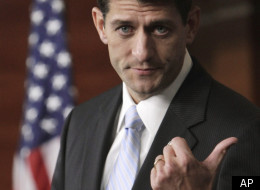
It’s customary for representatives to host free town halls open to the public so constituents can ask questions and weigh in on their elected officials’ votes. But Ryan and other conservative congressman who have been facing angry crowds recently have decided to limit their availability to only those willing to open their wallets. This didn’t sit well with many of Ryan’s constituents who are struggling just to get by and don’t think they should have to pay to get an audience with their congressman:
Ryan is currently vacationing with his family, but the seven individuals sitting in his office say they have all tried to contact Ryan, multiple times, and have received the same generic email response. Traditionally when members of Wisconsin’s Congressional Delegation break for the August recess they hold town hall meetings where they listen to concerns off constituents in their districts. Ryan, so far, has only scheduled one “public” appearance at the Whitenall Park Rotary September 6 banquet. Attendees will be required to pay a $15 fee to be one of the lucky 300 to meet with the Representative. I spoke with four of the Ryan Seven this afternoon and they all said they were planning to stay “as long as it takes.”
One of the protesters, Scott Page, says he’s been let go from two jobs in the past two years. One position was outsourced to Mexico, and for the second, he was required to train an individual in China to be his replacement. Page said he hoped Ryan would “have a heart” and “take time to listen to the unemployed in his backyard instead of only the business owners.” “I don’t have $15 to ask Rep. Ryan questions,” he added, “so I guess this is the only means I have to talk to him.” Several of the protesters have posted testimonial videos on the Wisconsin Jobs Now website. Unemployment in Ryan’s home state has been growing recently.
Instead of meeting with the protesters, Ryan’s staff called the police. The seven protesters occupying Ryan’s office left the building last night after negotiations with police to end the sit-in peacefully. The seven praised Ryan’s office staff for being “amazing” and “polite,” but had no warm words for Ryan.

Paul Ryan's Office Calls Cops On Jobless Protesters

 http://www.huffingtonpost.com/2011/08/19/paul-ryan-protesters-police_n_931508.html

Staffers for Rep. Paul Ryan (R-Wis.) called police on Thursday evening to disperse unemployed protesters staging a sit-in at his Kenosha, Wis., office, according to the protesters and police.
Two protesters told HuffPost they're unhappy with Ryan's proposals to gut social programs and also his new policy of not holding free public meetings with constituents during the congressional recess.
During the summer of 2009, Ryan hosted some 17 town halls. Admission to Ryan's one town-hall style event in his district this summer will cost $15, according to the Whitnall Park Rotary Club, which is hosting the Milwaukee-area event on Sept. 6.
"People don't realize that they have every right to stand up and talk to their congressman," Shanon Molina, 31, told HuffPost on Friday.
Molina, who lives in Kenosha with her daughter, said she lost her full-time job as an office administrator in 2009. For 18 months she received unemployment benefits and picked up a few shifts as a waitress and bartender. In January, she landed a new job as an office administrator, but at half the hours and half the pay of the previous job, which she said she'd had for 10 years.
"I have a child to support, I have a house to keep up," Molina said. "I didn't choose to be in this situation. I'm in an emergency here."
The unemployment rate is 10 percent, unchanged from a year ago, in nearby Racine -- the closest city with numbers available.Molina said she and other members of Wisconsin Jobs Now, a coalition of community groups, neighborhood associations and labor unions, organized the Kenosha protest, which at one point on Thursday she said attracted more than 100 people.
"I went there to talk to Paul Ryan," Molina said. "They said he was on vacation with his family in Colorado."
Shortly after the protesters arrived, said Molina, Ryan's staffers handed them a written statement from the congressman. She described the staffers as cordial and polite.
"Although I was unable to personally meet with those who stopped by my Kenosha office, I appreciate hearing from so many on the urgent need to create jobs in Southeast Wisconsin," the statement said, according to a YouTube video of protesters reading it into a bullhorn outside the Kenosha office. "I pride myself on being accessible to those I represent."
A spokesman for Ryan did not respond to requests for comment.
Lt. Eric Larsen of the Kenosha Police Department told HuffPost that Ryan's office called the department around 4 p.m. on Thursday, and that the officers who responded found seven protesters inside the building where the office is located and about 50 protesters outside.
"They left peaceably," Larsen said.
Some of the protesters returned on Friday. Kenosha resident Scott Page, 32, said he brought his laptop so he could look for jobs from inside Ryan's office. He said he hasn't been able to find anything better than temporary and part-time work since being laid off from a factory at the end of 2007.
"My rent's due in a short time here, and I honestly don't know where I'm going to come up with that money," Page said. "We're just gonna sit here until we get to talk to Ryan face to face. Every day we're going to sit here."
Ryan has boasted that he hosted lots of town hall meetings during the summer recess of 2009.
"I had 17 and shattered attendance records at my town halls," Ryan said during an appearance on MSNBC. "You know, at the end of them, I was asking for a show of hands of the people who had never been to a town hall before, and it was about 95 percent. They were very civil."
During town halls in April of this year, Ryan heard from hecklers opposed to his plan to turn Medicare into a voucher system.

06 January 2011

Tim Pawlenty repeats questionable statistic on growth of federal workforce from POLITIFACT 13DEZ10

A Christian deliberately using false information to inflame the electorate's disgust with government is wrong, hypocritical.....and sadly so typical of the gop and tea-baggers

The Truth-O-Meter Says:
Pawlenty

"Since January 2008 the private sector has lost nearly 8 million jobs while local, state and federal governments added 590,000."

Tim Pawlenty on Monday, December 13th, 2010 in an op-ed in the "Wall Street Journal"

Tim Pawlenty repeats questionable statistic on growth of federal workforce

In the Dec. 13, 2010, edition of the Wall Street Journal, outgoing Minnesota Gov. Tim Pawlenty -- a potential contender in the 2012 Republican presidential primary -- wrote a column that blasted public-employee unions. Pawlenty wrote that government employees, especially those who are unionized, have become unfairly advantaged compared to private-sector workers, through a "silent coup, an inside job engineered by self-interested politicians and fueled by campaign contributions."

"Across the country, at every level of government, the pattern is the same: Unionized public employees are making more money, receiving more generous benefits, and enjoying greater job security than the working families forced to pay for it with ever-higher taxes, deficits and debt," Pawlenty wrote. He even repeated what has become a major Republican talking point -- that "federal employees receive an average of $123,049 annually in pay and benefits, twice the average of the private sector." (In November, we ruled a less precisely worded version of this statistic False.)

"The majority of union members today no longer work in construction, manufacturing or 'strong back' jobs," Pawlenty wrote. "They work for government, which, thanks to President Obama, has become the only booming 'industry' left in our economy. Since January 2008, the private sector has lost nearly 8 million jobs while local, state and federal governments added 590,000."

We thought we'd take a look at one of the cornerstones of Pawlenty's column -- his contention that the private sector lost nearly 8 million jobs while government added 590,000.

To see if he was right, we turned to the Bureau of Labor Statistics, which calculates a wide range of labor and employment statistics on a monthly basis.

In January 2008, total private-sector employment in the United States stood at 115,562,000. By November 2010, the most current month available, that number had sunk to 108,278,000 -- a drop of roughly 7.3 million jobs. That pretty close to the "nearly 8 million" figure that Pawlenty cited. (Almost two-thirds of those job losses, incidentally, happened while George W. Bush was president.)

But Pawlenty's public-sector figures were problematic. The BLS has a category called government employment -- which encapsulates local, state and federal employment, just as Pawlenty had defined it. Over the same period, the number of government jobs went from 22,379,000 to 22,261,000 -- a decrease of 118,000, rather than an increase of 590,000, as Pawlenty had written.

At first we were flummoxed about how Pawlenty got the numbers so wrong. We called BLS to make sure we weren't overlooking another data set that measured the same subject, and spokesman Gary Steinberg confirmed that we were using exactly the same numbers he would use.

We also looked at federal employment trends over the same period, on the guess that Pawlenty might have meant to refer to federal jobs, rather than all government jobs. By this calculation, the number of jobs did increase, rather than decrease, but the amount was only one-sixth of what Pawlenty had indicated. Over that period, federal employment rose from 2,739,000 to 2,837,000 -- 98,000 jobs in all.

After a bit of online research, we found a reference to the mysterious 590,000 number in -- of all places -- a fact-check by our colleagues at PolitiFact Ohio.

It turns out that on Aug. 10, 2010, they analyzed a statement by Rep. Steve LaTourette, R-Ohio, that "since the president became the president, we have lost 3.3 million jobs in the private sector. But you know who's done okay and who's not complaining today? The public sector. We've gained 590,000 public sector jobs."

LaTourette's number for private-sector job losses at that point was spot-on. But PolitiFact Ohio found fault with his public-sector numbers. Here's what they wrote:

"In January 2009, there were 2,803,000 federal employees. By May, there were 3,396,000 federal workers. That’s a gain of 593,000, putting LaTourette on the money. But here’s the problem. BLS makes clear, the White House makes clear, and every major news report makes clear when these numbers are released each month that the stimulus had little to do with the growth of the federal workforce. Most of it -- 559,000 new jobs from January 2009 through May – came entirely from the temporary buildup of Census workers. And many of those jobs have already disappeared. ... Exclude all the Census workers hired from January 2009 through May 2010 and total federal hiring comes to only 34,000, not the 590,000 figure that LaTourette cited."

Assuming that Pawlenty was drawing his number from the same source as LaTourette did -- and we don't know for sure, because his spokesman did not respond to an inquiry -- then the Minnesota governor has even less justification for using the 590,000 figure than his Ohio colleague. Here's why:

• When we see Pawlenty saying "since January 2008," we assume he means from January 2008 to the present. But the numbers he used appeared to be based on the change from January 2009 to May 2009.

• Pawlenty specifically wrote that his job numbers referred to "local, state and federal government" employment, but LaTourette's 590,000 only counted federal workers.

• Pawlenty's statement doesn't account for the tremendous -- and now vanished -- bump from hiring Census workers.

The closest we could come to a 590,000 job gain using a legitimate statistic was a measurement suggested by Rea Hederman Jr., a research fellow at the conservative Heritage Foundation. He suggested looking at the federal workforce minus U.S. Postal Service employees. Postal workers are a different enough category of employee that the BLS does calculate a statistic that excludes them from the federal workforce, and that statistic shows an increase in federal employment since January 2008 of 215,700 employees. But that's still barely one-third of the total Pawlenty cited, and to get to it, you still have to directly contradict the definition of government workers that Pawlenty used in his column.

The question of whether government employees, because of public-employee unions, are compensated too generously or enjoy too much job security strikes us as a fair topic for debate. But Pawlenty did his cause no service by using the 590,000-employee statistic.

Not only did he apparently mangle the time frame, contradict his own definition of federal workers and fail to acknowledge the huge caveat of Census worker hiring, he also repeated a statistic that had been criticized as inaccurate as long as six months ago. (Another politician who got caught by PolitiFact Ohio was the incoming House Speaker, John Boehner, R-Ohio.) And in the context of his column, the job numbers comment was more than a throwaway line. The comparison of job growth he made -- which showed the size of the federal workforce going in exactly the opposite direction as it did in reality -- is a key pillar supporting the premise of his column, that government work is "the only booming 'industry' left in our economy." Pawlenty's number is so compromised that we rate his statement Pants on Fire!
UPDATE: After we posted our story, a spokesman for Pawlenty, Alex Conant, contacted PolitiFact to report that the source for Pawlenty's 590,000-job figure was a June 24, 2010, post by Veronique de Rugy, a senior research fellow at George Mason University's Mercatus Center, on the Big Government site run by conservative activist Andrew Breitbart. After looking at what de Rugy wrote, we stand by our analysis that the 590,000 number doesn't encapsulate the time frame or definition set out by Pawlenty in his Wall Street Journal op-ed, and that it is still skewed by a large bump in temporary Census jobs.
About this statement:
Published: Thursday, December 16th, 2010 at 11:28 a.m.
Subjects: Federal Budget, Workers
Sources:
Tim Pawlenty, "Government Unions vs. Taxpayers" (Wall Street Journal op-ed), Dec. 13, 2010

Bureau of Labor Statistics, main search index for "Employment, Hours, and Earnings from the Current Employment Statistics survey (National)," accessed Dec. 15, 2010
Bureau of Labor Statistics, search form for full database of "Employment, Hours, and Earnings from the Current Employment Statistics survey (National)," accessed Dec. 15, 2010
PolitiFact Ohio, "Rep. Steve LaTourette says that the stimulus has done little for private jobs while the federal workforce is booming," Aug. 18, 2010

PolitiFact Ohio, "John Boehner says Obama has presided over private job losses, increase in federal jobs," July 15, 2010

Interview with Gary Steinberg, spokesman for the Bureau of Labor Statistics, Dec. 15, 2010
E-mail interview with Wayne Vroman, senior fellow with the Urban Institute, Dec. 16, 2010
E-mail interview with Gary Burtless, senior fellow at the Brookings Institution, Dec. 15, 2010

E-mail interview with Rea Hederman Jr., research fellow at the Heritage Foundation, Dec. 15, 2010
Written by: Louis Jacobson
Researched by: Louis Jacobson
Edited by: Martha Hamilton

05 January 2011

Florida Welcomes Rick Scott As Their New Fraudster King 4JAN11

THE most rewarding part of this story is how the campaign workers, those people so stupid, ignorant and no doubt as greedy and self centered as the criminal they helped elect as governor, got shafted by being paid with GIFT CARDS!!!!!! HAHAHAHAHAHAHA!!!! BOHICA!!!!!!! How's that tea-bagger thingy working out for you former scott campaign workers! I love it! And I bet they will be looking for the government to take some sort of action for them to get their pay!!!!! Stupid, ignorant fools! Check out the other "benefits" Floridians can expect from gov scott...
As a raft of newly-elected governors take office across the country, the one I'm most excited about is Florida's Rick Scott, who's getting sworn in at this very moment. Scott rode the Tea Party wave past the Republican establishment pick, Bill McCollum, and went on to post a tight victory over Democratic nominee Alex Sink. Of course, prior to his electoral success, Scott was best known as a record-setting fraudster whose bilking of Medicare reached cartoon-villain proportions: under his stewardship Columbia/Hospital Corporation of America pleaded guilty to 14 felonies and was forced to pay a $2 billion fraud settlement, the largest in the history of the United States.
Now, he'll be taking over for Charlie Crist, running a state best known for passels of shambling old people, swamps riven with non-native species of python, and the statewide inability to pass a law banning sex with animals, including, perhaps, the aforementioned pythons. And if there ever was a man conditioned to rule over what Matt Taibbi refers to as "Griftopia," it's Scott, whose overall shadiness is well-established in advance of his taking an oath of office.
Campaign Workers Shafted:
It only took a week for Scott to show his shady side, after campaign workers complained that they were paid for their services in gift cards, rather than the hard coin of the realm:
Mark Don Givens told Florida's WTSP News that he was expecting a paycheck after he made phone calls and knocked on doors for the Scott campaign, which made jobs a top issue in the election. Givens said he and other workers were upset after they were told by the campaign that they could not offer them a paycheck and given American Express gift cards instead. "This would violate both tax laws and labor laws," Melanie Sloan, the Executive Director of Citizens for Responsibility and Ethics in Washington (CREW) told TPMmuckraker in an email. "It looks like the newly elected AG will be investigating the newly elected governor.
Lavish Inauguration Plans:
Across the country, most governors seem pretty clued in to the fact that Americans are struggling in this economy, and are responding by dialing down the inaugural festivities. As incoming Michigan Governor Rick Snyder put it, "It's a tough environment...You want to set the right kind of tone." Not so with Scott, who plans a gaudy self-celebration:
Before he's even taken office, however, some Floridians are criticizing Scott for planning an extravagant inauguration ceremony in the midst of the state's economic turmoil. The Governor's Inaugural Ball will take place in Tallahassee on Jan. 4, and any Floridian that can scrape together $95 can attend. So far, Scott -- who won by the narrowest margin in 134 years in a Florida gubernatorial race -- has raised $2 million for the ball, primarily from large corporations that conduct business in the state.
[...]
When challenged on the expensive ceremony, Scott responded that "he's not sure what the right number is" to spend on an inauguration, and that "it's important to have a celebration." This is a view that was not held by his predecessor, Gov. Charlie Crist, who canceled his inaugural ceremony in 2006 after similar criticisms over the cost and scale of the party. "I made a mistake, and, yes, it was a doozy," Crist said at the time. "Upon reflection, it doesn't feel right to me when there are people having trouble paying their insurance bills and making ends meet."
Scott's inaugural festivities include a trip to Disney World, the go-to location for U.S. governors seeking refuge from the demands of their constituents.
School Overhaul Plan To Benefit Grifters
Because so many people move to Florida in order to die, and then fail to do so, there is a broad swath of the voting population that just doesn't care about how anyone in the state gets educated. And so Rick Scott's plan to turn Florida's public schools into a giant corporate social experiment isn't going to encounter much resistance. What it will encounter is graft by the ton, since the proposal, as Mother Jones' Stephanie Mencimer points out, is "a fraudster's dream."
As soon as the state starts handing families $5500 a year, it's virtually assured that enterprising thieves will devise various schemes to help them part with those funds, including by starting "independent" for-profit virtual schools, charter schools, and other predatory "educational" institutions. While the idea of privatizing the education system may seem like a big money saver, and no one really loves school bureaucracies, putting that much taxpayer money out there without adequate oversight (i.e. bureaucracy) is a formula for disaster. It's not just a hypothetical harm, as charter schools in many states have demonstrated. Charter schools get paid by the number of kids they enroll, and they are free from much of the bureaucracy Republicans like to bash so much. All that money mixed with all that freedom hasn't produced much in the way of an education boost: Charter schools perform no better and often much worse than traditional ones. But they have produced a bumper crop of fraudsters.
In recent years, the US Department of Education's Office of the Inspector General has been raising red flags about charter school fraud and embezzlement, a problem that is increasing. In March, the OIG wrote that it had opened more than 40 charter school criminal investigations that resulted in the convictions of 15 charter school officials, with 24 cases still pending. Most of the cases involved charter school operators and employees who falsely increased enrollment figures and used the extra money to bankroll lavish lifestyles. They often engaged in testing and grade-fixing antics to ensure the money kept rolling in. At the time the report was released, prosecutors had recovered more than $4 million stolen by charter school employees and operators since 2005.
Welcome to the Columbia/HCA-ization of Florida schools, everyone! That former D.C. schools Chancellor Michelle Rhee wants to help out with this should, for all intents and purposes, halt plans for her canonization.
The New Front In The War On The Unemployed
Currently, the nation's unemployed face a steep hurdle on the road to getting their lives on a stable footing -- there exists only one job opening for every five job seekers. That basic fact should be seen as the larger problem in this massive unemployment crisis, but the economic advisers who will be guiding Rick Scott are instead telling him that the problem is that people are shiftless and lazy. Citing Alan Krueger, a Princeton University professor of economics, Scott's economic advisers have been telling him that the unemployed spend only a scant amount of time looking for work and are otherwise living high on the hog of unemployment benefits. They recommend that Scott "tighten job-search requirements for people getting benefits, cut off assistance for those who don't comply and assign community work for those who don't get a job in 12 weeks."
Naturally, as ThinkProgress has noted, their advice is predicated on massive distortions of Krueger's work.
Krueger, who is a well-regarded professor of economics at Princeton University, took issue with the characterization of his research. First, he said, the research -- which was conducted during the stronger economic period of the mid 2000s -- actually shows that the average amount of time spent job-searching is double what the report says -- more than 40 minutes a day, not 20.
Secondly, "the unemployed in the U.S. devote more time searching for a job than unemployed workers in other countries," Krueger wrote in an e-mail, "yet they [Scott's team] make it seem that the unemployed put little effort into finding a job."
And lastly, he added that the real problem faced by the unemployed today "is lack of jobs, not overly generous benefits." The team, he said, "misspelled my name and misused my study!"
Indeed, it only takes a few minutes access to Google to sufficiently prove that unemployed Americans are actually busting their humps, trying to find scarce work.
Reduced Priority On Drug Enforcement
Maybe I spent too much time watching "Miami Vice" growing up, maybe it's the fact that I witnessed a drug arrest with swarming, rifle-carrying cops at a Burger King drive-through within 20 minutes of arriving in Florida for the first time, but one thing I associate with the Sunshine State -- besides Disney and the elderly -- is drugs, lots and lots of drugs. But maybe there's nothing to Rick Scott's plan to eliminate the Jeb Bush-created Office of Drug Control.
Or maybe there is:
"We've got a heck of a problem in this state with drugs. And it's not going to be over any time soon," Grant said. "What you're saying by getting rid of this office is that's not a priority. And that's a mistake. Because it is a priority. We all have been connected to somebody with a substance abuse problem, and we all know how devastating it can be for a family and for our economy." Fontaine said a recent study showed that substance abuse has a $43 billion negative impact on the state economy due to loss of job productivity, and costs associated with hospital and emergency room visits and incarceration. Fontaine said about 65 percent of Florida inmates have substance abuse problems. Meanwhile, a 2009 Florida Department of Law Enforcement study concluded seven people in Florida die every day due to prescription drug abuse.
So basically, things in Florida are headed in the precise direction I imagined they would under the direction of America's Top Fraudster Scumbag: toward a future in which everyone is poorly educated, high on drugs, underemployed and paid in Wal-Mart gift cards, as Scott lavishes himself with attention and perks. Good luck with that, Florida.
UPDATE: Rick Scott, magnet for hecklers, was apparently interrupted by one today, as he delivered his inaugural speech:
A heckler briefly interrupted newly sworn in Gov. Rick Scott's speech. "You are a criminal, you are not a Christian," the heckler said at the beginning of the speech.
The governor did not respond, just paused, then kept talking. Capitol police quickly quieted him. There also were a couple of protesters in the crowd.
The heckler raises an interesting point! In additional fun Rick Scott news, Tampa Bay Online provides us with a pair of word-clouds, for our amusement. The first is derived from Scott's speech:

The second is titled, "One Word Feelings About Scott Taking Office":

Hopefully, Rick Scott's future grifter charter schools will at least help Floridians learn to spell "Voldemort."

03 December 2010

U.S. Unemployment Rate Jumps To 9.8 Percent 3DEZ10

THE unemployment rate is up.......this after the wealthy have been receiving their bush era tax cuts during this recession.....and the question remains unanswered......where are the jobs these tax cuts for the rich are supposed to be creating? Contact Pres Obama and tell him what you think at 
http://www.whitehouse.gov/contact

November Employment By The Numbers

Total nonfarm jobs: +39,000
Private: +50,000
Government: -11,000
Retail: -28,100
Construction: -5,000
Manufacturing: -13,000
Services: +65,000
Education and health: +30,000
Leisure and hospitality: +11,000
Source: Labor Department
The nation's unemployment rate rose to 9.8 percent in November after holding steady for months, defying analysts' expectations and raising concern that the economic recovery was losing steam.
The rate was up from 9.6 percent in October, where it had held for three straight months. The rate now has topped 9 percent for 19 months –- the longest stretch on record.
Employers added only 39,000 jobs last month, a sharp decline from the 172,000 created in October, the Labor Department said Friday. The number was also far below the 150,000 or so new jobs most economists had expected –- a figure that would have kept the unemployment rate steady.
"It's disappointing, to say the least," said Stephen Bronars, senior economist at Welch Consulting.
Bronars said private sector employment has hovered around 1 percent for the past year and "that's just not enough to pull us out of this deep recession."
Private employers added 50,000 jobs, down significantly from the 160,000 private-sector jobs created in October and the smallest gain since January.
"Job growth is not strong enough to take up all the new entries in the job market," economist Hugh Johnson told NPR. "It's a very disappointing report almost across the board."
Johnson said "the economy is recovering, but it's recovering at a very, very slow pace,"
Weakness hit most sectors of the economy, including retailers, factories, construction companies, financial firms and the government. In all, 15.1 million people were out of work in November.
The few bright spots included health care, which added 19,000 jobs, and the mining sector, adding 6,000 jobs in November.
The number of "underemployed" –- defined as people working part-time who would prefer full-time jobs and those who have given up looking for work — was 17 percent, the same as October. Still, the figure remains close to a record high set last year.
About 7 million to 8 million private-sector jobs were lost in the 2007-2009 period, Bronars said.
"We got about a million of them back, but there are more and more people entering the labor force," he told NPR.
A record 1.3 million "discouraged" workers -– people who have given up looking — were counted in the November numbers.
Last month, retailers slashed 28,100 jobs. Factories sliced 13,000. Financial firms cut 9,000 and construction companies trimmed 5,000. The public sector eliminated 11,000 positions, mostly reflecting cuts from local governments.
The economy needs to add at least 120,000 jobs to prevent the unemployment rate from rising. To reduce the unemployment rate significantly, monthly job creation has to be a lot stronger - up to 300,000 new jobs a month.
Scott Neuman and the Associated Press contributed to this report.

13 November 2010

Not So Fast: Future For High-Speed Rail Uncertain 12NOV10

THE ignorance of these governors elect is astonishing, especially with the high unemployment rates in their states, the uncertainty of any unemployment extensions from this Congress and the fact that Talgo already has 40 employees in Milwaukee with plans to increase their workforce to 125, all making high-speed trains.....good paying American jobs that can only increase in numbers as more rail lines are added and passenger loads increase. Now that is all at risk.......if the voters of Ohio and Wisconsin are looking for someone to complain to and blame I hope they realize all they have to do is look in a mirror. For more on this see my earlier post on this blog 'NEW GOP GOVERNORS KILL $1.2 BILLION IN HIGH-SPEED RAIL JOBS' 6NOV10

Talgo Series 8 rendering
Courtesy of Talgo Inc. High-speed-train manufacturer Talgo plans to produce its Series 8 passenger cars, shown above in a rendering, in Milwaukee. Wisconsin Gov.-elect Scott Walker says he will turn down federal funding for high-speed rail, putting Talgo's new Milwaukee factory and jobs at risk.
High-speed rail may be among the casualties of last week's midterm elections.
The governors-elect of Wisconsin and Ohio say they will reject hundreds of millions of dollars in federal funding intended to start up new high-speed passenger rail service in their states, even though the projects require their states to pay nothing upfront. Florida's governor-elect may do the same.
The moves to oppose the Obama administration's efforts to get high-speed trains whisking through some parts of the country appear to be the first of many fights between Democrats and newly elected Republicans who campaigned on promises to rein in spending.
And even states such as Illinois that want high-speed rail and tout its benefits could face a day of reckoning with the changing of the guard on Capitol Hill.
Rep. John Mica (R-FL), who is in line to be chairman of the House Committee on Transportation and Infrastructure, says he wants to re-examine all $10 billion worth of high-speed-rail grants already awarded around the country.
High-Speed Rail Is 'Dead'
"That train is dead," announced Republican John Kasich at his first press conference as Ohio's governor-elect. "I said it during the campaign: It is dead. We are not gonna have it." Kasich has said he will reject $400 million in federal funds meant to establish passenger rail service from Cleveland to Columbus and Cincinnati.
In Florida, Republican Gov.-elect Rick Scott suggests he might not take $2 billion for high-speed rails linking Tampa to Orlando and Miami.
John Kasich
Enlarge Jay LaPrete/AP Ohio Gov.-elect John Kasich (left) answers questions during a news conference. Kasich says he will reject $400 million in federal funds meant to establish high-speed passenger rail service from Cleveland to Columbus and Cincinnati.
John Kasich
Jay LaPrete/AP
Ohio Gov.-elect John Kasich (left) answers questions during a news conference. Kasich says he will reject $400 million in federal funds meant to establish high-speed passenger rail service from Cleveland to Columbus and Cincinnati.
And Wisconsin's Republican Gov.-elect Scott Walker says he will turn down more than $800 million in federal funds for high-speed trains between Milwaukee and Madison.
"The bottom line is, right now, I've seen no scenario where the taxpayers of the state of Wisconsin aren't gonna be on the hook for millions of dollars," Walker says. "And to me, unless there was an ironclad agreement that showed me otherwise, I'm not interested, and I think the majority of voters made that very clear in the election."
Riding the wave of anti-big-government sentiment that swept them into office, Walker and other Republicans have been slamming the Obama administration's stimulus-funded high-speed-rail projects around the country as $10 billion in boondoggles that would benefit too few travelers.
"Maybe it's time for the administration to reconsider the billions of dollars spent on high-speed rail," Walker says, "and instead, put those funds into the use for roads and bridges, not only [in] Wisconsin, but across the country."
The Answer Is, 'No'
Walker and Kasich wrote to Transportation Secretary Ray LaHood asking that they be allowed to repurpose the funds. But LaHood's response is, "No."
In letters to both governors-elect, LaHood points out their states already received hundreds of millions in stimulus funding for roads and bridges, and that this money can only be spent on high-speed rail.
Rejecting the high-speed-rail funds could prove to be quite costly to the incoming governors and their states' taxpayers, and not just in the thousands of jobs that killing the rail projects cost.
That train is dead. I said it during the campaign: It is dead. We are not gonna have it.
In Wisconsin, for example, if Walker turns away the federal funds, his state's taxpayers will be on the hook for close to $100 million in costs already incurred and in improvements that must be made, which the federal funding would have paid for, according to outgoing Gov. Jim Doyle's office.
Doyle adds that the state would only be required to pay an estimated $7.5 million subsidy to help operate the trains between Milwaukee and Madison, and that amount could be reduced by additional federal funds and if ridership exceeds expectations, as it has in neighboring Illinois.
Ohio's share of operating funds is estimated to be $17 million once Amtrak service would be established in the "3C" corridor, between Cincinnati, Columbus and Cleveland. But if the state rejects the federal funds, Ohio might be required to pay the $25 million already being spent on studies of the proposed rail line.
If the new governors do not want the federal funding, LaHood says the money will be reallocated to other states that want improved, cleaner and more efficient transportation options and the thousands of jobs the high-speed-rail projects would create.
Already, officials in New York, Illinois and California are trying to put dibs on the more than $3 billion Florida, Ohio and Wisconsin might give up.
Workers In The Middle
Caught in the middle of the backlash are workers for companies such as Talgo, a manufacturer of high-speed trains that just opened a new plant, bringing jobs to Milwaukee.

NPR Special Series

According to spokeswoman Nora Friend, Talgo will have 40 employees by the end of November, and it plans to hire up to 125 positions. Friend says the company is now faced with telling its workers they might be out of jobs when the trains they are making now are completed.
"If we don't have any more orders, then as a business entity, we have no choice but to shut down the facility," Friend says.
A Dream Off The Rails?
Downtown Chicago's Union Station is already a busy commuter hub, but Rick Harnish, executive director of the Midwest High Speed Rail Association, has dreams of something quite busier.
"In my dream, this station is completely replaced," Harnish says, "and it's replaced with a facility that's on par with the new station in Guangzhou, or the new station in Beijing."

More On Train Travel

With a boost from the Obama administration's stimulus package, Union Station was on its way to becoming the hub of a high-speed-rail network linking several Midwest cities, says Harnish.
"You could get from [Chicago] to any major city in the Midwest within three hours," Harnish says.
But those dreams of fast trains full of passengers zooming through the Midwest might soon be knocked off the rails.

06 November 2010

New GOP Governors Kill $1.2 Billion In High-Speed Rail Jobs 6NOV10

THE STUPIDITY OF THESE DECISIONS IS BOTH BREATHTAKING AND NOT UNEXPECTED. Both states have high unemployment, these projects would create jobs both in the construction of the rail lines, the trains, and in the operation of the lines and support services , provide a much needed alternative to air travel and the projects are paid for by the federal government. They are delivering to their electorate just what they promised (see my earlier post 'ARE TEA-PARTIERS BEING TAKEN FOR A RIDE?' 30OKT10). They are ideologically opposed to government investment for creating new jobs. I guess they are waiting for the wealthy in this country to begin creating jobs with their bush era tax cut money they have been receiving during this recession.....

Govs. elect John Kasich (R-OH) and Scott Walker (R-WI).
Republicans who were elected on Tuesday are beginning to deliver on their campaign promises to kill America’s future. Within hours of declaring victory, the incoming tea-party governors of Wisconsin and Ohio stood fast on pledges to kill $1.2 billion in funding for high-speed rail in their states. The funding, part of the American Recovery and Reinvestment Act, will revert to the federal government for investment in other states — unless Republicans in Congress are able to kill that, too. Walker warned he would fight President Obama to keep the Milwaukee-Madison link killed “if he tries to force this down the throats of the taxpayers.” Kasich — who called the high-speed rail project linking Cleveland, Columbus, and Cincinnati “one of the dumbest ideas” he’s ever heard — used his victory speech to announce, “That train is dead“:
Scott Walker, the incoming governor of Wisconsin, for instance, vowed on Wednesday to carry out a campaign pledge to kill a proposed high-speed rail link between Milwaukee and Madison, part of a larger project to create a high-speed rail corridor across the upper Midwest, from Minneapolis to Chicago. The project was to be fully paid for with $810 million in federal stimulus funds. Mr. Walker said he wanted the money spent on roads, although under the terms of the grants, such a use of the funds is prohibited.
The newly elected Republican governor of Ohio, John Kasich, who ousted Ted Strickland, a Democrat, has also reiterated a campaign pledge to kill a $400 million stimulus-funded rail project in his state. “Passenger rail is not in Ohio’s future,” Mr. Kasich said at his first news conference after the election. “That train is dead.
In addition to their ideological opposition to creating new jobs through government investment, both Walker and Kasich question the reality of climate science, like other new Republican governors threatening clean energy projects across the nation.

22 October 2010

The Tea Party's Wildest Dreams Come True -- in Britain. The Result? Disaster

A WARNING TO AMERICA OF WHAT IS TO COME AFTER NOVEMBER'S ELECTIONS IF THE REPUBLICANS AND TEA-BAGGERS PREVAIL.....from HuffPost
Margaret Thatcher is lying sick in a private hospital bed in Belgravia -- but her political children have just pushed her agenda further and harder and deeper than she ever dreamed of. The government of David Cameron just took the Tea Party's deepest fantasies -- of massive budget cuts, introduced immediately -- and imposed them on Britain. When was the last time Britain's public spending was slashed by more than 20 percent? Not in my mother's lifetime. Not even in my grandmother's lifetime. No: It was in 1918, when a conservative-liberal coalition said the best response to a global economic crisis was to rapidly pay off this country's debts. The result? Unemployment soared from six percent to 19 percent, and the country's economy collapsed so severely that they lost all ability to pay their bills, and the debt actually rose from 114 percent to 180 percent. "History doesn't repeat itself," Mark Twain said, "but it does rhyme."
George Osborne, the finance minister, has just gambled Britain's future on an extreme economic theory that has failed whenever and wherever it has been tried. In the Great Depression, we learned some basic principles. When an economy falters, ordinary people -- perfectly sensibly -- cut back their spending and try to pay down their debts. This causes a further fall in demand and makes the economy worse. If the government cuts back at the same time, then there is no demand at all, and the economy goes into freefall. That's why virtually every country in the world reacted to the Great Crash of 2008 -- caused entirely by deregulated bankers -- by increasing spending, funded by temporary debt. Better a deficit we repay in the good times than an endless depression. The countries that stimulated hardest, like South Korea, came out of recession first.
David Cameron and George Osborne have ignored all this. They have ignored the warnings of the Financial Times, the newspaper most critical of their strategy. They have dismissed the warnings of Nobel Laureates for Economics like Paul Krugman and Joseph Stiglitz, whose warnings have consistently been proven right in this crisis. They have refused to learn from the fact that the country they held up as a model for how to deal with a recession -- "Look and learn from across the Irish Sea," Osborne said -- has suffered the worst collapse in the developed world. They have instead blindly obeyed the ideological precepts they learned as baby Thatcherites: Slash the state, and make the poor pay most.
Osborne galloped through his Comprehensive Spending Review (CSR) speech, failing to name almost any of the services that will be slashed or shut down. It's revealing that he doesn't want to publicly name them while the nation is watching.
But beneath the statistics, there was a swathe of human tragedies that will now unnecessarily unfold across Britain. PriceWaterhouseCooper -- nobody's idea of a Trotskyite cell -- says that a million people will now lose their jobs as a direct result. My father lost his job at the height of the last Tory recession and had to leave the country to get another one. I remember how that felt. I remember what that did to my family. Now it's going to happen to a million more families -- and probably more after that. For the private sector to get all these people into work, as Osborne claims, there would have to be the most rapid business growth in my lifetime. Does anyone think that will happen?
Osborne has chosen the weakest people to take the worst cuts. The poorest sixteen year olds were given £30 a week to stay on in education, so they could afford to study -- until Osborne's team dismissed it as a "bribe" and shut it down. The most frail old people depend on council services to wash them and feed them -- yet Osborne just slashed their budget by 30 percent, which service providers say will mean more pensioners being left to die in their own filth. Every family living on benefits is set to lose an average of £1000 a year -- which, as I've seen from living in the East End of London, will mean many poor kids across Britain never getting a birthday party, or a trip to the seaside, or a bed of their own, or a winter coat. This isn't just On Yer Bike, it's On Yer Own.
The irrationality of this approach is perhaps plainest when you look at housing. We badly need more affordable housing in Britain. Some 4.5 million people are stuck on waiting lists for housing, and the average age of a home buyer is now 37. It's a cause of constant stress to the real middle class and despair for the poor. By a happy coincidence, house-building is one of the best stimulators of the economy: It employs a lot of people on average wages, who then spend their money quickly in a "multiplier effect."
Yet Osborne has chosen the opposite. There will be on average one new home built per week in the whole of London and the southeast. That's one. Indeed, instead of building homes, he's driving people out of them. By slashing housing benefit, London councils alone say 83,000 people here are going to be forced to leave their homes, with 1.3 million ending up in more debt. Cameron has revealed that his baby daughter sleeps in a cardboard box decorated for her by her big sister. Thanks to him, a lot more people are going to be sleeping in cardboard boxes soon.
It can't be coincidental that this is being done to us by three men -- Cameron, Osborne, and Nick Clegg -- who have never worried about a bill in their lives. On a basic level, they do not understand the effects of these decisions on real people. Remember, Cameron said before the election: "The papers keep writing that [my wife, Samantha] comes from a very blue-blooded background", but "she is actually very unconventional. She went to a day school." Osborne lives in a £4 million trust fund he did nothing whatsoever to earn, and which is stashed offshore to prevent it being taxed. Clegg actually thought the state pension was £30 a week, a level that would kill pensioners.
These attitudes have real consequences. We're not in this together. Who isn't in it with us? Them, their friends, and their families. They were asked to pay nothing more in this CSR. On the contrary: They are being let off left, right and center. To pluck a random example, one of the richest corporations in Britain, Vodafone, had an outstanding tax bill of £6 billion -- but Osborne simply canceled it this year. If he had made them pay, he could have prevented nearly all the cuts to all the welfare recipients in Britain. Ordinary British citizens should try refusing to pay their taxes next time, and see if George Osborne shows the same generosity to them as he does to the super-rich.
There is one stark symbol of how unjust the response to this economic disaster caused by bankers is. They have just paid themselves £7 billion in bonuses in Britain -- much of it taxpayers' money -- to reward themselves for failure. That's the same sum Osborne took from the benefits of the British poor yesterday, who did nothing to cause this crash. And he has the chutzpah to brag about "fairness."
Britain just became colder and crueler country. And for what? To pantingly follow a disproven ideology over a cliff. On the eve of the general election, Cameron told us: "There'll be no cuts to frontline services," "we're not talking about swingeing cuts," and "all cuts will be fair." Is it possible to call him anything but a liar and an ideologue today?
You can enjoy a long rest, Baroness Thatcher -- your successors have embarked on a cocaine-charged imitation that exceeds your most fantastical dreams.

Johann Hari is a writer for the Independent. To read more of his articles, click here or here. You can email him at j.hari [at] independent.co.uk

02 September 2010

The Cry for Democratic Moral Leadership and Effective Communication 2SEP10 & What Created the Populist Explosion and How Democrats Can Avoid the Shrapnel in November 31AUG10

If you have not read Drew Westen's outstanding piece, "What Created the Populist Explosion and How Democrats Can Avoid the Shrapnel in November" (SEE BELOW), on the Huffington Post, Alternet, and other venues, read it immediately. Westen states as eloquently and forcefully as anyone what he, I, and other progressives have been saying from the beginning of the Obama administration. I agree fully with everything he says. But ...
Westen's piece is incomplete in crucial ways. His piece can be read as saying that this election is about kitchen table economics (right) and only kitchen table economics (wrong).
This election is about more than just jobs, mortgages, and adequate health care. All politics is moral. All political leaders say to do what they propose because it is right. No political leaders say to do what they say because it is wrong. Morality is behind everything in politics -- and progressives and conservatives have different moral systems.
In the conservative moral system, the highest value is preserving and extending the moral system itself. That is why they keep saying no to Obama's proposals, even voting against their own ideas when Obama accepts them. To give Obama any victory at all would be a blow to their moral system. Their moral system requires non-cooperation. That is a major thing the Obama administration has not understood.
The conservatives understand the centrality of morality. They attacked the Obama health care plan as immoral for violating the moral principles of freedom ("government takeover") and reverence for life ("death panels.") The Obama administration made a policy case, not a moral case. The conservatives have characterized the bailouts as thievery and Obama's ties to Wall St. as immoral -- as being in bed with the thieves. The attacks on government are seen as moral attacks, with government seen as taking money out of working people's pockets and giving it to people who don't deserve it. Whether it is the birthers, or the anti-Muslims, or the anti-immigrants, of the pro-lifers, the attack is a moral attack. The Tea Party cry is moral -- for "freedom" (see my book Whose Freedom?), for God, for patriotism. Even jobless benefits are seen as giving money to people who are not working and don't deserve it. Even social security that workers have earned, that are deferred payments for work, are seen as undeserving people "sucking on the tits of the government."
The moral case is not answered just by good policy that will help people who need help -- as Westen proposed. The good policies -- extending unemployment benefits, help to small businesses, help for teachers and firemen, limits on credit card rates, restrictions on rate increases and service reductions by HMO's -- in themselves fit a progressive moral system, but don't in themselves make a case for progressive moral leadership.
Why are so many people about to vote against their interests? The Republicans are not offering kitchen-table benefits. When people are voting against their interests, more interest-based arguments don't help.
Westen's discussion of "the center" and of populism in general, misses what is crucial in this election. There is no one "center." Instead, a considerable number of Americans (perhaps as many as 15 to 20 percent) are conservative in some respects and progressive in other respects. The have both moral systems and apply them to different issues -- in all kinds of ways. You can be conservative on economics and progressive on social issues, or conservative on foreign policy and progressive on domestic issues, and so on -- in all sorts of combinations.
Neuroscience 101, which Westen correctly invokes, tells us that in the brains of such voters, the two incompatible systems inhibit each other, that strengthening one weakens the other, and that the stronger one can have its influence spread to other issues. The "swing voters" are really "swing thinkers." And it is language -- moral language, not policy language, heard over and over -- that strengthens one political moral system over the other and determines how people vote. The Democrats need to reach the swing thinkers -- the people who are moral conservatives on some issues and moral progressives on others -- and strengthen their progressive moral views. The kitchen table arguments must become moral arguments as well -- arguments about freedom, life, fairness, and the most central of American values.
What are those values? They are the values that won the 2008 election for Barack Obama -- and they were not just hope and change. Candidate Obama made the case that American is, and has always been, fundamentally about Americans caring about each other and acting responsibly on that care. Empathy, which he proclaimed over and over was the most important thing his mother taught him, and is the basis of our form of government. Responsibility is both personal and social. "I am my brother's keeper," as he said over and over in the campaign. And thirdly, excellence -- doing everything as well as we can, individually and as a nation. That is why we have life, freedom, fairness, equality -- and quality -- as fundamental values.
We haven't heard that kind of moral leadership since the inauguration. Americans are longing for it. And those moral values really do motivate every kitchen table policy!
It is morality, not just the right policy, that excites voters, that moves them to action -- that creates movements. Legislative action must come from a moral center, with moral language repeated over and over.
What should be avoided, besides policy-wonk and pure-policy discourse? Again, the answer comes from Neuroscience 101. Offense not defense. Argue for your values. Frame all issues in terms of your values. Avoid their language, even in arguing against them. There is a reason that I wrote a book called, Don't Think of an Elephant! Don't list their arguments and argue against them using their language. It just activates their arguments in the brains of listeners.
Don't move to the right in your discourse or action. That will just strengthen the conservative moral system in the brains of swing thinkers. Frame your arguments from your moral position.
In addition, beware of the same pollsters and focus-group-dialers who missed Scott Brown's moral message to the swing-thinkers in Massachusetts and claimed that Martha Coakley would win so handily that she could go on vacation. Just because a message plays well in focus-group-dialing doesn't mean it will win elections.
Finally, Democrats need a truly effective communication system. They need unified, morally-based framing of issues. They need to train spokespeople all over the country in using such framing and avoiding mistakes. They need to organize those spokespeople. And they need to book them, as conservatives do, on radio, TV, in civic and religious groups, in schools and universities. This is doable, but this late, it will take resolve from the top.
Winning this election will require the right policies and actions, but it will also require moral leadership with honest, morally-based messaging and a communications that will not just blog and knock on doors, but will be there in the districts with the crucial swing-thinkers 24/7 day and night.
The Democrats cannot take their base for granted. Only moral leadership backed by actions and communicated effectively can excite the Obama base once more. Without that excitement, the Democrats will lose big.

What Created the Populist Explosion and How Democrats Can Avoid the Shrapnel in November

 http://www.huffingtonpost.com/drew-westen/what-created-the-populist_b_699960.html

To say that the American people are angry is an understatement. The political brain of Americans today reflects a volatile mixture of fear and fury, and when you mix those together, you get an explosion. The only question at this point is how to mitigate the damage when the bomb detonates in November.
The bad news is that it's too late for Democrats to do what would have been both good policy and good politics (and what the House actually did do), namely to pass a major jobs bill when it was clear that the private sector couldn't keep Americans employed. The "Obama Doctrine" should have been that Americans who want to work and have the ability to contribute to our productivity as a nation should have the right to work, and that if the private sector can't meet the demand for jobs, we have plenty of roads and bridges to fix, new energy sources to develop and manufacture, and schools to build and renovate so our kids and workers returning for training can compete in the 21st century global economy. From having spent much of the last four years testing messages on a range of issues, from immigration to taxes and deficits, I can say with some certainty that nothing John Boehner or Eric Cantor could say could come within 30 points of generating the enthusiasm -- particularly among swing voters -- of a message that began, "We don't have a shortage of work ethic in this country, we have a shortage of work." That message resonates across the political spectrum. And it isn't even the strongest message we've tested in the last weeks or months that beats back the toughest deficit-cutting language the other side can muster.
But it's too late for that. The administration opted for an alternative doctrine, which Larry Summers enunciated on This Week several months ago: that unemployment is going to remain high for the foreseeable future and eventually come down -- as if there's nothing we can do about it -- and that they will push here and there for small symbolic measures whose symbolism tends to escape people who are out of work. It's hard to be excited by symbolism when your children are hungry or the bank is repossessing your home -- although you didn't do anything to deserve it -- while the people who did are once again making out like bandits.
Although the situation looks bleak for Democrats in November, it ain't over 'til it's over. Republicans are shooting themselves in the foot all over the country, running Tea Party candidates who are so far to the right you can't see Middle America from their porch. And some endangered Democrats will likely see victory in November from theirs if they understand the public mood and speak to it. 
What is that public mood? It can be characterized by a single phrase -- populist anger -- and it cuts across partisan lines. On the right, it is alloyed with racial anxiety and prejudice. On the left, it is alloyed with tremendous disappointment at what could have been if we had the kind of bold leadership for which times like these cry out. And among people in the vast political center, populist anger is alloyed with anxiety and uncertainty -- about their jobs, their homes, and their children's future.
How to Create a Populist Explosion: A Tragedy in Two Acts
So how did we get here? The story can be told as a tragedy in two acts.
Act I: The GOP Sets the Country on a Course of Economic Destruction and the President Calls for Truth and Reconciliation without the Truth Part
  • A strong economic downturn devolves into a Great Recession, as the stock market crashes and major banks fail. By October 2008, upper middle class moderate Republicans in the suburbs are so frightened by what's happening to their assets that they're willing to give Democrats a chance.
  • A Republican administration that believes in neither government nor regulation creates a 700 billion bank bailout with no accountability. Unlike Republicans, who would say "no" in a situation like this and let a Great Recession turn into a Great Depression, Democrats do the right thing, but they don't make it clear from the start that these are Bush Bailouts and remind Americans, over and over, that the cause of all the bankruptcies is the bankruptcy of Republican ideology.
  • A charismatic young president raises people's hopes and expectations, as he uniquely can. Americans are frightened, but they are willing and waiting to hear an alternative narrative to "government is the problem, not the solution" and a path back to economic recovery and security.
  • The White House refuses to tell the American people three stories they desperately need to hear.
  • The first is why the economy has gone into the ditch, and who did it. The president is steadfast in his position that we should "look forward, not backward," even as the GOP is blocking his every initiative to clean up its mess. As conservative attacks on him and Democrats increase, he refuses to indict the Republicans in Congress or President Bush for having destroyed our economy and putting one in eight Americans out of work and one in five either behind on their mortgage or in the process of having their homes foreclosed by the same bankers who gambled them away. Why did he need to tell the American people who was responsible for their misery -- and to repeat it again and again? Because otherwise, if the worst economic crisis since the Great Depression didn't subside within a year and half, voters would start to associate it with him and his party. This is Neuroscience 101 -- it's how mental associations are formed. But the president never even uttered George W. Bush's name in his first year in office, and the first time he did mention Bush was to appoint him, along with former President Clinton, to co-lead American relief efforts in Haiti. The president doesn't like putting antagonists in any of his stories, but if forced to, he would cite unnamed "naysayers," "Washington politics as usual," or "Congress," which was counterproductive given that Congress was held by his party. The guiding belief at the White House implicit in this messaging strategy was that Americans have a good grasp on economics and good memories.
  • The second story the American people needed to hear from the president was why deficit spending is essential when the economy is spiraling downward. It's not a hard story to tell, even in a sound bite. But one of the best educators to occupy the Oval Office in decades chose not to educate -- he actually did it once, with prodding, but never repeated what was a superb explanation --- nor did he remind voters every time his opponents attacked him for deficit spending that they had left him with a 1.2 trillion dollar deficit on the day he walked into office because of their unpaid-for tax cuts to millionaires and unpaid-for war on Iraq that called on no one to sacrifice except our soldiers and their families (and our kids and grandkids, who will be paying off this war for generations). A year later, with Democrats on the ropes, the president started to tell that story. It was the right move, but appeared defensive because it hadn't been part of his guiding narrative from the start.
  • The third story the president needed to offer was an alternative narrative on government. The president and his party were about to offer effective government as a solution to multiple problems after 30 years of solid branding by conservatives since Ronald Reagan about how government is the problem. But the narrative never came.
  • The White House and Democratic Congress pass what virtually all economists outside the Goldman Sachs-to-Washington pipeline consider a half-stimulus that they predict will likely produce half-results. It fulfilled its promise. But the equally predictable political result was a discrediting of the concept of government intervention to stimulate the economy in the eyes of the public -- enough to scare off Democratic lawmakers from doing what they learned about Keynesian economics in intro economics for the indefinite future. Instead of blasting the Republicans for having hurled the country toward an abyss that would now take drastic measures to avert and warning the American people that this could easily be the first of two or three trillion-dollar packages that might be needed to get Americans back to work and to get the gears of the economy grinding again before we could start returning to the kinds of surpluses Bill Clinton had left the last time a Democrat was in the White House, the president chose to compromise with a party that was so unpopular when he took office that only 20 percent of voters at that point would even admit to a pollster that they considered themselves Republicans -- the lowest point for the GOP since the rise of public opinion polling 50 years earlier.
  • The economy continues its free-fall, shedding 700,000 jobs a month. Meanwhile, Democrats don't take the kind of dramatic steps necessary to stop the bleeding. Americans are becoming desperate, but they remain hopeful that this new president will turn things around, and that perhaps the jobs provisions of the new "stimulus" act will do cauterize the wound. Meanwhile, the stimulus is being portrayed by Republicans as a mixture of pork and fat, and no one is effectively answering the charges, creating increasingly negative associations to an act that was never adequately crafted or sold.
  • The logical follow-up to a bill designed to pull the economy out of a ditch is to make such a bill unnecessary in the future, by attacking Wall Street for having thrown us into crisis and passing strong legislation to rein in the excesses that created the economic meltdown. This would have sealed the American people's loyalty to the new president and Congress. (Heading into November, this is, in fact, the most popular piece of legislation the Democrats have passed, but it took them nearly a year and a half to get there, and by then, neither the president nor the Democratic Congress enjoyed the good will of the average American.) Instead, the same banks that received bailouts are foreclosing in record rates on the homeowners whose payroll taxes funded the bailouts but don't seem to get the same kind of attention to their needs from the federal government. Adding insult to injury, the banks double and triple credit card interest rates to as high as 30 percent, including on people's existing credit card debt -- while continuing to receive no-interest loans from the federal government.
  • Despite talk of accountability, no one is fired (except one auto executive), virtually no one is prosecuted or even investigated as far as anyone knows, and banks that received bailouts flaunt record bonuses.
Act II: An Anemic Economy Meets an Anemic Health Care Plan
  • The public has been clamoring for health care reform. Over 40 million people don't have health insurance at all, and the 85 percent of voters who do have health care have seen their costs double during the Bush years at the same time as real income has declined. Effective narratives on health care are widely available that win by a 2:1 margin against the toughest Harry-and-Louise anti-reform language from the other side. The opposition knows it, as evident in a leaked memo by Republican wordsmith Frank Luntz, who warns that this will be an uphill climb for opponents of reform, who would do well to accept some major elements of it.
  • But instead of using any of the well-tested narratives that were highly effective during the campaign or devising any new ones of its own, the administration decides to try to "sell" health care without a narrative. (I wrote about this in detail a year ago and will not repeat that history here, except in telegraphic form.) The president refuses to state where he stands on any of the substantive debates about health reform for a year, such as whether we should have a "public option" (a term so ill-conceived it's hard to believe the public supported it anyway; imagine the support it might have received if it had been called instead "the one health care plan the health insurance companies don't get to control"). Instead, the White House uses phrases such as "bending the cost curve" while conservatives flood the airwaves with evocative phrases such as "government takeover," "a bureaucrat between you and your doctor," and "death panels."
  • Instead of using Big Pharma and the health insurance industry as the villains of the health care story, which would explain why we need an overhaul rather than a Band-Aid, the White House once again offers a story without protagonists or antagonists, and cuts secret deals with both industries that become public.
  • Over interminable months of trying to get the votes of the same Republicans who fought against Medicare for seniors for 30 years until the program was just too popular to keep attacking it and who are still trying to gut Social Security despite its popularity, the public then watches what George Will describes as the "serial bribery" of Republican and Democratic Senators alike, as each gets to take his or her turn as the 60th vote.
  • At the 11th hour, as a compromise plan is finally going to pass, the president nixes the idea of a Medicare-like alternative Americans can choose over a health-insurance industry plan if they so desire, despite 60 percent of even swing voters wanting it included in the bill.
  • Instead of being the signature bill that demonstrates both that Democrats can govern effectively and that government can be a force for good for working and middle class Americans (who have just been told that the better plans they've negotiated or been offered for years by their employers are "Cadillacs" that are going to be taxed out of existence), the entire process proves to the average American that government can't do anything right and scares moderate Democrats away from voting for any other bill that would ever put them on the record supporting government or spending.
  • "Government" hits an all-time low in the polls, matching the popularity of big corporations, CEOs, and bailouts.
  • Populist anger emerges as the primary emotion across the political spectrum, and the president's job approval with swing voters drops into the high thirties.
  • Following the conventional wisdom, Democrats return to their all-too-familiar defensive crouch, and conclude that when in trouble, tack right. On health care, the president and his Cabinet fan out all over television to "reassure" the public on health care that abortion won't be covered (thanks for the reassurance, but most of us didn't find that reassuring), that domestic partners won't be covered, and that immigrants won't be covered. None of these issues needed to be conceded. (I know this because I tested messages on them, and well- messaged progressive positions on them would have boosted the popularity of the bill with swing voters.)
  • The White House starts adopting failed conservative policies and talking points that leave the public utterly confused about where the president, and by extension, his party, stands on the central issues of the day. The president talks about cutting deficits and increasing spending in the same breath, using the metaphor of families tightening their belt in tough times, which only strengthens resolve against stimulating a faltering economy; pledges support for massively expanding offshore drilling and "clean coal" (which doesn't exist, by the way) in a speech on climate change; and sends in 1200 additional National Guards to Arizona as an apparent reward for passing "No Latino Left Behind," while publicly objecting to the legislation.
  • The underlying psychological assumption of these moves is that if you mix policies from the right and left in equal parts, you win the center. In fact, no one has ever won the center that way. It appears weak, opportunistic, and incoherent to the average swing voter, which is particularly problematic at a time when people in the center desperately want to know that their leaders have a vision and a coherent plan for what to do (which is why both FDR and Ronald Reagan were so effective in moving voters in the center). It doesn't win any votes on the right. But it does have one predictable effect: It sucks the motivation out of your base, who feel demoralized and betrayed (if they're part of the "professional left") or less likely to vote (if they're average voters who don't follow politics carefully but just don't feel very enthusiastic anymore, even if they don't really know why).
  • Capping it all off, the BP disaster occurs two weeks after the president has adopted the "drill here, drill now," "all of the above" position of the Republican Party and the oil companies. This could have been the perfect opportunity to go on the offensive, contrast what Democrats stand for (common sense, protection of our safety, the land we leave our children, and key American industries and jobs, and sticking up for ordinary Americans against big businesses and their lobbyists) with what Republicans stand for; and connect the dots between what happened on Wall Street (with regulators owned and operated by the companies they were supposed to regulate) and what happened in the Gulf (where precisely the same thing happened). Instead, the administration finds itself on the defensive, increasingly sounding like a subsidiary of BP, allowing BP to call the shots and control information for weeks, defending increasingly hard-to-believe statistics, and issuing press releases that appear indistinguishable from those issued by BP but are inconsistent with assessments of independent scientists.
Where Do We Go from Here? So that is where we find ourselves today: a Democratic Party and Democratic base that is demoralized and unlikely to vote in high numbers in November; a Republican Party that is selling replanted Bushes with tremendous enthusiasm; and a vast political center filled with voters who are utterly confused and unsure who to turn to but certain that things aren't going well.
In January 2009 no one could have predicted that Democrats would be in this predicament today. Perhaps Democrats might lose a few seats lost in an off-year election, but certainly no more than that. We had just seen -- and the American public knew we had just seen -- the most disastrous performance by a president and party in living history, and the American people had elected a tremendously charismatic young president with enormous Democratic majorities in both houses of Congress. They had given the president and Congress a strong mandate for whatever kind of change was necessary to get us out of economic free-fall and to put Americans back to work.
But there were red flags already by the end of Obama's first week in office that led me to offer the following advice to the new administration: Tell the story of how we got in this mess or you'll own it. Tell a coherent story about deficit spending. Re-brand government because there's only one story out there now (Reagan's), and it's not one that supports a progressive agenda. Never let attacks go unanswered, because doing so only emboldens your opposition and leads the public to believe that you have no answers to them. And if you throw a bipartisan party and no one comes, don't throw another one. All of what followed has been as predictable as it has been unfortunate. A year and a half later, the White House hasn't consistently done any of these things, although the President is now intermittently doing some of them, and when he does, he does them well.
The question today is whether Democrats can channel the populist anger we are seeing around the country this late in the game. The answer is that we'd better try. Having recently tested messages on economics and jobs, including how to talk about deficits and taxes -- widely assumed to be Democrats' Achilles Heel, particularly now -- there is little question that if Democrats and progressives from center to left simply say what they believe in ways that are evocative, values-driven, and speak to people's worries and anger, many stand a good chance of surviving November, particularly when their opponents have nothing to say other than warmed-over rhetoric about cutting taxes to millionaires and multinationals and fiscal restraint except where it cuts into profits of their campaign contributors. Even the most evocative boilerplate conservative messages fall flat against honest messages that speak to the need to get Americans working again. And on issue after issue, no message is more resonant right now than one that sides with working and middle class Americans and small business owners against special interests, big business, and their lobbyists.
But actions speak louder than words, and Americans want to see action. It may be too late for the kind of jobs bill we should have seen a year and a half ago, but it isn't too late for Democrats to go on the offensive against the Republicans -- virtually all of them -- who opposed extending unemployment insurance to millions of Americans who were thrown out of work by the Republicans' corporate sponsors. It isn't too late for Democrats to contrast their support for the highly popular aid to state and local governments that just saved the jobs of hundreds of thousands of teachers, firefighters, and police all over the country with Republicans' desire to throw them out onto the street. It isn't too late to make a voting issue out of the bill the Republicans are stalling that would give small businesses a fighting chance in an economy stacked against them, and to make clear that one party stands for small businesses, which create 75 percent of the new jobs in this country, and the other party stands for big businesses that outsource American jobs and offshore their profits to avoid paying their fair share of American taxes. It's not too late to pass a bill that would limit credit card interest rates to a reasonable percent above the rate at which credit is made available to credit card companies. It's not too late to pass the first badly need "fix" to the health care reform act to demonstrate to Americans that Democrats mean it when they say this was just the first step, namely a law that stops insurance companies from increasing their premiums by 40 percent while cutting the size of their networks by 50-75 percent, which violates the principles of affordability and choice that were so essential to efforts to sell health care reform to the public. It's not too late to vow to change the rules of the Senate to prevent the use of the filibuster to give every special interest veto power over every important piece of legislation. It's not too late to introduce legislation that's been on hold in both the House and Senate to guarantee fair elections, so that the voice of everyday Americans is heard over the voice of the special interests that finance political campaigns.
On every one of these issues, a strong populist message trounces anything the other side can say. But Democrats need to play offense. They need to take up-or-down votes on bill after bill, including those they expect the other side to block, knowing that every one of those votes has the leverage of a campaign ad behind it. They need to change the narrative from what sounds to the average American like a whiny and impotent one -- "the Republicans won't let us do it" -- to a narrative of strength in numbers shared with their constituents. And they need to make every election a choice between two well-articulated approaches to governance -- and to offer their articulation of both sides' positions and values.
That leads to a final point. What Democrats have needed to offer the American people is a clear narrative about what and who led our country to the mess in which we find ourselves today and a clear vision of what and who will lead us out. That narrative would have laid a roadmap for our elected officials and voters alike, rather than making each legislative issue a seemingly discrete turn onto a dirt road. That narrative might have included -- and should include today -- some key elements: that if the economy is tumbling, it's the role of leadership and government to stop the free-fall; that if Wall Street is gambling with our financial security, our homes, and our jobs, true leaders do not sit back helplessly and wax eloquent about the free market, they take away the dice; that if the private sector can't create jobs for people who want to work, then we'll put Americans back to work rebuilding our roads, bridges, and schools; that if Big Oil is preventing us from competing with China's wind and solar energy programs, then we'll eliminate the tax breaks that lead to dysfunctional investments in 19th century fuels and have a public-private partnership with companies that will create the clean, safe fuels of the 21st century and the millions of good American jobs that will follow.
That's what Democrats stand for. It's time they said it.