NORTON META TAG

Showing posts with label parasites. Show all posts

13 November 2018

Counting The Bugs And Bacteria, You're 'Never Home Alone' (And That's OK) 12NOV18


Humans would do better to accept many of the life forms that share our space, than to scrub them all away, says ecologist Rob Dunn.
Basic Books

I love NPR's Terri Gross and her show Fresh Air. This broadcast was fascinating, I had no idea so many different things are alive and thrive in our homes. Even after listening to this show I will still kill any spider I find inside my home! Listen to the show if you can.....

Counting The Bugs And Bacteria, You're 'Never Home Alone' (And That's OK)

You may be shocked by what's living in your home — the bacteria, the fungi, viruses, parasites and insects. Probably many more organisms than you imagined.
"Every surface; every bit of air; every bit of water in your home is alive," says Rob Dunn, a professor of applied ecology at North Carolina State University in Raleigh. "The average house has thousands of species."
Dunn started out studying microorganisms and insects in rain forests, but his focus gradually shifted toward backyards and houses. "I eventually found myself in homes with the realization that a lot of what I'd done in jungles ... we could do under the bed and showers," he says. "And we were making the same kinds of discoveries I'd make in Bolivia or Ghana or Australia or anywhere else."
Dunn's new book, Never Home Alone, describes the tiny life forms he's found living in different parts of the home, including on floors and water faucets and in basements and heating, ventilation and air conditioning systems.
Dunn warns that, too often, people attempt to scrub away all microbes — without considering that some of the organisms may actually be beneficial. Take antibacterial soaps, for instance. Dunn notes that although antibacterial soaps kill pathogens, they also tend to favor some bacteria that are harmful to humans.
"They're really a great example of where we've gone too far in trying to kill everything around us, and it's had unintended consequences," he says.
Instead, Dunn suggests that humans would do better to accept the microbes that share our space.


"Our bodies don't exist but for the species that live on and in them," he says. "We can't scrub ourselves free of the rest of life. I hope to be never alone in that sense — to be really isolated from the rest of life would be a very sad thing."

Interview Highlights
On bacteria that live in showerheads
If you unscrew an American-style showerhead — where you have that pipe going into the showerhead and you can just unscrew the tip and then look into the showerhead — what you'll see is a kind of gunk on the inside of the showerhead. That's a biofilm, which is kind of an apartment that the bacteria collectively excrete and then live in. And it keeps them buffered from the flow of water, and so they make that little apartment and they live there. They eat essentially the nutrients that are flowing in the water, through the tap toward you. So when you shower, that's right above you, and a little bit of that breaks off each time you're showering and sort of sprays down onto you. Mostly that's harmless, but there's a group of bacteria called nontuberculous mycobacteria, which are relatives of leprosy and tuberculosis, and those sometimes establish in those biofilms....
People who are on municipal water supply — cities like Philadelphia and New York — that are heavily chlorinated, that chlorine seems to kill most of the bacteria in the water system. But it leaves those nontuberculous mycobacteria alone because they're chlorine-tolerant. So it kind of creates a world in which they can live happily without much competition. On the other hand, in well water (from rural environments or municipal water from some of the European cities that don't treat their water with chlorine), the mycobacterium seems very, very rare. And so we're accidentally making them common by trying to kill everything.
On a recent study on how black mold fungus gets into houses
One place that fungi actually start to pose problems is in your walls. It's been known for a while that if your house gets wet there's suddenly a bunch of kinds of fungi that show up kind of miraculously out of nowhere and grow super quickly. And one of those is this toxic black mold that people worry a lot about. But, interestingly, although lots of money is made on doing abatement of that mold, nobody had really figured out what was going on with this basic biology — until a few years ago when the scientist Birgitte Andersen started to try to figure out, 'When that mold shows up in houses, where has it come from?' ...
So what [Andersen] did was to look at brand new drywall right from the factory to figure out, 'In that drywall, are there already some fungi?' And she was able to show that that toxic black mold — along with several other fungi — basically come preloaded in your drywall. And then they wait in your drywall for months, or years, or however long it takes for the drywall to get wet. And then, once the drywall gets wet, they can eat your house from bottom to top with great joy and a little bit of laughter, I think. And so that's when the problem emerges, and nobody really had any understanding of that until a year and a half ago.
On bacteria that live in our armpits
I find armpit bacteria fascinating. We actually have these glands in our armpits that are not really sweat glands. Their only job is to feed armpit bacteria. So, you have very special microbes in your armpit that, historically, must have had a pretty important role that we still don't really understand. Because those glands are feeding those bacteria so much, we shed lots of those microbes around the house.


I actually think it's pretty likely that those are some of the microbes that are most important in defending us against pathogens. If you think about your body, it's not actually just covered in skin — the outside layer of your body is totally microbial. If a flu virus lands on your hand, the first thing it encounters is not your immune system; it's the layer of your microbes on your hand. I think that some of what those glands are doing may be to feed some of the microbes that best defend us from some of those things we actually have to worry about.
On the microbes cats and dogs bring into our homes
Cats and dogs (and especially dogs) have a huge impact on what's in your home. ... They affect the microbes everywhere in the house. Their microbes drift up and around all over the place. We can actually identify whether or not there's a dog in the house just based on the microbes — 99 percent of the time. And cats have an effect, too, but it's more subtle. ...


It's hard to know which effects the dogs and cats and their microbes are having, and they can be very complex. But one of the things we see is that people, especially in urban environments with dogs, tend to have kids who are less prone to allergy and asthma. One of the things that we think may be happening is that the dogs are actually a vehicle for the connection of those kids to just a little bit of nature. In these environments in which we've isolated ourselves so much from the rest of the world ... the dirt on our dog's paws may be enough connection to forestall allergy and asthma at least a little bit. We don't see that effect with cats, but with dogs it's pretty strong. By the same token, dogs in rural environments seem to have less effect on allergy and asthma. We think that's because in rural environments you're getting so many other exposures to nature that the dog matters a lot less.
On whether one day there might be a probiotic-type product to bring good microbes into our homes
It's not there now, but I look forward to a time when we can essentially garden our homes — fill them with species that benefit us and push out the species that don't. The closest I think we come to that is in the context of making fermented foods. We study sourdough bread a lot. When you make a sourdough starter, that starter has a bunch of microbes that produce lactic acid, and that lactic acid is key to the starter, but it also kills off any other bacteria. And so it's kind of a garden that weeds itself. And for me, that's a metaphor for what we'd like to have in our homes.
Sam Briger and Thea Chaloner produced and edited the audio of this interview. Bridget Bentz, Molly Seavy-Nesper and Deborah Franklin adapted it for the Web.

15 April 2016

10 EVIL PARASITES THAT MAY BE LIVING INSIDE YOU RIGHT NOW 26FEB16

Parasite Infection
Source: DailyMail

10 EVIL PARASITES THAT MAY BE LIVING INSIDE YOU RIGHT NOW

Posting this just for the gross out factor. I worked with someone who came back from Central America and had a Botfly living on the back of his neck. Just talking about it would make one of the women in the office actually gag.....
Definitely overlooked as a leading reason for permanent health damage and even death, some parasite could be living in your body right now. Roundworms, tapeworms, pinworms, and other parasites can find a way into your food or through your skin. Once infected, they can move through your body and start coming out of your eyes or skin.
Here are some of the terrifying parasites that might be crawling under your skin right now.
Posting this just for the gross out factor....

1. Loa Loa

Loa Loa eye infection
Source: roarnews

This parasite can get into any opening in your body and end up coming out of your eye.

Loa loa first infect deerfly. Once these bugs are infected a single bite will spread the parasite. Unlike scabies, this parasite cannot be passed from person to person.
The adult worm will wander through the skin until it reaches the host’s eye. If the host is unlucky enough to have a male and a female worm, it will produce more eggs. Those eggs will circulate through the blood stream and spread throughout the body.
Treatment is dangerous and if you have the eyeworm can become increasingly complicated. The worm needs to be surgically removed. Removing the worm from your eye doesn’t cure the infection, and there may be many other parasites on other parts of your body.

2. Scabies

Crusted Scabies
Source: regionalderm

These highly contagious bugs make your skin break out in rashes.

Scabies in an infestation that affects the skin. The skin mites infest a person’s skin, making the person itchy and break out in rashes. Scabies is highly contagious, and direct skin-to-skin contact can quickly spread the infestation to other people.
A person who has never been infected with scabies before may not show any signs or symptoms until four to six weeks later. The most common sign is intense itching and rashes that begin appearing on the body. The rashes may appear all over the body, but the persistent itching is usually focused around the fingers, nipple, penis, buttocks, and waist. The rashes can have small blisters or scales and scratching can make it even worse, becoming infected by other bacteria.
There are products that can be used to treat scabies and kills the mites. There are some medications that can also kill the eggs.

3. Roundworm

Roundworm extraction
Source: MED

These parasites infect as many as 1.5 billion people and responsible for 60,000 deaths per year.

Roundworms are commonly found in the intestine of dogs and cats but can also infect humans. People who are owners of dogs or cats have a higher probability of contracting the parasite. About 13% of the US population has antibodies for the roundworm. Found in most places where there is poor sanitation, these parasites are transmitted through unsafe food or water.
Most people who get roundworms have no signs or symptoms and don’t ever get sick. The most severe and rare cases occur among young children that play or eat dirt that was contaminated by animal feces. There are different symptoms depending on where the roundworm infects its host. They can burrow into your lungs resulting in coughing, vomiting roundworms, and abdominal pain.

4. Guinea Worm

Guinea Worm
Source: Monitor

Drinking contaminated water will leave you with worms that will crawl out of your skin.

Most people become infected with the Guinea worm by drinking from stagnant ponds or bodies of water that contain “water fleas.” These bugs carry the Guinea worm larvae and when eaten, infect the host. The larvae will being to grow and develop inside the body. After a year, the female worms will start to crawl out of your skin.
The majority of people infected with the parasite won’t have symptoms until a year after they have been infected. Most people develop a fever, swelling, and pain in the area the worm tries to burrow out from. The pain from the Guinea worm is said to be very slow and even disabling depending on where they decide to come out. It can take weeks for the worm to escape the body, and the only way to help remove it is to pull it out a few centimeters each day.
There is no drug that can treat the Guinea worm and there is no vaccine to prevent getting infected.

5. Human Botfly

Botfly extraction
Source: Creepy Basement

These parasites can live in your skin, mouth or even eyes.

Known as myiasis, this is when a person is infected with a fly larva. These parasites attach their eggs to mosquitoes. Their larvae use the mosquito bite as an entryway into the body. Once inside, the eggs hatch and mature under the human skin. They stay under the skin until they’re fully developed and dig their way out of the host’s body. Another way people are infected when accidentally ingesting the larvae.
The majority of people who get infected usually happens in Africa and South America but cases have been found in the United States. In most cases, the fly larvae needs to be surgically removed.

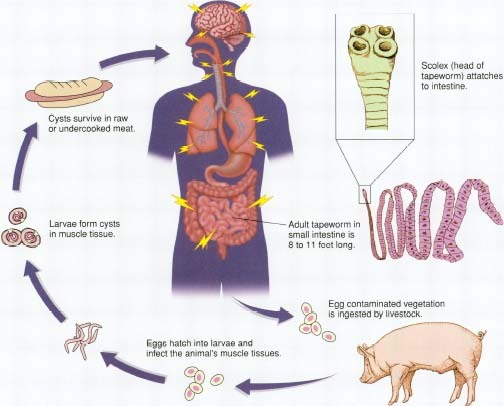
6. Tapeworm

Tapeworm Extraction
Source: humanillnesses

No signs or symptoms make it hard to tell if you have it or not.

Infection usually occurs when someone eats raw or undercooked meat from an infected animal. Once inside, the tapeworm begins to develop in your intestines. These worms can live up to 30 years in their hosts and in most cases, there are no signs or symptoms of the parasite.

7. Hookworm

Hookworm
Source: Flickr

Parasites live in your intestines and suck your blood.

There are over 700 million people who are infected with the hookworm. These intestinal worms can transfer between birds, dogs, cats or humans. It is easily passed in the feces of an infected person. Once they hatch and mature they can pierce through skin.
People living in warm and humid climates with poor hygiene are more likely to be infected. If they walk barefoot or allow their skin to come in contact these hookworms can pierce through the skin and spread to other parts of the body. Signs and symptoms are usually itching and rashes where they entered the body. People with a light infection don’t show any signs or symptoms while those with severe cases of hookworm experience abdominal pain, diarrhea, weight loss and anemia.
A hookworm infection during pregnancy can retard the growth of the fetus, premature birth, or death.

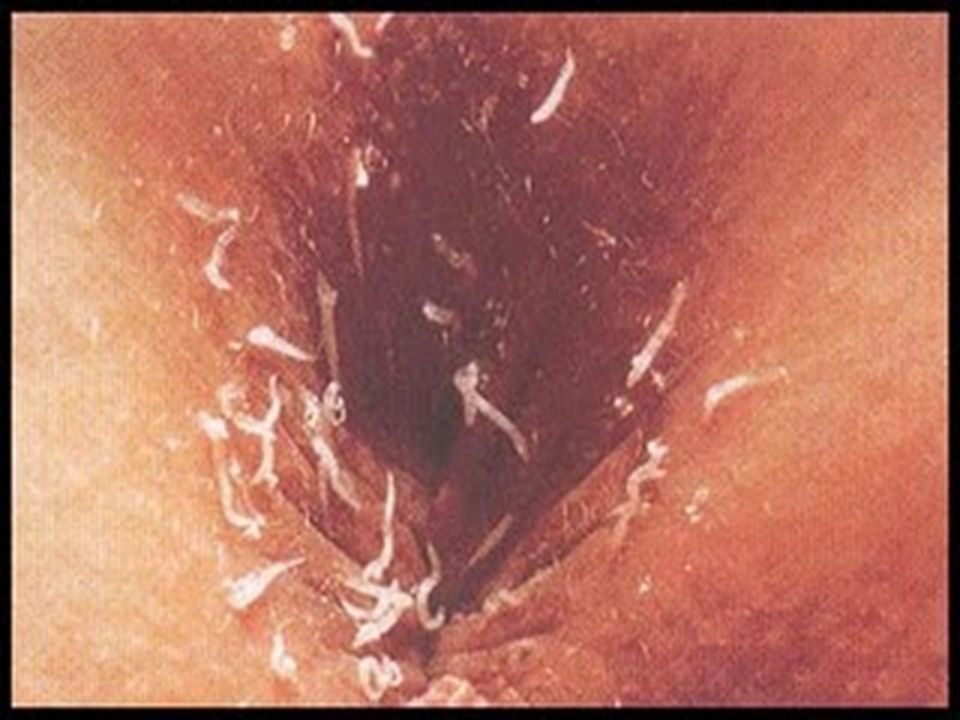
8. Pinworm

Pinworm Infection
Source: Slideplayer

Lay eggs on your anus and use you to infect other people.

The most common type of intestinal worm infection in the United States. These white roundworms can live in the colon and rectum of the body. They are the size of a staple and can easily multiply when left untreated.
The female lays thousands of eggs in the folds around the anus. Most people don’t have symptoms but will experience itchiness. Once they scratch, the eggs get lodged underneath the fingernails. The next thing that person touches is its next home.
They are most common among school-aged children and most likely transferred from fecal-oral route. That means they come from a person’s butt and spread by getting into someone’s mouth. They can live 2-3 weeks on clothing, bedding, or other objects before infecting another person.

9. Whipworm

Rectal Prolapse
Source: Stanford

Painful passage of stool, diarrhea, and rectal prolapse.

Another type of intestinal parasite, humans usually get infected from soil or water. The larvae and adult worms will infest the intestine of humans and multiply.
People with light infections usually have no signs or symptoms. But in extreme cases, once infected, the host will experience bloody diarrhea, painful defecation, nausea and vomiting, weight loss and rectal prolapse. Health care providers can diagnose whipworm from a stool sample and if there is a presence of whipworm eggs.
This parasite can be spread from person to person through feces. In some countries, mass drug administrations (MDAs) are administered to help prevent the parasite from spreading.

10. Blood-Flukes

Blood-Flukes Extraction
Source: Glogster

They journey into your bloodstream and lay eggs that spread to your liver, bladder, lungs and intestines.

Blood-flukes are flat worms that can be found on the bile ducts and liver of infected people or animals. They are found in more than 50 different countries and infect the host through contaminated water or eating vegetables like watercress or freshwater plants.
More than 200 million people infected with this parasite worldwide. The first symptoms once you’ve been infected are chills, cough, diarrhea, and fever. They will then begin to spread their eggs to other parts of your body like your liver, bladder, lungs. If it spreads to the brain or spinal cord, they can cause seizures or paralysis.