BUCKNACKT'S SORDID TAWDRY BLOG
We should not be a journey to the grave with the intention of arriving safely in an attractive & well preserved body, but rather to skid in sideways, chocolate, bier or wein in hand, body thoroughly used up, totally worn out and screaming "WHOO-HOO, WHAT A RIDE!!!!!!"
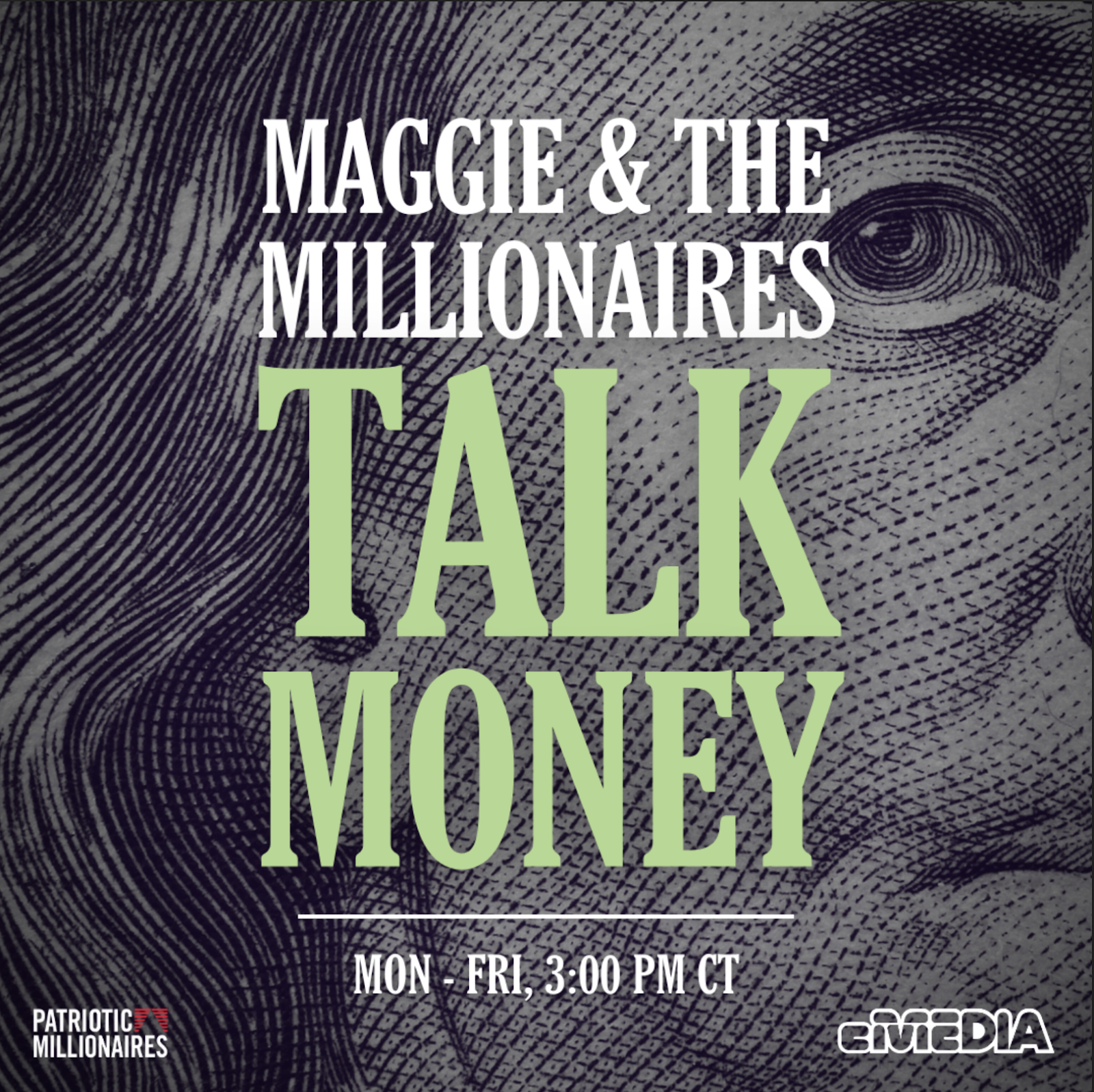
Exciting news! Today, Patriotic Millionaires, in partnership with Civic Media, is launching a new economic-centered live radio show and podcast. Tune into the first episode TODAY Monday, August 26th at 3pm CT / 4pm ET.
Maggie and the Millionaires TALK MONEYis a 30-minute show airing live statewide in Wisconsin and streaming nationally every weekday, Monday through Friday, through Election Day. As the 2024 election season kicks off in earnest -- and both candidates vie for the all-important working class vote -- join Maggie Daun and the Patriotic Millionaires for a daily deep dive into the one issue that matters most in a capitalist democracy: money. Money, money, money, money, money, money, money.
Maggie and her guest will unpack how the economy has been rigged against working people, what it means in the context of the day's news, and what we can do to fix it. The segment will feature a different guest each day -- including several of our Patriotic Millionaires, economists, and policy experts -- who will give listeners a fresh perspective and deeper understanding of America's rigged economic system and the power they have -- right now -- to fix it.
Stephen Prince, born, in his words, “a poor redneck from south Georgia,” became a multi-millionaire after starting National Business Products -- now known as Card Market, Inc. -- a gift card and in-store marketing material production company. The Gift Card Guy, Prince is the Vice Chair of Patriotic Millionaires, fighting to unrig the economy and build a better country for his children and grandchildren. Today, Stephen will explain exactly how the economy left so many behind and why, sometimes, $1,000 is worth more than $1 million.
All this week, Maggie will interview other experts and Patriotic Millionaires at 3pm CT/4pm ET:
Tuesday: Patriotic Millionaire Scott Ellis will explore “How Much is Too Much: Excessive Wealth and the $30 Million Success Project”
Wednesday: Tiffany Muller from End Citizens United will explore why “America Can't Have Both: It’s time to choose Concentrated Wealth or Freedom”
Thursday: University of Massachusetts Professor Bill Lazonick will discuss “How Billionaires Become Billionaires: Predatory Value Extraction and the Truth About Corporations”
Friday: Chuck Collins, heir to the Oscar Meyer fortune, will explain “Why you SHOULD take it personally: How Billionaire Wealth is Ruining YOUR Life”
It’s time to demand the economy working people in Wisconsin and all across America need. Through our new show, we will break down how to build that economy with a group of millionaires, economists, and policy experts who see how the system is rigged and want to fix it.
TO be fair to The Atlantic I added the second part of the title of this post. The fact is NOT MY pres drumpf / trump, in fact the entire drumpf / trump-pence administration with the republican / gop-greed over people controlled congress has been one of the most corrupt and greediest in decades. It isn't just the saudis and russians who have a financial hold on the drumpf / trump-pence and republican cabal, anyone who can be considered part of the 1% can buy into this cabal. When dealing with NOT MY pres drumpf / trump, NOT MY vp pence, and the republican / gop-greed over people cabal keep in mind morals are not required, just millions, billions of dollars. Is Trump Compromised by Saudi Money?
The incoming chairman of the House Intelligence Committee wants to know, saying the president hasn’t been honest in accepting Saudi denials in the Khashoggi murder.
ANDREW KRAGIE On Thanksgiving Day, President Donald Trump once again touted the Saudi royal family’s denial of any role in the murder of the journalist Jamal Khashoggi. That didn’t sit well with Representative Adam Schiff, the California Democrat poised to take over the House Intelligence Committee.
“The president is not being honest with the country about the murder of Jamal Khashoggi,” Schiff said Sunday on CNN’s State of the Union, having promised to use his new authority to investigate whether Trump’s personal finances influence his foreign policy. “Is his personal financial interest driving U.S. policy in the Gulf? … Are there financial entanglements with the Gulf? Are there financial inducements that the president has not to want to cross the Saudis?”
Although Trump tweeted last month that he has “no financial interests in Saudi Arabia,” he has in the past acknowledged business ties with the kingdom. “Saudi Arabia, I like the Saudis,” he said at a July 2015 campaign rally. “I make a lot of money with them. They buy all sorts of my stuff. All kinds of toys from Trump. They pay me millions and hundreds of millions.” The Associated Press reported that in the 1990s, when Trump was “teetering on personal bankruptcy and scrambling to raise cash,” a billionaire Saudi prince twice closed on multimillion-dollar deals, including one to buy a 282-foot yacht called Princess. More recent business comes through Saudi stays at Trump hotels during his presidency, though PolitiFact reports that the Trump Organization doesn’t appear to own property or invest in the kingdom.
These concerns about Trump’s financial entanglements with Saudi Arabia parallel suspicions about possible financial connections to Russia, which Schiff also promised to investigate, including “whether the Russians have been laundering money through the president’s businesses, and this is the financial hold that the Russians may have. It would certainly explain the otherwise bewildering conduct of the president in Helsinki, many of the president’s pro-Putin comments. It would explain why his sons have said at various times they don’t need money from U.S. banks—they get all the money they need from Russia.”
Schiff, whom Trump called “little Adam Schitt” in a tweet last week, apparently is laying the groundwork to dig into the president’s personal finances more than any other investigator. When the Democrats take control of the House in January, he’ll gain control of the Intelligence Committee’s subpoena power and majority staff. The Daily Beastreported a few days ago that the committee has created positions for “money-laundering and forensic accounting experts.”
Some GOP senators joined Schiff and the Democrats in rejecting Trump’s meek acceptance of Saudi denials as they pressed for tougher punishment.
“I disagree with the president’s assessment. It’s inconsistent with the intelligence I’ve seen,” said Senator Mike Lee, the libertarian-leaning Utahan who was the only non-judge on the president’s short list for the Supreme Court. On NBC’s Meet the Press, the host, Chuck Todd, asked whether Lee supported congressional investigations into Trump’s motive for accepting Saudi denials.
“Look, I don’t know why he’s siding with the Saudis … (But I’m) certain that in the next Congress, people will look into that.” The GOP senator argued for cutting U.S. support for the Saudis’ devastating war in Yemen, pointing to his collaboration with Bernie Sanders on that issue.
Senator Joni Ernst of Iowa, elected this month to the No. 5 GOP leadership spot, expressed a quieter objection. “I do think we need to look into this further,” she said on CNN’s State of the Union. She highlighted the importance of a strong U.S. ally in the Middle East but added, “We also are a very strong nation when it comes to human rights, when it comes to the rule of law. And if there are indicators that the prince was involved in this murder, then we need to absolutely consider further action.”
Nebraska Senator Ben Sasse, a frequent Trump critic whom Senator Jeff Flake of Arizona floated as a 2020 primary challenger, said on Fox News Sunday that the president’s statement was “very weak.” Sasse acknowledged the realpolitik case for a tight alliance with the Saudis and Crown Prince Mohammed bin Salman, known as MbS. But then he said, “Making the realist case is a different thing than being so weak that we failed to tell the truth. MbS contributed to murdering somebody abroad, and it is not strength to sort of mumble past that. Strength is telling the truth even when it’s hard.”
After a Thanksgiving Day teleconference with U.S. troops around the world, President Trump took questions from reporters, who asked about the American response to Khashoggi’s murder last month at the Saudi consulate in Istanbul. Although the CIA has concluded with high confidence that MbS ordered the killing, according to a Washington Postreport, Trump once again emphasized the vehemence of the royal family’s denials and said that “the CIA points it both ways.”
So, a reporter asked, “who should be held accountable?” The president’s response did not identify any other Saudi officials, military cooperation, arms sales, official visits, or support for the war in Yemen. Instead, Trump seemed to blame universal human depravity.
“Maybe the world should be held accountable, because the world is a vicious place,” Trump said. “The world is a very, very vicious place. If you look at what’s happening in China, if you look at what’s happening in so many different countries—I could name many countries. If you look at what’s happening with terrorism all over the world.”
So as Schiff lays the groundwork to investigate Trump’s ties to the Saudis and the Russians, it seems that, beyond the sanctions levied against 15 to 20 agents and officials directly involved in Khashoggi’s killing, the Trump administration is not likely to hold MbS or Saudi Arabia responsible for ordering the murder.
anthony kennedy leaves a dark stain on the history of the SCOTUS beginning with his vote on bush v Gore in 2000 allowing the only judicial coup d'etat in the history of our representative Democracy. Because of kennedy's vote we are still paying for the illegal and immoral Iraq War in blood and tax dollars. kennedy was bought and paid for by corporate America and the 1% and his court votes reflect he was guided by greed and not the concept of the common good and the American social contract. kennedy could have waited to announce his retirement after the 2018 Midterm election but he is the same kind of person as drumpf/trump-pence and the rest of their fascist administration and knows his successor will be a neo-nazi committed to eliminating more of our rights and protections enshrined on the American constitution while increasing the wealth and power of corporate America and the 1%. From Politico followed by a call to action from UltraViolet I hope you will participate in and then a report on kennedy's retirement from the SCOTUS blog.....
26 years after freeing itself from apartheid South Africa still struggles with income and economic inequality. South Africans may be equal politically but economically a very small group controls the economy and most of the wealth in the nation. Still, this World Bank report shows they are taking the necessary steps to address this problem, considering the hundreds of years the country was exploited as a colony and then a brutal plutocracy / oligarchy it is going to take more than 25 years to overcome the damage done. The United States ranking in this report is something to be ashamed of but also proves the voluntary political ignorance of the American people allowing them to be deceived and manipulated by politicians controlled by greedy corporate America, the 1%, is moving America closer and closer to being a Third World nation. From NPR
More than two decades after South Africa ousted a racist apartheid system that trapped the vast majority of South Africans in poverty, more than half the country still lives below the national poverty line and most of the nation's wealth remains in the hands of a small elite.
"The country was very unequal in 1994 [at the end of apartheid] and now 25 years later South Africa is the most unequal country in the world," says Victor Sulla, a senior economist for the World Bank in charge of southern Africa. "There is no country that we have data about where the inequality is higher than South Africa."
Sulla is the lead author of a new report on poverty and inequality in South Africa.
There are various ways to look at economic inequality and South Africa scores terribly on all of them. Income inequality looks at the gap between what the lowest paid workers earn each day versus the salaries of top employees.
"The people at the bottom in South Africa, they get wages comparable to the people who live in Bangladesh. It's very, very poor. Wages of less than $50 a month," Sulla says. "If you take the top ten percent, they live like in Austria. So it's very high level even by European standards or even by U.S. standards. And we are talking just about employees, people who are getting paid." And not the super-rich who are earning income from factories or property or other investments.
In addition to a huge problem with income inequality, South Africa also has a significant problem with wealth inequality. Wealth inequality looks at the range of a person's assets. So a businessman in Johanesburg might own real estate, factories or other investments while a farmer in KwaZulu Natal might not even own the land she's tilling.
This new report from the World Bank finds that the top 1 percent of South Africans own 70.9 percent of the nation's wealth. The bottom 60 percent of South Africans collectively control only 7 percent of the country's assets.
"How is that possible? Someone must explain this to me!" exclaims 30-year-old Phiwe Budaza, reached on her cellphone in Cape Town. "How is that even possible?"
Budaza, who grew up in the township of Khayelitsha, says inequality is part of life in South Africa.
"There's always been a difference between the white and the black but I think it's getting worse now," she says. Before her cellphone battery dies Budaza says she doesn't have a permanent job. She freelances as a photographer and in her words "hustles" to cover her bills.
"I work as a bartender and I work for a rental company that rents cameras and film equipment," she says.
"It's hard for someone like me who doesn't have a full-time job to survive in Cape Town. The rent for an apartment [in the city] is like three times what I earn in a month." She says she ends up living outside the city, which makes it harder to get to some jobs.
Budaza is not alone in struggling to make ends meet every month in South Africa. The nation's official unemployment rate is currently at 27 percent compared to roughly 4 percent in the United States.
"South Africa is really facing the triple challenge of poverty, unemployment and inequality," says the former head of the African Union, Nkosazana Dlamini-Zuma, about the report. Dlamini-Zuma is a long-time anti-apartheid activist who now heads up a national planning commission in President Cyril Ramaphosa's cabinet.
"We are a relatively rich country but with a lot of poor people," she says.
If things don't change dramatically in South Africa, Dlamini-Zuma adds, the country will fail to reach its goal of eliminating extreme poverty (people earning less than $1.90 a day) by the year 2030.
South Africa has been focused on trying to bring down poverty and reduce inequality. And it's had some success. Post-apartheid, the government launched a significant Black Economic Empowerment program to promote the transfer of white-owned businesses to black investors. South Africa has invested heavily in social programs including free primary education, a plan for universal health care, infrastructure projects to expand access to clean water and minimum income grants to parents.
Sulla at the World Bank says South Africa under the post-apartheid ANC government has been a leader on social programs.
"Their social protection programs in terms of different grants and support for the poor are working very well," he says. "This country is one of the best in the world in terms of the efficiency of its social protection system."
Yet despite these efforts the number of South Africans living below the national poverty has actually been increasing since 2011. In 2015, 55.5 percent of South Africans or more than 30 million people were surviving on less than $5 a day.
Sulla says the lack of progress against poverty is partly due to what he calls "opportunity inequality." Some people have more access to opportunity than others. And the people who've traditionally had wealth and economic opportunities continue to enjoy those benefits.
Dlamini-Zuma says the legacy of the apartheid regime still casts a long shadow over the opportunities available for millions of South Africans.
"We should not shy away from acknowledging that apartheid was a system that systematically excluded black people from the economy, from skills, from everything. So overcoming that has to be a big part of what we do."
She says South Africa's progress will be measured on the progress it makes against the "dehumanizing scourge" of poverty.
"Poverty stops us from reaching our full potential individually and collectively," she says. "It's not good to be the country with the highest inequality in the world. We need to get ourselves out of that space. But it's not going to be easy."