BUCKNACKT'S SORDID TAWDRY BLOG
We should not be a journey to the grave with the intention of arriving safely in an attractive & well preserved body, but rather to skid in sideways, chocolate, bier or wein in hand, body thoroughly used up, totally worn out and screaming "WHOO-HOO, WHAT A RIDE!!!!!!"
NORTON META TAG
Showing posts with label economic injustice. Show all posts
Showing posts with label economic injustice. Show all posts
DESCRIBES in plain language the reasons for this legislation and the kind of people who support it as well as the people who's political and religious philosophies influenced this project 2025 screed, like fascist fotze ayn rand. The bbb really is The Big Blasphemous Bill. From Sojourners
In Washington, a new piece of legislation glides forward on patriotic branding and moral ambition. The One Big Beautiful Bill Act, as it’s called, promises economic growth, national renewal, and family empowerment. But beneath the shimmering language of prosperity lies a troubling philosophy — one that recasts the U.S. citizen as a market participant above all else and reshapes public policy into a liturgy for the god of the economy.
Several sections of the bill emphasize that a person’s economic output should be what determines their worth and the benefits they receive for living in the United States. Food assistance under SNAP is now contingent on proving one’s usefulness in the workforce, and access to Medicaid is framed as a reward for monthly productivity. Colleges are penalized based on their graduates’ loan repayment rates, reducing education to a measure of economic return, while student aid is calculated not by need but by the expected value of a student’s future earnings. Even newborns are cast as future market participants, with state-seeded “Trump Accounts” designed to train them in contribution and market value from infancy. These provisions redefine public goods not as a matter of justice or care, but as a transactional reward for economic performance.
The bill, which lawmakers are aiming to pass July 4, encodes a worldview that valorizes self-reliance, moralizes wealth, and reduces citizenship to a transaction. It assumes that human worth can be measured by productivity, that those who receive assistance should earn it through compliance, and that belonging in a national community must be demonstrated economically.
The ethical logic here has little to do with preserving democratic ideals and has more in common with the author and philosopher Ayn Rand. Her objectivist philosophy, long a current beneath American political discourse, rejects altruism, elevates individualism, and dismisses collective obligation.
The Big Beautiful Bill supports the idea of individual selfishness, where altruism is viewed as a weakness. This bill reflects that by stripping programs of compassion and replacing them with contracts of compliance.
While lawmakers claim to be championing the prosperity of all Americans, the primary beneficiaries of this bill would be owners of big businesses and the top echelons of our society. This bill, if passed, will deliver a few hundred dollars in tax relief to a family making $40,000, while families making $400,000 will see thousands in breaks. This is clear evidence that this “One Big Beautiful Bill” is far more generous to high earners than it is to everyday, working class Americans.
This legislation is emblematic of the Make America Great Again movement. Sold as an investment in the next generation, it functions as an ideological seed bank: Children who are American enough, documented enough, and tax-advantaged enough will grow up with a savings vehicle tailored for the state’s economic goals. This isn’t policy, it’s formation. These children aren’t being prepared for civic engagement. They’re being trained to compete.
What’s missing here is a deeper vision of human dignity. Not one grounded in merit or productivity, but one grounded in the simple truth that every human being has value before they produce a single thing. That our worth does not begin with a Social Security number. That our belonging is not determined by how well we perform economically.
In Fratelli Tutti, the late Pope Francis warned against these evils, as such an economic perspective perpetuates injustices, social exclusion, and environmental degradation. In other words, if economic performance is the priority, then the common good is not taken into account. Francis’ encyclical calls on the economic sector to be subordinated to the service of people. There needs to be a moral limit on the market so that everyone can live with dignity and have what they need. Christ tells us that consumerism can enslave us and leave us unfulfilled (Luke 12:15). Christ also warns against turning the market into a god — some things shouldn’t be for sale (Matthew 6:24; 16:26).
When we equate wealth with moral goodness, we turn money into an idol and overlook the grace at the heart of the gospel. Tying someone’s dignity or belonging to their economic production denies the radical welcome Jesus offers to all, especially the vulnerable. A society that sits on a foundation of competition and control, rewarding only the compliant and self-reliant, forgets the call to mercy, justice, and community (Micah 6:8).
The market is not God. But this bill, with all its promise and polish, flirts with that blasphemy. It elevates market logic to moral logic. It treats tax brackets as indicators of virtue. It excludes the vulnerable in the name of order. It forgets that a just society does not begin by sorting the deserving from the undeserving, but by recognizing that all of us, in some way, fall short and are still worthy of care and consideration.
For citizens, there is an invitation here to consider not just what policies we support, but what they reveal about who we are becoming. Are we building a future where the dignity of each person is honored, regardless of their output? Or are we building a future where only the strong and the profitable thrive?
This isn’t about Left or Right. It’s about what we worship. And the warning is clear: When the economy becomes our god, we begin to sacrifice people on its altar.
We can choose another way. We can protect the vulnerable, honor the incarcerated, welcome the stranger, and trust that our shared life is richer when no one is left out. That kind of politics would be truly beautiful. It remains out of reach not because it has been tried and found difficult, but because it is difficult and so remains untried.
The Rt. Rev. C. Andrew Doyle serves as the Episcopal Bishop of Texas while also writing Unabashed Faith (2025), which examines Christian witness in our constantly connected society.
26 years after freeing itself from apartheid South Africa still struggles with income and economic inequality. South Africans may be equal politically but economically a very small group controls the economy and most of the wealth in the nation. Still, this World Bank report shows they are taking the necessary steps to address this problem, considering the hundreds of years the country was exploited as a colony and then a brutal plutocracy / oligarchy it is going to take more than 25 years to overcome the damage done. The United States ranking in this report is something to be ashamed of but also proves the voluntary political ignorance of the American people allowing them to be deceived and manipulated by politicians controlled by greedy corporate America, the 1%, is moving America closer and closer to being a Third World nation. From NPR
More than two decades after South Africa ousted a racist apartheid system that trapped the vast majority of South Africans in poverty, more than half the country still lives below the national poverty line and most of the nation's wealth remains in the hands of a small elite.
"The country was very unequal in 1994 [at the end of apartheid] and now 25 years later South Africa is the most unequal country in the world," says Victor Sulla, a senior economist for the World Bank in charge of southern Africa. "There is no country that we have data about where the inequality is higher than South Africa."
Sulla is the lead author of a new report on poverty and inequality in South Africa.
There are various ways to look at economic inequality and South Africa scores terribly on all of them. Income inequality looks at the gap between what the lowest paid workers earn each day versus the salaries of top employees.
"The people at the bottom in South Africa, they get wages comparable to the people who live in Bangladesh. It's very, very poor. Wages of less than $50 a month," Sulla says. "If you take the top ten percent, they live like in Austria. So it's very high level even by European standards or even by U.S. standards. And we are talking just about employees, people who are getting paid." And not the super-rich who are earning income from factories or property or other investments.
In addition to a huge problem with income inequality, South Africa also has a significant problem with wealth inequality. Wealth inequality looks at the range of a person's assets. So a businessman in Johanesburg might own real estate, factories or other investments while a farmer in KwaZulu Natal might not even own the land she's tilling.
This new report from the World Bank finds that the top 1 percent of South Africans own 70.9 percent of the nation's wealth. The bottom 60 percent of South Africans collectively control only 7 percent of the country's assets.
"How is that possible? Someone must explain this to me!" exclaims 30-year-old Phiwe Budaza, reached on her cellphone in Cape Town. "How is that even possible?"
Budaza, who grew up in the township of Khayelitsha, says inequality is part of life in South Africa.
"There's always been a difference between the white and the black but I think it's getting worse now," she says. Before her cellphone battery dies Budaza says she doesn't have a permanent job. She freelances as a photographer and in her words "hustles" to cover her bills.
"I work as a bartender and I work for a rental company that rents cameras and film equipment," she says.
"It's hard for someone like me who doesn't have a full-time job to survive in Cape Town. The rent for an apartment [in the city] is like three times what I earn in a month." She says she ends up living outside the city, which makes it harder to get to some jobs.
Budaza is not alone in struggling to make ends meet every month in South Africa. The nation's official unemployment rate is currently at 27 percent compared to roughly 4 percent in the United States.
"South Africa is really facing the triple challenge of poverty, unemployment and inequality," says the former head of the African Union, Nkosazana Dlamini-Zuma, about the report. Dlamini-Zuma is a long-time anti-apartheid activist who now heads up a national planning commission in President Cyril Ramaphosa's cabinet.
"We are a relatively rich country but with a lot of poor people," she says.
If things don't change dramatically in South Africa, Dlamini-Zuma adds, the country will fail to reach its goal of eliminating extreme poverty (people earning less than $1.90 a day) by the year 2030.
South Africa has been focused on trying to bring down poverty and reduce inequality. And it's had some success. Post-apartheid, the government launched a significant Black Economic Empowerment program to promote the transfer of white-owned businesses to black investors. South Africa has invested heavily in social programs including free primary education, a plan for universal health care, infrastructure projects to expand access to clean water and minimum income grants to parents.
Sulla at the World Bank says South Africa under the post-apartheid ANC government has been a leader on social programs.
"Their social protection programs in terms of different grants and support for the poor are working very well," he says. "This country is one of the best in the world in terms of the efficiency of its social protection system."
Yet despite these efforts the number of South Africans living below the national poverty has actually been increasing since 2011. In 2015, 55.5 percent of South Africans or more than 30 million people were surviving on less than $5 a day.
Sulla says the lack of progress against poverty is partly due to what he calls "opportunity inequality." Some people have more access to opportunity than others. And the people who've traditionally had wealth and economic opportunities continue to enjoy those benefits.
Dlamini-Zuma says the legacy of the apartheid regime still casts a long shadow over the opportunities available for millions of South Africans.
"We should not shy away from acknowledging that apartheid was a system that systematically excluded black people from the economy, from skills, from everything. So overcoming that has to be a big part of what we do."
She says South Africa's progress will be measured on the progress it makes against the "dehumanizing scourge" of poverty.
"Poverty stops us from reaching our full potential individually and collectively," she says. "It's not good to be the country with the highest inequality in the world. We need to get ourselves out of that space. But it's not going to be easy."
THIS is a perversion of justice that should have never happened and can not be allowed to stand. California Jerry Brown should exercise whatever authority he has to pardon Jasmine Richards. From +Democracy Now! .....
FELONY LYNCHING VIDEO In Pasadena, California, Black Lives Matter organizer Jasmine Richards is facing four years in state prison after she was convicted of a rarely used statute in California law originally known as "felony lynching." Under California’s penal code, "felony lynching" was defined as attempting to take a person out of police custody. Jasmine was arrested and charged with felony lynching last September, after police accused her of trying to de-arrest someone during a peace march at La Pintoresca Park in Pasadena on August 29, 2015. The arrest and jailing of a young black female activist on charges of felony lynching sparked a firestorm of controversy. Historically, the crime of lynching refers to when a white lynch mob takes a black person out of the custody of the police for the purpose of extrajudicially hanging them. In fact, the law’s name was so controversial that less than two months before Jasmine was arrested, California Governor Jerry Brown signed into law legislation removing the word "lynching" from the penal code. We speak with Richards’ lawyer, Nana Gyamfi, and Black Lives Matter organizer Melina Abdullah. "Her conviction is not only about punishing Jasmine Richards, but also is the lynching," Abdullah says. "So it’s really disgusting and ironic that she’s charged and convicted with felony lynching, when the real lynching that’s carried out is done in the same way it was carried out in the late 19th, early 20th century, where it’s supposed to punish those who dare to rise up against a system."
TRANSCRIPT
This is a rush transcript. Copy may not be in its final form.
AMYGOODMAN: We turn now to California. This is Democracy Now!, democracynow.org, The War and Peace Report. I’m Amy Goodman, with Nermeen Shaikh.
NERMEENSHAIKH: We go now to Pasadena, California, where a Black Lives Matter organizer is facing up to four years in state prison after she was convicted of a rarely known statute in California law known up until recently as "felony lynching." Jasmine Richards was arrested and charged with felony lynching last September after police accused her of trying to de-arrest someone during a peace march in Pasadena last August. At the time, Jasmine was one of the key organizers demanding justice for Kendrec McDade, a 19-year-old African American who was shot and killed by Pasadena police in 2012.
The arrest and jailing of a young black female activist on charges of felony lynching sparked a firestorm of controversy. In fact, the law’s name was so controversial that less than two months before Jasmine was arrested, California Governor Jerry Brown signed into law legislation removing the word "lynching" from the penal code.
AMYGOODMAN: Despite the change in the law’s name, Jasmine was still convicted Wednesday of attempting to take a person out of police custody. Her sentencing is scheduled for next week. She faces up to four years in prison.
We go now to Jasmine’s lawyer, Nana Gyamfi, and we’re also joined by Melina Abdullah, an organizer with Black Lives Matter and a professor and chair of Pan-African Studies at California State University, Los Angeles.
Nana and Melina, welcome back to Democracy Now! Nana, explain. So, until the final conviction, this was called felony lynching. What did Jasmine do that got her convicted of, this term, "felony lynching"?
NANAGYAMFI: Thank you so very much, Amy, for having us on the show. Jasmine didn’t do anything that was felony lynching, or even attempted felony lynching, which is what the charge was when she was arrested and, as you’ve indicated, up until this year. The allegations are that when the police were attempting to arrest a person, who was not related to the demonstration and the peace march that Jasmine Richards was having, that when they were trying to arrest that person, that she made some effort to get that person out of the custody of the police.
What’s very important to note here is that there’s a requirement that there be a riot, that there basically be a lynch mob that is assisting you in the lynching of the person that you’re trying to take from the police. And in this case, there was no riot. What you had were children on scooters and a couple of adults who were speaking up about state-sanctioned violence in Pasadena, about police murdering unarmed people in Pasadena, about the community coming together to talk about investing in the community and not investing in the police. And this is clearly a political persecution cooked up by the Pasadena District Attorney’s Office, the Pasadena Police Department and the Pasadena City Attorney’s Office, in what we are referring to as the attempted lynching of Jasmine Richards.
NERMEENSHAIKH: And, Nana Gyamfi, can you talk about the origin of this law, or previous law, felony lynching?
NANAGYAMFI: The origin comes from the times—which continue until this day, because we’ve had lynchings, not in California, but in this country, even within the last year—when the police would take a black person into custody, and the lynch mob would appear, take that black person from the police for the purposes of lynching that person, beating that person, killing that person, hanging that person, burning that person. That’s what the origin of this law is. And therefore, to take this law, that was used allegedly to protect black people from being lynched, and to turn around and use this law against a black person who is actually speaking about the lynchings, the serial lynchings, that are going on at the hands of police, not just in Pasadena, but all over this country, is more than ironic, it’s disgusting. It is demeaning to what little integrity the criminal justice system may have. And the District Attorney’s Office of Los Angeles and Jackie Lacey, the black woman at the head of the District Attorney’s Office, has nothing to be proud of. She ought to be ashamed, as well as the deputy district attorney that pursued this case, Christine Kee.
AMYGOODMAN: I want to go to Jasmine Richards in her own words, in this video posted online last year.
JASMINERICHARDS: Jasmine Richards. I’m with Black Lives Matter Pasadena. I’m an organizer. I’m the founder of Black Lives Matter Pasadena. Black Lives Matter Pasadena is actually located 15 minutes away from Los Angeles. We’re right up the hill, northwest. I started Black Lives Matter Pasadena in January of 2015. The reason for this is because I felt like we didn’t have any community programs or anything happening in my community. And there’s been a lot of youth that have been killed by the Pasadena police. Kendrec McDade is currently the youth that I am specifically doing all these actions around. Leroy Barnes, he was killed by the Pasadena police. Big homie named Big BA also killed by the Pasadena police. Our police have been notorious for bullying. Since I was a child, these police have scared me. They’ve harassed me, they’ve scared me. I know their first and last names. I felt like we needed a group out here that stood up to that injustice. Instead all of us being scared and just doing—wasting our time and not organizing and sitting at the park without any programs to help us, I felt like I should do something.
AMYGOODMAN: Jasmine Richards, who started Black Lives Matter in Pasadena. Melina Abdullah, you’re an organizer with Black Lives Matter there. Do you feel that Jasmine was targeted for her political activity? And if you can talk about the significance of this conviction and what Jasmine now faces?
MELINAABDULLAH: Sure. Thank you for having us. Yes, Jasmine was absolutely targeted in this arrest and many other arrests. So, Pasadena is a relatively small suburb of Los Angeles. Jasmine’s activism is hugely significant, because she comes out of an area of northwest Pasadena where it’s deprived of resources. And what her activism really means and really signals is that people who are deprived of resources have the capacity to look up and recognize that it’s the system that creates these conditions. And that system, the system that creates state-sanctioned violence, also deprives communities of resources. So, when Jasmine was awakened, she did a phenomenal job of also awakening all of the folks in her community. So, as Nana Gyamfi described, you know, she had children who were working with her. She had young people who were working with her. She had folks who had maybe been on the corner a week ago working with her and recognizing that the system needs to be transformed. And so that poses a threat to the existing social order that wants to keep black poor people, especially, oppressed. And so, Jasmine is our Bunchy Carter. Jasmine is a political prisoner and represents probably the hugest threat to the state, in that the folks at the bottom can recognize their own oppression and rise up against it.
Now, her conviction is hugely significant, because her conviction is not only about punishing Jasmine Richards, but also is the lynching. So it’s really disgusting and ironic that she’s charged and convicted with felony lynching, when the real lynching that’s carried out is done in the same way it was carried out in the late 19th, early 20th century, where it’s supposed to punish those who dare to rise up against the system. But also, you leave the body hanging from a tree to send a signal to the rest of those black folks who might want to get out of line, and remind them that the state has more power than they do. But I think that in the end, what we see—we had a packed courtroom for the entire trial. What we see is we are not going for this anymore. We are not going to let our folks be lynched. We’re not going to let our folks be murdered by the state. We are working continuously for justice for Kendrec McDade, for Ezell Ford, for Wakiesha Wilson, Jamar Clark and all of those that the state has murdered, but also for the freedom and the right to protest and really vision a new system that gets us free. And that’s what we are going to do. We’re going to struggle for justice for Jasmine Abdullah. She has chosen the name Jasmine Abdullah, but the state knows her as Jasmine Richards. We are going to continue to struggle for her freedom, because our freedom is bound up with her freedom.
NERMEENSHAIKH: And, Nana Gyamfi, very quickly before we conclude, could you talk about the makeup of the jury in Jasmine Richards’ trial?
NANAGYAMFI: In Jasmine’s trial, there were no black people on the jury that decided her case. And out of 55 jurors, there were only two black jurors, which is very much below the representative percentage both of Pasadena, which is 13 percent, and of L.A. County, which is 8 percent. And we, in fact, asked for the jury to be dissolved at the very beginning, based upon the panel that we received. We ended up with a panel that was about half-white; the rest of the folks on the panel were between the Chicanx-Latinx community and the Asian Pacific Islander community. But it was very clear that it was not a jury anywhere near of Jasmine’s peers, let alone the peers of the people who had come to support. And again, going back to those images once again, it is the jury without black people that then decides that the lynching of Jasmine Abdullah is appropriate. And it can’t be said enough times that this is a perfect example of what the criminal sanction system does to black people who dare to speak up, who dare to win, who dare to challenge the system and state-sanctioned violence.
AMYGOODMAN: I want to thank you both very much for being with us, Nana Gyamfi, attorney for Jasmine Richards, and Melina Abdullah, organizer with Black Lives Matter and a professor and chair of Pan-African Studies at California State University.
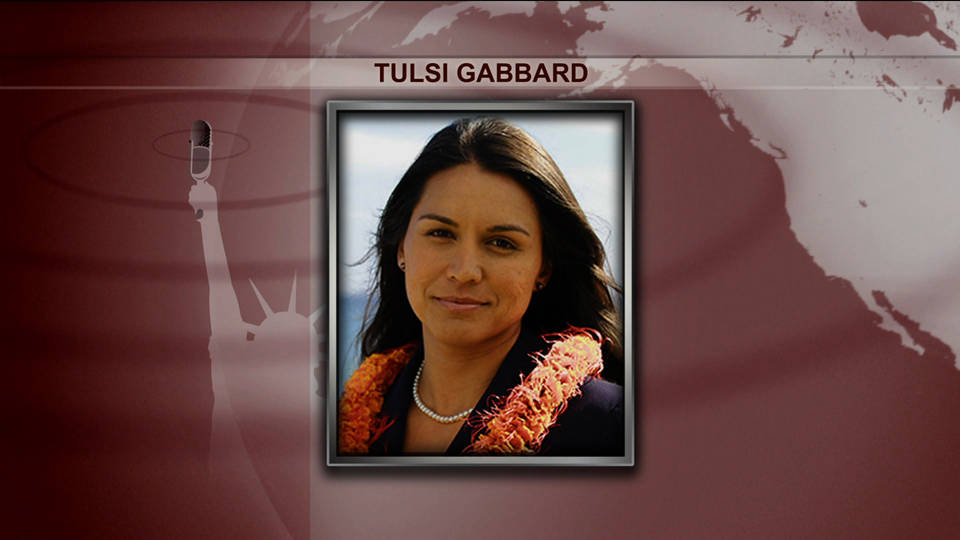
PEOPLE who know the DNC is stacking the deck in favor of hillary clinton are standing up to the party and endorsing +Senator Bernie Sanders for president. The DNC Vice Chair, Rep Tulsi Gabbard D HI, resigned her position endorse Bernie Sanders because she knows she can not represent all Democrats on the committee and support Sen Sanders ( Rep debbie wasserman schultz D FL should resign as she is supporting hillary clinton ). Former Sec of Labor Robert Reich has endorsed Bernie Sanders because he doesn't believe hillary clinton plans on challenging the economic oligarchy that controls our nation for their financial gain. Click BERNIE 2016 to go to his campaign website. These from +Democracy Now! and +NPR ....
On Sunday, Democratic Representative Tulsi Gabbard of Hawaii resigned as a vice chair of the Democratic National Committee in order to endorse Senator Bernie Sanders for president. Gabbard had clashed with DNC Chair Debbie Wasserman Schultz—who co-chaired Hillary Clinton’s 2008 presidential bid—over the number of debates, which is seen as favoring Clinton over Sanders. Meanwhile, Robert Reich, who was labor secretary under President Bill Clinton, also endorsed Sanders, saying he believes "Bernie Sanders is the agent of change this nation so desperately needs." We’ll have more on the latest primary news after headlines.
Gabbard, 34, is one of the youngest members of Congress and the first Hindu elected to Capitol Hill. She served in Iraq and with the Hawaii National Guard, and cites her military experience as the impetus for her decision to back Sanders.
"As a veteran and as a soldier I've seen firsthand the true cost of war," she said. "I think it's most important for us as we look at our choices as to who our next commander-in-chief will be ... to recognize the necessity to have a commander in chief who has foresight, who exercises good judgment."
She's the fourth current member of Congress to endorse Sanders, and the most high-profile.
We speak with Robert Reich, the former labor secretary under President Bill Clinton from 1993 to 1997, about his decision to formally endorse Senator Bernie Sanders for president on the Democratic ticket. "What worries me about other candidates, particularly Hillary Clinton, is that the message seems to be we cannot aim high, or we must not be ambitious, we must not try to be bold, because we can’t get there. That, to me, is exactly the wrong message," Reich says. "In terms of mobilizing Americans and organizing and getting the kind of response we need from Americans to push Congress, to change Congress, to get a government that is responsible for us, the message should be we must and can aim high. We can do it. And we’ve done it before in this country." This comes as four top economists and former advisers for Presidents Barack Obama and Bill Clinton have issued an open letter to Senator Sanders criticizing his economic platform. Reich is the author of many books, mostly recently, "Saving Capitalism: For the Many, Not the Few."
TRANSCRIPT
This is a rush transcript. Copy may not be in its final form.
AMYGOODMAN: As we turn right now to the Democrats, we’re going to turn now to an endorsement that might surprise many. We continue today’s show on Super Tuesday, the biggest primary day in the presidential race, as we turn to the Democratic race between Vermont Senator Bernie Sanders and former Secretary of State Hillary Clinton. Following her commanding win in South Carolina, Clinton now leads Bernie Sanders in six of the 11 states voting today—in Alabama, Arkansas, Georgia, Tennessee, Texas and Virginia. Sanders, meanwhile, has an overwhelming lead in Vermont. And four remaining states are up for grabs—Massachusetts, Minnesota, Oklahoma, Colorado—as well as the territory American Samoa.
About 880 delegates are at stake in today’s contests. Clinton has secured 91 regular delegates; Sanders has 65. But Clinton vastly leads Sanders in pledged support from superdelegates—the congressmen, senators, governors and other elected officials who are free to support either candidate and who often represent the Democratic Party elite. According to The New York Times delegate tracker, Clinton now has the support of 455 superdelegates, while Sanders has only 22 superdelegates. Now, again, those superdelegates can flip at any point. They are not obligated to stick with their original endorsement.
Well, on Friday, one of the former members of Bill Clinton’s Cabinet made headlines when he announced he is supporting Bernie Sanders. Robert Reich is the former labor secretary and author of many books, mostly recently, Saving Capitalism: For the Many, Not the Few. Although Secretary Reich served as labor secretary under President Bill Clinton, he broke with his support for the Clintons, writing, quote, "This extraordinary concentration of income, wealth, and political power at the very top imperils all else."
Robert Reich, welcome back to Democracy Now! Thanks for joining us from the University of California, Berkeley, studios, the University of California where you teach.
ROBERTREICH: Hi, Amy.
AMYGOODMAN: It’s good to have you with us. So, talk about this official endorsement, that may have taken many by surprise.
ROBERTREICH: Well, I don’t know why it should take anybody by surprise. I’ve been talking about the increasing concentration of income and wealth, and the political power that comes with increasingly concentrated income and wealth, for many, many years. And the problem is that it’s not getting better, it’s getting worse, unless we have a mobilization, a real movement, to get big money out of politics and to cure up—to kind of deal with this, this imbalance in our economy. It’s not going to be remedied on its own. And that’s why I support Bernie Sanders. He’s leading a movement to reverse what we have seen in terms of income and wealth at the top, and also leading the same kind of movement—and it really is the same thing—to get big money out of politics.
AMYGOODMAN: I want to turn to a quote of a letter that was released by a number of economists. I want to read from an open letter to Senator Sanders from four of the former chairs of the Council of Economic Advisers for President Barack Obama and Bill Clinton. Earlier this month, they wrote, quote, "We are concerned to see the Sanders campaign citing extreme claims by Gerald Friedman about the effect of Senator Sanders’s economic plan—claims that cannot be supported by the economic evidence. Friedman asserts that your plan will have huge beneficial impacts on growth rates, income and employment that exceed even the most grandiose predictions by Republicans about the impact of their tax cut proposals.
"As much as we wish it were so, no credible economic research supports economic impacts of these magnitudes. Making such promises runs against our party’s best traditions of evidence-based policy making and undermines our reputation as the party of responsible arithmetic. These claims undermine the credibility of the progressive economic agenda and make it that much more difficult to challenge the unrealistic claims made by Republican candidates."
Can you respond to what they’ve said?
ROBERTREICH: Well, they’re entitled to their opinion, Amy, but I respectfully disagree. Bernie Sanders is claiming—and Gerald Friedman, professor Gerald Friedman, an economist, backing him up, is claiming—that he could, because of his proposals, such as a single-payer plan, get economic growth up to 5.3 percent—that’s not out of the historic dimension of what’s possible; in fact, in the early 1980s, we had 5.3, almost 5.4, percent economic growth—and also get unemployment down to 3.9 percent or 3.8 percent—again, not out of historic possibility. In fact, that’s what was the approximate rate in the late 1990s.
And the reason that Bernie Sanders is claiming this, and the reason this is credible, is because a single-payer plan would have extraordinarily positive effects on the economy. We are now paying—well, healthcare is about 18 percent of the entire economy. If we actually did move to the single-payer plan, that would generate huge productivity increases that would free up resources in our economy and generate the possibilities for economic growth and also low unemployment of a sort that we see in that plan’s projections.
AMYGOODMAN: The people who wrote this, Austan Goolsbee, University of Chicago Booth School; Alan Krueger, Princeton; you have Christina Romer from your school, University of California, Berkeley, chair of the Council of Economic Advisers, 2009 to '10; and Laura Tyson, as well, also from your school. You're saying they’re all wrong?
ROBERTREICH: I’m saying I disagree with them. I mean, it’s not just me. Professor James Galbraith of the University of Texas, who was the executive director of the Joint Economic Committee in Congress—and that is the corresponding unit to the Council of Economic Advisers—agrees with Gerald Friedman and me that these projections are within the range of possibility, for exactly the reasons I gave you, that when you’re talking about a very large and ambitious program—in this case, a single-payer plan—you can get those kinds of very, very large and positively ambitious results.
AMYGOODMAN: In February, I interviewed Madeleine Kunin, the former governor of Vermont for three terms, from ’85 to ’91. She wrote the book, The New Feminist Agenda: Defining the Next Revolution for Women, Work, and Family. And I asked her about her op-ed in The Boston Globe. It was headlined "When Bernie Sanders Ran Against Me in Vermont."
MADELEINEKUNIN: I agree with what he says in principle, but how do you make it a reality? You know, how do we have an effective president of the United States? The word "revolution" is beautiful. You know, I’d like a revolution myself. I mean, the title "revolution" is in my book, The New Feminist Agenda, about women’s issues. But I think you have to say, "Who’s going to make it happen? Who can have the temperament to be president? Who can have the networks? Who can be collegial?"
You know, research has shown that women—and you see it in the United States Senate—they work well with each other. They work across party lines. They do their homework. And, you know, I’ve been involved in the women’s movement all of my life. And when—you know, we were told, to make it in the man’s world, you’ve got to play the game, while you’re changing how the game is played. And that’s what she is doing.
AMYGOODMAN: Can you respond to Governor Madeleine Kunin?
ROBERTREICH: Well, I’ve heard Governor Kunin and others say that this kind of radical change, a revolutionary change in our politics that Bernie Sanders is calling for, is not possible, or it is wishful thinking. I’ll tell you my response. And if you look at the civil rights movement, you look at way back in our history, the movement of women to get the vote, look at any major change in the power structure of America, or even the movement to end the Vietnam War, they were all movements. They were all mass mobilizations. People in the United States decided that they had had enough and they were going to change the structure of power in the United States. Bernie Sanders is leading exactly that kind of movement to get big money out of politics.
And, Amy, I don’t know how else to do it. I mean, I was there. I was in the Clinton administration; I have been in a Cabinet. I can tell you that unless good people outside the United States—rather, good people outside Washington are mobilized and organized and energized to make change happen, it doesn’t matter how good the people are in Washington, nothing is going to change, because the special interests are going to dominate. You need that kind of mobilization in order to get change. And Bernie Sanders is doing exactly that.
AMYGOODMAN: We’re going to break and then come back to this discussion. Our guest is Robert Reich, the former labor secretary under President Clinton, now professor at University of California, Berkeley, author of many books, most recently,Saving Capitalism: For the Many, Not the Few. This is Democracy Now! It’s Super Tuesday. We’ll be back in a minute.
[break]
AMYGOODMAN: "O Fortuna" performed by Mozarteum Orchestra Salzburg and Kurt Prestel. This is Democracy Now!, democracynow.org, The War and Peace Report. I’m Amy Goodman. This is Super Tuesday. I want to turn to a clip from the Sanders-Clinton debate earlier this month in Milwaukee. During one exchange about healthcare, Hillary Clinton continued to press the idea that Bernie Sanders’ single-payer healthcare system would undo the Affordable Care Act.
HILLARYCLINTON: Last week in a CNN town hall, the senator told a questioner that the questioner would spend about $500 in taxes to get about $5,000 in healthcare. Every progressive economist who has analyzed that says that the numbers don’t add up. And that’s a promise that cannot be kept. And it’s really important, now that we are getting into the rest of the country, that both of us are held to account for explaining what we are proposing, because especially with healthcare, this is not about math, this is about people’s lives. And we should level with the American people about what we can do to make sure they get quality, affordable healthcare.
AMYGOODMAN: That was Hillary Clinton in a debate with Bernie Sanders. We’re joined by Robert Reich, the former labor secretary under President Bill Clinton. And certainly, Robert Reich, this was an issue that Hillary Clinton was dealing with through the Bill Clinton presidency. Can you talk about her criticism of Bernie Sanders around pushing for single-payer healthcare?
ROBERTREICH: Yeah, well, I think that criticism centers around the worry that it is somehow going to lead to the destruction of the Affordable Care Act. I frankly don’t understand that, Amy. In fact, there are states like, for example, Vermont, that are and have considered putting a single-payer plan on the exchanges that people use under the Affordable Care Act—that is, using the Affordable Care Act as a launching pad for a single-payer plan.
Many health economists, many of us who do policy, think that a single-payer plan is almost inevitable in this country, because it is so much more efficient, because it reduces costs and also provides very high-quality care. Most other advanced nations have it. We are paying so much in this country for a healthcare system based on private, for-profit insurance, where so much of that money goes to advertising and promotion and administration and billing and CEO pay. This is absurd.
And as baby boomers get older and need more medical assistance, we’re not going to be able to afford the kind of healthcare system we have right now. And that’s why a single-payer plan is critical. That’s why Bernie Sanders wants to move to it. And it’s not going to jeopardize the Affordable Care Act. There can be just—you can make, as Barack Obama almost did, a kind of Medicare-for-all or a single-payer option.
AMYGOODMAN: So let’s go to Bernie Sanders in that same debate with Hillary Clinton.
SEN. BERNIESANDERS: Here’s the reality, folks: There is one major country on Earth that does not guarantee healthcare to all people. There is one major country, the United States, which ends up spending almost three times per capita what they do in the U.K. guaranteeing healthcare to all people, 50 percent more than they do in France guaranteeing healthcare to all people, far more than our Canadian neighbors, who guarantee healthcare to all people. Please do not tell me that in this country, if—and here’s the "if"—we have the courage to take on the drug companies and have the courage to take on the insurance companies and the medical equipment suppliers, if we do that, yes, we can guarantee healthcare to all people in a much more cost-effective way.
AMYGOODMAN: So that’s Senator Sanders talking about Medicare for all. But the question, Robert Reich, is—and this goes to the whole attack Hillary Clinton has waged against Bernie Sanders around, you know, waging a revolution, but how do you get there—how do you get there from here? How do you get to Medicare for all? If he were president, could he actually accomplish this? And you’ve been in the government. You were under the Clintons. Can you talk about how this would—what the pathway would be?
ROBERTREICH: I think the pathway, Amy, is very much the same pathway of getting big money out of politics. It is mobilization of people outside Washington. It’s getting the public to focus on what is important, and it is exercising that kind of leadership—also, aiming high. What worries me about other candidates, particularly Hillary Clinton, is that the message seems to be we cannot aim high, or we must not be ambitious, we must not try to be bold, because we can’t get there. That, to me, is exactly the wrong message. The message should be—in terms of mobilizing Americans and organizing and getting the kind of response we need from Americans to push Congress, to change Congress, to get a government that is responsible for us, the message should be we must and can aim high. We can do it.
And we’ve done it before in this country. We’ve had some very, very ambitious—and vicious—changes. You know, I lived through the civil rights era. I saw what activists like Martin Luther King Jr. and presidents like Lyndon Johnson were able to do. And we have to—you know, the urgency right now with regard to everything we consider important, from Black Lives Matter and the kind of discrimination, structural discrimination, we’re seeing, all the way through climate change, nothing can change unless we get big money out of politics, unless we return the United States from being almost an oligarchy to a true democracy once again. That’s what Bernie Sanders is talking about. I can’t understand why anybody would find that difficult or objectionable.
AMYGOODMAN: Well, you know, Robert Reich, you have an inside view of the Clinton administration. You were the labor secretary for years. Can you talk about the power of Hillary Clinton within that? I mean, there are a lot of presidencies where the president, who is the husband—you don’t know really what the wife’s views are. How powerful was Hillary Clinton within the Bill Clinton presidency?
ROBERTREICH: She was his chief adviser. I think that Hillary Clinton was as powerful, if not more powerful, than any first lady since Eleanor Roosevelt. And Hillary was continuously helping Bill Clinton make very, very fundamental decisions.
AMYGOODMAN: At a South Carolina fundraiser in Charleston, a young African-American woman, Ashley Williams, criticized—interrupted the fundraiser. A friend had paid the $500 for her to get into this protest. And she was saying, "I am not a superpredator." And this goes to the whole issue of criminal justice under the Clinton presidency. Can you talk about this and mass incarceration and the number of African Americans in prison, and how that relates to the Clinton presidency? This goes also to Michelle Alexander, who has written extensively about this and wrote a major piece in The Nation against Hillary Clinton, saying that it was under the Clintons—and held both responsible—that mass incarceration, we saw such an escalation, because of the policies put in place.
ROBERTREICH: Yes, I want to say, Amy—first of all, I want to say that I don’t think it’s entirely fair to hold somebody responsible, even if they are first lady, and even if they were a powerful first lady, for what their husbands did in office 20 ago. I think that’s a little bit of a stretch. There’s no question that Bill Clinton, on mass incarceration, that crime bill, also on welfare reform—so-called, which really was a very draconian welfare program, that subsequently showed itself to be very cruel to a lot of poor people in America—and thirdly, on some of the foreign policy that Bill Clinton got into—I think it’s unfair to hold Hillary responsible, even though she was a very powerful adviser. We don’t know which way she argued in those particular cases.
AMYGOODMAN: Well, on the issue of superpredators, she herself admits—and, of course, there’s video of her talking about superpredator children.
ROBERTREICH: Yeah, well, undoubtedly, on certain of those, she was—she was helping her husband. All I want to say is that I think that she’s got to be evaluated on her own merits, in terms of what she has done and what she has accomplished, what she has not accomplished, what she has said in this campaign, what we understand about her values. And I’ve known here, you know, for 49 years. I met her when she was 19 years old. I have a lot of confidence in her abilities. I think she’s very, very experienced.
I don’t think—you know, I think if she is president, she will do a job a thousand times better than any of the Republican clowns who are now running. But I think we do have a choice on the Democratic side between two people who are very different in terms of their ambitions with regard to remaking our democracy and remaking American politics, and also attacking this kind of economic oligarchy we now have.
AMYGOODMAN: Secretary Reich, what do you see—
ROBERTREICH: And I don’t think Hillary is willing to take that on.
AMYGOODMAN: What do you see is Bernie Sanders’ pathway to the presidency right now?
ROBERTREICH: He said last night that he is going to continue to take this all the way to the convention. And I believe that he sees himself as a vehicle for this movement. In other words, this campaign is less about Bernie Sanders, for Bernie Sanders—and he would be the first to admit this—than it is about a movement against American oligarchy and against big money in politics. And he, therefore, by saying that he’s going to take it all the way to the convention, I think he means he’s going to take this movement all the way to the convention. And hopefully it’s going to be, regardless of what happens, regardless of whether he has enough convention delegates, it is going to be a very vocal and very important movement in the future.
Amy, finally, let me just say, the superdelegate problem is a huge kind of symbol of what we are up against in this country. The Democratic Party has all these insider superdelegates. You’re right, they could change their mind at any time. But merely having superdelegates, who are insiders, who will play such a significant role at the convention, is testament to the fact that the Democratic Party still doesn’t quite get it, in terms of this antiestablishment era we are now entering in America, where most Americans are saying the political establishment has not worked for us.