NORTON META TAG

Showing posts with label Guinea Worm. Show all posts

16 January 2025

Jimmy Carter Applied His Faith to the Messiness of Politics. We Should Too 9JAN25


Jimmy Carter greets a young Nepali boy with the customary namaste gesture during the Carter Center’s observation of Nepal’s constituent assembly elections in November 2013. (Photo courtesy of The Carter Center)

ANOTHER well written tribute honoring Pres Jimmy Carter for the example he set for us as he lived his Christian faith and depended on it to guide his politics too. Thank you God for President Jimmy Carter and First Lady Rosalynn Carter. This from Sojourners .....

Jimmy Carter Applied His Faith to the Messiness of Politics. We Should Too


Rev. Adam Russell Taylor is president of Sojourners and author of A More Perfect Union: A New Vision for Building the Beloved CommunityFollow him on X @revadamtaylor.


Jan 9, 2025

I came into this world the same year Jimmy Carter was elected the 39th president of the United States. Roughly 18 years later, I had the honor of meeting Carter as a first-year college student at Emory University, where he served as a professor. Today, I said my heartfelt farewells to Carter at his state funeral, where I was moved to tears by many of the eulogies, including one written by Gerald Ford before his death and delivered today by Ford’s son. Though they were political rivals in the 1976 election, Carter and Ford later became deep friends — a beacon of hope in our hyperpartisan politics. “Jimmy, I’m looking forward to our reunion,” Ford wrote. “We have much to catch up on.”

When I first met Carter, he was well into his distinguished post-presidential career as a diplomat, humanitarian, and champion of public health, human rights, and global democracy. He and his wife, Rosalynn, had founded the Carter Center in partnership with Emory more than a decade earlier. But despite the other demands on his time, Carter held an annual town hall forum with first-year students and I was deeply impressed by how he responded to our barrage of questions with great humility, candor, intelligence, and often humor. While I don’t recall his specific answers, I still have a vivid memory of walking away from the event convinced that Carter was a person of deep moral character and tireless commitment to justice and peace. 

I was so inspired by Carter’s remarks that I decided to apply for an internship in the conflict resolution program at the Carter Center. I was an intern there for two years and while my interactions with Carter as an intern were rare, I was humbled to contribute to a weekly update about conflicts around the world that was not only shared with Carter himself, but also (I was told) shared with an esteemed group of peace and human rights elders from around the world that Carter helped convene.

Since his death, Carter’s remarkable life and numerous accomplishments have been rightly celebrated, including the Camp David Accords, a historic nuclear weapons treaty, major environmental protection legislation, the release of political prisoners, the near-eradication of  the Guinea worm, aid in conducting free and fair elections in dozens of countries around the world, and decades of volunteer service with Habitat for Humanity. But despite this impressive legacy, what most inspires me about Carter was how he applied his faith to the messiness of politics, both during his time in the White House and in his many years after — a model that we desperately need today in our increasingly polarized and vitriolic politics.

During his campaigns and presidency, Carter was extraordinarily open about how his born-again faith informed his public life. In his 1977 inaugural address, he quoted Micah 6:8 at the outset: “He hath showed thee, O man, what is good; and what doth the Lord require of thee, but to do justly, and to love mercy, and to walk humbly with thy God.” He made it clear in that moment that his faith was inseparable from his perspective on political issues and how that would lead him to govern as president. According to the Washington Post, he “once told an interviewer that on eventful days he might pray up to 25 times.” Despite the crushing demands of being president, Carter not only attended church regularly, but also found time to teach Sunday School — something that still amazes me. In a 1978 audio recording, Carter told a Sunday School class: “God will supply all your needs from his unlimited riches and glory through Christ Jesus. That’s a good promise. That’s a good campaign slogan. And it’s so good that a lot of people don’t believe it. But we know it’s true.”

I admire these and other ways that Carter authentically communicated how his faith shaped his values and worldview, all while also upholding a firm commitment to religious pluralism and religious freedom. While no party has a monopoly on faith, today’s Democratic party — which has often been reticent to talk about faith — as well as today’s Republican party — which often acts as though they own faith — could learn a great deal from Carter’s example.

But while Carter’s image as a born-again, Southern Baptist Sunday school teacher who promised never to lie to the American people endeared him to many evangelical voters in 1976, that same faith also inspired Carter to take bold — and sometimes unpopular — stands. His understanding of his faith also led him to stand up to his fellow evangelicals when he disagreed with their theological conclusions. For example, in 2000, he severed his affiliation with the Southern Baptist Convention over its positions on gender equality, saying their ban on female deacons and other policies “violate the basic premises of my Christian faith … I personally feel the Bible says all people are equal in the eyes of God. I personally feel that women should play an absolutely equal role in service of Christ in the church.” He also told the Huffington Post in 2015: “I think Jesus would encourage any love affair if it was honest and sincere and was not damaging to anyone else, and I don’t see that gay marriage damages anyone else.” 

Carter also applied his faith to the politics within the Baptist tradition he and I share. Carter was dismayed by the deep racial and ideological divisions that embroiled the Baptist world, undermining Christian unity and the ability of the church to serve others, particularly the disinherited. In response, Carter used his public profile to convene Baptist leaders and foster unity across Baptist denominations through the New Baptist Covenant, an initiative which brought together 30 organizations representing 20 million Baptists from across the racial and political spectrums. While the initiative made significant inroads in building relationship and unity across the Baptist community, the largest Baptist denomination, the Southern Baptist Convention, largely criticized or kept the initiative at arm’s length.

Jimmy Carter’s presidency marked a key turning point in the political allegiances of many white evangelicals in the United States. Carter won the presidency in 1976 with 51 percent of the evangelical vote, only to lose it decisively just four years later to Ronald Reagan. Several factors within Carter’s presidency impacted this shift among voters, including an IRS ruling denying tax exemptions to private religious schools that weren’t racially integrated and foreign policy crises that some voters felt showed Carter to be ineffective at protecting American power in the midst of the Cold War.

But the shift among evangelical voters was also bigger than Carter: After Carter’s presidency, most white evangelicals seemingly left behind the commitment to social justice and peace that infused Carter’s lifelong faith. They elected instead to fuse their faith with a narrow conservative agenda and allegiance to the Republican Party, a shift that intersected with Republicans’ Southern strategy and the then-ascendant Religious Right. Today, these strategies to unite white, Christian voters behind the Republican party have morphed into the current Christian nationalist movement that helped propel President-elect Donald Trump back to the White House. We can only imagine what the trajectory of the country and the evangelical movement would have looked like if white evangelicals had embraced more of Carter’s faith and priorities rooted in Matthew 25.

In Faith: A Journey for All, Carter writes: “Most church members are more self-satisfied, more committed to the status quo and more excluding of dissimilar people than are the political officeholders I have known.” Carter demonstrated throughout his life and career how our faith should be an active one that impacts and even transforms our community and world. He showed how our faith should influence and inspire our politics, rather than the other way around. As our nation and the world honor Carter’s legacy, I hope his steadfast faith will serve as an inspiration for everyone on how we can be salt and light, advancing and protecting dignity and human rights in our broken and hurting world.

15 April 2016

10 EVIL PARASITES THAT MAY BE LIVING INSIDE YOU RIGHT NOW 26FEB16

Parasite Infection
Source: DailyMail

10 EVIL PARASITES THAT MAY BE LIVING INSIDE YOU RIGHT NOW

Posting this just for the gross out factor. I worked with someone who came back from Central America and had a Botfly living on the back of his neck. Just talking about it would make one of the women in the office actually gag.....
Definitely overlooked as a leading reason for permanent health damage and even death, some parasite could be living in your body right now. Roundworms, tapeworms, pinworms, and other parasites can find a way into your food or through your skin. Once infected, they can move through your body and start coming out of your eyes or skin.
Here are some of the terrifying parasites that might be crawling under your skin right now.
Posting this just for the gross out factor....

1. Loa Loa

Loa Loa eye infection
Source: roarnews

This parasite can get into any opening in your body and end up coming out of your eye.

Loa loa first infect deerfly. Once these bugs are infected a single bite will spread the parasite. Unlike scabies, this parasite cannot be passed from person to person.
The adult worm will wander through the skin until it reaches the host’s eye. If the host is unlucky enough to have a male and a female worm, it will produce more eggs. Those eggs will circulate through the blood stream and spread throughout the body.
Treatment is dangerous and if you have the eyeworm can become increasingly complicated. The worm needs to be surgically removed. Removing the worm from your eye doesn’t cure the infection, and there may be many other parasites on other parts of your body.

2. Scabies

Crusted Scabies
Source: regionalderm

These highly contagious bugs make your skin break out in rashes.

Scabies in an infestation that affects the skin. The skin mites infest a person’s skin, making the person itchy and break out in rashes. Scabies is highly contagious, and direct skin-to-skin contact can quickly spread the infestation to other people.
A person who has never been infected with scabies before may not show any signs or symptoms until four to six weeks later. The most common sign is intense itching and rashes that begin appearing on the body. The rashes may appear all over the body, but the persistent itching is usually focused around the fingers, nipple, penis, buttocks, and waist. The rashes can have small blisters or scales and scratching can make it even worse, becoming infected by other bacteria.
There are products that can be used to treat scabies and kills the mites. There are some medications that can also kill the eggs.

3. Roundworm

Roundworm extraction
Source: MED

These parasites infect as many as 1.5 billion people and responsible for 60,000 deaths per year.

Roundworms are commonly found in the intestine of dogs and cats but can also infect humans. People who are owners of dogs or cats have a higher probability of contracting the parasite. About 13% of the US population has antibodies for the roundworm. Found in most places where there is poor sanitation, these parasites are transmitted through unsafe food or water.
Most people who get roundworms have no signs or symptoms and don’t ever get sick. The most severe and rare cases occur among young children that play or eat dirt that was contaminated by animal feces. There are different symptoms depending on where the roundworm infects its host. They can burrow into your lungs resulting in coughing, vomiting roundworms, and abdominal pain.

4. Guinea Worm

Guinea Worm
Source: Monitor

Drinking contaminated water will leave you with worms that will crawl out of your skin.

Most people become infected with the Guinea worm by drinking from stagnant ponds or bodies of water that contain “water fleas.” These bugs carry the Guinea worm larvae and when eaten, infect the host. The larvae will being to grow and develop inside the body. After a year, the female worms will start to crawl out of your skin.
The majority of people infected with the parasite won’t have symptoms until a year after they have been infected. Most people develop a fever, swelling, and pain in the area the worm tries to burrow out from. The pain from the Guinea worm is said to be very slow and even disabling depending on where they decide to come out. It can take weeks for the worm to escape the body, and the only way to help remove it is to pull it out a few centimeters each day.
There is no drug that can treat the Guinea worm and there is no vaccine to prevent getting infected.

5. Human Botfly

Botfly extraction
Source: Creepy Basement

These parasites can live in your skin, mouth or even eyes.

Known as myiasis, this is when a person is infected with a fly larva. These parasites attach their eggs to mosquitoes. Their larvae use the mosquito bite as an entryway into the body. Once inside, the eggs hatch and mature under the human skin. They stay under the skin until they’re fully developed and dig their way out of the host’s body. Another way people are infected when accidentally ingesting the larvae.
The majority of people who get infected usually happens in Africa and South America but cases have been found in the United States. In most cases, the fly larvae needs to be surgically removed.

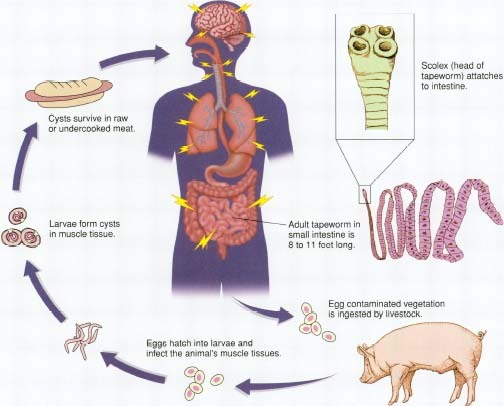
6. Tapeworm

Tapeworm Extraction
Source: humanillnesses

No signs or symptoms make it hard to tell if you have it or not.

Infection usually occurs when someone eats raw or undercooked meat from an infected animal. Once inside, the tapeworm begins to develop in your intestines. These worms can live up to 30 years in their hosts and in most cases, there are no signs or symptoms of the parasite.

7. Hookworm

Hookworm
Source: Flickr

Parasites live in your intestines and suck your blood.

There are over 700 million people who are infected with the hookworm. These intestinal worms can transfer between birds, dogs, cats or humans. It is easily passed in the feces of an infected person. Once they hatch and mature they can pierce through skin.
People living in warm and humid climates with poor hygiene are more likely to be infected. If they walk barefoot or allow their skin to come in contact these hookworms can pierce through the skin and spread to other parts of the body. Signs and symptoms are usually itching and rashes where they entered the body. People with a light infection don’t show any signs or symptoms while those with severe cases of hookworm experience abdominal pain, diarrhea, weight loss and anemia.
A hookworm infection during pregnancy can retard the growth of the fetus, premature birth, or death.

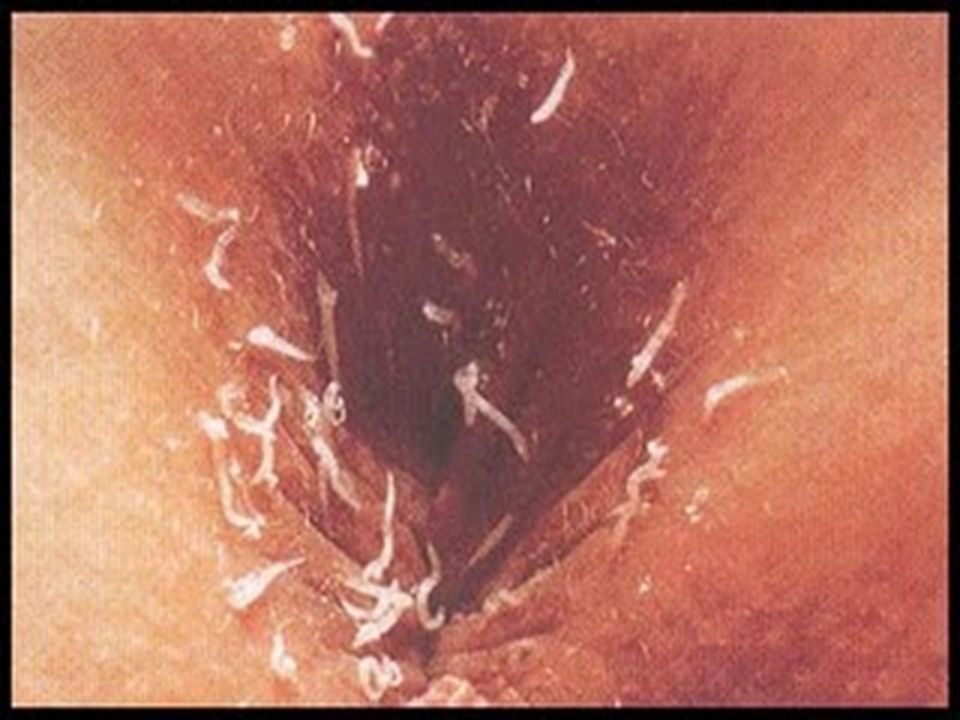
8. Pinworm

Pinworm Infection
Source: Slideplayer

Lay eggs on your anus and use you to infect other people.

The most common type of intestinal worm infection in the United States. These white roundworms can live in the colon and rectum of the body. They are the size of a staple and can easily multiply when left untreated.
The female lays thousands of eggs in the folds around the anus. Most people don’t have symptoms but will experience itchiness. Once they scratch, the eggs get lodged underneath the fingernails. The next thing that person touches is its next home.
They are most common among school-aged children and most likely transferred from fecal-oral route. That means they come from a person’s butt and spread by getting into someone’s mouth. They can live 2-3 weeks on clothing, bedding, or other objects before infecting another person.

9. Whipworm

Rectal Prolapse
Source: Stanford

Painful passage of stool, diarrhea, and rectal prolapse.

Another type of intestinal parasite, humans usually get infected from soil or water. The larvae and adult worms will infest the intestine of humans and multiply.
People with light infections usually have no signs or symptoms. But in extreme cases, once infected, the host will experience bloody diarrhea, painful defecation, nausea and vomiting, weight loss and rectal prolapse. Health care providers can diagnose whipworm from a stool sample and if there is a presence of whipworm eggs.
This parasite can be spread from person to person through feces. In some countries, mass drug administrations (MDAs) are administered to help prevent the parasite from spreading.

10. Blood-Flukes

Blood-Flukes Extraction
Source: Glogster

They journey into your bloodstream and lay eggs that spread to your liver, bladder, lungs and intestines.

Blood-flukes are flat worms that can be found on the bile ducts and liver of infected people or animals. They are found in more than 50 different countries and infect the host through contaminated water or eating vegetables like watercress or freshwater plants.
More than 200 million people infected with this parasite worldwide. The first symptoms once you’ve been infected are chills, cough, diarrhea, and fever. They will then begin to spread their eggs to other parts of your body like your liver, bladder, lungs. If it spreads to the brain or spinal cord, they can cause seizures or paralysis.