BUCKNACKT'S SORDID TAWDRY BLOG
We should not be a journey to the grave with the intention of arriving safely in an attractive & well preserved body, but rather to skid in sideways, chocolate, bier or wein in hand, body thoroughly used up, totally worn out and screaming "WHOO-HOO, WHAT A RIDE!!!!!!"
HE proves he is a no class drippings ( meaning the "best" part of vance ran down something's leg ) and is a national embarrassment for his deliberately ignorant comments about Canada. I apologize again to Canada for the vile ignorance and stupidity of the drumpf/trump-vance administration, their cabinet and the gop / greed over people-republican party cabal. This from the New York Times, but first a little poem about the vances...Hickory trees and hemlock boughs, ms u vance has a tw@t like a cow's.....Oh wait, I'm sorry, that was a mistake, a Freudian slip.....BUT then again aren't cows worshiped in India???
On Monday, Vice President JD Vance called Canada a state during his remarks to supporters in Maine, later saying that his words were “an accident” and a “Freudian slip.” Trade talks between the U.S. and Canada collapsed over the weekend after the two sides failed to reach a deal.
People hold placards during a protest in Mumbai, India, April 12, 2023, against what they claim are attacks on the Christian community, churches and institutions across India. (OSV News/Reuters/Francis Mascarenhas)
PERSECUTION of Christians by the Indian government is on the rise though freedom of religion has been guaranteed by the Indian constitution since the country was freed from British rule. Attacks on and against Christians and Christian Church officials, pastors, priest and nuns as well as Christian churches, offices, charities have increased in frequency and severity since Hindu ultra nationalist Prime Minister narendra modi ( bharatiya janata party ) came to power in 2014. Please e mail your representative and senators asking them to take action to defend Christianity as well as all minority religions and human rights for all in India. My e mails to Rep Subramanyam and Senators Warner and Kaine are at the end of this post. This from National Catholic Reporter.....
Sr. Sheela Savari Muthu is yet to recover from the trauma after police in Madhya Pradesh charged her with violating the central Indian state's anti-conversion laws.
"It is very painful that our small gesture of holding a health camp for the children of domestic workers is painted as a religious conversion activity," the Holy Spirit nun told Global Sisters Report.
The police in Indore, Madhya Pradesh state's commercial capital, filed charges against Muthu and three others on Feb. 16, accusing them of violating the state's anti-conversion laws.
Anti-forced conversion laws exist in 12 of India's 28 states. They prohibit conversion or an attempt to convert a person from one religion to another through misrepresentation, use of threat or force, fraud, undue influence, coercion, enticement, marriage or other fraudulent means.
In the northern Indian state of Uttar Pradesh, the jail term for violating anti-conversion laws could be 20 years to life.
Hindus make up nearly 80% of India's population, and Christians account for 2.3%, according to the country's most recent census in 2011.
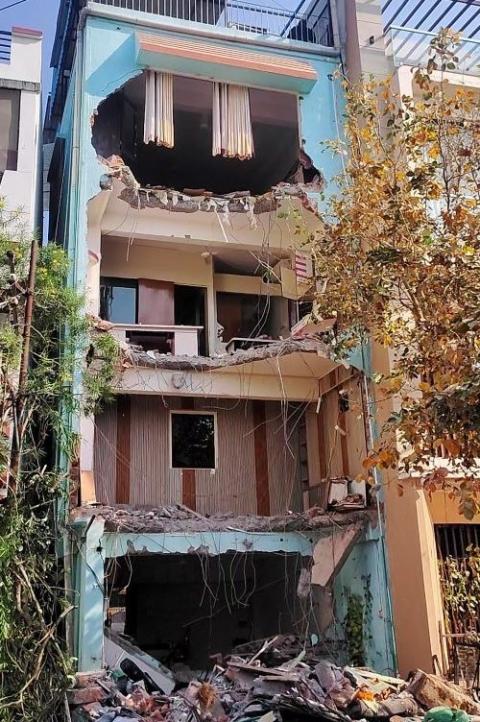
Holy Spirit Sr. Sheela Savari Muthu said municipal authorities demolished the four-story building that housed her office in the central Indian town of Indore. (Courtesy of Sheela Savari Muthu)
The Indore police acted against Muthu and others after right-wing activists supporting the Hindu-nationalist Bharatiya Janata Party accused them of converting children during an event at a public park to provide routine health checkups.
The police detained Muthu and her companions for nearly nine hours. Muthu said the Indore Municipal Corporation later demolished the four-story building housing her office, alleging encroachment.
Muthu said that municipal officials came with police and earth-moving machines and ignored their plea to await a high court decision on their plea for a stay.
"It was a planned operation," she said, adding that her congregation had bought the building 30 years ago from a retired Indian army official. "We never made any alteration to the building," she said.
Muthu said that any gesture to help others could now be interpreted as a religious conversion activity. "We can be punished. We have never faced such a situation until now," she said.
Presentation Sr. Elsa Muttathu, national secretary of the Conference of Religious India (Courtesy of Elsa Muttathu)
Catholic nuns are facing hostilities in other parts of India, too, said Sr. Elsa Muttathu, national secretary of the Conference of Religious India.
"We are living in a very difficult situation as everything we do can be termed as conversion activities," Muttathu, a Presentation nun, said.
Priests, lay Catholics and members of other Christian denominations are also being targeted, she said.
On April 1, the Catholic Bishops' Conference of India condemned Hindu radicals attacking a Catholic pilgrim group in Jabalpur in Madhya Pradesh. The radicals also assaulted the diocese's vicar general and the procurator.
"We don't know how to deal with this new phenomenon," Muttathu said. "We are used to working for the poor and the downtrodden through social work, education and health care."
Sr. Jaisa Antony, Holy Spirit congregation's central India provincial (Courtesy of Jaisa Antony)
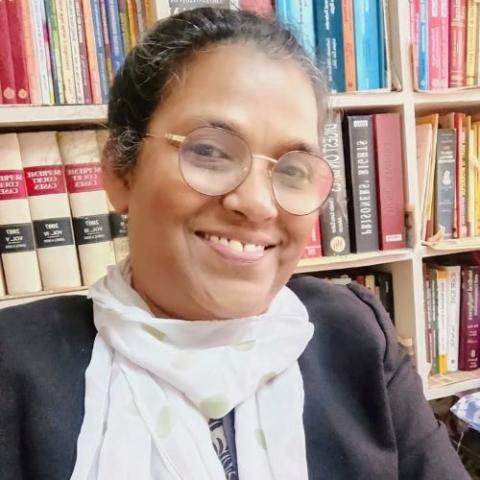
Sr. Mary Scaria, a Supreme Court lawyer based in New Delhi, said Christian persecution has increased since 2014 when the Bharatiya Janata Party came to power in India. It also won general elections in 2019 and 2024.
On June 6, 2023, Sr. Vibha Kerketta, her mother and other relatives were arrested for organizing a thanksgiving Mass in Balachhapar, a village in the Diocese of Jashpur in Chhattisgarh.
Kerketta had returned home after professing her final vows with the Daughters of St. Anne, news reports said. Local Hindu nationalists called the Mass a conversion activity and charged the family under anti-conversion laws.
In January 2022, a 62-year-old nun spent 40 days in prison in the southern Indian state of Tamil Nadu after a girl in her boarding school died by suicide, Asia News reported. Hindu nationalist groups alleged that the 17-year-old took poison after being harassed and abused because her family refused to convert to Christianity.
Sr. Mary Scaria, a lawyer and a member of the Sisters of Charity of Jesus Mary (Courtesy of Mary Scaria)
The Central Bureau of Investigation later reported that it had found no evidence to support the allegation.
"These incidents are clear indications that we need a lot of precaution before doing any missionary work, unlike in the past when we could do it fearlessly," said Sr. Jaisa Antony, Holy Spirit congregation's central India provincial.
"Article 25 of [the] Indian constitution allows every citizen to choose a religion of his or her choice, follow it and propagate it, but now a humanitarian act by a nun or a Christian could be interpreted as a conversion activity," said Scaria, a member of the Sisters of Charity of Jesus Mary.
She said the law blocks constitutional provisions for religious freedom.
"What is worse is that fringe elements that misuse these laws are given immunity to target nuns and Christians working among the poor," she said.
The United Christian Forum, a New Delhi-based ecumenical body that records persecution against Christians, said about two acts of Christian persecution occur daily. Fifty-five incidents were witnessed in January and 65 in February, according to its March report.
Muttathu said the Conference of Religious India has not addressed the anti-forced conversion law on the national level, but has dealt with each case locally.
She also said nuns need education about how these laws challenge their service to poor and marginalized people.
Scaria said some nuns have confided in her about their fear of traveling in religious dress.
Christian religious texts or the Bible, Scaria said, have become symbols of religious conversion and could lead to arrest. "This is a clear case of religious discrimination," she said.
PERSECUTION of Christians by the Indian government (https://www.ncronline.org/catholic-nuns-face-increasing-hostility-india ) is on the rise though freedom of religion has been guaranteed by the Indian constitution since the country was freed from British rule. Attacks on and against Christians and Christian Church officials, pastors, priest and nuns as well as Christian churches, offices, charities have increased in frequency and severity since Hindu ultra nationalist Prime Minister narendra modi ( bharatiya janata party ) came to power in 2014. Please insist action be taken against the Indian government and businesses when you address this issue with Sec of State Rubio and the rest of the U.S. House and Virginia's U.S. Senators.
Thank you
MY E MAIL TO SEN WARNER D-VA AND SEN KAINE D-VA
PERSECUTION of Christians by the Indian government (https://www.ncronline.org/catholic-nuns-face-increasing-hostility-india ) is on the rise though freedom of religion has been guaranteed by the Indian constitution since the country was freed from British rule. Attacks on and against Christians and Christian Church officials, pastors, priest and nuns as well as Christian churches, offices, charities have increased in frequency and severity since Hindu ultra nationalist Prime Minister narendra modi ( bharatiya janata party ) came to power in 2014. Please insist action be taken against the Indian government and businesses when you address this issue with Sec of State Rubio and the rest of the U.S. Senate and Virginia's U.S. House delegation.
THE Nobel Committee should be congratulated for awarding the Nobel Peace Prize to Malala Yousafzi and Kailash Satyarthi. Both have shown amazing bravery and an unwavering commitment to peacefully challenging and changing the world and improving the lives of millions in their countries around the world. While India and Pakistan are again involved in military clashes over Kashmir the Nobel Committee has sent a strong message to both these countries and to the world that a commitment to peace, not military domination, produces the most tangible and enduring positive changes in the lives of people worldwide. God bless Malala Yousafzi and Kailash Satyarthi!!!!! From +NPR .....
Malala Yousafzai poses for photographs in New York.
Yousafzai, who survived being shot by the Taliban because she advocated
education for girls, has been been named one of two recipients for the
2014 Nobel Peace Prize.
Frank Franklin II/AP
Updated at 8:20 a.m. ET
Malala
Yousafzai, the Pakistani teen who was attacked by Taliban militants for
promoting education for girls, will share the 2014 Nobel Peace Prize
with Kailash Satyarthi, an Indian campaigner against exploitation of
children.
The Norwegian Nobel Committee says on Nobelprize.org:
"Showing
great personal courage, Kailash Satyarthi, maintaining Gandhi's
tradition, has headed various forms of protests and demonstrations, all
peaceful, focusing on the grave exploitation of children for financial
gain. He has also contributed to the development of important
international conventions on children's rights.
"Despite her
youth, Malala Yousafzai has already fought for several years for the
right of girls to education, and has shown by example that children and
young people, too, can contribute to improving their own situations.
This she has done under the most dangerous circumstances. Through her
heroic struggle she has become a leading spokesperson for girls' rights
to education."
Kailash Satyarthi (in while) greets U.N. officials at a meeting in Geneva in 1998.
Donald Stampfli/AP
Yousafzai,
17, defied the Taliban in her town of Mingora in Swat Valley, near the
volatile western frontier dividing Pakistan and Afghanistan. In October
2012, Taliban militiamen boarded a school bus she was on, singled her out and shot her in the left side of the head. Two other girls were also wounded in the attack.
Left in critical condition, Yousafzai received an outpouring of international support and was moved to the U.K. for treatment.
"Malala
battled for her life, and came back to become an international
ambassador for the rights of girls to be educated," NPR's Julie McCarty
says.
In July 2013, Yousafzai addressed the United Nations, telling delegates that the Taliban "thought that bullets would silence us, but they failed.
"The
terrorists thought that they would change my aims and stop my
ambitions," she said defiantly, "but nothing changed in my life, except
this: weakness, fear and hopelessness died. Strength, power and courage
was born."
She is a previous recipient of the Sakharov Prize and was first nominated for the Peace Prize last year. She now lives in Birmingham, England, but the Taliban have threatened to target her again.
Yousafzai is the youngest-ever Nobel laureate.
Satyarthi,
60, is a long-time activist against child labor and for better
education of children in South Asia. In his 20s, he gave up a career as
an electrical engineer and "dedicated his life to helping the millions
of children in India who are forced into slavery by powerful and corrupt
business- and land-owners," PBS writes.
"His
original idea was daring and dangerous. He decided to mount raids on
factories — factories frequently manned by armed guards — where children
and often entire families were held captive as bonded workers.
"After
successfully freeing and rehabilitating thousands of children, he went
on to build up a global movement against child labor. Today Kailash
heads up the Global March Against Child Labor, a conglomeration of 2000
social-purpose organizations and trade unions in 140 countries."
The Robert F. Kennedy Center for Justice & Human Rights calls Satyarthi "India's lodestar for the abolition of child labor."
"Since
1980, he has led the rescue of over 75,000 bonded and child slaves in
India and developed a successful model for their education and
rehabilitation. Kailash has emancipated thousands of children from
bonded labor, a form of slavery where a desperate family typically
borrows needed funds from a lender (sums as little as $35) and is forced
to hand over a child as surety until the funds can be repaid," the RFK
Center says. Speaking to NPR in 2011,
Satyarthi decried the rise of female feticide — or so-called selective
abortions — in India, explaining: "The parents feel that the boy is a
help for the future, where the girl is a liability.
"If we
spend money on her, then we have to spend money on her marriage, dowry
probably, and then if something goes wrong, then we are always
sufferers. So better that that girl is not born," he said, explaining
the reasoning of some parents in India.
MOTHERS CAN AND DO CHALLENGE AND CHANGE THE WORLD EVERY DAY. Here is a short video about the work Playing for Change is involved in, empowering women in Nepal fight against human trafficking of women from Nepal to India to be sex slaves or domestics.
Your donation to the Playing For Change Foundation supports the Tintale Village Mothers' Society, and many other amazing people and organizations that are making a huge impact in their communities around the world. Thank you for your support!
When Playing For Change Foundation provided resources to the Mother’s Society in Tintale, Nepal, they knew there was a great need. Now, several years later, we all stand in awe of the creativity and courage of this group of women - and the girls who have joined them - who are using music, dance and performances to educate area villages about the risks of human trafficking, drugs and alcohol.
The society travels on a regular basis to perform and teach communities about the tricks human traffickers use to lure young women into the slave trade. The risks they address are real—each year more than 10,000 Nepali girls are stolen or sold to work in brothels in India. As a result of their performances, false promises of work, marriage and a better life made by traffickers are now recognized as a deceitful trap that can strip young girls of their freedom and future. Equally encouraging, the men of Tintale village fully support the project and have joined with their wives and daughters to help protect them and spread the word.
The cost for the Mother's Society to travel, perform, and deliver their urgent message to people in remote areas of Nepal is approximately $200USD per performance; this includes instruments, supplies, stipends for the performers, and a small administrative fee for the group's coordinator.
Visit Playing For Change Foundation's website to learn more about this organization and make a donation. You can be assured that your gift will support these remarkable women and girls who are committed to saving the lives of others and who are using music and performance to do it.
THIS makes me sick. I can not understand how a community could rally around those who raped this young woman, it shows low self esteem of Steubenville's women and the low mentality of Steubenville's "law enforcement and justice" communities. The football coach's comments are indefensible, but in that community probably typical. I hope the majority of the citizens in Steubenville are ashamed and outraged by this, but if they remain silent and allow the perpetrators get away with this then they are as guilty as those who committed this crime. We have seen the news reports about the Indian woman who was brutally raped in New Delhi, and who finally died from her injuries, and many no doubt have dismissed it as typical of "those people". Well, the people of Steubenville, Ohio are showing the world that we have too many of "those people" right here in the good old USA. From Daily Kos....
A timeline and presentation of the evidence of the Steubenville rape case. Warning: Graphic descriptions and language ahead.
Let’s be clear about what’s happening in Steubenville, and what led up to it.
It was August 11th when an end-of-year celebration occurred in
Steubenville, Ohio. The end of summer brought students from a number of
nearby schools for a party that would end some of their high school
careers, while others celebrated in one final fashion before the new
semester began. What was intended to be a wild night of fun, with booze
already illegally flowing in the hands of underage teenagers, quickly
grew far more tragic than people could have anticipated.
On that night, one young woman was brutally violated. Her body was
still, carried by her feet and hands. Word quickly spread of the night’s
insidious turn. The evidence? A trail of twitter posts, youtube videos
and Instagram photos painted a picture of rape. The young woman in
question was from Weirton, West Virginia, not too far from Steubenville.
Much of the evidence magically vanished, but some remained. When all
the evidence was considered, it seemed she had gone unconscious, then
sexually violated in a number of ways, included being urinated on and
forcefully penetrated. At the end of the night she was deposited on the
front steps of her parents’ home.
On August 22nd, Trent Mays and Ma’lik Richmond were arrested for the
rape in question. Police accused the pair of carrying her between
parties and violating her while she was in a state incapable of
resisting.
The aftermath is nearly as tragic as the incident itself. The country
prosecutor and judge charged with handling juvenile cases stepped away
from the case. In a town as small as Steubenville, it is not unusual to
hear they had close ties with the football team that Mays and Richmond
belonged to. Though the sheriff asked for witnesses to step forward, no
one seemed to want to.
Far worse were the active defenses of the football team in question.
In a part of the country suffering economic difficulty, football can
provide a bright light for a town to rally behind. It can also provide
motivation for people to behave in ugly ways. The family in question
received death threats for raising the rape accusations. Meanwhile, one
Steubenville football coach, Nate Hubbard, said this: “The rape was just
an excuse, I think. What else are you going to tell your parents when
you come home drunk like that and after a night like that? She had to
make up something. Now people are trying to blow up our football program
because of it.” The sheriff involved with the case stated to a new crew
that witnessing the crime but not reporting it was not illegal. This is
false. Failing to report a crime is, itself, a crime.
With so much resistance to the rape accusations, how did the evidence
begin coming to light? It’s related to the town’s resistance against
the accusations. It took an online blogger, who accused the town of
siding with the rapists, and even accusing the police department of
favoritism, to begin moving the wheels of justice. Defamation lawsuits
were filed against the blogger. As of this date, those lawsuits have
been dropped, but the point of the resistance remains.
The evidence collected and presented were, in the eyes of law
enforcement, not damning enough. This was when KnightSec, a hacktivist
collective of Anonymous, stepped in. On January 1st they threatened to
come forward with further information if those involved did not take
responsibility. When no response came, a 12 minute video of those
involved came out, in which one player incriminates himself by
repeatedly referencing the girl as both “raped” and “dead”. They make
various indications that they knew the girl had been raped. Both the
individual on camera, as well as those talking around him, can be heard
referencing to her as raped.
The same individual captured in the video posted this to their twitter the night of the incident:
And that a number of people were aware of it, far more than the few who
came forward in the case, is made clear by other Tweets collected from
that same night:
Prior to much of this evidence, several people involved claimed that
they weren't sure it was rape, or that any force was used. Photos taken
from the collectivist group produced this:
While Mays and Richmond have been accused, Nodianos' role in the rape
case has gone overlooked. Additionally, charges against Cody Saltsman
have been dropped. The photo directly above was posted by Saltsman, who
claims he received the photo, but was not present at the time of the
incident. On the other hand, he responded to Nodianos the night of the
rape:
In a country where it seems the protection we afford women is often
inconsistent, what's horrifying is that A.) A girl in that condition
could be viewed as willing and that B.) People in the two have either
refused to come forward or actively tried to suppress the truth of the
rape case. Here is one member of the town blaming the victim:
And finally, to reinforce just how miserable members of society can
behave, here we have this quote to reinforce how such attitudes are not
only isolated, but wider spread than we would like to think. From a
poster at deadspin: YOU NEVER HAVE THE RIGHT TO RAPE SOMEONE.
For the original story: http://www.nytimes.com/...
For Prinnifield's excellent exposure of the situation: http://prinniefied.com/...
For KnightSec's excellent efforts to bring even more evidence forward: http://localleaks.blogs.ru/ Update: 6:18 PM PT: For those interested, an Occupy movement to support the victim. Thanks to users mph2005 and JayRaye. http://www.occupysteubenville.com/
There are a ton of links and quotes there. http://www.ustream.tv/... http://www.wtrf.com/...
Videos of the various protesting.
Thanks for your interest in this guys. The harming of another human being should never be tolerated.
Originally posted to DAISHI on Thu Jan 03, 2013 at 03:38 PM PST.
AMERICAN job growth during the Obama recession. It would be more if American rich people would invest in America instead of the prc and India and if the bank-financial cabal would release money for investment in the American economy. From HuffPost....
A tiny, routine revision in some jobs data could have a big political payoff for President Obama.
The Labor Department on Thursday morning quietly released a new benchmark for payroll employment
in the U.S. It turns out that with the revision, there has been net job
growth -- not much, but more than nothing -- during Obama's first term.
According to the revision, total non-farm payrolls stood at 133.686
million jobs in August, up from 133.561 million in January 2009, when
Obama's first term began. Before the revision, payrolls were at 133.300
million in August.
In other words, 125,000 jobs have been created, in total, during
Obama's first term, compared with a prior estimate of a loss of 261,000.
This is obviously a very small difference, but it takes away a weapon
that former Massachusetts Gov. Mitt Romney, the Republican nominee for
president, has used repeatedly to hit Obama: the claim that there has been a net job loss since he took office.
That claim was arguably unfair in any event, given the state of the economy when Obama took on the worst job in America:
The economy was shedding about 750,000 jobs per month just before and
after his inauguration. With the new benchmark revisions, it added about 194,000 jobs per month in the year up to March 2012, according to Wharton economics professor Justin Wolfers.
The BLS regularly adjusts its payroll data to account for hard
unemployment insurance data from the states. The next revision is
scheduled for February 2013. In the latest revision, as of March 2012,
U.S. non-farm payrolls were 386,000 jobs higher than first estimated.
The BLS noted that these revisions are so tiny that they are not
considered statistically significant -- representing just 0.3 percent of
total non-farm payrolls.
If
not for deep cuts in government jobs, net job growth in Obama's first
term probably would have turned positive long ago. The BLS revision
raised private payrolls by 453,000 jobs, but lowered government payrolls
by 67,000. That means, in total, federal, state and local government
payrolls are 743,000 jobs lower than they were when Obama took office.
Private payrolls, in contrast, are 868,000 jobs higher than when Obama
took office, including the benchmark revision.
These numbers do not change the unemployment rate, because they are
derived from a survey of businesses that is separate from the household
survey that determines the unemployment rate. Unemployment is still too
high at 8.1 percent, and job growth has weakened noticeably in recent
months -- Thursday's benchmark revisions don't change that.
Still, by taking away one big talking point from Romney, these revisions could be politically significant. Update: A couple of points of context: Including
today's benchmark revision, about 4.4 million jobs have been created, in
total, since February 2010, when payrolls finally hit bottom after the
recession. We're still about 4.3 million jobs away from peak employment
in January 2008. http://www.huffingtonpost.com/2012/09/27/data-job-growth-obama_n_1919533.html?utm_hp_ref=daily-brief?utm_source=DailyBrief&utm_campaign=092812&utm_medium=email&utm_content=NewsEntry&utm_term=Daily%20Brief
THE Olympic Games are supposed to be all about fostering sportsmanship and world peace. The London Olympic Committee has tarnished this goal in two ways. First, in the name of profitability they have allowed dow to be a corporate sponsor, taking dow's money while the company leaves the people of Bophal, India still struggling to overcome the environmental disaster dow unleashed on that community on 2-3DEZ1984 (see http://en.wikipedia.org/wiki/Bhopal_disaster ). If dow has the money to sponsor the 2012 Summer Olympic Games in London they should have the money to continue the restoration and treatment of Bophal and it's families. Here are some pictures of dow's legacy in Bophal, keep them in mind when watching the opening ceremony and every time you see a commercial by dow during the Olympics.
The second action taken by the London Olympic Committee that exposed their hypocrisy of the ideals of the games was to allow the primary Russian arms dealer to the Syrian government of bashar al-assad, vladimir lisin, to attend the opening ceremony and the 2012 games. He is a merchant of mass murder, massacres, war crimes and crimes against humanity, and to allow him a presence at the games is nothing short of an endorsement of his actions. Below is an article from United Against Genocide objecting to victor lisin being allowed to attend the games, followed by coverage of the Syrian civil war from NPR.....
Terror Games: Syria, Russia and the Olympics
By Bama Athreya
Vladimir Lisin, Russian steel tycoon and vice president of the Russian Olympic Committee who has delivered arms to Syria.
This post originally appeared on OpEdNews.
Typically, the Olympic Games are an opportunity for the international
community to come together by promoting peace and preserving human
dignity through sport. But this year’s Games run the risk of being
tarnished by a Russian Olympic official who has been enabling the Syrian
regime.
Russia’s richest man, a steel tycoon named Vladimir Lisin, has been
helping supply Russian-made arms to the Syrian government responsible
for slaughtering thousands of its own people. According to news reports,
just one day after the Houla massacre, one of Lisin’s ships reached
Syria’s second largest port to offload an alleged shipment of weapons
from St. Petersburg.
The Russian government has rewarded Lisin’s loyalty with a top
position on their Olympic Committee. And as the families in Syria
continue to live in terror amid falling bombs and sniper fire, Lisin is
traveling to London to participate in the Olympic Opening Ceremonies.
Over 19,000 people have been killed in Syria and the violence
intensifies every day. A protracted civil war in Syria now seems
inevitable, which will undoubtedly lead to the loss of many more
civilian lives. In fact, the situation in Syria is now officially being
called a civil war by the International Red Cross.
Yet, Russia continues to support Assad’s murderous regime — recently
vetoing a United Nations Security Council resolution that would support
negotiations — and people like Lisin are profiting from it.
The multi-billion dollar arms trade between Russia and Syria has been
well exposed in recent months. In 2011, the Russian government provided
over $1 billion in weapons to the regime of Syrian President Bashar
al-Assad and over recent weeks attempted to ship attack helicopters and
munitions to the Syrian military.
The profits that Lisin has made are now tarnishing Russia’s gold at
the Olympics. The oligarch is offering $1 million as reward to every
Russian athlete who wins gold at the 2012 games. While the aim of prize
money is to inspire gold medal success, it will leave those achievements
with a bloody tarnish.
Keeping Lisin from attending the games will add to the much-needed
international pressure against Russia and the arms dealers enabling
Syrian President Bashar al-Assad. We must insist that those who enable
Syria’s continued attacks on its own men, women and children pay a
price.
It should be made clear to the London Organizing Committee: There is
no room at this year’s Games for individuals who enable mass atrocities
for their own financial gain.
Together we will stop the deadly flow of arms into Syria by exposing unscrupulous weapons dealers like Vladimir Lisin. http://blog.endgenocide.org/blog/2012/07/27/terror-games-syria-russia-and-the-olympics/?utm_source=rss&utm_medium=rss&utm_campaign=terror-games-syria-russia-and-the-olympics
REPORT AIR DATE: July 23, 2012
Forces Clash in Syria's Two Largest Cities
SUMMARY
President Bashar al-Assad's regime and
the Free Syrian Army battled for control over Syria's two largest
cities, Damascus and Aleppo. Independent Television News' John Irvine
and Alex Thomson report on the violence that continues between rebels
and government troops.
GWEN IFILL: Syria acknowledged for the first
time that it has chemical and biological weapons. But as fierce fighting
there continued, the Syrian foreign minister said the weapons wouldn't
be used to crush the rebels. President Obama said Syrian leader Bashar
al-Assad would be held accountable if his regime did use chemical
weapons.
We have two reports about the war in Syria from Independent
Television News, beginning with John Irvine on the shelling in the
country's second largest city, Aleppo. He filed his story from Beirut,
Lebanon.
JOHN IRVINE: A column of Syrian army
tanks used to be an irresistible force, but not anymore. This is a rebel
ambush in the streets of Aleppo. One tank, the rebels commandeer. At
least two others are destroyed. A burning hulk becomes the backdrop for a
triumphant group photograph.
As the war escalates, the Syrian armed forces are digging deeper into
their arsenal. Fast jets are now being used for bombing runs. The
regime has thrown almost everything it has against its own people, but
it apparently draws the line at chemical weapons. JIHAD MAKDISSI, Syrian Foreign Ministry: Any talks
of WMD or any unconventional weapon that the Syrian Arab Republic
possess would never, would never be used against civilian or against the
Syrian people during this crisis. JOHN IRVINE: What he said next amounted to a warning to the outside world not to get involved. JIHAD MAKDISSI: These weapons are meant to be used only and strictly in the event of external aggression against the Syrian Arab Republic. WILLIAM HAGUE, British foreign secretary: What is
actually happening is, their own people are rising up against a brutal
police state. It has nothing to do with any aggression from anywhere
else in the world. JOHN IRVINE: This conflict is 16 months old. But, still, both sides share an ability to live to fight another day. GWEN IFILL: Damascus has been the scene of pitched
battles between rebel and government troops since the bomb attack that
killed four of Assad's closest security officials last week. There have
been ongoing clashes in a neighborhood in the capital known as Midan.
Alex Thomson reports on the devastation there. ALEX THOMSON: The banality of normality, Damascene
traffic jams again a feature of life here. The gains claimed by the
rebels in the capital appear exaggerated.
The regime's boast that they have pushed the fighters out of some
districts altogether is ever more credible, but independent reporting is
near impossible. We're heading for Midan, where fighting has been
prolonged and intense in recent days. An army checkpoint seals off the
edge of the district. You film covertly and fast and move on in a game
of cat-and-mouse to try and get into the area.
And then, our guide, who would better stay anonymous, says, we're
here. Look around. He hardly needs to. Government forces turned
helicopter gunships, tanks, mortars, rockets, heavy machine guns on this
district for three days.
The government says, in two days' time, families can begin moving
back into Midan. But just take a look at what the family will find when
they move back to this house. People say, yes, of course, the rebel
fighters have been pushed out, but they will fight another day in
another way. And there is no chance that President Assad will win this
civil war.
A shopkeeper who fled the fighting comes back to find his business
has disintegrated. In theory, the government will pay, but all around
us, they're talking now off-camera of a massacre here. Finally, one man
will tell us anonymously everything he knows. MAN: Because this is the only family who stay in
their district during that time. They want to leave in a peaceful way.
And they couldn't right now. ALEX THOMSON: Channel 4 News spoke to seven residents independently of each other, who all either named the Ismailifamily as the victims or the figure of 16 being killed.
We were sent this video said to show the scene of the killings. The
details of a family shot through the head can't be shown. You do see the
poignant sight of an unfinished family meal. House after house trashed.
Everyone here said soldiers or the shabiha militias went on an orgy of
looting here. They know Syrians keep large amounts of cash at home.
This man said the militias stole 18,000 pounds from his place --
outside, the pathetic remains of rebel barricades, futile against
organized ground and air assault, the tank tracks of a departed
government army. Weirdly, the authorities have fastidiously painted over
most of the anti-Assad graffiti which covered the walls around here and
left their own: "The soldiers of God were here."
President Assad has won the battle for Damascus, and won it
convincingly, but everyone knows winning the battle is not the same as
winning the war. http://www.pbs.org/newshour/bb/world/july-dec12/syria_07-23.html Video from Al Jazeera
REPORT AIR DATE: July 26, 2012
Syrian Rebels Brace for Government Advance; Aleppo Civilians Caught in Crossfire
SUMMARY
Syrian troops have positioned
themselves on the edge of Aleppo, preparing to retake the city from
rebel control. In response, rebels have reinforced their weapons
stockpiles for the expected assault. Meanwhile, Aleppo's three million
civilians are caught between the two forces. Independent Television
News' Alex Thomson reports.
JUDY WOODRUFF: Syrian battle groups bore down
on the country's commercial capital today. They targeted rebels in
Aleppo, where some three million people were already under air and
artillery attack.
We begin with Alex Thomson of Independent Television News reporting from Damascus.
ALEX THOMSON: Damascus one week into
the battle for the city and video broadcast by Syrian state television
shows sustained firefights yesterday in the city's outskirts.
But it is Aleppo, Syria's biggest city, where the latest major
assault is likely. Pounded again by the regime's forces from both the
north and the south, helicopters move overhead as troops on the ground
prepare for a major assault.
Activist groups in Syria claim that the government troops are being
redeployed for a coming operation. Such claims are impossible to verify,
but several sources now report two Syrian army convoys, the first
heading from Hama Military Airport, apparently about 170 vehicles,
including tanks, and these are massing at al-Zarba, south of the city.
Another column is heading to Aleppo from Idlib province. With the
rebel counterattacks under way, here, what's claimed to be the wreckage
of one small part of the Idlib convoy, and nearby a captured government
tank.
The rebel attacks continue elsewhere. Here in Latakia,
it's claimed they attacked two army bases. In Homs, shelling by
government forces has scarcely ceased for more than three months, but
they still don't control the entire city. The capital quieter today,
though still some occasional shell fire on the outskirts.
But if the rebels cannot win in the major cities, they certainly
appear to be gaining ground in the propaganda war by being willing to
invite along cameras.
Yet, here in Damascus, all our requests to film with the Syrian army
have been refused point-blank. Could we speak to a government minister?
Impossible. What about a government spokesman even? No chance. The
regime apparently thinks this will still do, inside, the endless
pictures of the great leader and his dad, the same video of military
antics played on TV over and over again everyday, and outside, the
pristine flags, the murals, the devices of a regime strangely lost in
personality politics of the Cold War.
Some small opposition parties are tolerated here, so long as they're
powerless. Incredibly, it's actually easier to interview one of their
leaders than it is to speak to anybody from the government.
Hassan Abdullah Azim is chief of the opposition Nasseri (ph) party
and a lawyer in Damascus. He's been beaten and tortured by the regime in
the past, but he's still not afraid to call it even now. HASSAN ABDULLAH AZIM, opposition leader (through
translator): President Assad should step down and hand over power to the
people. We should move forward and organize new free elections for the
people to choose the government they want. ALEX THOMSON: For now, all that sounds like a distant dream. http://www.pbs.org/newshour/bb/world/july-dec12/syria1_07-26.html
ANALYSIS AIR DATE: July 26, 2012
On Syrian-Turkish Border, 'Underdog' Rebels Have Carved Out a Buffer Zone
SUMMARY
Pockets of Syria have fallen under the
control of rebel fighters, the anti-Assad opposition forces known as the
Syrian Free Army. Judy Woodruff speaks to NPR's Kelly McEvers about her
recent trip to five towns along the Turkish border in rural Syria.
JUDY WOODRUFF: For a first-hand look into
events on the ground in Syria, I'm joined now by NPR's Kelly McEvers.
She has just completed a weeklong reporting trip to northwestern Syria,
near the Turkish border, where she visited a number of towns currently
under rebel control.
Kelly McEvers, welcome.
And how did you decide where you were going inside Syria? We have a map, I think, we are going to be able to show people. KELLY MCEVERS, NPR: The rebels have basically carved
out their own sort of unofficial buffer zone there in northern Syria.
It's right next to the Turkish border.
For them, the benefit is that they're able to get their wounded out
into Turkey a lot more easily than they could before, and that they can
basically get weapons and money into Syria from that -- from the Turkish
area. So, for us, it made a lot of sense to sort of -- to get a sense
of who the rebels are to spend time in the region that they control,
instead of trying to sort of cower and hide and go with them undercover
from place to place, to be in this kind of swathe of towns and villages
that they actually control. JUDY WOODRUFF: Where they are relatively safe, free from government assault on a regular basis or...
KELLY MCEVERS: At this time. JUDY WOODRUFF: Yes. KELLY MCEVERS: If you were to try to look at the map
and say where exactly do the rebels control, every day, it changes a
little bit. It morphs and changes. On the edges of the area they
control, the government might take a town back.
There was one town when we were there that switched hands between the
government and the rebels four times. Why? Because the government
realizes that this border area is important to the rebels. They realize
that it is this buffer zone. And so they are trying to sort of regain
control.
But, obviously, the government's army is stretched and sees that its priorities are elsewhere, namely Damascus and Aleppo. JUDY WOODRUFF: Tell us about the rebels you met. And you talked to a number of them. Who are they? What are they like? KELLY MCEVERS: It's a really good question and it's one I think a lot of people want to answer right now.
They call themselves the Free Syrian Army, but that's about as far as
sort of the unification goes. They don't necessarily answer to a single
leader. They're a bunch of disparate groups spread out across the
country, some say up to 1,000 of them. One unit might only be eight
guys, mostly civilians.
I think the image is that these guys are mostly defected soldiers,
people who leave the army and then join the rebels. A lot of those guys
actually go to these refugee camps in Turkey, for fear of what would
happen to their family after they defect. So a lot of the guys we have
met are civilians, workers, farmers, people who decided to take up arms
and sort of defend this uprising, this revolution against the president. JUDY WOODRUFF: And relatively lightly armed, in contrast to what the government has. KELLY MCEVERS: Exactly. They are so outgunned right
now. They're basically operating with rifles and rocket-propelled
grenades and homemade bombs.
That's another key component to their sort of arsenal right now. That's how they deal with regime tanks.
But when you talk about a fully equipped army with tanks, artillery,
mortars, helicopters, and now we have seen jets being employed in this
fight by the regime's army, you can see that the rebels are definitely
the underdogs here. JUDY WOODRUFF: Kelly McEvers, what about the
civilians you talked to? And what are they saying about al this? Are
they caught in the middle? Are they hoping it's all going to be over?
Are they lining up with one side or another? KELLY MCEVERS: I was in just this very small pocket
of Syria, so it's important to say that I can only speak for the people
that I was with at that particular time.
By and large, in these villages, they see the rebels as their only
hope. They say, look, 16, 17 months ago, we went into the streets to
protest against our president. We said we wanted to bring down the
president. The regime shot at us, detained us, and tortured us. And no
one came to our aid except these guys. These guys picked up guns. And
maybe some of them are my cousins and uncles and brothers. They picked
up guns. They came here to defend us and we welcome them.
This, they say despite the fact that the rebels' presence in their
town sometimes brings the ire of the government. It might mean that
civilian homes get shelled, that people die. They say, we don't care.
We're willing to take that risk because these are the only people here
to protect us. So the rebels definitely have hearts and minds in these
towns. JUDY WOODRUFF: The morale overall, though, was what? What did you find? KELLY MCEVERS: Again, people were pretty willing to
stay on message, especially when talking to a Western journalist. Again,
we support these rebels, we support the cause. It's just any day now
that we're going to take down the regime.
While I was inside Syria, there was this high-level attack inside
Damascus that killed four high-ranking officials in the Syrian
government. So, I think that was a real morale boost. And a few days
after that, you saw a lot of units going to Aleppo. I was very close to
Aleppo, Syria's largest city in the north.
And you saw a lot of rebel units going there, sort of going to take
up the fight, and going all the way to Damascus as well. It looks like
the government has regained control in Damascus and may soon do the same
in Aleppo. So, that morale may turn around pretty quickly. JUDY WOODRUFF: You had some interesting
conversations with people, rebels and citizens, about why the United
States isn't doing more. Explain a little about that. KELLY MCEVERS: Yes, I think there's a lot of anger. I
think people look at the case of Libya and they look at the case of
other places where the U.S. or at least international community has done
more to intervene on the diplomatic level, on the military level.
Look, I think Syrians are smart enough to know that they don't want
an Iraq situation. I think most people would say, we don't want anyone
to come in and invade and occupy our country. I think they're OK with
that. And they're also smart enough to know that the Libya scenario
probably doesn't make sense for NATO or the United States. A no-fly
zone... JUDY WOODRUFF: The no-fly zone. KELLY MCEVERS: ... would be much more complicated in Syria. They get that.
But they say, look, how about some coordination? How about some help?
How about some training? There's a lot of things that you could do. You
could fly airplanes over our country and tell us, hey, there's some
tanks moving this way and there's no tanks on this road, reconnaissance,
intelligence, those sorts of things that frankly Western militaries are
good at.
And they see that that's not happening. And they say that it's not
much longer that they're going to be willing to accept this help. I
think, at some point, they are going to refuse it at any cost and it
might be too late for any intervention. JUDY WOODRUFF: Kelly McEvers, NPR, an extraordinary trip. Thank you very much. KELLY MCEVERS: You're welcome. JUDY WOODRUFF: And online, you can find links to four of Kelly's reports for NPR this week from the Turkish-Syrian border. http://www.pbs.org/newshour/bb/world/july-dec12/syria2_07-26.html