NORTON META TAG

Showing posts with label cold war. Show all posts

03 January 2021

Remembering John le Carré, who knew that deep down, we all want to be secret agents & Words from the Clandestine World of John le Carré 28&29DEZ20


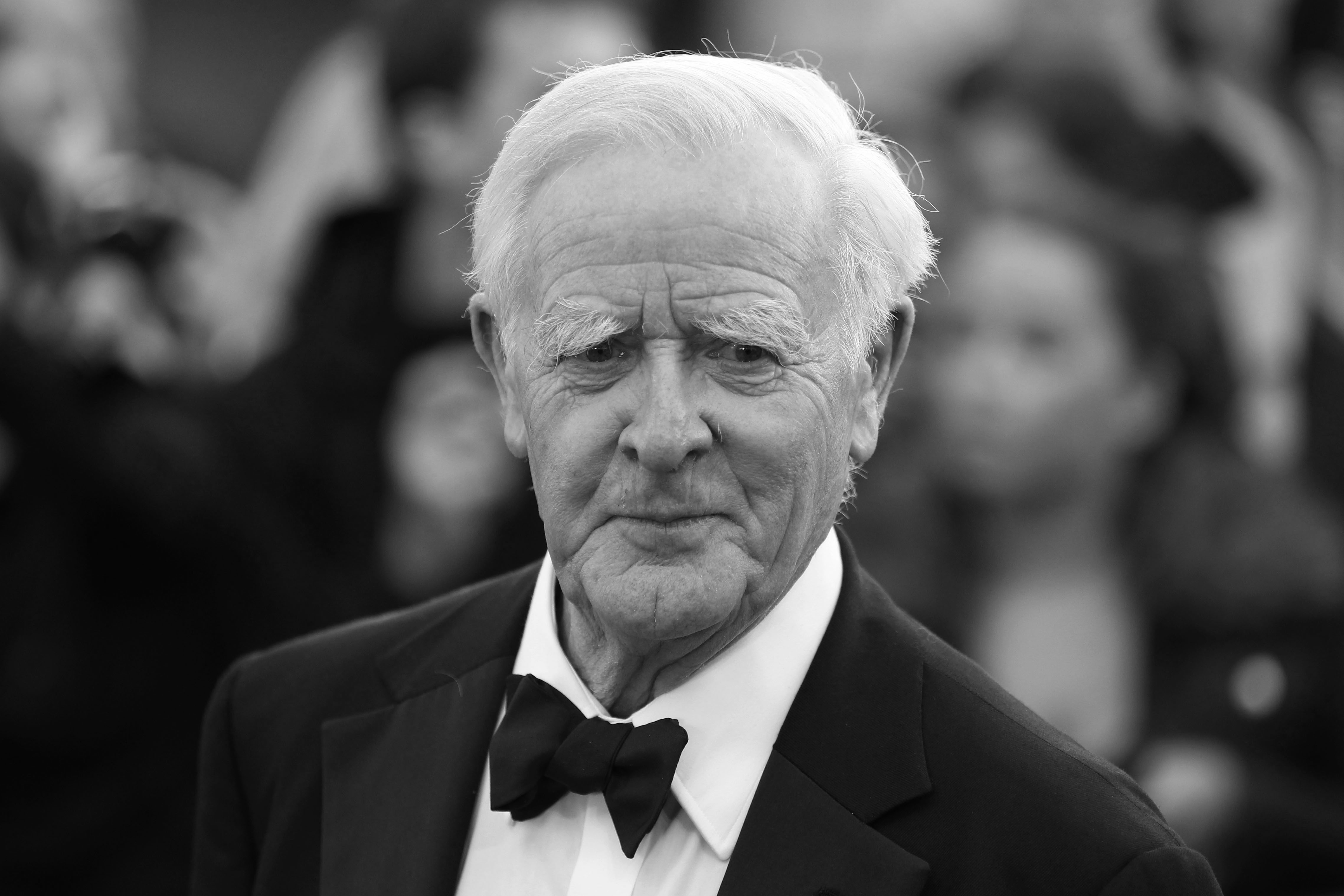
FILE - This Sept. 13, 2011, file photo shows British author John Le Carré at the U.K. film premiere of "Tinker Tailor Soldier Spy," in London. John le Carré, the spy-turned-novelist whose elegant and intricate narratives defined the Cold War espionage thriller and brought acclaim to a genre critics had once ignored, has died. He was 89, Le Carré’s literary agency, Curtis Brown, said Sunday, Dec. 13, 2020, that he died in Cornwall, in southwest England, on Saturday. (AP Photo/Sang Tan, File)

I became a fan of John le Carre when the Smiley's People miniseries was broadcast on PBS in the early 1980's. My family would gather at mom's and dad's hoping and praying the signal from WPSU in Clearfield was going to be strong enough for their antenna to pull it in! After that I started reading his books, always looking forward to his next publication knowing it was going to be amazing. I looked forward to his books to movies productions because of the control le Carre had. Godspeed David Cornwell, thank you for your books and movies. From American Magazine and Merriam-Webster.....

Remembering John le Carré, who knew that deep down, we all want to be secret agents

James T. KeaneDecember 28, 2020

Among the many fans of British novelist John le Carré, who died on Dec. 12 at the age of 89, was an America editor in chief: Thurston N. Davis, S.J., who filled the top job from 1955 to 1968. Davis wrote several long reviews of le Carré’s novels in the 1960s and 1970s, including a 1977 review of The Honourable Schoolboy that perhaps got to the heart of le Carré’s popularity and longevity. “The commercial success of John le Carré’s spy tales is no accident,” Father Davis wrote. “Partly, I suppose, it is explained by the theory that there is a secret agent deep in us all, and that the author simply knows how to feed those hidden fantasies.”

Father Davis, who had a Ph.D. in philosophy from Harvard and also edited The Catholic Mind for many years, might seem an unlikely fan of a spy novelist. Most of his reviews for America over the years were on serious books of history or theology. But, then again, John le Carré was closer on the literary spectrum to Graham Greene (who also knew his way around a good spy novel) than to his fellow popularizers of the genre. In 2008, London’s Sunday Times put him 22nd on their list of the 50 greatest British writers since 1945.

In addition to appealing to the inner secret agent in all of us, John le Carré also introduced millions of readers to a world of espionage that looked nothing like an Ian Fleming novel.

Father Davis did admit that Americans don’t tend to come off well in le Carré’s works, including C.I.A. agents who “incidentally, speak a peculiarly objectionable brand of American English. They tend to come from places like Norman, Oklahoma, and they despise the ‘Brits,’ who return that sentiment in genteel kind.” And indeed, one does not read le Carré’s early novels without getting the distinct sense that the United States was, in fact, regularly being mocked—in a particularly dry and subtle British way.

In addition to appealing to the inner secret agent in all of us, however, le Carré also introduced many millions of readers to a world of espionage that looked nothing like an Ian Fleming novel; in fact, Le Carré himself one described his most famous character, the rumpled and bookish George Smiley, as the “antidote to James Bond.”

John le Carré’s death from pneumonia brought an outpouring of grief and commentary from Great Britain but also from other corners of the globe. Stephen King tweeted that “This terrible year has claimed a literary giant and a humanitarian spirit,” while Stephen Fry wrote that “if there is a contemporary writer who's given me richer pleasure I can't for the moment name them.” Margaret Atwood wrote “His Smiley novels are key to understanding the mid-20th century.” (Unsurprisingly, the heads of the British intelligence services MI5 and MI6 have not always had such kind words for le Carre over the years, though the current director of MI6 did praise him as “a giant of literature who left his mark on #MI6 through his evocative & brilliant novels.”)

John B. Breslin, S.J., once noted that le Carré’s books depicted “authentic espionage,” and "the classic dilemma of every intelligence operation: Who watches the watchers?”

John le Carré’s most famous novels are probably the dense, carefully crafted Cold War thrillers collectively known as the “George Smiley novels,” including The Honourable Schoolboy, Tinker, Tailor, Soldier, Spy and The Spy Who Came In From The Cold, but they are but a small part of his output of 25 novels and a memoir over a career that spanned more than half a century. A number of his books were later made into films as well, including The Constant Gardener, The Tailor of Panama, The Spy Who Came In From The Cold and Tinker, Tailor, Soldier, Spy.

Born David Cornwell in 1931 (he adopted John le Carré as a pen name when his first novel was published in 1961), he had an insider’s view of Cold War espionage, because he worked briefly as an agent for the famed “MI5.” This firsthand experience of a world filled with betrayal, suspicion and intrigue also gave his characters a hardboiled and psychological complexity that is often lacking in other espionage thrillers. (No one could ever confuse George Smiley with Tom Clancy’s Jack Ryan, and certainly not with James Bond.) His books are not truly action-packed either; they are dense on interpersonal relations carried out in somewhat dingy hallways and dusty streets, the latter in locations all over the globe.

In a 1974 review of Tinker, Tailor, Soldier, Spy for America, John B. Breslin, S.J., noted that le Carré’s books depicted “authentic espionage,” and Tinker, Tailor, Soldier, Spy “tackles the classic dilemma of every intelligence operation: Who watches the watchers?”

He is survived by his wife Valerie Jane Eustace and four sons.

Words from the Clandestine World of John le Carré

Tinker, Tailor, Soldier, Dictionary.
Last Updated: 29 Dec 2020
Spy

“John le Carré” was the pseudonym of writer David Cornwell, who was working as a member of Her Majesty’s secret service when his first novels were published, requiring that he disguise his identity. He was advised by his publisher to choose a name with “two Anglo-Saxon monosyllables, like Chunk-Smith” as a false name, but chose instead the oddly French “le Carré.” Carré means “square” or “squared” in French, and is indeed sometimes a family name, but used with le seems a bit strange, coming across as “John the Square.”

This whole story of the writer’s name has an uncanny resonance with the word spy itself, which, while it has a chunky Anglo-Saxon monosyllabic quality, actually comes to English from French.

But, perhaps unsurprisingly, hiding behind the French word’s identity is a slightly unusual Germanic background—unusual for a language that directly descended from Latin, the language of origin for most French words. Spy, it turns out, comes from the French verb espier (“to spy”), itself from the Franconian spehôn, meaning “to observe attentively.” Franconian, known in French as francique, was a German dialect from a region that today includes Bavaria, known as Franconia. The French word was attested in the 11th century, and had come to Middle English by the 13th century.

A word’s etymology is its biography; sometimes it reveals a disguise. It seems fitting that the word spy is an English-looking monosyllable borrowed from French that ultimately comes from Germanic roots.

Espionage wears an indisputably French origin on its sleeve. It is pronounced in the French manner, rhyming with garage (for American English speakers), with that soft g sound that is distinctively French. Appropriately enough, it seems to be a word that is working in foreign territory.

Espionage shares roots with spy, but retains its superficial Frenchness because it was borrowed centuries later, in the late 1700s; earlier borrowings into English are often changed and anglicized more than relatively recent ones.

It also conveys something organized and systematic with its meaning “the practice of spying.” One could spy on a neighbor or act as a spy, but espionage brings a connotation of a network, an allegiance, an ideology, a motive.

The words that occur most frequently with espionage illustrate all of these elements:

industrial

economic

corporate

Chinese

cyber

Soviet

charges

international

case

thriller

Spies work behind the scenes, but the fact that thriller is among the most closely associated terms with espionage is perhaps proof that John le Carré made their secret stories take center stage.

John le Carré wasn’t the first person to use the term mole to refer to a spy, but it’s probable that he did more to make it commonly known than anyone else. Its use with the meaning “a spy (such as a double agent) who establishes a cover long before beginning espionage” actually dates back to the 1920s, but, according to the Oxford English Dictionary, “it is generally thought that the world of espionage adopted it from le Carré, rather than vice versa.”

Le Carré explains this use of the word in the text of Tinker, Tailor, Soldier, Spy:

Ivlov's task was to service a mole. A mole is a deep penetration agent so called because he burrows deep into the fabric of Western imperialism.

The plot of Tinker, Tailor involved the discovery of such a mole in the British secret service, one with deep factual resonance, since it paralleled the discovery of the British agent-turned-Soviet-spy Kim Philby (and is connected to the story of another Soviet mole in England whose discovery was depicted in The Crown).

Since Tinker, Tailor, Soldier, Spy derives from an English nursery rhyme, the French title for the novel and TV and film adaptations is more straightforward as La Taupe, the French word for mole (both the little furry animal and the human spy). A synonym of mole in this sense is sleeper.

The word assassin was borrowed into English directly from French, which based its word on a Latin term that traced back to the Arabic word ḥashshāsh, meaning “worthless person,” or, literally, “hashish user,” since the ultimate root of this word was hashīsh.

It originally referred to a member of a Shia Muslim sect at the time of the Crusades who was sent out on a suicidal mission to murder prominent enemies. The Oxford English Dictionary notes that this term, perhaps unsurprisingly, was initially a derogatory one that implied that the members of this group exhibited erratic behavior, as if intoxicated by hashish—or because they actually were.

Its current use, “a person who commits murder” and especially one who murders a politically important person for money or ideology, was first used in English in the 1500s. This modern meaning represents a subtle change in the idea behind the word’s use: if it initially referred to a particular quality of the killer, it now refers as much to a particular quality—prominence of some kind—of the killer’s target.

John le Carré, who had a brief career as a spy in the British secret service, used the word spook himself when referring to spies. The word’s use with this meaning dates to around World War II, a period rich with both spies and colorful informal language (ginormous, to cite just one example, was British military slang from WWII).

The original meaning of spook, meaning “ghost or specter,” was first attested in the United States in 1801, according to the Oxford English Dictionary. In what is an astonishing coincidence that would hardly be credible for a novelist to conjure, this first quotation using the word is from a publication entitled—wait for it: Massachusetts Spy:

By mine dunder I fly so swift as any spook.

Spook meaning “spy” is even used in discussions of another best-selling author:

Anyone with the patience and fortitude to wade through such imposing texts, claims Clancy, can accumulate enough intelligence to seem like a spook. The people in power know that the place to hide a fact isn't a safe (safes can be blown) but between a million other facts, most of them boring. So Clancy spends much of his time playing private eye, hunting down data as you might hunt down criminals.
— Rich Cohen, Rolling Stone, 1 December 1994

The Cold War is more than the background of le Carré’s novels: it was the essential world in which his characters moved. More than just ideologies, the Cold War, though rarely named explicitly, determined their motivations and actions and perceived rewards:

It was the time of great betrayal. The Cold War was really a game of loyalty. And the Cold War was fought under a constant mystery: how much can we do in defense of a free and decent society, and remain a free and decent society that was worth defending?

What he called “this vast conspiracy theory,” that Western governments and intelligence services were penetrated by communist spies, provided the context for the plots of his novels and the suspicions of his characters—what le Carré called “the atmosphere of mutual suspicion.”

He depicted a world of double agents and defectorssafe houses and dead drops, where the fear was real, even if the danger was, in part, imagined.

Because John le Carré was working as a low-level British spy in Germany when he submitted his first novels in the early 1960s, his books had to be approved by government censors (and he had to use a pseudonym) in order to demonstrate that he was not revealing details about the British secret service, its operations, or its personnel.

Because of this, he invented many of the colorful specifics of his fiction. He never anticipated the level of success that his books attained, and his vocabulary for spying was widely believed to be the real thing; he later said that, while he invented or popularized this terminology, it seemed real not because it was authentic, but because it was credible.

Considering that sales for The Spy Who Came in From the Cold were astonishingly high—twelve to fifteen million copies sold before the celebrated film was released—it seems that the terms he used for the world that he described so well would catch on and be used by others. At the very least, they would become recognized by those who read his books and saw their adaptations on TV and in movies.

These terms are not yet entered in our dictionaries. Some are probably too specialized and idiosyncratic to his works to become part of the general vocabulary, but some of them are widely used.

in from the cold : to return to normal life following a difficult period (such as an undercover assignment)

honey trap : seduction in order to gain information

chicken feed : unimportant information used to gain trust from an intelligence source

babysitter : a spy who remains out of sight in order to protect another

lamplighter : a surveillance agent

Moscow rules : secret codes, sequences, and signals to ensure the safety of a meeting of spies

espiocrat : high-ranking intelligence agency officials

02 February 2017

"THE TUNNELS" BY GREG MITCHELL 2FEB17

<b>ORDER MY NEW BOOK</b>
I am old enough to remember news reports about East Germans escaping or attempting to escape to the West through tunnels and by other means and frequently enough to be a reminder to the rest of the world the brutality of communism. I was visiting friends with my sister in West Germany in 1988 and we tried to go to West Berlin by train to see the Wall and the city but never got there. Anti-government protest were already breaking out in East Berlin, the government and their Soviet masters were getting nervous and so stopped all rail and autobahn travel from the West to West Berlin. Just a little over a year later the Wall came tumbling down....Everything I have heard and read about The Tunnels is good, I look forward to reading it. This from Greg Mitchell's blog Pressing Issues. Click the title to go to his blog to order the book (I ordered mine from Powell's, an independent book seller) at a discount (from Amazon).


is author of a dozen books (click on covers at right), including the new "THE TUNNELS: Escapes Under the Berlin Wall and the Historic Films the JFK White House Tried to Kill." He was the longtime editor of Editor & Publisher. Email: epic1934@aol.com. Twitter: @GregMitch


The Tunnels


Escapes Under the Berlin Wall and the Historic Films the JFK White House Tried to Kill Hardcover

A thrilling, true-life Cold War narrative exploring two harrowing attempts to rescue East Germans by tunneling beneath the Berlin Wall, the U.S. television networks who financed and filmed them, and the Kennedy administration's unprecedented attempt to suppress both films. Click on "buy" button at left to order from Amazon, B & N,  or independent bookstores.
“Shows the trade-off behind the scenes at one of the most pivotal moments in the standoff between the United States and the Soviet Union…A fascinating and complex picture of the interplay between politics and media in the Cold War era.” – Washington Post
"The greatest strength of The Tunnels is in the details....Days after finishing the book I could not escape one of Mitchell’s images–of a hat with a small hole in it landing softly on the Western side of the border while its owner’s dead body fell back into the East, waiting for the guards to hurry it out of sight. For those who see walls as the answer to policy problems, this book serves as a stark reminder that barriers can never cut people off entirely but only succeed in driving them underground.” -- The New York Times Book Review
"A story with so much inherent drama it sounds far-fetched even for a Hollywood thriller....Mitchell tells a kaleidoscopic cold war story from 1962, recreating a world seemingly on the edge of a third world war. " -- The Guardian
“Fascinating – and it is all true.” – Frederick Forsyth, author The Odessa File and Day of the Jackal
Featured by Scott Simon on NPR's "Weekend Edition"
In the summer of 1962, one year after East German Communists built the Berlin Wall, a group of daring young West Germans came up with a plan. They would risk prison, Stasi torture, even death to liberate friends, lovers, and strangers in East Berlin by digging tunnels under the Wall. Among the tunnelers and escape helpers were a legendary cyclist and an American student from Stanford.
Then two U.S. television networks, NBC and CBS, heard about the secret projects, and raced to be first to air a spectacular "inside tunnel" special on the human will for freedom. The networks funded two separate tunnels in return for exclusive rights to film the escapes. In response, President John F. Kennedy and Secretary of State Dean Rusk, wary of anything that might raise tensions and force a military confrontation with the Soviets, maneuvered to quash both documentaries.
Unfolding week by week, sometimes hour by hour, Greg Mitchell's riveting narrative deftly cuts back and forth from one extraordinary character to another.  There's the tunneler who had already served four years in the East German gulag; the Stasi informer who betrays the "CBS tunnel"; the young East Berliner who escapes with her baby, then marries one of the tunnelers; and broadcast legend Daniel Schorr, who battled unsuccessfully to save his film from White House interference and remained bitter about it to the end of his life. Looming over all is John F. Kennedy, who was ambivalent about--even hostile toward-- the escape operations.  Kennedy confessed to Dean Rusk:  "We don't care about East Berlin."
Based on extensive access to the Stasi archives, long-secret U.S. documents, and new interviews with tunnelers and refugees, The Tunnels provides both rich history and high suspense.  Award-winning journalist Mitchell captures the hopes and fears of everyday Berliners; the chilling reach of the Stasi secret police; U.S. networks prepared to "pay for play" yet willing to cave to official pressure; and a White House and State Department eager to suppress historic coverage. The result is a propulsive read whose themes reverberate even today.

PRAISE

"Greg Mitchell has written a riveting story focusing on one of the most powerful documentaries ever broadcast on television, NBC’s The Tunnel.  John Le Carré couldn’t have done it better."
BILL MOYERS
The Tunnels is one of the great untold stories of the Cold War. Brilliantly researched and told with great flair, Greg Mitchell’s non-fiction narrative reads like the best spy thriller, something Le Carré might have imagined. Easily the best book I’ve read all year.”
ALEX KERSHAW, author of Avenue of Spies
"Mitchell delivers a gripping, blow-by-blow account." --Publishers Weekly (*starred review)
“Greg Mitchell is the best kind of historian, a true storyteller. The Tunnels is a gripping tale about heroic individuals defying an authoritarian state at a critical moment in the Cold War. A brilliantly told thriller—but all true.”
KAI BIRD, author of The Good Spy
“When you have read the last page of Greg Mitchell’s The Tunnels you will close the book—but not until then.”
ALAN FURST, author of A Hero of France and Night Soldiers
The Tunnels uncovers an unexplored underworld of Cold War intrigue. As nuclear tensions grip Berlin, a whole realm of heroes and villains, of plot and counterplot, unfolds beneath the surface of the city. True historical drama.”
RON ROSENBAUM, author of Explaining Hitler and The Shakespeare Wars

“A compelling look at a wrenching chapter of the Cold War that chronicles the desperate flights for freedom beneath the streets of post-war Berlin and the costs that politics extracted in lives.”
BARRY MEIER, author of Missing Man


EXCERPT

1
The Cyclist
FEBRUARY–MARCH 1962
Harry Seidel loved action, speed, risk. He found them all in bicycle racing. Harry might have been an Olympic champion—still could be, probably—if he changed his attitude, for at twenty-three he remained in his leg--churning prime. But that wasn’t Harry. Once he set his mind on something he went full bore, and now he wasn’t chasing the next turn, other racers, or a finish line. Just months ago he had competed before thousands of cheering fans in raucous arenas. His picture appeared in newspapers. Children might call out to the lean, dark-haired sports hero when they recognized him cycling on the streets of Berlin. Now he toiled nearly alone. No one cheered, even if he deserved it for victories far beyond any of his racing exploits. That would be too dangerous.
Since the emergence of the new barrier dividing Berlin on August 13, 1961, Harry’s wife, Rotraut, had worried about him. Whenever he set off on one of his secret missions she wondered if he would fail to come home, perhaps forever. Friends called Harry a draufgänger—a daredevil. They urged him to quit his death-defying deeds, return to cycling, and open that newspaper kiosk he coveted, but they might as well have been shouting into a wintry wind off the River Spree. In just the first months after the Wall arrived, Seidel had led his wife and son, and more than two dozen others, across the nearly impenetrable border to the West. And in Harry’s mind there were still countless others (that is, nearly anyone in the East) to rescue.
Seidel had drawn only praise from the state during his cycling career, which had culminated in several East Berlin titles and two medals at the 1959 East German championships. Barely out of his teens, he quit his job as an electrician when the state began paying him to compete full-time. Even as he was being extolled in propaganda organs, Harry revealed himself as insufficiently patriotic when, unlike many others on the national team, he refused to ingest steroids to enhance his performance. He also failed to join the ruling Communist Party. This cost him any chance to make the country’s 1960 Olympic team, and his government stipend was canceled.
Now, in early 1962, his reputation in East German secret police files as an escape helper matched his fame as a cyclist. The trade had not come without cost.
Seidel’s first escape had been his own. Just hours after the wire and concrete barrier materialized to brutally divide Berlin on the morning of August 13, Seidel left the apartment he shared with his wife, son, and mother-in-law in the Prenzlauer Berg district to explore the border by bicycle. South of the city center he found a spot where the barbed wire was low. With guards distracted by protesters, he shouldered his bike and leaped over the wire. It was a test more than anything. He figured he could return to the East just as easily—which he did, a few hours later, passing through a checkpoint. (It was still no problem going in that direction.) Harry being Harry, he felt confident he could jump the border again in the hours ahead. He wasn’t eager to abandon Rotraut and baby Andre, but he didn’t want to lose the newspaper delivery job he held in the West. Even if he did get stuck across the barrier he would surely find a way to get his family, including his mother, out soon.
Later that day Harry considered another vault to the West, but it looked like the border guards were tightening their controls. Just after dark he wrapped his passport in plastic and dove into the Spree to swim the more than two hundred yards to the West. Coming up for air he nearly head-butted an East Berlin police boat. Treading water, he finally heard one of the cops say, “Let’s go, nothing to see here.” After they left he swam the rest of the way to the shore.
While Seidel pondered how to rescue his family, one of Rotraut’s brothers tried to get them out using West German passports bearing photos that resembled them. When that brother attempted to smuggle the fake IDs through a checkpoint, they did not pass muster. Harry’s mother and mother-in-law were arrested. His wife remained free only because she had a baby to care for. Harry, enraged, vowed to retrieve his mother when she emerged from prison—and to spring his wife and son immediately.
After another bicycle tour, this time along the Western side of the Wall, he determined that the safest place for a breakout was along Kiefholz Strasse, near Treptower, one of the city’s largest parks. There was nothing but barbed wire—no fencing or concrete—at the border there, and plenty of trees and bushes in the American-occupied zone for cover. To provide a blanket of darkness he shot out a couple of spotlights with an air rifle.
On the evening of September 3, 1961, three weeks after the coming of the Wall, Rotraut, slender and blue-eyed, received an unexpected phone call at her apartment. Harry, calling from a café in the East, announced that he would pick her up in an hour. Rotraut, whose family had emigrated from Poland, was as anti-Communist as her husband and had been considering ways to escape on her own, so the invitation from Harry was most welcome. When he arrived he told her to dress in black, give their baby part of a sleeping pill, and follow him. Soon they were penetrating the underbrush along Kiefholz Strasse, where Harry had already cut the barbed wire. He crawled through, then stood and lifted the top wire. Rotraut passed him the baby and stepped into the West. Then with Harry she ran like hell to his Ford Taunus. Minutes later the three Seidels were relaxing in Harry’s apartment in the Schöneberg district.
The ending was not so happy for two of Rotraut’s brothers, who were arrested on charges that they knew about or assisted the escape.
Few in East Berlin imagined that any sort of wall—or “anti-Fascist protection barrier,” as East German leader Walter Ulbricht dubbed it (proving he had read his Orwell)—could last for years. But Harry Seidel was not among the optimistic. He believed the vast, ugly scar and police state were meant to be permanent. And what could the West do about it? Berlin was a fractured island floating precariously in the middle of the Communist state, one hundred miles from West Germany. Harry Seidel sensed that his adventures at the border had barely begun. For one thing, he still had to rescue his mother.
After years of shortages and rationing, East Berliners liked to quip that even when they could afford to buy apples and potatoes they often found worms in them—and “they charge more with the worms.” Another bitter joke: “Did you know that Adam and Eve were actually East Germans? They had no clothes, they had to share an apple, and they were led to believe that they lived in a paradise.”
Since shortly after World War II, a wavy line on the map had separated the two German states, even before they took the names German Democratic Republic (GDR) and Federal Republic of Germany (FRG). West Germany was divided into sectors occupied by the Americans, the French, and the English. The Soviet-dominated GDR was Germany’s junior half, in landmass, population, and increasingly, economic performance. In 1955, with its economy booming and jobs plentiful, West Germany achieved full sovereignty, even as the three occupying forces remained. The Communists in the East, meanwhile, scrambled to stem an embarrassing refugee crisis. From the late 1940s to 1961 some 2.8 million East Germans fled to the West.
Most of this human tide, nearly 20 percent of the East German population and a high concentration of its skilled workers and professionals, exited via Berlin. GDR soldiers tightly policed the national boundary, but the sector border at Berlin, deep inside East Germany, remained porous. Levels of security varied wildly where the city’s four sectors met. Berlin remained, in most ways, one city, with interconnected telephone service, subway, train, tram, and bus lines. As many as sixty thousand East Berliners with official passes—teachers, doctors, engineers, lawyers, technicians, students—crossed into the West every weekday to work or attend classes at the Technical University or the Free University. They were known as grenzgänger—border crossers. Many never returned. By 1961, West Berlin’s population of 2.2 million doubled that of the Eastern sector.
The Soviets grew alarmed. Premier Nikita Khrushchev considered West Berlin “a bone in my throat,” even as he also likened it to testicles he could squeeze whenever he wanted the West to scream. Khruschchev had issued an ultimatum in November 1958 giving the three Western nations six months to agree to make West Berlin a “free,” demilitarized zone, and then withdraw. The Allies rejected this. They held that the unnatural division of the city had to end in free elections in every sector and, ultimately, in reunification. Khrushchev backed down for the moment. Running for president in 1960, John F. Kennedy predicted Berlin would continue to be a “test of our nerve and our will.”
The first Kennedy–Khrushchev summit took place in early June, 1961, in Vienna. The sixty-seven-year-old Soviet leader opened by calling Berlin “the most dangerous place in the world.” Testing the inexperienced JFK, he threatened to finally sign a long-promised “peace treaty” with East Germany, ending the four-power agreements on sharing Berlin. The East Germans would thereby gain control of all Western access to the city via air, rail, and autobahn. Again, the three Western nations rejected the idea. Yet a fumbling, intimidated Kennedy hinted that the United States now accepted the semipermanent division of Berlin, which only emboldened Khrushchev.
As the summit ended, Kennedy privately called it “the worst thing in my life. He savaged me.” JFK told aides there was little America could do for the East Berliners—the sole goal now was to defend the interests of those already in the West. He assured a top aide, “God knows I’m not an isolationist, but it seems particularly stupid to risk killing a million Americans over an argument about access rights on an autobahn . . . or because the Germans want Germany reunified.” After all, he added, “We didn’t cause the disunity in Germany.”
In a July 25, 1961, speech, Kennedy declared that the United States was not looking for another confrontation on Berlin. Still, in light of the Soviets’ growing belligerence there, JFK ordered a military buildup. “We seek peace,” Kennedy announced, “but we shall not surrender.” West Berliners focused on another element of the speech: Kennedy seemed to suggest that while America would remain a strong defender of West Germany, it would let the Communists do pretty much whatever they wanted in the East. Amid the growing tensions, the number of East Germans arriving at West Berlin’s refugee center, a colony of twenty-five buildings at Marienfelde, spiked. The rate had averaged 19,000 a month in 1961; this more than doubled in early August. East Germans had never been allowed to participate in free elections but they were voting with their feet.
Walter Ulbricht, the sixty-eight-year-old East German leader with a Lenin goatee, had seen enough. With Khrushchev’s blessing, he had weeks earlier ordered the stockpiling of massive quantities of barbed wire, fencing, and concrete blocks, his fantasy of a permanent barrier encircling West Berlin suddenly about to come to life. Somehow, despite their vast investment in intelligence operations in Berlin, the Americans knew little about any of this. President Kennedy’s daily CIA briefings mentioned nothing.
Not that it likely mattered. American leaders were profoundly ambivalent about the prospect of any sealing of the border. Ulbricht took heart from a well--publicized July 30 television interview with J. William Fulbright, an influential Democratic U.S. senator. Asked whether the Communists might reduce tensions by barring refugee flight, Fulbright answered, “Next week, if they chose to close their borders, they could without violating any treaty. I don’t understand why the East Germans don’t close their border. . . . I think they have a right to close it at any time.” West German media and American diplomats in Bonn, the capital, excoriated Fulbright. Some called him “Fulbricht.”
President Kennedy said nothing in public. But at the White House he told an adviser, “Khrushchev is losing East Germany. He cannot let that happen. If East Germany goes, so will Poland and all of Eastern Europe. He will have to do something to stop the flow of refugees. Perhaps a wall. And we won’t be able to prevent it.” Khrushchev, meanwhile, assured Ulbricht, “When the border is closed, the Americans and West Germans will be happy.” He claimed that the American ambassador to Moscow had told him the increasing intensity of the refugee flight was “causing the West Germans a lot of trouble. So when we institute these controls, everyone will be satisfied.” Ulbricht assigned his security chief, Erich Honecker, to make sure the operation succeeded.
Just after midnight on August 13 the first barbed wire was unrolled along major boulevards at the border, the first step in sealing off the ninety-six-mile circumference of West Berlin. Thousands of Soviet troops stood in reserve in case demonstrators in the West tried to stop it. Khrushchev had wisely advised Ulbricht to make sure the wire did not extend even one inch across the border.
When Secretary of State Dean Rusk heard the news later that morning, he ordered that U.S. officials refrain from issuing statements beyond mild protests. Any American response at the border, he feared, would trigger an escalation on the Communist side. Then he left his office to attend a Washington Senators baseball game. U.S. diplomats hoped West Berlin mayor Willy Brandt would not hear about Rusk’s outing, nor the reaction of Foy Kohler, one of Rusk’s aides: “The East Germans have done us a favor.”
More than ever, East Berlin was an armed camp, CBS correspondent Daniel Schorr reported that day. Troops were needed, he added, to hold back a “sullen population.” That night, Edward R. Murrow, the legendary newsman who had left CBS to direct the administration’s U.S. Information Agency (USIA), cabled his friend Jack Kennedy from Berlin, comparing Ulbricht’s move to Hitler’s marching into the Rhineland. He warned JFK that if he didn’t show resolve he might face a crisis of confidence both in West Germany and around the globe.
Residents in the East had adapted to the arbitrary division of their city, but the character of that cleaving had changed for the worse that morning of August 13. Tens of thousands suddenly lost their jobs in the West or a chance to complete their studies, as well as freedom to visit friends, family, and lovers. Finishing their routes in East Berlin, the U‑Bahn subway and S‑Bahn elevated trains now discharged passengers at the border.
On August 14, Kennedy nevertheless told aides, that “It’s not a very nice solution, but a wall is a hell of a lot better than a war.” In the same discussion, he said, “This is the end of the Berlin crisis. The other side panicked—not we. We’re going to do nothing now because there is no alternative except war. It’s all over, they’re not going to overrun Berlin.” American intelligence was almost sanguine. Kennedy’s CIA briefing on August 14 dryly referred to new “travel limitations” and “restrictions” in Berlin. The next day the CIA claimed that the East German and East Berlin populations were “generally reacting with caution,” with only “scattered expressions of open criticism and a few instances of anti--regime incidents.” The agency may not have known that at least ten East German border guards had already fled to the West.
The administration’s high--level Berlin Task Force, meeting in Washington, focused more on public relations than on countering the Soviet move with sanctions. Secretary of State Rusk stated that while the border closing was a serious matter, “in realistic terms it would make a Berlin settlement easier. Our immediate problem is the sense of outrage in Berlin and Germany which carries with it a feeling that we should do more than merely protest.” Attorney General Robert Kennedy merely called for a boost in anti--Soviet propaganda.
On August 16, the front page of the popular West German newspaper Bild Zeitung screamed, “The West Does Nothing!” President Kennedy, it complained, “stays silent.” Mayor Willy Brandt cabled a forceful message to Kennedy. He criticized the “inactivity and pure defensiveness” of the Allies, which could lead to a collapse of morale in West Berlin while promoting “an exaggerated self--confidence in the East Berlin regime.” If nothing was done, the next step was for the Communists to turn West Berlin into an isolated “ghetto” from which many of its citizens would flee. Kennedy must reject Soviet blackmail. At a giant rally in Berlin that evening, Brandt cried, “Berlin expects more than words! Berlin expects political action!”
Kennedy was unmoved, partly because he thought Brandt’s anger was motivated as much by electoral politics as anything else. He privately referred to Brandt as “that bastard from Berlin.”
Within days of the erection of the concrete and barbed wire, East Germans were jumping out windows of buildings adjacent to the border along several blocks of Bernauer Strasse in the Mitte (or “middle”) district, landing on the sidewalk in West Berlin. This was only possible in sections of the city where the façades of buildings marked the border. In some cases West Berlin firemen caught jumpers with their nets. A little more than a week after August 13 the first East Berliner died attempting to flee. This was Ida Siekmann, fifty-eight, who literally took flight after throwing a mattress and other belongings out the window of her third-floor apartment on Bernauer Strasse. Siekmann missed landing on the mattress and died on the way to the hospital. West Berliners were outraged. East Berlin workers bricked up windows facing West as quickly as possible.
Two days after Siekmann’s fatal leap, a twenty-five-year-old tailor named Günter Litfin was shot and killed at Berlin’s Humboldt Harbor. Litfin, one of the thousands of East Berliners who could no longer commute to a job in the West, had nearly finished his desperate swim to the opposite shore when he was shot in the back of the head by a border guard. Within hours, hundreds of West Berliners gathered there and screamed their protest. Police arrested Litfin’s brother and ransacked his mother’s apartment. East German media launched a smear campaign against the dead man, labeling him a homosexual whose nickname was “Doll.” Each guard who fired at Litfin received a medal, a wristwatch, and a cash bonus.
A West Berlin newspaper declared: “Ulbricht’s human hunters have become murderers.” A few days after Litfin’s death, another young East Berliner was shot dead in the Treptow Canal. Within days, three more died after climbing out of windows or falling off roofs at Bernauer Strasse. In October, two more young men were shot and killed in the River Spree. Early in the Wall era, most West Berliners believed that however callous the system in the East might be, soldiers or border guards would not shoot their fellow Germans. This hope was already proving false, over and over
Determined escapees remained undaunted. One couple swam across the Spree to the other side—pushing a tub with their three--year--old daughter in front of them.
By mid-October an eight-foot wall had replaced the barbed wire in more sections of the city. A Berlin sculptor described the Wall’s disjointed, slipshod construction as appearing to have “been thrown together by a band of backward apprentice stonemasons, when drunk.” Where dissidents found they could scale or blast through the concrete, GDR workers made the barrier even higher and thicker, and guard towers sprouted like mushrooms. On the side of the Wall facing west, graffiti appeared: KZ, the Nazi initials for concentration camp. Hundreds still made it to the West—through the sewers, in vehicles that smashed through bricks, in a train that refused to stop at the border. The Wall was both too much, and not quite enough.