

BUCKNACKT'S SORDID TAWDRY BLOG We should not be a journey to the grave with the intention of arriving safely in an attractive & well preserved body, but rather to skid in sideways, chocolate, bier or wein in hand, body thoroughly used up, totally worn out and screaming "WHOO-HOO, WHAT A RIDE!!!!!!"
Showing posts with label war profiteers. Show all posts
Showing posts with label war profiteers. Show all posts
26 May 2026

13 April 2026
VERSE AND VOICE FROM SOJOURNERS 13APR26
| |||

|


|
09 April 2026
Bernie Sanders is leading the way to stop Trump's new arms shipment to Israel & Sign the petition: Trump wants the biggest military spending increase in 70 years 8&9APR26

THE US military-industrial-prison complex is pushing the corrupt drumpf / trump-vance administration and the gop / greed over people-republican party to further slash funding for our nation's social safety net and the American social contract and allocate those funds to weapons systems, for funding and supplying foreign "allied" militaries and for funding illegal and immoral military actions in the Caribbean and wars we should not be involved in nor supporting on Iran. This administration and the republican controlled congress are not going to revoke the tax breaks granted to the billionaires and multi-millionaires in the bbb, they plan on funding this $660 million in weapons and ammunition for the neo-nazi fascist genocidal Israeli government of hitler incarnate wannabe bibi netanyahu PLUS $1.5 trillion for the US Military by cutting funding for every program for the general American public ( including healthcare and SNAP ) not affiliated with the US military-industrial-prison complex. Please call and / or e mail your representative and senators telling them to stop the $660 million in bombs to Israel and to stop the obscene $1.5 trillion military budget. My e mails are at the end of this post.
Sources: 1. BBC, "Israel carries out large wave of air strikes across Lebanon," April 8, 2026.
TELL Congress: Trump wants $1.5 trillion for his military budget to fund his criminal wars. It would be the biggest military spending increase in 70 years — and would come with deep cuts to health care and social services. Sign the petition: REJECT Trump's massive military budget! Trump's budget proposal demands $1.5 trillion in military spending — the largest increase in 70 years.1 "It’s not possible for us to take care of daycare, Medicaid, Medicare, all of these individual things," Trump said recently. "We have to take care of one thing: military protection."2 Besides Trump's wars killing thousands, displacing millions, and causing wholesale destruction, the White House now wants to use war as a reason to continue Project 2025 and slash government services. Trump made deep cuts to Medicaid, SNAP, and a wide array of critical government services last year, while handing tax breaks to the rich and corporations, and fueling ICE violence across the country. Congress must outright reject Trump’s absurd military spending. In addition to war funding, Trump and Russ Vought (an architect of Project 2025 and head of the White House budget office) are proposing a "historic investment" in the Department of Homeland Security, even after giving ICE tens of billions of dollars last year to terrorize communities and build more torture prisons.3 Trump and Vought have spent the last 14 months gutting government agencies, exploiting federal shutdowns to threaten funding to Democratic-led states, and defunding health care and social services.4 Congress must forcefully oppose increases in military and ICE funding, as well as cuts to social services. Sign the petition: Reject Trump's war budget now. Thanks for taking action,
Sources:
|



MY E MAIL TO REP SUBRAMANYAM D-VA 10TH, SEN MARK WARNER D-VA AND SEN TIM KAINE D-VA ON THE SALE OF BOMBS TO ISRAEL
The drumpf / trump-vance administration's plans to give the neo-nazi fascist genocidal government of Israel $660 million in bombs to commit war crimes and crimes against humanity in Iran, Lebanon and Gaza must be blocked. This transfer of armaments must also be stopped if Israel decides to pay for it, most likely it would be paid for with American tax dollars anyway. No more funding and supplying weapons and armaments for neo-nazi fascist bibi netanyahu's war crimes and crimes against humanity in my or any American's name.
Thank you
MY E MAIL TO REP SUBRAMANYAM D-VA 10TH, SEN MARK WARNER D-VA AND SEN TIM KAINE D-VA
I expect you to vote against the neo-nazi fascist drumpf / trump-vance regime's obscene $1.5 trillion Dept of Defense budget request. I expect you to vote against it even if the request is halved, there is no moral justification to slash funding of social safety net programs and American social contract programs to pay for illegal and immoral "military actions / wars" that only increase the profit margins of the military-industrial complex and the billionaires and multi-millionaires who own it. Pres Eisenhower warned America in his "Beware the Pentagon" speech, "Every gun that is made, every warship launched, every rocket fired, signifies, in the final sense, a theft from those who hunger and are not fed, those who are cold and are not clothed." --Dwight D. Eisenhower. The Rev Dr Martin Luther King also warned America, "A nation that continues year after year to spend more money on military defense than on programs of social uplift is approaching spiritual death." - Rev Dr Martin Luther King Jr. I also expect you to work with the entire Virginia to defeat this obscene and immoral Dept of Defense budget request and our nation's slide to spiritual death.
Thank you,

02 April 2026
April 2 is International Fact-Checking Day. Here’s what it means in 2026. / In uncertain times, fact-checkers are working with special urgency 2APR26

EVERYBODY lies ( except maybe the Pope, but he is human... ). NOT MY pres drumpf / trump, NOT MY vp vance, Sec of State fascist fotze trunt little marco rubio and Sec of Defense fascist fotze trunt petie lola hegseth are compulsive liars and their volume of lies, deception, misrepresentation, manipulation and Orwellian propaganda rivals what goebbels ( reincarnated as fascist fotze trunt stevie miller ), hitler, stalin, mao, putin and netanyahu spewed. We will be eternally grateful to the true Fact Checkers for the work they do and share. This from PolitiFact.....

On Feb. 28, the world learned that the United States and Israel had launched wide-ranging attacks on Iranian military and leadership targets. Tensions between the U.S. and Iran had been building for weeks, and prior to that, for decades. But the specific timing and the broad sweep of the military campaign caught many people off guard.
At such a tense moment, fact-checking is crucial. PolitiFact and other fact-checking outlets around the world, including Agence France-Presse, Germany’s Deutsche Welle, Iran’s Factnameh, India’s BOOM, and Israel’s Globes' Whistle, jumped in.
On the war’s first day, PolitiFact investigated whether President Donald Trump was right when he said Iran could "soon" have missiles capable of reaching the U.S. Trump contradicted a 2025 federal government assessment that said such capabilities are years away. In short order, we looked at what the war might mean for petroleum markets (nothing good) and whether the U.S. had a "virtually unlimited supply" of munitions to fight the war. (It varies by type.) And we delved into misleading social media posts, some of them using artificial intelligence, and offered advice on how not to get fooled by war fabrications online.
Trump asserted multiple times in mid-March that U.S. and Israeli strikes had already "destroyed 100% of Iran’s military capability." We concluded that although data showed that the U.S. had weakened Iran’s military capabilities, Iran was continuing to fire missiles and drones at its neighbors and U.S. military sites.
Determining the truth of something happening under classified conditions on the other side of the world is not easy, and fact-checkers’ assessments inevitably require caveats about what we don’t know. But PolitiFact and other fact-checking outlets know how to use the resources that do exist, including data and the assessments of experts we’ve found to be trustworthy. We value transparency — not anonymous sources, who may have an agenda — and we value fairness, including reaching out to whoever is making the claim, including the Trump White House.
On International Fact-Checking Day, April 2, we’re reflecting on our mission of holding powerful politicians to account, and of cutting through the clutter to provide our readers with a better understanding of often overwhelming news developments from across the globe.
The Iran war is an example of why the tradition of open-minded but clear-eyed fact-checking that PolitiFact and its colleagues around the world is needed every day.
Here are three political themes over the past year in which PolitiFact identified an immediate need for clarity, and sought to provide it. Each topic inspired public confusion on a matter of high import: war, democracy and the global economy.

A video broadcast on Iranian state television shows trucks outside the Fordo nuclear facility in Iran on Aug. 29, 2016. (Via AP)
The 2025 U.S. airstrike on Iranian nuclear facilities
After the United States attacked three Iranian nuclear sites on June 21, 2025, Trump said that "Iran’s key nuclear enrichment facilities have been completely and totally obliterated."
Trump’s comment immediately caught our eye because battle damage assessments take time to produce — and because Trump’s certitude contrasted with more measured assessments from Vice President JD Vance, Defense Secretary Pete Hegseth and Israeli military officials. So we jumped into action.
As Trump doubled and tripled down on his "obliterated" characterization, we published an extensively reported article that exposed uncertainty in Trump’s analysis. We concluded that Trump’s arrival at such certitude, so quickly, was questionable.
Assessing the results of a bombing raid begins with the use of overhead surveillance, from satellites and sometimes from drones, military experts told us. Reports from the participating pilots can also be valuable, although they might be hampered by high altitude and darkness.
In the case of the Iran strikes, the targets were located hundreds of feet underground and would not be visible on satellite imagery. Unless military forces or spies were on the ground, the U.S. would have to surveil conversations by Iranian officials or lower-level workers at the sites, or be fed information by Iranians working with U.S. intelligence. A completed assessment is also not as definitive as Trump’s "obliterated"; it is usually offered on a spectrum with a specific level of confidence — either high, low or somewhere in between.
Making these judgments is a painstakingly time-consuming process, requiring much more time than Trump would have had before making his initial statement shortly after the mission was completed.
In the nine months since that strike, a bit more information has become public about the 2025 strike, but little additional certainty, even though Trump continues to use such maximalist phrasing.
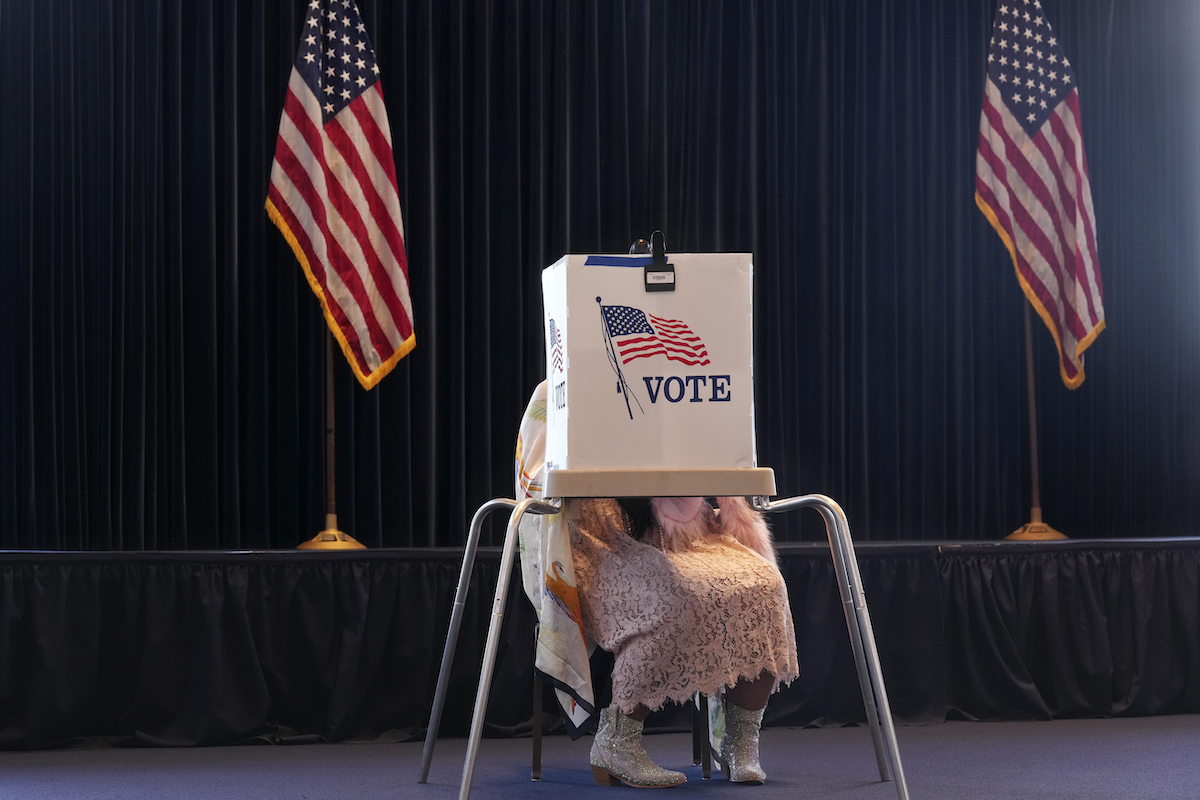
A voter works on her ballot at a polling place at the Ronald Reagan Presidential Library on Election Day, Tuesday, Nov. 5, 2024, in Simi Valley, Calif. (AP)
What’s the truth about a proposed rewrite of election law?
In the Trump era, he and his supporters have regularly questioned the legitimacy of the voting process. The audacity of these claims has led our readers to care a lot about the discussion over preserving democratic norms around voting. Our most-clicked 2025 fact-check concerned how married women who take their spouse’s name would be affected by a proposed law backed by Trump and his allies.
That debate and reader interest continued in 2026.
Having argued for years that he lost the 2020 election because it was "rigged" — even though it wasn’t — Trump has sought to curb practices like voting by mail and require voters to present documentation of their citizenship status before registering to vote. Verifying citizenship is commonly practiced across the world, experts say, but many countries have national ID cards, often mandatory and at no cost. That’s not the case in the U.S.
As lawmakers have been debating the Safeguard American Voter Eligibility (or SAVE America) Act, we’ve published numerous fact-checks of claims for and against the legislation. The mixed Truth-O-Meter ratings underscore another truth about fact-checking: Rhetoric is rarely black and white.
We’ve analyzed Democratic leaders’ talking points that it would force Americans to register in person (pretty much), require every voter to reregister (not really) and that 9% of American citizens lack the proposed identification requirement (basically right).
We also fact-checked Trump’s statement that "mail-in voting means mail-in cheating." That earned a Pants on Fire.

Gas prices are displayed at a station March 24, 2026, in Chicago. (AP)
How could the Iran war affect gasoline prices?
Crude oil prices, and the prices for many other commodities, have soared after Iran threatened tanker traffic in the Strait of Hormuz. Hardly any country has been immune. Amid widespread U.S. voter concern about high consumer prices — an issue that may have done more than anything to propel Trump back into the Oval Office in 2024 — few price increases hit consumers everywhere harder than prices at the gasoline pump.
The international market for oil is confusing and sometimes counterintuitive. For instance, the release of oil from underground stockpiles or increased Venezuelan production may not do much to lower gasoline prices for Americans. And higher output from U.S. oil producers may not be able to keep prices down.
In a March 12 Fox News interview, Energy Secretary Chris Wright downplayed the impact of stalled tanker traffic in the Strait of Hormuz. "The United States — we produce more oil than we can consume. We’re a net oil exporter," Wright said.
Wright’s comment was misleading.
The U.S. does produce a lot of crude oil, but it’s not a net exporter of crude oil on its own — and it’s not clear that the U.S. could meet its own consumption needs without also buying some oil from other countries.
The reason for this is a refinery mismatch — something the average reader may not know, but which an energy secretary should. The U.S. doesn’t have enough refinery capacity to make gasoline out of all the oil it produces domestically, so it exports some of the type of oil it can’t refine and imports some of the kind of oil that can be refined here. This makes the U.S. dependent for at least some of its oil on the international market, where the Strait of Hormuz blockage is pushing prices higher.
Once again, it was a case where we heard something our leaders were saying that raised our eyebrows. And if that’s the case, we think our readers will benefit from a deep, dispassionate investigation — especially at a time in which every day brings urgent news developments.
That’s what keeps us motivated to go into work every day.
Louis Jacobson is PolitiFact’s chief correspondent. A longtime Washington journalist, he joined PolitiFact in 2009. Reach him at ljacobson@poynter.org
15 March 2026
How the Trump Administration Is Giving Even More Tax Breaks to the Wealthy 8NOV25

Congressional Republicans celebrated the signing of the One Big Beautiful Bill Act in July. The legislation provided roughly $4 trillion in tax cuts.THESE ARE JUST SOME OF THE MEMBERS OF THE TRUMP ARSCHLECKEN CLUB
THE drumpf / trump-vance administration with the gop / greed over people-republican party wants $50 BILLION more for their illegal and immoral war in Iran after giving the wealthy more tax breaks knowing many of these same people are war profiteers and will benefit from all the wars he starts. Posting this from the New York Times though it was first published on 8 NOV 25 just to remind America who these neo-nazi fascist war pigs actually care about.....
How the Trump Administration Is Giving Even More Tax Breaks to the Wealthy
The Treasury Department and Internal Revenue Service are issuing rules that provide hundreds of billions of dollars in tax relief to big companies and the ultrarich.

Jesse Drucker has been investigating the tax strategies of large companies and the ultrawealthy for nearly 20 years. He reported from New York City.
With little public scrutiny, the Trump administration is handing out hundreds of billions of dollars in tax cuts to some of the country’s most profitable companies and wealthiest investors.
The Treasury Department and Internal Revenue Service, through a series of new notices and proposed regulations, are giving breaks to giant private equity firms, crypto companies, foreign real estate investors, insurance providers and a variety of multinational corporations.
The primary target: The administration is rapidly gutting a 2022 law intended to ensure that a sliver of the country’s most profitable corporations pay at least some federal income tax. The provision, the corporate alternative minimum tax, was passed by Democrats and signed into law by President Joseph R. Biden Jr. It sought to stop corporations like Microsoft, Amazon and Johnson & Johnson from being able to report big profits to shareholders yet low tax liabilities to the federal government. It was projected to raise $222 billion over a decade.
But the succession of notices the Treasury and I.R.S. have issued beginning this summer means the tax could bring in a fraction of that.
These breaks come in addition to the roughly $4 trillion package of tax cuts that President Trump signed into law in July. The legislation, passed entirely by Republicans, heavily benefits businesses and the ultrawealthy. It is projected to add trillions of dollars to the federal deficit and came with steep cuts to health care for the elderly and food stamps for the poorest Americans.
With its various tax relief provisions, the administration is now effectively adding hundreds of billions of dollars in new breaks for big businesses and investors. The Treasury is empowered to write rules to help the I.R.S. carry out tax laws passed by Congress. But the aggressive actions of the Trump administration raise questions about whether it is exceeding its legal authority.
Mr. Trump and congressional Republicans have attacked federal workers as instruments of the “deep state,” exercising power beyond anything authorized by the law. Now the administration is doing the same thing, several tax experts said, undermining laws that hit the ultrawealthy and big companies.
“Treasury has clearly been enacting unlegislated tax cuts,” said Kyle Pomerleau, a tax economist at the American Enterprise Institute, a right-leaning think tank. “Congress determines tax law. Treasury undermines this constitutional principle when it asserts more authority over the structure of the tax code than Congress provides it.”
The alternative minimum tax isn’t the administration’s only effort to roll back taxes on large businesses and wealthy individuals. Last month, the Treasury and I.R.S. granted new tax relief to foreign investors in U.S. real estate. In August, they withdrew regulations to prevent multinationals from avoiding taxes by claiming duplicate losses in multiple countries at once. And, as The New York Times previously reported, the Treasury and I.R.S. have rolled back a crackdown on an aggressive tax shelter used by big companies, including Occidental Petroleum and AT&T. That amounts to another $100 billion in cuts — and likely far more, according to tax advisers.
Changes like these are not widely publicized by the Treasury, but are closely followed by tax planners for the country’s biggest corporations — who are applauding the new guidelines. In notes to clients, advisers at KPMG celebrated the new “array of choices” available for investors seeking to avoid the corporate alternative minimum tax. They noted that the Treasury’s moves provided “significant flexibility” for clients to trim their bills, allowing them to “cherry-pick” the rules that best suit their needs.
A Treasury spokesman said the new moves were “a practical approach that supports American investment and competitiveness” and were meant to replace the Biden administration’s “compliance maze that would have buried taxpayers in red tape.” The spokesman did not address the issue of whether the Treasury was exceeding its legal authority.
Mr. Trump and congressional Republicans have attacked federal workers as instruments of the “deep state,” exercising power beyond anything authorized by the law. Now the administration is doing the same thing, several tax experts said, undermining laws that hit the ultrawealthy and big companies.
“Treasury has clearly been enacting unlegislated tax cuts,” said Kyle Pomerleau, a tax economist at the American Enterprise Institute, a right-leaning think tank. “Congress determines tax law. Treasury undermines this constitutional principle when it asserts more authority over the structure of the tax code than Congress provides it.”
The alternative minimum tax isn’t the administration’s only effort to roll back taxes on large businesses and wealthy individuals. Last month, the Treasury and I.R.S. granted new tax relief to foreign investors in U.S. real estate. In August, they withdrew regulations to prevent multinationals from avoiding taxes by claiming duplicate losses in multiple countries at once. And, as The New York Times previously reported, the Treasury and I.R.S. have rolled back a crackdown on an aggressive tax shelter used by big companies, including Occidental Petroleum and AT&T. That amounts to another $100 billion in cuts — and likely far more, according to tax advisers.
Changes like these are not widely publicized by the Treasury, but are closely followed by tax planners for the country’s biggest corporations — who are applauding the new guidelines. In notes to clients, advisers at KPMG celebrated the new “array of choices” available for investors seeking to avoid the corporate alternative minimum tax. They noted that the Treasury’s moves provided “significant flexibility” for clients to trim their bills, allowing them to “cherry-pick” the rules that best suit their needs.
A Treasury spokesman said the new moves were “a practical approach that supports American investment and competitiveness” and were meant to replace the Biden administration’s “compliance maze that would have buried taxpayers in red tape.” The spokesman did not address the issue of whether the Treasury was exceeding its legal authority.
The Treasury’s actions are probably contributing hundreds of billions of dollars to the federal deficit, tax experts said. That is on top of the trillions that the legislation signed by Mr. Trump in July is already adding to the deficit. Yet unlike laws passed by Congress, Treasury is under no obligation to publicly account for revenue lost by its actions — such as cutting spending to offset the money no longer being collected.
Doing it through the Treasury means “you can just give away the goodies to one group, without having to take back anything from another,” said Daniel Hemel, a law professor at New York University. This loophole, he said, is one “that previous administrations have exploited and which the Trump administration is exploiting more aggressively.”
The actions by Treasury over the past few months are an accelerated version of what the agency did during the first Trump administration: Regulators killed off efforts to crack down on a lucrative estate tax avoidance strategy, and watered down new taxes on multinational companies in the 2017 Republican tax package.
Big companies effectively keep two sets of books — one for investors and another for the I.R.S. The profits they report to the I.R.S. permit various deductions that can bring a firm’s tax rate far below the 21 percent corporate tax rate.
A holy grail of tax planning is figuring out a deduction that businesses can claim on their tax return — but one that they don’t report to investors, which would dent their profits, potentially hurt their stock price and thus depress compensation paid to executives. In 2021, the Biden administration was unable to get Congress to sign on to an international plan to tax multinational corporations. So the Democratic-led Congress revived an old idea to potentially achieve similar results by imposing a tax on the same profits that corporations report to their investors.
That alternative minimum tax was part of a 2022 domestic policy law called the Inflation Reduction Act. The new tax would apply to big corporations with an effective tax rate below 15 percent.
Not everyone viewed the new tax positively. “But it’s a thing that they were able to do at that moment in time,” said Kimberly Clausing, a top Biden administration Treasury tax official, and now a law professor at the University of California, Los Angeles.
The original proposal was relatively simple. Limited to a tiny group of corporations averaging profits of more than $1 billion a year, it would require I.R.S. auditors to look at the income reported to shareholders. If the companies paid taxes at a rate of less than 15 percent on those earnings, the new tax would kick in. It would hit as few as 80 corporations, according to one study.
Industry lobbyists swung into action, and Democrats in Congress began carving out enormous exceptions, permitting deductions for, say, businesses investing in heavy machinery and wireless spectrum used by the likes of T-Mobile and Verizon.
As a result of changes like these, the new tax’s projected revenue dropped to $222 billion from $319 billion, according to congressional estimates.
The amount of revenue is expected to shrink even more, in part because of the Treasury’s actions.
The “One Big Beautiful Bill Act” that Mr. Trump signed into law in July provided well over $1 trillion in relief for big companies when they calculate their income tax bills. But those breaks didn’t extend to the separate calculation that corporations must make for their alternative minimum tax bill. As a result, the regular tax bills of many businesses promise to drop so sharply — below 15 percent — that they could be newly subject to the alternative minimum tax.
The new law could have swept in two of the biggest crypto firms, Coinbase and Strategy. In response, they sought rule changes for calculating the minimum tax. Three high-powered legal advisers — Michael Desmond, who served as the I.R.S. chief counsel in the first Trump administration; Andrew Strelka, formerly senior tax counsel in the Biden administration; and Eugene Scalia, the labor secretary in the first Trump administration — pushed to exempt “mark to market” gains reported to investors. Those gains reflect the increase in value of the investments held by companies that haven’t been sold yet.
On Sept. 30, the I.R.S. granted their request, explicitly citing “digital assets.” Big crypto companies “have been granted a reprieve,” lawyers at Vedder Price wrote.
Strategy declared within hours that it “no longer expects to become subject to” the minimum tax, after previously disclosing a potential multibillion-dollar bill under the new tax.
Coinbase said in a statement that it supported the Trump administration’s approach to the regulations for administering the minimum tax. Strategy did not respond to a request for comment.
The crypto companies “owe tax and they’re not happy about it, so they’re going to the Trump administration for a special carve-out,” complained Senator Ron Wyden of Oregon, the ranking Democrat on the tax-writing Senate Finance Committee.
Some energy firms are already benefiting, too. Cheniere Energy, the giant natural gas exporter, disclosed in a securities filing last month that, thanks to the most recent Treasury notice, it was entitled to a refund of $380 million of previously paid alternative minimum tax.
Private equity firms are yet another beneficiary. Beginning in early 2023, the industry giant Blackstone pressed for a number of provisions to be included in the regulations to administer the minimum tax.
This summer, Blackstone succeeded. Much of the recent guidance grants Blackstone’s requests, giving private equity firms enormous flexibility to calculate their bills.
A Blackstone spokeswoman declined to comment.
The regulations also provide new flexibility for insurance companies in using so-called tax losses. For one, the new rules permit some insurers to use those losses to reduce their bills under the minimum tax — even for prior years.
“They’re effectively repealing the statute,” said Monte Jackel, a tax lawyer and former I.R.S. official, referring to the minimum tax law.
Kitty Bennett contributed research.
Jesse Drucker is an investigative reporter for the Business section and has written extensively on the world of high end tax avoidance.
A version of this article appears in print on Nov. 10, 2025, Section A, Page 1 of the New York edition with the headline: More Tax Breaks For the Wealthy.
The Latest on the Trump Administration
Oil Drilling Project: The $5 billion project in the Gulf of Mexico, approved by the Trump administration, is expected to produce up to 10 billion barrels of oil by the end of this decade. Critics say it could endanger people and marine life.
Housing Executive Orders: President Trump released two executive orders aimed at tackling the nation’s housing crisis. One order aims to increase housing supply, while the other loosens lending rules for community banks, making it easier for home buyers and builders to borrow.
Boat Strikes and Seized Oil Tankers: Experts in international and U.S. domestic law told an inter-American human rights organization that the Pentagon’s campaign of blowing up boats it suspected of smuggling drugs in the Pacific Ocean and the Caribbean was illegal. And maintaining the oil tankers the Trump administration has seized has already cost the United States tens of millions of dollars.
TikTok Fee: Investors in a deal to create a U.S.-controlled TikTok are set to pay $10 billion to the U.S. Treasury, the latest example of the Trump administration’s inserting the federal government into corporate deal making in unusual ways.
Jared Kushner: Trump’s son-in-law, who is one of the U.S. government’s chief negotiators in the Middle East, is trying to raise more money for his private equity firm from governments in the region, according to five people with knowledge of the talks who were not permitted to speak publicly about the discussions.
Talks With Cuba: President Miguel Díaz-Canel announced that his government had been holding talks with the Trump administration while managing an increasingly severe lack of fuel. The Cuban government also said that it was planning to release 51 prisoners, a move that appears to be an effort to appease the U.S. government.
Subscribe to:
Posts (Atom)