

BUCKNACKT'S SORDID TAWDRY BLOG We should not be a journey to the grave with the intention of arriving safely in an attractive & well preserved body, but rather to skid in sideways, chocolate, bier or wein in hand, body thoroughly used up, totally worn out and screaming "WHOO-HOO, WHAT A RIDE!!!!!!"

After Abraham Lincoln was assassinated in April 1865, President Andrew Johnson was left with the complex process of bringing the former Confederate states back into the Union after the Civil War and emancipation of all slaves. While Johnson, a Democrat and former slaveholder from Tennessee, supported emancipation, he had a different view from Congress, which had a Republican majority, on what the start of the Reconstruction era should look like. Johnson tended to show more leniency toward former Confederate states as they were incorporated back into the Union.
Many northerners were angry when the newly elected southern state legislatures, which were mostly headed by former Confederate leaders, enacted black codes. Black codes were restrictive laws designed to limit the freedom of African Americans and guarantee that they are available as cheap labor for white planters. This led Congress to enforce the new Thirteenth Amendment, which abolished slavery, by creating the Civil Rights Act of 1866 to protect the rights of African Americans. President Johnson vetoed the bill, but Congress successfully overrode his veto and made it into law in April of 1866. However, some Republicans in Congress thought another amendment was needed to support this law under the Constitution.
At the end of April, Representative Thaddeus Stevens proposed combining several different legislations, including civil rights for African Americans, how to apportion representatives in Congress, and how to punish the Confederate States and handle the Civil War debt, into one constitutional amendment. Both houses of Congress approved the amendment, and it was submitted to the states for ratification. President Johnson was clear that he opposed the Fourteenth Amendment, but both houses had Republican majorities and therefore had the power to pass the amendment despite his veto. Southern states were also reluctant to ratify the amendment, but Congress ensured that they would do so by requiring ratification of the Thirteenth and Fourteenth Amendments for the states to regain representation in Congress.
On July 9, 1868, Louisiana and South Carolina ratified the amendment, and the Fourteenth Amendment achieved the necessary three-fourths majority to be added to the Constitution. However, there is debate over the official date of ratification because before these two states’ approvals, Ohio and New Jersey had “withdrawn” their approvals. This was not provided for in the Constitution, so there was question over whether these withdrawals were legitimate. As this controversy occurred over the next two weeks, both Alabama and Georgia ratified the Fourteenth Amendment, and Congress declared the amendment a valid part of the Constitution.
Section 1. All persons born or naturalized in the United States and subject to the jurisdiction thereof, are citizens of the United States and of the State wherein they reside. No State shall make or enforce any law which shall abridge the privileges or immunities of citizens of the United States; nor shall any State deprive any person of life, liberty, or property, without due process of law; nor deny to any person within its jurisdiction the equal protection of the laws.
Section 2. Representatives shall be apportioned among the several States according to their respective numbers, counting the whole number of persons in each State, excluding Indians not taxed. But when the right to vote at any election for the choice of electors for President and Vice President of the United States, Representatives in Congress, the Executive and Judicial officers of a State, or the members of the Legislature thereof, is denied to any of the male inhabitants of such State, being twenty-one years of age, and citizens of the United States, or in any way abridged, except for participation in rebellion, or other crime, the basis of representation therein shall be reduced in the proportion which the number of such male citizens shall bear to the whole number of male citizens twenty-one years of age in such State.
Section 3. No person shall be a Senator or Representative in Congress, or elector of President and Vice President, or hold any office, civil or military, under the United States, or under any State, who, having previously taken an oath, as a member of Congress, or as an officer of the United States, or as a member of any State legislature, or as an executive or judicial officer of any State, to support the Constitution of the United States, shall have engaged in insurrection or rebellion against the same, or given aid or comfort to the enemies thereof. But Congress may by a vote of two-thirds of each House, remove such disability.
Section 4. The validity of the public debt of the United States, authorized by law, including debts incurred for payment of pensions and bounties for services in suppressing insurrection or rebellion, shall not be questioned. But neither the United States nor any State shall assume or pay any debt or obligation incurred in aid of insurrection or rebellion against the United States, or any claim for the loss or emancipation of any slave; but all such debts, obligations and claims shall be held illegal and void.
Section 5. The Congress shall have power to enforce, by appropriate legislation, the provisions of this article.
The opening sentence of Section 1, also known as the Citizenship Clause, clearly outlines race-blind citizenship based on birth and naturalization. The next clause, known as the Privileges and Immunities Clause, expands the civil and legal rights of all American citizens by protecting them from states violating their rights instead of just the federal government. The third clause, or Due Process clause, echoes the sentiments of the Fifth Amendment, which provides a number of rights related to criminal and civil legal proceedings, and applies this requirement to states as well as the federal government. Finally, the Equal Protection Clause prohibits state governments from discriminating against Black Americans by providing equal protection for all citizens under the law.
Section 2 of the Fourteenth Amendment repeals the three-fifths clause of the Constitution, which counted slaves as three-fifths of a person as a means to apportion representation in Congress. Regardless of race, each citizen is counted as one whole person, and all male citizens over the age of 21 are granted the right to vote. The section punishes states that do not allow all males over age 21 to vote by reducing their population for representation in Congress.
Section 3 disqualifies any person from public office who previously took an oath as a federal or state officer, engaged in insurrection or rebellion, unless there is a two-thirds majority in Congress. This section intended to prevent former leaders of the Confederacy from regaining political power.
Section 4 confirms the legitimacy of all public debt acquired by Congress in an effort to put an end to rebellion or insurrection. It also states that neither the United States nor any states will repay war debts sustained to aid rebellion or compensate former slave owners for the emancipation of their slaves
Section 5, the final section of the Fourteenth Amendment, like the Thirteenth Amendment, gives Congress the power to pass laws to enforce the provisions within the Amendment.
Prior to the ratification of the Fourteenth Amendment, in the infamous 1857 Case Dred Scott v. Sandford, Dred Scott, born a slave, sued his owner for freedom after traveling with him to Illinois, a free territory. The Court concluded that Scott would remain a slave because African Americans, whether enslaved or free, were not citizens and therefore were not granted the power to sue in the federal courts. In 1868, the Fourteenth Amendment overturned the Dred Scott decision by granting citizenship to all individuals born in the United States, regardless of race.
Most Supreme Court Cases involving the Fourteenth Amendment concern due process and equal protection under the law.
In early decisions involving the Fourteenth Amendment, the Supreme Court infrequently applied its protections on a state and local level. In Plessy v. Ferguson, a 1896 Case, the Court held that segregation was acceptable according to the Constitution as long as the facilities were “equal.” Nearly sixty years later, in Brown v. Board of Education, the Court overturned that decision and ruled that separate is inherently unequal, so public school segregation based on race violates the Fourteenth Amendment.
The Court’s decision in Mapp v. Ohio, a 1961 Court Case, determined what would occur if police obtained evidence from an illegal search or seizure. Prior to the case, the evidence could still be collected, but the police would be condemned. However, the Court held that evidence collected from an unlawful search should be excluded from an individual’s trial, citing the Due Process Clause of the Fourteenth Amendment.
In later decisions, the Court has used the Fourteenth Amendment more creatively. In Roe v. Wade, a 1973 Case, the Court determined that Americans have a right to privacy, which is violated by statutes that ban abortions. In the 2000 Case Bush v. Gore, George W. Bush’s lawyers successfully argued that the Florida recount that would decide the presidency violated the Fourteenth Amendment’s Equal Protection Clause because different standards of counting were used in different municipalities, eliminating the recount. In Obergefell v. Hodges, a 2015 Case, the Court legalized same-sex marriage across the nation using the Due Process and Equal Protection Clauses.
Modern controversy surrounding the Fourteenth Amendment is related to its meaning and its scope of power or overall effectiveness today. First, the meaning of the Fourteenth Amendment is not necessarily straightforward, apparent by the fact that the Supreme Court’s interpretations of certain clauses, such as the Equal Protection Clause, have changed significantly over time. Second, many people question how much power Congress has to enforce the Fourteenth Amendment. Similarly, others point out that the Amendment may not be as impactful today as we think, considering that people of all races, genders, and abilities do not necessarily have “equal” protection under the law in practice.
The Fourteenth Amendment is one of the most important amendments of the Constitution, outlining many rights and protections guaranteed to citizens of the United States. The Amendment transformed our democracy and has been the foundation for many pivotal Supreme Court decisions. While many may not recognize it, the Fourteenth Amendment is one of the most relevant amendments in Americans’ lives today.


January 10, 2022
I've been in denial about Omicron for weeks.
Maybe you can sympathize. After two pandemic years, I was sick of wearing a mask. Vaccinated and boosted, I couldn't understand why I should worry about a milder, albeit more contagious, variant that is highly unlikely to send a healthy twentysomething to the hospital. I was, as they say, "vaxxed and done."
It wasn't until I read Ed Yong's latest piece in the Atlantic that I understood that a small number of severe cases out of a large number of infected people is still a massive burden on the hospital system. On an individual level, this means that if I crash my bike and need to go to the emergency room, I'll likely have to wait hours to be treated. Societally, it means a shortage of hospital workers—because they've either gotten sick or left the profession—and the collapse of the health care system as a whole. "This is the cost of two years spent prematurely pushing for a return to normal," Yong writes. "The lack of a normal to return to."
I've been thinking a lot about what the return to "normal" looks like, especially this weekend. In October 2020, I moved from New York City to Denver, but my old roommate hung onto the apartment. On Saturday, he moved upstate. It took me a while to figure out why this positive development in his life made me so sad. And then I realized that that apartment embodied my pre-pandemic life. When I visited last spring—climbing those same carpeted steps, eating pizza on that same ratty brown couch—I could almost pretend that things were as they had always been.
Soon, a stranger will sign the lease and start sleeping in my old bedroom. Things will never go back to the way they were, and I was foolish, in those early pandemic days, to think they would. I guess Omicron isn't the only thing I've been in denial about. Nothing lasts forever. And that's just the way things go.
Onward.
—Abigail Weinberg

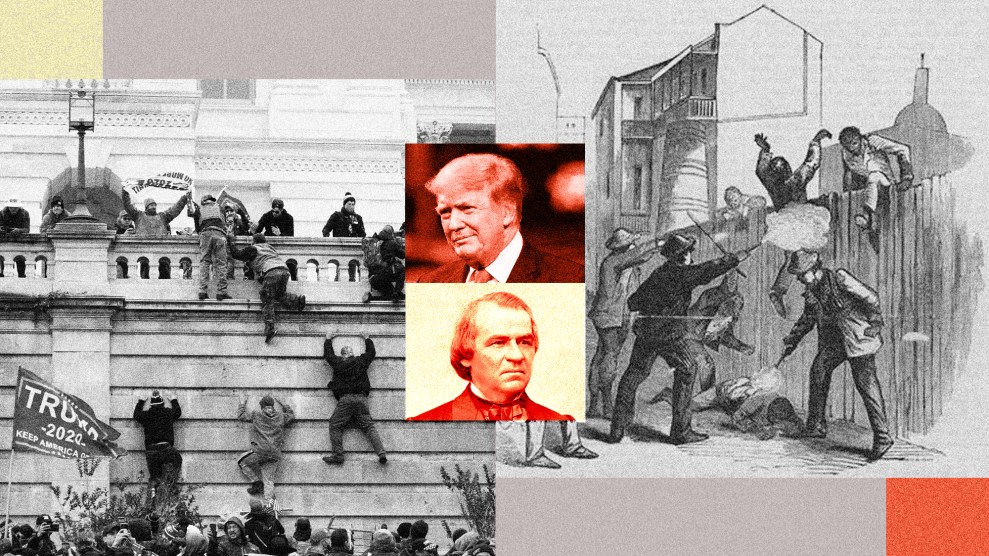
The historical resonances are astounding.
BY ANTHONY CONWRIGHT

BY ARI BERMAN
BY DAMIAN CARRINGTON
BY DAN SPINELLI
BY JAMES DINEEN


The “Midwest Carbon Express” will rely heavily on policies that Vilsack has been pushing for his entire career.
BY TOM PHILPOTT

Support from readers allows Mother Jones to do journalism that doesn't just follow the pack.
Did you enjoy this newsletter? Help us out by forwarding it to a friend or sharing it on Facebook and Twitter.

I remember singing a children’s worship song in my Pentecostal church when I was around 10 years old:
It’s time to cross over.
It’s time to possess the land.
We’ll stand, lifting up Your praises.
Through this mighty army, we’ll bring revival to the land.
That memory — kids singing about spiritual warfare in church — was what flashed through my mind when I saw charismatic worshippers at the entrance of the Capitol building across from the Supreme Court on Jan. 3, 2021. I had just moved into the Capitol Hill neighborhood the day before. My new housemate and Twitter feed told me President Donald Trump's supporters were coming to town for a “Jericho march,” and I wanted to check out the scene. Under the guise that I was taking in my new surroundings (should I get confronted and asked), I observed them in the chilly, misty weather from afar.
It was a group of about 10 people; one or two had shofars blowing, a 20-something white woman was dancing in a pseudo-ballet style, and the rest were moving to an unrecognizable tune of some Hillsong or Bethel-esque worship anthem. I wanted to watch them, to see how the group would change and evolve over the few hours of daylight left. But I was concerned that I’d look a bit suspicious staring at this group for too long. So I continued my stroll.
Near the entrance of the Capitol building, between the two visitor centers, was a white man in his 50s, walking his German Shepherd and wearing a camouflage jacket. He was shouting angrily, accusing “the establishment,” of meddling with the presidential election votes, and also incoherent ramblings about former President Barack Obama’s “connection with the Chinese Communist Party.”
I looked at him, and then looked at the worshippers several yards away — the two scenes were threads from the same cloth. The man sounded aggressive and fearful; the worshippers carried themselves in a mystical, flowery manner that could leave an off-putting and eerie aura to the passerby, given the tense moment stirring in Washington. Their approaches seemed vastly different, yet, I’d assumed, they were all there for the same reason: because of the false belief that the election was stolen.
I stood thinking to myself until I saw a security guard making his rounds toward me.
“Getting crazy here, huh?” I asked him.
He replied, “Oh, it’s like any other day on the Hill.”
By Jan. 5, 2021, I started to see more red hats throughout my new neighborhood. Nearing the front of the Supreme Court, I saw American flags, Trump flags, and “Don’t Tread On Me” flags, of motley variations, all over First Street. I noticed a group forming at the Supreme Court and headed over. Roger Stone was speaking to those assembled. Stone’s speech wasn’t as eventful in my memory, but having a top figure in Trump’s world leading chants to “stop the steal” and insulting Washington’s mayor, Muriel Bowser, pumped up the crowd.
After Stone was finished, I observed two friends — who perhaps hadn’t seen each other in a while — embrace and share encouragements for the following day:
“We gotta stop the steal, man.”
“Yeah, we just gotta.”
I left the Supreme Court building feeling a dread and uncertainty of what was going to happen the next day.
Jan. 6: The Feast of the Epiphany. The day that marks the revelation of God’s incarnation in Jesus Christ. It was an important day in my family growing up. On “King’s Day,'' in Puerto Rican custom, children would go to the fields and pick grass to leave under their beds. By the next morning, the “Magi” would have already visited — leaving presents in lieu of grass, their camels well-fed from the grass for their journey to the next house.
On that day last year, I woke up late to headlines blaring that rioters “STORMED THE CAPITOL.” I put on clothes, shoes, and a coat and dashed over there.
As I got close, I saw a large “Jesus 2020” sign hanging from the brown garden bed on the right of the Capitol Building East. The iconic MAGA hats flooded the grounds. I strolled around and took a good look at the people who were there. I saw men covered in militaristic-looking gear. I saw teens walking around taking selfies and playing on their iPhones. I spoke with an adult son and elderly mother who were quickly departing to avoid any possible interactions with “antifa.” I heard what sounded like club music playing from large speakers. What struck me about this entire group was that they all felt familiar — like I had grown up surrounded by them my entire life. The Capitol Hill grounds felt like an insurrectionist-themed tailgate party. There were families along with extremists, children along with militants, and up-to-then average Joes and Josephines coupled with Proud Boys and not-so-average armed nationalists. Crosses, Trump flags, red hats all melded together to create a moment that — while denounced as “un-American” later on — felt as American as I remember growing up in a part of Virginia that loved God, guns, and confessional American patriotism. This milieu is as inseparable and intersectional as its more progressive counterpart.
Never had I felt so familial yet so distanced by an infinite chasm to these people, and to those back home, than in those moments on Capitol Hill on Jan. 6. It was a surreal, eerie space in time that hasn’t left me since.
This reverie was broken by a guy with red blowhorn who started taunting a reporter and cameraman in front of me. A group started to form as the journalists retreated behind a small metal fence where other members of the media stood. This group of harassers became increasingly large and hostile, shouting “Get outta here!” and unpublishable expletives. Finally, as if a dam broke, the crowds pushed the flimsy metal barriers aside and went after the camera crews and journalists. They assaulted the journalists, and it appeared that some of crowd broke their camera equipment in the process. Not long after the incident, I walked home, full of adrenaline and emotionally numb to everything that I just saw.
It’s now been a year since Jan. 6, 2021. I’m sitting in a neighborhood coffee shop with snow covering the cars and trees, feeling exhausted from a year of seemingly endless pandemic surges, political polarization that’s affected my relationships with few of my friends and family, and attempts to come to grips with the inescapable disillusionment that never fully left when I was on the Capitol building grounds that day.
In that time, I’ve returned to acknowledging that “spiritual warfare” is actually a vital part of my own faith. The progressive and leftish-leaning Christian folk I hang out with nowadays eschew militaristic language, metaphors, and terminology that even hints of one person causing physical harm to another. But in the realm of the Spirit, there are certainly ideas, values, and beliefs that leave the world slightly better off than before, and that are worth fighting for. And while certainly we can’t engage in any sort of physical struggle, I believe there are principalities and powers (and humans who embody these forces) who we must contend with through prayer, confrontation, and all the nonviolent tools at our disposal.
The friends, family and acquaintances of mine who’d been pro-Trump up to Jan 6. still haven't left Trumpism. Some of them still blame “antifa” or #BlackLivesMatter and want to forget about that day. A few others I know have joined the local school board to push back against the threats they see in COVID-19 safety measures and “critical race theory.” Across the country, those supportive of or sympathetic to the insurrection are running for local office and election boards to help prevent the pseudo-issue of “election fraud.” What Jan. 6 confirmed for me is that my junior-church teachers, pastors, and televangelists were actually correct: There really is a war going on.
I’m not much of a combative spirit, to be frank, and I’m certainly far too weary to muster all my energy to “fight the good fight.” In reflecting on King’s Day, it almost seems as if the wise men, in a simple way that was devoid of loud prayers in tongues, shofars, or elaborate dancing, conducted their own form of spiritual warfare. In the gospel, we read that after the wise men had left their gifts with the child Christ, they “left for their own country by another road” because they had “been warned in a dream not to return to Herod” who was out to destroy Jesus (Matthew 2:11-12). They couldn’t necessarily prevent Herod’s murder of the infants following their departure. Nevertheless, they helped foil Herod’s plot to murder the Christ child. Their weapon was to simply choose to go into another direction.

Miguel Petrosky is an essayist, writer, and journalist based in Washington, D.C., and whose work has appeared in Sojourners and Religion & Politics. You can follow him on Twitter @petrosky_miguel.
Remember the broken glass and broken barricades. Remember the angry chants of “hang Mike Pence.” Remember the estimated 140 officers who were injured trying to protect the members of Congress who were certifying the election. Remember the misuse and abuse of crosses and prayers and American flags. Remember these and other sobering images of the U.S. Capitol building attacked and overrun by rioters and insurrectionists; images that can feel unfathomable unless we remember the breadth and depth of racialized violence in our nation’s history. History is about both the what and the why. Given the volumes of footage and visible evidence, it is difficult to refute what happened on Jan. 6, 2021. The deeper struggle will be understanding why it happened.
Memory is a powerful thing. Both how we remember and what we choose to remember profoundly shape our sense of reality. A growing body of research shows that “memory allows for a kind of mental time travel, a way for us to picture not just the past but also a version of the future.” Memory is like truth — it can either hold us captive or help set us free.
Having taken the Israelites to the verge of entering the promised land, Moses implores the Israelites before his death on Mount Nebo to keep God’s commandments and warns, “Only be careful, and watch yourselves closely so that you do not forget the things your eyes have seen or let them fade from your heart as long as you live. Teach them to your children and to their children after them” (Deuteronomy 4:9, NIV, emphasis mine). Moses is adamant: The people must remember. Years of wandering in the wilderness stretched into four decades in part because of the Israelites’ failure to remember their oppression and suffering in Egypt and how God brought them out. Some mothers and fathers even longed to return to Egypt because while God had delivered them from Egypt, Egypt was still within them. The memory of Egypt became essential for overcoming the travails in the wilderness and resisting the temptation to whitewash the past.
On this first anniversary of the Jan. 6 insurrection, it is imperative to ask ourselves: How will we remember this dark stain on our nation’s history, and what must we learn from it? Unless we confront the why — unless we refuse to hide from ugly and painful truths — we are much more liable to repeat them.
In my recent book A More Perfect Union, I make the case that one of the principal reasons our nation is so dangerously polarized is that we have conflicting understandings and competing narratives about our history. Without a baseline of shared truth and collective memory, our sense of unity and common purpose is imperiled; our nation will be like a house divided against itself, which Jesus said cannot stand.
How we understand Jan. 6 represents a real-time test of our collective memory. Unfortunately, recent polls signal that our nation is woefully failing this test. A CBS News-YouGov poll released on Monday found fairly consistent condemnation of the actions of those who forced their way into the Capitol: 83 percent disapprove now, down from 87 percent last January. But alarmingly, 56 percent of Republicans say what happened at the Capitol was “defending freedom” and another 47 percent say it was “patriotism.” On top of that, 41 percent of GOP respondents say they believe most of those who ransacked the Capitol were “left-leaning groups.”
Rather than insurrectionists or rioters, many Republican politicians and Trump supporters refer to the people who stormed the Capitol as patriots or protesters who were defending our democracy. While I initially understood Jan. 6 through the lens of a cold civil war that turned violently hot on that day, I now believe that a more accurate description is a growing and increasingly dangerous insurgency that is working to unravel democracy into a more authoritarian direction and derail the multiracial democracy that the United States is becoming.
How can our democracy survive, let alone thrive, when a large portion of the country is so detached from the reality of that terrible day? The stakes couldn’t be higher: How we teach the next generation about what happened on Jan. 6 — and the days leading up to it — affects how we reckon with our past and whether we commit to cocreating a more just and hopeful future.
I’ve thought a lot about how I will teach my kids about Jan. 6, particularly as they get older. This had to be done in real time as my two sons, who were 8 and 10, caught glimpses of some of the sobering images of the Capitol attack on television. I tried to explain to them that these rioters were angry because they believed the lie that the election was stolen. I tried to teach them that resorting to violence to advance your cause is never justified. A year later, I’ve come to see that in order to fully remember the why behind January, we must teach three truths:
In the days after the 2020 election, my 8-year-old son quickly understood the first truth. He continually asked, “Daddy, who won the election?” After days stretched into a week without a victor, he declared, “President Trump will never concede because he is a sore loser.” His young mind intuited something that is critical to how we remember the why behind Jan. 6: President Trump’s bitter refusal to concede — and the subversive campaign he orchestrated with his allies to overturn the results — fueled the violent attack on the Capitol that day.
When it happened, I was wrapping up edits for my book, and I knew I would need to update it to reflect upon the events of that terrible day. In my mind and spirit, the attempted coup represented a dark nadir in our nation’s history, but it also represented a potential turning point — perhaps the nation would finally reject the big lie that the election was stolen. Sadly, this year has shown otherwise: It’s clear former President Trump still has an iron grip on the majority of the Republican Party. And attempts to undo the last election never really stopped, as hundreds of state-level bills have been proposed that will make it more difficult for people to vote and easier for state legislatures to overturn election outcomes.
Photos from Jan. 6 clearly show the rioters’ white supremacist and Christian nationalist tendencies, and scholars have dedicated much time to proving such. Research by University of Chicago professor Robert Pape reinforces that this was largely a white supremacist mob. Pape found that a disproportionate number of those who traveled to Washington and participated in the insurrection came from counties where the white population had decreased in recent years. Alarmingly, the right-wing “great replacement” conspiracy theory, which says that white people will be replaced by minorities, has gone from fringe to more mainstream. The number of Confederate flags and the noose hanging from gallows erected outside the Capitol are also tell-tale signs that the mob sought to uphold white supremacy.
The third truth to understand the why behind Jan. 6 intersects with current fights over how we teach and reckon with our nation’s history. In much more rapid fashion, we are facing a test similar to that of the post-Civil War period in which competing narratives battled for the consciousness of the country. Ultimately, the “Lost Cause” narrative — a revisionist history that reframed the Civil War as a struggle over states’ rights and heritage rather than over the evils of slavery — prevailed among white Southerners. This narrative, rooted in disinformation and fear mongering, helped fuel the backlash and violence that ultimately led to the end of the short-lived Reconstruction era.
As long as people fail to remember the why and not just the what of Jan. 6, we will continue to wander in a wilderness of deepening polarization and racialized violence. Our failure to remember the peril of Jan. 6 presents a danger to our democracy and will sabotage our pursuit of a more perfect union. But by remembering the full breadth of our history, including the ongoing impacts of white supremacy, we can better fathom both how and why Jan. 6 took place and understand the degree to which it wasn’t simply an aberration. By remembering the why we can better galvanize the political will necessary in the Senate to pass legislation that will help protect the sacred right to vote and safeguard our democracy. By remembering the why, we can foster healing and repair that opens the door to transformation. Let us not fail this test to remember — for ourselves and the next generation.

Adam Russell Taylor is president of Sojourners and author of A More Perfect Union: A New Vision for Building the Beloved Community. Follow him on Twitter @revadamtaylor.
