NORTON META TAG

Showing posts with label fed taxes. Show all posts

09 January 2014

Ten True Facts Guaranteed to Short-Circuit Republican Brains 4SEP12

FACTS, those truths repiglicans and tea-baggers and the like can't accept, but here they are....
Richard Riis
As a public service to those who find themselves inextricably cornered by aggressively ill-informed Republicans at work, on the train or at family gatherings, presented here are ten indisputably true facts that will seriously challenge a Republican’s worldview and probably blow a brain cell or two. At the very least, any one of these GOP-busters should stun and confuse them long enough for you to slip quietly away from a pointless debate and allow you to get on about your business.
1. The United States is not a Christian nation, and the Bible is not the cornerstone of our law.
Don’t take my word for it. Let these Founding Fathers speak for themselves:
John Adams: “The government of the United States of America is not in any sense founded on the Christian religion.” (Treaty of Tripoli, 1797)
Thomas Jefferson: “Christianity neither is, nor ever was, a part of the common law.” (Letter to Dr. Thomas Cooper, February 10, 1814)
James Madison: “The civil government … functions with complete success … by the total separation of the Church from the State.” (Writings, 8:432, 1819)
George Washington: “If I could conceive that the general government might ever be so administered as to render the liberty of conscience insecure, I beg you will be persuaded, that no one would be more zealous than myself to establish effectual barriers against the horrors of spiritual tyranny, and every species of religious persecution.” (Letter to the United Baptist Chamber of Virginia, May 1789)
You can find a multitude of similar quotes from these men and most others who signed the Declaration of Independence and/or formulated the United States Constitution. These are hardly the words of men who believed that America should be a Christian nation governed by the Bible, as a disturbingly growing number of Republicans like to claim.
2. The Pledge of Allegiance was written by a socialist.
The Pledge was written in 1892 for public school celebrations of the 400th anniversary of Columbus’ arrival in the Americas. Its author was Francis Bellamy, a Baptist minister, Christian socialist and cousin of socialist utopian novelist Edward Bellamy. Christian socialism maintains, among other ideas, that capitalism is idolatrous and rooted in greed, and the underlying cause of much of the world’s social inequity. Definitely more “Occupy Wall Street” than “Grand Old Party” by anyone’s standard.
3. The first president to propose national health insurance was a Republican.
He was also a trust-busting, pro-labor, Nobel Peace Prize-winning environmentalist. Is there any wonder why Theodore Roosevelt, who first proposed a system of national health insurance during his unsuccessful Progressive Party campaign to retake the White House from William Howard Taft in 1912, gets scarce mention at Republican National Conventions these days?
4. Ronald Reagan once signed a bill legalizing abortion.
The Ronald Reagan Republicans worship today is more myth than reality. Reagan was a conservative for sure, but also a practical politician who understood the necessities of compromise. In the spring of 1967, four months into his first term as governor of California, Ronald Reagan signed a bill that, among its other provisions, legalized abortion for the vaguely-defined “well being” of the mother. Reagan may have been personally pro-life, but in this instance he was willing to compromise in order to achieve other ends he considered more important. That he claimed later to regret signing the bill doesn’t change the fact that he did. As Casey Stengel liked to say, “You could look it up.”
5. Reagan raised federal taxes eleven times.
Okay, Ronald Reagan cut tax rates more than any other president – with a big asterisk. Sure, the top rate was reduced from 70% in 1980 all the way down to 28% in 1988, but while Republicans typically point to Reagan’s tax-cutting as the right approach to improving the economy, Reagan himself realized the resulting national debt from his revenue slashing was untenable, so he quietly raised other taxes on income – primarily Social Security and payroll taxes - no less than eleven times. Most of Reagan’s highly publicized tax cuts went to the usual Republican handout-takers in the top income brackets, while his stealth tax increases had their biggest impact on the middle class. These increases were well hidden inside such innocuous-sounding packages as the Tax Equity and Fiscal Responsibility Act of 1982, the Deficit Reduction Act of 1984 and the Omnibus Budget Reconciliation Act of 1987. Leave it to a seasoned actor to pull off such a masterful charade.
6. Roe v. Wade was a bipartisan ruling made by a predominantly Republican-appointed Supreme Court.
Technically, Roe v. Wade did not make abortion legal in the United States; the Supreme Court’s decision held only that individual states could not make abortion illegal. That being said, the landmark 1973 ruling that Republicans love to hate, was decided on a 7-2 vote that broke down like this:
Majority (for Roe): Chief Justice Warren Burger (conservative, appointed by Nixon), William O. Douglas (liberal, appointed by FDR), William J. Brennan (liberal, appointed by Eisenhower), Potter Stewart (moderate, appointed by Eisenhower), Thurgood Marshall (liberal, appointed by LBJ), Harry Blackmun (author of the majority opinion and a conservative who eventually turned liberal, appointed by Nixon), Lewis Powell (moderate, appointed by Nixon). Summary: 2 conservatives, 3 liberals, 2 moderates.
Dissenting (for Wade): Byron White (generally liberal/sometimes conservative, appointed by JFK), William Rehnquist (conservative, appointed by Nixon). Summary: 1 liberal, 1 conservative.
By ideological orientation, the decision was for Roe all the way: conservatives 2-1, liberals 3-1, moderates 2-0; by party of presidential appointment it was Republicans 5-1, Democrats 2-1. No one can rightly say that this was a leftist court forcing its liberal beliefs on America.
7. The Federal Reserve System was a Republican invention.
Republicans, and, truth be told, many Democrats, despise the Federal Reserve as an example of government interference in the free market. But hold everything: The Federal Reserve System was the brainchild of financial expert and Senate Republican leader Nelson Aldrich, grandfather of future Republican governor and vice president Nelson Rockefeller. Aldrich set up two commissions: one to study the American monetary system in depth and the other, headed by Aldrich himself, to study the European central banking systems. Aldrich went to Europe opposed to centralized banking, but after viewing Germany's monetary system he came away believing that a centralized bank was better than the government-issued bond system that he had previously supported. The Federal Reserve Act, developed around Senator Aldrich’s recommendations and - adding insult to injury in the minds of today’s Republicans - based on a European model, was signed into law in 1913.
8. The Environmental Protection Agency was, too.
The United States Environment Protection Agency, arch-enemy of polluters in particular and government regulation haters in general, was created by President Richard Nixon. In his 1970 State of the Union Address, Nixon proclaimed the new decade a period of environmental transformation. Shortly thereafter he presented Congress an unprecedented 37-point message on the environment, requesting billions for the improvement of water treatment facilities, asking for national air quality standards and stringent guidelines to lower motor vehicle emissions, and launching federally-funded research to reduce automobile pollution. Nixon also ordered a clean-up of air- and water-polluting federal facilities, sought legislation to end the dumping of wastes into the Great Lakes, proposed a tax on lead additives in gasoline, and approved a National Contingency Plan for the treatment of petroleum spills. In July 1970 Nixon declared his intention to establish the Environmental Protection Agency, and that December the EPA opened for business. Hard to believe, but if it hadn’t been for Watergate, we might remember Richard Nixon today as the “environmental president”.
Oh, yes - Republicans might enjoy knowing Nixon was an advocate of national health insurance, too.
9. Obama has increased government spending less than any president in at least a generation.
Republican campaign strategists may lie, but the numbers don’t. Government spending, when adjusted for inflation, has increased during his administration (to date) by 1.4%.  Under George W. Bush, the increases were 7.3% (first term) and 8.1% (second term). Bill Clinton, in his two terms, comes in at 3.2% and 3.9%. George H. W. Bush increased government spending by 5.4%, while Ronald Reagan added 8.7% and 4.9% in his two terms.
Not only does Obama turn out to be the most thrifty president in recent memory, but the evidence shows that Republican administrations consistently increased government spending significantly more than any Democratic administration. Go figure.
10. President Obama was not only born in the United States, his roots run deeper in American history than most people know.
The argument that Barack Obama was born anywhere but at Kapiolani Maternity and Gynecological Hospital in Honolulu, Hawaii, is not worth addressing; the evidence is indisputable by any rational human being. But not even irrational “birthers” can dispute Obama’s well-documented family tree on his mother’s side. By way of his Dunham lineage, President Obama has at least 11 direct ancestors who took up arms and fought for American independence in the Revolutionary War and two others cited as patriots by the Daughters of the American Revolution for furnishing supplies to the colonial army. This star-spangled heritage makes Obama eligible to join the Sons of the American Revolution, and his daughters the Daughters of the American Revolution. Not bad for someone 56% of Republicans still believe is a foreigner.
Okay, feel free to drop any or all of these ten true facts on your local Republican windbag. Tell him or her to put any of these choice nuggets in his or her teabag and steep it. Then sit back and enjoy the silence.
Note: Although the facts are 100% true, the context is, of course, one of humor; the oxymoronic reference to "Republican Brains" in the title should have been a dead giveaway. Additionally, as everyone knows, there are no facts in the Republican cosmos, only Fox News Alerts.
 http://www.dailykos.com/story/2012/09/04/1127663/-Ten-True-Facts-Guaranteed-to-Short-Circuit-Republican-Brains

13 November 2012

How The Alternative Minimum Tax Could Slam You 13NOV12

HERE is a great article from NPR on the ATM, Alternative Minimum Tax, and how it may cost some a lot more in taxes because our Senators and Representatives, republicans and Democrats alike, can't get their act together and fix this permanently. It is important to keep track of the negotiations on resolving the problem of the fiscal cliff (sequestration) to make sure the poor, working class and middle class are not hit by higher taxes and cuts in services while the write-offs, loopholes and deductions of the rich, corporations and the bank-financial cabal are left intact. The people voted for a government for all the people, not just the plutocrats, and we will not tolerate kow-towing and pandering to them any more. Keep informed and stay involved.....
Customers line up at an H&R Block office in Nashville, Tenn., on April 17, the deadline for filing 2011 federal income taxes.
Enlarge Mark Humphrey/AP Customers line up at an H&R Block office in Nashville, Tenn., on April 17, the deadline for filing 2011 federal income taxes.

Seriously, again?
Anyone who follows the adventures of the alternative minimum tax has to be getting sick of the many sequels. Again and again, this unpopular income tax threatens to hit middle-class families with large and unexpected tax increases.
And each time the threat reappears, Congress applies a "patch" to fix the problem temporarily. That makes the threat an annual event — along with the associated congressional hand-wringing and taxpayer confusion.
So here we are again, with the AMT looming over about 27 million more taxpayers this year. It's just one part of the so-called fiscal cliff — a big cluster of automatic spending cuts and tax hikes that will take effect at year's end unless Congress acts.
To understand the AMT, you need three chunks of information, involving its history, its impact and the politics. Let's get started.
AMT History
In 1969, Congress enacted an individual AMT to ensure that everyone paid a minimum amount of taxes, even while preserving tax breaks written into the code as economic and social incentives.
Here's an example: Congress wanted to keep the home mortgage interest deduction to provide more incentive to buy real estate, on the grounds that homeownership has economic and social value. But the tax code had so many different deductions that some wealthy people would take lots of them and end up paying very little in taxes.
So Congress, in effect, said, "OK, let's keep the cherished deductions, but still make sure the rich pay their fair share. Wealthy Americans can figure out their taxes the regular way, taking whatever deductions that may apply to them. And then they can recalculate everything under a formula that sets a minimum amount of tax. The wealthy taxpayers will pay whichever amount of taxes is greater."
But Congress did not build in an inflation escalator. And then it cut tax rates. The combined effect of higher inflation and lower rates played havoc with the intention of the AMT, allowing the parallel tax system to cover more and more middle-class families. A tax that was supposed to hit only the richest Americans must continually get updated or it will affect larger and larger numbers of average people.
AMT Impact
Originally, the AMT was supposed to affect only the top taxpayers. These days, Congress "patches" it so that it hits around 5 million upper-middle-class households. Usually, those are families with children in high-cost states like New York and California.
This year, unless Congress applies a new patch, the AMT will apply to nearly half of people with incomes of $75,000 to $100,000. Without action, an estimated 27 million more tax filers could find themselves paying an average of $3,700 more in taxes for 2012.
And yes, the financial hit applies to this tax year. Even if the new, incoming Congress applies an AMT patch after January, experts say it will be an accounting nightmare. It's difficult to undo the tax once the filing season has begun in January, and at the least, it would result in long processing delays of all returns.
"The biggest and thorniest problem for the IRS and next year's filing season is the AMT patch," IRS Commissioner Doug Shulman said in a September speech to the American Bar Association.
Raising taxes for tens of millions of middle-class Americans and delaying tax refunds for millions more would hurt consumer spending, economists say.
AMT Politics
The AMT makes for a fine Exhibit A for anyone trying to make the case that the U.S. tax code is a mess. And that means it may have some positive political value as Congress struggles with the fiscal cliff and its tangled collection of expiring tax breaks. The AMT is so unpopular that lawmakers may be able to use its elimination as a kind of "carrot" to get lawmakers to move along toward compromise.
On the other hand, often on Capitol Hill, dangling a juicy "carrot" in front of lawmakers can hurt negotiations as each side scrambles to grab it first and hold tight.
"If patching the AMT were the only thing out there, it would get done," says Eric Toder, co-director of the Tax Policy Center, a nonpartisan research group. But as part of a grand bargain on taxes and spending, "this could get tied up in the negotiations," he warns.
So why does Congress annually put itself through this weird exercise of having to patch the AMT? Why not just eliminate it?
Toder says the problem is that the AMT — if unpatched — generates loads of theoretical tax revenues in coming years. When Congress puts together the annual federal budget and projects deficits into the future, it knows that having an unpatched AMT will make the fiscal future look brighter. But each year, Congress does not allow those projected revenues to actually come into Treasury coffers because it patches the AMT.
In other words, the AMT exists today to make Congress look less inept at budgeting in the future, Toder says. "They can only afford to kill it a year at a time," he says. "It's a mess."

17 April 2012

It's Tax Day: Calculate Your Tax Receipt 17APR12

I paid my federal taxes today. I always have to pay, not because I am extremely wealthy but because I am single and a renter and am blessed to make a living wage in the Northern Virginia / Metro D.C. area. So I pay my taxes without complaining because it is my responsibility to my fellow citizens to do so, it is the social contract of the nation. YES, I wish I had more say in how my tax dollars are spent, and so am very political to try to influence policy to reflect my moral and political views. Here is a tool to show you just where your tax dollars go (based on your income and taxes paid) and a tool to show you how many of the nations wealthy pay less in taxes than you......check them out, and then be sure to register to vote and vote in your local, state and national elections this year!

Your Federal Taxpayer Receipt


Understand how and where your tax dollars are being spent, click the link http://www.whitehouse.gov/2011-taxreceipt?utm_source=041712&utm_medium=topper&utm_campaign=daily

14 October 2011

Herman Cain's Plan to Double Your Taxes from MOTHER JONES & There is no such thing as the 9-9-9 tax from WAPO13OKT11

Herman Cain's tax plan will cost the poor, working class and middle class more in taxes, it is that simple. This from Mother Jones followed by an in depth analysis by Ezra Klein of The Washington Post.....
The University of Southern California's Edward Kleinbard performs the thankless task of trying to figure out the actual impact of Herman Cain's 9/9/9 campaign slogan cum tax plan, and he comes up with the following. Warning: It gets a little complicated:
Now let's put the three taxes together. Starting with $100 of pretax firm-level gross income available to pay salaries, the employee receives $91 in wages, and the firm pays $9 in "business flat tax." The employee then pays $8.19 in "individual flat tax" (9 percent of $91.00). Finally, the employee incurs a $7.45 further tax (the sales tax, measured as 9 percent of $82.81 in post-flat tax cash available for consumption), leaving her with $75.36 after all federal taxes to invest or spend. That represents a 24.6 percent all-in tax on the firm's gross income attributable to the employee's added value. Converting the $24.64 in total tax to a payroll tax equivalent, by comparing that tax to the $91 in salary the employee receives, yields a payroll tax equivalent rate of 27 percent ($24.64/$91).
In other words, when you take a look at the actual effect of the three different parts of Cain's plan, they all act similarly to a flat payroll tax. And the three parts add up to 27 percent. This means that if you're an average worker who spends most of your paycheck each month (in other words, virtually all of us), you'll be paying 27 percent of your income in federal taxes under Cain's plan. This compares to a current federal tax burden of about 14 percent for an average family.
Bottom line: If you make, say, $50,000 a year, your current total federal tax burden is about $7,000. Under Herman Cain's plan, it would be about $13,000. Even if you tweak the numbers a bit to make up for different measurement methodologies, that's a big difference.
So here's Herman Cain's new slogan: If you want to double your federal taxes, vote for me! I know I'm not a conservative and can't really pretend to understand what conservatives want, but I'm pretty sure this is not a tea party winner.
Via Ezra Klein, who adds the obvious point that Cain's 9/9/9 plan isn't a real plan anyway; it's just a brief set of bullet points. Which is just another way of saying that it's a joke.

There is no such thing as the 9-9-9 tax 

Ezra Klein of the Washington Post

Let’s get something straight: There is no 9-9-9 plan. Not, at least, in the sense that most people think there is.
Herman Cain has not proposed three entirely separate taxes -- one a 9 percent corporate income tax, another a 9 percent consumption tax, and then a final 9 percent personal income tax. Rather, he has proposed an 18-9 plan: an 18 percent consumption tax and a 9 percent personal income tax. Or maybe he has proposed a 27 plan: a straight 27 percent payroll tax on wage income. Depends on which tax professor you ask and how deep into the details you want to go.

Republican presidential candidate Herman Cain (Jim Cole - AP)
As Daniel Shaviro, a tax professor at New York University, notes, “a key part of 9-9-9’s intuitive appeal is the idea that, not only is 9 a low number, but the plan’s three 9’s appear to be spread out.” The only problem? The business tax and the sales tax are “effectively the same tax.”
The business tax is not a corporate income tax. It’s essentially a value-added tax. And a value-added tax is simply a form of a consumption tax. To tax wonks, this is comedy gold. Here they have spent years arguing whether a sales tax or a VAT tax is the better way to tax consumption, and Cain just went ahead and put both taxes in his plan. “So two of the 9’s in the Cain plan are simply redundant versions of almost the same thing,” writes Shaviro. That’s how you get to an 18 percent consumption tax.
But if you go deeper with the tax wonks, they’ll tell you that in the long run, all income is spent. This is the really long run we’re talking about here, to be fair. This is a long run that can last multiple lifetimes, as a father passes on savings to his more spendthrift kids, who hand it over to their more spendthrift kids. But in that world, Shaviro says, “a wage and a consumption tax are ultimately the same. Wages are ultimately spent. I guess you could burn your wages. but otherwise, you’ll spend them.”
That’s how USC tax professor Edward Kleinbard, in an extremely thorough analysis, can conclude that “the 9-9-9 thus replaces current law’s payroll tax and income tax with a new system that is the economic equivalent of a 27 percent payroll tax on employees.”
Yikes. It’s fairly well understood that in our current tax system, the income tax is progressive, in that the rich pay more and the poor pay less, and the payroll tax is regressive. Cain’s system is that system on steroids: There’s no longer a progressive income tax; all there is is a regressive payroll tax. A huge regressive payroll tax. “The 9-9-9 Plan would mean a huge tax hike for the working poor and middle class,” writes Kleinbard. Bruce Bartlett makes it even more straightforward: “The 47 percent of tax filers who now pay no federal income taxes will pay 9 percent on their total income,” not to mention another 18 percent on the goods they purchase.
So what does Cain say about this? Well, usually he deflects the question. But my colleague Jennifer Rubin got his economic adviser Rich Lowrie to confront it directly. And Lowrie says that this just wasn’t something he or Cain was interested in when developing the 9-9-9 plan. He called it “Washington thinking” to worry about who would pay how much under the new system, and he “repeatedly refused to say how much more of the tax burden would be borne by the poor and middle class.”
There are other problems and oddities in the plan. For instance: Cain says it’s just a step on the way to implementing “the FairTax” proposal. But as Bartlett writes, “whatever one thinks of the Fair Tax, it makes not the slightest bit of sense to have a plan that requires fundamental changes to the federal tax system twice to achieve its objective.”
Moreover, the plan has all sorts of inconsistencies, obvious oversights and simple mistakes: Cain’s plan doesn’t allow employers to deduct the cost of their wages; he does allow them to make a tax shelter out of borrowing money to pay dividends; and he uses a sales tax, which is notoriously easy to game. Indeed, the plan’s holes loom so large that Kleinbard, in a dryly humorous section, explains that he’ll pass on assessing portions of the plan, such as its treatment of interest income, because he assumes they are an “inadvertent error.” The opportunities for tax evasion would be dramatic.
Which gets to perhaps the main way in which there is no 9-9-9 plan: This plan wouldn’t work. Not as policy and, as I expect Cain will soon find out, not as politics. Moving to an 18 percent consumption tax is, among other things, very bad for older voters, who make up a substantial portion of the Tea Party base. Jacking up taxes on the poor and the middle class even as you sharply reduce them on the rich and completely eliminate them on overseas income for corporations isn’t popular among anyone in the political system who isn’t specifically paid by the Club for Growth. The 9-9-9 plan is a great slogan. But the more seriously Cain gets taken, the more seriously the plan is going to get taken. And as that happens, it will soon become clear that it’s very poor policy.

08 September 2011

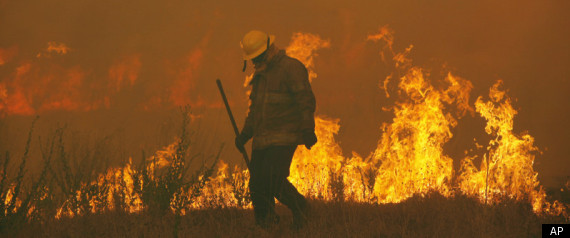
Rick Perry's Budget Leaves Texans In Bind Amidst Historic Wildfires 7SEP11& MSNBC host Rachel Maddow says Texas routinely receives more federal dollars than Texans pay in federal taxes 22APR11

I feel sorry for the people of Texas, especially for those who have lost loved ones to these horrible fires, as well as for those who have lost their homes and businesses. But I am also amazed at the gall exhibited by so many Texans who cheered on their governor when he ran his mouth about the secession of Texas from the Union and the evils about big government and excessive federal government spending, those Texans who support politicians who cut funding for state social safety net programs to leave the poor, the least among us struggling, worse of than ever before, those Texans who now look to the federal government for help because now they too are without homes and jobs, all they had is gone. And these Texans have the gall to expect the federal government that they despise, that they express so much hatred for, to provide for them. You may ask about the taxes Texas pays to the federal government. This from PolitiFact
In 2009, most states — there were 45, including Texas — received more than residents paid in taxes. Though no data is yet available, DeLuna Castro said Texas will again receive more than residents paid in taxes in 2010. But by 2011, when stimulus funds dry up, she speculated that Texas will revert to being a "donor state."
So Texas, how's that gop tea-bagger thingy workin out for you now? Is it giving you any hope??? This from HuffPost, and following that the article on the amount Texas pays and receives in federal tax dollars....

WASHINGTON -- As wildfires engulfed her Bastrop County, Texas, neighborhood on Sunday, Betty Dunkerley was forced to evacuate her home for safer ground. There were few options for shelter, she said. Only a middle school and a Catholic church had been opened up to evacuees, and the middle school were already crowded.
While seeking shelter, Dunkerley saw others who had been displaced -- families with nowhere to go and no support system in place to assist them. Some slept in parking lots, with kids sleeping in sleeping bags in truck beds alongside the family dog.
"A lot of people were trying to camp out," Dunkerley, a former Austin City Council member, told The Huffington Post.
The wildfires threatening Dunkerley and her neighbors are being met by an inadequately funded response team. Back in May, Texas Gov. Rick Perry (R) signed a budget presented by the state legislature that cut funding for the state agency in charge of combating such blazes.
The Texas Forest Service's funding was sliced from $117.7 million to $83 million. More devastating cuts hit the assistance grants to volunteer fire departments around the state. Those grants were slashed 55 percent from $30 million per year in 2010 and 2011 to $13.5 million per year in 2012 and 2013. Those cuts are effective now.
As of Tuesday, the Houston Chronicle reported that wildfires had consumed more than 33,000 acres in Bastrop County, clearing out 20 neighborhoods and claiming two lives. Fires had also sprung up in several counties outside of Houston, burning at least 7,000 acres. Aerial photos from the Bastrop blaze showed a huge smoke plume had drifted over Austin.
Dunkerley was lucky. She had a key to her church and was able to set up camp there. Her house was not among the 800 or so turned to ash. It had survived. But, she was told, her neighborhood had not. It looked like a "war zone."
Dunkerley had managed to flee with her three cats, a dress she planned to wear for an upcoming family wedding and little else. She said she doesn't know when she will be allowed back into her home.
"In hindsight, we should have all had a better plan on a personal level and a governmental level," she said. "All over central Texas you can have this repeated," she added. "Everything is a tinderbox."
Texas is currently facing its worst single-year drought on record, with agricultural losses topping $5 billion. Similar drought conditions and water rationing caused deadly fires that raged two years ago. Despite that history, Texas's governor and state lawmakers failed to make any allowances for wildfires this year.
Perry, who is now the frontrunner in the GOP presidential primary, returned home from the campaign trail to address the fires on Monday, the day after Dunkerley had been evacuated.
"I think our local state senator has been very visible," Dunkerley said. "Our county judge and our mayor in Bastrop have been very visible." She added that once Perry returned to Texas, "some of our state resources were showing up a little faster."
But the consequences of the cuts to firefighting funding remain evident.
"We were outvoted -- what can I say?" said Texas state Sen. Mario Gallegos (D), who voted against the state budget. "Obviously this money is needed for natural disasters like the ones we have right now."
"We do have a rainy day fund, and I would hope that the governor goes into the rainy day fund," he added. "But we have to also be responsible here locally, and cutting the Forest Service budget significantly was not being responsible."
Gallegos, who worked for 22 years in the Houston fire department, noted that outside major cities like Houston and Dallas, volunteer firefighters are the backbone of the Texas firefighting force.
"Out in the suburbs and in the woods, we have to count on our volunteers," he told HuffPost.
Analiese Kornely, executive director of the Perry watchdog group Back to Basics PAC, said that the governor had the money to fund volunteer fire department programs.
"[Budget writers] did actually have the $60 million needed to fund the program at 2010-2011 levels but did not use it," she said in an email. Instead, the volunteers took the 55 percent cut.
In Texas, volunteer firefighting programs receive state money through tax revenues set aside in a dedicated fund.
"We're all paying this money to a dedicated fund," said Jim Dunnam, a former state representative and current fellow at the Texas First Foundation. "And they're not spending the money because they need that money to offset their spending elsewhere." State officials, he said, "are telling people, 'You need to pay taxes for fire prevention,' and then [they] don't spend it. It's crazy."
Instead, the funds are left in a general account. "It is one of the gimmicks they used to balance the budget in Texas," Dunnam said. "[Perry's] good at flying back to Texas for a photo op," he added, "but over his tenure as governor, we've just had chronic neglect of basic things to allow Texas to move forward."
Robert Ryland, a democratic precinct chair in Elgin, a town located 18 miles north of Bastrop, called the decision to cut volunteer firefighter funds "horrible." He noted the area had endured wild fires in recent years, and drought conditions were already a big problem when the cuts came down.
"You're literally playing with fire," Ryland told HuffPost. "When you are talking about essential public services, those things to tend to be a third rail even in Texas. This is the first time in my memory that I've ever seen funding for that kind of thing tossed around or used as an accounting trick to keep their numbers where they wanted them, where Perry wanted them to be."
Bastrop has a small fire department, Ryland said, and the surrounding towns had volunteer forces. "These are truly volunteers, with other jobs and families," he explained. "Just having that available in small communities is a life line for a lot of folks. This is not something you should mess with."
It's not just the funding, but Perry himself who has been MIA during the wildfires, Ryland said. "He basically came down here and told us FEMA would be here on Wednesday," he said, "and then he took off."
Eva DeLuna, a budget analyst with the Center for Public Policy Priorities, told HuffPost the Texas state legislature almost always deals with natural disasters after the fact.
"We tend not to do prevention because we're the lowest-spending state in the country," DeLuna said. "We tend to deal with things once it’s an emergency." She cited creating firebreaks as one preventative measure fire departments could take if they had the resources.
"We know what we should do, but we just don't have the money to deal with it," she said, adding, "well we do -- we just don’t want to collect it in taxes.”
In an email to HuffPost, Texas state Sen. Kirk Watson (D) scolded his fellow lawmakers for failing to prepare for the wildfires.
"It would be refreshing to see those in control -- of the Capitol and of the budgeting process -- express as much concern about preventing these tragedies before they take place as they do after land, property and possessions of Texans are lost," he wrote.
"During the session, budget decisions are presented as little more than math problems," Watson continued. "They're presented as raw numbers, and the discussion ends as soon as those numbers balance -- or even just appear to balance, by any means necessary. Events such as these fires show these kinds of debates aren't just about numbers. They're about specific impacts on very real people and their lives."
Perry has berated the Obama administration for not approving quickly enough a request he put in to FEMA for federal funds to assist firefighting efforts in Texas.
"You see hundreds of thousands of acres of Texas burning and you know that there will soon be emergency declarations, and we did that now a couple of weeks ago, but still no response from this administration," he told local news radio station WOAI in an April interview. "There is a point in time where you say, hey, what's going on here," Perry added. "You have to ask why are you taking care of Alabama and other states? I know our letter didn't get lost in the mail."
But after complaining to the feds and conducting a statewide prayer for rain earlier this year, Perry appears to have shifted his focus to the 2012 election.
Recent polls showed Perry surging ahead of Mitt Romney and the rest of the GOP 2012 pack, with 29 percent of Republicans and Republican-leaning independents listing him as their first choice for the Republican nomination. His closest competitor, Romney, landed just 17 percent of respondents.
People in Texas, however, are not as convinced by Perry's performance. A survey conducted by Public Policy Polling found Perry trailing Obama 45 percent to 47 percent in Texas, which hasn't voted for a Democratic president since 1976. The June poll showed Perry's approval rating at just 43 percent. Another University of TexasTexas Tribune poll shows him doing considerably worse.
A call to Perry’s office Wednesday was not returned.


The Truth-O-Meter Says:
Maddow

Says Texas routinely gets "a lot more federal spending" than it pays in taxes.

Rachel Maddow on Tuesday, April 12th, 2011 in an episode of The Rachel Maddow Show.

MSNBC host Rachel Maddow says Texas routinely receives more federal dollars than Texans pay in federal taxes

After playing a 2009 video clip in which Republican Gov. Rick Perry touts states’ rights, MSNBC host Rachel Maddow suggested secession could hurt the Lone Star state’s bottom line.

"Many of these states flexing their 10th Amendment muscle, flexing their state sovereignty, even flirting with secession, states like Texas, Tennessee, South Carolina and Utah, one of these things about the states is that they all routinely get a lot more federal spending than they pay in taxes," she said on the April 12 edition of her weeknight show. A reader brought her comment to our attention.

Is Texas really getting more for less? To back up Maddow, MSNBC spokeswoman Lauren Skowronski pointed us to the most recent state-by-state analysis of federal tax burdens and spending by the Washington-based Tax Foundation, a business-backed tax policy group. It covers the 25-year period between 1981 and 2005.

According to the analysis, Texans paid about $147 billion in federal taxes in 2005 while the state received $149 billion in federal spending. That year, 33 other states also got, as Maddow put it, more money back than residents paid in.

The paid taxes included employment, estate and trust income taxes, among others. Federal spending in Texas includes funding for retirement and disability, grants (such as for research and construction), wages of federal employees and direct payments for programs such as Medicare.

On an annual basis, however, there were only six years in that time period when Texas residents paid fewer dollars in federal taxes than they got in return, according to the foundation.

And since 2005? For those numbers, Skowronski pointed us to the most recent federal tax data posted by the IRS and federal spending data from the U.S. Census Bureau.

In fiscal 2009, the IRS collected about $163 billion from Texans and the state received about $224 billion, for a net gain of $61 billion. Federal spending in Texas also exceeded tax payments in 2008 by $8 billion. It was the other way around in 2006 and 2007, when tax payments by Texans exceeded federal spending by a total of about $47 billion.

Eva DeLuna Castro, a budget analyst at Austin’s Center for Public Policy Priorities, which advocates for moderate- to low-income Texans, told us Texas started receiving more federal funds in the last decade because of an increase in military spending, tax cuts and tax credits and a modest growth in federal health spending — not to mention a spike in social services and aid every time a hurricane hit.

"Texas is definitely getting back way more than people in Texas are paying in taxes," she said. "So do a lot of other states. Texas isn’t unique in that."

In 2009, most states — there were 45, including Texas — received more than residents paid in taxes. Though no data is yet available, DeLuna Castro said Texas will again receive more than residents paid in taxes in 2010. But by 2011, when stimulus funds dry up, she speculated that Texas will revert to being a "donor state."

Summing up: The figures from our sources show two different trends. On an annual basis between 1981 and 2003, Texas almost always paid more in federal taxes than it got back from Uncle Sam. But since 2003 the reverse has been true, with Texas receiving more than it paid in five out of seven years, which is close to routine.

We rate Maddow’s statement as Mostly True.
About this statement:
Published: Friday, April 22nd, 2011 at 6:00 a.m.
Subjects: Federal Budget, Taxes
Sources:
MSNBC,The Rachel Maddow Show transcriptfor April 12, 2011

Tax Foundation,Federal tax burdens and expenditures by state, March 16, 2006

National Association of State Budget Officers, Fiscal year 2009 state expenditure report, published fall 2010

Tax Foundation, Federal taxes paid vs. federal spending received by state, 1981-2005, Oct. 19, 2007

Tax Foundation, Federal spending received per dollar of taxes paid by state, 2005, Oct. 9, 2007

Tax Foundation, Special report: Federal tax burdens and expenditures by state, March 2006

U.S. Census Bureau, Consolidated federal funds report for fiscal year 2009, issued August 2010

U.S. Census Bureau, Consolidated federal funds report for fiscal year 2008, issued July 2009

U.S. Census Bureau, Consolidated federal funds report for fiscal year 2007, issued September 2008

U.S. Census Bureau, Consolidated federal funds report for fiscal year 2006, revised September 2008

U.S. Census Bureau, Consolidated federal funds report for fiscal year, issued

Why do Red States vote Republican while Blue States pay the bills?, by Dean Lacy, presented at the Annual meeting of the American Political Science Association, Sept. 3-6, 2009

Tax Law Review, Rich states, poor states: Assessing the design and effect of a U.S. fiscal equalization regime, by Kirk Stark, 2010

Interview with Curtis Dubay, senior tax policy analyst, Heritage Foundation, April 18, 2011

Interview with Richard Morrison,  manager of communications, Tax Foundation, April 18, 2011

E-mail interview with Dale Craymer, president, Texas Taxpayers and Research Association, April 18, 2011

Interview with Eva DeLuna Castro, senior budget analyst, Center for Public Policy Priorities, April 18, 2011

E-mail interview with Lauren Skowronski, director of media relations, MSNBC, April 19, 2011

E-mail interview with Dean Lacy, government professor, Dartmouth College, April 18, 2011

E-mail interview with Kirk Stark, law professor, University of California, Los Angeles, April 19, 2011
Written by: Ciara O'Rourke
Researched by: Ciara O'Rourke
Edited by: W. Gardner Selby