NORTON META TAG

Showing posts with label secession. Show all posts

23 September 2014

These Are the Regions Where Americans Are Most Likely to Favor Secession & These Places Really, Really Want to Secede From Their States 23SEP14&7NOV13

INTERESTING, and of all the places I'd have no problem saying good-bye to it would be Texas. There is just something about that state. I have family I love there, have been all over the state, but there are a lot of really ignorant people in Texas, a lot of really ignorant laws and policies and there seems to be an underlying simmering of right wing racist fanaticism just waiting to explode. I could see Texas becoming the "christian sharia" center of the Western Hemisphere. Oh well, just my ramblings. Check this out from +Mother Jones .....
| Tue Sep. 23, 2014 1:40 PM EDT

Inspired by the events surrounding the recent Scottish independence referendum, a new poll reveals an alarming number of Americans think a similar splintering of the union is a fine idea.
The poll, organized by Reuters, found that 23.9 percent of Americans would favor their state seceding from the rest of the country. Residents of the Southwest and the Rockies were the most likely to voice support, polling at 34 percent and 25 percent respectively. A plurality of would-be secessionists reported an annual income of $25,000 or less.
A shock to no one, more Republicans than Democrats want to break free.
Among reasons for secession, a disillusionment with Washington, coupled with a strong hatred for Obamacare ranked high. All this despite the fact these Americans are in need of healthcare expansion the most and studies continue to show states that have embraced the Affordable Care Act have seen the sharpest drop in uninsured rates.
Texas in particular, which has a history of secessionist sentiment and makes up a large portion of the Southwest, is the one determined state that might actually have a chance at surviving without the American whole. But let's keep in mind Texas has relied heavily on their much deplored Washington.
Turns out Texas was the state that depended the most on those very stimulus funds to plug nearly 97% of its shortfall for fiscal 2010, according to the National Conference of State Legislatures. Texas, which crafts a budget every two years, was facing a $6.6 billion shortfall for its 2010-2011 fiscal years. It plugged nearly all of that deficit with $6.4 billion in Recovery Act money, allowing it to leave its $9.1 billion rainy day fund untouched.
"Texas has everything we need. We have the manufacturing, we have the oil, and we don't need them," one Texan still told Reuters.
But don't be too concerned. The same poll found 53.3 percent understand secession is a no good, bad idea.

07 March 2014

Moscow Raises Pressure on West in Ukraine Crisis 7MAR14

I saw this as Russian aggression against Ukraine, but after reading and listening to an interview on TRNN (A Struggle Amongst Oligarchs in Ukraine Pt.1 7MAR14
http://bucknacktssordidtawdryblog.blogspot.com/2014/03/a-struggle-amongst-oligarchs-in-ukraine.html  ) I have a very different take on the story. Now I see it as the struggle by the common people of Ukraine against the corruption of the oligarchs that were ruling them in cooperation with the oligarchs controlling Russia with putin. putin's Russia and the corporate / bank-financial cabals of the West have escalated this from a national revolution holding out the promise of freedom and democracy to a dangerous geopolitical crisis. 


Continue reading the main story Video

Play Video
Video|2:39
Credit Sergey Ponomarev for The New York Times

In Crimea, Speaking out on Referendum

In Yalta and Simferopol, Crimean citizens spoke about the planned referendum on whether to break from Ukraine and join the Russian Federation.

MOSCOW — Leaders of both houses of Russia’s Parliament said on Friday that they would support a vote by Crimea to break away from Ukraine and become a new region of the Russian Federation, the first public signal that the Kremlin was backing the secessionist move that Ukraine, the United States and other countries have denounced as a violation of international law.
Russia also raised pressure on the financially stressed interim central government in Kiev, which Russia has refused to recognize since the pro-Kremlin former president, Viktor F. Yanukovych, fled last month. Gazprom, the Russian energy company that supplies Ukraine with gas, warned it might shut off exports unless Ukraine paid $1.89 billion that it owes. “We cannot deliver gas for free,” Russia news agencies quoted Gazprom’s chief executive Alexei Miller as saying.


Gazprom cut gas to Ukraine for nearly two weeks in January 2009, causing severe economic problems for Ukraine and European customers who depend on Gazprom supplies delivered via Ukraine pipelines.

Continue reading the main story Video

Play Video
Video|2:10
Credit Gabriella Demczuk/The New York Times

Obama Delivers Statement on Ukraine

President Obama said, “Any discussion about the future of Ukraine must include the legitimate government of Ukraine.”

Valentina I. Matviyenko, the chairwoman of the upper house, the Federation Council, compared the Crimea secession vote to a scheduled referendum in Scotland on whether to become independent from Britain, omitting the fact that London has agreed to the ballot. Ukraine’s new interim leaders have fiercely opposed splintering the country.
The speaker of the lower house, Sergei Y. Naryshkin, echoed Ms. Matviyenko’s remarks.
“We will respect the historic choice of the people of Crimea,” he said.
The remarks by the leaders, both close political allies of President Vladimir V. Putin, came a day after Crimea’s regional assembly voted behind closed doors to secede from Ukraine and to hold a referendum on March 16 for voters in the region to ratify the decision. On Friday a delegation of lawmakers from Crimea arrived in Moscow to lay the groundwork for joining Russia, winning strong endorsements from senior lawmakers.
“We admire your fortitude and courage,” Ms. Matviyenko told them, according to Interfax news agency. “Many threats have been made against you; there were threats of attacks, in particular, against the Black Sea Fleet, but you endured that and protected your people.”
In another telling sign of official Russian support for the Crimean referendum, delegation representatives were cheered at a “We are together” rally organized in central Moscow that was shown at length on state television, with songs and chants of “Russia, Moscow, Crimea.” News agencies quoted the police as saying the rally was attended 60,000 people.
The developments underscored how quickly the crisis was evolving. Only three days earlier, Mr. Putin said he did not foresee the possibility of Crimea becoming part of Russia, though he cited the independence of Kosovo as a precedent. “We will in no way provoke any such decision and will not breed such sentiments,” he said.
The Kremlin has not yet directly addressed the possibility of Crimea’s secession. Even if the referendum proceeds as planned and Crimea residents approve, it remains unclear what would happen next.
The move to break away from Ukraine was swiftly denounced by the fledgling national government in Kiev, which said it would invalidate the decision and dissolve the Crimean Parliament, and by President Obama in Washington, where the United States government on Thursday announced sanctions in response to Russia’s military occupation of the Crimean Peninsula.
“Any discussion about the future of Ukraine must include the legitimate government of Ukraine,” Mr. Obama said at the White House. “In 2014, we are well beyond the days when borders can be redrawn over the heads of democratic leaders.”
Hours after the United States announced the first punitive actions against specific Russians, Mr. Obama contacted Mr. Putin. The two leaders spoke for an hour by telephone and, according to the White House, Mr. Obama urged Mr. Putin to authorize direct talks with Ukraine’s new, pro-Western government, permit the entry of international monitors and return his forces to the bases that Russia leases in Crimea.
Early Friday, the Kremlin released a statement offering a starkly different account of the phone call, and emphasizing Russia’s view that the new government in Kiev is illegitimate.


“In the course of the discussion there emerged differences in approaches and assessments of the causes which brought about the current crisis and the resulting state of affairs,” the statement said. “Vladimir Putin, for his part, noted that this had occurred as a result of an anti-constitutional coup, which does not have a national mandate.”
The Kremlin went on to say that the current Ukrainian leadership had imposed “absolutely illegitimate decisions” on the eastern and southeastern regions of the country. “Russia cannot ignore appeals connected to this, calls for help, and acts appropriately, in accordance with international law,” the statement said.
Mr. Putin, the statement said, appreciated the importance of the Russian-American relationship to global security, and added that bilateral ties “should not be sacrificed for individual — albeit rather important — international problems.”
In Kiev, the leader of the Right Sector movement, Dmytro Yarosh, will run for president of Ukraine, the chairman of the local branch of the movement, Andriy Tarasenko, said on Friday. The nationalist group, which was important in the fight for Kiev’s Independence Square, will rename itself at a congress in a week and participate in elections at all levels, Mr. Tarasenko said.
Right Sector has been controversial for its semi-military organization, but it has also refrained from working in eastern Ukraine, where its presence could be seen as a provocation by Russia. But Mr. Tarasenko said that the group was prepared to fight, in Crimea and elsewhere, “if the Kremlin tramples on us further.” He added, “Accordingly, we are conducting mobilization and are preparing to repel foreign aggression.”
Arseniy P. Yatsenyuk, the interim prime minister of Ukraine, said on Friday that he had requested a second telephone conversation with the Russian prime minister, Dmitri A. Medvedev. The two men last spoke on Saturday, which was the only high-level contact between Moscow and the new authorities in Kiev.
Ukraine is ready for talks with Russia, Mr. Yatsenyuk said, but Moscow must first withdraw its troops, abide by international agreements and halt its support for “separatists and terrorists in Crimea.” He repeated Ukraine’s position that a referendum in Crimea is both illegal and unconstitutional. “No one in the civilized world will recognize the results of a so-called referendum carried out by these so-called authorities,” Mr. Yatsenyuk said.
With Washington and Moscow trading angry accusations of hypocrisy on the issue of respecting state sovereignty, validating Crimea’s secession would carry pointed political risks for Mr. Putin, given longstanding demands for independence from Russia by its own similarly autonomous republics in the Caucasus, including Dagestan and Chechnya.
Michael A. McFaul, the former American ambassador to Russia, noted the parallel in a sharp post on Twitter. “If Russian government endorses Crimean referendum,” Mr. McFaul wrote, using abbreviations needed for a 140-character limit, “will they also allow/endorse similar votes in republics in the Russian Federation?”
The West, which has insisted that the Ukrainian people are entitled to decide their future without interference from Russia, faces similar challenges as it seeks to explain why the people of Crimea should not necessarily decide their own fate.
The United States and its European allies typically support self-determination but have opposed independence for regions in their own borders, like Scotland from Britain or Catalonia from Spain.
There was no sign on Friday that Russian armed forces were relaxing their tight clench on the Crimean peninsula, with military bases surrounded and border crossings under strict control. For the second consecutive day, an observer mission from the Organization for Security and Co-operation in Europe, the 57-member organization that includes both Ukraine and Russia, was prevented from entering Crimea at a checkpoint blocked by armed men.

Photo

Pro-Russia protesters got off a police bus in Donetsk, in eastern Ukraine, on Thursday and were greeted by supporters, who had forced the police to release them. Credit Uriel Sinai for The New York Times

On Thursday, international diplomats raced from meeting to meeting in an effort to end the standoff. European leaders signaled they might join American sanctions and Moscow threatened countermeasures as an already tense situation was made edgier by the start of new Russian military drills.
European Union leaders issued a statement in Brussels calling an annexation referendum “contrary to the Ukrainian Constitution and therefore illegal.”
In Kiev, the acting president of Ukraine, Oleksandr V. Turchynov, said Thursday that the national government would invalidate the decision to hold the referendum and would dissolve the Crimean Parliament. Crimea, part of Ukraine since 1954, has enjoyed substantial autonomy since shortly after the collapse of the Soviet Union, but the region’s Constitution generally defers to the national Ukrainian Constitution on jurisdictional matters.
Mr. Turchynov scoffed at the plan for a referendum, noting that Russian forces had taken control of Crimea’s borders and ports and were blocking Ukrainian military bases and occupying other security installations. “This will be a farce,” he said in a televised address. “This will be false. This will be a crime against the state.” He insisted that Ukraine would “protect the sanctity of our territory.”
Officials in Kiev had already declared the Crimean Parliament to be acting illegally, and a court issued an arrest warrant for Sergei Aksyonov, the leader of the breakaway effort, who was installed as prime minister of Crimea after armed men seized the Parliament building last week.
Leaders of the peninsula’s large Crimean Tatar minority also denounced the move. “Today’s decision by the Parliament is completely illegal,” said Refat Chubarov, the leader of the main Tatar organization and a member of Parliament. He refused to take part in the parliamentary voting on Thursday because he said it was illegitimate.
“More troubling for us is that this decision could provoke and lead to further escalation of tensions,” Mr. Chubarov said in an interview. “A referendum under the conditions of the presence of foreign troops on the streets is called something entirely different in world practice — it’s a coup. It’s the seizure of territory.”
The sanctions Mr. Obama approved Thursday imposed visa bans on officials and other individuals deemed responsible for undermining Ukrainian sovereignty and territorial integrity. The administration would not disclose the names or number of people penalized, but a senior official said privately that it would affect just under a dozen people, mostly Russians but some of them Ukrainian.
Among those targeted were political figures, policy advisers, security officials and military officers who played a direct role in the Crimean crisis, the official said. Any of them seeking to travel to the United States would be barred, and a few who currently hold American visas will have them revoked.
Mr. Obama also signed an executive order laying out a framework for tougher measures like freezing the assets of individuals and institutions. But the White House refrained from applying those measures while officials gathered evidence in the hope that waiting would provide some space for Russia to reverse course. The House, in the meantime, approved an economic aid package for the Kiev government and advanced its own sanctions resolution.
Moscow, however, gave no indication that it would back down, suggesting that it would reciprocate with measures seizing American property in Russia. “The U.S. has the right, and we have the right to respond to it,” Vladimir Lukin, a Russian envoy who has worked on the Ukrainian crisis, told Interfax, a Russian news agency. “But all that is, of course, not making me happy.”
The European Union took a step toward more serious measures by suspending talks with Moscow on a wide-ranging political-economic pact and on liberalizing visa requirements to make it easier for Russians to travel to Europe. European leaders laid out a three-stage process that, absent progress, would next move to travel bans, asset seizures and the cancellation of a planned European Union-Russia summit meeting and eventually to broader economic measures.
Chancellor Angela Merkel of Germany, who has been reluctant to move quickly toward sanctions, said the European Union was looking for concrete evidence that Russia was trying to calm the situation “in the next few days,” but she noted that Thursday’s events in Crimea made the need for action more urgent.
“We made it very clear that we are absolutely willing to achieve matters by negotiation,” she said. “We also say, however, that we are ready and willing, if these hopes were to be dashed and looking at what happened on Crimea, to adopt sanctions.”

08 September 2011

Rick Perry's Budget Leaves Texans In Bind Amidst Historic Wildfires 7SEP11& MSNBC host Rachel Maddow says Texas routinely receives more federal dollars than Texans pay in federal taxes 22APR11

I feel sorry for the people of Texas, especially for those who have lost loved ones to these horrible fires, as well as for those who have lost their homes and businesses. But I am also amazed at the gall exhibited by so many Texans who cheered on their governor when he ran his mouth about the secession of Texas from the Union and the evils about big government and excessive federal government spending, those Texans who support politicians who cut funding for state social safety net programs to leave the poor, the least among us struggling, worse of than ever before, those Texans who now look to the federal government for help because now they too are without homes and jobs, all they had is gone. And these Texans have the gall to expect the federal government that they despise, that they express so much hatred for, to provide for them. You may ask about the taxes Texas pays to the federal government. This from PolitiFact
In 2009, most states — there were 45, including Texas — received more than residents paid in taxes. Though no data is yet available, DeLuna Castro said Texas will again receive more than residents paid in taxes in 2010. But by 2011, when stimulus funds dry up, she speculated that Texas will revert to being a "donor state."
So Texas, how's that gop tea-bagger thingy workin out for you now? Is it giving you any hope??? This from HuffPost, and following that the article on the amount Texas pays and receives in federal tax dollars....

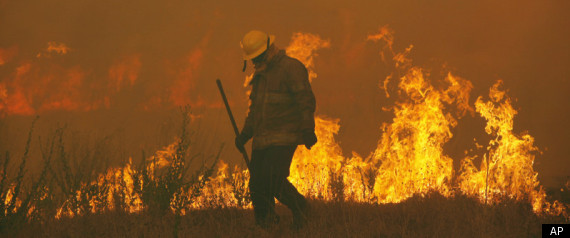
WASHINGTON -- As wildfires engulfed her Bastrop County, Texas, neighborhood on Sunday, Betty Dunkerley was forced to evacuate her home for safer ground. There were few options for shelter, she said. Only a middle school and a Catholic church had been opened up to evacuees, and the middle school were already crowded.
While seeking shelter, Dunkerley saw others who had been displaced -- families with nowhere to go and no support system in place to assist them. Some slept in parking lots, with kids sleeping in sleeping bags in truck beds alongside the family dog.
"A lot of people were trying to camp out," Dunkerley, a former Austin City Council member, told The Huffington Post.
The wildfires threatening Dunkerley and her neighbors are being met by an inadequately funded response team. Back in May, Texas Gov. Rick Perry (R) signed a budget presented by the state legislature that cut funding for the state agency in charge of combating such blazes.
The Texas Forest Service's funding was sliced from $117.7 million to $83 million. More devastating cuts hit the assistance grants to volunteer fire departments around the state. Those grants were slashed 55 percent from $30 million per year in 2010 and 2011 to $13.5 million per year in 2012 and 2013. Those cuts are effective now.
As of Tuesday, the Houston Chronicle reported that wildfires had consumed more than 33,000 acres in Bastrop County, clearing out 20 neighborhoods and claiming two lives. Fires had also sprung up in several counties outside of Houston, burning at least 7,000 acres. Aerial photos from the Bastrop blaze showed a huge smoke plume had drifted over Austin.
Dunkerley was lucky. She had a key to her church and was able to set up camp there. Her house was not among the 800 or so turned to ash. It had survived. But, she was told, her neighborhood had not. It looked like a "war zone."
Dunkerley had managed to flee with her three cats, a dress she planned to wear for an upcoming family wedding and little else. She said she doesn't know when she will be allowed back into her home.
"In hindsight, we should have all had a better plan on a personal level and a governmental level," she said. "All over central Texas you can have this repeated," she added. "Everything is a tinderbox."
Texas is currently facing its worst single-year drought on record, with agricultural losses topping $5 billion. Similar drought conditions and water rationing caused deadly fires that raged two years ago. Despite that history, Texas's governor and state lawmakers failed to make any allowances for wildfires this year.
Perry, who is now the frontrunner in the GOP presidential primary, returned home from the campaign trail to address the fires on Monday, the day after Dunkerley had been evacuated.
"I think our local state senator has been very visible," Dunkerley said. "Our county judge and our mayor in Bastrop have been very visible." She added that once Perry returned to Texas, "some of our state resources were showing up a little faster."
But the consequences of the cuts to firefighting funding remain evident.
"We were outvoted -- what can I say?" said Texas state Sen. Mario Gallegos (D), who voted against the state budget. "Obviously this money is needed for natural disasters like the ones we have right now."
"We do have a rainy day fund, and I would hope that the governor goes into the rainy day fund," he added. "But we have to also be responsible here locally, and cutting the Forest Service budget significantly was not being responsible."
Gallegos, who worked for 22 years in the Houston fire department, noted that outside major cities like Houston and Dallas, volunteer firefighters are the backbone of the Texas firefighting force.
"Out in the suburbs and in the woods, we have to count on our volunteers," he told HuffPost.
Analiese Kornely, executive director of the Perry watchdog group Back to Basics PAC, said that the governor had the money to fund volunteer fire department programs.
"[Budget writers] did actually have the $60 million needed to fund the program at 2010-2011 levels but did not use it," she said in an email. Instead, the volunteers took the 55 percent cut.
In Texas, volunteer firefighting programs receive state money through tax revenues set aside in a dedicated fund.
"We're all paying this money to a dedicated fund," said Jim Dunnam, a former state representative and current fellow at the Texas First Foundation. "And they're not spending the money because they need that money to offset their spending elsewhere." State officials, he said, "are telling people, 'You need to pay taxes for fire prevention,' and then [they] don't spend it. It's crazy."
Instead, the funds are left in a general account. "It is one of the gimmicks they used to balance the budget in Texas," Dunnam said. "[Perry's] good at flying back to Texas for a photo op," he added, "but over his tenure as governor, we've just had chronic neglect of basic things to allow Texas to move forward."
Robert Ryland, a democratic precinct chair in Elgin, a town located 18 miles north of Bastrop, called the decision to cut volunteer firefighter funds "horrible." He noted the area had endured wild fires in recent years, and drought conditions were already a big problem when the cuts came down.
"You're literally playing with fire," Ryland told HuffPost. "When you are talking about essential public services, those things to tend to be a third rail even in Texas. This is the first time in my memory that I've ever seen funding for that kind of thing tossed around or used as an accounting trick to keep their numbers where they wanted them, where Perry wanted them to be."
Bastrop has a small fire department, Ryland said, and the surrounding towns had volunteer forces. "These are truly volunteers, with other jobs and families," he explained. "Just having that available in small communities is a life line for a lot of folks. This is not something you should mess with."
It's not just the funding, but Perry himself who has been MIA during the wildfires, Ryland said. "He basically came down here and told us FEMA would be here on Wednesday," he said, "and then he took off."
Eva DeLuna, a budget analyst with the Center for Public Policy Priorities, told HuffPost the Texas state legislature almost always deals with natural disasters after the fact.
"We tend not to do prevention because we're the lowest-spending state in the country," DeLuna said. "We tend to deal with things once it’s an emergency." She cited creating firebreaks as one preventative measure fire departments could take if they had the resources.
"We know what we should do, but we just don't have the money to deal with it," she said, adding, "well we do -- we just don’t want to collect it in taxes.”
In an email to HuffPost, Texas state Sen. Kirk Watson (D) scolded his fellow lawmakers for failing to prepare for the wildfires.
"It would be refreshing to see those in control -- of the Capitol and of the budgeting process -- express as much concern about preventing these tragedies before they take place as they do after land, property and possessions of Texans are lost," he wrote.
"During the session, budget decisions are presented as little more than math problems," Watson continued. "They're presented as raw numbers, and the discussion ends as soon as those numbers balance -- or even just appear to balance, by any means necessary. Events such as these fires show these kinds of debates aren't just about numbers. They're about specific impacts on very real people and their lives."
Perry has berated the Obama administration for not approving quickly enough a request he put in to FEMA for federal funds to assist firefighting efforts in Texas.
"You see hundreds of thousands of acres of Texas burning and you know that there will soon be emergency declarations, and we did that now a couple of weeks ago, but still no response from this administration," he told local news radio station WOAI in an April interview. "There is a point in time where you say, hey, what's going on here," Perry added. "You have to ask why are you taking care of Alabama and other states? I know our letter didn't get lost in the mail."
But after complaining to the feds and conducting a statewide prayer for rain earlier this year, Perry appears to have shifted his focus to the 2012 election.
Recent polls showed Perry surging ahead of Mitt Romney and the rest of the GOP 2012 pack, with 29 percent of Republicans and Republican-leaning independents listing him as their first choice for the Republican nomination. His closest competitor, Romney, landed just 17 percent of respondents.
People in Texas, however, are not as convinced by Perry's performance. A survey conducted by Public Policy Polling found Perry trailing Obama 45 percent to 47 percent in Texas, which hasn't voted for a Democratic president since 1976. The June poll showed Perry's approval rating at just 43 percent. Another University of TexasTexas Tribune poll shows him doing considerably worse.
A call to Perry’s office Wednesday was not returned.


The Truth-O-Meter Says:
Maddow

Says Texas routinely gets "a lot more federal spending" than it pays in taxes.

Rachel Maddow on Tuesday, April 12th, 2011 in an episode of The Rachel Maddow Show.

MSNBC host Rachel Maddow says Texas routinely receives more federal dollars than Texans pay in federal taxes

After playing a 2009 video clip in which Republican Gov. Rick Perry touts states’ rights, MSNBC host Rachel Maddow suggested secession could hurt the Lone Star state’s bottom line.

"Many of these states flexing their 10th Amendment muscle, flexing their state sovereignty, even flirting with secession, states like Texas, Tennessee, South Carolina and Utah, one of these things about the states is that they all routinely get a lot more federal spending than they pay in taxes," she said on the April 12 edition of her weeknight show. A reader brought her comment to our attention.

Is Texas really getting more for less? To back up Maddow, MSNBC spokeswoman Lauren Skowronski pointed us to the most recent state-by-state analysis of federal tax burdens and spending by the Washington-based Tax Foundation, a business-backed tax policy group. It covers the 25-year period between 1981 and 2005.

According to the analysis, Texans paid about $147 billion in federal taxes in 2005 while the state received $149 billion in federal spending. That year, 33 other states also got, as Maddow put it, more money back than residents paid in.

The paid taxes included employment, estate and trust income taxes, among others. Federal spending in Texas includes funding for retirement and disability, grants (such as for research and construction), wages of federal employees and direct payments for programs such as Medicare.

On an annual basis, however, there were only six years in that time period when Texas residents paid fewer dollars in federal taxes than they got in return, according to the foundation.

And since 2005? For those numbers, Skowronski pointed us to the most recent federal tax data posted by the IRS and federal spending data from the U.S. Census Bureau.

In fiscal 2009, the IRS collected about $163 billion from Texans and the state received about $224 billion, for a net gain of $61 billion. Federal spending in Texas also exceeded tax payments in 2008 by $8 billion. It was the other way around in 2006 and 2007, when tax payments by Texans exceeded federal spending by a total of about $47 billion.

Eva DeLuna Castro, a budget analyst at Austin’s Center for Public Policy Priorities, which advocates for moderate- to low-income Texans, told us Texas started receiving more federal funds in the last decade because of an increase in military spending, tax cuts and tax credits and a modest growth in federal health spending — not to mention a spike in social services and aid every time a hurricane hit.

"Texas is definitely getting back way more than people in Texas are paying in taxes," she said. "So do a lot of other states. Texas isn’t unique in that."

In 2009, most states — there were 45, including Texas — received more than residents paid in taxes. Though no data is yet available, DeLuna Castro said Texas will again receive more than residents paid in taxes in 2010. But by 2011, when stimulus funds dry up, she speculated that Texas will revert to being a "donor state."

Summing up: The figures from our sources show two different trends. On an annual basis between 1981 and 2003, Texas almost always paid more in federal taxes than it got back from Uncle Sam. But since 2003 the reverse has been true, with Texas receiving more than it paid in five out of seven years, which is close to routine.

We rate Maddow’s statement as Mostly True.
About this statement:
Published: Friday, April 22nd, 2011 at 6:00 a.m.
Subjects: Federal Budget, Taxes
Sources:
MSNBC,The Rachel Maddow Show transcriptfor April 12, 2011

Tax Foundation,Federal tax burdens and expenditures by state, March 16, 2006

National Association of State Budget Officers, Fiscal year 2009 state expenditure report, published fall 2010

Tax Foundation, Federal taxes paid vs. federal spending received by state, 1981-2005, Oct. 19, 2007

Tax Foundation, Federal spending received per dollar of taxes paid by state, 2005, Oct. 9, 2007

Tax Foundation, Special report: Federal tax burdens and expenditures by state, March 2006

U.S. Census Bureau, Consolidated federal funds report for fiscal year 2009, issued August 2010

U.S. Census Bureau, Consolidated federal funds report for fiscal year 2008, issued July 2009

U.S. Census Bureau, Consolidated federal funds report for fiscal year 2007, issued September 2008

U.S. Census Bureau, Consolidated federal funds report for fiscal year 2006, revised September 2008

U.S. Census Bureau, Consolidated federal funds report for fiscal year, issued

Why do Red States vote Republican while Blue States pay the bills?, by Dean Lacy, presented at the Annual meeting of the American Political Science Association, Sept. 3-6, 2009

Tax Law Review, Rich states, poor states: Assessing the design and effect of a U.S. fiscal equalization regime, by Kirk Stark, 2010

Interview with Curtis Dubay, senior tax policy analyst, Heritage Foundation, April 18, 2011

Interview with Richard Morrison,  manager of communications, Tax Foundation, April 18, 2011

E-mail interview with Dale Craymer, president, Texas Taxpayers and Research Association, April 18, 2011

Interview with Eva DeLuna Castro, senior budget analyst, Center for Public Policy Priorities, April 18, 2011

E-mail interview with Lauren Skowronski, director of media relations, MSNBC, April 19, 2011

E-mail interview with Dean Lacy, government professor, Dartmouth College, April 18, 2011

E-mail interview with Kirk Stark, law professor, University of California, Los Angeles, April 19, 2011
Written by: Ciara O'Rourke
Researched by: Ciara O'Rourke
Edited by: W. Gardner Selby