BUCKNACKT'S SORDID TAWDRY BLOG We should not be a journey to the grave with the intention of arriving safely in an attractive & well preserved body, but rather to skid in sideways, chocolate, bier or wein in hand, body thoroughly used up, totally worn out and screaming "WHOO-HOO, WHAT A RIDE!!!!!!"
WHEN I turned 18 and registered to vote in Pennsylvania I registered as a Socialist, not just because I was against the military-industrial complex, war and American imperialism. I registered as a Socialist because of my faith. I was confirmed in the United Methodist Church and believed (and still do) in the teachings of Jesus Christ and was and am still inspired by the Beatitudes. I think the Beatitudes are the inspiration for secularism's attempts to address the inequalities in income, housing, education, health care, nutrition, child care and whatever other obstacles cause harm to others in our communities. The gop / greed over people-republican party never was and is not interested in the teachings of Jesus, and the Democratic party never agreed and will never agree to totally implementing the teachings of Jesus to guide their governing. I am still a Christian and a Socialist though I am a registered Democrat just so I can more fully participate in the democratic process of our political system. This from Sojourners......
This interview is part of The Reconstruct, a weekly newsletter from Sojourners. In a world where so much needs to change, Mitchell Atencio and Josiah R. Daniels interview people who have faith in a new future and are working toward repair. Subscribe here.
26 November 2024
Back when X was called Twitter, and back when I had social media, I met Andrew Wilkes. I had read some of Wilkes’ writings on Black radicalism and capitalism, and immediately decided he was someone worth following. Not only was he writing on topics that occupied a major preoccupation of my own, but he was also a Black Christian.
While I think it is largely a myth that leftist politics is primarily a “white space” (whatever that means), I think it’s fair to say that Black Christian leftists are a rarity. So when I discovered Wilkes, I made a commitment to follow his work.
Far from being some theorist in an ebony tower, Wilkes is both a thinker and a doer. Wilkes recently completed his doctorate in political science at The City University of New York; he co-pastors the Double Love Experience Church in Brooklyn with his wife, Rev. Gabby Cudjoe-Wilkes; he has written one book with Rev. Cudjoe-Wilkes about Psalms for Black Lives; and he’s written another book about how Black radicals can help us imagine an economy outside of a scarcity mindset.
Wilkes is the co-chair of the board for the Institute for Christian Socialism, an organization committed to awakening “among followers of Jesus an awareness of and commitment to the socialism that is inherent to the Gospel.” I first heard of ICS and its publishing outlet, The Bias, after interacting with Wilkes on Twitter. In fact, I even became a dues-paying member and participated in a 2022 base society — which was ostensibly a small group dedicated to reading leftist Christian literature. However, due to a lack of transparency around organizational changes, I ended up suspending my membership. I spoke with Wilkes about this and asked what ICS has done to improve transparency with its members.
In my conversation with Wilkes, we talked about the 2024 election, the difficulties in organizing the Christian left, and his new book, Plenty Good Room.
This interview has been edited for length and clarity.
Josiah R. Daniels, Sojourners: Who are you and what do you do?
Andrew Wilkes: I describe myself as a pastor, as a political scientist, as a writer, and as someone who tries to bring a bit of a contemplative spirit to both of those things.
And I think the hunger for love, for justice, [wondering] how else could we organize society ... is connected to the question of peace and calm in one’s interior life. And when you have regimes of austerity and injustice, it disfigures us on the inside as well as globally.
Tell me about your book, Plenty Good Room.
Plenty Good Room is grounded in the Black church tradition and a saying [that can be interpreted] in two ways: There’s “plenty of good room for all at the foot of the cross” and there’s “plenty of good room for all in God’s kin-dom.”
What I’m particularly pushing against in the book is scarcity. I’m attempting to push back against scarcity and austerity not only in our politics and economics but also within social justice communities.
I’m trying to make the case for what solidarity economics at scale looks like while being in deep conversation with the Black radical tradition.
Say a bit more about what you mean when it comes to a scarcity mindset in social justice communities.
In some social justice and “beloved community” spaces we miss that sense of having a deep emphasis on universal basic income, federal job guarantees, and public banks. These are not things that are supplemental or nice to have, they should be at the core of what we’re praying for and pushing for.
So, sometimes social justice movements simply settle for what’s possible?
I think that’s very much it. And, when we talk about a vision of public health and a “cooperative commonwealth,” as W.E.B. Du Bois called it, it points us in the direction of what’s doable and what’s desirable.
We should be pushing the horizon of what collective action is actually trying to accomplish. If you had the resources, if you had the numbers behind you, what would you do with them? I think that helps us to articulate a more compelling narrative.
[For example], if the goal is simply kinder, gentler policing and not public health, then we end up making concessions and missing the connections between the carceral impulse not only in neighborhoods but in schools and on college campuses and in foreign policy. Whereas, if something like public health or cooperative commonwealth and a robust sense of abundant life is the kind of benchmark against which we’re assessing policy and politics, I think it helps us to see what we’re after in a much more humane register.
Tell me about the Double Love Experience Church, which you co-pastor with your wife, Rev. Gabby Cudjoe-Wilkes. Why are you still committed to church?
The church is in Bed-Stuy, Brooklyn. [We are a part of the] Progressive National Baptist Convention — [Martin Luther King Jr.’s] denomination. So the PNBC, at its best, has this legacy of braiding social justice and the “religion of Jesus,” as Howard Thurman would put it. But the other interesting thing is that our church is housed in Bedford-Stuyvesant Restoration Corporation, known locally as “Restoration Plaza.” Which is, by some accounts, the nation’s first community development corporation.
[The plaza] exists because the Community Coordinating Council got together with then-Senator Robert F. Kennedy, and there was a bit of pushing and pulling, but ultimately it continues to be something that makes a huge difference in the community. [In 1966, Kennedy toured Bedford-Stuyvesant with community leaders who criticized the senator about speeches and empty promises. This inspired Kennedy to work together with activists and local politicians to launch a development plan for the Bedford-Stuyvesant neighborhood that would combine “the best of community action with the best of the private enterprise system.”]
For instance, during the week the Brooklyn NAACP meets in the same place where we meet for worship on Sundays. The National Council of Negro Women meets in the same multipurpose room. And we’ve had the Brooklyn NAACP president join us for worship and talk about some of that work. And so the notion of weaving together all of these different organizations is what Gabby and I, along with our congregation, are really excited about trying to curate and bring forth in the world.
I think co-pastoring speaks to possibilities of interpersonal power sharing and deliberation. It’s not concentrating on any one figure. I think seeing shared stewardship of decision making points to a different way to organize church.
I think the peace traditions of the church are, for me, what makes the church radical. Not simply peace as in the absence of military violence and police violence, but peace in the sense of relations that do away with predation and allow for a kind of unusual belonging — we see this in the lion laying down with the lamb.
Predation is something we need to get beyond. We need to move toward a space of belonging and interdependence. This is a thicker vision of peace that underpins the push in our politics and economics and even intimate friendships and partner relationships. For me the urge toward peace and the end of predation is what excites me about pastoring.
What do you think about the suggestion that people voted for Trump because of economic anxieties?
I’d approach it this way: The idea that people voted for Trump because of inflation concerns — the price of milk, eggs, housing, gas — I think that’s partly right. I think the post-election call is for class plus [identity] politics and class plus faith.
Some have pushed back saying, “We need to talk about class and not identity politics,” but that misses the opportunity. Class shouldn’t be something that we separate and divorce from the rest of our lived experiences; [it is] very much at the center of the multiple dimensions that shape who we are and how we show up together and hopefully achieve something like solidarity.
Tell me about the Institute for Christian Socialism. How do you organize the Christian Left?
I think the ICS takes the connection between Jesus and Mary’s vision very seriously. Jesus tells us that the gospel is about good news to the poor and announcing the acceptable year of the Lord’s favor.
But Jesus gets this from his mother. Mary’s Magnificat talks about, “The mighty being dethroned,” “those who are made to be lowly and humble are exalted,” “the rich are sent away empty,” and “the hungry are filled with good things.”
I think those two points of inspiration are the counterpoint to racial capitalism and imperial ways of organizing society, and so I think socialism is a much better approximation of the kin-dom of God than capitalism. We are trying to put that point squarely before folks through [our online magazine] The Bias, through base societies, and small groups where people come together and explore what community, identity, and story look like beyond some of the handed-down scripts of Christianity. I think ICS, along with many other organizations that are already doing this work, are pointing to a different way of imagining Christian presence on the Left. I see folks moving beyond individual pockets of discontent and disillusionment to build something together.
But I think it’s an uphill battle in the U.S. and abroad for folks trying to organize for a more equitable, just, and inclusive way of organizing our politics and economics. How do we deal with dissent and dissonance in a way that honors people’s humanity while also trying to push the ball forward for the liberation of the world?
Full disclosure: I participated in the base societies when they first launched and then there was a bit of organizational upheaval that ensued, and I was dissatisfied with ICS’ lack of transparency. How has ICS worked to become more transparent?
We had a series of forthright conversations with folks through Discord and other means about some of the challenges that ICS was going through.
I think we’ve emerged from those challenges over the past 12-16 months. You are not the only one who has shared that concern. It took conversations with the board and members to figure out how to build deeper trust.
How can we build a deeper base of decision making together? I certainly wouldn’t suggest it’s something that has reached a perfect place, but I think we have made some strong strides and have had multiple rounds of frank conversations that were really key to repairing trust. This has been an explicit step to remove some of what may have been experienced as asymmetry or non-transparency.
What do you do with the mad you feel?
I think the arts provide a space to feel through the things that can’t be talked through. I think there’s a point in which arguments and movements, if they don’t turn to the arts, if they don’t turn to freedom dreams, then we miss the opportunity to speak to right and left brains, to the entirety of our individuality, and our fullest selves.
For me, a song that has always been embedded in my memory is a song from Solange and Lil Wayne called “Mad.” And [the interlude is] Solange’s father talking about all of the racism that he experienced early in his life and how he just was eaten up in some ways by the mad that he felt. And Solange talks about how you “have the right to be mad.”
Some of it is just knowing that someone experienced anger like I did for similar sorts of reasons. Some of it is allowing the music to soothe me, to calm me, to relax me. Some of it is I think anger — rage — is informative. Audre Lorde talks a lot about that.
But also I think anger or rage clarifies, motivates, and keeps me in touch with the very human sense of the work. The first eulogy I did was for a 20-something who passed not because the Lord called him home but because of an inequitable health care system where he couldn’t afford insurance. That made me incredibly upset. Still does. So some of the mad I feel helps to foster the push for a more beautiful, more just, more fair society.

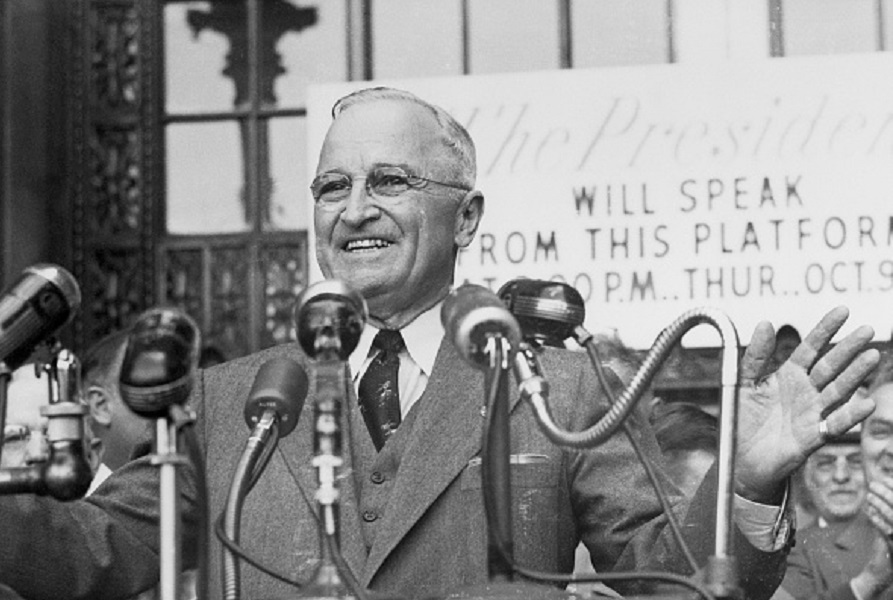
President Truman denounced the use of "socialism" as a "scare word ... for almost anything that helps all the people."

In early 2019, several progressive Democratic politicians who were frequent headline subjects — including Rep. Alexandria Ocasio-Cortez of New York, Sen. Bernie Senators of Vermont, and Rep. Ilhan Omar of Minnesota — were often tagged by critics with the word “socialist,” used as a pejorative. At the recently concluded Conservative Political Action Conference (CPAC), for example, Republicans warned of “radical” Democrats “embracing socialism.” News accounts proclaimed that “Republicans are determined to paint Democrats as out-of-control, out-of-their minds socialists.”
That political climate touched off the online circulation of a memetic quote from 33rd U.S. President Harry S. Truman, who purportedly fended off similar attacks on Democrats in 1952 by declaring that “socialism” was a “scare word [Republicans] have hurled at every advance the people have made in the last 20 years”:
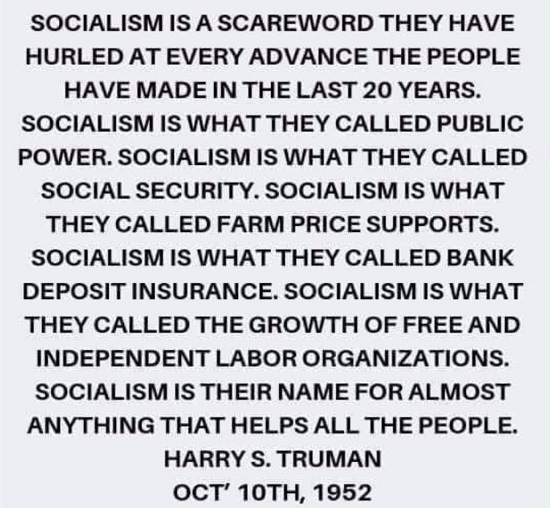
The circulated meme was an accurate reproduction of a portion of a campaign speech Truman delivered from the rear platform of a train in Syracuse, New York, on 10 October 1952. (Truman himself was not a candidate for re-election that year, but he stumped for the Democratic ticket, headed by Illinois Gov. Adlai Stevenson II). Much of Truman’s speech was a caustic rebuke of Republicans (and their presidential nominee, General Dwight D. Eisenhower), whom Truman characterized as having “opposed almost all our programs to help the economic life of the country” and “having blindly turned [their] back on the tradition of public action for the public good”:
[Republican Senator Robert] Taft explained that the great issue in this campaign is “creeping socialism.” Now that is the patented trademark of the special interest lobbies. Socialism is a scare word they have hurled at every advance the people have made in the last 20 years.
Socialism is what they called public power.
Socialism is what they called social security.
Socialism is what they called farm price supports.
Socialism is what they called bank deposit insurance.
Socialism is what they called the growth of free and independent labor organizations.
Socialism is their name for almost anything that helps all the people.
When the Republican candidate inscribes the slogan “Down With Socialism” on the banner of his “great crusade,” that is really not what he means at all.
What he really means is, “Down with Progress — down with Franklin Roosevelt’s New Deal,” and “down with Harry Truman’s fair Deal.” That is what he means.
Truman had earlier touched on the idea of “socialism” as a Republican scare word during an address he delivered at a Better Business Bureaus dinner on 6 June 1950, leading into a sardonic joke about New York Gov. Thomas E. Dewey (the unsuccessful Republican presidential nominee in the 1944 and 1948 elections):
I know that you have been hearing a lot of charges lately about Government interference with business, about the undermining of the free enterprise system, and about “creeping socialism.” In short, you have been hearing that the Government is doing everything possible to wreck every industry in the country.
Nothing could be further from the truth. The record shows that the Government action in recent years has been the salvation of private enterprise …
I know there are some people who still don’t believe that the policies of the Government have had anything to do with our present prosperity. That reminds me of a story I heard on my recent nonpolitical trip. It seems that there was a rock-ribbed old gentleman of a political persuasion, shall we say, somewhat different from mine. One of his friends asked him what man to vote for for President in 1952.
“Well,” he said, “I would like to vote for Dewey.”
“Dewey!” said the friend. “Why Dewey?”
“Well,” he said, “I voted for him the last two times, in 1944 and in 1948, and business has never been so good as it is today” …
The funny thing is that this has all been said before. The current campaign is almost exactly like the campaign of the old Liberty League, back in 1935 and 1936. I was in that campaign, too, by the way. It uses the same old slogans, the same old scarewords, and the same old falsehoods. The only difference is that it sounds even more foolish now than it did 14 years ago.


It was very lonely to be on the side that said: ‘Absolutely no cuts, under any circumstances.’Alex Lawson, Social Security Works
The tea party was more useful than Democratic leadership when it came to killing a grand bargain that would have cut Social Security benefits.Adam Green, Progressive Change Campaign Committee
Thank you, tea party!Adam Green, Progressive Change Campaign Committee

I don’t think there is anything new here.Gabe Horwitz, Third Way