
YOUR DISTRICT, YOUR VOTE | ||
|
SUPPORT OUR STUDENTS | ||
|
PRIVACY PITFALLS | ||
|
AT LIBERTY PODCAST | |||
|

JUSTICE FOR JOURNALISTS | ||
|
CHURCH OR JAIL | ||
|
WAITING AT THE BORDER | ||
|

BUCKNACKT'S SORDID TAWDRY BLOG We should not be a journey to the grave with the intention of arriving safely in an attractive & well preserved body, but rather to skid in sideways, chocolate, bier or wein in hand, body thoroughly used up, totally worn out and screaming "WHOO-HOO, WHAT A RIDE!!!!!!"
YOUR DISTRICT, YOUR VOTE | ||
|
SUPPORT OUR STUDENTS | ||
|
PRIVACY PITFALLS | ||
|
AT LIBERTY PODCAST | |||
|
JUSTICE FOR JOURNALISTS | ||
|
CHURCH OR JAIL | ||
|
WAITING AT THE BORDER | ||
|

AMERICAN Labor Day, the first Monday in September, created to keep American workers from joining forces with the rest of the world for fair wages, benefits and workers rights. The rest of the world celebrates Labor Day (with good reason) on 1 MAY. They are protected and provided for because of the struggles and activism of previous generations of workers. Americans continue to face exploitation, discrimination, neglect and abuse, in short class warfare to protect and increase the profit margins of corporate America and the politicians they have bought. This from The Hill just might document a new American labor movement....
As we approach Labor Day, America’s working people are deep into a protracted general strike. Millions are refusing to go back into low-wage, no-benefits jobs that require they abandon dignity and rights at the workplace door. Their struggle has brewed for 40 years as wages stagnated, benefits vanished and public policy offered working families little reprieve. Employers complain that too few people are returning to work, but America’s “labor shortage” is really a shortage of good wages and workers rights on the job.
Recent jobs reports show an uptick in the numbers of workers returning to work, but payroll tallies are still more than 5 million shy of pre-pandemic levels. Restaurants, retailers and hospitality firms say it is especially difficult to hire, and some blame generous unemployment checks. However, even those states that have rescinded supplemental unemployment benefits are finding that many people remain hesitant to take the sorts of jobs that are on offer.
The pandemic shook up what workers want and expect from a job. America cheered front-line workers during the early days of the pandemic, banging pots and pans for health care workers, honking for delivery drivers, and thanking cashiers. But these workers’ wages remain too low to cover rising housing, education and health care costs. You’d need an average of $25 an hour to rent a modest two-bedroom apartment, according to the National Low Income Housing Coalition, and minimum wage workers can’t afford rent anywhere in the nation. An extra dollar or two more just isn’t cutting it for most people, especially when they’re putting their health on the line.
Meanwhile, women are still shouldering the bulk of unpaid child and elder care, a balancing act that the pandemic has made nearly impossible. Nearly 2 million women dropped out of the labor force during the pandemic, and many did so in order to take care of their kids or sick parents. It’s no coincidence that the sectors having the most difficult time staffing up — food service and retail — are majority female occupations. Women are looking at their paltry options and voting with their feet by staying home.
This isn’t the first time Americans withheld their labor to turn big societal changes in their favor. W.E.B. Du Bois posited in his masterful "Black Reconstruction in America" that enslaved people engaged in a general strike when they ran away from plantations, took up arms and sabotaged cotton production, forcing President Abraham Lincoln’s decision to end slavery. When President Franklin D. Roosevelt’s first Depression-era revision to labor law gave employers the upper hand, general strikes in San Francisco, Minneapolis and the textile industry helped convince him to pass the National Labor Relations Act.
The U.S. is at another such historical crossroads due to the pandemic, and working people are weighing in by staying home. In the 1970s, employers started creating the kinds of bad jobs that are now the norm; they started hiring part-time, contract labor, lowering wages and benefits, and attacking workers unions with new vehemence. Meanwhile, U.S. policy didn’t keep up. It abandoned working people to the whims of corporations and the market. America’s working women and men are now looking at these bad jobs and the lack of governmental oversight and support, weighing the risks and personal costs, and deciding that they just aren’t doing it anymore.
Working people’s reluctance to rush back into poorly paid and precarious jobs could help bolster Democrats’ chances of passing the $3.5 trillion budget resolution agreement, which marks a long-overdue expansion of the federal social safety net. This legislation could help get people back to work and keep them there because it gives workers many of the supports they need to navigate today’s economy. It would expand child care, create universal pre-K, boost affordable housing, offer free community college, enact paid family and medical leave, support long-term home care, and expand Medicare. Alongside higher wages, these wraparound supports would mean that people who wait tables, deliver packages and ring up customers can finally pay rent, afford health and child care, and even send kids to college.
This Labor Day, working women and men are deeply fed up and ready for the kind of economic game changer that will improve their lives for decades to come. Until they see more rights and support, they might just choose to stay home.
Lane Windham, Ph.D., is the associate director of Georgetown University’s Kalmanovitz Initiative for Labor and the Working Poor and author of “Knocking on Labor’s Door: Union Organizing in the 1970s and the Roots of a New Economic Divide.”


August 31, 2021
It's the last day of August, and the United States' involvement in Afghanistan is officially over.
As the Taliban claims victory, more than 100 Americans remain in the country, though the State Department has said that it plans to assist those who want to leave. Secretary of State Antony Blinken said yesterday that more than 123,000 people had been safely flown out of Afghanistan, including about 6,000 US citizens.
Meanwhile, conservative war hawks are spinning US withdrawal from Afghanistan as a win for China. Social media executives are grappling with the thorny issue of whether to ban the Taliban from their sites. And President Biden will have to figure out how to continue diplomatic relations with a Taliban-run government.
Biden just discussed the future of US foreign policy in Afghanistan. Watch his remarks here.
—Abigail Weinberg
Advertisement


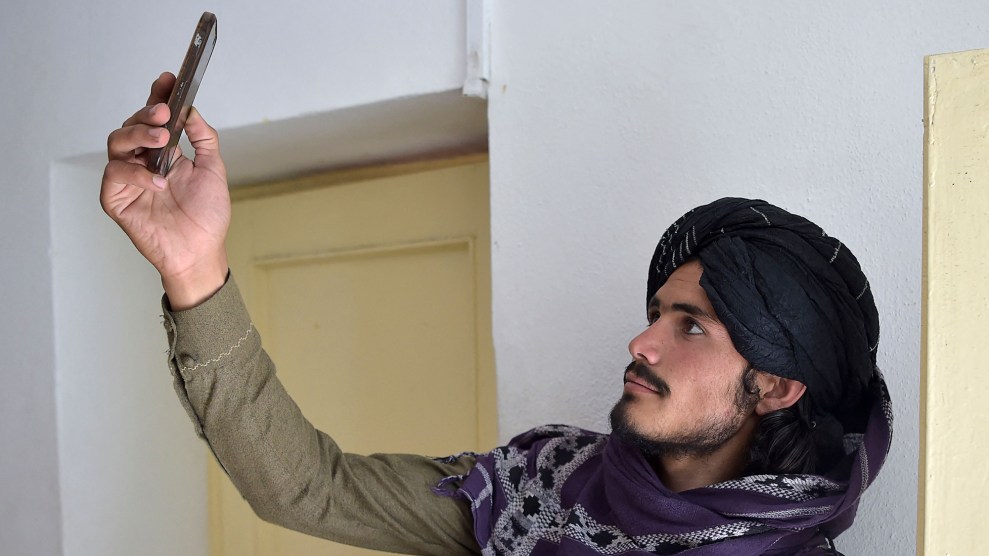
The conundrum of how companies handle the new regime.
BY ALI BRELAND

BY INAE OH AND DAN FRIEDMAN
BY DAN SPINELLI
BY SAMANTHA MICHAELS
BY MATT SIMON
Advertisement


"This snail-paced, piecemeal approach isn’t leadership.”
BY DAMIAN CARRINGTON

Support from readers allows Mother Jones to do journalism that doesn't just follow the pack.

SOME GOOD NEWS, FOR ONCE
Forget the idea that Black cinema primarily depicts a singular set of storylines and themes centered on shared trauma, says screenwriter Maya Cade, who spent a year cataloging more than 250 currently streaming Black films from between 1915 and 1979. Her effort to make that rich history easily accessible culminated in the launch of the Black Film Archive last week. From silent films to horror flicks to blockbuster comedies and romance, Black cinema spans ever-expanding genres and generations, now archived on her site.
In her introductory note, Cade writes that the films appearing in the archive “have something significant to say about the Black experience; speak to Black audiences; and/or have a Black star, writer, producer, or director.” The intentionally broad criteria is an attempt to expand the ways Black films are framed. “I’ve been thinking a lot about the fact that the act of making Black film history accessible is the act of transforming collective memory,” Cade told me. “To intentionally preserve is to remember, and to remember is to reimagine what the future can hold. Here, the films can be many things, and among those things are being remembered, treasured, and seen.”
Beyond archiving, Cade is also one of the vanishingly few people to use Twitter to spread joy, bringing snippets of cultural history—and countless gems from cinema as a whole—to her followers’ feeds every day. She’ll continue updating the archive monthly and maintaining a supplemental newsletter. Explore the rich range of Black film: If you find yourself with an hour to spare, pick a movie and start streaming.
—Abigail Weinberg
Did you enjoy this newsletter? Help us out by forwarding it to a friend or sharing it on Facebook and Twitter.
