NORTON META TAG

Showing posts with label corporate America. Show all posts

12 July 2022

The secret to the GOP’s assault on your rights This is not a battle of left vs. right. It is a battle between democracy and autocracy. 11JUL22


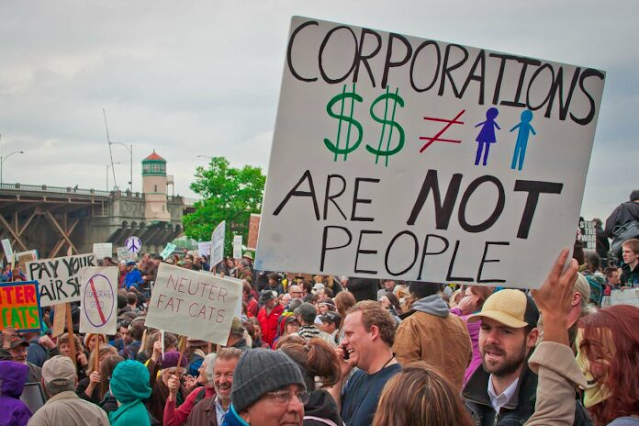
 AS Robert Reich says in this piece from Nation of Change we are not in a battle of left vs right, we are in a battle of democracy vs autocracy. Politicians who have been bought and paid for by corporate America look to consolidate and strengthen their authoritarian gains at the local, state and national level in the coming 2022 midterm elections. It is not too late to stop that from happening. Democracy is not a spectator sport and for the love of our country we have to do everything possible to elect pro-democracy candidates to local and state offices and especially to the U.S. Congress to increase the number of  pro-democracy senators and representatives. It is a sad fact that republican senators and a vast majority of republican representatives can not be considered pro-democracy politicians and need to be voted out of office. "Democratic" senators joe manchin and kyrsten sinema are not pro-democracy politicians and need to be voted out of office. We need to support pro-democracy candidates, financially and / or by volunteering to begin to restore and protect our democratic Republic. REMEMBER, DEMOCRACY IS NOT A SPECTATOR SPORT!


The Secret to the GOP’s Assault on Your Rights | Robert Reich

The secret to the GOP’s assault on your rights

This is not a battle of left vs. right. It is a battle between democracy and autocracy.

Democracy is not just under attack in America. In some states, it’s being lost.

Supreme Court Justice Louis Brandeis once suggested that states could serve as laboratories of democracy, but these states are more like laboratories of autocracy.

Take Wisconsin. The GOP has so successfully rigged state elections through gerrymandering that even when Democrats get more votes, Republicans win more seats. In 2018, Republicans won just 45% of the vote statewide, but were awarded 64% of the seats.

Wisconsin is one of several states where an anti-democracy movement has taken hold.

But it wasn’t always this way. In fact, Wisconsin pioneered the progressive era of American politics at the start of the twentieth century — with policies that empowered workers, protected the environment, and took on corporate monopolies. State lawmakers established the nation’s first unemployment insurance, workers’ compensation, and strict child labor laws.

Teddy Roosevelt called the state a “laboratory for wise … legislation aiming to secure the social and political betterment of the people as a whole.”

But for the last decade, Wisconsin has become a laboratory for legislation that does the exact opposite.

After Republicans took control in 2010, one of the first bills they passed gutted workers’ rights by dismantling public-sector unions — which then decimated labor’s ability to support pro-worker candidates.

This move aligned with the interests of their corporate donors, who benefited from weaker unions and lower wages.

This new Wisconsin formula has been replicated elsewhere.

Republicans in Pennsylvania, Michigan, and North Carolina won a minority of votes in 2018, but still won majorities in their state assemblies thanks to gerrymandering.

In Texas, Ohio, and Georgia, Republicans have crafted gerrymanders that are strong enough to create supermajorities capable of overturning a governor’s veto.

Even more alarming, hundreds of these Republican state legislators, “used the power of their office to discredit or try to overturn the results of the 2020 presidential election,” on behalf of Donald Trump.

How did this happen? Put simply: years of careful planning by corporate interest groups and their radical allies.

And the corporations enabling these takeovers aren’t just influencing the law — their lobbyists are literally writing many of the bills that get passed.

This political alliance with corporate power has given these Republican legislatures free rein to pursue an extreme culture-war agenda — one that strips away rights that majorities of people support — while deflecting attention from their corporate patrons’ economic agendas.

Republicans are introducing bills that restrict or criminalize abortion. They’re banning teachers from discussing the history of racism in this country. They are making it harder to protest and easier to harm protestors. They are punishing trans people for receiving gender-affirming care and their doctors for providing it.

But it doesn’t have to be this way. There are still laboratories of democracy where true public servants are finding creative ways to defend the rights of us all.

Elected officials in Colorado and Vermont are codifying the right to abortion. California lawmakers have proposed making the state a refuge for transgender youth and their families. And workers across the country are reclaiming their right to organize, which is helping to rebuild an important counterweight to corporate power.

But winning will ultimately require a fifty state strategy — with a Democratic Senate willing to reform or end the filibuster to codify Roe v. Wade, protect voting rights, and protect the right to organize nationwide.

America needs a national pro-democracy movement to stop the anti-democracy movement now underway — a pro-democracy movement committed to helping candidates everywhere, including in state-level races.

This is where you come in. Volunteer for pro-democracy candidates — and if you don’t have time, contribute to their campaigns.

This is not a battle of left vs. right. It is a battle between democracy and autocracy.

Robert B. Reich is Chancellor's Professor of Public Policy at the University of California at Berkeley and Senior Fellow at the Blum Center for Developing Economies. He served as Secretary of Labor in the Clinton administration, for which Time Magazine named him one of the ten most effective cabinet secretaries of the twentieth century. He has written fourteen books, including the best sellers "Aftershock", "The Work of Nations," and"Beyond Outrage," and, his most recent, "Saving Capitalism." He is also a founding editor of the American Prospect magazine, chairman of Common Cause, a member of the American Academy of Arts and Sciences, co-founder of the nonprofit Inequality Media and co-creator of the award-winning documentary, Inequality for All.

05 September 2021

It's not a labor shortage — it's a wage and workers rights shortage 2SEP21


 AMERICAN Labor Day, the first Monday in September, created to keep American workers from joining forces with the rest of the world for fair wages, benefits and workers rights. The rest of the world celebrates Labor Day (with good reason) on 1 MAY. They are protected and provided for because of the struggles and activism of previous generations of workers. Americans continue to face exploitation, discrimination, neglect and abuse, in short class warfare to protect and increase the profit margins of corporate America and the politicians they have bought. This from The Hill just might document a new American labor movement....

It's not a labor shortage — it's a wage and workers rights shortage


BY LANE WINDHAM, OPINION CONTRIBUTOR — 

As we approach Labor Day, America’s working people are deep into a protracted general strike. Millions are refusing to go back into low-wage, no-benefits jobs that require they abandon dignity and rights at the workplace door. Their struggle has brewed for 40 years as wages stagnated, benefits vanished and public policy offered working families little reprieve. Employers complain that too few people are returning to work, but America’s “labor shortage” is really a shortage of good wages and workers rights on the job. 

Recent jobs reports show an uptick in the numbers of workers returning to work, but payroll tallies are still more than 5 million shy of pre-pandemic levels. Restaurants, retailers and hospitality firms say it is especially difficult to hire, and some blame generous unemployment checks. However, even those states that have rescinded supplemental unemployment benefits are finding that many people remain hesitant to take the sorts of jobs that are on offer.   

The pandemic shook up what workers want and expect from a job. America cheered front-line workers during the early days of the pandemic, banging pots and pans for health care workers, honking for delivery drivers, and thanking cashiers. But these workers’ wages remain too low to cover rising housing, education and health care costs. You’d need an average of $25 an hour to rent a modest two-bedroom apartment, according to the National Low Income Housing Coalition, and minimum wage workers can’t afford rent anywhere in the nation. An extra dollar or two more just isn’t cutting it for most people, especially when they’re putting their health on the line.   

Meanwhile, women are still shouldering the bulk of unpaid child and elder care, a balancing act that the pandemic has made nearly impossible. Nearly 2 million women dropped out of the labor force during the pandemic, and many did so in order to take care of their kids or sick parents. It’s no coincidence that the sectors having the most difficult time staffing up — food service and retail — are majority female occupations. Women are looking at their paltry options and voting with their feet by staying home.   

This isn’t the first time Americans withheld their labor to turn big societal changes in their favor. W.E.B. Du Bois posited in his masterful "Black Reconstruction in America" that enslaved people engaged in a general strike when they ran away from plantations, took up arms and sabotaged cotton production, forcing President Abraham Lincoln’s decision to end slavery. When President Franklin D. Roosevelt’s first Depression-era revision to labor law gave employers the upper hand, general strikes in San Francisco, Minneapolis and the textile industry helped convince him to pass the National Labor Relations Act. 

The U.S. is at another such historical crossroads due to the pandemic, and working people are weighing in by staying home. In the 1970s, employers started creating the kinds of bad jobs that are now the norm; they started hiring part-time, contract labor, lowering wages and benefits, and attacking workers unions with new vehemence. Meanwhile, U.S. policy didn’t keep up. It abandoned working people to the whims of corporations and the market. America’s working women and men are now looking at these bad jobs and the lack of governmental oversight and support, weighing the risks and personal costs, and deciding that they just aren’t doing it anymore.

Working people’s reluctance to rush back into poorly paid and precarious jobs could help bolster Democrats’ chances of passing the $3.5 trillion budget resolution agreement, which marks a long-overdue expansion of the federal social safety net. This legislation could help get people back to work and keep them there because it gives workers many of the supports they need to navigate today’s economy. It would expand child care, create universal pre-K, boost affordable housing, offer free community college, enact paid family and medical leave, support long-term home care, and expand Medicare. Alongside higher wages, these wraparound supports would mean that people who wait tables, deliver packages and ring up customers can finally pay rent, afford health and child care, and even send kids to college. 

This Labor Day, working women and men are deeply fed up and ready for the kind of economic game changer that will improve their lives for decades to come. Until they see more rights and support, they might just choose to stay home. 

Lane Windham, Ph.D., is the associate director of Georgetown University’s Kalmanovitz Initiative for Labor and the Working Poor and author of “Knocking on Labor’s Door: Union Organizing in the 1970s and the Roots of a New Economic Divide.

18 March 2016

These 25 Companies Are More Powerful Than Many Countries & Editors' Picks: Love is the root of true power, and the enormous cost of Africa’s instability 17MAR16

Rise of the Titans

THIS is mind boggling even when my mind is telling me I already know this. This is why Bernie's call for a non-violent political revolution in America appeals to millions this election year. This is why Democratic and republican political party leadership are colluding to limit the political and economic damage to corporate America and the 1%.  Sen ted cruz r TX will be sacrificed to reign in the rogue factions of the republican party. hillary clinton will be elected president with a Democratic senate though her "progressive" agenda will be thwarted by a republican house. The oligarchs will gain more power by continuing to decrease our government through funding cuts resulting in system and program failures nationwide. Will our Republic survive to 2050 or will the situation become so disruptive and such a threat to the corporate world that the shadow plutocracy will be forced to seize power and complete our transformation to Third World America? So why not just give up now? It just isn't in our genes, as the passion of +Senator Bernie Sanders supporters and the unshakable voluntary ignorance of donald drumpf supporters shows. This from +Foreign Policy .....

These 25 Companies Are More Powerful Than Many Countries

MAR/APR 2016 FOREIGN POLICY MAGAZINE
At first glance, the story of Accenture reads like the archetype of the American dream. One of the world’s biggest consulting companies, which commands tens of billions of dollars in annual revenues, was born in the 1950s as a small division of accounting firm Arthur Andersen. Its first major project was advising General Electric to install a computer at a Kentucky facility in order to automate payment processing. Several decades of growth followed, and by 1989, the division was successful enough to become its own organization: Andersen Consulting.
Yet a deeper look at the business shows its ascent veering off the American track. This wasn’t because it opened foreign offices in Mexico, Japan, and other countries; international expansion is pro forma for many U.S. companies. Rather, Andersen Consulting saw benefits—fewer taxes, cheaper labor, less onerous regulations — beyond borders and restructured internally to take advantage of them. By 2001, when it went public after adopting the name Accenture, it had morphed into a network of franchises loosely coordinated out of a Swiss holding company. It incorporated in Bermuda and stayed there until 2009, when it redomiciled in Ireland, another low-tax jurisdiction. Today, Accenture’s roughly 373,000 employees are scattered across more than 200 cities in 55 countries. Consultants parachute into locations for commissioned work but often report to offices in regional hubs, such as Prague and Dubai, with lower tax rates. To avoid pesky residency status, the human resources department ensures that employees don’t spend too much time at their project sites.
Welcome to the age of metanationals: companies that, like Accenture, are effectively stateless. When business and strategy experts Yves Doz, José Santos, and Peter Williamson coined the term in a 2001 book, metanationals were an emerging phenomenon, a divergence from the tradition of corporations taking pride in their national roots. (In the 1950s, General Motors President Charles Wilson famously said, “What was good for our country was good for General Motors, and vice versa.”) Today, the severing of state lifelines has become business as usual.
ExxonMobil, Unilever, BlackRock, HSBC, DHL, Visa—these companies all choose locations for personnel, factories, executive suites, or bank accounts based on where regulations are friendly, resources abundant, and connectivity seamless. Clever metanationals often have legal domicile in one country, corporate management in another, financial assets in a third, and administrative staff spread over several more. Some of the largest American-born firms — GE, IBM, Microsoft, to name a few — collectively are holding trillions of dollars tax-free offshore by having revenues from overseas markets paid to holding companies incorporated in Switzerland, Luxembourg, the Cayman Islands, or Singapore. In a nice illustration of the tension this trend creates with policymakers, some observers have dubbed the money “stateless income,” while U.S. President Barack Obama has called the companies hoarding it America’s “corporate deserters.”
It isn’t surprising, of course, when companies find new ways to act in their own interest; it’s surprising when they don’t. The rise of metanationals, however, isn’t just about new ways of making money. It also unsettles the definition of “global superpower.”
The debate over that term usually focuses on states—that is, can any country compete with America’s status and influence? In June 2015, the Pew Research Center surveyed people in 40 countries and found that a median of 48 percent thought China had or would surpass the United States as a superpower, while just 35 percent said it never would. Pew, however, might have considered widening its scope of research — for corporations are likely to overtake all states in terms of clout.
Already, the cash that Apple has on hand exceeds the GDPs of two-thirds of the world’s countries. Firms are also setting the pace vis-à-vis government regulators in a perennial game of cat-and-mouse. After the 2008 financial crisis, the U.S. Congress passed the Dodd-Frank Act to discourage banks from growing excessively big and catastrophe-prone. Yet while the law crushed some smaller financial institutions, the largest banks — with operations spread across many countries — actually became even larger, amassing more capital and lending less. Today, the 10 biggest banks still control almost 50 percent of assets under management worldwide. Meanwhile, some European Union officials, including Competition Commissioner Margrethe Vestager, are pushing for a common tax-base policy among member states to prevent corporations from taking advantage of preferential rates. But if that happened (and it’s a very big if), firms would just look beyond the continent for metanational opportunities.
The world is entering an era in which the most powerful law is not that of sovereignty but that of supply and demand. As scholar Gary Gereffi of Duke University has argued, denationalization now involves companies assembling the capacities of various locations into their global value chains. This has birthed success for companies, such as commodities trader Glencore and logistics firm Archer Daniels Midland, that don’t focus primarily on manufacturing goods, but are experts at getting the physical ingredients of what metanationals make wherever they’re needed.
Could businesses go a step further, shifting from stateless to virtual? Some people think so. In 2013, Balaji Srinivasan, now a partner at the venture-capital company Andreessen Horowitz, gave a much debated talk in which he claimed Silicon Valley is becoming more powerful than Wall Street and the U.S. government. He described “Silicon Valley’s ultimate exit,” or the creation of “an opt-in society, ultimately outside the U.S., run by technology.” The idea is that because social communities increasingly exist online, businesses and their operations might move entirely into the cloud.
Much as the notion of taxing a metanational based on its headquarters’ location now seems painfully antiquated, Srinivasan’s ultimate exit may ring of techie utopianism. If stateless companies live by one rule, however, it’s that there’s always another place to go where profits are higher, oversight friendlier, and opportunities more plentiful. This belief has helped nimble, mobile, and smart corporations outgrow their original masters, including the world’s reigning superpower. Seen in this light, metanationals disassociating from terrestrial restraints and harnessing the power of the cloud is anything but far-fetched. It may even be inevitable.
The Top 25 Corporate Nations
BY DAVID FRANCIS


EDITORS' PICKS


Thursday, March 17
 
 
Welcome to Editors' Picks, FP's round-up of the day's best articles. 

Today, we look at the essence of power, an economic nightmare waiting to happen in the Horn of Africa region, and the geopolitical saga of the cursed blue diamond.


1


MONEY, POWER, SEX, OR LOVE?: Great influence comes not from “hard” qualities such as money or power, but from the human heart, FP’s David Rothkopf writes: Read more


2


AFRICA’S $700 BILLION LIABILITY: The Horn of Africa region is central to the world’s maritime trade. It’s also beginning to fall apart, Alex de Waal writes: Read more


3


APPROVE TO DISAPPROVE: In the latest print issue, FP's Decoder looks at why so many potentially life saving gene therapies have gone unapproved by governments around the world: Read more


4


THE BLUE DIAMOND AFFAIR: The Thai migrant worker who stole a 50-carat diamond from a Saudi prince and sparked an enduring diplomatic rift has now become a monk, FP’s Henry Johnson writes:Read more


5


TRUMP’S RUSSIAN TOADY: The head of Moscow’s state-run news network Russia Today is an ardent supporter of U.S. presidential candidate Donald Trump, FP’s Siobhan O’Grady: Read more


Check in later for FP's Dan De Luce and Paul McLeary on why the Pentagon is whitewashing the bombing of an MSF hospital in Afghanistan.


Foreign Policy Magazine 
editorspicks@foreignpolicy.com