BUCKNACKT'S SORDID TAWDRY BLOG
We should not be a journey to the grave with the intention of arriving safely in an attractive & well preserved body, but rather to skid in sideways, chocolate, bier or wein in hand, body thoroughly used up, totally worn out and screaming "WHOO-HOO, WHAT A RIDE!!!!!!"
NORTON META TAG
Showing posts with label trans pacific partnership tpp. Show all posts
Showing posts with label trans pacific partnership tpp. Show all posts
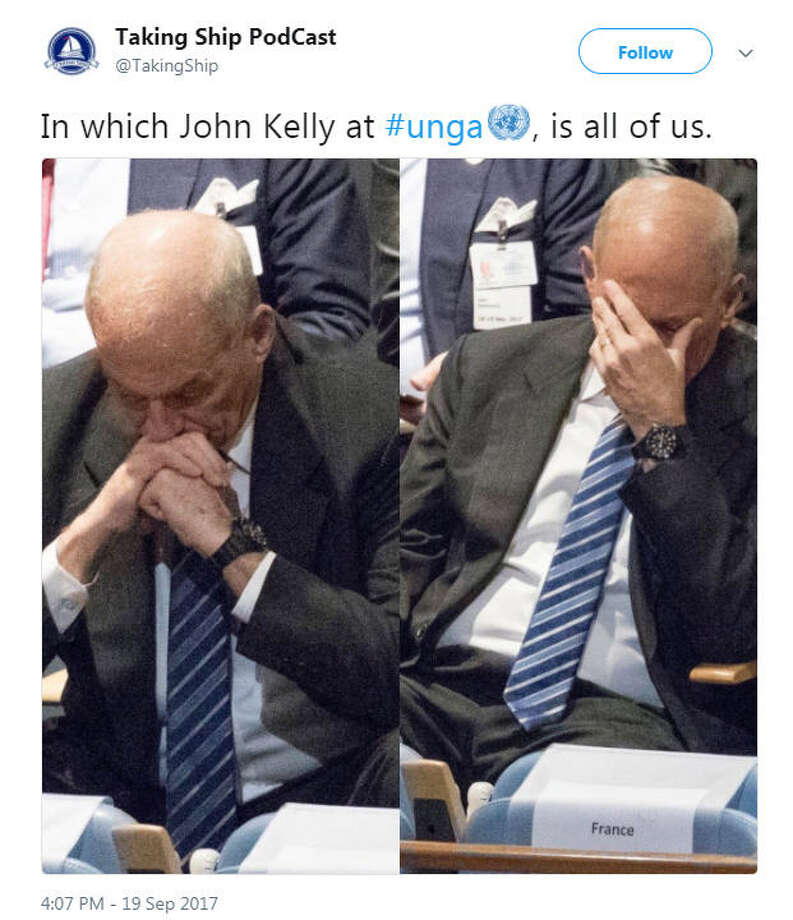
john kelly with his face in his hands in an attempt to hide the fact that he was at the meeting or that physical response when one covers one's face with a hand when one can't believe what they are hearing and seeing. Keep this in mind, john kelly is a drumpf/trump-pence republican, he is as corrupt and rotten as the rest of the administration, if he wasn't he wouldn't be part of it..... See why Trump tweeted and then deleted this embarrassing photo (we've got the screenshots!)
Friday April 13, 2018·11:04 AM EDT
Donald Trump wanted to show he’s a serious man who can hold serious meetings. Nothing says “I’m a serious person” like tweeting out photos of you taking a break from Fox News to attend a meeting where your fellow Republicans explain to you that your trade policies are moronic and ill-advised. That’s the scene in the image below as Donald Trump hosted an “Agriculture Roundtable” where red state senators who are worried about re-election and their farmer constituents tried to get Trump to walk back his tariffs and rejoin the Trans-Pacific Partnership.
In an attempt to prove he actually does occasionally take a break from Fox News and golfing, he sent out this now deleted tweet bragging about the meeting. Here’s a screenshot of the now missing tweet. Jump below to see why he deleted it.
That last picture on the bottom right? Let’s zoom in a little closer.
It appears that Trump has deleted this tweet—the one where, in the last image, you can see John Kelly with his head buried in his palm. pic.twitter.com/ExHgFzGYHH
hillary clinton is using semantics to deny she has been a strong supporter of the tpp / trans-pacific partnership. She is lying, as this analysis from +PolitiFact shows. If hillary is lying about this what else is shy lying about? Go to Bernie 2016 for the Bernie's positions on the issues. Go here for the threat the tpp presents to the American economy and to our Republic.
Bernie Sanders opposes the Trans-Pacific Partnership, and Hillary Clinton supports it.
— Viral image on Wednesday, August 26th, 2015 in a viral Internet chart
By Will Cabaniss on Wednesday, September 2nd, 2015 at 10:26 a.m.
This shareable image compares positions between Hillary Clinton and Bernie Sanders, Democratic presidential candidates.
A widespread Internet post claims Democratic presidential
candidates Hillary Clinton and Bernie Sanders have opposing views on a
number of issues, including the Trans-Pacific Partnership, a proposed
trade deal involving the United States and 11 other nations.
The image says Sanders opposes the deal, but Clinton supports it.
As part of a couple of fact-checks
on the post, we looked into whether the two candidates differ on
support for the deal, which has divided Democratic leaders on the Hill.
President Barack Obama, the deal’s primary advocate, has sparred with Sen. Harry Reid, D-Nev., a longtime ally, and received praise from Senate Majority Leader Mitch McConnell, R-Ky., a frequent opponent, over the deal.
So where do the leading Democratic presidential candidates stand on the Trans-Pacific Partnership?
Sanders sides with other members of the Senate’s progressive caucus in vehemently opposing the deal. In January 2014, he said he’s against it primarily because it will allow corporations to move jobs overseas.
Clinton’s position on the proposal is complicated by her time as
secretary of state, and she’s been careful as a presidential candidate
not to express a firm position.
There’s evidence to suggest Clinton was deeply involved in the deal’s
formation and promotion as the country’s lead diplomat. In 2011, she told a congressional committee
that even though the State Department was not in charge of the
negotiations, "we work closely with the U.S. (Trade Representative)."Leaked diplomatic cablesshow Clinton’s deputies specifically discussed the TPP with foreign heads of state.
Clinton openly pushed for the deal at least 45 times during her tenure as secretary of state, according to CNN’s tally.
In 2012, she touted the trade deal, also called TPP, to a group of
American and Australian officials as a way to "lower trade barriers,
raise labor and environmental standards, and drive growth across the
region."
But since entering the race for president, Clinton has distanced herself from those remarks.
"I did not work on TPP," she told reporters in July, saying the deal was "the responsibility of the United States Trade Representative."
At times, Clinton has echoed Sanders’ concerns about outsourcing.
"Any trade deal has to produce jobs and raise wages and increase
prosperity and protect our security," she told a reporter from MSNBC in
April. "We have to do our part in making sure we have the capabilities
and the skills to be competitive. It's got to be really a partnership
between our business, our government, our workforce, the intellectual
property that comes out of our universities, and we have to get back to a
much more focused effort in my opinion to try to produce those
capacities here at home so that we can be competitive in a global
economy."
Hopeful comments about job creation and increased wages do not signal a clear position on the Trans-Pacific Partnership.
Clinton’s campaign website lists no official position on the deal. Our ruling
The graphic claims Bernie Sanders opposes the Trans-Pacific Partnership, and Hillary Clinton supports it.
Sanders has said on multiple occasions that he would oppose the trade
deal. Clinton supported it as secretary of state, and there’s even
evidence to suggest she was an advocate for the deal within the Obama
administration. But she has taken a neutral stance on the deal during
her campaign for the presidency, voicing some of Sanders’ same concerns
yet refusing to explicitly criticize the proposal.
Clinton spoke often in support of the Trans-Pacific Partnership — until that backing irritated parts of her Democratic base.
We rate the post’s claim Mostly True.
About this statement:
Published: Wednesday, September 2nd, 2015 at 10:26 a.m.
Researched by: Will Cabaniss
Edited by: Katie Sanders
Subjects: Trade
THE tpp will be worse than nafta for American workers no matter what obama, the third way democrats and the repiglicans say. It is a treaty crafted by and for corporate america, one that will not only make the rich richer, it will take more jobs from American workers and send them to countries where workers will be paid a fraction of American wages. The obama administration and all politicians of both parties supporting the tpp are liars. From +Daily Kos .....
Last Friday, House Democrats wrenched President Obama's trade agenda to an unexpected, though perhaps temporary, halt.
Obama had asked Congress to pass a bill that would grant him so-called
"Trade Promotion Authority" (TPA), better known as "fast-track." This
legislation would allow the president to conclude a controversial trade
agreement with 11 Pacific Rim nations without giving Congress the chance
to amend it; only an up-or-down vote would be permitted on the deal,
known as the Trans-Pacific Partnership (TPP).
Many Democrats, supported by organized labor and progressive
activists, are hostile to the TPP (the trade accord), and therefore are
hostile to TPA (fast-track). Some Republicans are opposed as well,
enough to require John Boehner to cobble together a bipartisan coalition
to bring TPA to fruition. So in an attempt to win over votes from
unhappy Democrats, the House required that TPA (which is favored by most
Republicans) pass in concert with another piece of legislation called
Trade Adjustment Assistance (TAA).
TAA helps retrain workers, so Democrats typically like it while
Republicans deride it as welfare. But smart progressives knew that
tanking TAA would also stop TPA, at least for the moment, so Democrats voted against TAAen masse. GOP leadership then staged a show vote on TPA,
but even though it carried a majority, it didn't pass because of the
pre-arranged requirement that both laws stand or fall together.
The map above shows how Democrats cast their votes on both roll
calls. Districts highlighted in yellow show Democrats who voted for both
TAA and TPA, which is the position Obama lobbied for; still, only 27
members of his party stuck with him. Green shows those who voted for TAA
but not TPA, the classic liberal position. Obama actually encouraged this stance,
because he knew Republicans would provide enough votes to get TPA
through as long as TAA passed, and he figured (or hoped) Democrats would
be willing to take the good (TAA) with the bad (TPP). But TAA was a
small sop at best, and only 13 Democrats were willing to play along.
Pink shows the typical Republican position, a vote for TPA but
against the TAA "give-away." (Just one Democrat landed in this box, the
baffling Rubén Hinojosa.) Finally, blue shows the strategic progressive
position of voting against both TAA and TPA, which most House Democrats
adopted (143 in total). (Click here to match names to districts.)
Have a peek below the fold and you'll see how the Republicans voted.
Republicans were far less united than Democrats. A large number (81),
concentrated in the industrial Midwest, voted as Obama preferred (for
both TPA and TAA), but the plurality of Republicans (109) voted for TPA
but against TAA, their expected position.
Most notable, however, is the substantial number of Republicans (49)
colored in blue, meaning they voted the same way as progressives. The reasoning behind this stance
on the Republican side can be found in tea party principles: the idea
that more power should not be given to the executive, particularly when
he's named Barack Obama, no matter what the business lobby says. Indeed,
liberal groups lobbied Republicans with conservative rhetoric in their attempt to weave together a coalition opposed to fast-track trade. What happens next is unclear,
but for now, supporters of the TPA and the TPP (yes, these acronyms can
get confusing) are scrambling, while opponents have declared at least a
provisional victory.
To learn more about the map used in the post, click here.
Originally posted to Daily Kos Elections on Tue Jun 16, 2015 at 07:00 AM PDT.
THE free trade agreements we have in place now are a farce. As someone who works in the international shipping industry I see how these agreements do not work. The only ones benefiting are multinational corporations who gain access to cheap labor markets and corrupt government officials in the countries we have these agreements with (Canada is the exception to the rule). These agreements are not good for America. Now Pres Obama wants to fast track the TPP and the free trade agreement with the E.U. Congress must not give him this authority. Sign the petition to your member of Congress telling them to deny the president fast track authority on these treaties and reject any new free trade treaties the government negotiates.
I'm writing to let you know about a secret trade deal that would threaten our democracy and help giant mega-corporations become even more powerful. This agreement, known as the Trans-Pacific Partnership (TPP), would allow companies to sue and overturn democratically created laws if they hurt those companies' profits. For example, cities that vote to ban fracking could then be sued by greedy gas companies over lost profits — totally undermining local laws and the democratic process itself.
The scariest part? Only a few members of Congress have even seen the details of the Trans-Pacific Partnership, while about 600 corporations have weighed in on the ins and outs of this deal.
The TPP would include 12 countries that border the Pacific, making it the largest free trade deal ever considered by the U.S., and also probably the biggest corporate power grab in history. This trade deal threatens everything we fight for. And to make matters worse, President Obama wants to approve this plan himself — without the input of the American public or Congress.



pic.twitter.com/OB8hUNJDKH


