NORTON META TAG

Showing posts with label freedom of speech. Show all posts

21 September 2025

Effort to censure Rep. Ilhan Omar over Charlie Kirk comments fails 18SEP25


Thank you to the 4 Republican representatives who with their Democratic colleagues, have the moral courage to defend our constitutional right of free speech and our democratic Republic. I wish there were more of you for the sake of our nation and your political party. From the Washington Post.....

Effort to censure Rep. Ilhan Omar over Charlie Kirk comments fails


The effort was part of a GOP campaign to punish individuals Republicans accuse of posthumously smearing Kirk.


The resolution was introduced under special rules by Rep. Nancy Mace (R-South Carolina) on Monday, fast-tracking it to a floor vote. House Minority Whip Katherine Clark (D-Massachusetts) introduced a motion to table — essentially, to dismiss — the resolution Wednesday.

The motion to table succeeded by a vote of 214-213, with four Republicans — Reps. Mike Flood (Nebraska), Jeff Hurd (Colorado), Tom McClintock (California) and Cory Mills (Florida) — voting with Democrats.

“This is a First Amendment issue,” Mills said. “We may not like or agree with what someone says, but that does not mean we should deny their First Amendment right.”

The vote followed bitter exchanges between Omar and Mace over social media.
President Donald Trump expressed dissatisfaction with Omar on Thursday.

“I think she’s terrible,” Trump told reporters as he traveled to Washington from his state visit to the United Kingdom, after being asked about the censure vote. “She should be impeached, and it should happen fast.” Congressional lawmakers are widely seen as immune from impeachment under the Constitution but are eligible for expulsion.

Had the resolution succeeded, it would have removed Omar from her congressional committees for comments she made about Kirk during an interview with liberal commentator Mehdi Hasan. The resolution also criticized Omar for reposting a video to X from an anonymous user who called Kirk a “reprehensible human being” who was “spewing racist dog whistles” in his “last, dying words.”

During the interview with Hasan, Omar expressed “empathy” for Kirk’s wife and children but also chastised those who “completely pretend” that the conservative influencer just wanted a “civil debate,” pointing to his views on guns, slavery and George Floyd.

In the wake of his death, congressional Republicans launched an aggressive campaign to punish individuals they accuse of posthumously smearing Kirk, threatening to bring them before lawmakers, defund entities that protect them and oust them from positions of power.

The resolution to censure Omar was the first legislative effort to punish someone perceived as a Kirk critic to come to a vote. Though it has failed, the others remain in motion, including a second resolution attempting to censure Omar, from Rep. Buddy Carter (R-Georgia), that seeks to remove Omar from the House Budget Committee and Education Committee.

Besides the censure efforts, one lawmaker from Wisconsin introduced legislation this week threatening to block federal funds to entities that employ people “who condone and celebrate political violence,” and three dozen GOP lawmakers are demanding the formation of a House committee to investigate the “radical left’s assault on America and the rule of law.”

The aggressive rhetoric from House Republicans echoes the tone from the White House, where Trump, Vice President JD Vance and senior adviser Stephen Miller have vowed to undertake a broad campaign against left-wing groups they say have engaged in violence. And it’s a stark departure for the Republican Party, which has historically championed free speech and decried the “cancel culture” of the left for punishing those whose viewpoints it deems offensive.

Kadia Goba covers the House of Representatives for The Washington Post. Send her secure tips on Signal at kadia.99

21 April 2017

Donald Trump Has Free Speech Rights, Too 20APR17

Image result for aclu logo
A LOT of people, mostly on the political right, do not like the ACLU because they are seen as promoting a liberal, left wing agenda. Nothing could be farther from the truth. The ACLU is dedicated to protecting the civil liberties, civil rights and human rights of all Americans and they have done that since their founding. The political right demonizes the ACLU with deceptive and false propaganda because  the cases and causes the ACLU takes on and / or supports often oppose the agenda of the political right and are or would be a violation of our civil liberties, our civil right, our human rights as Americans. The ACLU has and will continue to defend these very rights for people and organizations of the political right. Here is an article from the ACLU regarding freedom of speech, the right of all of us, including (NOT MY) president drumpf/trump. I am not a fan or supporter of drumpf/trump, but this article makes me proud to be a member and supporter (financially and through activism) of the ACLU for many years.

Donald Trump Has Free Speech Rights, Too

By Lee Rowland, Senior Staff Attorney, ACLU Speech, Privacy, and Technology Project
APRIL 20, 2017 | 2:15 PM

Few organizations have been more engaged in fighting President Donald Trump’s attacks on civil liberties and civil rights than the ACLU. But it’s important to remember that political candidates — including Donald Trump — have constitutional rights, too.
A judge recently held that Donald Trump may have committed incitement when, at a campaign rally in Kentucky last year, he called on his audience to eject protesters who were subsequently manhandled by the crowd. While it’s a closer case than most, I don’t think those words can clear the high bar for what constitutes incitement. 
The case arises from a March 2016 campaign rally in Louisville. A video from the event shows a Black woman surrounded by a sea of shouting white faces contorted by fury. Trump yells, “Get ‘em outta here! Get out!” He adds, with notably less enthusiasm, “Don’t hurt ‘em.” The woman is shoved, screamed at, and spun like a top by a multitude of Trump loyalists. It’s a truly scary sight.
The woman, Kashiya Nwanguma, and two other attendees who were similarly ejected from the Louisville rally have filed a lawsuit over the incident. They assert claims of assault and battery against several of the rally’s attendees, and anyone who physically abused them should absolutely be held liable. But the plaintiffs also sued Trump, alleging that his speech incited the other defendants to act violently. They pointed to a history of violence at Trump’s rallies and his prior assurances that he’d cover the legal fees of his supporters who roughed up protesters.
There is no question that Trump’s decision to use his bully pulpit to actually bully protesters and to rile up his crowds against them is morally despicable. But legally, deciding whether what happened in that crowded theater rises to the level of incitement is a trickier task.
This month, a federal judge in Kentucky allowed the case to proceed on the grounds that Trump may have engaged in “incitement to riot” at that rally. (Notably, he allowed the case on two theories — both intentional and negligent incitement — more on that below.)
The decision is troubling from a civil liberties perspective, no matter what you think of Trump or of his policies. Many of our strongest First Amendment protections come from cases in which the government tried to punish individuals for advocating illegal activity.
Incitement charges have been used to jail anti-war protestors, labor picketers, Communists, and civil rights activists. Over time, the Supreme Court learned from these mistakes and adopted a very speech-protective test to determine when incitement has taken place. In Brandenburg v. Ohio, the court ruled that the First Amendment permits liability for incitement only when speech is intended and likely to cause imminent and serious lawlessness. It’s a high bar for a reason, and Trump’s conduct at the rally didn’t meet it.   
A brief tour through the history of Supreme Court incitement cases shows how the very same First Amendment rules that protect racist speech also protect civil rights advocates. The Brandenburg test is named after Clarence Brandenburg, an avowed racist convicted for holding an Ohio KKK rally in the late 1960s. The Supreme Court overturned his conviction, despite the rally’s talk of “revengeance” against Jews and Black people, and held that “abstract advocacy of force” was protected speech that did not amount to incitement.
A few years later, in a short opinion relying entirely on Brandenburg, the court struck down another state conviction — this time of an anti-war protester who a cop overheard yelling, “We’ll take the fucking streets later.” The court again held that advocacy of generic illegal action was not incitement.
And perhaps the high water mark for incitement law is NAACP v. Claiborne Hardware, in which the court upheld civil rights icon Charles Evers’ right to deliver “emotionally charged rhetoric” at a 1966 rally. Evers was advocating that a crowd of supporters boycott racist, white-owned businesses, and during his passionate speech, he promised that “we’ll break the damn neck” of anyone who broke the boycott. Citing Brandenburg once again, the court held that there was no evidence “that Evers authorized, ratified, or directly threatened acts of violence” — even if he suggested such violence might be justified.
So the history of modern incitement jurisprudence begins with a KKK leader’s free speech rights and extends to a Vietnam War protester and a great civil rights icon. There can hardly be a better illustration that our free speech rights are truly indivisible. And they sprang, battle-born, from the tumult of the civil rights era — and apply to racists and civil rights advocates alike.
The stringent Brandenburg test is designed to ensure breathing room for the messy, chaotic, ad hominem, passionate, and even racist speech that may be part of the American political conversation. For that reason, the Supreme Court’s signposts for incitement consist of cases upholding free speech rights in the face of overzealous prosecutions. So we know what the Supreme Court thinks incitement isn’t more than we know what they think it is.
From a lawyer’s point of view, there is something fascinating about Donald Trump: he appears determined to make us dust off our law books and reexamine basic constitutional precepts. Now it’s incitement’s turn.
So we have a theater, a frenzied crowd, an assault on a vulnerable person, and a demagogue. Why doesn’t this qualify as incitement?
First, the notion of “negligent incitement” is plainly unconstitutional, and, under Brandenburg, a contradiction in terms. Negligent conduct is careless conduct, not intentional conduct. The law makes it clear that if Trump did not intentionally advocate violence, he cannot be held liable for incitement.
Even setting negligence aside, however, the facts we have also don’t add up to intentional incitement. Start with the words themselves: “Get ‘em outta here.” As my colleague Rachel Goodman and I have previously written, the First Amendment does not entitle you to protest at a politician’s privately run rally. So by protesting in Louisville, Nwanguma and her two co-plaintiffs were subject to lawful removal. Therefore, Trump’s words do not explicitly refer to any unlawful action — he had a right to tell them to leave. And remember that Trump added, from the lectern, “Don’t hurt ‘em.” At face value, this doesn’t appear to pass that high bar for incitement. Indeed, Trump explicitly disavowed violence.
But the plaintiffs did a good job marshaling their facts, which is what makes this such a close case. Since incitement is in part about state of mind, the fact that Trump previously shared his hope that people “knock the crap outta” protesters and offered to pay the legal fees of those who did has real relevance. And interestingly, the judge cited the words uttered right after “Get ‘em outta here”: Trump added, “I can’t say ‘go get ‘em’ or I’ll get in trouble.” The judge held that this was Trump’s way of conveying, with a wink and nod, a desire for violence to his supporters.
The final inquiry is whether Trump’s words were actually likely to incite violence. Put another way, would a reasonable person have heard “Get ‘em outta here” as code for “violently assault those protesters”? Last week, one of the individual defendants in this case actually countersued Trump, arguing that if he’s found liable for assault, Trump should pay his legal fees — as the president does appear to have promised. So we have one listener who claims violence was what Trump wanted. (Of course, this argument would conveniently relieve him of responsibility for his own conduct.)  
But the First Amendment requires that we focus fault on those who act, rather than on those who merely speak, absent extraordinary circumstances. We need to be extremely wary of granting government the power to shut down a speaker because of the power of her words. We need to ensure a world where Charles Evers can get heated and where street activists can sharply criticize the police, without worrying that someone in the audience will hurt someone and then try to blame the speaker.
Some people have cheered the judge’s ruling in this case — perhaps gratified that Trump’s ugly campaign is finally getting some comeuppance. It’s certainly understandable why reasonable people could see those Trump rallies as racist, sexist powder kegs. I know that many Americans fear we’re slipping into fascism, and see the violent euphoria that has sometimes emerged at Trump rallies as a harbinger of a moment from which our democracy won’t return. I worry, too.
But if we really want to protect against that moment, we cannot do it by weakening our commitment to constitutional values. So many of the high water marks of the First Amendment were etched during the civil rights era. It is never a good time to alter the law so that more speech can be punished. Political speech should qualify as incitement only if it is unequivocally and inherently a request for violent and unlawful action.  
“Get ‘em out” just doesn’t meet that bar.

06 April 2017

ХТО ВИ ДУМАЄТЕ покращала? І це тепер незаконно в Росії розділити образ Путіна як гей-клоун 5APR17


Існує так багато диму закрученої про лідерство і мужності путінської , а також Donald drumpf "(і він почав його під час президентської кампанії) не важко собі уявити , або таємно бачити себе ,як описано вище. Я впевнений (НЕ МІЙ) президент drumpf / козирем хоче він міг урядове розпорядження такий же закон Росія має в Америці. З Washington Post ..... 
Це тепер незаконно в Росії ділитися чином Путіна як гей - клоун
Росія заборонила картини із зображенням президента Володимира Путіна в якості потенційно гей-клоуна.
Російські інформаційні агентства виникли проблеми саме звітність, образ багатьох Путін-гей-клоун мемів Інтернету тепер незаконно, щоб розділити. Тому що, ви знаєте, це було заборонено.
Але картина була описана на минулому тижні в списку російського уряду речей, які представляють собою «екстремізм».
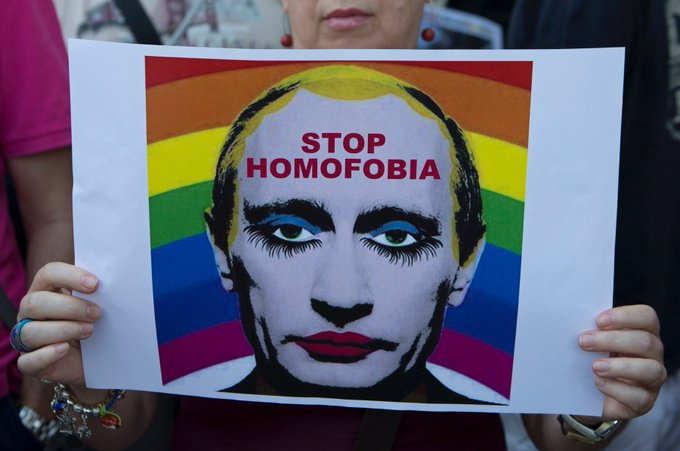
Пункт 4071 : картина з Путіним , як людина «з очима і губами , зроблених до» припиненого з неявним анти-гей плямою, маючи на увазі «передбачувану нестандартну сексуальну орієнтацію президента Російської Федерації.»
The Moscow Times  вважає , що  це , ймовірно , виглядає наступним чином :
Цей плакат став популярним в 2013 році, після того, як в Росії був прийнятий закон , що забороняє пропагує дітям про «нетрадиційних сексуальних відносин»,  і протестуючі права геїв були побиті і арештовані .
Але гей - меми Путін вже  поширилися  в Росії розправився з обох сексуальних свобод і онлайн мовлення в останні роки.
Таким чином, ще один новинний сайт вважає, що заборона зображення це один:
Фото публікується В РФ визнали екстремістським плакат з нафарбованими Путіним і Медведєвим
(Інша людина в цій картині є прем'єр - міністр Росії Дмитро Медведєв, до речі. Він частіше асоціюється з  сплячих мемів ,  ніж питань сексуальності, хоча в 2015 році  він підписав наказ , що забороняє транссексуалів від водіння .)
Представник Кремля розповів державне інформаційне обслуговування в Росії, ТАСС, що він не бачив Путін-клоун картини, хоча він був упевнений, що він не став президентом.
«Кремль говорить Путін вміло обтрушуючи" вульгарність "кинули проти нього," читає  санкціоноване державою заголовок  на цьому інтерв'ю.

да, ляльковий Обами П.Порошенко явно не корумповані  NoBigGovDuh  rahulvarshney  KevinRothrock ArtWendeley  pic.twitter.com/Hf8oAEvxyV

Кремль також став досить вправний в управлінні, що люди говорять один про одного в Інтернеті.
Росія пройшла свій  перший «Інтернет екстремізм» закони  в 2013 році, в відповідно до Moscow Times - рік після того, як Путін повернувся на пост президента і почав обмежувати громадянські права.
Через рік, газета повідомила,  Путін підписав закон про  введення тюремного ув'язнення для людей , які дають так багато , як палець вгору до забороненого інтернет - поштою. До їх числа відносяться статті про теоретичному перевороті, який висадився професором філософії в ув'язненні.
У 2015 році російська влада почала вимикаючи сайти Путіна критиків, і обмеження майже всі анонімні блоги,  повідомила The Washington Post . І російський інтернет - цензор вже давно дозволив громадських діячів в файл судових скарг , якщо вони перебігти мем , що спотворює їх «особистість». Як цей, може бути.


Сумно я не можу носити мій «Путін» браслет в аеропорту завтра з - АСП ... 

У минулому році United Press International та інші торгові точки повідомили про  матері -одиначці засуджений до громадських робіт  за перепроведення карикатури Путіни , дивлячись на карті , з ножем у руці. І колишній морський капітан з Ростова , який повторно відправили антивоєнний звіт про Україну отримав два роки умовно і один рік умовно за розпалювання ненависті і ворожнечі.

Повідомлення повідомила про дані плану уряду блокувати онлайн оголошення про антиурядовому мітингу в Москві в минулі вихідні,  заарештувавши сотні на останньому протесті .
Сага забороненого Путіна клоуна фактично почалося багато років тому, коли людина розмістив вбивання образливих зображень російського клон Facebook.
Серед них відкрито расистські та анти-іммігрантських повідомлення,  повідомляє Радіо Вільна Європа . Чоловік був визнаний винним в минулому році, його соціальний рахунок засобів масової інформації був закритий, і він був поміщений в психіатричну допомогу.
Через рік, багато з образів , які він спільно були додані уряду  багатотисячного чорного списку «екстремістських матеріалів»  - з потенційно гей клоуна перерахованих прямо над зображенням Путіна і Медведєва як нацистських солдатів.
Більше читання:
Avi SELK є американо-канадським кочівником. Він повідомив в Dallas Morning News від 2009 до грудня 2016 року, коли він приєднався до загального Ассайнмент Деск.
   дотримуйтесь @aviselk

Девід Філіпов є керівником бюро Пошти в Москві, зосередивши увагу на Росії і республік колишнього Радянського Союзу. Раніше він повідомив в The Boston Globe з Бостона, Росії, Іраку і Афганістану.
   дотримуйтесь @davidfilipov