NORTON META TAG

Showing posts with label ACLU. Show all posts

17 January 2025

The ACLU's Inauguration Day Advocacy Guide is here 17JAN25


 THE ACLU'S Inauguration Day Advocacy Guide is here. Do not be confused, it is not just for January 20th, 2025, but is a primer for the next 4 years. Click the link, bookmark the guide and if you can join the ACLU. I have been a sustaining member of the ACLU for many years, I donate $10.00 a month, not a lot but it is what I can afford.  And I participate in their campaigns on different issues to protect, maintain and strengthen our civil rights, our civil liberties, our Constitution and our democratic Republic. The threat to our nation is real and serious and must not be ignored or go unchallenged. 

The ACLU's Inauguration Day Advocacy Guide is here

Donate Now
Facebook     Threads     Instagram

Sign up for ACLU texts 

We respect your right to privacy – view our policy.

This email was sent by:
ACLU
125 Broad St.
New York, NY 10004

11 November 2024

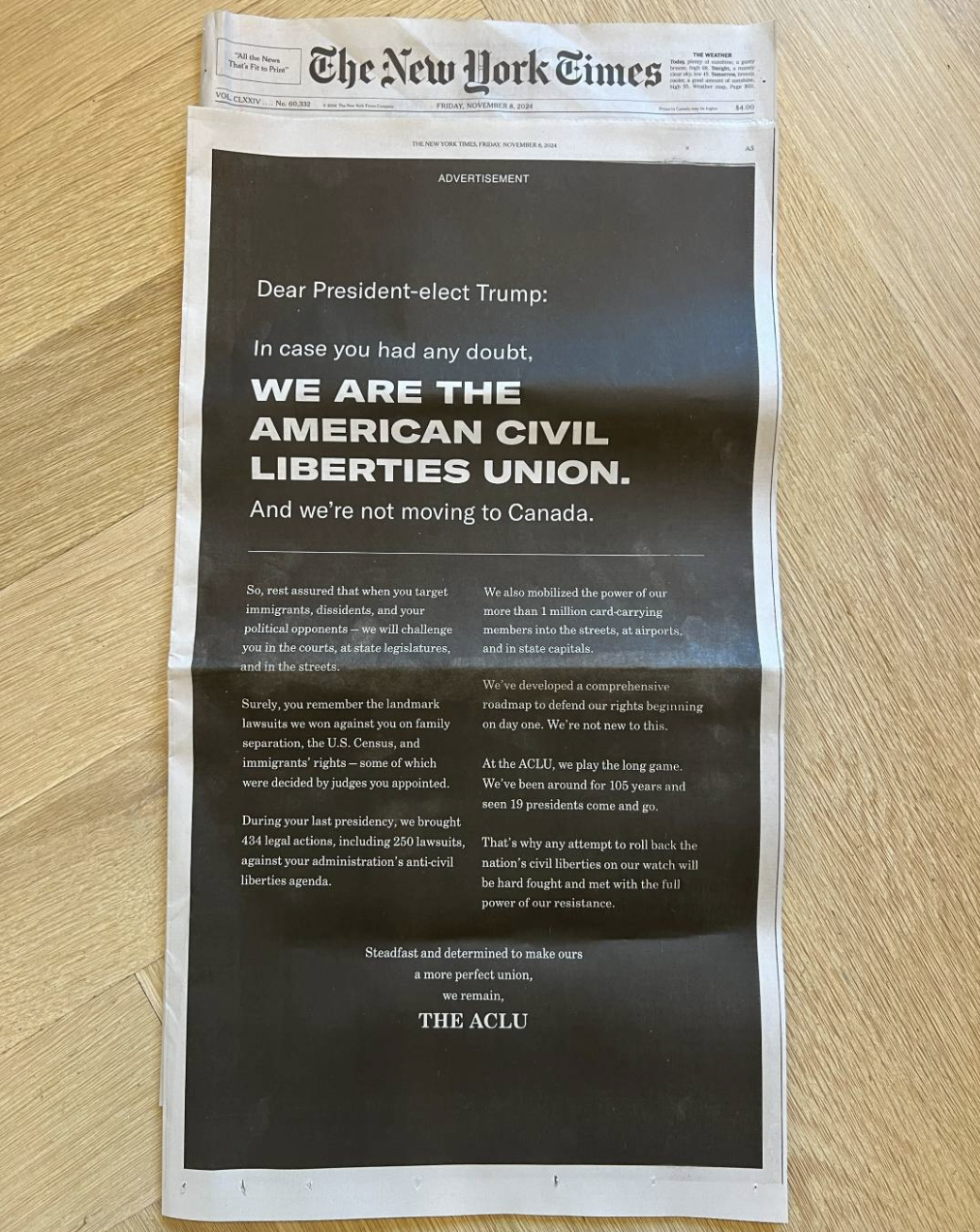
We have a message for Donald Trump 11NOV24


 I will survive due to my faith and the ACLU! I have been a proud member and supporter for years!


15 September 2020

LET PEOPLE VOTE: Your voting plan in 4 easy steps FROM THE ACLU 14SEP20


Today 15 September, 2020, we have 49 days till the 2020 presidential and national elections on TUESDAY, 3  NOVEMBER 2020. If you are not sure if you are registered to vote, if you have to register to vote, if you do not know what voting requirements are in your state the ACLU offers the following information.  So many people have sacrificed so much including those who gave their own lives on the battlefield as well as on the streets of America so we have the ability, the right and the responsibility to choose those who govern us, please do not let their sacrifice be in vain. In the words of the late, great John Lewis, "We must go out and vote like we have never, ever, voted before"!

We have just 50 days until Election Day, and it's imperative that every eligible voter safely casts their ballot amidst the ongoing pandemic. As the ACLU continues to fight for voting rights nationwide, we also want to help you make your own voting plan now.

Here are four easy ways to start putting your voting plan in place for this pivotal election:

1. Register

  • First thing's first: Check your registration status if you haven't done so already. If you discover you need to register to vote or update your registration, go to vote.gov to start the process. (Please note: Both links take you to third-party websites, nass.org and vote.gov, respectively.)

2. Find VA's Voting Information

3. Learn About Vote by Mail

4. Know Your Voting Rights

  • Before you fill out your ballot, knowing your voting rights is crucial. Learn more here about how to exercise your voting rights, resist voter intimidation efforts, and access disability-related accommodations and language assistance at the polls.

Craig, we are in the courts and in Congress doing everything in our power right now to ensure no one has to choose between their health and the right to vote during a global pandemic. And it's in your power to help in this fight by making a voting plan at aclu.org/voter today. Then, come November 3rd, we'll all have done our part to ensure we can vote like our rights depend on it. Because they do.

Thanks for taking action,

The ACLU Team

P.S. Already made your voting plan? Help your friends and family be just as prepared by forwarding this email or texting five contacts in your phone this link: aclu.org/voter

05 December 2017

Mother Jones Giving Guide.4DEZ17

Related image
MOTHER JONES offers this gift giving guide for those who want to donate to organizations and / or buy from companies that make a difference in the lives of the least among us. I am a monthly donor to the ACLU and  Doctors Without Borders, both are 4 star (highest ranking) charities per Charity Navigator as is NARAL. Operation Smile is not rated  on Charity Navigator because so much of their expenses are covered by donated services.  About 24% of Operation Smile funds go for administration and fund raising , and I checked organizations rated by Charity Navigator with similar expenses, they are generally rated 2 stars. I myself do not donate to 2 star charities, each can make their own decision. 
Dear Reader,
If you read Mother Jones that tells me you value independent, impactful journalism. And I’d bet those same values apply to the purchases you plan to make as the holiday season starts to pick up.
Whether a bottle of sustainable wine, a book or pin that make a statement, or a donation in-honor of a loved one, our Annual Gift Giving Guide is full of thoughtful and unique gifts that our advertisers picked out just for Mother Jones readers like you. You can feel good about where your money goes when you shop with our featured partners, and I hope you’ll check out their offerings in the email below.
Sincerely,
Steve Katz
Publisher, Mother Jones
 
ACLU
The ACLU is fighting a wave of extremism in all 50 states. Now more than ever, we need you by our side. We are your ACLU. Make your donation today and help us keep fighting for the Constitution and the rule of law.
aclu.org
 
Article22
ARTICLE22 is a social enterprise that creates beautiful, meaningful jewelry and gifts from upcycled Vietnam War era bomb scrap and other debris. Each piece is hand crafted by fair trade farmer-artisan families in Laos who work from their gardens.
article22.com
 
Dissent Pins
Give the gift of RBG! Justice Ruth Bader Ginsburg wears a special collar when she dissents from a Supreme Court decision, and her "dissent collar" is now available as an enamel pin or necklace! 50% of profits from all sales are donated to the Center for Reproductive Rights, The International Refugee Assistance Project, and the Bronx Freedom Fund.
dissentpins.com
 
Doctors Without Borders
Donate now to help Doctors Without Borders bring emergency medical care where it is needed most. Doctors Without Borders USA takes no government funding and relies on unrestricted funds from private donors. So when an emergency strikes, we don't have to write grants or ask for earmarked donations before we respond—we assess the needs and act fast.
doctorswithoutborders.org
 
As the Poppies Bloomed
A Novel of Love in a Time of Fear
Double Bronze Winner, 2015 Foreword INDIEFAB Book for the Year Awards. Finalist, Best New Fiction Category, 10th Annual National Indie Excellence Awards. Finalist, Best New Fiction Category, 2015 USA Best Book Awards.
ipgbook.com
 
NARAL Pro-Choice America
Give the gift of reproductive freedom to yourself or in honor of someone you care about this holiday season! Be a part of our 1.2 million member-activists organizing and mobilizing to protect abortion care and birth control access, paid leave, and pregnancy discrimination protections for every person, in every state.prochoiceamerica.org
 
Operation Smile
Is there anything better than a smile? Igniting that spark of joy and gratitude is the best part of giving a thoughtful gift. Now, with our brand-new 2017 Holiday Gift Catalog you can help bring TWO smiles with ONE gift: your loved one will appreciate a meaningful gift, and you will help transform the life of a child born with cleft lip or cleft palate.
operationsmile.org
 
Voices for Progressive Change
UC Press
From searing critiques of politics and capitalism, to in-depth investigations on racial and gender inequality, to absorbing histories of activism and social justice, these new releases from the University of California Press will inspire the way you think about the world today.
ucpress.edu
 
Holiday Gift Guide comes to you from Mother Jones, an award-winning, nonprofit investigative journalism organization.
DonateMother Jones Store

Mother Jones and its non-profit publisher, the Foundation for National Progress, does not endorse any political candidate, political organization, commercial product, process or service, and the views expressed in this communication do not constitute an endorsement, recommendation or favoring by Mother Jones.

21 April 2017

Donald Trump Has Free Speech Rights, Too 20APR17

Image result for aclu logo
A LOT of people, mostly on the political right, do not like the ACLU because they are seen as promoting a liberal, left wing agenda. Nothing could be farther from the truth. The ACLU is dedicated to protecting the civil liberties, civil rights and human rights of all Americans and they have done that since their founding. The political right demonizes the ACLU with deceptive and false propaganda because  the cases and causes the ACLU takes on and / or supports often oppose the agenda of the political right and are or would be a violation of our civil liberties, our civil right, our human rights as Americans. The ACLU has and will continue to defend these very rights for people and organizations of the political right. Here is an article from the ACLU regarding freedom of speech, the right of all of us, including (NOT MY) president drumpf/trump. I am not a fan or supporter of drumpf/trump, but this article makes me proud to be a member and supporter (financially and through activism) of the ACLU for many years.

Donald Trump Has Free Speech Rights, Too

By Lee Rowland, Senior Staff Attorney, ACLU Speech, Privacy, and Technology Project
APRIL 20, 2017 | 2:15 PM

Few organizations have been more engaged in fighting President Donald Trump’s attacks on civil liberties and civil rights than the ACLU. But it’s important to remember that political candidates — including Donald Trump — have constitutional rights, too.
A judge recently held that Donald Trump may have committed incitement when, at a campaign rally in Kentucky last year, he called on his audience to eject protesters who were subsequently manhandled by the crowd. While it’s a closer case than most, I don’t think those words can clear the high bar for what constitutes incitement. 
The case arises from a March 2016 campaign rally in Louisville. A video from the event shows a Black woman surrounded by a sea of shouting white faces contorted by fury. Trump yells, “Get ‘em outta here! Get out!” He adds, with notably less enthusiasm, “Don’t hurt ‘em.” The woman is shoved, screamed at, and spun like a top by a multitude of Trump loyalists. It’s a truly scary sight.
The woman, Kashiya Nwanguma, and two other attendees who were similarly ejected from the Louisville rally have filed a lawsuit over the incident. They assert claims of assault and battery against several of the rally’s attendees, and anyone who physically abused them should absolutely be held liable. But the plaintiffs also sued Trump, alleging that his speech incited the other defendants to act violently. They pointed to a history of violence at Trump’s rallies and his prior assurances that he’d cover the legal fees of his supporters who roughed up protesters.
There is no question that Trump’s decision to use his bully pulpit to actually bully protesters and to rile up his crowds against them is morally despicable. But legally, deciding whether what happened in that crowded theater rises to the level of incitement is a trickier task.
This month, a federal judge in Kentucky allowed the case to proceed on the grounds that Trump may have engaged in “incitement to riot” at that rally. (Notably, he allowed the case on two theories — both intentional and negligent incitement — more on that below.)
The decision is troubling from a civil liberties perspective, no matter what you think of Trump or of his policies. Many of our strongest First Amendment protections come from cases in which the government tried to punish individuals for advocating illegal activity.
Incitement charges have been used to jail anti-war protestors, labor picketers, Communists, and civil rights activists. Over time, the Supreme Court learned from these mistakes and adopted a very speech-protective test to determine when incitement has taken place. In Brandenburg v. Ohio, the court ruled that the First Amendment permits liability for incitement only when speech is intended and likely to cause imminent and serious lawlessness. It’s a high bar for a reason, and Trump’s conduct at the rally didn’t meet it.   
A brief tour through the history of Supreme Court incitement cases shows how the very same First Amendment rules that protect racist speech also protect civil rights advocates. The Brandenburg test is named after Clarence Brandenburg, an avowed racist convicted for holding an Ohio KKK rally in the late 1960s. The Supreme Court overturned his conviction, despite the rally’s talk of “revengeance” against Jews and Black people, and held that “abstract advocacy of force” was protected speech that did not amount to incitement.
A few years later, in a short opinion relying entirely on Brandenburg, the court struck down another state conviction — this time of an anti-war protester who a cop overheard yelling, “We’ll take the fucking streets later.” The court again held that advocacy of generic illegal action was not incitement.
And perhaps the high water mark for incitement law is NAACP v. Claiborne Hardware, in which the court upheld civil rights icon Charles Evers’ right to deliver “emotionally charged rhetoric” at a 1966 rally. Evers was advocating that a crowd of supporters boycott racist, white-owned businesses, and during his passionate speech, he promised that “we’ll break the damn neck” of anyone who broke the boycott. Citing Brandenburg once again, the court held that there was no evidence “that Evers authorized, ratified, or directly threatened acts of violence” — even if he suggested such violence might be justified.
So the history of modern incitement jurisprudence begins with a KKK leader’s free speech rights and extends to a Vietnam War protester and a great civil rights icon. There can hardly be a better illustration that our free speech rights are truly indivisible. And they sprang, battle-born, from the tumult of the civil rights era — and apply to racists and civil rights advocates alike.
The stringent Brandenburg test is designed to ensure breathing room for the messy, chaotic, ad hominem, passionate, and even racist speech that may be part of the American political conversation. For that reason, the Supreme Court’s signposts for incitement consist of cases upholding free speech rights in the face of overzealous prosecutions. So we know what the Supreme Court thinks incitement isn’t more than we know what they think it is.
From a lawyer’s point of view, there is something fascinating about Donald Trump: he appears determined to make us dust off our law books and reexamine basic constitutional precepts. Now it’s incitement’s turn.
So we have a theater, a frenzied crowd, an assault on a vulnerable person, and a demagogue. Why doesn’t this qualify as incitement?
First, the notion of “negligent incitement” is plainly unconstitutional, and, under Brandenburg, a contradiction in terms. Negligent conduct is careless conduct, not intentional conduct. The law makes it clear that if Trump did not intentionally advocate violence, he cannot be held liable for incitement.
Even setting negligence aside, however, the facts we have also don’t add up to intentional incitement. Start with the words themselves: “Get ‘em outta here.” As my colleague Rachel Goodman and I have previously written, the First Amendment does not entitle you to protest at a politician’s privately run rally. So by protesting in Louisville, Nwanguma and her two co-plaintiffs were subject to lawful removal. Therefore, Trump’s words do not explicitly refer to any unlawful action — he had a right to tell them to leave. And remember that Trump added, from the lectern, “Don’t hurt ‘em.” At face value, this doesn’t appear to pass that high bar for incitement. Indeed, Trump explicitly disavowed violence.
But the plaintiffs did a good job marshaling their facts, which is what makes this such a close case. Since incitement is in part about state of mind, the fact that Trump previously shared his hope that people “knock the crap outta” protesters and offered to pay the legal fees of those who did has real relevance. And interestingly, the judge cited the words uttered right after “Get ‘em outta here”: Trump added, “I can’t say ‘go get ‘em’ or I’ll get in trouble.” The judge held that this was Trump’s way of conveying, with a wink and nod, a desire for violence to his supporters.
The final inquiry is whether Trump’s words were actually likely to incite violence. Put another way, would a reasonable person have heard “Get ‘em outta here” as code for “violently assault those protesters”? Last week, one of the individual defendants in this case actually countersued Trump, arguing that if he’s found liable for assault, Trump should pay his legal fees — as the president does appear to have promised. So we have one listener who claims violence was what Trump wanted. (Of course, this argument would conveniently relieve him of responsibility for his own conduct.)  
But the First Amendment requires that we focus fault on those who act, rather than on those who merely speak, absent extraordinary circumstances. We need to be extremely wary of granting government the power to shut down a speaker because of the power of her words. We need to ensure a world where Charles Evers can get heated and where street activists can sharply criticize the police, without worrying that someone in the audience will hurt someone and then try to blame the speaker.
Some people have cheered the judge’s ruling in this case — perhaps gratified that Trump’s ugly campaign is finally getting some comeuppance. It’s certainly understandable why reasonable people could see those Trump rallies as racist, sexist powder kegs. I know that many Americans fear we’re slipping into fascism, and see the violent euphoria that has sometimes emerged at Trump rallies as a harbinger of a moment from which our democracy won’t return. I worry, too.
But if we really want to protect against that moment, we cannot do it by weakening our commitment to constitutional values. So many of the high water marks of the First Amendment were etched during the civil rights era. It is never a good time to alter the law so that more speech can be punished. Political speech should qualify as incitement only if it is unequivocally and inherently a request for violent and unlawful action.  
“Get ‘em out” just doesn’t meet that bar.