

CHRISTIANS, not the apostate "christian" nationalist, and true followers of all other faiths and those morally opposed to the ice, hsi and cbp gestapo actions of the drumpf / trump-vance administration must join Pope Leo XIV, the US Catholic Bishops, and others and speak out against the racism, hate, brutality, violence, illegal and immoral actions and policies against immigrants and American citizens by the fascist department of homeland security and fascist fotze trunt kkkristi noem and fascist fotze trunt gregory bovino. If you see ice, hsi and cbp gestapo in action video it and post it on line. Support organizations providing support for immigrants, e mail your representative and senators telling them to introduce, support and pass legislation to rein in homeland security. This from Sojourners
Of Course the Virgin Mary Would Trample ICE
Every age of Christian art has wrestled with power. From the earliest icons to contemporary murals and prints, artists have used sacred imagery to question authority, confront injustice, and call the church to stay accountable to its own ideals. As chaplain Federico Cinocca writes, protest art can serve as “a precious ally to help theology in its [critical] role and uncover narratives that reinforce marginalization.” In this sense, religious art does more than depict belief; it performs theology through resistance.
When artists turn to Christian symbols not to flatter power but to challenge it, they act in the prophetic tradition—reclaiming artistic creativity as a force for liberation. This tradition continues today in the work of Catholic and queer artists who reinterpret sacred figures to stand with the oppressed.
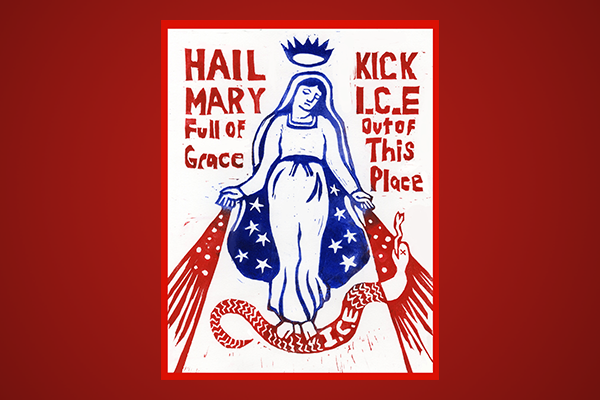
Libby Kercher, who is a friend, recently created a print of the Virgin Mary trampling a serpent with the abbreviation for Immigration and Customs Enforcement on it. This art is an example of a queer Catholic transforming a familiar image into a prayer of protest. Depicted in the colors of the American flag, Mary holds her arms out as she gazes down at the snake, rays of red light shooting out from her hands. The text on Kercher’s image reads, “Hail Mary, Full of Grace, Kick I.C.E. Out of This Place.”
The print quickly went viral among Catholic communities—including far-right ones. Within hours of its release, Former Australian politician George Christensen posted on X, “The Left has appropriated Mary in their war against Trump’s deportation strategy, with a meme of Our Lady of Guadalupe standing on a snake representing ICE.” He added that he had “created a new prayer and meme” in response.
Christensen’s image depicts a white, brown-haired Mary draped in a white veil and cloak, clutching lilies, and crowned with gold. Behind her waves an American flag. The text encircling her reads: “Hail Mary, Full of Grace, Let No Invader Show Their Face.” The aesthetic borrows the familiar language of a devotional image but empties it of compassion, converting Mary into a kind of border guard.
The dichotomy between Christensen and Kercher’s images is acute. And while both images are modern interpretations of the Virgin Mary, only one of these images comes close to representing who she actually was.
Mary herself was a Jewish woman from the land of Palestine who fled political violence with her family; the Holy Family’s flight into Egypt is one of Christianity’s earliest stories of migration (Matthew 2:13-23). To call immigrants “invaders” in her name is to invert the gospel entirely.
What Christensen’s meme misses is that Mary has long been a symbol of resistance for the colonized and displaced. According to tradition, she first appeared to the Indigenous peasant Juan Diego Cuauhtlatoatzin in 1531, speaking not Latin or Spanish but Nahuatl, the language of the Aztec empire. She emblazoned her own image on his tilma (cloak) of cactus fiber, revealing herself not to the people in power but to the poor and vulnerable. Her name, Our Lady of Guadalupe, is a bit of a colonial misnomer, with Guadalupe a possible mishearing of the Nahuatl phrase “Coatlaxopeuh” that sounds like “Guadalupe” in Spanish or a shrine in Guadalupe, Spain.
Guadalupe’s apparition itself was a kind of divine affirmation that holiness speaks the language of the oppressed.
From the moment she appeared to Diego, who is now a saint, the Virgin of Guadalupe has been a banner of liberation. During the Mexican War of Independence against Spanish colonial rule, insurgents marched into battle crying, “¡Viva la Virgen de Guadalupe!” A century later, her image resurfaced in the Mexican Revolution under Emiliano Zapata and again in the Chicano movement. When César Chávez and the United Farm Workers fought for labor rights in the 1960s, they carried her image at the front of their marches.
That legacy continues today. Anthropologist Alyshia Gálvez notes that many undocumented immigrants draw courage from devotion to Our Lady of Guadalupe, finding in her the promise of dignity amid persecution. When federal ICE raids swept Chicago in early September, parishioners from St. Eulalia Parish processed to a detention facility carrying a banner of the Virgin, hoping to bring communion to those held inside. They were turned away at the gate. The same thing happened again just last week. The procession, blocked by armed officers, mirrored the gospel story itself: Mary and her child again denied entry.
Christensen’s image ignores this history and denies Mary’s allegiance to the oppressed. He essentializes the Mother of God into an icon of white supremacy and Catholic nationalism. The figure of a white Mary is hardly new, but it is historically false. Around the world, believers have long depicted her and her child in their own image, a sign of divine solidarity with every culture and complexion. But over the last half-century, as white American depictions of Jesus have come to dominate global iconography, Mary’s whiteness has been coded as purity itself.
In that sense, it is Christensen—not Kercher—who has appropriated Mary. His white, flag-draped Virgin descends directly from the colonial imagination: This is the same imagination that baptized conquest, erased Indigenous faiths, and justified enslavement in the name of Christian “civilization.”
To claim that Christensen’s image is somehow “better,” as one X user did, is to reinforce a Catholic nationalism that privileges white Catholic power at the expense of the very people who make up 36% of U.S. Catholics. Christensen’s image is only one of many digital reproductions that drape the Virgin in American iconography—images where Mary’s veil becomes the stars and stripes, or the infant Christ is swaddled in the flag itself. Each image collapses holiness into nationalism, glorifying the same nativist impulses that have long excluded and even brutalized both white Catholics and Catholics of color.
By contrast, Kercher’s illustration recalls a far older and more radical tradition: Mary as the patroness of the poor, the insurgent, and the exiled. Kercher is not alone in this reclamation. Across social media, artists are reimagining the Mother of God not as an ideal of racial purity but as a fierce, grieving, and defiant woman who protects her children. Artist Ben Wildflower, for example, depicts Mary in combat boots poised on a skull, fist raised, surrounded by the Magnificat’s own words: “Cast down the mighty, send the rich away. Fill the hungry, lift the lowly.”
Kercher was stunned by the response. “The reception of the print has gotten out of my hands,” Kercher told Sojourners through text message earlier this month. “I’ve had to shut down people putting it on T-shirts and have been monitoring its reception on X.” The response to the image signals a theological reckoning with who Mary has been, and who she is becoming.
In every age, Christian art has wrestled with power—and in doing so, has revealed the pulse of a living faith. Kercher’s Mary, fierce and unflinching, belongs to that lineage of artists who refuse to let the sacred be domesticated by empire. The image is not a rupture from Catholic tradition but its renewal, an echo of the Magnificat’s own protest song. In Kercher’s print, Mary is not meek but magnificent: She tramples the serpent of state violence and opens a new horizon for those seeking liberation within the church itself.

Emma Cieslik (she/her) is a queer, disabled religious scholar and museum worker based in Washington, D.C.

Max Kuzma is a transgender man and lifelong Catholic who advocates for LGBTQ+ inclusion in the church and writes about the unique gifts of queer people and the beauty of diversity in God’s creation.
U.S. Catholic Bishops Issue Rare Rebuke of Trump's Immigration Crackdown

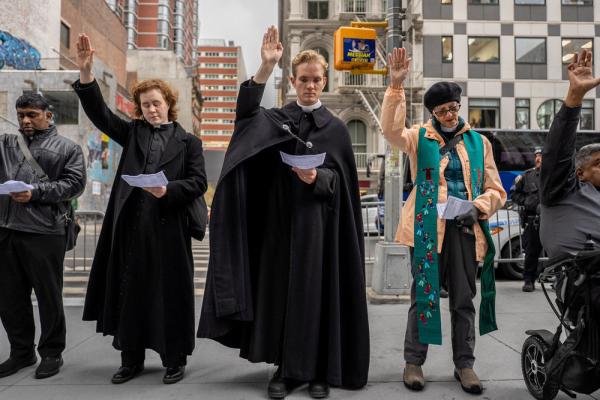
FILE PHOTO: A priest and other members of the clergy pray for respondents and detainees outside of U.S. immigration court in Manhattan, in New York City, U.S., November 13, 2025. REUTERS/David 'Dee' Delgado/File Photo
The United States Conference of Catholic Bishops has issued a rare condemnation of President Donald Trump's immigration crackdown and advocated for “meaningful immigration reform.”
“We are troubled by threats against the sanctity of houses of worship and the special nature of hospitals and schools,” the bishops said in a special message, the first of its kind in 12 years.
The Department of Homeland Security, which oversees immigration efforts, did not immediately respond to a request for comment.
The message echoes similar critiques made by Pope Leo, who has called for “deep reflection” about the way migrants are being treated in the U.S. under Trump.
The Trump administration has advanced an aggressive immigration agenda since taking office earlier this year. Trump has rescinded policy that limited immigration arrests near sensitive locations, including churches, hospitals and schools, and deployed federal agents across the U.S. to ramp up such arrests.
In their message, the bishops expressed concern about what they described as “a climate of fear and anxiety around questions of profiling” and immigration enforcement. They said they were saddened by the debate and vilification of migrants, and opposed “the indiscriminate mass deportation of people.”
The bishops also raised concerns about conditions in detention centers, and what they called the arbitrary removal of legal status of some migrants.
“We recognize that nations have a responsibility to regulate their borders and establish a just and orderly immigration system for the sake of the common good,” the bishops said.
Jasper Ward is a breaking news reporter in Washington. She primarily covers national affairs and U.S. politics. Jasper was previously based in The Bahamas where she covered the collapse of FTX and the subsequent arrest of its founder Sam Bankman-Fried. She was a part of the Reuters team that won the Gerald Loeb Award for breaking news for its FTX coverage.





 About Nadia Bolz Weber