NORTON META TAG

Showing posts with label 2017 gop congress. Show all posts

12 December 2017

THE FIGHT OVER THE GOP TAX SCAM ISN'T OVER. CALL OR E MAIL CONGRESS NOW. 11DEZ17

Related image
DEMOCRATIC and republican representatives and senators need to be called and / or e mailed and told by the people, the 99%,  to vote against the republican tax plan that takes from the middle class, the retired, the poor, the working poor, from students and children and military veterans to give tax breaks to the 1%, to the greedy American oligarchy that has bought and paid for the drumpf/trump-pence administration and is demanding a return on their corrupt "investment". Find your representative here and your senators here and remember DEMOCRACY IS NOT A  SPECTATOR SPORT so if you do not contact your elected officials and the republican tax legislation is passed so every day becomes a BOHICA day for you and your family just remember to be looking in the mirror when you are complaining about it. From UltraViolet....
Some think the fight to defeat the tax bill may be lost, but it's far from over.
The bill is still headed for one final vote, and Republicans in Congress are already facing a barrage of protests.
Constituents shut down Sen. Susan Collins' office in Bangor, Maine. Folks in Toms River, New Jersey marched to The Beatles' "Taxman" to urge Rep. Chris Smith to vote no. And at over 60 colleges and universities in 33 states, students protested the Republican tax bill's plan to make college unaffordable.
Your Representative, your Senator, may be one of the few who isn't entirely convinced by the tax plan, is facing a ton of constituent outrage, too. That's why Republican leaders are frantically trying to rush a final vote. Your call could actually swing their vote--and kill this bill.
When you contact your Representative and Senators it's best to speak in your own words, but here are some points to get you started.
  • Hi, my name is ___ from [your location]. I'm calling to demand the Representative vote NO on the final tax plan.
  • 83 million middle- and working-class families will get a tax hike to pay for an additional 20% tax break for corporations and the 62% of tax cuts that will go to the top 1%. 
  • How can the Representative plan on ending individual tax cuts for middle-class families while giving corporations a permanent tax giveaway? 
  • Women and their families will end up paying for this plan. The plan will gut Medicaid, Medicare, food assistance, and other services millions of women rely on so billionaires and corporations don't have to pay their fair share.
  • Under the Senate tax plan, 13 million people will end up without health care. Don't let that happen!

04 December 2017

Will the GOP tax bill cost Donald Trump 'a fortune'? No 30NOV17


I was going to start this post on the 2017 gop/greed over people tax plan with the question 'why would drumpf/trump lie about this' but then I was like DUH, this is donald drumpf/trump and he is a pathological liar, From PolitiFact.....

Will the GOP tax bill cost Donald Trump 'a fortune'? No


By Louis Jacobson 
President Donald Trump said he wouldn’t benefit financially from the Republican tax legislation on Capitol Hill. In fact, he said he would get socked by it.
"So right now, America's tax code is a total dysfunctional mess," Trump said in a speech in St. Charles, Mo., on Nov. 29, 2017. "The current system has cost our nation millions of American jobs, trillions and trillions of dollars, and billions of hours wasted on paperwork and compliance. It is riddled with loopholes that let some special interests -- including myself, in all fairness. This is going to cost me a fortune, this thing -- believe me. Believe me, this is not good for me."
Trump’s claim sounded dubious. The analyses of the bills we have seen show advantages, not disadvantages, for the wealthy as well as corporations.
When we asked the White House for additional details about how the law would hurt Trump, they cited the repeal of the state and local tax deduction, which allows taxpayers to deduct all or some of their state and local tax burden from their federal taxable income. As a wealthy resident of New York City, Trump would likely face high tax state and local rates. (At the Nov. 30 press briefing, White House Press Secretary Sarah Huckabee Sanders cited the elimination of deductions as one possible source of a tax increase for the president.)
The White House also cited "anti-abuse" provisions within the changes being made to the "pass-through" tax rates for business income that is taxed within individual tax filings.
Trump may indeed get hit by some of the tax bill’s specific provisions. But independent analyses of the bill’s potential impact on his own tax situation agree that, after all is said and done, he should come out far ahead compared to the status quo.
It is impossible to pin down the benefits that would flow to Trump's tax situation due to his own refusal to follow the decades-old presidential precedent of releasing his tax returns. (He broke his promise to release them).
Any projections depend on a leaked, partial tax return from 12 years ago, and a lot may have changed since then. For instance, there's no way of knowing whether 2005 was an unusual year for Trump’s finances.
Analyses by the New York Times and NBC attempted to understand how Trump's finances would be impacted by the House bill rely on the partial 2005 return. The Times based its calculations on a framework that preceded the official release of both chambers’ bills. The NBC analysis was based on the House version of the bill. (The framework is different than the House bill in its details, but they share many common elements.)
The elimination of the alternative minimum tax and the lowering of the pass-through tax rate for certain types of business income -- minus tax increases from eliminating many existing deductions -- would leave Trump $42 million better off, according to the New York Times analysis. (The alternative minimum tax requires that taxpayers with many deductions pay at least a minimum amount of taxes.)
The NBC analysis — undertaken by Maury Cartine, the partner in charge of tax and business services in the New York City office of the Marcum Group — found net savings of $22.5 million for Trump, primarily from eliminating the alternative minimum tax.
Trump’s myriad ventures could enable him to benefit from several changes.
The House version would allow "pass-through" business income to be taxed at 25 percent, rather than the current maximum of 39.6 percent. The Senate bill would use a different mechanism for such income that is less advantageous.
Trump’s 2005 return showed more than $109 million in income from businesses that would potentially benefit from a tax break on pass-through income.
So, at the very least, two independent estimates came up with immediate savings in the low tens of millions of dollars. Even if the actual savings for Trump end up being a small fraction of that amount, that would be more money than most Americans make in a year, and more than some make in a lifetime.
Meanwhile, this doesn’t include the potentially massive benefits Trump could see from changes to the estate tax -- albeit savings that would take longer to materialize.
The estate tax comes into play when someone dies and their estate is large enough to qualify for the tax. Due to generous exemptions, the tax generally hits wealthy taxpayers.
The House bill would end the estate tax after 2024. The Senate bill would keep it, instead doubling the current exemption for individuals to $11 million. The approach that prevails in the final version of the bill is unknown for now.
Both the Times and NBC estimated that the House version of the estate tax could save Trump more than $1.1 billion. Neither analysis looked specifically at the Senate’s version; that approach would likely provide Trump with some savings, but on a much smaller scale. (It’s worth noting that any potential savings from the estate tax would come only after the death of Trump or his wife Melania, presumably years down the road.)
Trump’s possible gains from the bill are hardly unique for the wealthiest Americans.
According to analysis of the Senate bill by the Joint Committee on Taxation, American households with incomes in excess of $1 million -- a threshold Trump is almost certainly far above -- would see a tax savings of $41,819 in 2019 and $36,259 in 2017.
And an analysis by an independent group, the Urban Institute-Brookings Institution Tax Policy Center, estimated that for the top one-tenth of 1 percent of earners -- those with incomes of at least $3,439,900 -- 72 percent would see tax cuts and 28 would see a tax increase in 2018. The average tax cut for this group would be $174,620 in 2018.
Our ruling
Trump said, "This (tax bill) is going to cost me a fortune, this thing -- believe me. Believe me, this is not good for me."
While there is uncertainty about the exact scale of Trump’s potential gains -- both because of the lack of a final version of the bill and because of big gaps in the public knowledge about his personal finances -- either of the GOP bills would almost certainly give Trump a big windfall.
Two independent analyses suggest that it could be in the low tens of millions of dollars immediately. His family also could get as much as $1.1 billion over the longer term if the estate tax is fully repealed, as the House bill would do.
We rate the statement False.

About this statement:

Published: Thursday, November 30th, 2017 at 5:14 p.m.
Researched by: Louis Jacobson
Edited by: Katie Sanders
Subjects: Taxes

Sources:

THE POLITICS OF JOHN MCCAIN

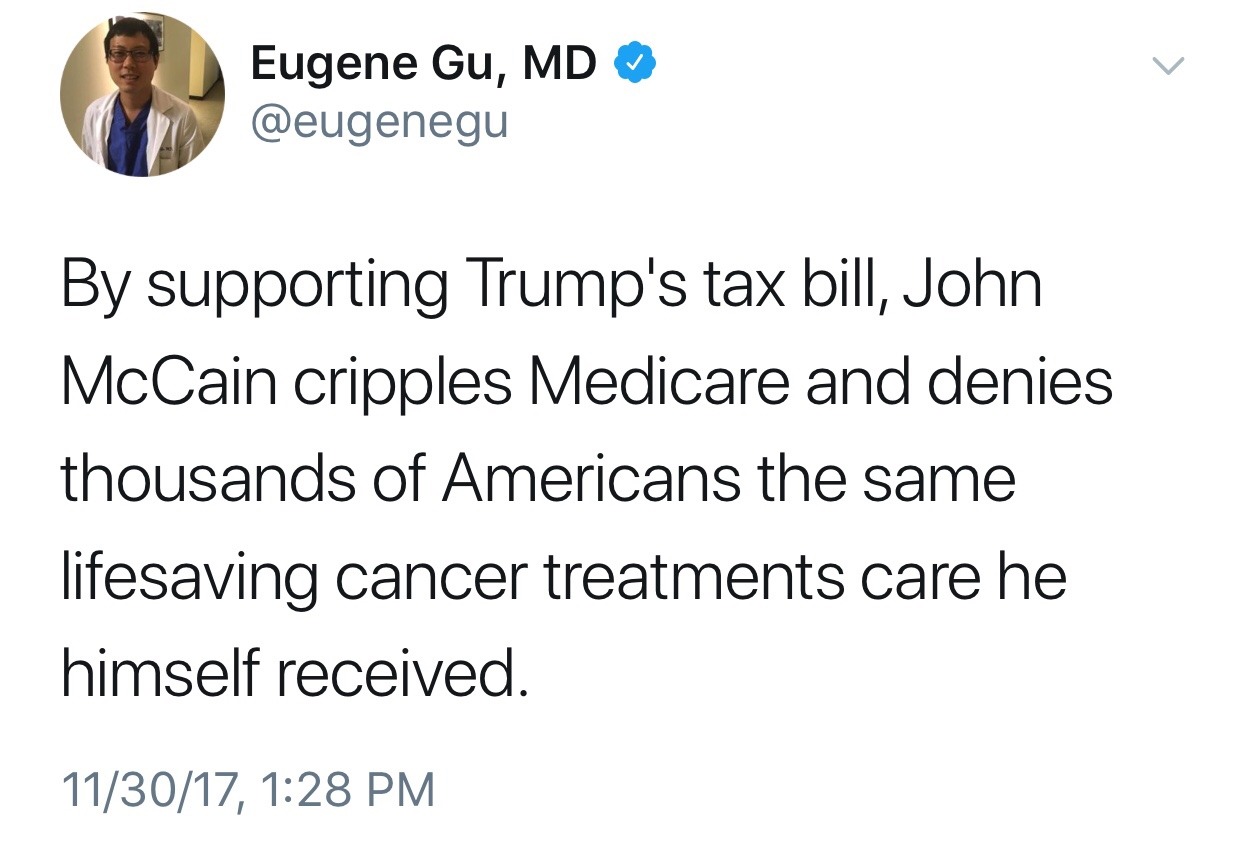
SEN john mccain r AZ has shown time and again since drumpf/trump-pence took power he is neither brave or a patriot. His vote on the 2017 gop/greed over people tax plan proves again he doesn't have the courage to stand up to the gop congressional leadership and the drumpf/trump-pence administration in defense of the American people and that he is as greedy and self-serving as his repiglican colleagues. mccain gives true American heroes a bad name.....


David Stockman bombshell: How my Republican Party destroyed the American economy. TRUE IN 2010, ABOUT TO BECOME TRUE IN 2017

"The modern conservative is engaged in one of man's oldest exercises in moral philosophy; that is, the search for a superior moral justification for selfishness.” - John Kenneth Galbraith


Senate Republicans pass a tax bill giving corporations a massive tax cut and cutting health care
“The hypocrisy is astounding”: this tax bill shows the GOP’s debt concerns were pure fraud
The Republican tax bill will exacerbate income inequality in America

America’s rich have gotten richer for decades, while the middle class and poor have seen meager gains. Since the mid-20th century, the top 1 percent have more than doubled their share of the nation’s income, from less than 10 percent to more than 20 percent.

The tax bill is the start of Obamacare collapse

It will hit red states especially hard.

David Stockman bombshell: How my Republican Party destroyed the American economy.

The “debt explosion has resulted not from big spending by the Democrats, but instead the Republican Party’s embrace, about three decades ago, of the insidious doctrine that deficits don’t matter if they result from tax cuts.”

Cue the FoxNews denunciations.
David Stockman, director of the Office of Management and Budget under President Ronald Reagan, has dared to call out his own party for creating our current economic problems. His NYT op-ed, “Four Deformations of the Apocalypse,” begins:
IF there were such a thing as Chapter 11 for politicians, the Republican push to extend the unaffordable Bush tax cuts would amount to a bankruptcy filing.
Given our long-term deficit problem, Stockman said it is “unseemly for the Senate minority leader, Mitch McConnell, to insist that the nation’s wealthiest taxpayers be spared even a three-percentage-point rate increase.”
UPDATE: Huffpost reports that in an interview today on NBC’s Meet the Press, “Former Fed Chairman Alan Greenspan said that the push by congressional Republicans to extend the Bush tax cuts without offsetting the costs elsewhere could end up being ‘disastrous’ for the economy.”
Here are some more excerpts from Stockman’s must-read piece:
More fundamentally, Mr. McConnell’s stand puts the lie to the Republican pretense that its new monetarist and supply-side doctrines are rooted in its traditional financial philosophy. Republicans used to believe that prosperity depended upon the regular balancing of accounts “” in government, in international trade, on the ledgers of central banks and in the financial affairs of private households and businesses, too. But the new catechism, as practiced by Republican policymakers for decades now, has amounted to little more than money printing and deficit finance “” vulgar Keynesianism robed in the ideological vestments of the prosperous classes.
This approach has not simply made a mockery of traditional party ideals. It has also led to the serial financial bubbles and Wall Street depredations that have crippled our economy. More specifically, the new policy doctrines have caused four great deformations of the national economy, and modern Republicans have turned a blind eye to each one….
The second unhappy change in the American economy has been the extraordinary growth of our public debt. In 1970 it was just 40 percent of gross domestic product, or about $425 billion. When it reaches $18 trillion, it will be 40 times greater than in 1970. This debt explosion has resulted not from big spending by the Democrats, but instead the Republican Party’s embrace, about three decades ago, of the insidious doctrine that deficits don’t matter if they result from tax cuts.
… when, in the following years, the Federal Reserve chairman, Paul Volcker, finally crushed inflation, enabling a solid economic rebound, the new tax-cutters not only claimed victory for their supply-side strategy but hooked Republicans for good on the delusion that the economy will outgrow the deficit if plied with enough tax cuts.By fiscal year 2009, the tax-cutters had reduced federal revenues to 15 percent of gross domestic product, lower than they had been since the 1940s. Then, after rarely vetoing a budget bill and engaging in two unfinanced foreign military adventures, George W. Bush surrendered on domestic spending cuts, too “” signing into law $420 billion in non-defense appropriations, a 65 percent gain from the $260 billion he had inherited eight years earlier. Republicans thus joined the Democrats in a shameless embrace of a free-lunch fiscal policy.
The third ominous change in the American economy has been the vast, unproductive expansion of our financial sector. Here, Republicans have been oblivious to the grave danger of flooding financial markets with freely printed money and, at the same time, removing traditional restrictions on leverage and speculation.
There’s only one piece of GOP orthodoxy even Stockman can’t bring himself to take on — the need for government policy to rebuild the U.S. industrial base:
The fourth destructive change has been the hollowing out of the larger American economy. Having lived beyond our means for decades by borrowing heavily from abroad, we have steadily sent jobs and production offshore. In the past decade, the number of high-value jobs in goods production and in service categories like trade, transportation, information technology and the professions has shrunk by 12 percent, to 68 million from 77 million. The only reason we have not experienced a severe reduction in nonfarm payrolls since 2000 is that there has been a gain in low-paying, often part-time positions in places like bars, hotels and nursing homes.
Well, the bold-face identification of the problem is right, but a major reason we have hollowed out the larger American economy is that the GOP have succeeded in blocking almost every major progressive effort to increase investment in infrastructure and R&D and other key aspects of a 21st century economy when Democrats were in charge, and they cut funding in those crucial areas when they were in charge. This effort will only intensify in the coming years.
So Stockman has only this solution:
It is not surprising, then, that during the last bubble (from 2002 to 2006) the top 1 percent of Americans “” paid mainly from the Wall Street casino “” received two-thirds of the gain in national income, while the bottom 90 percent “” mainly dependent on Main Street’s shrinking economy “” got only 12 percent. This growing wealth gap is not the market’s fault. It’s the decaying fruit of bad economic policy.
The day of national reckoning has arrived. We will not have a conventional business recovery now, but rather a long hangover of debt liquidation and downsizing “” as suggested by last week’s news that the national economy grew at an anemic annual rate of 2.4 percent in the second quarter. Under these circumstances, it’s a pity that the modern Republican Party offers the American people an irrelevant platform of recycled Keynesianism when the old approach “” balanced budgets, sound money and financial discipline “” is needed more than ever.
That would perhaps get our economic house in order in a narrow sense — assuming we deferred the balanced budgets until after the recovery is much further advanced. But it would continue the decline of our relative competitiveness to our major trading competitors.
Still, considering the source, this is an Emperor-has-no-clothes moment for the GOP. At least until the rest of the conservative kingdom turns on him.
Related Think Progress posts from today:
Related CP Posts: