NORTON META TAG

Showing posts with label Sen john mccain r AZ. Show all posts

04 December 2017

THE POLITICS OF JOHN MCCAIN

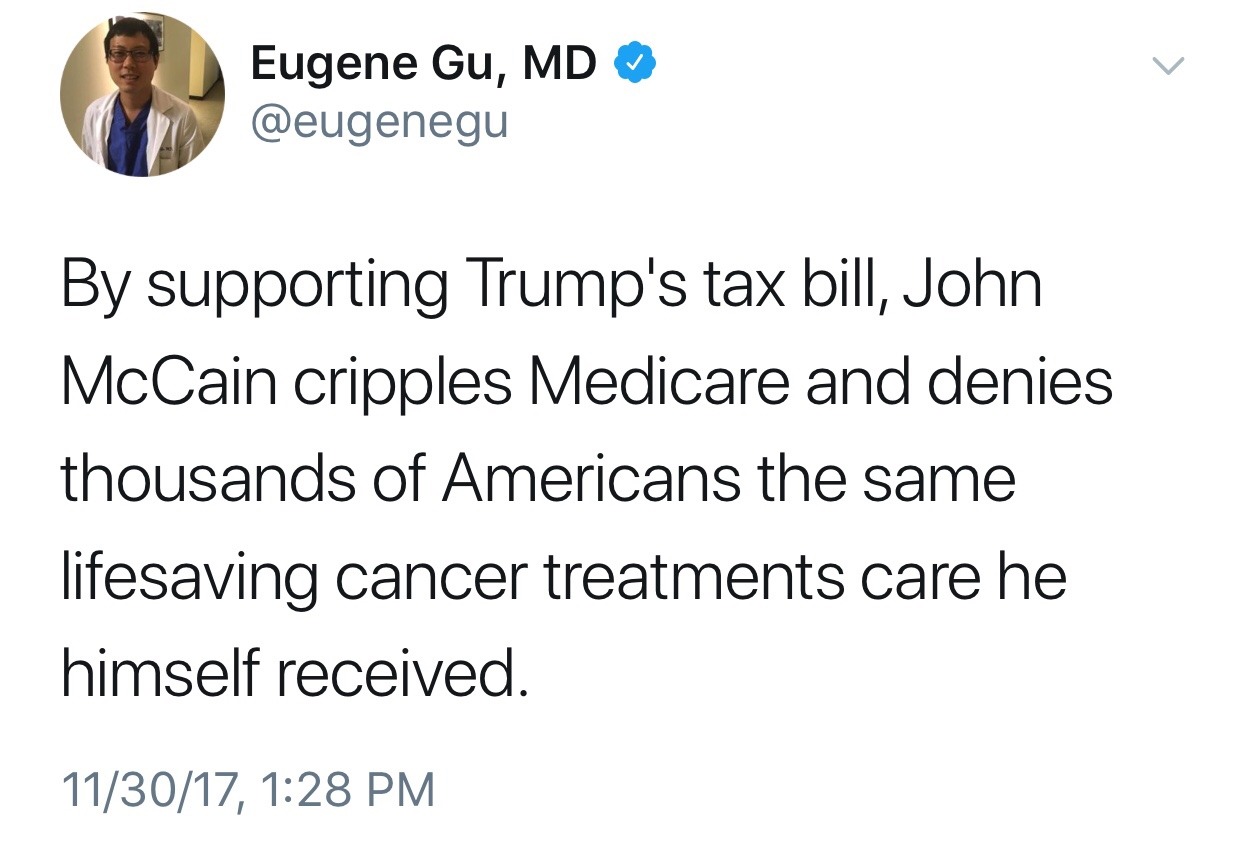
SEN john mccain r AZ has shown time and again since drumpf/trump-pence took power he is neither brave or a patriot. His vote on the 2017 gop/greed over people tax plan proves again he doesn't have the courage to stand up to the gop congressional leadership and the drumpf/trump-pence administration in defense of the American people and that he is as greedy and self-serving as his repiglican colleagues. mccain gives true American heroes a bad name.....


25 September 2017

3 GOP Senators Oppose Graham-Cassidy, Effectively Blocking Health Care Bill 25SEP17


Sens. John McCain, R-Ariz., Susan Collins, R-Maine, in a 2013 file photo. They along with Sen. Rand Paul, R-Ky., have announced firm opposition to the latest GOP health care bill.
Brendan Smialowski/AFP/Getty Images

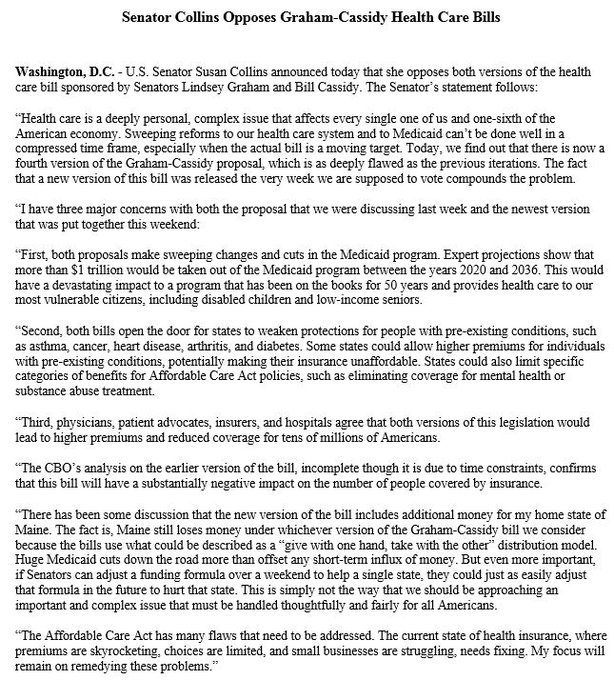
THANK YOU Sen Susan Collins R ME for deciding to vote against the graham-cassidy (NO) health care bill. This should end the chances of this bill being passed by the US Senate, but we will still welcome Sen Lisa Murkowski R AK and any other Republican senator to join the opposition! From NPR.....

3 GOP Senators Oppose Graham-Cassidy, Effectively Blocking Health Care Bill

The latest Republican push to repeal key parts of the Affordable Care Act appears to have met the fate of all previous Senate repeal efforts this year – it doesn't have the votes needed to pass the chamber.
Maine Sen. Susan Collins announced Monday that she'll oppose the bill, authored by South Carolina Sen. Lindsey Graham and Louisiana Sen. Bill Cassidy. Collins' decision means three Republicans have now publicly said they are against the bill – and that's one more than the GOP could afford to lose.
In a statement, Collins said, "Sweeping reforms to our health care system and to Medicaid can't be done well in a compressed time frame, especially when the actual bill is a moving target."
Cassidy was asked earlier Monday on CNN whether Collins's opposition would mean it's over for the bill and said, "Yes, it is." It's not clear yet whether Senate Majority Leader Mitch McConnell would still bring the bill to the floor for a vote now that it's fate is clear.
Collins has been a steady skeptic of the Republican repeal push all year, regularly raising concerns about how the various repeal incarnations would affect the millions of people who rely on Medicaid, especially in states that chose to expand their Medicaid programs under the Affordable Care Act. She had previously indicated she'd likely vote no, but said she'd withhold a final judgement until after the Congressional Budget Office released its analysis.
That analysis came out Monday evening, and found the bill would reduce the federal deficit by $133 billion by 2026, but was only a partial analysis due to the limited time CBO has had to examine it. The analysis does not have specific projections on how the bill would affect coverage, but says "millions" fewer people would be covered as funding decreases for Medicaid, subsidies for exchanges and the elimination of the individual mandate to have coverage.
The Graham-Cassidy bill would transform Medicaid, giving states, not the federal government, control over how the bulk of billions of dollars in funding is spent. It would also allow states to waive key Obamacare regulations and protections, including the bill's trademark ban on insurance companies charging higher rates to people with preexisting conditions.
Collins joins Arizona Sen. John McCain and Kentucky Sen. Rand Paul as firm "no" votes on Graham-Cassidy. While Republicans have until Saturday to pass the bill with a simple majority, and Cassidy has already announced changes to the measure's text, it's hard to see how any of the three lawmakers change their mind.
President Trump called into the Rick & Bubba Show, a talk radio program in Alabama, to discuss the GOP senate primary happening there on Tuesday and took the opportunity to criticize Republicans as the bill looked imperiled.
"What McCain has done is a tremendous slap in the face of the Republican Party," Trump said after again criticizing the GOP for campaigning on a promise to repeal Obamacare for seven years. The president also seemed resigned to the bill's defeat on Monday morning when he said, "So we're gonna lose two or three votes and that's the end of that."
Collins, McCain, and Paul have each voiced separate, fundamental problems with either the bill's content, or the repeal process as a whole. None of their concerns could be easily fixed by changing funding formulas. What's more – a move to assuage Paul's concerns would likely make Collins more opposed, since Paul's chief complaint is the measure keeps too much of Obamacare in place, and Collins is worried it would erode key protections promised by the law.
Indeed, Paul's office has already said that, having seen the new amendments, Paul remains opposed to the bill. "My main concern is that the main thing this bill does is reshuffle the money from Democrat states to Republican states but doesn't fix the problem," Paul told reporters, calling for more "freedom in the marketplace," including the ability to buy insurance over state lines and allow people to buy cheaper plans that provide less coverage for care.
Other Republicans are wavering, too. Texas Sen. Ted Cruz said over the weekend that he's not yet ready to publicly support the bill. Alaska Sen. Lisa Murkowski – who along with Collins has been a prominent skeptic of the entire repeal process – hasn't announced where she stands, either.
Still, given the immense pressure Republicans are facing from their base constituents and conservative donors to repeal Obamacare – not to mention constant criticism from President Trump – the Senate could still proceed to a vote later this week.
Iowa Sen. Chuck Grassley summed up the GOP political calculation in a call with reporters last week. "I could have – maybe give you 10 reasons why this bill shouldn't be considered," Grassley said. "But Republicans campaigned on this so often that we have –you have a responsibility to carry out what you said in a campaign."


Graham-Cassidy Health Care Hearing Starts With Eruption Of Protests 25SEP17


Activists opposed to the GOP's Graham-Cassidy health care repeal bill, many with disabilities, are removed after disrupting a Senate Finance Committee hearing on Monday. (J. Scott Applewhite/AP)

ONCE again those who depend on Medicaid for their health care are forced to protest and disrupt the US Senate hearings on the latest republican attempt to repeal Obamacare with a plan that will result in 32 million Americans uninsured by 2027 and the 1% much richer as soon as the legislation is activated. This is class warfare, the least among us, those with pre-existing conditions and the sickest who need health care insurance the most will suffer and die sooner than they should all because of the greed of the 1% and corporate America and the lack of morality of the Christian politicians they bought in congress. Sen lindsey graham r SC and Sen bill cassidy r LA should be ashamed for this bill and the propaganda campaign of lies, deception and manipulation the republican party has unleashed on the American people to sell this travesty. While I seldom agree with the politics and opinions of the Republicans who have declared their opposition to graham-cassidy (NO) health care, I am thankful to Sen John McCain R AZ, Sen Rand Paul R KY for their pledge to vote no. I hope and pray Sen Lisa Murkowski R AK and Sen Susan Collins R ME will be guided by their responsibility to the people of their states and also vote no. AND THANK YOU U.S. SENATE DEMOCRATS FOR YOUR UNITED OPPOSITION TO graham-cassidy. From NPR.....

Graham-Cassidy Health Care Hearing Starts With Eruption Of Protests

Updated at 3:30 p.m. ET
Republican Sens. Lindsey Graham of South Carolina and Bill Cassidy of Louisiana are defending their namesake health care bill Monday afternoon during an emotional hearing before the Senate Finance Committee.
The hearing was immediately interrupted by protesters chanting, "No cuts to Medicaid. Save our liberty."
Committee Chairman Orrin Hatch, R-Utah, suspended the hearing for about 15 minutes while the demonstrators — some in wheelchairs — were dragged from the room.
U.S. Capitol Police remove a protester from Monday's Senate Finance Committee hearing on the Graham-Cassidy health care plan to repeal Obamacare.
Saul Loeb/AFP/Getty Images
"If the hearing is going to devolve into a sideshow or a forum for simply putting partisan points on the board, there's absolutely no reason for us to be here," Hatch said.
The bill's authors have made changes to the legislation in hopes of winning over holdouts. But it appears they may still fall short of the 50 votes needed — along with the vice president as tiebreaker — to pass the bill. And Senate Republicans are facing a Saturday deadline to act on the legislation under special rules designed to foil a Democratic filibuster.
Sen. Rand Paul, R-Ky., confirmed Monday morning that despite the last-minute changes, he's still a "no" vote. Sen. John McCain, R-Ariz., is also on record in opposition, so Republicans can't afford to lose anyone else. Maine Sen. Susan Collins and Texas Sen. Ted Cruz have also expressed reservations. Sen. Lisa Murkowski of Alaska is undecided but voted against other repeal measures earlier this summer. Some of the last-minute changes to the bill include extra money for Alaska, Maine, Kentucky, Arizona and Texas.
Oregon Sen. Ron Wyden, the ranking Democrat on the committee, complained that Republicans are trying to push through an inadequate bill to beat the Saturday deadline.
"Nobody has got to buy a lemon just because it's the last car on the lot," Wyden said.
Forecasters from the nonpartisan Congressional Budget Office are expected to release their analysis of the bill's budget impacts Monday afternoon. But the CBO did not have time to predict how the measure would affect the level of insurance coverage. CBO forecasts of a spike in the number of uninsured people were a factor in the defeat of earlier Obamacare repeal efforts. Researchers at the Brookings Institution predict the Graham-Cassidy bill would leave 32 million more Americans without health insurance by 2027.
The bill would eliminate federally financed subsidies for people buying insurance on the individual market as well as the Medicaid expansion. Some of that federal money would be repackaged as "block grants" for the states.
"My goal is to get the money and power out of Washington, closer to where people live, so they'll have a voice about the most important thing in their life." Graham said.
The bill would also make major changes to traditional Medicaid, capping the federal government's contribution. Over time, federal expenditures on Medicaid could grow more slowly than health care costs, shifting responsibility for those bills to state governments or patients themselves.
Graham argued that unless Congress is able to put the brakes on health care spending, it will consume an ever-growing portion of the federal budget.
The acting secretary of Pennsylvania's Department of Human Services said she welcomes flexibility, but not if it comes with a smaller budget.
"Cutting billions of dollars from Medicaid and giving states reduced funding in the form of block grants — funding that goes away after seven years — is not the kind of flexibility that we're looking for," said Teresa Miller.
Activists and members of the public wait for a Senate Committee on Finance hearing on the latest GOP health care proposal on Capitol Hill on Monday. Once inside the hearing, activists began chanting and temporarily suspended the hearing.
Saul Loeb/AFP/Getty Images
She added such cuts would force governors to make agonizing choices.
"Who should receive health care?" Miller asked. "A child born with a disability? A young adult struggling with an opioid addiction? A mom fighting breast cancer? A senior who's worked hard all his life and needs access to quality health care to age with dignity?"
The bill would eliminate the requirement that most Americans obtain health insurance or pay a penalty. It would also allow states to ease restrictions on the insurance market, which critics say would lead to higher prices for people with pre-existing medical conditions.
"This bill is an all-out assault on vital consumer protections," Wyden said. "It's going to make the health care that many people need unaffordable."
More than 200 protesters had lined up outside the hearing room hours before it started — many arrived as early as 6 a.m.
"If Medicaid is cut so dramatically, it will force people into institutions," said Bruce Darling, an organizer from New York with the disability rights group ADAPT, ahead of the hearing. "For people with disabilities, Medicaid is our life and our liberty," he added.
NPR producer Barbara Sprunt contributed to this report.


11 September 2017

McCain shocks again, calls partisan gerrymandering 'wasted votes, silenced voices and hidden power' & McCain, Whitehouse Make Bipartisan Appeal To SCOTUS Against Wisconsin Gerrymandering 6&5SEP17

WASHINGTON, DC - JULY 25:  Sen. John McCain (L) (R-AZ) returns to the U.S. Senate accompanied by his wife Cindy (R) July 25, 2017 in Washington, DC. McCain was recently diagnosed with brain cancer but returned on the day the Senate is holding a key procedural vote on U.S. President Donald TrumpÕs effort to repeal and replace the Affordable Care Act..  (Photo by Win McNamee/Getty Images)
IT seems Sen john mccain r AZ is doing penance for his blind support of the right wing republican agenda that is partly responsible for the political and socio-economic state our nation is in. I am thankful for his change of heart and admire his courage and I hope he is able to motivate others in congress to stand for the American people and not just those who can afford to buy their politicians. Hang in there Sen mccain, and keep giving congress  hell! 
McCain shocks again, calls partisan gerrymandering 'wasted votes, silenced voices and hidden power'
Sen. John McCain has taken another surprising stance, partnering with Sen. Sheldon Whitehouse (D-RI), to call on the Supreme Court to strike down Wisconsin’s partisan redistricting. The senators did not mince words in calling for the Supreme Court to affirm previous rulings:
In an amicus brief filed in Gill v. Whitford on Tuesday, McCain and Whitehouse argue that the redistricting map is the result of excessive partisan redistricting.
“Americans do not like gerrymandering,” McCain and Whitehouse wrote in the brief, first highlighted by The Huffington Post. “They see its mischief, and absent a legal remedy, their sense of powerlessness and discouragement has increased, deepening the crisis of confidence in our democracy."
"We share this perspective," they continued. "From our vantage point, we see wasted votes and silenced voices. We see hidden power. And we see a correctable problem.”
Wow! Sen. McCain and Sen. Whitehouse correctly calling partisan redistricting exactly what it is: “wasted votes, silenced voices” and hidden power.
Gerrymandering and partisan redistricting are the key to Republican control of the House. From the Associated Press analysis of the the 2016 election:
The analysis found four times as many states with Republican-skewed state House or Assembly districts than Democratic ones. Among the two dozen most populated states that determine the vast majority of Congress, there were nearly three times as many with Republican-tilted U.S. House districts.
Traditional battlegrounds such as Michigan, North Carolina, Pennsylvania, Wisconsin, Florida and Virginia were among those with significant Republican advantages in their U.S. or state House races. All had districts drawn by Republicans after the last Census in 2010.
The AP analysis also found that Republicans won as many as 22 additional U.S. House seats over what would have been expected based on the average vote share in congressional districts across the country. That helped provide the GOP with a comfortable majority over Democrats instead of a narrow one.
Even if Democrats turned out at full strength, gerrymandering would limit their chances in key districts:
Yet the data suggest that even if Democrats had turned out in larger numbers, their chances of substantial legislative gains were limited by gerrymandering.
“The outcome was already cooked in, if you will, because of the way the districts were drawn,” said John McGlennon, a longtime professor of government and public policy at the College of William & Mary in Virginia who ran unsuccessfully for Congress as a Democrat in the 1980s.
That has got to change. Kudos to Sen. McCain and Sen. Whitehouse for publicly asking the Supreme Court to strike down Wisconsin’s partisan redistricting. 

McCain, Whitehouse Make Bipartisan Appeal To SCOTUS Against Wisconsin Gerrymandering

“Americans do not like gerrymandering. They see its mischief, and absent a legal remedy, their sense of powerlessness and discouragement has increased.”

Sens. John McCain (R-Ariz.) and Sheldon Whitehouse (D-R.I.) asked the Supreme Court on Tuesday to uphold a lower court’s ruling that Wisconsin’s electoral maps for the state legislature were unconstitutional.
The senators made their argument in a friend of the court brief filed in Gill v. Whitford, a potentially monumental case the Supreme Court is set to hear on Oct. 3. The nation’s highest court has never said whether an electoral map, drawn by state lawmakers every 10 years ― often by the party in power ― can be unconstitutional simply for favoring one party too much over the other.
The Supreme Court could make such a determination in the Wisconsin case, which could remake American politics by requiring states to draw maps that put lawmakers in more competitive races.
In the brief, McCain and Whitehouse said the case “implicates the effective functioning of American representative democracy.”
Redrawing electoral maps to weaken the electoral influence of a particular group, often called gerrymandering, can now be done with extreme sophistication, using algorithms and complex software, the senators wrote.
“This new breed of ‘bulk’ partisan gerrymandering distorts statewide votes, systematically diluting the effect of votes based on political affiliation and leading to the election of congressional and state legislative delegations that do not represent the will of the voters,” they wrote. “This practice violates ‘the core principle of republican government, namely, that the voters should choose their representatives, not the other way around.’”
Both Republicans and Democrats have benefitted from gerrymandering, the brief notes. The progressive Brennan Center for Justice estimates that gerrymandering accounts for 16 or 17 current Republican seats in the House of Representatives. 
In a 2004 case called Vieth v. Jubelirer, the court ruled 5-4 not to strike down Pennsylvania’s congressional maps as an unconstitutional gerrymander, and four justices wrote the Supreme Court couldn’t even hear the case. Despite voting with the majority, however, Justice Anthony Kennedy wrote that he believed a standard for determining whether a map was unconstitutional could in fact exist. Because of that opinion, Kennedy is being closely watched in the Wisconsin case and the plaintiffs are hoping he sees a standard that he likes.
The brief argues the court does not need to establish a comprehensive test in the Wisconsin case about gerrymandering. But it says that affirming the ruling of the lower court that the maps in that case were unconstitutional would send a strong signal about the Supreme Court’s attitude on the issue.
“The district court’s test provides a workable framework for distinguishing between district maps drawn based on legitimate political considerations and those constituting unlawful partisan gerrymandering,” the brief says. “Beyond remedying the constitutional violations present in this case, affirming the district court’s decision will send a clear message that partisan gerrymandering will not be tolerated.”
In a separate brief filed Tuesday, 65 current and former state lawmakers (26 Republicans and 39 Democrats) from eight states also asked the Supreme Court to uphold the lower court’s decision and say Wisconsin’s map was unconstitutional.
In the brief from McCain and Whitehouse, the senators noted that gerrymandering weakens confidence in the electoral system.
“Americans do not like gerrymandering. They see its mischief, and absent a legal remedy, their sense of powerlessness and discouragement has increased, deepening the crisis of confidence in our democracy. We share this perspective,” they wrote. “We see wasted votes and silenced voices. We see hidden power. And we see a correctable problem.”
More than three dozen current and former Republican lawmakers have signed onto briefs urging the court to say the Wisconsin maps were unconstitutional. The Republicans ranged across the political spectrum and included House Freedom Caucus Chairman Mark Meadows (S.C.), former California Gov. Arnold Schwarzenegger and Ohio Gov. John Kasich.
This article has been updated with more information about which GOP lawmakers have signed onto briefs.