NORTON META TAG

Showing posts with label Sen Susan Collins R ME. Show all posts

25 September 2017

3 GOP Senators Oppose Graham-Cassidy, Effectively Blocking Health Care Bill 25SEP17


Sens. John McCain, R-Ariz., Susan Collins, R-Maine, in a 2013 file photo. They along with Sen. Rand Paul, R-Ky., have announced firm opposition to the latest GOP health care bill.
Brendan Smialowski/AFP/Getty Images

THANK YOU Sen Susan Collins R ME for deciding to vote against the graham-cassidy (NO) health care bill. This should end the chances of this bill being passed by the US Senate, but we will still welcome Sen Lisa Murkowski R AK and any other Republican senator to join the opposition! From NPR.....

3 GOP Senators Oppose Graham-Cassidy, Effectively Blocking Health Care Bill

The latest Republican push to repeal key parts of the Affordable Care Act appears to have met the fate of all previous Senate repeal efforts this year – it doesn't have the votes needed to pass the chamber.
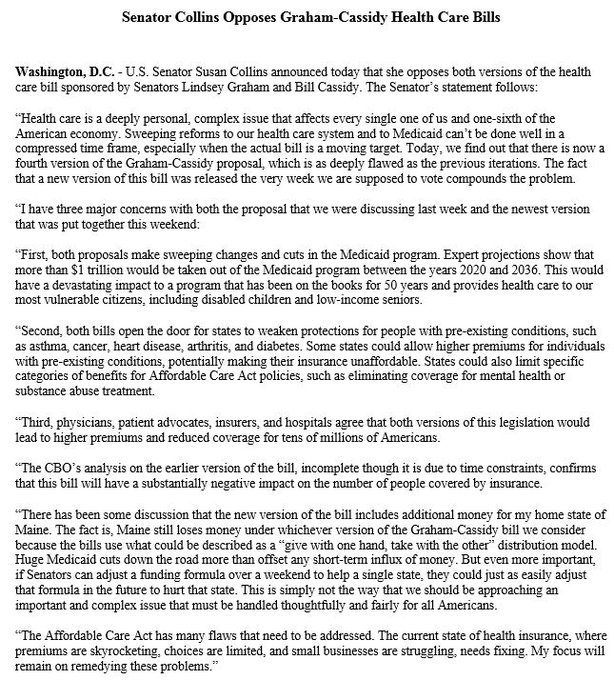
Maine Sen. Susan Collins announced Monday that she'll oppose the bill, authored by South Carolina Sen. Lindsey Graham and Louisiana Sen. Bill Cassidy. Collins' decision means three Republicans have now publicly said they are against the bill – and that's one more than the GOP could afford to lose.
In a statement, Collins said, "Sweeping reforms to our health care system and to Medicaid can't be done well in a compressed time frame, especially when the actual bill is a moving target."
Cassidy was asked earlier Monday on CNN whether Collins's opposition would mean it's over for the bill and said, "Yes, it is." It's not clear yet whether Senate Majority Leader Mitch McConnell would still bring the bill to the floor for a vote now that it's fate is clear.
Collins has been a steady skeptic of the Republican repeal push all year, regularly raising concerns about how the various repeal incarnations would affect the millions of people who rely on Medicaid, especially in states that chose to expand their Medicaid programs under the Affordable Care Act. She had previously indicated she'd likely vote no, but said she'd withhold a final judgement until after the Congressional Budget Office released its analysis.
That analysis came out Monday evening, and found the bill would reduce the federal deficit by $133 billion by 2026, but was only a partial analysis due to the limited time CBO has had to examine it. The analysis does not have specific projections on how the bill would affect coverage, but says "millions" fewer people would be covered as funding decreases for Medicaid, subsidies for exchanges and the elimination of the individual mandate to have coverage.
The Graham-Cassidy bill would transform Medicaid, giving states, not the federal government, control over how the bulk of billions of dollars in funding is spent. It would also allow states to waive key Obamacare regulations and protections, including the bill's trademark ban on insurance companies charging higher rates to people with preexisting conditions.
Collins joins Arizona Sen. John McCain and Kentucky Sen. Rand Paul as firm "no" votes on Graham-Cassidy. While Republicans have until Saturday to pass the bill with a simple majority, and Cassidy has already announced changes to the measure's text, it's hard to see how any of the three lawmakers change their mind.
President Trump called into the Rick & Bubba Show, a talk radio program in Alabama, to discuss the GOP senate primary happening there on Tuesday and took the opportunity to criticize Republicans as the bill looked imperiled.
"What McCain has done is a tremendous slap in the face of the Republican Party," Trump said after again criticizing the GOP for campaigning on a promise to repeal Obamacare for seven years. The president also seemed resigned to the bill's defeat on Monday morning when he said, "So we're gonna lose two or three votes and that's the end of that."
Collins, McCain, and Paul have each voiced separate, fundamental problems with either the bill's content, or the repeal process as a whole. None of their concerns could be easily fixed by changing funding formulas. What's more – a move to assuage Paul's concerns would likely make Collins more opposed, since Paul's chief complaint is the measure keeps too much of Obamacare in place, and Collins is worried it would erode key protections promised by the law.
Indeed, Paul's office has already said that, having seen the new amendments, Paul remains opposed to the bill. "My main concern is that the main thing this bill does is reshuffle the money from Democrat states to Republican states but doesn't fix the problem," Paul told reporters, calling for more "freedom in the marketplace," including the ability to buy insurance over state lines and allow people to buy cheaper plans that provide less coverage for care.
Other Republicans are wavering, too. Texas Sen. Ted Cruz said over the weekend that he's not yet ready to publicly support the bill. Alaska Sen. Lisa Murkowski – who along with Collins has been a prominent skeptic of the entire repeal process – hasn't announced where she stands, either.
Still, given the immense pressure Republicans are facing from their base constituents and conservative donors to repeal Obamacare – not to mention constant criticism from President Trump – the Senate could still proceed to a vote later this week.
Iowa Sen. Chuck Grassley summed up the GOP political calculation in a call with reporters last week. "I could have – maybe give you 10 reasons why this bill shouldn't be considered," Grassley said. "But Republicans campaigned on this so often that we have –you have a responsibility to carry out what you said in a campaign."





Graham-Cassidy Health Care Hearing Starts With Eruption Of Protests 25SEP17


Activists opposed to the GOP's Graham-Cassidy health care repeal bill, many with disabilities, are removed after disrupting a Senate Finance Committee hearing on Monday. (J. Scott Applewhite/AP)

ONCE again those who depend on Medicaid for their health care are forced to protest and disrupt the US Senate hearings on the latest republican attempt to repeal Obamacare with a plan that will result in 32 million Americans uninsured by 2027 and the 1% much richer as soon as the legislation is activated. This is class warfare, the least among us, those with pre-existing conditions and the sickest who need health care insurance the most will suffer and die sooner than they should all because of the greed of the 1% and corporate America and the lack of morality of the Christian politicians they bought in congress. Sen lindsey graham r SC and Sen bill cassidy r LA should be ashamed for this bill and the propaganda campaign of lies, deception and manipulation the republican party has unleashed on the American people to sell this travesty. While I seldom agree with the politics and opinions of the Republicans who have declared their opposition to graham-cassidy (NO) health care, I am thankful to Sen John McCain R AZ, Sen Rand Paul R KY for their pledge to vote no. I hope and pray Sen Lisa Murkowski R AK and Sen Susan Collins R ME will be guided by their responsibility to the people of their states and also vote no. AND THANK YOU U.S. SENATE DEMOCRATS FOR YOUR UNITED OPPOSITION TO graham-cassidy. From NPR.....

Graham-Cassidy Health Care Hearing Starts With Eruption Of Protests

Updated at 3:30 p.m. ET
Republican Sens. Lindsey Graham of South Carolina and Bill Cassidy of Louisiana are defending their namesake health care bill Monday afternoon during an emotional hearing before the Senate Finance Committee.
The hearing was immediately interrupted by protesters chanting, "No cuts to Medicaid. Save our liberty."
Committee Chairman Orrin Hatch, R-Utah, suspended the hearing for about 15 minutes while the demonstrators — some in wheelchairs — were dragged from the room.
U.S. Capitol Police remove a protester from Monday's Senate Finance Committee hearing on the Graham-Cassidy health care plan to repeal Obamacare.
Saul Loeb/AFP/Getty Images
"If the hearing is going to devolve into a sideshow or a forum for simply putting partisan points on the board, there's absolutely no reason for us to be here," Hatch said.
The bill's authors have made changes to the legislation in hopes of winning over holdouts. But it appears they may still fall short of the 50 votes needed — along with the vice president as tiebreaker — to pass the bill. And Senate Republicans are facing a Saturday deadline to act on the legislation under special rules designed to foil a Democratic filibuster.
Sen. Rand Paul, R-Ky., confirmed Monday morning that despite the last-minute changes, he's still a "no" vote. Sen. John McCain, R-Ariz., is also on record in opposition, so Republicans can't afford to lose anyone else. Maine Sen. Susan Collins and Texas Sen. Ted Cruz have also expressed reservations. Sen. Lisa Murkowski of Alaska is undecided but voted against other repeal measures earlier this summer. Some of the last-minute changes to the bill include extra money for Alaska, Maine, Kentucky, Arizona and Texas.
Oregon Sen. Ron Wyden, the ranking Democrat on the committee, complained that Republicans are trying to push through an inadequate bill to beat the Saturday deadline.
"Nobody has got to buy a lemon just because it's the last car on the lot," Wyden said.
Forecasters from the nonpartisan Congressional Budget Office are expected to release their analysis of the bill's budget impacts Monday afternoon. But the CBO did not have time to predict how the measure would affect the level of insurance coverage. CBO forecasts of a spike in the number of uninsured people were a factor in the defeat of earlier Obamacare repeal efforts. Researchers at the Brookings Institution predict the Graham-Cassidy bill would leave 32 million more Americans without health insurance by 2027.
The bill would eliminate federally financed subsidies for people buying insurance on the individual market as well as the Medicaid expansion. Some of that federal money would be repackaged as "block grants" for the states.
"My goal is to get the money and power out of Washington, closer to where people live, so they'll have a voice about the most important thing in their life." Graham said.
The bill would also make major changes to traditional Medicaid, capping the federal government's contribution. Over time, federal expenditures on Medicaid could grow more slowly than health care costs, shifting responsibility for those bills to state governments or patients themselves.
Graham argued that unless Congress is able to put the brakes on health care spending, it will consume an ever-growing portion of the federal budget.
The acting secretary of Pennsylvania's Department of Human Services said she welcomes flexibility, but not if it comes with a smaller budget.
"Cutting billions of dollars from Medicaid and giving states reduced funding in the form of block grants — funding that goes away after seven years — is not the kind of flexibility that we're looking for," said Teresa Miller.
Activists and members of the public wait for a Senate Committee on Finance hearing on the latest GOP health care proposal on Capitol Hill on Monday. Once inside the hearing, activists began chanting and temporarily suspended the hearing.
Saul Loeb/AFP/Getty Images
She added such cuts would force governors to make agonizing choices.
"Who should receive health care?" Miller asked. "A child born with a disability? A young adult struggling with an opioid addiction? A mom fighting breast cancer? A senior who's worked hard all his life and needs access to quality health care to age with dignity?"
The bill would eliminate the requirement that most Americans obtain health insurance or pay a penalty. It would also allow states to ease restrictions on the insurance market, which critics say would lead to higher prices for people with pre-existing medical conditions.
"This bill is an all-out assault on vital consumer protections," Wyden said. "It's going to make the health care that many people need unaffordable."
More than 200 protesters had lined up outside the hearing room hours before it started — many arrived as early as 6 a.m.
"If Medicaid is cut so dramatically, it will force people into institutions," said Bruce Darling, an organizer from New York with the disability rights group ADAPT, ahead of the hearing. "For people with disabilities, Medicaid is our life and our liberty," he added.
NPR producer Barbara Sprunt contributed to this report.


10 November 2011

Workers' Comp: Senators Look To Slash Benefits For Disabled Civil Servants 10NOV11

TYPICAL of the wanton disregard for the working and middle classes by the gop / tea-bagger kabal and that kapo joe lieberman. These political whores won't consider cutting corporate welfare for fear of loosing campaign contributions from the rich and the business and financial institutions who control them. No, they will turn on those with the least in money, power and influence, those whose interest and welfare they are supposed to be representing. Disgusting.

WASHINGTON -- Lawmakers on Capitol Hill are looking to cut benefits for federal workers disabled on the job, a budget-trimming move that critics warn could leave many injured civil servants and their families without enough to live on in retirement.
With support from Sens. Joseph Lieberman (I-Conn.) and Susan Collins (R-Maine), the Senate Committee on Homeland Security and Government Affairs moved forward Wednesday with a Postal Service reform bill that would apply broad workers' compensation reforms to all federal workers. Many disabled federal employees who have reached retirement age currently receive between 66 and 75 percent of the salary they had at the time of their injury, but the bill pushed by Lieberman and Collins would cut that to 50 percent.
Some employees who aren't at retirement age would also lose benefits they receive for children or other dependents they care for. Ron Watson, a workers' comp expert at the National Association of Letter Carriers, says the reductions are "intentionally targeted at injured workers with families, their widows and widowers, and the elderly."
But in a Senate hearing Wednesday, Collins suggested the cuts were targeted at nonagenarians who are bleeding the workers' comp system, citing federal workers who are "99-years-old" and still collecting a substantial portion of their salaries from old workplace injuries. She also said the White House has shown support for many of the proposed reforms.
"These are not draconian changes," Collins said of the bill. "We've worked very hard to come up with a fair approach. This involves substantial money."
Opponents of the legislation say no one has looked closely at how these cuts would affect disabled workers financially, particularly those on the lower end of the wage scale. They also worry that the bill will serve as a model for the congressional super committee, the body tasked with reducing the deficit by $1.2 trillion. Sen. Daniel Akaka (D-Hawaii) has been the most vocal skeptic of the workers' comp changes, urging his colleagues to study the issue further before acting.
"We may set benefits too low, seriously harming disabled workers," Akaka said Wednesday. "We must not make arbitrary cuts that could harm the disabled ... who sustained injuries in the service of their country."
For decades the federal workers' compensation program has been considered the benchmark for such programs across the country, providing a generous lifeline for civil servants who can no longer perform their duties because of on-the-job injuries. Lawmakers have talked time and again about the need to reform the program due to costs, but new political pressures to trim the federal budget have made changes all the more likely.
Unions for federal employees have been watching the debate closely. Last week a group of 13 unions sent a letter to Lieberman voicing their "strong objections" to the inclusion of broad workers' compensation reform in a bill meant to address only the Postal Service's financial problems. Postal employees account for about 40 percent of the disbursements under the workers' comp law, known as the Federal Employees' Compensation Act, or FECA.
"The proposed legislation would impose a substantial and unfair income reduction for federal employees who simply came to work one day ready to serve their country but tragically suffered an injury that took away their ability to ever work again," union officials wrote.
A Democratic aide in the House told HuffPost that the cuts would disproportionately hurt workers who were disabled at a young age or while in a low-wage position. Workers' comp benefits are tax-free and will remain so, he noted, but that does little good for a low-income earner who's already paying little in taxes.
"The core premise around workers comp is that you should be no better off and no worse off" after the injury, the aide said. "But with this bill many people will be far worse off, particularly on the lower end of the wage scale."
At Wednesday's hearing, Collins said the committee had adopted "most" of the recommendations put forth by the White House, which could save $500 billion over the course of ten years.
But the savings could come at a great cost for disabled workers, said Joe Mansour, a workers' comp expert with the Council of Prison Locals, which represents prison employees. Mansour told HuffPost that his groups' members are vulnerable to stabbings and other assaults by inmates, and that they'll see less compensation under the Senate bill in the event of a disabling attack.
"It's punitive for being injured," Mansour said. "They're saying don't be involved in any serious accidents, because you're going to go home and make a lot less money."

18 November 2010

How the GOP Blew it on the Paycheck Fairness Act -- and Who the Biggest Cowards Were 17NOV10

HEY all you tea-bagging gop women! Congrats!!!! Whether you voted or didn't, the people you sent to Congress with the results of the mid-term elections of 2010 are already paying you back, and they haven't even taken office yet. They are setting the agenda though, and so you will keep earning less than men for doing the same job, and it is all legal! White women, you'll make $.78 for every dollar a man earns; Black women, you'll get $.62 on the dollar and Latina women, you get $.53 on the dollar. That is what you all wanted.....isn't it?!?!?!?!?
 
Well, it didn't take long. The Republican Party was handed a historic opportunity with women. For the first time since the advent of exit polling data in 1982, women voters favored the GOP in the 2010 election. A rather shocking occurrence given that just two short years ago, President Obama had a 14 point advantage with women. What does the GOP do with this historic opportunity? Blow it!
Wednesday, The Senate voted 58-41 against allowing debate on the Paycheck Fairness Act. Not a single Republican voted "yea." Wise up there GOP -- if you have any hopes of taking the White House in 2012, you'll need women voters. But after shooting down the Paycheck Fairness Act Wednesday and perpetuating a boys' club in Congress, you ain't showing us much.
Here's what we know from the 2010 election: issue #1 for women is economic security. That's why women gave the GOP a once in a generation opportunity to win us over. Absurdly, the Republican Party then turns around and pushes women away by thwarting our financial security. Ya know, us 'wimminz' -- the primary breadwinners or co-breadwinners in nearly two-thirds of American families.
Is the Paycheck Fairness Act perfect? No. Does it solve the disparity of pay that women face? Not totally. But it is a huge step towards women's financial security. Sadly, here's what the GOP said to women Wednesday: "we don't believe women deserve to make the same wage as men for doing the same job." It's not much more complicated than that. Even if the bill in it's current form (which likely no Republican Senator actually read) wasn't nirvana, then bring it to the floor and hash it out.
There's plenty of blame to go around. And, it's time for some accountability! Here are the recipients of the Paycheck Fairness Act Coward Awards.
1. Senators Olympia Snowe (R-ME) and Susan Collins (R-ME) -- after courageously going against their party to vote with the Democrats in February 2009 for the Lilly Ledbetter Fair Pay Act, Wednesday Senators Snowe and Collins showed that they care more about their 2012 re-elections than women. Cowards!
2. Senator Kay Bailey Hutchinson (R-TX) -- after much ballyhoo as a bipartisan leader for women, including voting for the Fair Pay Act and a joint appearance with Secretary Clinton at the Women's History Museum, Senator Hutchinson let us down. Coward!
3. Senator Lisa Murkowski (R-AK) -- who also voted for the Fair Pay Act, recently boasted that she will not be beholden to the GOP. She will, however, sell-out women. Standing ovation on the Senate Floor Tuesday - jet set out of town before the vote Wednesday. Coward!
4. Senior White House Advisor Valerie Jarrett (D) (Chair of the White House Council on Women and Girls) -- progressive blogger Joanne Bamberger said it best on Facebook: President Obama and his advisor Valerie Jarrett have said time and again they are committed to passage of the Paycheck Fairness Act and it was a priority to them. Wednesday, fair pay failed by 2 votes. They couldn't use their "commitment" to women to get us 2 votes?
It's unclear which offense is worse: not fighting for women or being completely ineffectual as Chair of the White House Council. What is clear: Coward!
5. Majority Leader Harry Reid (D-NV) -- who has buried the Paycheck Fairness Act since its passage in the House in January 2009. Senator Reid failed to use the momentum of the passage of the Fair Pay Act. Fighter for women? You kidding? Coward!
The only ray of light for women in this fiasco is the continued ascension of Senator Kirsten Gillibrand, an unabashed and unapologetic advocate for women. After being written off as an 'easy target' in 2010, Senator Gillibrand went on to slay over 30 would-be challengers, and then romp her opponent Joseph DioGuardi 62-36. Senator Gillibrand took the airwaves slamming the Republicans and clearly explaining how their actions Wednesday hurt both women and children:

Can you say: Gillibrand 2016!
As for the cowards, we need to hold them accountable. Even though it was the GOP that blew it this week, there's plenty of blame to go around.
What we do know from the 2010 election is that women's votes are in play. Time will tell which party will seize the opportunity!

22 July 2010

Obama Signs Bill Restoring Jobless Benefits & President Obama signs six-month extension of emergency unemployment benefits 22JUL10

Federal checks could begin flowing again as early as next week to millions of jobless people who lost up to seven weeks of unemployment benefits in a congressional standoff.
President Barack Obama on Thursday signed into law a restoration of benefits for people who have been out of work for six months or more. Congress approved the measure earlier in the day. The move ended an interruption that cut off payments averaging about $300 a week to 2.5 million people who have been unable to find work in the aftermath of the nation's long and deep recession.
At stake are up to 73 weeks of federally financed benefits for people who have exhausted their 26 weeks of state jobless benefits. About half of the approximately 5 million people in the program have had their benefits cut off since its authorization expired June 2.
They are eligible for lump-sum retroactive payments that are typically delivered directly to their bank accounts or credited to state-issued debit cards. Many states have encouraged beneficiaries to keep updating their paperwork in hopes of speeding payments once the program was restored.
In states like Pennsylvania and New York, the back payments should go out next week, officials said. In others, like Nevada and North Carolina, it may take a few weeks for all of those eligible to receive benefits.
The 272-152 House vote came less than 24 hours after a mostly party-line Senate vote Wednesday on the measure, which is just one piece of a larger Democratic jobs agenda that has otherwise mostly collapsed after months of battles with Republicans.
"Americans who are working day and night to get back on their feet and support their families in these tough economic times deserve more than obstruction and partisan game-playing," Obama said Wednesday night.
The measure is what remains of a Democratic effort launched in February to renew elements of last year's economic stimulus bill. But GOP opposition forced Democrats to drop $24 billion to help state governments avoid layoffs and higher taxes, as well as a package of expired tax cuts and a health insurance subsidy for the unemployed.
Wrangling over the larger measure consumed about four months. The jobless benefits portion picked up enough GOP support in the Senate — Maine moderates Susan Collins and Olympia Snowe — only after it was broken off as a stand-alone bill. It would have passed last month were it not for the death of Robert Byrd (D-WV); Byrd's replacement, Democrat Carte Goodwin, cast the key 60th vote Tuesday to defeat a GOP filibuster.
Most Republicans opposed the measure because it would add $34 billion to a national debt that has hit $13 trillion, arguing that it should have been paid for with cuts to other programs, such as unspent money from last year's economic stimulus bill, which is earning mixed grades at best from voters as unemployment stands at 9.5 percent nationwide.
Thirty-one House Republicans, about one in six, voted for the measure Thursday, while 10 Democrats opposed it.
"The other side says that these unemployment benefits stretching to almost two years are needed and must be added to the $13 trillion debt, even as they claim their trillion-dollar stimulus plan has been a success at creating millions of jobs," said Rep. Charles Boustany (R-LA). "It makes you wonder if they're looking at the same jobs data as the rest of us."
Opposition marked a change of heart for many Republicans who had voted for deficit-financed unemployment benefits in the past, including twice during George W. Bush's administration. Earlier this year, Republicans twice allowed temporary unemployment measures to pass without asking for a roll call vote.
Opinion polls show that deficits and debt are of increasing concern to voters, especially Republicans' core conservative supporters and the tea party activists whose support the GOP is courting in hopes of retaking control of Congress.
Republicans winced in February when Sen. Jim Bunning (R-KY), blocked a temporary benefits measure for several days, only to relent amid a wave of bad publicity. But just a few weeks later, all but a handful of Republicans were opposed to renewing benefits unless they were paid for with cuts elsewhere in the $3.7 trillion federal budget.
Democrats countered that many economists say unemployment benefits boost the economy since most beneficiaries spend them immediately. But any such effects are likely to be modest when measured against a $14.6 trillion economy.
"Unemployment benefits protect those who have lost their jobs through no fault of their own but would lead to more jobs, higher wages and a stronger economy for all Americans," said Speaker Nancy Pelosi (D-CA). "The money will be spent immediately on necessity, injecting demand into the economy, creating jobs."
The program is being renewed through the end of November. The White House signaled earlier this week that another extension may be sought if the jobless rate remains high, as many expect.

President Obama signs six-month extension of emergency unemployment benefits

By Lori Montgomery
Washington Post Staff Writer
Friday, July 23, 2010; A02


President Obama signed a six-month extension of emergency jobless benefits for the long-term unemployed on Thursday, restoring aid to nearly 3 million people whose checks have been cut off since the program expired in early June.
The White House signing ceremony came barely three hours after the House approved the $34 billion measure on a vote of 272 to 152. The Senate passed the measure Wednesday after a months-long stalemate.
"Americans who are fighting to find a good job and support their families will finally get the support they need to get back on their feet during these tough economic times," Obama said in a statement. He called on Congress to swiftly approve additional measures to create jobs and bolster the sluggish recovery, including a package of small-business incentives that faced a battery of GOP objections in the Senate late Thursday.
"Small businesses are the engine of job growth, and measures to cut their taxes and make lending available should not be held hostage to partisan tactics like those that unconscionably held up unemployment insurance," Obama said.
The jobless bill revives a program that provides up to 99 weeks of income support to those who have lost their jobs in the recession. Advocates for the unemployed said checks in some states are likely to go out quickly; in others, people can expect a delay of several weeks.
With unemployment at 9.5 percent, both parties agree that jobless benefits should be extended, but the legislation has been mired in an increasingly bitter election-year battle over whether the government should add to an already bloated national debt to bolster the economy. Republicans said no, arguing that the nation should pay for the extension with unexpended funds from last year's economic stimulus package.
"I haven't heard anybody say we shouldn't be extending unemployment benefits. The difference is one side wants to borrow 34 cents on the dollar, mainly from the Chinese, and send the bill to our children and our grandchildren," Rep. Jeb Hensarling (R-Tex.) said during debate in the House on Thursday.
Democrats argued that emergency benefits have never been paid for -- even during the Reagan administration -- and accused Republicans of trying to undermine public faith in the Obama administration.
"They'll say it's because of the deficit. But in reality, they're simply trying to make this president fail at any cost," said Rep. Jim McDermott (D-Wash.), who accused the GOP of trying to "infect" voters with "fiscal fear."
"The Republican leadership in Congress has decided that the way to get the White House back is by denying unemployment benefits to people who have lost their jobs through no fault of their own and show them that this government doesn't work," he said.
The extension was first introduced in a nearly $200 billion package of economic measures sought by the Obama administration, including fresh aid to state governments and extended health insurance subsidies for the unemployed. Republicans blasted the spending plan, and conservative Democrats revolted, demanding that the package be scaled back.
Democratic leaders spent the next two months tossing various items overboard until nothing was left but the least controversial bit of spending: income support for unemployed workers. Democrats downsized even that program, dropping a $25-a-week bonus for all jobless workers that had been enacted under last year's stimulus package.
Even as the House approved the jobless bill, the Senate was wrestling with what may be the final item on the president's economic agenda for this year -- a package of small-business tax incentives.
Late Thursday, the Senate approved a provision that lies at the heart of the package -- a $30 billion fund to increase small-business lending. The measure passed 60-39, as Republicans George V. Voinovich (Ohio) and George S. LeMieux (Fla.) voted with the Democratic caucus in favor of the fund.