NORTON META TAG

Showing posts with label Bismark ND. Show all posts

28 October 2016

DEMOCRACY NOW! REPORTS ON THE STANDING ROCK SIOUX PROTEST AGAINST THE DAKOTA ACCESS PIPELINE

Image result for images of standing rock protests
+Democracy Now! has been providing the most extensive coverage of the Standing Rock Sioux protest against the dap / dakota access pipeline. There was a report on the +PBS NewsHour explaining the reason behind the protest , but the situation in N Dakota has escalated to a dangerous situation due to violence by dap employees and heavily militarized state and local police and sheriffs as well as N Dakota National Guard troops against the peaceful protesters at Sacred Stone and the other protest camps at the dap construction site. Democracy Now! anchor Amy Goodman was arrested while reporting on the protest at Sacred Stone after witnessing the use of attack dogs on protesters by employees of dap. +350.org is heading a campaign calling on the Obama administration to send US Justice Department observers to N. Dakota to monitor the situation and protect the protesters constitutional rights as well as ensure their safety. Click dakota access pipeline (below) for the reports and videos Democracy Now! has filed on the struggle to stop the dap. If you want information about the GoFundMe campaign for the Sacred Stone Camp of the Standing Rock Sioux see below.....

DAKOTA ACCESS PIPELINE

Democracy Now! coverage of resistance to the Dakota Access Pipeline. If completed, the $3.8 billion pipeline would carry about 500,000 barrels of crude per day from North Dakota’s Bakken oilfield to Illinois. The project has faced months of resistance from the Standing Rock Sioux tribe and members of nearly 100 more tribes from across the U.S. and Canada.

Hau we are the Inyan wakankagapi otip-Sacred Stone Camp from the Standing Rock Sioux Tribe.   We have partnership with the Oectc  Sakowin- Seven Council Fires, Indians and Cowboys and anyone who was to stand with us against the Dakota Access Pipeline. This pipeline will cross the Missouri River and Cannon Ball River which is the life line to many tribes and non native, when this pipeline leaks it will destroy the water and land.  Water is life ! So this pipeline is along the Missouri River and the KL pipeline was along the Ogall aquifer both are important to save.
We are asking for financial support for water-propane - food and blankets  for the camp.  This is a prayer camp movement to save our sacred land and water and has been entirely supported by the people and the campers. We are in great appreciation for all you contributions....Wopila lila tanka-- we are deeply grateful for you contributions thank you! 
In Spirit
Sacred Stone Camp
DONATE

Water protectors under attack & (VIDEOS) "A Shameful Moment for This Country": Report Back on Militarized Police Raid of DAPL Resistance Camp & Standing Rock: Police Arrest 120+ Water Protectors as Dakota Access Speeds Up Pipeline Construction 28&24OKT16


YESTERDAY'S  police and National Guard attack on peaceful protesters at Standing Rock camp is inexcusable. To resort to pepper spray, tasers, batons and rubber bullets against peaceful protesters is evidence of police brutality that if left unchecked by the government will resort to serious casualties and possible deaths on both sides. The White House needs to intervene and send observers to North Dakota right away to protect the lives and rights of the protesters at the Standing Rock protest camps and then take action to stop the construction of the dap. At the very least the government needs to stop the construction of the dap while there is an investigation of why the route of the pipeline was changed from crossing under the Missouri River upstream from Bismark, ND to the new route downstream from the city. The investigation will expose the environmental racism that led to the pipeline reroute (click the Standing Rock link above for the PBS report on this). Justice will be the government ordering the dap back to it's original routing but the best outcome would be the government canceling the entire project. +350.org is asking people to call the White House (I did, it took 40 tries but I finally got through) and demand Justice Dept observers be sent to N Dakota right away and for Pres Obama to stop the dap. Be sure to watch the video and read the transcripts from +Democracy Now!  AND click here  to donate to the Sacred Stone Camp (I did).  
Yesterday, the National Guard and State Police raided one of the peaceful resistance camps at Standing Rock. Can you call the White House at (202) 456-1111 and tell President Obama to send Justice Department observers immediately and stop the Dakota Access Pipeline?
Call Now
Friends,
Yesterday, the National Guard and State Police raided one of the peaceful resistance camps at Standing Rock.
This frontline camp set up over the weekend along the Dakota Access Pipeline path was cleared by hundreds of heavily militarized police. For months, peaceful actions along the pipeline route have been met by a large police presence – but yesterday's events were different than anything before. 
At least 141 water protectors were arrested after law enforcement used pepper spray, tasers, batons and rubber bullets to forcibly remove those defending sacred land and water. These brutal police tactics are dehumanizing, uncalled for, and a threat to the First Amendment rights of people protecting their land, water and climate from Big Oil.
The original camps near the pipeline route – Oceti Sakowin, Sacred Stone, and Red Warrior – are standing strong. While yesterday’s events were shocking and painful, the spirit and determination of those of the front lines is unwavering.
If completed, this pipeline would carry toxic fracked oil from North Dakota under the Missouri River, immediately upstream from the Standing Rock Sioux Nation. It is not only a threat to the Native communities nearby, but a disaster for the climate.
President Obama has the power to stop this project by denying the pipelines’s final federal permit. Over 200 tribes are united in opposition to Dakota Access, more than 300 people have been arrested while peacefully resisting, and numerous leaders from Jesse Jackson to Bernie Sanders have come out in support of the Standing Rock Sioux and the #NoDAPL fight.  
We know that the fossil fuel industry has enough coal, oil and gas in their existing mines and wells to push the planet past the red lines of climate safety. Dakota Access is just one symbol of their recklessness -- and the only option left is to stop building any new fossil fuel projects, and fully invest in 100% renewable energy for all.
Water protectors in Standing Rock are defending their rights, their land, and the climate. President Obama should stand with them. 
In solidarity, 
Kendall

"A Shameful Moment for This Country": Report Back on Militarized Police Raid of DAPL Resistance Camp


GUESTS
Tara Houska
national campaigns director for Honor the Earth.
We go to Standing Rock, North Dakota, for an update on how hundreds of police with military equipment raided a resistance camp Thursday that was established by Native American water protectors in the path of the proposed $3.8 billion Dakota Access pipeline. More than 100 officers in riot gear with automatic rifles lined up across a highway, flanked by multiple MRAPs, an LRAD sound cannon, Humvees driven by National Guardsmen, an armored police truck and a bulldozer. Water protectors say police deployed tear gas, mace, pepper spray and flash-bang grenades and bean bag rounds against the Native Americans and shot rubber bullets at their horses. "We learned a lot about the relationship of North Dakota to Native people," says Tara Houska, national campaigns director for Honor the Earth. "I was standing next to a group of teenagers that were all maced in the face. … Myself, I actually was almost shot in the face by bean bag round."
AMY GOODMAN: This is Democracy Now!, democracynow.org, The War and Peace Report. I’m Amy Goodman, with Juan González.
JUAN GONZÁLEZ: We turn now to North Dakota, where on Thursday hundreds of police with military equipment raided a resistance camp established by Native American water protectors in the path of the proposed $3.8 billion Dakota Access pipeline, which has faced months of resistance from the Standing Rock Sioux Tribe and members of hundreds of other tribes from across the Americas. On Thursday afternoon, over a hundred officers in riot gear with automatic rifles lined up across North Dakota’s Highway 1806, flanked by multiple MRAPs—that’s mine-resistant ambush protected military vehicles—sound cannon, Humvees driven by National Guardsmen, an armored police truck and a bulldozer. Water protectors say that police deployed tear gas, mace, pepper spray and flash-bang grenades and bean bag rounds against the Native Americans and shot rubber bullets at their horses. This is a video shot by Unicorn Riot, followed by a Facebook Live video from Sacheen Seitcham of the West Coast Women Warriors Media Cooperative.
SACHEEN SEITCHAM: They’ve been pepper-spraying. They’ve maced. They’ve tasered. They’ve thrown percussion bombs and smoke grenades at us. All for water. Over 300 pigs. We are protecting the water. They’re protecting oil. That’s what’s happening.
AMY GOODMAN: Water protectors set up a blockade of the highway using cars, tires, fire in order to try to protect their camp, parts of which were demolished by police. Four people locked themselves to a truck parked in the middle of the highway in order to stop the police advance. Elders also led prayer ceremonies in front of the police line. Some were arrested in the middle of prayer. In total, more than 100 people were arrested. Ahead of the police raid, the Federal Aviation Administration also issued a temporary no-fly zone for the airspace above the resistance camps for all aircraft except for those used by law enforcement. Police appeared to be evicting the frontline camp in order to clear the way for the Dakota Access pipeline company to continue construction. Company cranes and bulldozers were active Thursday just behind the police line on the site of the sacred burial ground where Dakota Access security guards unleashed dogs on Native Americans on September 3rd. We’re going to turn to Dallas Goldtooth of the Indigenous Environmental Network, this clip from the front line.
DALLAS GOLDTOOTH: This is at the front line of the Dakota Access pipeline fight right here. And we are about one—about two miles from the river to the west here—or east, sorry. And to the west, right over this hill, Dakota Access is doing construction, trying to get to this road right here. So there is a police line on top of the hill here with Dakota Access workers and police protecting the workers.
AMY GOODMAN: That’s Dallas Goldtooth. And before that, you hear the LRAD, the long-range acoustic device.
For more, we’re joined by Tara Houska, national campaigns director for Honor the Earth.
Welcome back to Democracy Now!, Tara. Explain what took place yesterday, I mean, the video and the photos that we have of the military hardware, a raid against the protesters.
TARA HOUSKA: Yesterday we saw that—you know, we saw—we learned a lot about the relationship of people to fossil fuels. We learned a lot about the relationship of North Dakota to Native people. And we learned a lot about America and where we stand.
Yesterday, we saw folks being maced. I was standing right next to a group of teenagers that were all maced in the face, maced right—like all kinds of people. Myself, I actually was almost shot in the face by bean bag round. It ricocheted off a truck right next to my head. These police were actively trying to hurt people, pushing them back to allow construction of the Dakota Access pipeline. They were defending monetary interests as human beings were being physically hurt. You know, I saw—I saw, right in front of me, a group of police officers pull a protester forward and begin beating him over the head with sticks. There’s video of it that you can see. I mean, this was an all-out war that was waged on indigenous protectors that were doing nothing more than peacefully assembling. There was no fires, there was nothing like that, until the police began their violent attack on us.
JUAN GONZÁLEZ: And, Tara, where was this incident in—for instance, in relationship to the September 3rd dog attacks at the tribal burial site?
TARA HOUSKA: When Dakota Access jumped ahead over 20 miles to destroy the site that had just been identified by the tribe the day before as a sacred place, that happened on September 3rd. That’s also the anniversary of the Whitestone Hill massacre. That was the exact place the day that Dakota Access was basically constructing its pipeline, right in the background, as literally hundreds and hundreds of people came to stand and pray and bring all of their energy forward to stop this from happening. And it was right at that site where Native American men, women and children had been attacked by private security, by dogs and mace and all the same things that we saw yesterday—this incredible escalated violence against people that were doing nothing more than trying to stop the destruction of sacred sites right in front of their eyes.
AMY GOODMAN: Tara, you saw rifles aimed directly at people, police aiming those rifles?
TARA HOUSKA: Yes, there were police walking around everywhere with assault rifles. Directly across from us, there was actually a policeman holding his rifle trained on us, directly on us. Bean bag rifle assault—bean bag non-lethal weapons were also aimed at us. Every time we put our hands up, they’d put them down. As soon as our hands came down, they would aim back at us. Police officers were smiling at us as they were doing these things. There were police officers filming this, laughing, as they—as human beings were being attacked, being maced. I mean, it was a nightmarish scene. And it should be a shame to the federal government, it should be a shame to the American people, that this is happening within U.S. borders to indigenous people and to our allies, to all people that are trying to protect water. Yesterday was a really shameful moment for this country and where we stand.
AMY GOODMAN: And the number of people you estimate were arrested, Tara?
TARA HOUSKA: I saw dozens of people being arrested. I mean, they were just pulling people out and arresting them. You know, I saw—I actually had to get pulled back from a group that—I mean, the police were pushing forward and just grabbing people at will. We had a number of lockdowns, like that were right in front of us in this truck in the middle of the road, that was used to attempt to blockade these police from advancing forward. There were five people, actually, that were locked to that. They attempted to construct a tipi in the middle, right behind people that were praying and singing. And they—there were folks that locked down to that tipi, or attempted to. The police ripped that tipi down and ripped those people out. It was—it was a really horrible scene yesterday.


GUESTS
Sacheen Seitcham
media activist with West Coast Women Warriors Media Cooperative.
We go to North Dakota for an update on the ongoing Standoff at Standing Rock, where thousands of Native Americans representing more than 200 tribes from across the Americas are resisting the construction of the $3.8 billion Dakota Access pipeline, which is slated to carry oil from North Dakota’s Bakken oilfields through South Dakota, Iowa and into Illinois. On Saturday, over 100 people, who call themselves protectors, not protesters, were arrested at a peaceful march after they were confronted by police in riot gear, carrying assault rifles. They say police pepper-sprayed them and then arrested them en masse, and discharged rubber bullets to shoot down drones the water protectors were using to document the police activity. We are joined by Sacheen Seitcham, media activist with West Coast Women Warriors Media Cooperative who was arrested Saturday along with more than 80 other protesters and journalists at a construction site for the Dakota Access pipeline in North Dakota.
TRANSCRIPT
This is a rush transcript. Copy may not be in its final form.
AMY GOODMAN: We begin today’s show in North Dakota with the ongoing Standoff at Standing Rock, where thousands of Native Americans, representing more than 200 tribes from across the Americas, are resisting the construction of the $3.8 billion Dakota Access pipeline, which is slated to carry oil from North Dakota’s Bakken oilfields through South Dakota, Iowa and into Illinois. On Saturday, over a hundred people, who call themselves protectors, not protesters, were arrested on a peaceful march after they were confronted by police in riot gear carrying assault rifles. They say police pepper-sprayed them, then arrested them en masse. This is footage from the Sacred Stone Camp.
POLICE OFFICER 1: You’re all under arrest!
WATER PROTECTOR 1: Hey!
POLICE OFFICER 1: Back off!
POLICE OFFICER 2: You’re all under arrest!
WATER PROTECTOR 1: Stay together! Stay together! Do not be afraid! Stand your prayer!
WATER PROTECTOR 2: Hey!
AMY GOODMAN: Organizers also say police discharged rubber bullets to shoot down drones the water protectors were using to document the police activity. In response to Saturday’s protest, Morton County Sheriff Kyle Kirchmeier said, quote, "Today’s situation clearly illustrates what we have been saying for weeks, that this protest is not peaceful or lawful. ... This protest was intentionally coordinated and planned by agitators with the specific intent to engage in illegal activities," Kirchmeier said. Those arrested face charges including riot, reckless endangerment, criminal trespass, assaulting an officer and resisting arrest.
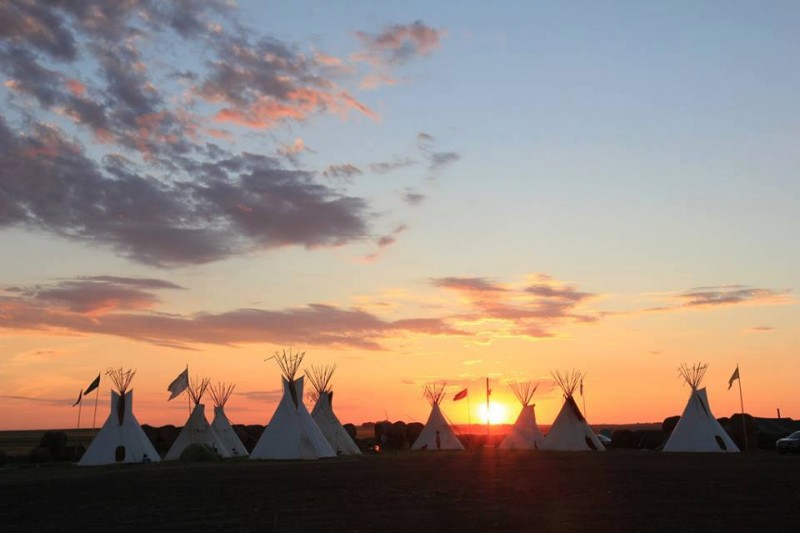
On Sunday, hundreds of water protectors erected a new frontline camp of several structures and tipis directly on the proposed path of the Dakota Access pipeline. The new frontline camp is just to the east of North Dakota State Highway 1806 across from the site where on September 3rd, over Labor Day weekend, Dakota Access security guards unleashed pepper spray and dogs against Native Americans trying to protect a sacred ground from destruction. The water protectors also erected three road blockades that stopped traffic for hours on Highway 1806 Saturday to the north and south of the main resistance camp and along County Road 134. The group cited an 1851 treaty, which they say makes the entire area unceded sovereign land under the control of the Sioux. The blockades were dismantled late Sunday.
For more, we’re joined by two guests. Sacheen Seitcham is an activist and journalist with West Coast Women Warriors Media Cooperative. She was arrested Saturday along with more than a hundred water protectors and journalists at a construction site for the Dakota Access pipeline. And Tara Houska, national campaigns director for Honor the Earth, she’s Ojibwe from Couchiching First Nation.
We welcome you both to Democracy Now! OK, let’s first go to Sacheen. You were arrested Saturday. Can you take us through this day? What happened on Saturday?
SACHEEN SEITCHAM: What happened on Saturday was completely uncalled for, out of—out of the realm of any understanding of people who exist in this world who are trying to do something good and right. Basically, we had come to a lockdown that was trying to reach—we were trying to stop the construction of the DAPL pipeline that day. And our objective was to go walk with them in prayer and meet with them and to lift them up, to be with them as they were locked down. While we walked, we encountered quite a few police. And basically, they had little ATVs, where they were like dune buggies. They were following us. And then more and more police cars came. We actually had to avoid them by running down a hill into a gully and crossing a small river to go and reach the worksite. And at this point, there had been at least six to eight [inaudible] police cars and many officers on the opposite side of the fence from us. And so, we kept walking so that we could go and meet our objective, be at this worksite and to, you know, really prevent the pipeline from being built on sacred ground, on ancient burial sites where the ancestors are laying and should not be disturbed.
AMY GOODMAN: Sacheen?
SACHEEN SEITCHAM: Sorry. At this point, there had been about two—maybe roughly 200 of us. And we’re walking to the field with banners, singing. There was a lot of ceremony and prayer songs. There was a lot of smudging going on with people with sweetgrass and sage and tobacco. And this police vehicle rolled up beside us and basically said, "You’re all trespassing. You’re all under arrest." So we kept going, because at this point we knew—too important what we’re doing. We can’t be intimidated or fearful. Regardless of what they do to us, we must continue and do what we are going to do to protect the sacred water, to protect the sacred ground. So we kept walking.
They kept massing more people of their—their cop riot gear. They had their lethal assault weapons, holding them. And, you know, they’re rubber bullets, but, as we know, rubber bullets can also be fatal. They had their batons out and were openly carrying around cans of mace in a threatening manner. And they eventually, as we walked, cut open the fence to come at us. And they started yelling and running towards us and yelling and inducing fear in people. And we were trying to create a sense of, you know, organization, where we were asking people, "Please, stay calm. Everybody, group together." At this point, they just started being snatch-happy. They were just grabbing people, out of pocket, just, you know, throwing them off to the side. They threw a young woman who was trying to protect a child in the march. They smacked her in the ribs with a baton and, you know, broke it. That’s how forceful they were.
AMY GOODMAN: Sacheen, how were you arrested?
SACHEEN SEITCHAM: I was arrested—basically, the cops tried to tell us to go, and I was arrested, because we were walking away. So, we said, "OK, we’re going to leave. You’ve asked us to leave. You told us we’re trespassing." And so, we all started walking away. And as we walked, the police came through to the front, and then they surrounded us at the back, creating a circle. They kettled us in. We were arrested for engaging in a riot and criminal trespass.
AMY GOODMAN: How many people, do you believe, have been arrested so far? We see the estimates between 87, around there, that the Sheriff’s Office is saying, to upwards of—CNN is reporting 127. The camp is reporting 140.
SACHEEN SEITCHAM: I’m going to go with the camp’s estimate. While I was being processed in the—we were all in the garage. They had no idea what to do with us. They were completely disorganized. The Sheriff’s Office had us all penned up in the garage for roughly two hours. And there was upwards of more than a hundred people down there.
AMY GOODMAN: What were you charged with?
SACHEEN SEITCHAM: I was charged with criminal trespass and engaging in a riot at DAPL worksite 127.
AMY GOODMAN: Were you ever brought to the Mandan jail?
SACHEEN SEITCHAM: Yes. Yes, I was.
AMY GOODMAN: And were you strip-searched?
SACHEEN SEITCHAM: Yes, I was made to disrobe. At this point, they were very disorganized, and I wasn’t treated, basically, the way other women were. I wasn’t forced to squat or cough. They just basically made me disrobe and then put my clothes back on. But, you know, at that point, there was a lot of other women who shared their stories with me that they were strip-searched, they were forced to squat, they were forced to cough and be treated in that manner.
AMY GOODMAN: And how long were you held?
SACHEEN SEITCHAM: I got to the jail, I would say, roughly around maybe 2:00 in the afternoon, and I was released at 7:00 a.m. yesterday morning.
AMY GOODMAN: Well, Sacheen Seitcham, I want to thank you for being with us. Sacheen is a member of the West Coast Women Warriors Media Cooperative. She was arrested Saturday along with scores of other people, both protesters, or, as they call themselves, protectors, as well as journalists, at the construction site for the Dakota Access pipeline in North Dakota. When we come back, we’ll speak to Tara Houska about the overall plan. We called Dakota Access pipeline but weren’t able to get them on. The plan right now—is the pipeline accelerating construction? And then we’ll speak with Shailene Woodley. Shailene Woodley, the actress, who went to the Dakota Access pipeline protests, she was arrested. She was strip-searched, like so many others. Stay with us.


17 September 2016

THE STANDING ROCK PROTEST EXPLAINED. Tribes across North America converge at Standing Rock, hoping to be heard. 16SEP16

Image result for images of standing rock protests
THE Native American protest against the dapl / dakota access pipeline has been going on for about a month and many people have the attitude that the Native Americans are holding up progress and much needed oil and they are rejecting the fact that transporting oil through pipelines is much safer than trains or trucks. This report from the +PBS NewsHour exposes the under reported aspect of  this story. Environmental discrimination is at play here and is the root cause of the Standing Rock protest. The pipeline was supposed to go under the Missouri River north of Bismark, N. Dakota but was rerouted to go under the Missouri South of Bismark after the overwhelmingly White (92%, 4% Native American, median income about $53,000) city of Bismark expressed concerns about their water supply being contaminated if the pipeline ruptured. The Standing Rock Sioux rightly see this as another example environmental discrimination inflicted on many minorities, that they are seen by business and politicians as expendable, that it won't matter if the pipeline ruptures and contaminates their water supply. We have already seen how this attitude and policy plays out with the contaminated water crisis in Flint, Michigan (57% Black, 37% White, median income about $26, 000). Check out this video followed by the transcripts from the +PBS NewsHour report.....

Tribes across North America converge at Standing Rock, hoping to be heard

September 16, 2016 at 6:30 PM EDT
Protestors of the North Dakota pipeline celebrated after the Department of Justice temporarily halted the project in federal jurisdictions last Friday. But while some equipment sits idle, construction in other areas continues. William Brangham visits the Standing Rock Reservation, where more than 100 Native American tribes have gathered, to recap a week of protests.

JUDY WOODRUFF: But, first: As we reported last week, a protest in North Dakota continues to grow against a major oil pipeline continues to grow. Over 100 Native American tribes have joined the fight against the project, saying that it threatens one tribe’s water supply and its sacred lands.
While the U.S. Justice Department has put a temporary halt to part of the project, as the “NewsHour”‘s William Brangham reports, the fight is far from over.
WILLIAM BRANGHAM: After months of protest, it was a moment to celebrate. Last Friday, the Department of Justice blocked construction on part of the $4 billion Dakota Access Pipeline, the very pipeline that brought these thousands of protesters here to rural North Dakota.
But celebration soon turned to suspicion. That’s because work on the pipeline hasn’t fully stopped. In areas outside of federal jurisdiction, construction continues, as do efforts to block it. At least 22 people were arrested this week.
LIZ MCKENZIE, Navajo Tribe: It is most definitely not a victory.
WILLIAM BRANGHAM: Liz McKenzie drove 1,000 miles from Albuquerque to protest with her fellow Native Americans.
LIZ MCKENZIE: People are finally noticing us, not as beings of the past, not as, like, costumes you buy in Halloween stores. Like, we are here, we are still fighting, and that does mean a lot.
WILLIAM BRANGHAM: The Dakota Access Pipeline begins in North Dakota’s Bakken oil fields, and would carry crude oil almost 1,200 miles through South Dakota and Iowa down to Illinois.
The pipeline’s original path crossed the Missouri River just north of Bismarck, a city that’s 90 percent white. But when concerns were raised about a potential oil spill there, the pipeline was rerouted south to go under the river right next to the Standing Rock Reservation.
The Missouri River is the reservation’s primary source of drinking water. The tribe says a spill there could be catastrophic for them. So, when construction started, a plea for help went out.
LADONNA BRAVE BULL ALLARD, Standing Rock Sioux Tribe: I am asking anybody who’s willing to stand with us to say that water is important to come stand with us.
WILLIAM BRANGHAM: Ladonna Brave Bull Allard put out that call. She is a member of Standing Rock, and her land looks over the ridge where the pipeline would be built.
LADONNA BRAVE BULL ALLARD: When I put the call out, I really thought maybe 40 people would come. It’s overwhelming. In my own vision, I didn’t expect this.
WILLIAM BRANGHAM: Now over a hundred Native American tribes from across North America have joined Standing Rock’s movement. And in this sprawling camp, a community has formed.
This kitchen serves donated food to all. Kids can take classes at a makeshift school. Cords of donated firewood are split and stacked, free for the taking.
Why do you think that this has taken off and spoken to so many people from so many parts of the country?
LADONNA BRAVE BULL ALLARD: The water. We know how precious that water is. We know that we must stand for the water.
Mni Wiconi, we say, water of life. So, every time we drink water, we remind ourself how important the water is. Don’t you do that? You will now.
WILLIAM BRANGHAM: Protecting the water spurred Brenda Guachena to drive 30 hours from Southern California to be here. She’s from the Rincon Band of Luiseno Indians. She came with dozens of people, including her grandkids, and brought trucks full of donated supplies.
BRENDA GUACHENA, Rincon Band of Luiseno Indians: Walking in, it was so humbling to see all of these flags. All of the people, of the native people in all the reservations that showed up here to show Standing Rock, we’re here to support you, and we’re not going to let people do this to us anymore.
WILLIAM BRANGHAM: Guy Jones was born in Standing Rock. He says the tribes are tired of being ignored.
GUY JONES, Standing Rock Sioux Tribe: They didn’t want it in Bismarck, but it was, oh, it’s OK if the Indians — you can go down and run it through the reservation where all those Indians live. You know, who cares about the Indians? And that’s one of the things that kind of incensed people.
WILLIAM BRANGHAM: The company that’s building the pipeline energy, Energy Transfer Partners, says it’s followed all the rules. And it points out the pipeline isn’t even on a reservation land. Plus, it argues that moving oil via modern pipelines is a far safer way than putting it on trucks or trains, which statistics show are far more likely to crash and spill.
It also says the pipeline will generate revenue and jobs for North Dakota. We asked the company several times to talk with us on camera. They didn’t make anyone available.
We did speak with Ron Ness, president of the North Dakota Petroleum Council, the trade association that includes Energy Transfer Partners.
RON NESS, North Dakota Petroleum Energy Council: Pipelines are the most safe — most efficient, safest, and cost-effective way to move oil to market. And the products get there virtually 100 percent of the time without issue.
WILLIAM BRANGHAM: That said, the 2.5 million miles of oil and gas pipelines across the U.S. do sometimes leak and rupture, and when they do, they often spill far more oil than a single train car carries. Since 1995, there’s been more than 2,000 significant accidents on oil and gas pipelines, causing about $3 billion in property damage.
For example, in July 2010, at least 800,000 gallons of crude oil spilled into the Kalamazoo River near Marshall, Michigan. It was one of the largest inland oil spills in U.S. history, and the costliest. Almost 5,000 acres of wetland habitat was inundated with oil. Hundreds of animals were killed. Thousands more were recovered, cleaned and released. Full recovery could take decades.
And just this summer, a pipeline in Canada spilled about 65,000 gallons of oil and other toxins into the North Saskatchewan River, polluting the drinking water used by the James Smith Cree Nation.
The Petroleum Council says those kinds of spills near the Standing Rock Reservation are very unlikely.
RON NESS: This pipe is 90 feet below the riverbed. It’s not going to leak right into the river. It’s got the detection equipment and the shutoff valves on each side of this pipeline.
WILLIAM BRANGHAM: But Ladonna Allard doesn’t believe the industry’s assurances. She says half-a-million gallons of oil coursing every day under their drinking water is not safe.
LADONNA BRAVE BULL ALLARD: When that oil spills, who’s going to come save us? We’re Indian people. We’re expendable. Who is going to come? Who is going to come and give us water?
WILLIAM BRANGHAM: The tribe’s other concern is that, even though the pipeline is just off their reservation, it still runs right through areas they say are sacred ancestral grounds.
Ten days ago, the tribe submitted evidence of newly discovered artifacts and burial sites, asking a state court for an emergency injunction. But before the court could make a decision, bulldozers started digging in that area. Protesters broke through a fence to try and stop them. They were met with pepper spray and guard dogs.
Last month, the tribe sued the U.S. Army Corps of Engineers, arguing that, in its meetings with the tribe, the Corps ignored their concerns.
David Archambault II is chairman of the Standing Rock Sioux Tribe.
DAVID ARCHAMBAULT II, Chairman, Standing Rock Sioux Tribe: They never heard us. It was just a process that keeps moving forward because of the interest of economic development, the interest of money, the interest of greed.
WILLIAM BRANGHAM: But, last Friday, a federal court in Washington rejected the tribe’s suit, allowing the pipeline to proceed. It was at that point that the Justice Department halted the project, directing the Corps and other agencies to take a second look at the tribe’s concerns.
Now that the Department of Justice has stepped in and said they’re going to halt this construction, temporarily at least, is this over for you?
DAVID ARCHAMBAULT II: It’s far from over, and we knew this coming in. Regardless of the outcome from the court’s decision, this was the beginning. It’s the start. We finally are getting people to hear.
WILLIAM BRANGHAM: For now, on the lands near the reservation, construction equipment sits idle while the federal reviews are under way. Despite this delay, work on the pipeline continues elsewhere in North Dakota.
Back at the camp, people have begun building shelters, so their vigil can carry on through the coming winter.
For the “PBS NewsHour,” I’m William Brangham near the Standing Rock Reservation in North Dakota.
JUDY WOODRUFF: On a related note, a large gasoline pipeline that supplies the Eastern United States was shut down this week after a quarter-million gallons of gasoline leaked near Birmingham, Alabama.
And, online, you can hear more Native American voices from the front lines of the Standing Rock protest in an audio slide show. That’s on our Facebook page, Facebook.com/NewsHour.