NORTON META TAG

01 February 2020

ACLU THIS WEEK IN CIVIL LIBERTIES: Harnessing History and Solidarity to Stop Migrant Detention, We're Back in Court this Week Defending Access to Safe Abortion in Kentucky, Amendment 4 is Still on the Line. Here's What's New, Asylum-Seekers are Being Abandoned in Guatemala in a New Policy Officials Call a "Total Disaster", The Government is Trying to Strip Student Workers of the Ability to Unionize,In Latest Encryption Battle with Apple, Justice Department Still Wrong 1FEB20

An altered version of the sign as it appears in the photograph shown at the National Archives. (Salwan Georges/The Washington Post)
THE NATIONAL ARCHIVES made a censorship decision to protect us from our democracy. Their decision was a move too many countries would have taken if the initial event that brought about the National Archives to act had even been allowed to take place. We are supposed to be different, we are supposed to have civil liberties that the government protects and promotes our rights. The person / persons who made the decision to and actually censored the photos need to be punished, best will be if they are fired, removed from federal employment, From the ACLU and the Washington Post.....
Altering the photo — and thereby rewriting history — was nothing less than Orwellian.
Louise Melling Deputy Legal Director and Director of Center for Liberty
January 22, 2020

“God hates Trump.” 
“If my vagina could shoot bullets, it’d be less REGULATED.” 
Trump & GOP – Hands Off.”
“This pussy grabs back.”
Last week, the Washington Post revealed that the National Archives — the government body charged with documenting and preserving records — had doctored four protest signs in a photograph of the 2017 Women’s March. The photo was displayed as part of an exhibit, “Rightfully Hers: American Women and the Vote.” The signs had the slogans referenced above. The words crossed out were blurred. 
Doctoring the photo was nothing less than Orwellian. Instead of documenting history, the National Archives had altered history to mask criticism of the president and erase our bodies. We’re demanding answers.
The photo the National Archives doctored was of a protest about the country’s, and the president’s, treatment of women. The National Archives decided our protest was too controversial, and therefore unmentionable.
The signs used the word “pussy” because the president himself notoriously said it. But when we talk about our own bodies, all too often we are shamed, punished, or outright banned from speaking. Just a few years ago, Lisa Brown, a Michigan legislator, was found to have violated the legislature’s rules of decorum when, during a heated abortion debate, she said, “I’m flattered that you’re all so interested in my vagina, but ‘no’ means ‘no.’”  Instagram didn't allow photos of breastfeeding until 2014. Ads for post-partum health care and menstrual products have faced resistance in recent years because they speak of vaginas or periods.
The hypocrisy of altering a photograph to avoid controversy of the president’s own making rightly put the agency at the center of a political storm.
The National Archives initially defended its action, saying it blurred references to the president’s name and our bodies “so as not to engage in current political controversy” and to avoid content that might be inappropriate for young visitors. The agency was honest about its aims — to change history to suit its own, more comfortable, narrative.
Faced with an outpouring of criticism, the agency later apologized in a statement, saying it was a “mistake” to alter the images. But a mistake is tripping and spilling coffee on the photo. Blurring signs critical of Trump or referencing women’s bodies is a deliberate act — an apology alone won’t cut it.
In a Freedom of Information Act request filed today, we’re demanding the National Archives release all records answering for how this happened, who ordered the decision to alter the photo, and what guidelines they used to inform the decision. Perhaps most importantly, the agency needs to tell the public what other photos, if any, have been altered.
As the National Archives astutely observes in its mission statement, “Public access to government records strengthens democracy by allowing Americans to claim their rights of citizenship, hold their government accountable, and understand their history so they can participate more effectively in their government.”
Controversy is central to a robust democracy. If we begin to let the government rewrite history to make it more comfortable or less controversial, we set ourselves on a destructive path.
The National Archives has compromised the public’s trust that it will faithfully execute its thankless yet critical task of documenting and preserving history. As a first step to restoring that trust, the National Archives must be fully transparent and make public all records concerning its troubling decision to rewrite history. We can’t — and won’t — rest until it does.

ACLU
This week's best reads from the front lines of the fight for civil liberties.
AT LIBERTY PODCAST

Harnessing History and Solidarity to Stop Migrant Detention

The U.S. has a long history of detaining and incarcerating communities of color under the auspice of protecting its national security. On Korematsu Day, January 30th, we honor and celebrate the legacy of those who stood up against the mass incarceration of Japanese Americans during World War II. In this episode, we speak with Linda Morris, an ACLU fellow and a descendant of Japanese American prisoners incarcerated in U.S. camps during WWII, who is engaging her own family history to stand in solidarity with immigrants currently detained by ICE.
Listen here →
By ACLU Staff
January 29, 2020
KENTUCKY'S LAST STAND

We're Back in Court this Week Defending Access to Safe Abortion in Kentucky

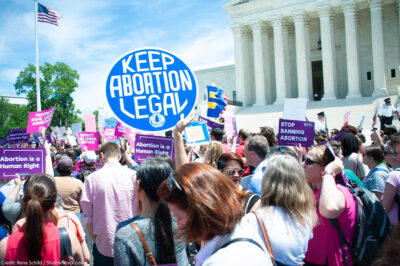
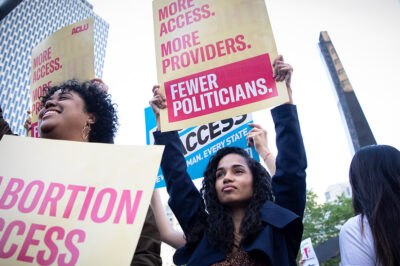
The ACLU was back in court this week to stop Kentucky's latest attempt to block access to abortion. At issue is a law that makes it a crime for doctors at Kentucky's last remaining abortion clinic to perform an abortion procedure that is the standard of care. In reality, the law is nothing more than a backdoor abortion ban: It would bar the only procedure available in the state after about 15 weeks of pregnancy. Kentucky politicians are determined to stop people who have decided to have an abortion from getting one. But we won't turn from this fight. Read more →
By Amber Duke
January 29, 2020
VOTING WITH A PRICE TAG

Amendment 4 is Still on the Line. Here's What's New.

In June, Florida Gov. Ron DeSantis put hundreds of thousands of newly eligible voters in danger of being permanently disenfranchised yet again. Following the passage of Amendment Four and a court battle, DeSantis signed a bill that requires people with past felony convictions to pay the exorbitant court costs, fines, and fees levied against them at the time of their conviction, or lose their right to vote. Governor DeSantis is trying to run out the clock before the March 2020 primary, and is deliberately sowing confusion to dissuade eligible voters from registering and going to the polls. We will continue fighting in federal court for our clients and the hundreds of thousands of Floridians' voting rights that this bill seeks to unconstitutionally eliminate. Read more →
By Orion Danjuma, Jonathan Topaz, and Leila Rafei
January 23, 2020
ASYLUM MAYHEM

Asylum-Seekers are Being Abandoned in Guatemala in a New Policy Officials Call a "Total Disaster"

In late November, U.S. immigration authorities began deporting some Central American asylum-seekers to Guatemala under a new policy that makes it nearly impossible for them to seek asylum in the U.S. But Guatemalan human rights workers say that their country's asylum system isn't capable of handling even the relatively small numbers that have been sent there so far, and that asylum seekers' precarious status in the country has already pushed many to leave. Our Staff Reporter spoke to people on the ground about the challenges faced by those subjected to this policy, and what lies ahead for asylum-seekers. Read more →
By Ashoka Mukpo
January 28, 2020

ACADEMIC FREEDOM?

The Government is Trying to Strip Student Workers of the Ability to Unionize

The federal government recently proposed a rule that would strip graduate student workers of their ability to organize under the National Labor Relations Act, which grants most private sector employees the right to engage in collective bargaining. The National Labor Relations Board argued that allowing graduate student assistants to bargain collectively would "uniquely imperil the protection of academic freedoms." The government is wrong. Like any other employee, student workers seek to organize to improve their working conditions – not to exert control over academic matters. "Protecting academic freedom" is just the government's phony justification for limiting workers' ability to unionize, and, as an organization deeply devoted to both academic freedom and free association, we won't stand by it. That's why we're opposing the proposed rule. Read more →
By Arianna Demas
January 30, 2020
YOUR PHONE, YOUR BUSINESS

In Latest Encryption Battle with Apple, Justice Department Still Wrong

The federal government is once again trying to force Apple to weaken the security of millions of iPhones. On Wednesday, President Trump issued a call for Apple to assist law enforcement in unlocking iPhones. The week before, Trump made the same demand of Apple, tweeting that the company should unlock cell phones as a quid pro quo for any benefits it enjoys as a result of favorable U.S. trade deals. Buying off private parties to do police bidding is neither good trade policy nor good law enforcement. The government's attempts to force developers to build insecure products, or to undermine existing security measures, are dangerous and unlawful. Law enforcement does not and should not have the authority to commandeer innocent third parties into becoming its undercover agents, spies, or hackers. Read more →
By Jennifer Stisa Granick
January 23, 2020
This email was sent by:
American Civil Liberties Union
125 Broad Street, 18th Floor
New York, NY 10004, USA

National Archives exhibit blurs images critical of President Trump

The original, unaltered photo of the 2017 Women’s March in the District. An altered version appears in an exhibit at the National Archives. (Mario Tama/Getty Images)

The original, unaltered photo of the 2017 Women’s March in the District. An altered version appears in an exhibit at the National Archives. (Mario Tama/Getty Images)

Jan. 17, 2020 at 6:54 p.m. EST

The large color photograph that greets visitors to a National Archives exhibit celebrating the centennial of women’s suffrage shows a massive crowd filling Pennsylvania Avenue NW for the Women’s March on Jan. 21, 2017, the day after President Trump’s inauguration.
The 49-by-69-inch photograph is a powerful display. Viewed from one perspective, it shows the 2017 march. Viewed from another angle, it shifts to show a 1913 black-and-white image of a women’s suffrage march also on Pennsylvania Avenue. The display links momentous demonstrations for women’s rights more than a century apart on the same stretch of pavement.

But a closer look reveals a different story.
The Archives acknowledged in a statement this week that it made multiple alterations to the photo of the 2017 Women’s March showcased at the museum, blurring signs held by marchers that were critical of Trump. Words on signs that referenced women’s anatomy were also blurred.
In the original version of the 2017 photograph, taken by Getty Images photographer Mario Tama, the street is packed with marchers carrying a variety of signs, with the Capitol in the background. In the Archives version, at least four of those signs are altered.
A placard that proclaims “God Hates Trump” has “Trump” blotted out so that it reads “God Hates.” A sign that reads “Trump & GOP — Hands Off Women” has the word Trump blurred out.
A sign in the original, unaltered photo of the 2017 Women’s March on Washington. (Mario Tama/Getty Images)
An altered version of the sign as it appears in the photograph shown at the National Archives. (Salwan Georges/The Washington Post)
Signs with messages that referenced women’s anatomy — which were prevalent at the march — are also digitally altered. One that reads “If my vagina could shoot bullets, it’d be less REGULATED” has “vagina” blurred out. And another that says “This Pussy Grabs Back” has the word “Pussy” erased.
The Archives said the decision to obscure the words was made as the exhibit was being developed by agency managers and museum staff members. It said David S. Ferriero, the archivist of the United States who was appointed by President Barack Obama in 2009, participated in talks regarding the exhibit and supports the decision to edit the photo.

“As a non-partisan, non-political federal agency, we blurred references to the President’s name on some posters, so as not to engage in current political controversy,” Archives spokeswoman Miriam Kleiman said in an emailed statement. “Our mission is to safeguard and provide access to the nation’s most important federal records, and our exhibits are one way in which we connect the American people to those records. Modifying the image was an attempt on our part to keep the focus on the records.”
Archive officials did not respond to a request to provide examples of previous instances in which the Archives altered a document or photograph so as not to engage in political controversy.
Kleiman said the images from the 2017 and 1913 marches were presented together “to illustrate the ongoing struggles of women fighting for their interests.”

The decision to blur references to women’s genitals was made because the museum hosts many groups of students and young people and the words could be perceived as inappropriate, Kleiman said in the statement.
Kleiman said the National Archives “only alters images in exhibits when they are used as graphic design components.”
“We do not alter images or documents that are displayed as artifacts in exhibitions,” she said. “In this case, the image is part of a promotional display, not an artifact.”
When told about the action taken by the Archives, prominent historians expressed dismay.
"There's no reason for the National Archives to ever digitally alter a historic photograph," Rice University historian Douglas Brinkley said. "If they don't want to use a specific image, then don't use it. But to confuse the public is reprehensible. The head of the Archives has to very quickly fix this damage. A lot of history is messy, and there's zero reason why the Archives can't be upfront about a photo from a women's march."

Wendy Kline, a history professor at Purdue University, said it was disturbing that the Archives chose to edit out the words "vagina" and "pussy" from an image of the Women's March, especially when it was part of an exhibit about the suffragist movement. Hundreds of thousands of people took part in the 2017 march in the District, which was widely seen as a protest of Trump's victory.
"Doctoring a commemorative photograph buys right into the notion that it's okay to silence women's voice and actions," Kline said in an email. "It is literally erasing something that was accurately captured on camera. That's an attempt to erase a powerful message."
The altered photograph greets visitors to "Rightfully Hers: American Women and the Vote," an exhibit that opened in May celebrating the centennial of women's suffrage. The 19th Amendment to the Constitution, which was ratified in 1920, prohibits the federal government and states from denying the right to vote on the basis of sex.

"This landmark voting rights victory was made possible by decades of suffragists' persistent political engagement, and yet it is just one critical milestone in women's battle for the vote," reads a news release announcing the exhibit on the Archives website.
Archives spokesman John Valceanu said the proposed edits were sent to Getty for approval, and Getty "then licensed our use of the image."
A Getty spokeswoman, Anne Flanagan, confirmed that the image was licensed by the National Archives Foundation but said in an email Friday evening that Getty was still determining whether it approved alterations to the image.
Karin Wulf, a history professor at the College of William & Mary and executive director of the Omohundro Institute of Early American History and Culture, said that to ensure transparency, the Archives at the very least should have noted prominently that the photo had been altered.

"The Archives has always been self-conscious about its responsibility to educate about source material, and in this case they could have said, or should have said, 'We edited this image in the following way for the following reasons,' " she said. "If you don't have transparency and integrity in government documents, democracy doesn't function."

DRUMPF / TRUMP SAYS MEXICANS LOVE HIM

A collection of funny memes and viral images skewering Republican presidential nominee Donald Trump.

This is an outrage, and we're going to make our voices heard & Yes, 75 percent of Americans support calling witnesses — but maybe not the same witnesses & Trump impeachment: Failed witnesses vote paves way for acquittal 31 & 29JAN & 1FEB20


Rep Jennifer Wexton D VA (10th District) is disgusted with the Senate vote denying the calling of witnesses to testify in (NOT MY) pres drumpf's / trump's impeachment trial, defying the opinion of 75% of the American people. Rep Wexton's votes for the articles of impeachment make her a target of the gop in the 2020 elections. We can not go back to being "represented" by the likes of that fascist fotze barbara comstock who voted with drumpf / trump-pence 97.8% of the time. Rep Wexton represents the values and interest of  the people of the 10th congressional district voting with drumpf / trump-pence 4.5% of the time.  This from Rep Wexton, click the links to go to her campaign website or to her congressional office.....
Jennifer Wexton for Congress

                                       
I'm outraged by the GOP-led Senate's vote to block witnesses at Donald Trump's impeachment trial. It's clear that Mitch McConnell will move quickly now to end the trial and acquit the president.

The American people have been denied the opportunity to hear further testimony and evidence that would paint a damning picture of this administration's corrupt behavior and its attempts to subvert free and fair elections. We now need to make our outrage heard at the ballot box in November by voting against those who would further enable Donald Trump.

Will you donate to help me keep fighting to protect the rule of law? Trump's team wants to make me a one-term congresswoman, and we need to be ready for all the smears and lies they'll throw our way.

Thank you,

Jennifer

Rep. Jennifer Wexton proudly serves the 10th District of Virginia. She's fighting to create a strong economy, ensure equality for all, and invest in a better future for America.
CONTRIBUTE

Yes, 75 percent of Americans support calling witnesses — but maybe not the same witnesses

Jan. 29, 2020 at 2:18 p.m. EST
Proponents of expanding President Trump’s impeachment trial in the Senate seized upon a new poll result released Tuesday by Quinnipiac University.
That poll, conducted over the past week, determined that 75 percent of respondents support allowing witnesses to offer testimony as part of the Senate proceeding. That includes nearly all Democrats and most independents — as well as a plurality of Republicans.
Image without a caption
This is a question of salience right now, given the emergence of reporting suggesting that former national security adviser John Bolton may have information strongly bolstering the case against the president. Trump, unsurprisingly, would rather that Bolton not present testimony to the senators who are empowered to remove the president from office. Senate Majority Leader Mitch McConnell (R-Ky.) is inclined to agree.
The implication of the poll for Trump’s opponents is clear: Americans want witnesses, so let Bolton in. That line of thought, though, misses two important points.
The first is that Congress has repeatedly shown a remarkable disinterest in responding to the majority will of the electorate when possible. Take the example of expanded background checks for gun sales: In the abstract, legislation to that end consistently has the support of a wide majority of the country. Often, though, possible legislative responses are simply set aside, allowing members of Congress to avoid having to weigh in against the will of the people. When legislation is introduced, specific proposals are often picked apart and attacked on the basis of particular elements of the legislation.
That, as it turns out, is probably a good analogy for the debate over impeachment trial witnesses. What a celebration of that 75 percent figure buries is that the witnesses sought by the 95 percent of Democrats who support the idea are almost certainly not the same witnesses supported by that plurality of Republicans.
Democrats want to hear Bolton and maybe acting White House chief of staff Mick Mulvaney. Republicans, however, want to see former vice president Joe Biden grilled, or even lead impeachment manager Rep. Adam B. Schiff (D-Calif.). Both sides support witnesses — but only in the abstract.
There’s evidence for that in other polling. Last week, CNN and its polling partner SSRS released a poll in which it found similarly high support for allowing witness testimony. This was before the Bolton news broke; at the time, about two-thirds of respondents supported allowing witnesses.
Image without a caption
(CNN’s poll was conducted entirely before the Bolton news broke. Quinnipiac’s overlapped with the emergence of that news.)
However, CNN and SSRS asked a question that sheds more light on what respondents wanted to see. Specifically, they asked respondents if the push by Democrats to solicit new testimony was a function of their seeking a fair trail — or just because they wanted to hurt Republican chances in this year’s election.
Two-thirds of Republicans supported the latter view.
Image without a caption
In other words, while about half of Republicans support witnesses, two-thirds think that the Democrats only want witnesses to hurt Republicans. Which strongly suggests that Republicans want to see witnesses who aren’t the ones the Democrats are advocating.
That said, it’s still the case that most Americans do want to see witnesses. A flat decision against calling witnesses runs contrary to that desire. As with background checks, though, the manifestation of that desire differs by party, complicating the politics. Both Democrats and Republicans should bear in mind that if witnesses are approved, neither side may be entirely happy with what they get.
Unlike background checks, though, the Senate won’t be able to avoid a vote.

Trump impeachment: Failed witnesses vote paves way for acquittal

US President Donald Trump is set to be acquitted in his impeachment trial after senators voted against calling witnesses or admitting new evidence. 

1 February 2020
Democrats hoped four swing Republicans would vote for witnesses, which would have extended the trial without in all likelihood changing its outcome.
In the end, only two of the four Republicans voted with Democrats.
The trial now moves forward to a vote on whether to acquit President Trump, which he is all but certain to win.
Senior members of President Trump's Republican Party pushed from the outset for a speedy trial with no witnesses or new evidence. Above all, they wanted to avoid senators hearing from former National Security Adviser John Bolton.
According to reporting by the New York Times, Mr Bolton writes in his forthcoming book that the president directly instructed him to withhold military aid from Ukraine in exchange for dirt on a Democratic political rival, Joe Biden.
Testimony from Mr Bolton about his involvement in the Ukraine affair threatened to significantly undermine the case made by the president's lawyers during his trial.
Trump was impeached on two charges - abuse of power and obstruction of Congress. The first charge stemmed from an allegation that he pressured Ukraine to damage Mr Biden for his own political benefit. The second from an allegation that he purposefully obstructed the Congressional impeachment investigation.
The final vote on whether or not to acquit Mr Trump will be held on 5 February.

What happens next?

The Senate will vote on Wednesday 5 February on whether to convict or acquit the president on the two articles of impeachment brought against him.
Democratic Senate leader Chuck Schumer said there would be four votes on Friday night on Democratic amendments, followed by closing arguments on Monday, speeches from senators from Monday to Wednesday, and a final vote on Wednesday - the day after President Trump's State of the Union address.
A two-thirds majority in the chamber of 67 votes is required to remove him from office. The Republicans control the Senate with a 53-47 majority over Democrats, and no Republican senator has signalled that they plan to vote for Mr Trump's removal.
Eyes will instead fall on several Democrats in Republican-leaning states who have indicated they may vote to acquit. Any Democratic defections would be a symbolic victory for the president that he will likely use to his advantage on the campaign trail in the coming months.
Media captionRepublicans did not want witnesses called. Here's why.
The battle over witnesses intensified a week ago after reports emerged that Mr Bolton might have highly damaging testimony about the president's involvement an alleged quid pro quo with Ukraine.
Mr Bolton's forthcoming book reportedly alleges that the president personally directed the scheme to get dirt from Ukraine on Mr Biden, a former US vice president. The revelations threatened to undo Republican arguments that no impeachment witness had first-hand testimony of the president's involvement.
But the slim chance of Mr Bolton being called to give testimony to the Senate slipped away from Democrats on Friday, after two of the four Republican senators they had hoped would defect confirmed that they would not.
Senator Lamar Alexander of Tennessee said in a statement late on Thursday that, while the Democrats had clearly demonstrated the president's actions were "inappropriate", they had not proved to be impeachable offenses.
"The question then is not whether the president did it, but whether the United States Senate or the American people should decide what to do about what he did," he said.
"I believe that the constitution provides that the people should make that decision in the presidential election that begins in Iowa on Monday."
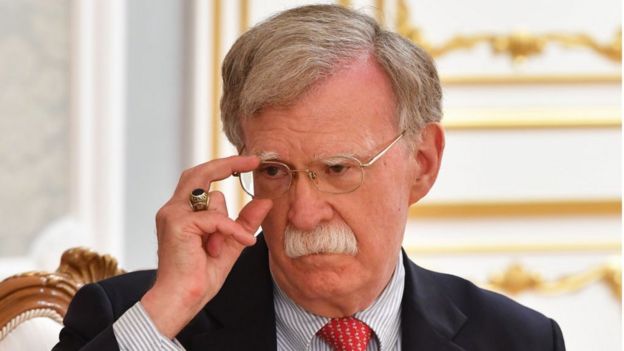
John BoltonImage copyrightGETTY IMAGES
Image captionJohn Bolton was fired from his post as National Security Adviser in September
Senator Lisa Murkowski of Alaska, another moderate, said in a statement on Friday afternoon: "The House chose to send articles of impeachment that are rushed and flawed. I carefully considered the need for additional witnesses and documents, to cure the shortcomings of its process, but ultimately decided that I will vote against considering motions to subpoena."
Republican senators Susan Collins of Maine and Mitt Romney of Utah decided to vote to call witnesses, but they were alone among the 53-strong Republican Senate caucus.
Democratic House impeachment managers said throughout the process that a trial without witnesses amounted to a sham trial. They were joined on Friday by President Trump's former White House chief of staff, John Kelly, who told a New Jersey publication that Mr Trump had been subjected to only "half a trial".
Analysis box by Anthony Zurcher, North America reporter
Donald Trump's Senate impeachment trial is all but over.
Barring an unforeseen and unexpected blockbuster development, a largely party-line vote will acquit him of the two charges brought by the House of Representatives, which itself approved those articles of impeachment on a nearly party-line vote.
Both sides will soon be left to sift through the political rubble just nine months before a national election that has the entire House, more than a third of the Senate and the presidency itself on the ballot.
According to polls, the nation's political disposition is much as it was before the impeachment process began. The US is sharply divided along partisan lines. The president's approval ratings hover in the low to mid-40s, roughly where they've been the entirety of his term in office. His re-election chances are dicey but far from slim.
The decision not to seek witnesses - which polls show Americans overwhelming wanted - may be forgotten before long.
Polls don't tell the whole story, however, and there are other signs that the impeachment proceedings have made an impact.
Presentational grey line

How did senators react?

Three of the four Democratic senators running for president tweeted in the moments after the witnesses vote went against the party.
"Senate Republicans just failed the American people & broke their oath to the United States Constitution," wrote Massachusetts senator Elizabeth Warren.
Vermont senator Bernie Sanders, an independent who caucuses with Democrats, wrote: "I've never heard of a trial where you don't have witnesses. This is a sad day in American history."
Senator Amy Klobuchar of Minnesota wrote: "If you don't have witnesses, you do not have a fair trial. The truth will come out."
Presentational white space
Marco Rubio, Republican senator for Florida, said: "Just because actions meet a standard of impeachment does not mean it is in the best interest of the country to remove a President from office."