BUCKNACKT'S SORDID TAWDRY BLOG We should not be a journey to the grave with the intention of arriving safely in an attractive & well preserved body, but rather to skid in sideways, chocolate, bier or wein in hand, body thoroughly used up, totally worn out and screaming "WHOO-HOO, WHAT A RIDE!!!!!!"

I can imagine NOT MY pres drumpf / trump actually doing what herod did after the birth of Christ, he is enough of a psychopath / sociopath / narcissist to not be bothered by the slaughter of innocents to get his way, to maintain his power. Just look at what he is doing to our country, the dhs domestic terrorism and violence he has unleashed on the residents of America and the wanton military terrorism and aggression he has unleashed on the rest of the world, on our friends and foes alike. He is an evil person and all who support him and do his bidding are complicit in his war crimes, his crimes against humanity, his sins. This from Sojourners.....
Chaos fills the streets as families are separated by force, and mothers cry out as their children are taken from them. To exert control and maintain power, a ruler orders agents to detain people off the street. Those the ruler labels as “subversive” are treated as a threat to his reign. The violence is indiscriminate and unrelenting. It does not matter who gets hurt, as long as the ruler stays on the throne.
If your mind went directly to President Donald Trump or the news of Immigration and Customs Enforcement agents shooting and killing two Minnesota residents—mom and poet Renee Nicole Macklin Good, and intensive care nurse Alex Pretti—you are not alone. But in this case, I am talking about Herod and his order to kill the children in Bethlehem and its surrounding region (Matthew 2:16). While the parallels are not identical, the shared logic of unrestrained state power is unmistakable.
Herod the Great was a Rome-backed king who ruled Judea. He had a multiethnic background, with his family being Idumean, Arab, and Jewish, and was considered, both by himself and others, as the “king of the Jews.” Josephus, the first-century Jewish historian, recounts how Mark Antony had resolved to make Herod king and even advocated on his behalf to the Roman Senate, showing how imperial power backed his reign. While Herod’s identity and rise to power might be complicated, his abuse and crimes were not. Josephus records how Herod had one of his wives strangled, and multiple sons killed.
In Matthew’s gospel, the author chronicles how news that the true “king of the Jews” has been born put Herod and all of Jerusalem on edge (2:1–5). He recruits the magi to be his spies, asking them to return with word of the child’s location so that he can eliminate this rival to his throne (2:7–8). Matthew’s point is not only that Herod is cruel, but that anxious power is easily threatened. It treats the most vulnerable, such as children and those marked as outsiders, as dangers that must be eliminated.
Some people attempt to justify ICE raids with stories that cast undocumented immigrants as dangerous, subversive, and incapable of assimilating. Claims that noncitizens are voting in federal elections persist, even though credible investigations have repeatedly found this to be extremely rare. The result is a politics of suspicion that makes it easier to profile, detain, and separate people on the basis of who they appear to be, not on the basis of any actual evidence.
The dangerous logic of suspicion and fear surfaced clearly in September 2025, when the Supreme Court stayed a district court order that had temporarily barred immigration agents in Los Angeles from making stops based on racial, linguistic, and cultural markers. Another common basis for aggressive enforcement is the claim that immigrants commit higher rates of crime than U.S.-born citizens. But research from the nonpartisan Migration Policy Institute shows that “immigrants in the United States commit crimes at lower rates than the U.S.-born population.” Empowered by the Trump administration, ICE is operating with a logic of anxious state power, where fear turns the outsider into a threat and that “threat” is used to justify indiscriminate violence.
The biblical story of Herod offers an example of what happens when a ruler embraces indiscriminate violence. When Herod realizes the magi are not planning to return to tell him the location of Jesus, he responds with a blanket order: He has boys 2-years-old and younger in Bethlehem and its surrounding region killed (Matthew 2:16). He does not need to know which child is Jesus. He does not care. His command sweeps up an entire community to eliminate a perceived threat to his power. This is one of Matthew’s clearest portraits of how anxious power operates. When rulers feel that their power is being threatened, they reach for indiscriminate force.
Like Herod’s violence in Bethlehem, ICE raids often operate with a blunt, sweeping logic. In practice, raids can upend households in minutes, separating parents from children and forcing families into sudden displacement. Some people detained in the United States have even been transferred to El Salvador’s CECOT mega-prison, with families struggling to learn where their loved ones are, as immigration agents disappear them without notice, and without an opportunity to retain legal representation. Some have even been deported by “mistake.” And these “mistakes” do not end with noncitizens.
In October 2025, ProPublica reported that more than 170 U.S. citizens were detained by immigration agents. Earlier that year, federal agents raided the wrong home and degradingly forced a family of U.S. citizens in Oklahoma City, Okla., to wait outside in the rain before they could fully dress. This atmosphere has intensified in our current moment. On Jan. 7, 2026, an ICE agent fatally shot Renee Nicole Macklin Good in Minneapolis during a confrontation captured on video. And then again, on Jan. 24, officers with Customs and Border Protection fatally shot Alex Pretti. In both cases, federal officials have tried to frame the shootings as self-defense, accusing the victims of being “domestic terrorists” who were trying to harm immigration agents. This, despite video evidence and eyewitness accounts that directly expose such characterizations for what they are: lies.
READ MORE: The Chaplain Helping the Timberwolves Stand in Solidarity with Minnesota
To be clear, my comparison between Herod and Trump is not meant to suggest they are the same, as if history, context, and specific actions directly parallel one another. Instead, I am drawing on what New Testament scholar Love Lazarus Sechrest calls “associative hermeneutics,” which reads ancient and modern situations as analogues, identifying the “rhyme” between their social dynamics. In this case, the Trump administration initially claimed it would target the “worst of the worst,” yet these actions have instead swept up innocent families, people in our congregations, and others who are simply trying to survive in our society. Even if you think deporting some individuals is justified, disregarding their humanity, sending them to prisons in a third country, and separating families is not moral. Setting Herod and Trump side–by–side reveals how Trump’s brutality, carried out by ICE agents, “rhymes” with Herod’s indiscriminate actions. In this case, the sound is not a symphony of love and moral action, but a cacophony of violence.
This chorus of threats is spreading fear across immigrant communities. ICE pressures neighbors to police one another. They treat whole populations as threats. They treat nonviolent resistance as tantamount to domestic terrorism. In the face of these seemingly insurmountable powers, Christians can embrace prophetic responsibility. On Sunday, Jan. 18, protesters nonviolently disrupted a service at Cities Church in St. Paul, Minn., a church in the Southern Baptist Convention. One of the pastors, David Easterwood, serves as the acting director of the ICE St. Paul field office. The peaceful protesters raised their voices in unison, bellowing “ICE out” and “justice for Renee Good.” In shouting this melody of protest, they offered a beautiful example of how Christians can tell the truth, name what is happening, and speak to unjust systems with moral clarity. Despite being arrested on felony charges for her participation in organizing the nonviolent protest at Cities Church, Rev. Nekima Levy Armstrong told Democracy Now! after her release that “We cannot be silent at a time like this … I am continuing to use my voice to speak out against this fascism, tyranny and authoritarianism of the Trump administration. And others have to do the same.”
As we continue to witness ICE’s actions against our neighbors, I cannot help but see echoes of Herod’s world in our own, as state terror abounds, and tyranny reigns. Yet Herod did not have the final word. He could not stop God’s purposes. Rev. David Black, the Chicago pastor one who was shot with pepper balls outside an ICE processing facility in Broadview, Ill., put it plainly to Sojourners in October 2025: “When I look at a lot of my Christian siblings, who I see being so profoundly confused and misled, I believe that they have been made to follow a faith that is based in fear, coercion, and control.” Instead of living in fear of the “other,” we can and should embrace our neighbors, treating them as if we were caring for Christ himself (Matthew 25:31–46).

Rubin James Yi McClain is an opinion writer for the 2026 Sojourners Journalism Cohort.

In the weeks since an ICE agent shot and killed Renée Good, an unarmed US citizen and mother of three young children, federal officers have met protesters in Minneapolis with a tunnel vision of violence. These men have smashed car windows, tear-gassed kids, hauled off screaming women on their way to the doctor. They went door to door, carrying guns, asking neighbors where to find “the Asian” families.
Last weekend, predictably, federal agents again shot and killed someone.
The Trump administration may be starting to show small signs of regret after its lies about Alex Pretti’s killing proved too much for Americans. But make no mistake: The wind-down is about quelling a PR crisis amid tanking poll numbers—not regret for its terrorist-like behavior. President Donald Trump and his inner circle still insist that rounding up people and crushing dissidents brings peace to American cities besieged by the assault of having an immigrant community. In fact, some, like Steve Bannon, are calling for further escalation. “If you blink in Minneapolis, you’ll never make it to Detroit, to Chicago, to Philadelphia, to Los Angeles, to New York,” Bannon said on his podcast, the aptly titled War Room, on Monday. Trump must “put the insurgency down immediately.”
The pretext for this war, of course, has always been a bogus premise. Yet federal agents treat it with the dogma of settled fact. But I keep wondering: How does the average CBP or ICE agent convince themselves of this? Even now, I can’t help shake the absurdity of anyone—Trump, Gregory Bovino, whomever—hoping to convince a thinking person, even themselves, to believe that places like Minneapolis have ever required an armed occupation. It’s against this genuine perplexity that I keep coming back to how these officers look and what mirrors might reflect back to them when they dress up for war.
“Anybody who’s had a fun evening on Halloween can understand what happens when somebody fully dresses up in paramilitary gear with flash-bang grenades hanging off of them,” said Peter Kraska, a justice studies professor at Eastern Kentucky University. “They’re going to walk out in public and say to themselves, ‘I am different from all these people.’ They become the enforcer. And when they look out and see the other, they see an enemy. The [paramilitary gear] gets them to react differently and think differently than they normally would.”
The role of military-style uniforms in helping the Trump administration create a theater of war where none exists cannot be overstated. It marks a stark evolution from the early days of Trump’s mass deportation plans, when plainclothed agents looked a lot like your best friend’s worst boyfriend—the guy who moved to rural Pennsylvania and discovered the basement levels of gun culture. Now, agents march into town in the costume of a foreign invasion.
Consider the camouflage now ubiquitous across the cities ICE occupies. At first, the pattern’s technical science might seem like a natural extension of the Trump administration’s increasingly illegal efforts to shield the identities of the men carrying out its vision of cruelty. But the theory breaks down when you look at the urban landscapes where ICE hunts down immigrants. Simply put, wearing camo in places like Lake Street or Hyde Park defies its central aim. If camo’s built-in purpose is to avoid detection, ICE’s embrace of it is the opposite: They want maximum visibility. They want to show they are soldiers. And they want to do so to make it seem reasonable, if only to themselves, to act like an invading army.
When I reached out to the Department of Homeland Security about the use of military gear among ICE agents, spokesperson Tricia McLaughlin responded with her own question: “Why do ICE agents wear tactical gear when they are facing rampant assaults and vehicular attacks? Is that the question you’re asking?” No, not really. But the snark with which McLaughlin replied was enough to grasp that questioning why DHS employs camo when lush woodlands do not exist in the cities its agents invade was irrelevant. They are dressing for the war they want.
What other way was there to interpret the coat of the former envoy of terror, Bovino? The commentariat spent much time deliberating its lineage, whether or not Bovino’s hulking olive garb was in fact true Nazi wear. (It turns out it was not.) But in roaming around Minneapolis in the fashions of Hugo Boss circa 1933, Bovino, who reportedly travels with his own film crew, succeeded in pushing the optics of war where it does not exist.
“What you’re seeing is the functionality of gear for legitimate, militarized purposes versus a type of postmodern, performative imagery,” Kraska said. “It makes them feel a particular way, to tap into those warrior fantasies and masculine drive of, ‘I’m a real man, I’m a real badass.’”
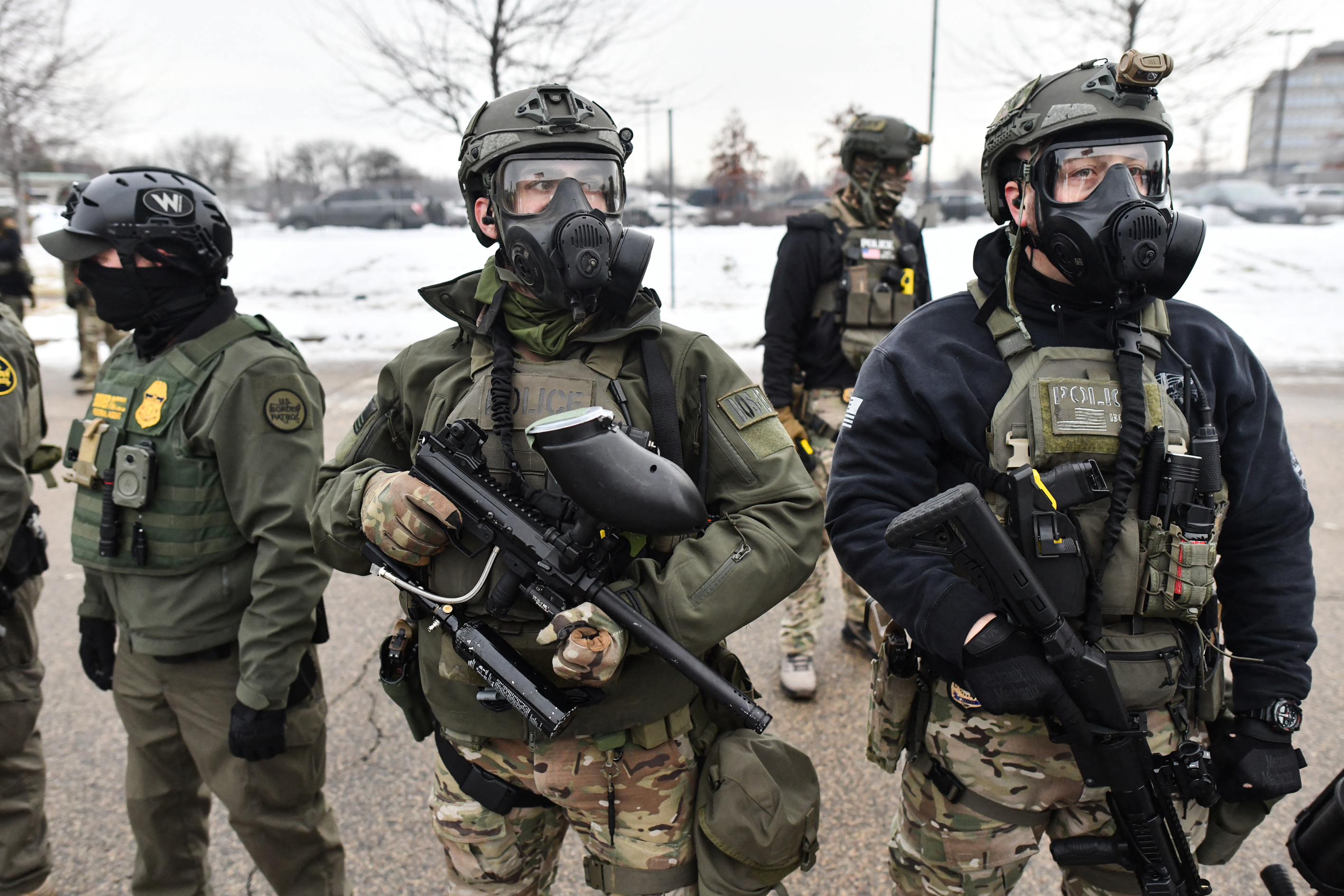
The same holds for the men under Bovino. These are federal agents who wear hats intended for jungle warfare—again, in Minneapolis, where no such jungle exists—as well as blood-type patches, despite little evidence that they would ever be needed. After all, they are in Minneapolis, an American city with American hospitals, where doctors provide blood transfusions without the help of uniform instructions, the way a soldier on a remote battlefield might actually need. Furthermore, ICE’s own data strongly undercuts the notion that the job of an ICE officer is even uniquely dangerous work. In the absence of peril, federal agents turn to costume to legitimize their presence.
“This administration sees all of that as a benefit,” journalist Radley Balko, who writes the criminal justice newsletter The Watch, wrote over email. “They want to terrorize immigrant communities. They want to be seen as an occupying force. They’ve been clear about this. They want to make immigrant communities so fearful that they’ll self-deport, and they’ll tell others to stop coming here. Making immigration officers as scary and intimidating as possible is part of the strategy.”
The result has been a mix of violence and lethality at the hands of federal officials. But as Adam Serwer writes in the Atlantic, MAGA’s imagination of Trump’s men as warrior-like figures belies the fear behind their body armor. It also seeks to conceal the ham-fisted follies that have been paired with their false pretexts for war: jacked-up men in military gear falling on their asses; inebriated ICE agents threatening immigration checks on sheriffs who catch them drunk driving; ICE officers, some resembling the “overweight” men Defense Secretary Pete Hegseth complains about, failing to arrest a delivery worker as he shouts, “I’m not a US citizen!” Above in their hotel rooms, federal agents return to their dead mall aesthetics to once again demonstrate what Kraska describes as “the paradox of this fascist movement.”
ICE BEING EXTREMELY PROFESSIONAL IN METRO MINNEAPOLIS, MN
“Yes, it’s being run by incompetent buffoons,” Kraska told me. “This all seems like silly, immature, B-league stuff. But at the same time, it’s just as dangerous as any movement we’ve seen.”
You can see the same “badass” theatrics play out in DHS’s social accounts, where videos of immigrant arrests “flood the airwaves” and are celebrated to thumping music. Some are viewed by millions; others are shared by the president. So an uncomfortable question emerges: Does ICE roam the streets hoping to be featured in such videos? It certainly seems that way. A report from the Washington Post showed the DHS social media team eagerly hoping to go viral from arrests.
The same theatrical through line exists all the way up to Kristi Noem, who, despite a résumé completely devoid of any law enforcement background, landed the job as Trump’s homeland security secretary. What Noem did have, as I wrote in March, was the seemingly altered face for the job. It’s all about content.
It strikes as ironic, then, that cameras have emerged as one of the most powerful means to resist ICE’s violent tactics. Wielded by protesters, these devices have been critical in dismantling the Trump administration’s lies about the people its agents fatally shoot. If it is a war—an invasion!—then the administration said it could do whatever it wanted. It could separate families; it could hunt down immigrants. Well, maybe the opposite is true. Maybe dressing up like soldiers and beating up everyday people, when filmed, looks bad. For an administration so obsessed with content, it forgot that, at some point, backlash tends to follow those who go viral.