NORTON META TAG

Showing posts with label neonicotinoid. Show all posts

09 April 2018

COMMENT DEADLINE APPROACHING: Tell the EPA to Protect our Bees & EU expected to vote on pesticide ban after major scientific review 7APR&28FEB18

Related imageImage result for bee die off meme
THE campaign started in 2014 against pesticides that kill bees continues, neonicotinoids and neonics are being pushed by bayer and syngenta, and though they know their products are responsible for killing off bee colonies across the country and are threats to the health of farm workers and residents in farm states where the bayer-syngenta cabal is seeking approval for expanded use of these poisons. They are putting profit over the health and safety of the American people and environment. These pesticides were banned from use on sunflowers, oilseed rape and corn in Europe in 2013 because studies prove they kill bees. Now the EU is expected to vote on completely banning their outdoor use because of more studies showing  they ans killing off bees. bayer and syngenta believe they will get approval from the US EPA director scott pruit to expand the use of these poisons to 165 million acres of American farmland.  Please submit a comment telling the EPA to deny bayer and syngenta  their request to expand the use of these pesticides and point out the EPA is supposed to be the Environmental Protection Agency. And be sure to check out the article in Nature...... 


Survey of more than 1,500 studies concludes that neonicotinoids harm bees.
URGENT: Scott Pruitt is embroiled in scandal, but his EPA is not stopping plans to expand the use of dangerous bee-killing pesticides. Help protect our pollinators and submit an official comment by April 21st »

URGENT ACTION NEEDED!

We cannot let Pruitt's dirty dealings decimate our pollinator populations, contaminate our waterways, and jeopardize our health.

Right now, while scandal after scandal breaks exposing EPA chief Scott Pruitt's cozy ties to industry insiders, he is still moving to help his corporate buddies. This time, it's by expanding the use of extremely toxic bee-killing neonicotinoid thiamethoxam pesticides on over 165 million acres of farmland.

Scientific evidence has shown that this pesticide is hazardous to our environment and that the EPA should be reducing its use, not expanding it.

We know Scott Pruitt is willing to prioritize the profits of Big Corporations over the health of our pollinators, communities, and ecosystems. And with mega-corporations Bayer and Syngenta — two of the largest producers of these bee-killing neonic pesticides — lobbying Pruitt to make sure that their pesticides stay on the market, we must act quickly and LOUDLY.

There are only a few weeks left to act — that's why we need LCV members like you to speak out and tell the EPA to eliminate these dangerous pesticides once and for all. Pressure is building against Scott Pruitt's EPA so now is the time to act — join us.

TIME IS RUNNING OUT: Tell the EPA to keep bee-killing pesticides OUT of our farms. GOAL 30,000 comments »

Numerous studies have shown that neonic pesticides not only harm bees, but they also pose danger for birds and aquatic species through the contamination of plants and waterways. Already these chemicals have become ubiquitous in our food supply — with evidence of neonic pesticides found on fruits, vegetables, and honey sold in our grocery stores.

To make matters worse, the communities that work on and live near these farms are disproportionally exposed to these dangerous pesticides and suffer from greater health risks. And Pruitt is moving to reduce the minimum age requirement for farm workers, increasing the exposure of young workers to these dangerous pesticides.

We cannot ignore the science — these pesticides harm wildlife, contaminate the produce we eat, and risk the health of our communities. We must raise our voices in opposition to any move that could jeopardize the health of our pollinators and frontline farm working communities! 

As Big Corporations try to discredit science and stop the EPA from taking action in order to protect their bottom line, we must build a bigger and stronger movement to stand up against dangerous pesticides. If enough of us submit a comment, the EPA will have no choice but to reconsider this disasterous plan — and we can save the bees. We can stop them, but we only have until April 21st to speak out.

Join the fight — submit a comment and tell Pruitt to stop putting Big Corporations above our health and environment »

The EPA exists to protect our pollinators, communities, and environment from dangers just like this. Scott Pruitt thinks he can get away with only protecting the interests of corporations like Bayer and Syngenta. We simply won't let that stand. Show the EPA that we're paying attention and won't stand for attacks against our pollinators.

Thank you for standing up for our bees.

EU expected to vote on pesticide ban after major scientific review
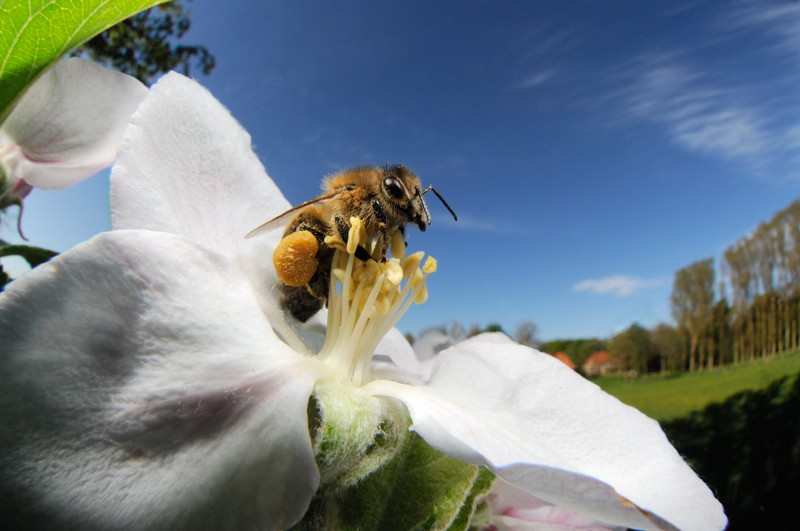
Honey bee (Apis mellifera) collecting pollen from the flower of an apple tree
A honeybee (Apis mellifera) gathers pollen from an apple-tree flower.Credit: Solvin Zankl/NPL
Survey of more than 1,500 studies concludes that neonicotinoids harm bees.
In a long-awaited assessment, the European Union’s food-safety agency has concluded that three controversial neonicotinoid insecticides pose a high risk to wild bees and honeybees. The findings by the European Food Safety Authority (EFSA) in Parma, Italy, raise the chances that the EU will soon move to ban all uses of the insecticides on outdoor crops.
In 2013, the EU prohibited applications of the three chemicals on crops attractive to bees — such as sunflowers, oilseed rape and maize (corn) — after an EFSA assessment raised concern about the insecticides’ effects. Since then, researchers have amassed more evidence of harm to bees, and the European Commission last year proposed banning all outdoor uses, while still allowing the pesticides in greenhouses. The latest EFSA assessment strengthens the scientific basis for the proposal, says Anca Păduraru, a European Commission spokeswoman for public health and food safety. EU member states could vote on the issue as soon as 22 March.
Neonicotinoids (often abbreviated to neonics) are highly toxic to insects, causing paralysis and death by interfering with the central nervous system. Unlike pesticides that remain on plant surfaces, neonicotinoids are taken up throughout the plant — in the roots, stems, leaves, flowers, pollen and nectar.
The EFSA assessment covered the three neonicotinoids of greatest concern to bee health — clothianidin, imidacloprid and thiamethoxam. The agency considered more than 1,500 studies, including all the relevant published scientific literature, together with data from academia, chemical companies, national authorities, non-governmental organizations (NGOs) and beekeepers’ and farmers’ associations. The assessment found that each of the three chemicals posed at least one type of high risk to bees in all outdoor uses.
Harmful exposure
The agency found that foraging bees are exposed to harmful levels of pesticide residues in pollen and nectar in treated fields and contaminated areas nearby, as well as in dust created when treated seeds are planted. It also concluded, on the basis of more limited evidence, that neonicotinoids can sometimes persist and accumulate in the soil, and so can affect generations of planted crops and the bees that forage on them.
“EFSA’s advice is often criticized by interested parties such as NGOs and companies, but this is a good demonstration of how EFSA gives scientifically sound and impartial advice,” says José Tarazona, head of the agency’s pesticides unit.
A spokesperson for the global biotechnology firm Syngenta, which produces neonicotinoids, says that EFSA’s conclusions are overly conservative. “When regulators make decisions about crop-protection products, what should matter is science, data and that the processes in place are respected and that the public interest is served,” the spokesperson says. “Any further restrictions based on this report would be ill-conceived.”
EU member states were scheduled to vote on the proposal to outlaw outdoor uses on 13 December, but postponed it partly because many wanted to wait until EFSA completed its evaluation.
Member states plan to discuss the EFSA assessment at a meeting of the commission’s Standing Committee on Plants, Animals, Food and Feed sometime in March, says Păduraru. “The protection of bees is an important issue for the commission since it concerns biodiversity, food production and the environment.”

RELATED ARTICLES

20 June 2014

Bzzzzzzzzzzzz......STOP THE BEE-POCALYPSE 16JUN14 & SNL KILLER BEES......


Killer Bees.
SNL's Killer Bee skits were hysterical, the bee die-off isn't.
HR 2692 has 65 co-sponsors in the US House. This legislation will ban pesticides containing neonics / neonicotinoids for two years while safer pesticides are developed. We are running out of time, the bees can't keep dying in the numbers they are without the potential for major disruptions in agricultural production in this country. Please click the link to send your Representative a letter telling them to support, co-sponsor and vote for HR 2692!
LCV logo header


honeybee

Could you imagine a fall without fresh apples? Thanksgiving without cranberry sauce or pumpkin pie? Chips without guacamole? It’s hard to picture, but this could be our not-so-distant future if we don’t take action now to save our number one food security guard -- the honeybee.
In recent years, nearly one third of commercial bee colonies in the U.S. have been dying over the winter. In Oregon last year we saw the biggest mass killing ever, as 50,000 bumblebees dropped dead after coming in contact with a pesticide used purely for aesthetic purposes. The situation is so bad that people have started to dub it the “Bee-pocalypse.”
Why is this a big deal? Because one third of the food produced in North America, including nearly 100 varieties of fruits and vegetables like apples, pumpkins, cranberries, and avocados, rely on honeybees for pollination.
Losing our bees wouldn’t just leave us without delicious guacamole and apple pie, it would be a crushing blow to our economy. We could lose more than $15 billion a year in agricultural production in the U.S.
The good news is that Congress has finally started to take notice. Just last week, a bill (H.R. 2692) to save honeybees by temporarily banning certain pesticides reached 65 co-sponsors.
This is the closest we’ve ever gotten to actual legislation to protect our bees, so we need your help to spread the word and keep the momentum going. If enough of us speak out, we can get more members of Congress to support this bill and make saving our bees a reality.
The mass death of our honeybees is not a natural phenomenon. Europe is seeing huge population declines as well. The difference is that the European Union is working to reverse this trend with a two-year ban in place on neonicotinoids, the pesticides linked to mass bee deaths. We need your help to get the United States to follow suit.
This bill would temporarily halt certain pesticides while safer pesticides are being developed. And get this -- we may already have the key to a safer pesticide. Researchers in England have been investigating the venom of one of the world’s most deadly spiders, the Australian funnel web spider. The spider’s venom creates a bio-pesticide that is still fatal to common farm pests, but appears to have absolutely no effect on bees.
We have a very real shot at saving the bees, but only if we stop the use of dangerous pesticides and develop new, safer alternatives. But we have to act now to convince Congress to do something about it. There are 65 members supporting the bill so far -- will you help us get even more on our side?
There’s no simple solution to the bee crisis, but we do know about some steps we can take now to move us in the right direction and the first one is passing this bill. The success of our crops and security of our nation’s food supply hinges on whether or not we can protect our bees. So thank you for telling Congress to take action today.
Best,
Vanessa
Vanessa Kritzer
Director of Digital Strategy
League of Conservation Voters

1920 L Street, NW Suite 800
Washington, DC 20036
202-785-8683
lcv-optim-share-donate.png

Bee deaths a result of pesticide Safari; count upped to 50,000 dead insects

Elizabeth Case, The Oregonian By Elizabeth Case, The Oregonian
Follow on Twitter
on June 21, 2013 at 5:16 PM, updated April 22, 2014 at 1:05 PM


As the estimate of dead bees rose to 50,000, the Oregon Department of Agriculture confirmed the insecticide Safari caused the deaths in a Wilsonville earlier this week. A landscaping company sprayed 55 linden trees in a Target parking lot to control for aphids, said Dan Hilburn, the plants division director at the department of agriculture. The bees have been dropping from trees since the spraying on Saturday.

Aphids produce honeydew, a sticky liquid that can drip off onto cars or pedestrians. A Target representative said by email that the Wilsonville store had received no customer complaints about it. 

The Portland-based Xerces Society, which first reported the die off to the state Agriculture Department said aphids can be controlled without insecticides, including by spraying infested plants with soapy water. 

On Friday the Agriculture Department, the City of Wilsonville, neighboring towns and some local landscape contractors covered the sprayed trees with netting in an attempt to prevent further insect deaths. 

The state is investigating any violation of pesticide laws, which could take up to four months, said Dale Mitchell of the Agriculture Department. 

Mitchell said the bee deaths, the largest documented die-off of bumblebees, could prove important in determining the use and regulations of Safari and other insecticides in the United States. 

Safari's main ingredient is dinotefuran, a neonicotinoid. There are two main kinds of neonicotinoids, both of which are general use insecticides. Safari is a member of the nitro-group.  Research published in 2012 shows these are generally more toxic to bees than the other type. The European Union issued a temporary ban on three other kinds of nitro-group neonicotinoids, which will go into effect this December. 

Elliot Associates, the land management company that rents the affected Argyle Square lot, released the following statement Thursday: "If a cause is discovered which may be attributable to our actions or those of our contractors, a proactive course of action will be taken after consulting with the DOA and other experts in this field." 


Bumblebee deaths caused by insecticide A bee poisoned by the insecticide "Safari" struggles in a parking lot in Wilsonville. 25,000 bees and insects were affected.
Meanwhile, other reports of bees dying around Wilsonville and surrounding towns have prompted Xerces to check whether similar pesticides were used elsewhere. 

"My worry is that we're going to lose sight of the real message," said Mace Vaughan of Xerces. "I think we're (using insecticides) all over the place, and people are doing it in their backyards without even knowing it." 

The agriculture department and other related groups will meet Monday to discuss any further action.

13 June 2014

Did Scientists Just Solve the Bee Collapse Mystery? 20MAI14

IF you are buying plants for your garden from home depot and lowe's you are killing bees. home depot and lowe's both sell plants and gardening / landscaping products containing neonics / neonicotinoids which are directly linked to bee colony collapse / mass bee die-off. The European Union has banned the sale of these products for two years to see the effect on bees there. If you are concerned about the massive bee die-off that has been occuring in the U.S. and around the world the choice is quite simple, stop buying plants and products containing neonics / neonicotinoids, and stop buying products from bayer and syngenta, the two international companies producing these chemicals responsible for the massive bee die-off threatening agriculture worldwide. From +Mother Jones .....
| Tue May 20, 2014 6:00 AM EDT

It's a hard-knock life, scouring the landscape for pollen to sustain a beehive. Alight upon the wrong field, and you might encounter fungicides, increasingly used on corn and soybean crops, and shown to harm honeybees at tiny levels. Get hauled in to pollinate California's vast almond groves, as 60 percent of US honeybees do, and you'll likely make contact with a group of chemicals called adjuvants—allegedly "inert" pesticide additives that have emerged as a prime suspect for a large bee die-off during this year's almond bloom.
Harvard researcher Lu believes that with this study, coming on the heels of a similar one he released in 2012, the colony collapse mystery has been solved.
The hardest-to-avoid menace of all might be the neonicotinoid class of pesticides, widely used not only on big Midwestern crops like corn and soybeans but also on cotton, sorghum, sugar beets, apples, cherries, peaches, oranges, berries, leafy greens, tomatoes, and potatoes. They're even common in yard and landscaping products. I've written before about the growing weight of science linking these lucrative pesticides, marketed by European agrichemical giants Bayer and Syngenta, to declining bee health, including the annual die-offs known as colony collapse disorder, which began in the winter of 2005-06.
And now, a new Harvard study fingers neonics as the key driver of colony collapse disorder. The experiment couldn't have been simpler. Working with nearby beekeepers, Harvard researcher Chensheng Lu and his team treated 12 colonies with tiny levels of neonics and kept six control hives free of the popular chemicals. All 18 hives made it through summer without any apparent trouble. Come winter, though, the bees in six of the treated hives vanished, leaving behind empty colonies—the classic behavior of colony collapse disorder. None of the six control hives experienced a CCD-style disappearing act, although one did succumb to a common-to-bees gut pathogen called nosema.
What makes the new Harvard study remarkable is that it actually simulated colony collapse disorder.
Other studies have shown negative "sublethal" impacts of neonics on bees—that is, that the chemicals harm bees in subtle ways at doses too low to kill them outright. For example, this 2012 Science paper found that tiny amounts of the chemicals significantly affects bees' ability to find their way back to their hives—"at levels that could put a colony at risk of collapse." Another 2012 study, also published in Science, found that bumblebees exposed to "field-realistic levels" of a neonicotinoid called imidacloprid exhibited a severely diminished capacity to produce new queens. What makes the new Harvard study remarkable is that it actually simulated colony collapse disorder—neonic-treated bees suddenly abandoned hives that had been healthy all summer, while untreated bees hung around and repopulated their hives.
In the paper, the authors call the spectacle of abandoned hives "striking and perplexing" because "honeybees normally do not abandon their hives during the winter." More research is needed to identify the mechanism by which neonic pesticides trigger the evacuations, they write, but the results point to "impairment of honeybee neurological functions, specifically memory, cognition, or behavior, as the results from the chronic sublethal neonicotinoid exposure."
Lu told me he thinks that with this study, coming on the heels of a similar one he published in 2012, the CCD mystery has been solved.
For its part, the pesticide industry is doing its best to shroud the phenomenon in uncertainty, promoting a "multifactorial" explanation that points the finger at mites, viruses, and "many other factors, but not…the use of insecticides," as neonic producer Bayer puts it in its "Honey Bee Health" pamphlet. As for Lu's study, Bayer is dismissive. In a response published on the trade website Ag Professional, Bayer accused Lu of overdosing the bees in his study:
Feeding honey bees levels of neonicotinoids greater than 10 times what they would normally encounter is more than unrealistic—it is deceptive and represents a disservice to genuine scientific investigation related to honey bee health.
In an email, Lu disputed this attack. He noted that the dose used, 0.74 micrograms per bee per day over 13 weeks, is actually quite tiny—by contrast, a grain of table salt weighs 64,800 micrograms. The level used in the study is also well below what scientists call the median lethal dose (LCD50) for neonicsthat is, the dose required to kill half the members of a tested population. Lu stressed that the treated bees showed no ill effects during the 13 weeks of the feeding—it was only well after exposure to the pesticides, during the winter, that they fled their hives.
Bayer also took issue with the length of the exposure, arguing that it went on too long. "Given the artificially high levels tested over 13 consecutive weeks, the colony failure rates observed are completely expected," the company claimed in its statement. Lu countered that in New England, where he performed the experiment, bees can forage outside from March to September—30 weeks. In other parts of the country, he added, bees can forage for as long as 41 weeks.
This year, beekeepers in Ohio, for example, reported winter losses of 50 percent to 80 percent.
For context on Lu's paper, I contacted Jeff Pettis, a USDA bee researcher who has participated in several papers on the recent decline of honeybee health—including a 2012 study showing that bees exposed to tiny levels of a neonic called imidacloprid were significantly more prone to succumb to the gut pathogen nosema than unexposed bees. Pettis told me that he thought Lu's study "adds to the list" of studies showing that pesticides pose a significant threat to honeybees. But he's not ready to declare a smoking gun—Lu's sample size, 12 treated hives and six controls, is too small, he says, to draw such a conclusion.
Meanwhile, the USDA has released a preliminary report on its nationwide survey asking beekeepers how their hives fared over the winter. The report found that 23.2 percent of hives collapsed—the lowest levels since CCD began in 2005-06, and down from a peak of about 35 percent in the winter of 2007-08. The previous year's losses clocked in 31 percent. For its part, Bayer declared the report "encouraging news to everyone who cares about bee health."
Lu isn't so sure. He notes that the numbers reflect nationwide averages, and might mask significant regional losses. Beekeepers in Ohio, for example, reported winter losses of 50 percent to 80 percent, and their peers in neighboring Pennsylvania suffered heavy losses as well. He plans to continue studying what he believes is a strong link to neonic pesticides. Last year, Europe placed a two-year moratorium on most neonic uses, pending more research on their effect on honeybees. The US Environmental Protection Agency, for its part, is reviewing its registration of the chemicals, and won't be done until 2016 at the earliest.