
With a team of more than 100 legal experts on staff and more than 400 active cases, Earthjustice is holding accountable those who threaten to harm our environment and break our bedrock environmental laws.
|
| |||||||||

|


|

BUCKNACKT'S SORDID TAWDRY BLOG We should not be a journey to the grave with the intention of arriving safely in an attractive & well preserved body, but rather to skid in sideways, chocolate, bier or wein in hand, body thoroughly used up, totally worn out and screaming "WHOO-HOO, WHAT A RIDE!!!!!!"
With a team of more than 100 legal experts on staff and more than 400 active cases, Earthjustice is holding accountable those who threaten to harm our environment and break our bedrock environmental laws.
|
| |||||||||
|
|


 | ||||||||||||||||||
 | ||||||||||||||||||
| Survey of more than 1,500 studies concludes that neonicotinoids harm bees. |
URGENT: Scott Pruitt is embroiled in scandal, but his EPA is not stopping plans to expand the use of dangerous bee-killing pesticides. Help protect our pollinators and submit an official comment by April 21st »
Scientific evidence has shown that this pesticide is hazardous to our environment and that the EPA should be reducing its use, not expanding it. We know Scott Pruitt is willing to prioritize the profits of Big Corporations over the health of our pollinators, communities, and ecosystems. And with mega-corporations Bayer and Syngenta — two of the largest producers of these bee-killing neonic pesticides — lobbying Pruitt to make sure that their pesticides stay on the market, we must act quickly and LOUDLY. There are only a few weeks left to act — that's why we need LCV members like you to speak out and tell the EPA to eliminate these dangerous pesticides once and for all. Pressure is building against Scott Pruitt's EPA so now is the time to act — join us. TIME IS RUNNING OUT: Tell the EPA to keep bee-killing pesticides OUT of our farms. GOAL 30,000 comments » Numerous studies have shown that neonic pesticides not only harm bees, but they also pose danger for birds and aquatic species through the contamination of plants and waterways. Already these chemicals have become ubiquitous in our food supply — with evidence of neonic pesticides found on fruits, vegetables, and honey sold in our grocery stores. To make matters worse, the communities that work on and live near these farms are disproportionally exposed to these dangerous pesticides and suffer from greater health risks. And Pruitt is moving to reduce the minimum age requirement for farm workers, increasing the exposure of young workers to these dangerous pesticides. We cannot ignore the science — these pesticides harm wildlife, contaminate the produce we eat, and risk the health of our communities. We must raise our voices in opposition to any move that could jeopardize the health of our pollinators and frontline farm working communities! As Big Corporations try to discredit science and stop the EPA from taking action in order to protect their bottom line, we must build a bigger and stronger movement to stand up against dangerous pesticides. If enough of us submit a comment, the EPA will have no choice but to reconsider this disasterous plan — and we can save the bees. We can stop them, but we only have until April 21st to speak out. Join the fight — submit a comment and tell Pruitt to stop putting Big Corporations above our health and environment » The EPA exists to protect our pollinators, communities, and environment from dangers just like this. Scott Pruitt thinks he can get away with only protecting the interests of corporations like Bayer and Syngenta. We simply won't let that stand. Show the EPA that we're paying attention and won't stand for attacks against our pollinators. Thank you for standing up for our bees. EU expected to vote on pesticide ban after major scientific review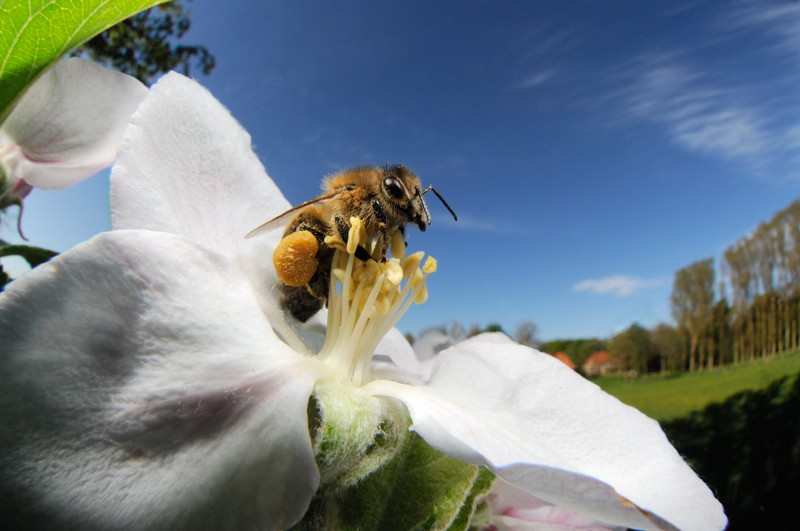
A honeybee (Apis mellifera) gathers pollen from an apple-tree flower.Credit: Solvin Zankl/NPL
Survey of more than 1,500 studies concludes that neonicotinoids harm bees.
In a long-awaited assessment, the European Union’s food-safety agency has concluded that three controversial neonicotinoid insecticides pose a high risk to wild bees and honeybees. The findings by the European Food Safety Authority (EFSA) in Parma, Italy, raise the chances that the EU will soon move to ban all uses of the insecticides on outdoor crops.
In 2013, the EU prohibited applications of the three chemicals on crops attractive to bees — such as sunflowers, oilseed rape and maize (corn) — after an EFSA assessment raised concern about the insecticides’ effects. Since then, researchers have amassed more evidence of harm to bees, and the European Commission last year proposed banning all outdoor uses, while still allowing the pesticides in greenhouses. The latest EFSA assessment strengthens the scientific basis for the proposal, says Anca Păduraru, a European Commission spokeswoman for public health and food safety. EU member states could vote on the issue as soon as 22 March.
Neonicotinoids (often abbreviated to neonics) are highly toxic to insects, causing paralysis and death by interfering with the central nervous system. Unlike pesticides that remain on plant surfaces, neonicotinoids are taken up throughout the plant — in the roots, stems, leaves, flowers, pollen and nectar.
The EFSA assessment covered the three neonicotinoids of greatest concern to bee health — clothianidin, imidacloprid and thiamethoxam. The agency considered more than 1,500 studies, including all the relevant published scientific literature, together with data from academia, chemical companies, national authorities, non-governmental organizations (NGOs) and beekeepers’ and farmers’ associations. The assessment found that each of the three chemicals posed at least one type of high risk to bees in all outdoor uses.
Harmful exposure
The agency found that foraging bees are exposed to harmful levels of pesticide residues in pollen and nectar in treated fields and contaminated areas nearby, as well as in dust created when treated seeds are planted. It also concluded, on the basis of more limited evidence, that neonicotinoids can sometimes persist and accumulate in the soil, and so can affect generations of planted crops and the bees that forage on them.
“EFSA’s advice is often criticized by interested parties such as NGOs and companies, but this is a good demonstration of how EFSA gives scientifically sound and impartial advice,” says José Tarazona, head of the agency’s pesticides unit.
A spokesperson for the global biotechnology firm Syngenta, which produces neonicotinoids, says that EFSA’s conclusions are overly conservative. “When regulators make decisions about crop-protection products, what should matter is science, data and that the processes in place are respected and that the public interest is served,” the spokesperson says. “Any further restrictions based on this report would be ill-conceived.”
EU member states were scheduled to vote on the proposal to outlaw outdoor uses on 13 December, but postponed it partly because many wanted to wait until EFSA completed its evaluation.
Member states plan to discuss the EFSA assessment at a meeting of the commission’s Standing Committee on Plants, Animals, Food and Feed sometime in March, says Păduraru. “The protection of bees is an important issue for the commission since it concerns biodiversity, food production and the environment.”
RELATED ARTICLES | |||||||||||||||||

