NORTON META TAG

Showing posts with label U.S. civil war. Show all posts

21 June 2021

JUNETEENTH BY CALVIN J WALKER

4th United States Colored Infantry, 1864. Public domain.
 

CLICK the poem title to watch the powerful, moving performance of Juneteenth by Jasmine Shanise Gammon.....

Juneteenth

Editor's note: Very few people are aware of the history behind Juneteenth. As people are discovering this 155-year-old holiday, Sojourners reached out to Dallas-based, African American artist, Calvin J. Walker to shed insight on how the holiday he grew up with might have influenced Black Texans. Walker wrote the following poem, performed in this video by Jasmine Shanise Gammon.

I woke up to the sounds of the djembe
I woke up to the warmth of the sun caressing my face as if it were an extension of God’s hand
I woke up free
And then ...
I didn’t sleep, yet my soul awoke in the dark rooms of the slave castle
My hands and feet shackled together
The woman next to me sobbing so that her tears created a river
She tried to jump into that river and let her sorrow carry her away to somewhere safe, alas the river was too shallow
I woke up next to her in the belly of the ship
She’d never stopped crying since I met her—never stopped filling that river
She’d cried a river to the city of Zion and she’d snuck away as we slept
I woke up to a sun thats warmth didn’t caress me
This sun seemed to scorch, to burn, to punish
I stood naked on an auction block while strange men shouted strange things with strange looks in their eyes
I woke up in a shack
The piercing sound of metal jolting me
Speaking for the strange men whose strange language I didn’t understand
I didn’t sleep, yet my soul awoke in the cotton fields
My fingers pricked and the cotton bulbs were dyed red
I didn’t sleep, yet my soul awoke the first time I saw a man’s flesh rip apart as a whip cracked against his skin
I woke up to the sound of horses—heavy footsteps crashing through my door
Men ripping my children from my arms
A hand slapping my face as I protested, knocking the scream out of my mouth and rendering me mute
I woke up to wars
Guns shooting
People dying
Rumors of freedom
Freedom never coming
And then ...
I woke up to the sounds of feet marching
Steps so loud they sounded like a band of horses
Death’s horses finally coming to take what was left of our souls
Death’s horses finally showing us mercy
But it was a different kind of death—the kind the leads to life
The kind that springs up three days later
The kind that testifies to divine power and divine justice
Death’s horses had come for the thing that had come for me
the day I woke to the sound of djembe
the day I woke without any thought of a strange new world or its evil practices
Death’s horses were thousands of Black men in army uniforms that had come
with sickle in their hand to reap the souls of the slavers
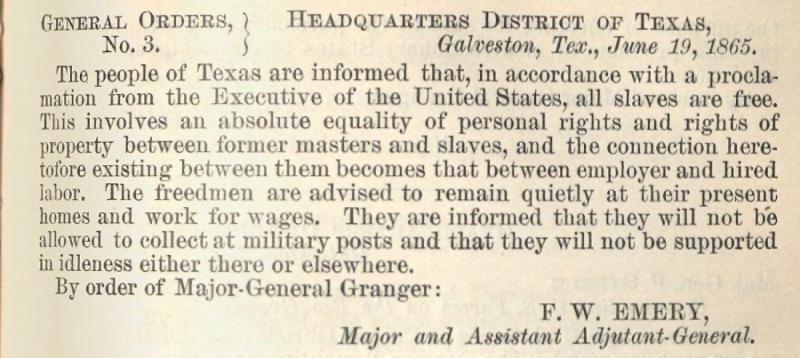
My soul awoke as Gen. Gregory read from General Order No. 3
The order said that we’d been free
We’d been free for years yet no one had bothered to tell us
Truthfully, we’d been free long before we were emancipated
We were created free
Born free
The ones who were truly enslaved
were the men whose minds allowed them to believe they were gods that could own people
I woke up to the sounds of marching not too long ago
I woke up to the sounds of chants
I woke up to the sounds of the voices of ancestors and descendants speaking with one voice
I woke up to the sounds of proclamations whose power has yet to fully emancipate a people that were always meant to be free

JUNETEENTH: ‘HOW BEAUTIFUL ARE THE FEET OF THOSE WHO BRING GOOD NEWS’ 17JUN21


JUNETEENTH became a national holiday on Wednesday, 16 JUN 2021, a celebration of proclaiming the good news of emancipation to the still enslaved Blacks in Texas on 19 JUN 1865. This from Sojourners, be sure to click on the link for the moving and intense video of "Juneteenth", the poem by Calvin J Walker. God bless America......

My father was a Marine before I was born and served as a reservist until I was around 5 years old. I loved the dress uniform decorating my father’s trim frame and his handsome dark skin and dark eyes peering from underneath his cap. What I did not like were the room inspections and summer workouts he subjected his daughters to, but that’s a story for another time. Though I’m the daughter of a Marine and great-great-granddaughter of once-enslaved people, I still get chills when I see photos of Black men in Union uniforms from the Civil War, the way I imagine my ancestors did in the 1860s.

“How beautiful are the feet of those who bring good news,” the Apostle Paul quotes the prophet Isaiah after asking, “How can they hear without someone preaching to them? And how can anyone preach unless they are sent?” (Romans 10:14-15).

If you’ve been taught about Juneteenth at all, the common telling is that President Abraham Lincoln's 1863 Emancipation Proclamation pronounced freedom for all enslaved people in states that had seceded from the Union, but that Black Texans weren’t informed until June 19, 1865 — two and a half years later. The delay is sometimes blamed on distance and limited communication or the idea that enslavers weren't inclined to comply with the law. While these may have been contributing factors, these explanations obscure why the Black residents of Galveston, Texas, actually celebrated the first Juneteenth — and obscures how that celebration still speaks to us today.

VIDEO: Juneteenth Editor's note: Very few people are aware of the history behind Juneteenth. As people are discovering this 155-year-old holiday, Sojourners reached out to Dallas-based, African American artist, Calvin J. Walker to shed insight on how the holiday he grew up with might have influenced Black Texans. Walker wrote the following poem, performed in this video by Jasmine Shanise Gammon.

The reality is that Lincoln’s executive order was meaningless to the rebellious states unless and until the Union army arrived to enforce it. Likewise, while the 13th Amendment —passed by the Senate in 1864, the House in January 1865, and ratified by the states later that year — formally abolished slavery in the United States, most Texans didn't yet consider themselves a part of the U.S. (though the U.S. didn’t consider the secessions legal, Texas didn't regain full congressional representation and ratify the 13th Amendment until 1870). As such, in 1865, the Lone Star State did not recognize the authority of Lincoln or the U.S. Constitution.

Reflecting on this history, I’m haunted by recent declarations of “Not my president” and images of the Confederate flag in the corridors of the U.S. Capitol six months ago. American history books teach that the Civil War ended in April 1865 at the Appomattox Court House in Virginia, but that was just a military surrender by the outnumbered Gen. Robert E. Lee. Battles were still being waged, including in Texas. “Officers and men can return to their homes [with the] satisfaction that proceeds from a consciousness of duty faithfully performed,” Lee said to the Southern soldiers in his 1866 farewell speech.

Lee’s speech sounds eerily like former President Donald Trump's speech on Jan. 6, 2021: “This was a fraudulent election, but we can't play into the hands of these people. We have to have peace. So go home. We love you. You're very special,” Trump said to the Capitol insurrectionists.

The spiritual side of me thinks of the Apostle Paul’s description in Romans 7:19 of the ongoing battle inside of him between good and sin. Bodily, as an African American, I feel this battle waging outside of me, too; in the United States, this battle waged all around me, ever ongoing, invisible, but impactful. Both spiritually and in my Black American existence, I recognize that no one in rebellion adheres to authority without the presence of that authority.

For white and Black Texans in 1865, this authority was represented by as many as 10,000 Black men in Union uniforms, bearing guns and proud faces from their numerous major victories. Juneteenth observations rightfully focus on Union Gen. Gordon Granger reading Order No. 3, finally announcing the news of emancipation, as he was flanked by two transports full of soldiers marching to the Negro Church on Broadway (now known as Reedy Chapel AME Church). But it’s the divine order of events that added to the beauty of this day.

gen-ord-no3.jpg

General Order No. 3

In May 1865, following the Union’s victory in Virginia, the entire XXV Corps — composed of free and formerly enslaved Black men — was shipped to Texas to secure the Mexican border from Napoleon's army and prevent resurgent Confederate activity. While en route, stormy seas — some might call “acts of God” — forced the transport ships to anchor in Galveston Bay on June 18, 1865 to gather supplies. The next day, Friday, June 19, when Granger arrived, the more than 1,000 enslaved people working in Galveston’s ports, houses, hotels, cotton fields, and barber and smithing shops would have witnessed thousands of Black men in blue uniforms as far as the eye could see as their liberators.

Granger read the words:

“The people of Texas are informed that, in accordance with a proclamation from the Executive of the United States, all slaves are free. This involves an absolute equality of personal rights and rights of property between former masters and slaves ...”

It was the beautiful presence of authoritative Black bodies that made these words real. These Black soldiers, like Christ, gave flesh to the emancipating spoken words. They embodied the chorus of the Negro spiritual “Oh Freedom,” which rang: “And before I’d be a slave, I’ll be buried in my grave, and go home to my Lord, and be free.” Before them marched the cost of their freedom, the death of the sin that bound them, and the new life being offered to them. Their freedom didn’t just come from an order of a white man; freedom came enforced by faces that looked like them, a living picture of freedom that spoke 10,000 words.

As we acknowledge the day Black Texans heard they were free, we cannot neglect thanking the beautiful Black feet that were sent and stood with the good news.

Editor’s note: This article was updated on June 17, 2021 at 12:00 p.m. to clarify the timeline of the 13th Amendmentment ratification in Texas.