NORTON META TAG

Showing posts with label just war. Show all posts

07 February 2013

Angry Senators Afraid of Debate & John McCain’s Theology of War is Wrong 7&1FEB13

COMMENTARY from Jim Wallis of Sojourners, food for thought....


We do not arm ourselves against any nation; we do not learn the art of war; because, through Jesus Christ, we have become the children of peace.

-Origen

It was the biggest story inside the Beltway. Since last Thursday’s hearing, the whole Washington media machine has been discussing and dissecting the extraordinary confrontation in the Senate Armed Services Committee regarding the potential confirmation of former Sen. Chuck Hagel as the new secretary of defense. Several Republican senators were extremely combative with the combat veteran who earned two Purple Hearts for his wounds in Vietnam. Hagel deserves another Purple Heart for the wounds his former “friends” and party members tried to inflict upon him. Hagel didn’t really defend his views — which were both caricatured and attacked by his adversaries — perhaps on White House advice not to risk further debates before being confirmed.
But I think Hagel’s views and the important questions he has raised about current U.S. wars and military policy deserve defending and, indeed, should become the subjects of a national debate. So I wrote a piece about one of Hagel’s most hostile questioners who insisted the possible new secretary answer the simple question of whether the surge in Iraq was “right” or “wrong.” I said it was wrong, as was the war in Iraq, as was the war in Vietnam, as are the views of John McCain on war throughout his entire political career; and how the nation has been wounded by McCain’s and others’ “theology of war.
Chuck Hagel’s views could lead us to a necessary national debate if he becomes the new leader of the Pentagon. And it is that potential debate that Hagel’s critics are so afraid to have.
Chuck Hagel is the first soldier of enlisted rank to ever be nominated as secretary of defense. Think about that. As an Army sergeant, Hagel says he saw war from “the bottom up.” That is very different from the “top down” view of war that has always characterized the Pentagon and the military leaders who have sent so many young men and women to the bottom of so many horrible conflicts. Hagel says he wants to make absolutely sure that a projected war is worthy of the lives of American young men and women.
Those wars of occupation have clearly failed — as more and more Americans believe — and they have caused such terrible destruction and suffering for so many American families, and for the countless innocents from other countries who have perished in our wars. Isn’t it time to seriously debate wars like these?
Just today, my wife and I talked about the pain of a fourth-grade teacher in our son’s school who lost her son in Afghanistan last summer. We all know or have heard the stories of children who have lost one of their parents or at least precious time with them, or the wives and husbands who have lost their beloved in unnecessary wars. This is a national tragedy it is time to morally debate. When we see all the ads and stories about our “wounded warriors” and all the suffering they now need to overcome, can we start to ask about the decisions and decision-makers who sent them? War looks far different from the bottom up than it does from the top down; and that is exactly the change we need.
This possible future secretary of defense also thinks there is Pentagon spending that should and could be cut; and he wants to distinguish between genuine national defense and the business of war — including the political pork of massive military expenditures. In raising those critical questions, Hagel sounds like another Republican and war veteran who warned America about the growing “military industrial complex” when he left the office of the U.S. presidency — General Dwight Eisenhower. But the military contractors who control much of our foreign policy are trying to prevent that debate. They don’t want Hagel either.
Then there were all the attacks on Hagel about U.S. policy toward Israel, even with charges of “anti-Semitism.” But why can’t we debate the policies of the state of Israel, their expanding settlements, their treatment of Palestinians, and how the door is closing on the possibility of a genuine two-state solution between the Israelis and the Palestinians? Are we critical only of Hamas rocket attacks? A new generation of Jewish leaders in the U. S. and in Israel is entering that debate — along with people of every faith who are unequivocally opposed to terrorism in all its forms but believe that many of our current military and foreign policy assumptions are actually making those threats worse.
Then there was the problem of Iran. Why is the idea of engaging our enemies dismissed as naïve and indefensible, and why again are military solutions believed to be the most effective in the end? If “containment” was our policy with the Soviet Union over several decades, why should it be completely rejected now?  Should we have gone to nuclear war with the Russians during the Cuban Missile Crisis? We better have a national debate before starting or supporting another war in Iran.
The questions that a decorated foot soldier and former senator has asked raise the possibility of a new national debate about United States foreign and military policy. The president’s appointment of Hagel suggests he thinks such debate is healthy. I believe a majority of Americans, who are very weary of our failed war policies, are also ready for that debate. And that is what the senators and supporters of our old policies are so angry with Hagel about. They are afraid of the debate that our nation needs to have.
It’s time to confirm Chuck Hagel. It’s time to have the debate.
Jim Wallis is the author of the forthcoming book, On God's Side: What Religion Forgets and Politics Hasn’t Learned about Serving the Common Good and CEO of SojournersFollow Jim on Twitter @JimWallis.

John McCain’s Theology of War is Wrong


John McCain angrily insisted on “right” and “wrong” answers to his questions of Chuck Hagel yesterday. As a theologian and a religious leader, I want to say that John McCain is “wrong.”
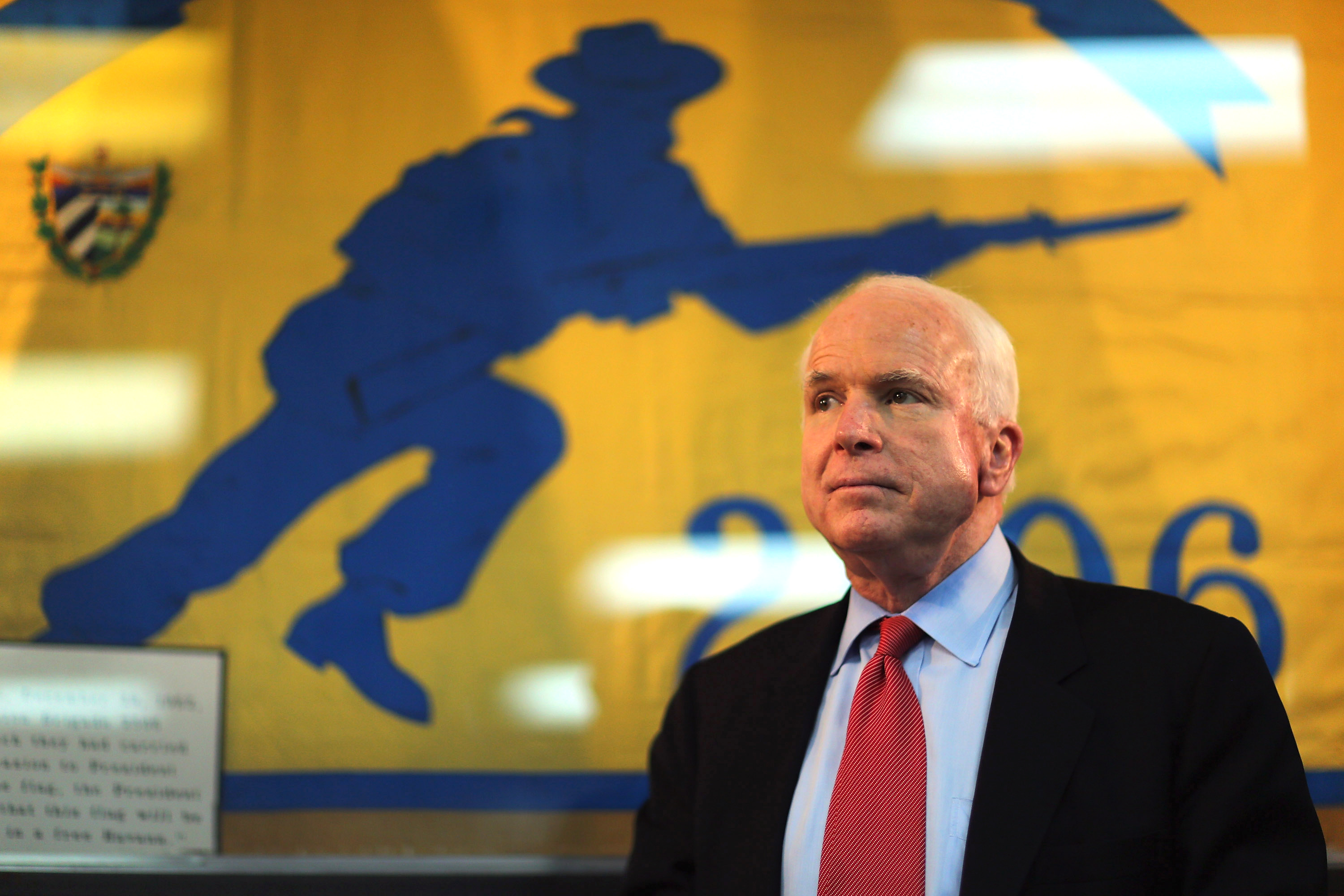
Joe Raedle / Getty Images
McCain waits to speak during a campaign visit to support former presidential candidate Mitt Romney. Joe Raedle/Getty Images

Related Reading

I watched the hostile questions that Sen. McCain asked Hagel in the hearings on his nomination for Secretary of Defense. The angry attacks from McCain were about the Iraq War, for which McCain was one of America’s leading advocates. Hagel had previously called the war in Iraq the biggest American foreign policy mistake since Vietnam. Obviously furious, McCain tried to force Hagel to say the last “surge” in Iraq, which McCain had made his cause, was right after all. Despite the aggressive and disrespectful questioning from his former “friend,” Hagel wouldn’t submit to McCain’s demands and said these questions would be subject to history — and to theological morality, to which John McCain has never submitted his views. In fact, his repeated desire to invade other people’s countries is offensive moral hubris.
Let me state some clear convictions from many of us in faith community. The war in Vietnam was morally wrong. The war in Iraq was morally wrong. And John McCain has been morally wrong on both of them. Christian judgments of war should always run a narrow spectrum — from the peacemaking ethic of Jesus which rejects war to the just war theology of Augustine and Aquinas. But even in the just war tradition, conflicts have to pass a number of moral tests and be the option of “last resort.” The burden of proof is always on those who support war to justify the taking of life.
Both Vietnam and Iraq failed those tests and were unnecessary wars of choice. Those wars were unnecessary, the terrible deaths from those wars were unnecessary, the enormous casualties were unnecessary, the painful family losses were unnecessary, and all the horrible costs were unnecessary.
And yesterday, we saw a politician who has based his entire political career on war furiously trying to force a potential Secretary of Defense to say that he has been right all along.
But McCain hasn’t been right in his endless promotion of war as the primary solution to our national conflicts. He has been consistently wrong and America has paid a very high price because of the ideological zealots of war that McCain represents.
After yesterday, I wished that the coming vote on confirmation could be the other way around; that America could somehow vote John McCain out of office and off the American political stage. The cost of McCain’s theology of war has been far too high.
The important discussions yesterday should have been about other critical issues: like how quickly and responsibly we can leave the endless war in Afghanistan, how we can address the real threats of terrorism in better ways than failed wars of occupation, what we should do about the real problem of Iran, and a very serious strategic and moral examination of our growing reliance on drones as a primary instrument of our foreign policy.
Instead, we saw old men defending their old wars. That was both very sad and morally objectionable. In the future, I would suggest the Senate Armed Service Committee call some religious leaders to their hearings to raise the questions that they need to hear.
Jim Wallis is the author of Rediscovering Values: A Guide for Economic and Moral Recovery, and CEO of Sojourners. His forthcoming book, On God's Side: What Religion Forgets and Politics Hasn’t Learned about Serving the Common Good, is set to release in April. Follow Jim on Twitter @JimWallis.
Photo: Joe Raedle / Getty Images

RELATED STORIES


19 November 2010

Churches Call to End the War in Afghanistan from SOJO 18NOV10 & A CALL TO END THE WAR IN AFGHANISTAN BY THE NAT COUNCIL OF CHURCHES 9NOV10

IT IS TIME TO END THE WAR IN AFGHANISTAN AND TO BRING OUR SERVICEMEN AND WOMEN HOME. READ THE RESOLUTION FROM THE NATIONAL COUNCIL OF CHURCHES GOVERNING BOARD BELOW...IT IS A WELL WRITTEN, COMPASSIONATE AND REALISTIC DECLARATION AGAINST CONTINUING THE WAR IN AFGHANISTAN AND OFFERS ALTERNATIVES TO THE BLOODSHED AND CARNAGE WE ARE NOW EXPERIENCING.
 
In his December 2009 speech on Afghanistan, President Obama announced that he was sending 30,000 additional troops to Afghanistan, but that
… these additional American and international troops will allow us to accelerate handing over responsibility to Afghan forces, and allow us to begin the transfer of our forces out of Afghanistan in July of 2011.
In recent weeks, however, the military and now the administration are backpedaling from that statement as fast as they can. A news story yesterday reported that  ”The White House on Tuesday unveiled a plan for Afghanistan that foresees U.S. troops remaining there until at least the end of 2014.” Another asked, “Is 2014 the new 2011 for Pentagon war planners?” saying, “Senior U.S. military officials are increasingly deemphasizing the July 2011 deadline set by President Obama earlier this year for beginning U.S. troop withdrawals from Afghanistan, instead talking up a 2014 date ….”
With this rapid change of message, it is good news to read that the National Council of Churches Governing Board last week passed a resolution, “A Call To End The War In Afghanistan.” While urging that development aid be continued and that the human rights situation be carefully monitored, the resolution:
… Calls upon the President of the United States to negotiate a withdrawal of U.S. and NATO forces from Afghanistan to be completed as soon as possible without further endangerment to the lives and welfare of U.S. and NATO troops, Afghan troops and Afghan civilians …
That is welcome news. The church has been largely been silent on the war, and it is time for its voice to be heard. The war in Afghanistan has gone on for too long, at the cost of too many deaths and too many resources desperately needed elsewhere. May this statement be the first of many actions toward ending the war.
Duane Shank is the senior political advisor at Sojourners. 

A CALL TO END THE WAR IN AFGHANISTAN
ADOPTED BY THE NATIONAL COUNCIL OF CHURCHES GOVERNING BOARD,
NOVEMBER 9, 2010, IN NEW ORLEANS
INTRODUCTION
The War in Afghanistan – dubbed “Operation Enduring Freedom” at its onset – has been raging 10 since October 7, 2001. It is the longest war in U.S. history. The war began with significant popular support and in its initial stages was the lead story moved daily on U.S. media. Today, the story no longer tops the agenda of public interest. President Obama has set a deadline of July 2011 for the tactical end of U.S. involvement in Afghanistan. The President has rejected calls from politicians, including former Secretary of State Henry Kissinger, to cancel the deadline and set an open‐ended commitment to U.S. military involvement, but he is under continuing pressure to change his mind. It is the considered view of the National Council of Churches and its 36 member communions that the war must end as soon as possible – in July 2011 or before – and that the United States must hereinafter pursue a policy of just peace in all of its foreign engagements.
After nearly a decade of war in Afghanistan, it is clearly too late to correct the mistakes and miscalculations of the past. But we set before the churches a call to greater vigilance in the future. It is no mere cliché that history repeats itself, and there is little doubt that U.S. presidents and military leaders will again be tempted to choose war over diplomacy as a means of redressing grievances. When those circumstances arise, may the church, which too often has been silent in the face of war, be prepared to offer its Christian witness that war is always contrary to the will of God, and that there are alternatives to war that wise leaders must seek.


SUMMARY.
The War in Afghanistan, titled “Operation Enduring Freedom,” is one critical response of the United States to the al‐Qaeda attacks of September 11, 2001. The United States committed itself to a military operation with the expressed cognizance of further consideration given to economic, political and diplomatic alternatives to end the war. The war continues at this time on several fronts due to a growing resurgent presence by Taliban forces in the country. The cost
of the war to the United States as well as to Afghanistan is measured in the balance of human life and precious national resources. The effects on both resources have been staggering. From late 2001, and relative to the process of justifying an increased U.S. military presence in the Middle East, the Christian churches have expressed serious and informed reservations about how just the war has been and continues to be. (See appendix)
THEREFORE BE IT RESOLVED:
That the Governing Board of the National Council of Churches of Christ in the United States of America, Cognizant of the valiant and courageous efforts of women and men of many nations who have served in Afghanistan as military personnel, diplomats and humanitarian workers, such as Church World Service and others, with the aim of bringing peace, justice and stability to Afghanistan, and
Concerned for the spiritual, physical and mental health of the veterans of this war, yet Convicted by our common discernment that war and violence fall short of God’s will for methods of rooting out tyranny and injustice, and deeply grieved by the loss of life, homes and property in Afghanistan since U.S. and NATO forces launched “Operation Enduring Freedom,” a war against the Taliban in October 2001, and concerned that continued U.S. and coalition military operations against Afghan insurgents will solidify resistance and stimulate support for Taliban and al‐Qaeda terrorists, and mindful of the millennia‐long history of failed efforts by foreign powers to defeat entrenched and insular Afghan forces by military means,
and deeply convicted that we must reaffirm our witness to Christ’s commandment to love our enemies, Therefore calls upon the President of the United States to negotiate a withdrawal of U.S. and NATO forces from Afghanistan to be completed as soon as possible without further endangerment to the lives and welfare of U.S. and NATO troops, Afghan troops and Afghan civilians; and urges the President of the United States to continue to monitor the human‐rights situation in
Afghanistan in the context of the United Nations declaration to use all available diplomatic means to protect the population from crimes against humanity, and to employ military means of protection only as a last resort; and urges the President of the United States to continue, upon invitation of the Afghan government, the American support of the development of medical facilities, schools and other
essential institutions in Afghanistan; and calls upon the President of the United States to appoint a commission composed of high ranking government, military and religious leaders to discern and recommend policies through which the United States will pursue the goals of a just peace; and calls upon the member communions of the National Council of Churches to engage in further study of the war in Afghanistan, the factors that led up to it, and the opportunities for nonmilitary engagement with the people of Afghanistan to under gird a safe and stable way of life; and calls upon the member communions of the National Council of Churches to articulate to one another and to government authorities the concept of a “Just Peace” as a proactive strategy for avoiding premature or unnecessary decisions to employ military means of solving conflicts. 
Policy base:
Human Rights, adopted by the General Assembly, December 6, 1963
Imperatives of Peace and the Responsibilities of Power, adopted by the General Board, February 21, 1968
Human Rights, The Fulfillment of Life in the Social Order, adopted by the General Board, November 17, 1995
Pillars of Peace for the 21st Century, A Policy Statement on the United Nations, adopted by the General Assembly, November 11, 1999
Related Resolutions:
Out of the Ashes and Tragedy of September 11, 2001, a statement adopted by the General Assembly, November 15, 2001
Resolution on the Threat to Civil and Religious Liberties in Post‐9/11 America, adopted by the General Assembly, November 9, 2005
Resolution on the Responsibility to Protect, adopted by the Governing Board, September 24, 2007
 

APPENDIX BACKGROUND:
Most Americans, including the estimated 45 million persons who worship in the 100,000 congregations related to the 36 member communions of the National Council of Churches, have vivid and painful memories of the circumstances that led to the war in Afghanistan. On September 11, 2001, al‐Qaeda operatives hijacked four commercial airliners and crashed them into the World Trade Center in New York and the Pentagon in Washington. A fourth plane crashed in a field in Shanksville, Pennsylvania. More than 3,000 persons died in the attacks.
Although none of the 19 hijackers were Afghan nationals, Afghanistan was the al‐Qaeda base and President George W. Bush quickly drew up plans to invade Afghanistan as a means of combating terrorism. “Operation Enduring Freedom,” the war in Afghanistan, commenced on October 7, 2001.
 

DEEP CONCERNS
While there is no doubt that Operation Enduring Freedom was supported by persons of faith, including many members of churches related to NCC member communions, including church leaders, have nonetheless expressed profound concerns about the war. Costs in lives and property continue to mount, as does the political instability that continues in Afghanistan despite – or perhaps because of – the U.S. and NATO presence there. Neither the initial motivation to go to war nor the more recent decisions to escalate military operations in Afghanistan are consistent with the criteria some churches support for entering into a “just war.” Indeed, the decision to go to war was made without a considered deliberation about peaceful alternatives, including forms of economic sanction and diplomatic pressure.
Costs. Apart from the billions of dollars the United States has spent on the War in Afghanistan since 2001ii, the cost in terms of lives has been staggering. Precise figures are difficult to confirm. A report (http://icasualties.org/oef ), based larger on Department of Defense sources, indicates that more than 2,070 coalition members were killed between 2001 and 2010, with Americans accounting for at least 1,275 of those deaths. Another source claims to have “conservative” counts estimating the number of persons killed – Afghan troops and civilians, U.S. troops, Coalition troops, contractors and journalists – at more than 19,600.
Just War. When U.S. and British air forces began a bombing campaign, “Operation Enduring Freedom,” against Taliban forces in October 2001, polls indicated a large majority of Americans – including persons of Christian faith – supported the military effort as an appropriate retaliation for the terror attacks of September 11. Among the leaders of most NCC member communions, however, there was even then considerable doubt that the retaliation satisfied the generally accepted criteria for a “just war”, including
• The damage inflicted by the aggressor on the nation or community of nations must be lasting, grave, and certain.
• All other means of putting an end to it must have been shown to be impractical or ineffective.
• There must be serious prospects of success.
• The use of arms must not produce evils and disorders graver than the evil to be
evaluating this condition.)
(http://www.ewtn.com/expert/answers/just_war.htm)
When many of the communions that form the National Council of Churches met in 1948 to form the World Council of Churches, the world looked to the gathering for a comment on the recently concluded Second World War and the nuclear bombing of Hiroshima and Nagasaki. Our comment was blunt: “War is contrary to the will of God.” Moreover, the churches said in 1948: There is a settled Christian conviction that the use of force, however unavoidable it may be for the fulfillment of the distinctive tasks of the state, is in itself absolutely opposed to the commandment of love. It can only be used as the lesser of two evils in reliance on divine
forgiveness. (Christian Responsibility in a World of Power, The Amsterdam Series, 1948, p. 207.)
As the world reeled with the implications of the terror attacks of September 11, 2001, the churches prayerfully sought to apply their theological convictions to current realties. On November 15, 2001, in the midst of the Afghanistan invasion, a statement adopted by the General Assembly of the National Council of Churches and Church World Service in Oakland, Calif. expressed the sense of the churches that, instead of war, it would be wiser to address the political, economic and cultural injustices that give rise to unrest and terrorism:
It is time for us as an ecumenical community to make a renewed commitment to a
ministry of peace with justice, and to make real in these days the call of Jesus, "Love your enemies and pray for those who persecute you." (Matthew 5:44) In his Beatitudes, Jesus calls us, his followers, to be merciful if we are to receive mercy; he reminds us that the peacemakers are blessed and will be called children of God. And, he proclaims us "the light of the world"; our good works should be a beacon to others so they may give glory to God. (Matthew 5:1‐4 16).
We lift up "Pillars of Peace for the 21st Century," a 1999 Policy Statement of the National Council of the Churches of Christ in the U.S.A. We reaffirm and highlight the Statement’s call to build a culture of peace with justice characterized by these convictions:
1. "the transcending sovereignty and love of God for all creation and the expression of that love in the incarnation of Jesus Christ, whose mission was to reveal understanding about that divine presence, to proclaim a message of salvation and to bring justice and peace;
2. the unity of creation and the equality of all races and peoples;
3. the dignity and worth of each person as a child of God; and
4. the church, the body of 130 believers, whose global mission of witness, peacemaking and reconciliation testifies to God’s action in history."
Just Peace. Not all member communions of the National Council of Churches subscribe to or believe in a doctrine that regards war as ever justifiable – for example, the Historic Peace Churches and growing minorities within other Christian traditions. Indeed, the perspective that war can ever be just is disputed by many Christians in the U.S. and around the world.
The Historic Peace Churches believe that the life and teachings of Jesus Christ are a trustworthy ethical guide when faced with the issues of war and violence in our world. In Jesus’ life and teachings, as communicated in the gospels and the New testament, it is clear that love for the enemy must be the norm – and this is not compatible with military action.
In fact, the World Council of Churches in its first Assembly in Amsterdam, The Netherlands, in 1948 provided a glimpse to where that worldwide ecumenical body has come in its thinking about an appropriate response of Christianity toward warfare and violence. The first Assembly’s clear statement that “War is contrary to the will of God” presaged current work by the WCC that may well entirely replace the concept of “just war” with an understanding of “just peace.” While the just war position only defines criteria under which the use of force is acceptable, a just peace perspective describes foundations for nonviolent conflict and the building of justice, reconciliation, and abundant life. The engagement of “just peace” is not merely a reaction to conflict. “Just peace” is proactive, requiring governments and other authorities to address in advance those conditions that may lead to future violence: poverty, hunger, economic injustice, climate change and many more.
One outcome of this historic and emerging stream of thought has been the initiation of the Decade to Overcome Violence (2000‐2010). However, the events of this decade – specifically the terrorist attacks of 9/11 and wars in Iraq and Afghanistan ‐‐ led the World Council of Churches to wrestle anew with the ethics of war and violence, and the WCC is now drafting an ecumenical declaration on just peace – a major document that is expected to reflect a crucial shift in global
Christian teaching on the issue of war. For an increasing number of Christians, there are no gospel criteria that may adequately justify
going to war. Instead, these Christians earnestly seek a just peace that is grounded in the God who loves all creation and all the peoples of the earth, and that seeks the help of the Holy Spirit to love the enemy and friend alike.
 

COMPLICATING FACTORS
While the church’s message of justice and peace is firmly based on a common understanding of the gospel of Jesus Christ and the incarnational love of God, it is nonetheless important to consider the implications of the gospel in a world where evil reigns. If the United States and NATO forces were to withdraw unconditionally from Afghanistan, what would be the effect?
Most analysts express concern that the current government of President Hamid Karzai is too Taliban and al Qaeda forces would soon regain control of the country. If President Karzai’s government falls, one fear is the re‐establishment of safe havens in Afghanistan for al‐Qaeda and other terrorist factions whose goals are to strike at the vital interests of American and European societies. Perhaps an even more imminent and compelling scenario of a Taliban restoration is the bloodbath that might be inflicted on women and men who failed to observe fundamentalist religious law, and the abusive subjugation of women and girls. In these
situations, what is the moral obligation of the United States, and what must be the counsel of the churches?
Responsibility to Protect. Atrocities on a civilian population inspired by religion are a frightening and unacceptable outcome, in Afghanistan or elsewhere. The National Council of Churches has endorsed the “Responsibility to Protect,” a declaration adopted by the United Nation’s General Assembly in 2005 that “each individual State has the responsibility to protect its populations from genocide, war crimes, ethnic cleansing and crimes against humanity” and that the international community, through the UN, should “take collective action” to prevent these
crimes “should peaceful means be inadequate and national authorities are manifestly failing to protect their populations” from these crimes.
The NCC resolution on the Responsibility to Protect, adopted September 24, 2007, recognizes “that war is always a failure to find peaceful resolution to conflict” and encourages the U.S. government and the international community “always to first seek non‐violent means of intervention, and exhaust all opportunities for peaceful resolution, as a means of protecting those threatened by genocide, war crimes, ethnic cleansing and crimes against humanity.”
 

A STRATEGY OF PEACE
Committed to our call to be Christ’s witnesses for peace and love in an unredeemed world, we believe it is imperative to raise the question as to whether military intervention by powerful outside forces is the most effective way of compelling governments to live within the acceptable guidelines of civilized nations. In addition, armed conflict has increasingly involved non‐state actors, such as insurgencies and terrorist groups, the actions of which are not bound by these guidelines, thus creating an additional set of moral and ethical issues and responses. Given the limitations of military solutions to threats in Afghanistan and elsewhere, the member communions of the National Council of Churches welcome and endorse peaceful efforts already undertaken by the United States and its allies to strengthen the infrastructure and support the development of well‐trained law enforcement specialists, health‐providers and educators in Afghanistan. Bombs and guns can destroy lives and infrastructures, but that kind of devastation may be the most frightening nightmare of all. And bombs and guns can also sow hatred and
resolve in the hearts of those we call our enemy – and one of the safest predictions we can make is those who hate us will remain in their native Afghanistan long after we are gone. In the long‐run, we believe, peaceful partnerships and humanitarian aid will be far more effective in achieving our goals of eliminating extremist insurgents. A peaceful American partnership in
Afghanistan will go a long way towards effectively refuting claims by insurgents and al Qaeda combatants that we are an occupying power intent on destroying Afghan way of life. It is our faith that convicts us that arms and violence are not the way to assure security, but even the most pragmatic observers will conclude that clinics and schools are more powerful alternatives against extremism than guns and bombs

23 April 2010

DEMAND AN EXIT DATE FROM AFGHANISTAN from CREDO ACTION 23APR10

I am tired of war. I am tired of the thousands killed, the tens of thousands wounded, the destruction of lives and property, the waste of life and hundreds of millions of dollars, the corruption of the Afghan government and the U.S. military-industrial complex. And the perversion of Christianity by the "just war" argument makes me sick, it is as wrong as the perversion of Islam by the fanatics we are fighting in Afghanistan and Iraq. I have signed the petition demanding a date be set for our exit from Afghanistan, click on the header to sign it too.

We can't let the U.S. military occupation of Afghanistan continue with no end in sight. It's time to set a timetable to get out of the quagmire.

Senator Russ Feingold, Representative Jim McGovern, and Representative Walter Jones have introduced a bipartisan bill that would require that the administration present to Congress by January 1, 2011, a plan for the safe withdrawal of all U.S. armed forces from Afghanistan. This plan must include a timeline for the completion of the withdrawal, and the president must report his progress on the timeline to Congress every 90 days.

Urge your representative and senators to cosponsor the Afghanistan withdrawal bill. Just click the link below to get started.

http://act.credoaction.com/campaign/mcgovern_feingold/?r_by=8831-179986-3atj4Mx&rc=paste1

11 February 2010

Reinvigorating the Discourse on Just War and Pacifism fom Sojo 2FEB10

Reinvigorating the Discourse on Just War and Pacifism
by Logan Laituri 02-02-2010
Before I went to Iraq with my friend and fellow God’s Politics contributor Shane Claiborne, I was trying to figure out how to take the lessons I would learn there back home. I felt certain (and now know) that the experience could be a small but powerful step toward improving our understanding of how to prevent any future indiscriminate uses of force similar to the invasion and occupation of Iraq.

Our individual experiences in Iraq were all profoundly personal, but we all expressed hope that the collective experience might have a greater significance upon our return. My own hopes were to help transform the course of the war itself or perhaps invigorate the Church’s discernment of war and peace. I began asking myself how something as uncalled for and illegitimate as the war on Iraq could be averted in the future.

In our representative form of government, it is hard to escape even a fraction of complicity for the damage we are causing across the world. As a former service member, I share the pain and guilt that often leads to suicide or severe depression, but I know that they will not have the last word. I know that the military as it exists today is a system that makes it difficult to do good and very easy to do evil. Michael Walzer is correct in the afterword of his Just And Unjust Wars that the restraint of war is the foundation upon which peace is built.

Not long before departing for Iraq, I was invited to testify at the upcoming Truth Commission on Conscience in War (TCCW) in March of this year. In my own mind, this provided the framework in which I could utilize my experiences in a productive and transformative way. The TCCW is being organized by Faith Voices for the Common Good, The Ministry and Social Justice Commission of The Riverside Church, Soldiers of Conscience, Starr King School for the Ministry, and Union Theological Seminary. The event will be held at the Riverside Church in New York City, the same church in which Martin Luther King shared his “Beyond Vietnam: A Time to Break the Silence,” the inaugural address that formed Clergy and Laity Concerned About Vietnam. He gave the speech on April 4, 1967, and was killed exactly one year later.

The main thrust of the Commission will be to explore conscientious objection in the U.S. and how it may be improved to be more reflective of principles of Just War held by Jewish, Christian, and Muslim faiths (as well as our own Constitution). Many prominent seminaries and divinity schools are actively supporting the TCCW by providing scholars as expert witnesses and nominating seminarians as commissioners to compile a final report by Martinmas, 2010 (a.k.a.Veterans Day).

More details are available on the Commission Web site, including information on the public hearing on March 21 at 4 p.m. If you’re in the area, you should seriously consider stopping by, religious leaders from across the country will be in attendance, as this event marks only the beginning of a major national discussion about military service and freedom of conscience as religious expression. I’ll be there too, we can do coffee.

The time is ripe to reinvigorate the discourse surrounding just war and pacifism. As we near the withdrawal of U.S. forces from Iraq, let’s not let the experience slip into history quietly and without critical analysis. Let’s learn from our mistakes and celebrate our successes, but to do that we need to be able to tell the two apart.

Logan Laituri is an Army veteran with combatant service in Iraq during OIF II and experience with Christian Peacemaker Teams in Israel and the West Bank. He blogs sporadically and is a co-founder of Centurion’s Guild.