NORTON META TAG

Showing posts with label Vietnam. Show all posts

08 August 2013

Obama Cancels One-On-One Meeting With Putin & The sneaky switch that set the stage for the NSA’s call records program 7AUG13

PATHETIC! Pres Obama isn't going to meet with pres putin in Russia because Edward Snowden has been granted temporary asylum by the Russian government (something all patriotic Americans are extremely grateful for). Yet he recently hosted the leader of Vietnam, a country that is committing gross human rights violations daily, at the White House. Just another example of the hypocrisy of the Obama administration's foreign policy and what a disappointment he, and his administration, has become. It is actually embarrassing, considering the U.S. government has been spying on not only it's own people but on our allies and friendly countries. Now Pres Obama is acting like a child, mad because he has been caught doing something wrong and scrambling to blame someone else for his behavior. I am no fan of putin, I think he is a dangerous, unstable and unreliable man. He can not be considered a friend or ally of the U.S. All the more reason for Pres Obama to meet with him. From NPR, followed by more information from ARS Technica on how pres george w bush, Pres Obama and too many congressmen/women have been violating American law, our Constitution, our civil liberties....
Russian President Vladimir Putin and President Obama when they sat down together in June at a G8 summit in Northern Ireland.
Alexi Nikolsky /EPA /LANDOV
President Obama has canceled a one-on-one September summit with Russian President Vladimir Putin, the White House says.
It's the most dramatic effect so far on U.S.-Russian relations in the wake of Russia's decision to grant "NSA leaker" temporary asylum while he tries to get safe haven in some third country.
Word of the decision not to meet with Putin was first reported by The Associated Press earlier Wednesday morning. The White House then confirmed the news in statements sent to NPR and other news outlets.
Obama is still set to attend the in St. Petersburg, Russia, on Sept. 5 and 6 — which Putin will host. The meeting that's being canceled was to have been between Obama and Putin in Moscow while the president is in Russia.
As and others have reported, and as the president said Tuesday , the U.S. is disappointed in Russia's decision to give Snowden temporary asylum. Snowden, a former contractor for companies that do business with the National Security Agency, earlier this summer .
Update at 9:35 a.m. ET. White House Says Decision Came After "Careful Review."
This statement was just emailed to reporters from the White House press office:
"Following a careful review begun in July, we have reached the conclusion that there is not enough recent progress in our bilateral agenda with Russia to hold a U.S.-Russia Summit in early September. We value the achievements made with Russia in the president's first term, including the New START Treaty, and cooperation on Afghanistan, Iran, and North Korea.
"However, given our lack of progress on issues such as missile defense and arms control, trade and commercial relations, global security issues, and human rights and civil society in the last twelve months, we have informed the Russian government that we believe it would be more constructive to postpone the summit until we have more results from our shared agenda.
"Russia's disappointing decision to grant Edward Snowden temporary asylum was also a factor that we considered in assessing the current state of our bilateral relationship.
"Our cooperation on these issues remains a priority for the United States, so on Friday, Aug. 9, Secretaries Hagel and Kerry will meet with their Russian counterparts in a 2+2 format in Washington to discuss how we can best make progress moving forward on the full range of issues in our bilateral relationship.
"The president still looks forward to traveling to St. Petersburg on September 5-6 to attend the G-20 Summit."
http://www.npr.org/blogs/thetwo-way/2013/08/07/209801359/obama-cancels-one-on-one-meeting-with-putin?utm_medium=Email&utm_source=BreakingNews&utm_campaign=

The sneaky switch that set the stage for the NSA’s call records program

The wording of Section 215 of the Patriot Act was modified at the last minute in 2005.


Defenders of the National Security Agency’s controversial call records program, which vacuums up Americans’ phone logs in bulk, like to remind us that the Patriot Act power to collect “business records” has been ratified by large majorities in Congress. Yet a compromise sharply limiting that authority, strongly endorsed by then-Senator Barack Obama, was unanimously approved by the Senate way back in 2005—until a sneaky last-minute change turned the limits on their head.
Passed in haste mere weeks after the terrorist attacks of September 11, several provisions of the Patriot Act—including Section 215, which allows the government to obtain business records with an order from a secret court—included built-in expiration dates. When the time came to reauthorize those provisions in the summer of 2005, a bipartisan group of legislators—including Dick Durbin, Larry Craig, John Sununu, and Lisa Murkowski—hammered out a compromise aimed at ensuring that Section 215 could only be used for records that had some concrete connection to a suspected spy or terrorist.
Under the proposed language, the government could obtain an order for business records from the classified Foreign Intelligence Surveillance Court provided the records were “relevant to an authorized investigation” and fell into one of three categories: the records would have to pertain either to a suspected “agent of a foreign power,” someone in direct contact with the suspect, or the “activities” of a suspect. This language would have allowed the government to look at associates “one hop” away from the target of an investigation—to distinguish innocent acquaintances from potential co-conspirators—as opposed to the two or three hops we now know the NSA routinely pursues. The “activities” category, meanwhile, would have allowed the FBI to follow-up leads about plots—such as a tip that Al Qaeda agents in a particular area were trying to buy explosive chemicals—without necessarily knowing who the individual plotters were.
This change would have been less restrictive than an amendment sponsored by Rep. Justin Amash (R-Mich.), which recently failed to pass the House of Representatives by the narrowest of margins, and which would have allowed Section 215 to be used only for the records of the “subject” of the investigation. Yet it would also clearly rule out the indiscriminate bulk collection of records—which the NSA would begin doing under Section 215 in 2006. The reform sailed through the Republican-controlled Senate on a unanimous consent vote in July 2005.
In November, however, supporters of the new safeguards received a rude surprise: The conference committee tasked with reconciling the House and Senate versions of the Patriot reauthorization had made a subtle change that actually expanded the scope of Section 215—a change staffers familiar with the reauthorization believe was made at the behest of the White House. The compromise language had specified that the government could get records that were both relevant and fell into one of those three categories linking them to a terror suspect. The new language not only did away with the limitation—any records that met the low standard of “relevance” were fair game—it said that all records in those three categories were “presumptively” relevant. This change would also have sent a subtle signal to the court under normal principles of legal interpretation: If these three categories were automatically relevant, then by implication, even records that didn’t fit into any of those categories had to be potentially “relevant” also—just not automatically.
When the legislators who had hammered out the compromise objected, Sen. Arlen Specter, then the chair of the Judiciary Committee, sought to reassure them that Section 215 would only very rarely be used so broadly:
The relevance standard will apply only in extraordinary circumstances because the Conference Report channels all applications for Section 215 orders into the three categories delineated in the Senate bill. By providing a presumption of relevance when the government can demonstrate a connection to a suspected terrorist or spy, the bill ensures that requests falling outside the three categories will be the exception and not the rule. Indeed, the presumption ensures that law enforcement will face an uphill battle in any effort to obtain a 215 order that does not fall into one of the three categories and thereby provides an incentive for the FBI to use the tool only when it can show a connection to a suspected terrorist or spy.
Many legislators were unconvinced—including the freshman senator from Illinois, a promising young politician named Barack Obama. In a bipartisan follow-up letter, Obama and eight of his colleagues complained that the late changes meant that “the Senate is being asked to reauthorize the Patriot Act without adequate opportunity for debate.” They also rejected Specter’s assurances that the broad relevance standard, unrestricted to specific categories, would be used only in “limited, extraordinary circumstances.” Their original compromise, they wrote, imposed upon the government “a very low burden to meet, but one that will protect innocent Americans from unnecessary surveillance and ensure that government scrutiny is based on individualized suspicion, a fundamental principle of our legal system."
They were obviously right to be concerned. Within a year, as we now know, the NSA began using Section 215 to routinely collect the phone records of all Americans. Far from being rare or extraordinary, a recently declassified summary of the program acknowledges that this bulk collection was actually the “largest and most significant” use of the Section 215 authority.
By the time the Patriot Act next came up for reauthorization in 2009, the NSA program was in full swing—but even those legislators who knew about it couldn’t debate it publicly. Under pressure from the new administration, then, the same reform that the Senate had unanimously approved four years earlier died without any real discussion. “The real reason for resisting this obvious common-sense modification of Section 215 is cloaked in secrecy,” Sen. Dick Durbin complained at the time. “Someday the cloak will be lifted, and future generations will ask whether our actions today meet the test of a democratic society—transparency, accountability, and fidelity to the rule of law and our Constitution.”
Now that the cloak has been lifted, that’s precisely the question a lot of Americans are asking.
Listing image by tenaciousme

 http://arstechnica.com/tech-policy/2013/08/the-sneaky-switch-that-set-the-stage-for-the-nsas-call-records-program/

01 August 2013

Obama Says Ho Chi Minh Was Inspired by Founding Fathers, Conservatives Freak Out 26JUL13

THE repiglicans and tea-baggers will do their best to make this an issue about the Obama administration. The voluntarily ignorant, those who are too lazy to check out the validity of their claims, as well as those who just want another reason to hate and oppose the Obama administration, will jump on the bandwagon. This is frustrating, but only shows how stupid these people are. This from Mother Jones.....
| Fri Jul. 26, 2013 1:22 PM PDT
Barack Obama communistOfficial White House portrait.
After a meeting with Vietnam's president Truong Tan Sang on Thursday, President Barack Obama said the following to reporters (emphasis mine):
At the conclusion of the meeting, President Sang shared with me a copy of a letter sent by Ho Chi Minh to Harry Truman. And we discussed the fact that Ho Chi Minh was actually inspired by the US Declaration of Independence and Constitution, and the words of Thomas Jefferson. Ho Chi Minh talks about his interest in cooperation with the United States. And President Sang indicated that even if it's 67 years later, it's good that we're still making progress.
(Ho Chi Minh was a Vietnamese communist and nationalist revolutionary leader who died in 1969. He fought alongside Allied forces during World War II, but fought American forces during the Vietnam War.)
Some conservatives have chosen to freak out about that second sentence. For instance, here's former tea party congressman Allen West:
Several conservative media outlets blasted the president on similar terms. "Obama may have just been trying to flatter his guest who was obviously eager to show that Ho was not the monster history shows him to be," Chris Stirewalt, digital politics editor for Fox News wrote. "But his connection between the American founders and Ho shows either a massive lack of historical knowledge on the part of the president or a remarkable degree of moral flexibility." (The Drudge Report quickly picked up the Fox piece.) The headline at Breitbart.com read, "Obama Praises Communist Dictator & American Enemy Ho Chi Minh." And so on and so forth.
Yes, it is true that the United States once waged a disastrous, pointless, and horrific war against Ho Chi Minh and the people of Vietnam. But Obama's comment wasn't a gaffe or insult to American war vets, as much as someone like Allen West would like it to be. What Obama said is literally a historical fact. In September 1945, Ho Chi Minh delivered the Declaration of Independence of the Democratic Republic of Vietnam in Hanoi to a crowd of nearly a million Vietnamese. Not only was the "The Star-Spangled Banner" played by a Vietnamese band during his address, but he opens his speech by quoting Thomas Jefferson. Here's the excerpt:
"All men are created equal. They are endowed by their Creator with certain inalienable rights, among these are Life, Liberty, and the pursuit of Happiness"
This immortal statement was made in the Declaration of Independence of the United States of America in 1776. In a broader sense, this means: All the peoples on the earth are equal from birth, all the peoples have a right to live, to be happy and free.
So there you go. Anyone with the capacity to Google "ho chi minh thomas jefferson" would have been able to find all of this in seconds. Wait until Allen West and right-leaning editorialists discover that Karl Marx was a supporter of Abraham Lincoln and Ulysses S. Grant. Or that Margaret Thatcher supported the ultra-Maoist, genocidal Khmer Rouge in the 1980s.
Historical irony, man.

Asawin Suebsaeng

Interactive Writing Fellow
Asawin Suebsaeng is an interactive writing fellow at the Washington, DC, bureau of Mother Jones. For more of his stories, click here. You can also follow him on Twitter. Email tips, insights, and anger to asuebsaeng [at] motherjones [dot] com. 

You Liked This, You Might Also Like...


07 February 2013

Angry Senators Afraid of Debate & John McCain’s Theology of War is Wrong 7&1FEB13

COMMENTARY from Jim Wallis of Sojourners, food for thought....


We do not arm ourselves against any nation; we do not learn the art of war; because, through Jesus Christ, we have become the children of peace.

-Origen

It was the biggest story inside the Beltway. Since last Thursday’s hearing, the whole Washington media machine has been discussing and dissecting the extraordinary confrontation in the Senate Armed Services Committee regarding the potential confirmation of former Sen. Chuck Hagel as the new secretary of defense. Several Republican senators were extremely combative with the combat veteran who earned two Purple Hearts for his wounds in Vietnam. Hagel deserves another Purple Heart for the wounds his former “friends” and party members tried to inflict upon him. Hagel didn’t really defend his views — which were both caricatured and attacked by his adversaries — perhaps on White House advice not to risk further debates before being confirmed.
But I think Hagel’s views and the important questions he has raised about current U.S. wars and military policy deserve defending and, indeed, should become the subjects of a national debate. So I wrote a piece about one of Hagel’s most hostile questioners who insisted the possible new secretary answer the simple question of whether the surge in Iraq was “right” or “wrong.” I said it was wrong, as was the war in Iraq, as was the war in Vietnam, as are the views of John McCain on war throughout his entire political career; and how the nation has been wounded by McCain’s and others’ “theology of war.
Chuck Hagel’s views could lead us to a necessary national debate if he becomes the new leader of the Pentagon. And it is that potential debate that Hagel’s critics are so afraid to have.
Chuck Hagel is the first soldier of enlisted rank to ever be nominated as secretary of defense. Think about that. As an Army sergeant, Hagel says he saw war from “the bottom up.” That is very different from the “top down” view of war that has always characterized the Pentagon and the military leaders who have sent so many young men and women to the bottom of so many horrible conflicts. Hagel says he wants to make absolutely sure that a projected war is worthy of the lives of American young men and women.
Those wars of occupation have clearly failed — as more and more Americans believe — and they have caused such terrible destruction and suffering for so many American families, and for the countless innocents from other countries who have perished in our wars. Isn’t it time to seriously debate wars like these?
Just today, my wife and I talked about the pain of a fourth-grade teacher in our son’s school who lost her son in Afghanistan last summer. We all know or have heard the stories of children who have lost one of their parents or at least precious time with them, or the wives and husbands who have lost their beloved in unnecessary wars. This is a national tragedy it is time to morally debate. When we see all the ads and stories about our “wounded warriors” and all the suffering they now need to overcome, can we start to ask about the decisions and decision-makers who sent them? War looks far different from the bottom up than it does from the top down; and that is exactly the change we need.
This possible future secretary of defense also thinks there is Pentagon spending that should and could be cut; and he wants to distinguish between genuine national defense and the business of war — including the political pork of massive military expenditures. In raising those critical questions, Hagel sounds like another Republican and war veteran who warned America about the growing “military industrial complex” when he left the office of the U.S. presidency — General Dwight Eisenhower. But the military contractors who control much of our foreign policy are trying to prevent that debate. They don’t want Hagel either.
Then there were all the attacks on Hagel about U.S. policy toward Israel, even with charges of “anti-Semitism.” But why can’t we debate the policies of the state of Israel, their expanding settlements, their treatment of Palestinians, and how the door is closing on the possibility of a genuine two-state solution between the Israelis and the Palestinians? Are we critical only of Hamas rocket attacks? A new generation of Jewish leaders in the U. S. and in Israel is entering that debate — along with people of every faith who are unequivocally opposed to terrorism in all its forms but believe that many of our current military and foreign policy assumptions are actually making those threats worse.
Then there was the problem of Iran. Why is the idea of engaging our enemies dismissed as naïve and indefensible, and why again are military solutions believed to be the most effective in the end? If “containment” was our policy with the Soviet Union over several decades, why should it be completely rejected now?  Should we have gone to nuclear war with the Russians during the Cuban Missile Crisis? We better have a national debate before starting or supporting another war in Iran.
The questions that a decorated foot soldier and former senator has asked raise the possibility of a new national debate about United States foreign and military policy. The president’s appointment of Hagel suggests he thinks such debate is healthy. I believe a majority of Americans, who are very weary of our failed war policies, are also ready for that debate. And that is what the senators and supporters of our old policies are so angry with Hagel about. They are afraid of the debate that our nation needs to have.
It’s time to confirm Chuck Hagel. It’s time to have the debate.
Jim Wallis is the author of the forthcoming book, On God's Side: What Religion Forgets and Politics Hasn’t Learned about Serving the Common Good and CEO of SojournersFollow Jim on Twitter @JimWallis.

John McCain’s Theology of War is Wrong


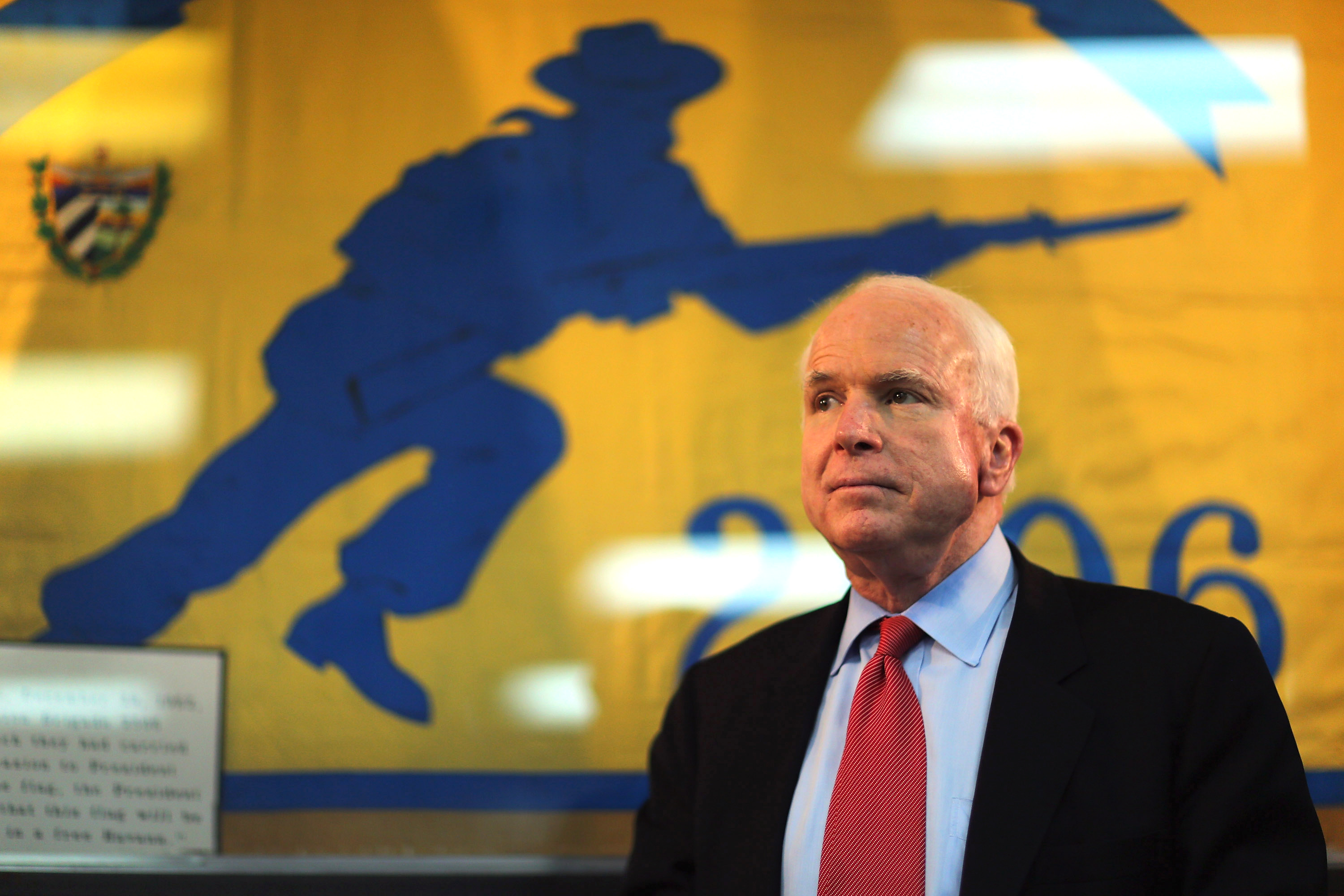
John McCain angrily insisted on “right” and “wrong” answers to his questions of Chuck Hagel yesterday. As a theologian and a religious leader, I want to say that John McCain is “wrong.”
Joe Raedle / Getty Images
McCain waits to speak during a campaign visit to support former presidential candidate Mitt Romney. Joe Raedle/Getty Images

Related Reading

I watched the hostile questions that Sen. McCain asked Hagel in the hearings on his nomination for Secretary of Defense. The angry attacks from McCain were about the Iraq War, for which McCain was one of America’s leading advocates. Hagel had previously called the war in Iraq the biggest American foreign policy mistake since Vietnam. Obviously furious, McCain tried to force Hagel to say the last “surge” in Iraq, which McCain had made his cause, was right after all. Despite the aggressive and disrespectful questioning from his former “friend,” Hagel wouldn’t submit to McCain’s demands and said these questions would be subject to history — and to theological morality, to which John McCain has never submitted his views. In fact, his repeated desire to invade other people’s countries is offensive moral hubris.
Let me state some clear convictions from many of us in faith community. The war in Vietnam was morally wrong. The war in Iraq was morally wrong. And John McCain has been morally wrong on both of them. Christian judgments of war should always run a narrow spectrum — from the peacemaking ethic of Jesus which rejects war to the just war theology of Augustine and Aquinas. But even in the just war tradition, conflicts have to pass a number of moral tests and be the option of “last resort.” The burden of proof is always on those who support war to justify the taking of life.
Both Vietnam and Iraq failed those tests and were unnecessary wars of choice. Those wars were unnecessary, the terrible deaths from those wars were unnecessary, the enormous casualties were unnecessary, the painful family losses were unnecessary, and all the horrible costs were unnecessary.
And yesterday, we saw a politician who has based his entire political career on war furiously trying to force a potential Secretary of Defense to say that he has been right all along.
But McCain hasn’t been right in his endless promotion of war as the primary solution to our national conflicts. He has been consistently wrong and America has paid a very high price because of the ideological zealots of war that McCain represents.
After yesterday, I wished that the coming vote on confirmation could be the other way around; that America could somehow vote John McCain out of office and off the American political stage. The cost of McCain’s theology of war has been far too high.
The important discussions yesterday should have been about other critical issues: like how quickly and responsibly we can leave the endless war in Afghanistan, how we can address the real threats of terrorism in better ways than failed wars of occupation, what we should do about the real problem of Iran, and a very serious strategic and moral examination of our growing reliance on drones as a primary instrument of our foreign policy.
Instead, we saw old men defending their old wars. That was both very sad and morally objectionable. In the future, I would suggest the Senate Armed Service Committee call some religious leaders to their hearings to raise the questions that they need to hear.
Jim Wallis is the author of Rediscovering Values: A Guide for Economic and Moral Recovery, and CEO of Sojourners. His forthcoming book, On God's Side: What Religion Forgets and Politics Hasn’t Learned about Serving the Common Good, is set to release in April. Follow Jim on Twitter @JimWallis.
Photo: Joe Raedle / Getty Images

RELATED STORIES


07 September 2012

Disputes in Asia Pacific Pits China Against Its Neighbors 7SEP12

ALL the money we send to the prc because American jobs have been outsourced to the prc will soon be used against us, not economically, but militarily. It won't be long before the prc takes more aggressive action against the Philippines or Vietnam or Japan in one of these island chains and then the American government is going to have to decide how to respond. As long as the prc is the brutal communist dictatorship it is we need to respond economically and militarily if the Philippines or Japan are attacked. Vietnam is no better than the prc, if they start fighting the most we should do is take the necessary actions to protect our friends and allies in the region from collateral damage. Too many American lives have been lost and damaged in Iraq and Afghanistan, nations that we can not count as friends or allies, we can not make that mistake again. From NPR....
A Philippine soldier stands guard next to fishing boats at a pier in Masinloc town, Zambales province on May 18. Protesters planned to use the boats to get to the disputed Scarborough Shoal. Photo by Ted Aljibe/AFP/GettyImages.
Secretary of State Hillary Clinton's visit to China this week marked the end of what has been a bruising summer in the Asia Pacific. Disputes between China and its neighbors have flared enough to raise the temperature in some of the world's most vital shipping lanes.
At the heart of many of these conflicts are dense fishing grounds and potentially massive energy reserves. Vietnam, the Philippines and China are all scrambling to advance offshore drilling efforts in contested regions, and overexploited coastal zones have driven fishermen to venture further and further into disputed waters. Diplomacy has stalled, China continues to refuse multilateral talks, while smaller countries with claims in the region are fortifying defenses and soliciting help from foreign powers.
It's quickly shaping into the greatest geopolitical chess match to strike the high seas in decades. In the balance are vast consequences for global trade, American influence abroad and the livelihoods of 10s of millions of people who depend daily on ocean resources.
"There are a lot of different directions this could go, and many of them are not good," said Bonnie Glaser, a China expert and senior fellow at the Center for Strategic and International Studies. "To some extent, the Chinese have really taken their gloves off."
The United States, meanwhile, has great interest in the Asia Pacific for its shipping lanes and strategic military positioning. American diplomats have had to walk a tight-rope between concerns from regional allies, such as Japan and the Philippines, while appeasing China, its second leading trade partner.
On a map, the five major flashpoints for this festering conflict are just specks in a seemingly endless expanse of blue. But for the handful of nations, including the United States, now locked in bitter dispute over them, they are the keys to a prolonged and energy independent tomorrow.
Paracel and Spratly Island Chains

In July, in one of its boldest moves yet in contested waters, China established a city and military garrison on a sparsely populated island in the Paracels to manage the nearly 1.4 million-mile swath of ocean it now claims in the South China Sea. The move was a direct response to an earlier attempt by Vietnam to force foreign ships to notify officials before crossing their waters. It also put neighbors and the United States on notice that China has no plans of backing away from rival claims. They will simply fight fire with fire.
In addition to the island, China claims the entirety of the Paracel and Spratly chains -- the largest underdeveloped archipelagos in the South China Sea -- and their surrounding waters, which are dense with fish and cover potentially vast oil and natural gas reserves. The claim is hotly refuted by Vietnam and the Philippines, which each claim portions of both chains.
Scarborough Shoal

China and the Philippines have long bickered over this tiny guano-coated outcropping and the fishing grounds and purportedly vast energy stores it pinpoints. But lately the feud has taken a hostile turn and each side appears to be growing bolder in its claim, building defenses and digging in for what could prove a violent next couple of years.
Last spring, a clash erupted between the two countries when a Philippine warship tried to force Chinese fishermen from the shoal, prompting China to dispatch paramilitary ships and put a freeze on Filipino banana imports. A tense two-month staredown ensued. The Philippines finally backed off, at least temporarily; the Chinese still have boats there and are reportedly blocking Filipino fishermen from reaching the best fishing grounds.
At its annual meeting this summer, ASEAN, the bloc representing Southeast Asian interests, failed to publicly address the Scarborough conflict and others like it. For the first time in its 45-year history, the group failed even to produce a simple communiqué, and reports trickled out that Cambodia, which China continues to pump with money, opposed any mention of the disputes.
Filipino President Benigno Aquino III announced in July that his country will acquire at least 40 military aircraft, a retired U.S. Coast Guard boat and other weapons in the next two years, in order to better defend itself in future confrontations.
Senkaku Islands

Anti-Japanese protests have spread across China in recent weeks after Japan arrested Chinese activists who sailed to these disputed islands in the East China Sea and began hurling bricks at Japanese coast guard officials.
Japan has claimed the group of islands for more than 40 years, despite opposition from both China and Taiwan. Both sides have interests in the archipelago's strategic positioning and its nearby resources -- fish, mineral deposits and potential energy reserves.
The feud intensified in 2010, when a Chinese fishing vessel collided with Japanese patrol ships near one of the islands. Japan arrested and deported the fishermen, but the episode infuriated many in China and Taiwan. Japan sparked a fresh round of shouting when it announced last year it would purchase the islands from their longtime private Japanese owner.
Dokdo Islands

South Korean President Lee Myung-bak ripped open the long-festering wound between Japan and his country over these islands when he visited them last month -- the first such visit by a South Korean president ever. The Japanese government immediately denounced the trip and lashed back by pulling its ambassador out of Seoul.
Japan and both Koreas lay claim to this pair of islands and their surrounding fishing grounds, though the central disagreement has long been between Japan and South Korea. South Korea, which has stationed a military unit on the islands since the 1950s, views them as important symbols in its still-lingering colonial vendetta with Japan.
Maps by Calvin Solomon/PBS NewsHour. View more of our World coverage and follow us on Twitter:
http://www.pbs.org/newshour/rundown/2012/09/disputes-in-asia-pacific.html 


06 September 2012

CNN Airs The Most Ridiculous Statement I’ve Ever Seen On Television 28AUG12

HERE is a revealing piece about how poor mitt robme "suffered" during his mormon missionary stint in France in 1968, after applying for and receiving a total of for deferments to avoid the draft and having to serve the country he loves in Vietnam (note, SARCASM INTENDED)....
When a friend tweeted me about a line from CNN’s Romney Revealed documentary, I thought he must have misheard or paraphrased it, but as it turns out, Gloria Borger‘s narration of the Mitt Romney profile really did contain the most ridiculous sentence I’ve ever heard on television, so ridiculous that I’m half-suspicious CNN is actually a cabal of master satirists who are making fun of the Republican presidential candidate.
The portion of the documentary in question covers Mitt Romney’s stint as a door-to-door Mormon recruiter in 1968 France, a duty which helped him to avoid military service in Vietnam. Earlier in the doc, narrator and interviewer Gloria Borger glossed over the fact that Romney sought, and received, four deferments during the Vietnam War (and later lied about it), instead saying simply that he was “exempt as a student, and with a high draft number.”
The doc also notes, as an example of Romney “becoming his own man,” that he protested in favor of the draft that he so skillfully avoided, before moving on to the time he spent in France, a time that Romney once described as “tough” because the French were “not happy to see Americans, because we were in Vietnam at the time.”
Yes, you heard that right. Not only did Mitt Romney protest in favor of sending other people’s children to die in Vietnam, even as he avoided service himself, he then complained about how those dying Americans made it “tough” for him while he was in France avoiding service.
Perhaps to avoid charges of bias, the documentary steers clear of these contradictions, but then takes the whitewashing to blindingly absurd levels by introducing the next segment with the aforementioned most ridiculous statement I’ve ever seen on television. “In 1968, France was a dangerous place to be for a 21-year-old American,” Borger says, “but Mitt Romney was right in the middle of it.”
That’s right, in 1968, the year in which the highest number of American deaths in Vietnam were reported (16,592), France was a dangerous place to be for a 21-year-old American who was avoiding service in Vietnam. Aside from the constant danger of having one’s eye put out by an errant baguette, what hardships did Mitt Romney face while he was “in country?”
Well, all those dying Americans were causing protests in France, and as a result, says fellow Romney missionary Mike Bush, “There was no train service, there were no buses, no newspapers. The electricity would go off from time-to-time.”
The electricity would go off from time-to-time? Mon Dieu. Think of the horrific flashbacks to rudely-interrupted Gilligan’s Island reruns and spoiled escargot. But the horrors of Vietnam-era France didn’t end there.
“There were no letters from home,” Bush continues. “The money at the time came via check. That was our lifeline was getting letters from home.”
So, CNN’s story is that Mitt Romney had it tough during Vietnam because the protests in France made it hard for his dad to send him money. That’ll give anyone the thousand-yard stare.
The quest for “objectivity” has increasingly become the quest to avoid charges of bias, but in Romney Revealed, CNN seems to have bent over so far backward that they ended up unintentionally parodying the poor guy. Mitt Romney, and CNN’s audience, deserve better.
Here’s the clip, from CNN’s Romney Revealed:
<iframe src="http://videos.mediaite.com/embed/player/?content=7K7NX72XY19X8NL0&content_type=content_item&layout=&playlist_cid=&media_type=video&widget_type_cid=svp&read_more=1" width="420" height="421" frameborder="0" marginheight="0" marginwidth="0" scrolling="no" allowtransparency="true"></iframe>
(h/t Don Millard)
http://www.mediaite.com/tv/cnn-airs-the-most-ridiculous-statement-ive-ever-seen-on-television/
 

26 January 2012

Philippines may allow greater U.S. military presence in reaction to China’s rise 26JAN12

AMERICAN military forces, and the money they bring through resupply, fueling, repair and leave time for sailors, soldiers and airmen should only be available to countries that are democratic or are making tangible (not superficial) changes to democracy and who respect and follow the Universal Declaration of Human Rights. We should not be showing the flag in Vietnam when the government in Hanoi is more repressive than the prc and corruption is rampant. We should not be spending U.S. taxpayer dollars in Singapore while their government continues it's policies of political repression. We have been down this road before. The Cold War with the communist bloc from the late 40's into the 80's brought conflict over economic resources, political power and spheres of influence to much of Africa, Central America and the Caribbean, the Mid-East, many countries in South America as we as across the Indian Subcontinent and Southeast Asia. The regular people of these nations were used as pawns by both sides and the nations used in this worldwide cold war lost too many of their own, lost human rights, economic development, educational development, health care for their citizens and lost political stability and maturity. The U.S., for all the military lives sacrificed, the billions of dollars in military material wasted, the political opportunities squandered by supporting corrupt, brutal, dictatorial, autocratic regimes and revolutionary movements ended up worse off in relations with most of the world and despised by most of the world's people. 
We are starting to make the same mistake on a global scale again. The American government, following the dictates of corporate America (who sees oil and gas and gold and profits in the waters and lands of Southeast Asia) and the American military-industrial complex (because war is business) is muscling it's way back into the area, but for all the wrong reasons. We are not establishing a military presence in the area to protect and promote human rights and democracy, to encourage democratic governments to stay the course, to support new democracies to continue on the path to full democracy, or to show the repressive autocratic governments the economic benefits they are missing by not being democratic. No, we are there because of economic greed and lust for power. And just like every other military foray dictated by corporate America and the U.S. military-industrial complex, this one will cost us too many American lives and too many American taxpayer dollars, and our nation end up worse off economically, politically, militarily and in our international standing. This from the Washington Post....

By

Two decades after evicting U.S. forces from their biggest base in the Pacific, the Philippines is in talks with the Obama administration about expanding the American military presence in the island nation, the latest in a series of strategic moves aimed at China.
Although negotiations are in the early stages, officials from both governments said they are favorably inclined toward a deal. They are scheduled to intensify the discussions Thursday and Friday in Washington before higher-level meetings in March. If an arrangement is reached, it would follow other recent agreements to base thousands of U.S. Marines in northern Australia and to station Navy warships in Singapore.
Among the options under consideration are operating Navy ships from the Philippines, deploying troops on a rotational basis and staging more frequent joint exercises. Under each scenario, U.S. forces would effectively be guests at existing foreign bases.
The sudden rush by many in the Asia-Pacific region to embrace Washington is a direct reaction to China’s rise as a military power and its assertiveness in staking claims to disputed territories, such as the energy-rich South China Sea.
“We can point to other countries: Australia, Japan, Singapore,” said a senior Philippine official involved in the talks, speaking on the condition of anonymity because of the confidentiality of the deliberations. “We’re not the only one doing this, and for good reason. We all want to see a peaceful and stable region. Nobody wants to have to face China or confront China.”
The strategic talks with the Philippines are in addition to feelers that the Obama administration has put out to other Southeast Asian countries, including Vietnam and Thailand, about possibly bolstering military partnerships.
The United States already has about 600 Special Operations troops in the Philippines, where they advise local forces in their fight with rebels sympathetic to al-Qaeda. But the talks underway between Manila and Washington potentially involve a much more extensive partnership.
Officials in the Philippines — which has 7,107 islands — said their priority is to strengthen maritime defenses, especially near the South China Sea. They indicated a willingness to host American ships and surveillance aircraft.
Although the U.S. military has tens of thousands of troops stationed at long-standing bases in Japan, South Korea and Guam, as well as the island of Diego Garcia in the Indian Ocean, it is seeking to solidify its presence in Southeast Asia. Some of the world’s busiest trade routes pass through the South China Sea and the nearby Strait of Malacca.
Instead of trying to establish giant bases reminiscent of the Cold War, however, Pentagon officials said they want to maintain a light footprint.
“We have no desire nor any interest in creating a U.S.-only base in Southeast Asia,” said Robert Scher, a deputy assistant secretary of defense who oversees security policy in the region. “In each one of these cases, the core decision and discussion is about how we work better with our friends and allies. And the key piece of that is working from their locations.”
‘Political sensitivities’
The distinction is critical in the Philippines, which kicked the U.S. military out of its sprawling naval base at Subic Bay in 1992 after lawmakers rejected a new treaty. Along with the nearby Clark Air Base, which the Pentagon abandoned in 1991 after a volcanic eruption, Subic Bay had served as a keystone of the U.S. military presence in Asia for nearly a century.
Manila and Washington signed a subsequent agreement that allows U.S. forces to visit the archipelago or deploy there periodically while remaining under U.S. legal jurisdiction. The constitution of the Philippines forbids foreign military bases without a treaty.
“There are political sensitivities, and the U.S. is aware of that,” said a senior Philippine official, speaking on the condition of anonymity to discuss confidential deliberations. “So how can we achieve that presence without it costing too much in terms of political friction?”
Philippine officials said they favor allowing the United States to deploy more troops or ships, as long as they rotate periodically or are considered temporary.
Temporary, however, can still mean a long time. The 600 U.S. Special Operations troops in the Philippines have been on the southern island of Mindanao since 2002, and there is no firm timetable to withdraw them.
The number of port visits by U.S. Navy ships has soared in recent years. The Philippines recently acquired a cutter from the U.S. Coast Guard and is seeking two more of the ships to boost its naval forces. It also wants to buy F-16 fighter jets from Washington.
In interviews, neither Philippine nor Obama administration officials would rule out a return by U.S. ships or forces to Subic Bay. The harbor is now a thriving economic hub and free-trade zone, so any American military presence would pale in comparison with the old days.
But even a small, visiting U.S. force in the Philippines would send a strong signal to Beijing. Although Washington has said it is not trying to contain China’s rise as an economic and military superpower, Obama announced a new military strategy this month under which the Pentagon will “rebalance” the armed forces toward the Asia-Pacific region in the aftermath of the wars in Iraq and Afghanistan.
‘A necessary normal’
Some advocates said the shift in emphasis to Asia was long overdue, given its economic importance and China’s rise.
“I don’t really see this as a pivot. . . . What I see now is a return to a necessary normal,” said Sen. James Webb (D-Va.), chairman of the Senate Foreign Relations subcommittee on East Asia and Pacific affairs. “The presence of the United States has become the essential ingredient for stability.”
In addition to the Philippines, Vietnam — another country that once shunned the U.S. military — is restoring ties. In August, a U.S. Navy ship visited the Vietnamese naval base at Cam Ranh Bay for the first time in 38 years. Cam Ranh Bay is a deep-water harbor that served as one of the largest American military installations during the Vietnam War. Vietnam, which has its own territorial disputes with China, has slowly opened its bases to the U.S. Navy for port visits and ship repairs since 2009.
“I don’t see in the near future an American base in Vietnam, but we have seen much more increased military cooperation,” said Webb, a former Navy secretary who fought in Vietnam as a Marine. “They’re not shutting down their relationship with China, but they’re attempting to balance it.”
Adm. Jonathan W. Greenert, chief of naval operations, has called Southeast Asia the region with “perhaps the greatest potential in the future” for the Navy to increase its presence through military partnerships. In a Jan. 10 speech to the Center for a New American Security in Washington, he singled out the Philippines as a country “where perhaps there will be more opportunities emerging,” although he didn’t elaborate.
Greenert cautioned that some of those partnerships would be limited, saying, “Not everybody is interested in getting in an alliance and getting tied up in a long term.” He cited Vietnam as an example. “We don’t want to push it too hard,” he said. “If you move a little too fast, there’s a hesi­ta­tion.”

20 January 2012

Vietnam's Land Struggle: Tension Between Farmers And State 20JAN12

HERE is an article from Reuters via HuffPost that reminds us Vietnam is not the workers paradise the government in Hanoi would like the world to believe. Shoes, clothing, electronics, agricultural products and other items made in Vietnam and exported to the U.S. support the repressive government which denies it's people their human rights as outlined in the U.N.'s Declaration of Human Rights. One will do better to look for products made in the U.S.A. or at least in places like Mexico, Cambodia, Bangladesh, the nations of Central America and the Caribbean, nations that have a better record on human rights than Vietnam or the prc. Can only find the item you are shopping for exported from the prc or Vietnam? Then think about whether you really need it, ask yourself if you really want to use your hard earned dollars to support repression and denial of human rights.


By John Ruwitch

HANOI, Jan 20 (Reuters) - The case of a family of farmers in Vietnam who used homemade landmines and guns in a bid to stop local officials taking their land this month has sparked rare open criticism of the authorities' strong-arm approach, forcing the government to act to limit the damage.

Coverage of the issue in state-backed media has cast a spotlight on a potential flashpoint in this one-party state, which has attracted foreign investment in part because of relative political stability under Communist rule.

"Over recent years Vietnam has witnessed a rise in violence directed against state authorities by aggrieved citizens," said professor Carlyle Thayer of the University of New South Wales.

"Their frequency is an indication that the avenues to adjudication and redress are not available."

As in China, where land grabs sparked a revolt in the southern village of Wukan that lasted for months, land issues are a leading source of friction between the public and officials. All land is owned by the state and usage rights are not always clear or protected.

On the outskirts of Vietnam's third-largest city, Haiphong, the land dispute that erupted violently on Jan. 5 had simmered for over four years, according to newspapers and websites.

Six police and soldiers were injured, and four people -- farmer Doan Van Vuon, his brother and two other relatives -- were arrested.

Critics, including a former state president, were quick to decry the local authorities' heavy-handed bid to reclaim the land that Vuon had converted for aquaculture, saying the use of security forces was inappropriate and illegal.

"Eviction is wrong. Moreover, deploying the army and police to evict someone is even more wrong," Le Duc Anh, Vietnam's president from 1992-1997 and a senior army general, told the newspaper Vietnam Education.

Dang Hung Vo, a one-time deputy minister of natural resources and the environment, said the decision to take the land "was both against the law and ethics, intentionally stripping them of their rights", the online news portal VNExpress.vn reported.

Supporters in Hanoi donated 60 million dong ($2,857) to Vuon and his brother, 6 million to the injured security officers, and had some 200 million more, blogger Nguyen Xuan Dien said online.


MANIPULATING FACTS

Prime Minister Nguyen Tan Dung responded this week by ordering the Haiphong city government to investigate.

But getting the true story may prove difficult.

"Shooting at police is wrong, and they will be jailed for sure," a Vietnamese reporter following the case said on Friday.

"But what the press want to know is what drove these people to such a reaction. Whether the local authorities will admit they were wrong is open to question ... In the provinces, authorities may think they can do what they want."

Thayer said there was no independent means to adjudicate land use disputes. "The local government is free to manipulate the facts of any given case to suit its purpose," he said.

A zooming economy has driven up land prices, tempting officials to move farmers off their land to make way for lucrative projects such as apartments and industrial zones. Local officials said Vuon's land would become an airport.

The Foreign Ministry said local authorities turned down a Reuters request to visit the site. Foreign reporters must obtain government permission to report outside of Hanoi.

Vietnamese media reported that in 2007 district officials sought to reclaim land from Vuon and a neighbour, but the families sued. Arbitration followed and in 2010 the families dropped the lawsuit in exchange for extensions to their leases.

Not long after, though, local officials said the deal was invalid and began pushing anew to repossess the land.

What brought things to a head is unclear. Vuon was not at the scene but is suspected of having planned the ambush.

Shortly after the clash, a family-owned house where the gunmen took refuge was reduced to rubble. One government official reportedly said security forces were behind the demolition. Another later said they were not. (Editing by Alan Raybould and Ed Lane)

31 December 2011

Ron Paul Had Accurate Conspiracy Theory: CIA Was Tied To Drug Traffickers 30DEZ11

THIS is not news, anyone who thinks the cia has been working to defend the average American has been living in a dream world. The majority of these people live and work on the dark side, employing the same tactics, embracing the same evil as their opponents, leaving one to wonder what the difference between them really is? The cia has been involved in drug trafficking at least since WW II (read 'The Politics of Heroin: CIA Complicity in the Global Drug Trade' by Alfred W McCoy) through Vietnam and the Central American insurgencies and in Afghanistan. Why? Because their activities have not been to protect American democracy and to foster democracy around the world, they have not been interested in protecting the American people from becoming enslaved under a communist government or dictatorship. NO, they have been controlled by corporate America and the military-industrial complex to protect the wealth and profits of the rich, the 1% who control our nation and it's destiny, and their actions and involvement in drug trafficking has just been one of the tools they have been allowed to use to achieve their goals. Just as they have overthrown governments and waged wars, killing those who stood in the way of American corporate profitability so too have they encouraged, facilitated, developed, enabled and facilitated drug trafficking and the drug underworld in the U.S. for the same reasons, the protection of American corporate profits and the U.S. military-industrial complex. All this, all the killing, the corruption, the government created drug addictions, all done in the name of and for the greed and lust for power of corporate America and the American military-industrial complex. And as long as the American public tolerates the cia continuing as the rogue agency it is, they commit these atrocities in our name too. From HuffPost....
WASHINGTON -- According to a former aide, Republican presidential candidate Ron Paul has long been drawn toward conspiracy theories. Eric Dondero, who served Paul off and on from 1987 to 2003, wrote recently that the Texas Republican suspected that George W. Bush may have had advance knowledge of the 9/11 attacks and that Franklin Roosevelt knew in advance about Pearl Harbor. Paul's writings and speeches spotlight a host of other plots, including the "war on Christmas."
But just because not all of Paul's theories are backed by good evidence doesn't mean none of them are.
In 1988, while running for president on the Libertarian Party ticket, he highlighted yet another conspiracy theory, and this one doesn't collapse under investigation: The CIA, Paul told a gathering of the National Organization for the Reform of Marijuana Laws, was involved in trafficking drugs as part of the Iran-Contra debacle.
Drug trafficking is "a gold mine for people who want to raise money in the underground government in order to finance projects that they can't get legitimately. It is very clear that the CIA has been very much involved with drug dealings," Paul said. "The CIA was very much involved in the Iran-Contra scandals. I'm not making up the stories; we saw it on television. They were hauling down weapons and drugs back. And the CIA and government officials were closing their eyes, fighting a war that was technically illegal."
Earlier this week, I looked into Paul's claim in the same speech that the war on drugs had racist origins and that the medical community played a role in lobbying for drug prohibitions. That charge was more or less accurate.
So is Paul's claim about the CIA and drug trafficking, a connection I explore in the book "This Is Your Country On Drugs: The Secret History of Getting High in America." (An excerpt of the chapter on the CIA appeared in The Root.) The following is drawn from my book.
Since at least the 1940s, the American government has organized and supported insurgent armies for the purpose of overthrowing some presumably hostile foreign regime. In Italy, the United States helped pit the Corsican and Sicilian mobs against the Fascists and then the Communists. In China, it aided Chiang Kai-shek's Kuomintang in its struggle against Mao Zedong's communist forces. In Afghanistan, it once backed the mujahedeen in their fight against the Soviet Union and today backs warlords in opposition to the mujahedeen.
All of these and other U.S.-supported groups profited, or still profit, heavily from the drug trade. One of the principal arguments made by the Drug Enforcement Administration in support of the global drug war is that the illegal drug trade funds violent, stateless organizations. The DEA refers specifically to al Qaeda and the Taliban, but the same method of fundraising has long been used by other violent, stateless actors whom the United States befriended.
AN 'UNCOMFORTABLE' STORY
Douglas Farah was in El Salvador when the San Jose Mercury News broke a major story in the summer of 1996: The Nicaraguan Contras, a confederation of paramilitary rebels sponsored by the CIA, had been funding some of their operations by exporting cocaine to the United States. One of their best customers was a man nicknamed "Freeway Rick" -- Ricky Donnell Ross, then a Southern California dealer who was running an operation the Los Angeles Times dubbed "the Wal-Mart of crack dealing."
"My first thought was, 'Holy shit!' because there'd been so many rumors in the region of this going on," said Farah 12 years later. He'd grown up in Latin America and covered it for 20 years for the Washington Post. "There had always been these stories floating around about [the Contras] and cocaine. I knew [Contra leader] Adolfo Calero and some of the other folks there, and they were all sleazebags. You wouldn't read the story and say, 'Oh my god, these guys would never do that.' It was more like, 'Oh, one more dirty thing they were doing.' So I took it seriously."
The same would not hold true of most of Farah's colleagues, either in the newspaper business in general or at the Post in particular. "If you're talking about our intelligence community tolerating -- if not promoting -- drugs to pay for black ops, it's rather an uncomfortable thing to do when you're an establishment paper like the Post," Farah told me. "If you were going to be directly rubbing up against the government, they wanted it more solid than it could probably ever be done."
In the mid to late 1980s, a number of reports had surfaced that connected the Contras to the cocaine trade. The first was by Associated Press scribes Brian Barger and Robert Parry, who published a story in December 1985 that began, "Nicaraguan rebels operating in northern Costa Rica have engaged in cocaine trafficking, in part to help finance their war against Nicaragua's leftist government, according to U.S. investigators and American volunteers who work with the rebels."
Only a few outlets followed Barger and Parry's lead, including the San Francisco Examiner and the lefty magazine In These Times, which both published similar stories in 1986, and CBS's "West 57th" TV series, which did a segment in 1987. A Nexis search of the year following Barger and Parry's revelation turned up a total of only four stories containing the terms "Contras" and "cocaine," one of them a denial of the accusation from a Contra spokesperson. Stories popped up here and there over the next decade, but many of them made only oblique reference to a couldn't-possibly-be-true conspiracy theory.
Then came the San Jose Mercury News article, a 20,000-word three-parter by Pulitzer Prize-winning staffer Gary Webb, published under the headline "Dark Alliance." "For the better part of a decade, a San Francisco Bay Area drug ring sold tons of cocaine to the Crips and Bloods street gangs of Los Angeles and funneled millions in drug profits to a Latin American guerrilla army run by the U.S. Central Intelligence Agency, a Mercury News investigation has found," the story began.
The series initially received little attention from major media outlets, but it was eventually spread across the nation by the Internet and black talk radio. The latter put its own spin on the tale: that the U.S. government had deliberately spread crack to African-American neighborhoods to quell unruly residents. The Post newsroom was bombarded with phone calls asking why it was ignoring the story, the paper's ombudsman later reported.
In response, the Washington Post, New York Times and Los Angeles Times would all weigh in with multiple articles claiming that Webb's assertions were bunk. His career was effectively ruined, and even his own paper eventually disavowed "Dark Alliance," despite having given it a cutting-edge online presentation complete with document transcriptions and audio recordings.
The big papers had been pushing their same line for years. In 1987, New York Times reporter Keith Schneider had dismissed out of hand a lawsuit filed by a liberal group charging that the Contras were funding their operations with drug money. "Other investigators, including reporters from major news organizations, have tried without success to find proof of aspects of the case," he wrote, "particularly the allegations that military supplies for the contras may have been paid for with profits from drug trafficking."
In These Times later asked Schneider why he'd rejected the Contra-coke connection. He was trying to avoid "shatter[ing] the Republic," he said. "I think it is so damaging, the implications are so extraordinary, that for us to run the story, it had better be based on the most solid evidence we could amass."
The American republic, of course, is an idea as much as it is a reality. That idea is of a nation founded on freedom and dedicated to the progress of human rights around the globe. It's most certainly not of a country that aids the underground drug trade -- even if it does.
WHAT DRUG RUNNERS DO
If Webb didn't have ironclad proof that the CIA had knowingly done just that, he did, as one Senate investigator later noted, have "a strong circumstantial case that Contra officials who were paid by the CIA knew about [drug smuggling] and looked the other way." He based his series on court records and interviews with key drug-runners. One of them, Danilo Blandón, was once described by Assistant U.S. Attorney L.J. O'Neale as "the biggest Nicaraguan cocaine dealer in the United States."
Webb had been unable to persuade Blandón to talk, but the cocaine dealer testified at a trial shortly before "Dark Alliance" came out. Blandón wasn't on trial himself, wasn't facing any jail time, and was in fact being paid by the U.S. government to act as an informant. In other words, he had no obvious incentive to lie to make the United States look bad. Nevertheless, in sworn testimony, he said that in 1981 alone, his drug operation sold almost a ton of cocaine in the United States and that "whatever we were running in L.A., the profit was going to the Contra revolution."
Blandón's boss in the operation was Norwin Meneses, the head of political operations and U.S. fundraising for the Contras. Meneses was known as "Rey de la Droga" -- King of Drugs -- and had been under active investigation by the U.S. government since the early '70s as the Cali cocaine cartel's top representative in Nicaragua. The DEA considered him a major trafficker, and he had been implicated in 45 separate federal investigations, Webb discovered through government documents. Regardless, Meneses had never served any time in federal prison and lived openly in his San Francisco home.
In 1981, Blandón testified, he and Meneses had traveled to Honduras to meet Col. Enrique Bermúdez, the military leader of the Contra army and a full-time CIA employee. "While Blandon says Bermudez didn't know cocaine would be the fund-raising device they used," Webb wrote, "the presence of the mysterious Mr. Meneses strongly suggests otherwise." The reporter drew on court documents and government records to show that anyone involved in or familiar with the drug world at the time knew exactly how Meneses went about raising revenue.
Blandón sold the Contras' product to Ross for prices well below what other dealers could command, allowing him to expand his business throughout Los Angeles, then to Texas, Ohio and beyond. Ross told Webb that he owed his rise to Blandón and his cheap coke. ''I'm not saying I wouldn't have been a dope dealer without Danilo,'' Ross said. ''But I wouldn't have been Freeway Rick.''

Farah, the Washington Post reporter, said that his reporting on Webb's trail led to one of the biggest battles of his career. "There were maybe, in my 20 years at the Post, two or three stories out of however many hundreds or thousands I wrote where I had this kind of problem, and this was one of them. I wasn't in general in confrontation with my editors but ... this thing was weird and I knew it was weird," he said. "I did have a long and dispiriting fight with the editors at the Post because they wanted to say ultimately -- their basic take was that I was dealing with a bunch of liars, so it was one person's word against another person's word, and therefore you couldn't tell the truth. But it was pretty clear to me."

The official government response was provided to Post national security reporter Walter Pincus, who had at one time served in the U.S. Army Counterintelligence Corps. "One of my big fights on this was with Pincus," Farah remembered, "and my disadvantage was that I was in Managua and he was sitting in on the story meetings and talking directly to the editors. And we had a disagreement over the validity of what I was finding. At the time, I didn't realize he had been an agency employee for awhile. That might have helped me understand what was going on there a bit."
Pincus, who said that his involvement with the CIA several decades before is overblown, recalled the developing story differently. "To be honest, I can't remember talking to Doug at the time," he said. "To me, it was no great shock that some of the people the agency was dealing with were also drug dealers. But the idea that the agency was then running the drug program was totally different."
Pincus said that Webb's core story about the Contras and cocaine didn't resonate not because it didn't have any truth to it, but because it was obviously true. "This is a problem that came up -- it's probably a question of how long you cover these things," he said. "It came up during the Vietnam War, where the U.S. was dealing with the Hmong tribes in Laos and some of the people that were flying airplanes that the agency was using were also [running] drugs."
Through his reporting, Farah concluded, he'd confirmed the greater part of Webb's story. "The Contra-drug stuff, I think, was there," Farah said. "Largely, I think it [Webb's story] was right."
THE MEDIA ONSLAUGHT
The editorial cuts and pushback, however, discouraged Farah from pursuing a further investigation into the Contras' drug-running history. "I was really sort of disappointed at how things had run there at the Post on that story, and there wasn't much incentive to go forward after that," said Farah. (The Post's top editor at the time, Leonard Downie, told me that he didn't remember the incident well enough to comment on it.)
Although Pincus said that he didn't have any role in neutering and burying Farah's story, he did say that he sympathized with his fellow reporter. "I was writing about there being no weapons in Iraq, and it was put in the back of the paper," Pincus said. "I've been through the same thing."
The Washington Post, like the New York Times and Los Angeles Times, published a massive package dedicated to debunking Webb's story. When a congressional investigation later confirmed the major elements of Webb's reporting, the papers barely covered it. (I go into the media attack in more detail in the book.)
In the face of the media onslaught, Webb's editor retracted the story. Webb was demoted and sent to a dustbin bureau 150 miles from San Jose. He resigned after settling an arbitration claim and went to work for a small alt-weekly. Over the next several years, his marriage fell apart and his wages were garnished for child support. On Dec. 10, 2004, Webb was discovered dead, shot twice in the head with his father's .38. The local coroner declared the death a suicide.
Obituaries in the major papers referenced his "discredited" series. The Los Angeles Times obit recalled his "widely criticized series linking the CIA to the explosion of crack cocaine in Los Angeles," noting that "[m]ajor newspapers, including the Los Angeles Times, New York Times and Washington Post, wrote reports discrediting elements of Webb's reporting." The New York Times ran a five-paragraph Reuters obit that began, "Gary Webb, a reporter who won national attention with a series of articles, later discredited." The obit continued, "The articles led to calls in Congress for an investigation, but major newspapers discredited parts of Mr. Webb's work." It made no mention of the fact that those calls for an investigation were heeded and that the investigation confirmed a great deal of Webb's reporting.
The headline "Web of Deception" ran atop Howard Kurtz's story in the Washington Post. "There was a time when Gary Webb was at the center of a huge, racially charged national controversy. That was eight years ago, and it turned out badly for him," Kurtz wrote. "The lesson," he concluded, "is that just because a news outlet makes sensational charges doesn't make them true, and just because the rest of the media challenge the charges doesn't make them part of some cover-up."
Reading the obituaries at the time, Farah recalled, was dispiriting. "Everybody, especially in the news business when you're working fast, makes mistakes," he said. "But I don't think that should stand as the final word on what he did."
Kurtz, however, stands by what he wrote then. "Of course it's very sad what happened to [Gary Webb] in the end, but I just did some basic reporting on him," Kurtz said. "I wasn't going out on a limb."