NORTON META TAG

Showing posts with label big oil and gas. Show all posts

18 July 2025

TAKE ACTION: Stop this ultra-deepwater drilling project in the Gulf of Mexico 18JUL25


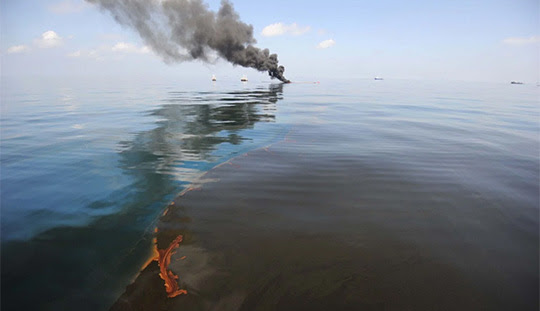
Dark clouds of smoke and fire emerge as oil burns during a controlled fire in the Gulf of Mexico in the aftermath of the Deepwater Horizon oil spill disaster. (Mass Communication Specialist 2nd Class Justin Stumberg / U.S. Navy)

 IT is the sequel we all hoped would never be made. Still in planning, and we are doubting the directors, producers and crews will be prepared and will perform any better than those who brought bp's deepwater horizon to the explosive climax they pulled off 15 years ago. The fact is there is no good reason, no need for this well. Instead of putting the entire GULF OF MEXICO and the states along the GULF OF MEXICO at risk of another explosion, too many crew deaths, another massive oil spill, economic disruption, environmental degradation and lingering civilian health issues bp should have continued their $6.5-$7 billion planned investment in renewable energy instead of taking $5 billion from it to bring their total oil and gas spending to $10 billion. That decision was driven by corporate greed, especially from elliott investment management from the U.S. and holds 5% of bp. Following the message from Earthjustice are 13 out of dozens of post on this blog covering bp's deepwater horizon disaster, their unpreparedness for the oil spill and their attempts supported by gop / greed over people-republican party tea-baggers to stick American taxpayers with the cleanup bill. To find more just search deepwater horizon on this blog. Please click the link to join in this action from Earthjustice, make a donation if you can and share this with family, friends and coworkers. My e mail to Ms. Bernadette Thomas, Regional Director, Bureau of Ocean Energy Management: is at the end of this post.

EARTHJUSTICE | BECAUSE THE EARTH NEEDS A GOOD LAWYER


If approved, this project will be BP’s first completely new oilfield development in the Gulf of Mexico since the catastrophic Deepwater Horizon disaster.
TAKE ACTION
Dark clouds of smoke and fire emerge as oil burns during a controlled fire in the Gulf of Mexico in the aftermath of the Deepwater Horizon oil spill disaster. (Mass Communication Specialist 2nd Class Justin Stumberg / U.S. Navy)
 

Fifteen years ago, BP’s Deepwater Horizon disaster in the Gulf of Mexico became the worst marine oil spill in U.S. history. Now, BP is asking the federal government to allow it to drill even deeper for oil in the Gulf of Mexico with its proposed Kaskida drilling project.
We need to send letters to the Bureau of Ocean Energy Management’s regional office in the Gulf and tell them about your support for stronger protections for Gulf communities and ecosystems from the harms of fossil fuel development in the region.
Conditions surrounding the proposed Kaskida project make it potentially more dangerous than the drilling operation that led to the Deepwater Horizon disaster. Kaskida is at much greater depths, relying on still-emerging technology to withstand extreme pressures and temperatures. This proposal raises red flags due to uncertainty about whether BP will have equipment available to respond to accidents at such high pressures or the necessary experience to prevent accidents from happening.
In addition to significant oil spill risks, BP’s proposal will have impacts on already overburdened Gulf communities, sensitive deep-sea ecosystems, and imperiled marine life such as Kemp’s ridley sea turtles and the critically endangered Rice’s whale, whose population was significantly harmed by Deepwater Horizon.
Past deepwater drilling incidents show us what is at stake. The Bureau of Ocean Energy Management’s regional office in the Gulf is listening. Let them know this proposed project poses significant risks for the Gulf and threatens the public health of Gulf communities, numerous types of marine life, as well as the regional economy.
TAKE ACTION


Bretty Hardy
 
.
Sincerely,
Brettny Hardy
Senior Attorney, Oceans
Earthjustice
Thank you for your support of Earthjustice.
DONATE NOW
 

Supporters like you power this work

Earthjustice, 180 Steuart St. #194330, San Francisco, CA 94105-5741
About Us  
Delivered to you by Earthjustice. Your support makes the difference.
Photo Credits: Dark clouds of smoke and fire emerge as oil burns during a controlled fire in the Gulf of Mexico in the aftermath of the Deepwater Horizon oil spill disaster. (Mass Communication Specialist 2nd Class Justin Stumberg / U.S. Navy)
© 2025

WHERE ARE THE 'DRILL BABY DRILL' ASSHOLES NOW???Officials Dispatched To Gulf As Oil Spill Worries Grow 29APR10


MY E MAIL TO RE: BP Exploration & Production Inc.’s Initial Development Operations Coordination Document (DOCD), Kaskida Project, Keathley Canyon Blocks 292 and 293

Dear Ms. Bernadette Thomas, Regional Director, Bureau of Ocean Energy Management:

I am writing to urge you to disapprove BP’s proposed Kaskida ultra-deepwater drilling project.

Kaskida, as proposed, poses significant risks to our economy, the marine and coastal environment, and the humans who depend on it.

BP’s Deepwater Horizon disaster, which caused $17.2 billion worth of damage, dealt significant blows to the regional economy, including eliminating 25,000 jobs in the Gulf. Deepwater Horizon also led to billions of dollars in financial losses including gross regional product, lost labor income, and federal, state and local tax revenues. It was particularly cruel to the Gulf’s tourism and fishing industries, the latter of which suffered an estimated $1.5 billion in lost revenue. Kaskida could repeat Deepwater Horizon’s economic devastation to the Gulf.

With Kaskida, BP is asking to develop oil and gas reserves at even greater depths than where its Deepwater Horizon rig suffered a loss of control incident – an event that killed 11 people and turned into the worst marine oil spill in U.S. history. The Kaskida project proposes to drill wells in waters up to 6,200 feet deep — whereas BP’s well that blew out in 2010 was about 5,000 feet deep.  It would also be one of the first development projects in the region to use oil well equipment that needs to be able to handle pressures up to 20,000 pounds per square inch. By comparison, the faulty blowout preventer used in Deepwater Horizon could handle pressures of only 15,000 pounds. s. In its proposal to the government, BP has failed to demonstrate that such a facility can safely operate a high-pressure, high-temperature well like Kaskida. BP has not obtained U.S. certification to operate a high-pressure, high-temperature well and has not pointed to experience drilling these types of wells in other places.

In other words, BP would be pushing ultra-deepwater drilling to extreme depths while relying on still-emerging technologies. This is concerning and highly risky, since the likelihood of well blowouts and uncontrolled oil spills increases exponentially with depth and pressure, and spills from this type of drilling are harder to respond to and contain. In fact, reports have shown that projects like Kaskida are six times more likely to experience an incident due to the extreme pressures and temperatures at such great depths.

In addition to significant oil spill risks, this project would negatively impact already overburdened Gulf communities, sensitive deep-sea ecosystems, and imperiled marine life such as Kemp's ridley sea turtles and the critically endangered Rice's whale, whose population was significantly harmed by Deepwater Horizon.

Past deepwater drilling incidents show us what is at stake, and the Gulf of Mexico cannot handle another catastrophic disaster. Past incidents also show how unprepared  these companies like BP are for these catastrophic disasters, how protecting their profit margins are more important than clean up, environmental restoration and healthcare and economic compensation. There was even an attempt by BP and associated companies to leave the American taxpayers financially responsible for their catastrophe in the Gulf. Please deny BP's request for approval of their Kaskida Project.

--

20 November 2017

EARTHJUSTICE NEWSLETTER: GRIZZLIES ‘SAVED HIS LIFE’ , THE DIRT ON “CLEAN” NATURAL GAS, COAL ASH & PRUITT, CONSUMER SAFETY, SAN PEDRO RIVER 18NOV17


BESIDES the articles from EarthJustice there are to actions you can take part in. I sent this message to the Army Corps of Engineers regarding the proposed development along the San Pedro River.
"It is time to put the brakes on our environmental greed and to take the necessary steps to protect the biodiversity of areas like the San Pedro River watershed. I am asking you to revoke  CWA Permit No. 2003-00826-SDM and to deny any development along the San Pedro River."
AND I sent this to the BLM and Sec of the Interior asking that the 2015 Sage Grouse agreement be maintained, not weakened or abolished.
"There is no reason to weaken or abandon the agreement negotiated and agreed to by the BLM, US Forest Service, the oil and gas industry and conservation and environmental groups. This agreement protects people, property and profits and is an example of what can be accomplished  when people work together. The agreed to protections for sage grouse habitat protects the biodiversity of area environment to the benefit of all."
PLEASE CLICK THE LINKS AND SEND MESSAGES FOR THESE TWO ACTIONS AND FIND MORE ABOUT AT THE EARTHJUSTICE ACTION CENTER.

“If people are allowed to shoot grizzlies, all these bears that have tolerated people are going to be betrayed by humanity in such a deadly way. It’s ugly.”
Earthjustice
Doug Peacock stands on the edge of the Yellowstone River in Emigrant, Montana. (Tom Robertson)
After two tours, this Vietnam vet went into the American wilderness to confront his demons
The story of how grizzly bears “saved his life” and why he’s fighting like hell to protect them.
READ MORE
Your gift will be matched $1-for-$1!
We’ve been fighting in court for years to protect grizzly bears and other endangered wildlife and we’re not stopping now. Help us take on these critical courtroom battles today and your gift will be matched $1-for-$1!
DONATE NOW
Jonah Field, a natural gas field in Wyoming (Photo courtesy of RSC Publishing)
Here’s the dirt that industry won’t tell you about ‘clean’ natural gasIt’s not clean, it’s not good for the planet, and it’s not necessary.
READ MORE
The Reid Gardner coal plant stood about 300 yards from the Moapa River Indian Reservation in Nevada. (Chris Jordan-Bloch/Earthjustice)
For two decades, this tribe fought for the right to breathe clean air—then wonNow EPA Administrator Scott Pruitt wants to take these protections away as a gift to the coal industry.
READ MORE
Dana Baiocco before her Senate Commerce, Science and Transportation Committee confirmation hearing. (Chip Somodevilla/Getty Images)
Her list of clients includes Big TobaccoAn attorney who has spent her career defending defective or dangerous products could soon be part of the very agency responsible for developing safety standards for our consumer products.
READ MORE
Concerns about litter led Coral Gables to ban Styrofoam containers. But the Florida state legislature has blocked the city's effort to keep its beaches clean. (Wingedwolf/Getty Images)
Why are we still fighting about Styrofoam trash?In Florida, cities have banned it, but powerful lobbyists are using it as a proxy battle to stop local governments from passing strong environmental laws.
READ MORE
Quotable
“It’s a procedural victory, but a victory for people breathing nonetheless.”
— Earthjustice attorney Adrian Martinez on a recent ruling that will make it harder for industry lobbyists to push through last-minute changes to weaken air regulations.
READ MORE
HOW YOU CAN HELP
Help protect this iconic bird’s habitat
The health of sage-grouse habitat determines the survival of an entire ecosystem, including the golden eagle, elk, pronghorn and mule deer. But if the oil and gas industry has its say, tens of millions of acres of wildlife habitat across the western U.S. could soon make way for fossil fuel development.
TAKE ACTION
A massive development threatens Southwest’s last free-flowing river
The San Pedro River provides an oasis of life for hundreds of species of migratory birds, and jaguars have been seen prowling the nearby Whetstone mountains—but a massive development could decimate this desert gem.
TAKE ACTION

Share this:
Facebook  Twitter  Email  Addthis
Trouble seeing this email?
View in browser
Earthjustice
50 California Street, Suite 500
San Francisco, CA 94111
enews@earthjustice.org
Photo Credits (top to bottom): Tom Robertson, Photo courtesy of RSC Publishing, Chris Jordan-Bloch/Earthjustice, Chip Somodevilla/Getty Images, Wingedwolf/Getty Images