NORTON META TAG

Showing posts with label off-shore oil drilling. Show all posts

18 July 2025

TAKE ACTION: Stop this ultra-deepwater drilling project in the Gulf of Mexico 18JUL25


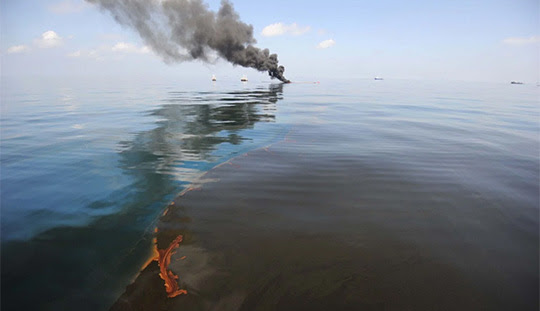
Dark clouds of smoke and fire emerge as oil burns during a controlled fire in the Gulf of Mexico in the aftermath of the Deepwater Horizon oil spill disaster. (Mass Communication Specialist 2nd Class Justin Stumberg / U.S. Navy)

 IT is the sequel we all hoped would never be made. Still in planning, and we are doubting the directors, producers and crews will be prepared and will perform any better than those who brought bp's deepwater horizon to the explosive climax they pulled off 15 years ago. The fact is there is no good reason, no need for this well. Instead of putting the entire GULF OF MEXICO and the states along the GULF OF MEXICO at risk of another explosion, too many crew deaths, another massive oil spill, economic disruption, environmental degradation and lingering civilian health issues bp should have continued their $6.5-$7 billion planned investment in renewable energy instead of taking $5 billion from it to bring their total oil and gas spending to $10 billion. That decision was driven by corporate greed, especially from elliott investment management from the U.S. and holds 5% of bp. Following the message from Earthjustice are 13 out of dozens of post on this blog covering bp's deepwater horizon disaster, their unpreparedness for the oil spill and their attempts supported by gop / greed over people-republican party tea-baggers to stick American taxpayers with the cleanup bill. To find more just search deepwater horizon on this blog. Please click the link to join in this action from Earthjustice, make a donation if you can and share this with family, friends and coworkers. My e mail to Ms. Bernadette Thomas, Regional Director, Bureau of Ocean Energy Management: is at the end of this post.

EARTHJUSTICE | BECAUSE THE EARTH NEEDS A GOOD LAWYER


If approved, this project will be BP’s first completely new oilfield development in the Gulf of Mexico since the catastrophic Deepwater Horizon disaster.
TAKE ACTION
Dark clouds of smoke and fire emerge as oil burns during a controlled fire in the Gulf of Mexico in the aftermath of the Deepwater Horizon oil spill disaster. (Mass Communication Specialist 2nd Class Justin Stumberg / U.S. Navy)
 

Fifteen years ago, BP’s Deepwater Horizon disaster in the Gulf of Mexico became the worst marine oil spill in U.S. history. Now, BP is asking the federal government to allow it to drill even deeper for oil in the Gulf of Mexico with its proposed Kaskida drilling project.
We need to send letters to the Bureau of Ocean Energy Management’s regional office in the Gulf and tell them about your support for stronger protections for Gulf communities and ecosystems from the harms of fossil fuel development in the region.
Conditions surrounding the proposed Kaskida project make it potentially more dangerous than the drilling operation that led to the Deepwater Horizon disaster. Kaskida is at much greater depths, relying on still-emerging technology to withstand extreme pressures and temperatures. This proposal raises red flags due to uncertainty about whether BP will have equipment available to respond to accidents at such high pressures or the necessary experience to prevent accidents from happening.
In addition to significant oil spill risks, BP’s proposal will have impacts on already overburdened Gulf communities, sensitive deep-sea ecosystems, and imperiled marine life such as Kemp’s ridley sea turtles and the critically endangered Rice’s whale, whose population was significantly harmed by Deepwater Horizon.
Past deepwater drilling incidents show us what is at stake. The Bureau of Ocean Energy Management’s regional office in the Gulf is listening. Let them know this proposed project poses significant risks for the Gulf and threatens the public health of Gulf communities, numerous types of marine life, as well as the regional economy.
TAKE ACTION


Bretty Hardy
 
.
Sincerely,
Brettny Hardy
Senior Attorney, Oceans
Earthjustice
Thank you for your support of Earthjustice.
DONATE NOW
 

Supporters like you power this work

Earthjustice, 180 Steuart St. #194330, San Francisco, CA 94105-5741
About Us  
Delivered to you by Earthjustice. Your support makes the difference.
Photo Credits: Dark clouds of smoke and fire emerge as oil burns during a controlled fire in the Gulf of Mexico in the aftermath of the Deepwater Horizon oil spill disaster. (Mass Communication Specialist 2nd Class Justin Stumberg / U.S. Navy)
© 2025

WHERE ARE THE 'DRILL BABY DRILL' ASSHOLES NOW???Officials Dispatched To Gulf As Oil Spill Worries Grow 29APR10


MY E MAIL TO RE: BP Exploration & Production Inc.’s Initial Development Operations Coordination Document (DOCD), Kaskida Project, Keathley Canyon Blocks 292 and 293

Dear Ms. Bernadette Thomas, Regional Director, Bureau of Ocean Energy Management:

I am writing to urge you to disapprove BP’s proposed Kaskida ultra-deepwater drilling project.

Kaskida, as proposed, poses significant risks to our economy, the marine and coastal environment, and the humans who depend on it.

BP’s Deepwater Horizon disaster, which caused $17.2 billion worth of damage, dealt significant blows to the regional economy, including eliminating 25,000 jobs in the Gulf. Deepwater Horizon also led to billions of dollars in financial losses including gross regional product, lost labor income, and federal, state and local tax revenues. It was particularly cruel to the Gulf’s tourism and fishing industries, the latter of which suffered an estimated $1.5 billion in lost revenue. Kaskida could repeat Deepwater Horizon’s economic devastation to the Gulf.

With Kaskida, BP is asking to develop oil and gas reserves at even greater depths than where its Deepwater Horizon rig suffered a loss of control incident – an event that killed 11 people and turned into the worst marine oil spill in U.S. history. The Kaskida project proposes to drill wells in waters up to 6,200 feet deep — whereas BP’s well that blew out in 2010 was about 5,000 feet deep.  It would also be one of the first development projects in the region to use oil well equipment that needs to be able to handle pressures up to 20,000 pounds per square inch. By comparison, the faulty blowout preventer used in Deepwater Horizon could handle pressures of only 15,000 pounds. s. In its proposal to the government, BP has failed to demonstrate that such a facility can safely operate a high-pressure, high-temperature well like Kaskida. BP has not obtained U.S. certification to operate a high-pressure, high-temperature well and has not pointed to experience drilling these types of wells in other places.

In other words, BP would be pushing ultra-deepwater drilling to extreme depths while relying on still-emerging technologies. This is concerning and highly risky, since the likelihood of well blowouts and uncontrolled oil spills increases exponentially with depth and pressure, and spills from this type of drilling are harder to respond to and contain. In fact, reports have shown that projects like Kaskida are six times more likely to experience an incident due to the extreme pressures and temperatures at such great depths.

In addition to significant oil spill risks, this project would negatively impact already overburdened Gulf communities, sensitive deep-sea ecosystems, and imperiled marine life such as Kemp's ridley sea turtles and the critically endangered Rice's whale, whose population was significantly harmed by Deepwater Horizon.

Past deepwater drilling incidents show us what is at stake, and the Gulf of Mexico cannot handle another catastrophic disaster. Past incidents also show how unprepared  these companies like BP are for these catastrophic disasters, how protecting their profit margins are more important than clean up, environmental restoration and healthcare and economic compensation. There was even an attempt by BP and associated companies to leave the American taxpayers financially responsible for their catastrophe in the Gulf. Please deny BP's request for approval of their Kaskida Project.

--

22 April 2011

IT'S EARTH DAY! BP getting massive tax break because of Gulf disaster 22APR11

SIGN the petition to let bp know they are still on of the most despised companies in America and they should pay their fair share of taxes...
Does this email look funny? View it online here
I Am USAction

BP getting massive tax break because of Gulf disaster
Dear TrueMajority Member,


As we celebrate Earth Day today, it's sobering to remember that exactly one year this week BP's oil spill started gushing into the Gulf of Mexico. The massive spill lasted three months and left economic and environmental devastation in its path, as well as health problems for thousands of Gulf Coast residents.

But what's really disturbing is that BP just scored a $13 billion tax credit by writing off its losses incurred by the spill. BP won't even say if the company is paying ANY taxes this year -- they could even be getting a refund.1

This is crazy. BP's tax credit is bigger than the entire EPA budget. It's equal to one-third of all the cuts recently agreed to by Congress and President Obama in their short-term budget deal.

Americans shouldn't have to endure massive budget cuts because BP took a $13 billion tax deduction at the expense of the Gulf of Mexico. So we're teaming up with our friends at CREDO to tell BP to amend its tax return and pay its fair share. Will you help to?
Click here to sign the petition telling BP to stop dodging, and pay their taxes.

The $13 billion credit comes after BP wrote-off the $40.9 billion it set aside to cover clean-up costs, fines, and for a $20 billion victim compensation fund (which has been notoriously slow and stingy in responding to claims, paying out less than $4 billion so far).2

BP brought us the worst environmental disaster in our nation's history. We don't owe BP a tax-credit. BP owes us. The least they can do this Earth Day is pay their fair share. Sign here to tell them so.

Thank you for holding polluters accountable.

Sincerely,
Drew Hudson
USAction/TrueMajority
1 - http://tpmdc.talkingpointsmemo.com/2011/04/bp-to-cut-tax-bill-by-13b-isnt-saying-what-it-paid-irs-for-2010.php
2 - http://www.bloomberg.com/news/2011-04-18/gulf-coast-claims-facility-reports-approving-3-8-bln-in-payouts.html

Donate
Facebook
Twitter


  | Support USAction
USAction, 1825 K St. NW, Suite 210, Washington, DC 20006
PH: 202.263.4520 FAX: 202.263.4530

hello

15 April 2011

Experts Fear Another Oil Disaster 14APR11

THE government needs to force the big oil companies to do more to prevent another oil disaster in the Gulf and other off-shore drilling locations. There is no way off-shore drilling should ever be approved for the Arctic. We are still dealing with oil, pollution, and the deaths of countless sea creatures along the Gulf of Mexico and with oil damage in Cook Inlet (remember exxon valdez????) to risk the environmental damage a spill in the Arctic would create. From HuffPost....

NEW ORLEANS -- With everything Big Oil and the government have learned in the year since the Gulf of Mexico disaster, could it happen again? Absolutely, according to an Associated Press examination of the industry and interviews with experts on the perils of deep-sea drilling.
The government has given the OK for oil exploration in treacherously deep waters to resume, saying it is confident such drilling can be done safely. The industry has given similar assurances. But there are still serious questions in some quarters about whether the lessons of the BP oil spill have been applied.
The industry "is ill-prepared at the least," said Charles Perrow, a Yale University professor specializing in accidents involving high-risk technologies. "I have seen no evidence that they have marshaled containment efforts that are sufficient to deal with another major spill. I don't think they have found ways to change the corporate culture sufficiently to prevent future accidents."
He added: "There are so many opportunities for things to go wrong that major spills are unavoidable."
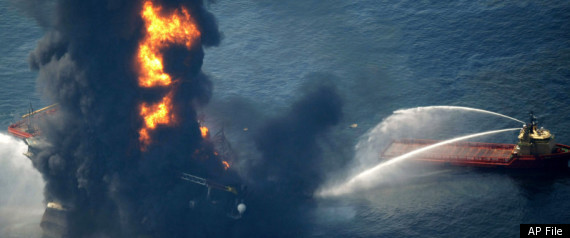
The worst offshore oil spill in U.S. history began with an explosion April 20, 2010, that killed 11 workers aboard the Deepwater Horizon rig. More than 200 million gallons of crude spewed from the well a mile beneath the sea.
Since then, new drilling rules have been imposed, a high-tech system for capping a blown-out well and containing the oil has been built, and regulators have taken steps to ramp up oversight of the industry.
But deep-sea drilling remains highly risky. The effectiveness of the much-touted containment system is being questioned because it hasn't been tested on the sea floor. A design flaw in the blowout preventers widely used across the industry has been identified but not corrected. And regulators are allowing companies to obtain drilling permits before approving their updated oil-spill response plans.
After a monthslong moratorium, the Obama administration resumed issuing drilling permits earlier this year amid great pressure from the industry and lawmakers seeking to protect communities and workers whose livelihoods depend on drilling.
A petroleum industry group is creating a center for offshore safety in Houston to address management practices and improve industry communication. And the agency that oversees offshore drilling now bars inspectors from regulating a company that employs a family member or friend. Also, inspectors who join the agency from the oil industry cannot perform inspections of their former employers for two years.
BP says it is poised to become a much safer company. It ousted several key figures during the disaster – including CEO Tony Hayward – and created a powerful unit to police company safety. BP spokesman Daren Beaudo said that because of advances made during the crisis, "the capability exists to respond to a deep-water well blowout." Similarly, Chevron spokesman Russell A. Johnson said his company is "confident of our ability to prevent an incident similar" to the Gulf oil spill.
Whether any of that translates into better protection remains to be seen.
"I'm not an oddsmaker, but I would say in the next five years we should have at least one major blowout," Perrow said. "Even if everybody tries very hard, there is going to be an accident caused by cost-cutting and pressure on workers. These are moneymaking machines and they make money by pushing things to the limit."
After the Deepwater Horizon explosion, oil producers including BP were criticized for errors in their federally required oil-spill response plans, such as severely underestimating the time it takes oil to reach shore.
Several of the biggest oil producers told the AP they have updated their response plans but are still waiting for them to be approved. The Bureau of Ocean Energy Management, Regulation and Enforcement said it is operating under a 2002 federal regulation that allows two years to approve such plans. In the meantime, companies are allowed to proceed with their drilling applications and obtain permits as long as they certify in writing that they can handle a spill, said agency spokeswoman Eileen Angelico.
The agency "is taking the oil companies' word for it that they can handle a spill," said David Pettit, a senior attorney for the National Resources Defense Council, one of the nation's leading environmental groups. "This is the same kind of deference to claimed oil company expertise that led directly to the BP Deepwater Horizon disaster."
Regulators, however, point out that operators have to provide significant supplemental data before permits are approved.
To bolster their case for safer drilling, the companies can point to a new system developed by industry titans including Exxon Mobil, Chevron, Shell and ConocoPhillips to contain oil spills. The system includes a cap and a series of undersea devices – including cables, a riser and a piece of equipment that would pump dispersant. Lines would be hooked up to vessels on the surface.
Oil companies say the system is capable of quickly containing a blowout 8,000 feet under water and capturing as much as 60,000 barrels of oil per day. By comparison, at the height of the Gulf spill in mid-June, BP's well was spewing some 57,000 barrels a day at a depth of 5,000 feet.
Michael Bromwich, director of the U.S. agency that regulates offshore drilling, recently acknowledged that the system was not tested in a dynamic situation – meaning in the ocean or during blowout conditions. He said such testing would be ideal, but he was still confident the system would work.
Martin W. Massey, CEO of the Marine Well Containment Co., the consortium of companies that built the system, told the AP that components of the system were tested on land in Houston in a controlled environment, with government officials monitoring and approving it. He suggested that ocean testing was not necessary.
"We're quite confident," he said. "We're ready to respond. The system is ready to go."
The consortium has said an expanded network capable of plugging a well at more than 10,000 feet below the surface and collecting 100,000 barrels of oil per day won't be ready until early 2012.
Another piece of equipment that has come under new scrutiny is the blowout preventer.
In a report last month, a firm hired by the government to test the 300-ton device made by Houston-based Cameron and used with BP's ill-fated well said the device failed to pinch the well shut in part because of a design flaw that prevented it from cutting through a drill pipe that had been knocked off center.
Cameron is one of the biggest manufacturers of blowout preventers, so the finding has raised concerns that the devices may have to be overhauled across the board. No design changes have been announced since the finding, and a Cameron vice president defended the integrity of the blowout preventers at a federal hearing this month.
If oil reaches the surface and threatens land, response companies today would still rely on the same equipment and technology that failed to quickly protect land during the BP spill. Floating booms, for example, would still be put in place around sensitive marshes and beaches.
Bromwich said recently that some oil and gas companies continue to tell him they believe the Deepwater Horizon was an aberration belonging to one party – BP – and it could not happen to them.
"In my judgment, this is as disappointing as it is shortsighted," Bromwich said. "Our view is this was a broad problem."
___
Mohr reported from Jackson, Miss. Associated Press writers Michael Kunzelman in New Orleans and Dina Cappiello in Washington contributed to this report.

08 April 2011

DEFENDERS OF WILDLIFE E NEWS 8APR11

E MAIL news letter with an action request to stop off shore drilling as long as the oil companies are still operating with the same technology that lead to the bp Gulf of Mexico deepwater horizon spill....
View in Browser   |   Donate Now   |   Sign Up   |   Share:Facebook Twitter Tell A Friend
Take Action
Disaster's Lessons Learned?
Deepwater Horizon Blowout (Photo: Coast Guard, 4/22/10) Millions of barrels spilled, nearly 10,000 birds, sea turtles and other wildlife oiled or killed, 11 people dead and coastal economies still recovering. Have we learned any lessons from the devastation? Apparently not.

Big Oil and its allies in Congress are pushing hard for new dirty drilling, using rising prices at the pump as a false excuse to put our wildlife and wild places at risk.

Take Action Now: Urge your elected officials to heed the lessons from the BP Drilling Disaster: The price of dirty drilling is too high for our wildlife and wild places.

Take Action

Feature
Win for Unimak Wolves
Mexican wolf (USFWS)Many of the wolves of Alaska's Unimak Island could have faced certain death this spring. More than 65,000 Defenders spoke out against the planned killings -- and federal officials heard you.

The U.S. Fish and Wildlife Service made the right decision last month -- siding with science and avoiding an unjustified wolf cull.

Learn more about this win for wolves!

Wins for Wildlife
Senate Rejects EPA Climate Restrictions
The U.S. Senate rejected four amendments that would strip the EPA of its ability to regulate greenhouse gas pollution that causes climate change and threatens the health of our communities and natural resources -- thanks in part to the tens of thousands of Defenders supporters who have spoken out against such provisions.
>>Learn More
U.S. Capitol
Living With Wildlife
Wildlife and agriculture don’t always mix, but with a little extra effort conflict can be prevented. Learn how some farmers and ranchers are working creatively to keep wildlife -- and livestock -- out of harm's way.
>>Learn More
Wolf (M. Quinton/NGS)
River Revival
A dedicated band of river keepers is working with Defenders to clean up Stockton, California's Lower Calaveras River -- and restore this vitally important waterway.
>>Learn More
Chinook Salmon
Pausing to Look Back
You helped us achieve many successes in 2010, despite a recalcitrant Congress, a serious economic downturn and the devastating oil-well blowout in the Gulf of Mexico.
>>Take a look back at our successes -- Download Defenders' 2010 Annual Report (PDF).
Defenders' 2010 Annual Report
Defending Wildlife
Defending Wildlife 'Til Death Do 'Em Part
Henry Coletto, Martha SchaussWildlife experts, Martha Schauss and Henry Coletto, are committed to more than just each other. The married couple is also dedicated to saving some of California’s most charismatic critters.

This dynamic duo has had a hand in ushering more than one endangered species away from death’s door. They helped to reintroduce Tule elk to the Mount Hamilton range, fought to keep lead bullets out of California condor country, and are now working to protect some of the last habitats for the San Joaquin kit fox from falling victim to energy sprawl.

Watch a video feature on DefendersBlog.org


Creature Feature
Amphibians
American toad (NBII)Amphibians are animals that live two lives -- one in water, one on land. But these amazing animals are suffering the effects of climate change and disease.

Read how conservationists are racing to rescue frogs in Panama.

Download our latest wallpaper for your computer desktop!

Get Wild

"I support Defenders because the group is an effective advocate for wildlife." -- Marshall H., Waxahachie, TX
Connect with Defenders!
Facebook Twitter YouTube


Envirotip
Defenders' Cindy Hoffman shows how to give shelter to some garden friends -- warts and all.

Watch the video and get other simple steps to improve your WildLifeStyle.
Upcoming Events
Whether you are an activist looking for ways to make your voice heard or a biologist seeking a conference where you can share your latest paper, Defenders has an event for you.

Click here for the latest upcoming events.


Defenders Market Place -- Shop Now!
Defender's Home Privacy Policy Contact Us Donate Now

16 October 2010

Tell President Obama - Offshore Wind NOT Offshore Oil 13OKT10

THE off shore drilling ban has been lifted by the Obama administration while the cleanup of BP's Gulf of Mexico oil spill is ongoing and the effects of this massive spill are still being investigated. Join Greenpeace in demanding the government invest in and support renewable energy, like off shore wind farms. Click the header to participate in this action.
What will the next oil spill look like?
Future Oil Spills 2

This is absolutely unbelievable. After four million barrels of oil have spilled into the Gulf, President Obama has lifted the ban on offshore drilling. It’s only been six months since the largest oil spill in U.S. history and only a week since the Administration’s own panel investigating the spill determined that it was guilty of covering up the facts surrounding this catastrophe.

First the Administration told us that the spill didn’t cause lasting harm to the environment and Gulf residents. Now, the Administration is clearing the way for more drilling and more potential oil spill disasters in places like the East Coast and the pristine waters off of Alaska’s coast.

Is this an early Halloween trick? Because it’s certainly an environmental nightmare.
 We can’t let Big Oil determine our future that’s for you and me to decide.

Greenpeace is still in the Gulf, and we’re finding oil every day. The impact of the BP spill will be felt for decades to come. We simply can’t afford to repeat a disaster like that.

This is just one battle, and in the fight for a clean energy future, we need your support more than ever. The very same day that the Administration lifted the offshore drilling moratorium, they announced the largest offshore wind development in the U.S. Clean, renewable energy like wind doesn’t spill and doesn’t contribute to global warming. You and I know the difference between right and wrong: offshore wind is right and offshore drilling is just plain wrong.

For a better future,
Dan
Dan Howells
Deputy Campaigns Director
Greenpeace
702 H Street, NW, Suite 300, Washington, DC 20001 | 1-800-326-0959