Amna Nawaz:
American counterterror officials are meeting today with officials from other allied nations to coordinate efforts against what the U.S. calls deadly threats from terror groups and non-state actors.
But, as William Brangham reports, America's recently released strategy to fight terrorism contains some unusual targets.
William Brangham:
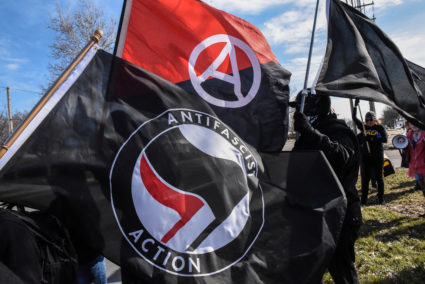
Amna, the U.S.' counterterrorism strategy, detailed in a 16-page memo released on Tuesday, identifies three main terror threats facing the U.S., narco-terrorists and transnational gangs, legacy Islamist terrorists, and violent left-wing extremists, including anarchists and anti-fascists.
That last group is later defined as those whose ideology is anti-American, radically pro-transgender and anarchist, citing, among other threats, the man accused of murdering conservative activist Charlie Kirk. The memo makes no mention of right-wing extremist groups, despite research from the U.S. government and others indicating those groups are responsible for the majority of violent attacks over the last years.
So, for more on America's counterterror strategy, we are joined by Colin Clarke. He's the executive director of the Soufan Center, where he focuses on domestic and international terrorism.
Colin, thank you so much for being here.
On first blush, what is your reaction to this counterterror strategy?
Colin Clarke, The Soufan Center:
Thanks for having me.
Well, it's about what I expected, if not a little bit subpar. Look, there's a couple of things that it gets right, and that's the focus on hostages and wrongfully detained persons, the focus on terrorist acquisition of weapons of mass destruction, and the enduring threat posed by jihadist groups.
But it gets a lot wrong. It gets the wrong the omission of far right terrorist groups. It doesn't deal at all with domestic terrorism and homegrown violent extremism. And the entire document is riddled with partisan accusations and snubs, after proclaiming to be an apolitical document, which it unfortunately is not.
William Brangham:
Let's tick through some of those things. I mentioned the three main sources it sites as threats, the first one being narco-terrorists and criminal gangs.
I mean, the administration argues that the flow of drugs into America is a clear and present danger. What do you make of their framing of that threat?
Colin Clarke:
Look, these groups absolutely need to be countered and combated. Groups like the Sinaloa cartel, MS-13, and others, these are groups that are pushing crime and drugs into the United States.
But they're not terrorist groups. They're motivated by profit, not by politics. And so traditionally we have used law enforcement to deal with such groups. And so when you all of a sudden start painting every single non-state actor as a terrorist group, it muddles the picture.
It confuses those that are forced to deal with this issue. And, frankly, it takes resources away. We live in a world of finite resources now more than ever. And so, for the money personnel and training and expertise that goes to dealing with these groups, you have less of that to deal with other serious threats.
William Brangham:
Second on that list is the threat of Islamic terrorists.
And that still seems like a legitimate threat facing the U.S. What do you make of their strategy against those groups?
Colin Clarke:
Well, this document is not much of a strategy. It's actually more of a world view. So it's very descriptive in nature. It doesn't tell you exactly what the United States can and should do, other than a very kinetic approach.
Sebastian Gorka likes to talk about turning jihadis into -- quote, unquote -- "red mist" and this very aggressive, we will find you and we will kill you kind of tagline that he trots out. But there's very little nuance. There's very little substance behind that.
The document barely engages with emerging technologies and all of the tools that terrorists use as forced multipliers, including 3-D printing, artificial intelligence, unmanned aerial systems or drones, cryptocurrency, and the range of different tools that they use online, encrypted platforms, to recruit and radicalize new members.
William Brangham:
We should say Sebastian Gorka is the U.S. counterterrorism official who is believed to have authored this report.
But the third on that list was this inclusion, as I mentioned, of left-wing radicals, pro-transgender activists. Is there any view that those groups or individuals are a substantive threat to America?
Colin Clarke:
Look, I do think we have seen an uptick in far left violence. Part of that is due to what we call reciprocal radicalization., As the far right has grown in this country -- and we can go back over the past few years and look at very violent attacks in Pittsburgh, Pennsylvania, where I join you today, at the Tree of Life Synagogue, at the Walmart in El Paso, at a supermarket in Buffalo, where a white supremacist targeted African American Americans.
There's been highly lethal right-wing attacks. Any time you have a rise in the far right, you're going to have a rise in the far left. And so we have seen an uptick in far left violence, and that uptick could continue, motivated by a range of factors, whether socioeconomic, anger over Gaza or other issues.
But, on balance and in aggregate, far right terrorism still poses a far more significant threat than the far left does. And so to focus on one over the other and not look across the ideological spectrum comes across as cherry-picking and politicizing counterterrorism, rather than using intelligence and data-driven methods to deal with it.
William Brangham:
Lastly, I couldn't help but notice, as you mentioned, that so many of the remedies here are militaristic and force-based, killing bad guys, so to speak, and no mention whatsoever of American soft power, which has been a bipartisan belief for a generation.
What do you make of that omission?
Colin Clarke:
Well, I have to believe it was somewhat deliberate.
If you look at the DOGE cuts to USAID and others, it really pulled the mat out from under our soft power efforts, including in sub-Saharan Africa. And so as we see a growing crisis in Mali with al-Qaida-linked groups there, the lack of funding for things to help improve governance, to help deal with border security, to help deal with all of these issues that we know contribute to the structural conditions and the drivers of radicalization, none of that is present anymore.
And so all we're left with is the kinetic option. But if we think back to the global war on terrorism, we deal with the old adage of, are we creating more terrorists than we're killing? And it becomes a game of Whac-A-Mole. We tried that for two decades. It didn't work. In fact, it backfired spectacularly.
And, unfortunately, this document seems to be heading back into that exact direction.
William Brangham:
All right, that is Colin Clarke of The Soufan Center.
Colin, thank you so much for being here.
Colin Clarke:
Thank you.
By —
William Brangham
William Brangham is an award-winning correspondent, producer, and substitute anchor for the PBS News Hour. He also serves as the host of Horizons from PBS News.
By —
Dan Sagalyn
As the deputy senior producer for foreign affairs and defense at the PBS NewsHour, Dan plays a key role in helping oversee and produce the program’s foreign affairs and defense stories. His pieces have broken new ground on an array of military issues, exposing debates simmering outside the public eye.
What is antifa and why Trump wants to label it a terrorist organization
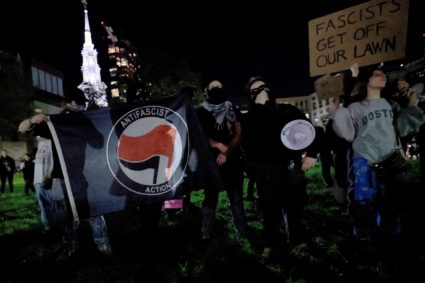
President Trump is targeting the antifa movement, labeling it a “domestic terrorist organization,” even though no such designation exists under U.S. law. The move comes less than two weeks after conservative activist Charlie Kirk was killed at a college campus event. The man accused of shooting Kirk has no publicly known link to the movement. Geoff Bennett discussed more with Luke Baumgartner.
Notice: Transcripts are machine and human generated and lightly edited for accuracy. They may contain errors.
Geoff Bennett:
President Trump is targeting the left-wing Antifa movement, labeling it a domestic terrorist organization, even though no such designation exists under U.S. law.
The move follows a weekend memorial for conservative activist Charlie Kirk, who was shot and killed at a college campus event less than two weeks ago. Top Republicans have been calling for increased scrutiny of Antifa since Kirk's assassination, even though so far the man accused of shooting Kirk has no publicly known link to the movement.
We're joined now by Luke Baumgartner, a research fellow with George Washington University's Program on Extremism.
Thanks for being with us.
Luke Baumgartner, Program on Extremism Research Fellow, George Washington University: Thanks for having me.
Geoff Bennett:
So what exactly is Antifa? How do you describe its core beliefs and tactics?
Luke Baumgartner:
So, simply put Antifa is just short for anti-fascist. If you want to get more simple than that it just means the opposition to fascism.
Now, their belief system has a fairly wide range of encompassing ideologies, mostly on the political left. And they encompass anarchists, socialists, communists and a lot of people in between there.
Geoff Bennett:
So how is it organized, if at all? Are there actual leaders or networks for the administration to target, or is that just a misconception?
Luke Baumgartner:
No, it's a widely held misconception, especially those who are looking to try and target this idea of Antifa. There is no hierarchical organizational structure.
It is primarily a movement and an ideology. And there are no leaders. There are no assets. There are no bank accounts or revenue streams to go after either.
Geoff Bennett:
Given all of that, is it a genuine security threat, is it a political scapegoat or something in between?
Luke Baumgartner:
I would classify it more as a political scapegoat, honestly.
There have been incidents of political violence linked to far left extremists in the U.S. in recent years, but the overwhelming majority of the data points towards far right extremism being a much more serious threat to national security.
Geoff Bennett:
Tell me more about that.
Luke Baumgartner:
In the last five, six, seven years or the last 10 years more broadly, we have seen a rise in left-wing or left-aligned political violence. You can look at the shooting at the congressional baseball game as one or the recent attacks on a ICE facility or the CBP station down at Texas.
But data bears out time and time again from the University of Maryland, from the Center for Strategic and International Studies as well as my own work at the Program on Extremism that political violence in the U.S. has overwhelmingly been attributed to those on the far end of the political spectrum.
Geoff Bennett:
President Trump signing an executive order designating Antifa as a domestic terrorist organization, a label that doesn't exist in U.S. law, what legal weight, if any, does that carry?
Luke Baumgartner:
Not much, to be honest.
Like you said, there is no codified prohibition for domestic terrorist groups in the U.S. That does not exist in U.S. penal code, the way it would for foreign terrorist organizations like al-Qaida or ISIS. So the full brunt and the full weight of the U.S. government and law enforcement agencies can't exactly come down on it like they would for others.
And, as I mentioned before, there's no bank accounts, there's no revenue streams, and there's no well-known or at least well-documented proof of funding.
Geoff Bennett:
So does this move then give the administration cover to brand and prosecute virtually anyone it opposes as Antifa?
Luke Baumgartner:
I would say so, and that label has been used in the past. Any time there's been any sort of resistance to far right extremism or any of the administration's policies, the 5150 protests, the No Kings protests, the Black Lives Matter protests, that was always labeled as Antifa.
And it's this nebulous concept that's been put into the minds of the administration that these are the enemies.
Geoff Bennett:
Luke Baumgartner with George Washington University's Program on Extremism, thank you for being with us.
Luke Baumgartner:
Of course.
By —
Geoff Bennett
Geoff Bennett serves as co-anchor and co-managing editor of PBS News Hour. He also serves as an NBC News and MSNBC political contributor.