BUCKNACKT'S SORDID TAWDRY BLOG
We should not be a journey to the grave with the intention of arriving safely in an attractive & well preserved body, but rather to skid in sideways, chocolate, bier or wein in hand, body thoroughly used up, totally worn out and screaming "WHOO-HOO, WHAT A RIDE!!!!!!"
AND NOT MY pres drumpf / trump wonders why we consider him a SUPER CALLOUS FRAGILE RACIST SEXIST NAZI POTUS! What an ignoramus! The fascist drumpf / trump-vance administration with gop / gestapo oppressing people-republican party and "christian" nationalist apostates exposing what is in store for America if they are successful in replacing our democratic Republic with the neo-nazi heritage foundation's project 2025 authoritarian theocratic oligarchy. Gestapo and Sturmtruppen. From The Daily Beast.....
Rep. Ilhan Omar said her American-born son was pulled over by Immigration and Customs Enforcement agents and asked to provide proof of citizenship.
The Minnesota Democrat, who has long been targeted by President Donald Trump’s attacks against Somali people and other immigrants, described the Saturday incident involving her 20-year-old son after writing a letter to the Department of Homeland Security accusing ICE of “blatant racial profiling” in her community.
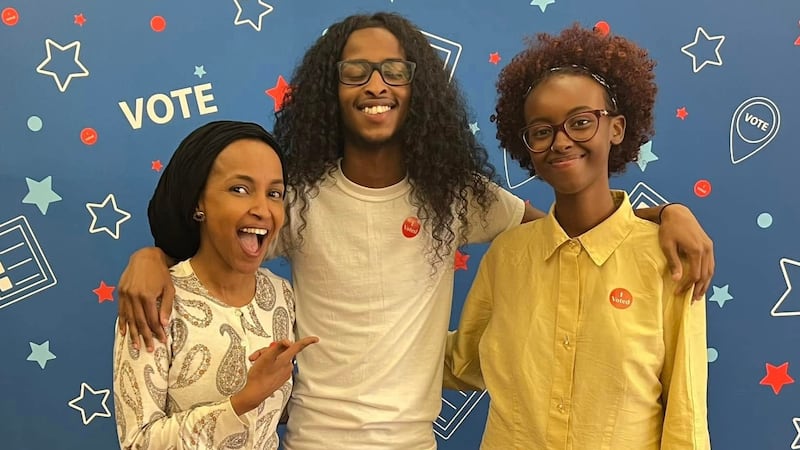
Ilhan Omar pictured with her son, Adnan Hirsi, and daugher, Isra Hirsi, far right, in 2024.Facebook/IlhanOmar
“Yesterday, after he made a stop at Target, he did get pulled over by ICE agents, and once he was able to produce his passport ID, they did let him go,” Omar told local Minnesota news station WCCO on Sunday.
Omar also blasted the president’s attacks against her, including calling her and other Somali immigrants “garbage” who need to “go back” to where they came from.
During a speech in Pennsylvania—where the president was supposed to be trying to convince tens of millions of Americans suffering a cost-of-living crisis that the economy is in good shape—Trump instead went on a vicious tirade before a MAGA crowd and suggested the country should “throw her the hell out.”
Omar, a U.S. citizen who came to the U.S. as a child while fleeing Somalia’s civil war, told WCCO it is “really disturbing and creepy” to have the president be “obsessed with you and those who share your ethnicity.”
Ilhan Omar is part of the progressive group of House members known as “The Squad.”Pete Kiehart for The Washington Post via Getty Images
“Everybody knows I came to the United States at the age of 12 [and] gained my citizenship at the age of 17,” she added.
On Friday, Omar also wrote to Homeland Security Secretary Kristi Noem, expressing concern about the Trump administration’s Operation Metro Surge, in which more than 400 members of the Somali, Latino, and Asian immigrant communities in the Twin Cities area have been detained.
“Constituents, advocates, and local officials have documented blatant racial profiling, an egregious level of unnecessary force, and activity that appears designed for social media rather than befitting a law enforcement agency,” Omar wrote. “I am demanding answers on behalf of my constituents whose constitutional rights are being violated on a daily basis.”
“It is clear to me that this surge came in direct response to Trump’s racist comments about Somali people, and about me in particular,” she added.
The Daily Beast has contacted the Department of Homeland Security for comment.
HERE'S two great stories about good people facing bad situations and doing the right thing, some making the ultimate sacrifice. It gives one hope, and it is good to read and hear about the good people out there, real heroes. The full stories follow the NPR article.....
The wreckage of an American helicopter sits
in Mogadishu, Somalia on Oct. 14, 1993. The events of the Battle of
Mogadishu became a flashpoint for conversations about military
interventions — and fodder for a big-budget Hollywood drama.
Scott Peterson/Getty Images
Tina Brown, editor-in-chief of The Daily Beast, joins NPR's Steve Inskeep again for a recurring feature Morning Edition likes to call Word of Mouth. This month her suggestions are all about heroes — whether being heroic means doing something, or not doing something. Revisiting Black Hawk Down
Brown's
first selection is a Daniel Klaidman piece from The Daily Beast today,
looking at a fateful U.S. military operation in Somalia from the vantage
point of 20 years later. Eighteen American soldiers were killed in the
Battle of Mogadishu when a rescue mission — one that was later
dramatized in the Ridley Scott film Black Hawk Down — went terribly wrong.
"Of
course it's now become a kind of mantra, that we don't want to have
'another Black Hawk Down' ... when people talk about intervention or
going into a very risky place to rescue people."
In ","
Klaidman interviews many of the people who were part of the mission,
drawing somewhat different conclusions than were arrived at in the movie
inspired by the incident.
"The mantra of that movie, at the
end, was 'It's not about politics, it's not about a mission, in the end
it's about the man standing next to you,'" Brown says. "He's the guy
that you fight for, he's the guy that you die for.
"But 20
years later, when Dan Klaidman goes back to interview many of the people
who were part of it, it's more complicated than that. Yes, it was about
their colleagues. But they do also want questions answered."
"They
really want to know whether this was worth it," Brown continues. "Why
[it was] that people died. Why we were there at all. And was this
mission in vain? It's a very haunting thing for the people who lived and
survived."
The article also looks at how the operation has affected the lives of the soldiers who were there.
The remains of a U.S. soldier killed in Afghanistan in May arrive at Dover Air Force Base in Delaware. In Breach of Trust,
writer and veteran Andrew Bacevich asks whether we the people are
sufficiently connected to those who fight our wars — and die in them.
Chip Somodevilla/Getty Images
"One of the people who was there, [Chris] Faris, he says that he
vows that he'd never send a man or woman into battle unless he could
tell their mother or father their child didn't die in vain," Brown says.
"And he speaks with a great deal of conviction about never sending
people into battle without a clear, attainable objective, and without
fully considering the consequences of those actions — something that he
says wasn't done before he and his brothers fast-roped down into the
streets of Mogadishu." The Heroes Of The Military
"The
whole question now is whether or not we have now become far too
dislocated from the ethos, from the values and from the sacrifice of our
military," Brown says, talking about her second selection. It's Breach of Trust, a book by Andrew Bacevich about the public's relationship with the military.
"He
himself is a vet and his son died Iraq. And he talks about how we all
stand up and have patriotic moments at the start of ball games — we all
sort of salute and say thank you for your service — but then we really
move on," she says. "There's a great disengagement now. We are
disconnected from our military. It is they who go make the sacrifice,
and we simply say 'thank you for your service' and go shopping."
The book also looks at how this disconnect may have changed how and when we go to war.
"[Bacevich]
thinks that this dislocation between civilian life and military life
has allowed our military leaders far too long a rope to send us into
reckless wars," Brown says. "That if, in fact, there was far more
engagement, we wouldn't have had more than a decade of unwinnable wars.
Had we been sacrificing, we would have probably ended these wars way,
way faster than they did." When Heroism Means Saying 'No'
Brown's final pick is yet another Daily Beast article, this time reported by Andrew Slater.
A Syrian soldier takes aim at rebel fighters positioned in the mountains of the town of Maalula in September.
AFP/Getty Images
"Former Syrian Soldier Describes Life in the Army at the Start of War" is a -part focusing on a man in the Syrian army under Bashar al-Assad, who showed his heroism when he refused to kill civilians.
"It
talks about how heroism really can also be simply about saying 'No,'"
Brown says. "[The soldier] was given the instruction to shoot a group of
30 men coming out of a mosque, and when the order came to fire, he told
the five guys with him to shoot over them, not at them."
The five soldiers were arrested for not following orders.
"They
were tortured in prison for three days," Brown says. "And one of them
eventually confessed that it was our hero who had told them not to
shoot" — and then he was arrested.
Finally, a lawyer for one of the five soldiers helped to get him released, after which he fled to Iraq.
"What
it shows, I think, is that just by saying 'No' you can be a hero,"
Brown says. "Here is a guy who is willing to go through torture,
beatings, humiliation and terror, simply because he knew it was the
wrong thing to shoot people that he'd been told to shoot. He refused to
follow orders, he's an unsung hero and I'm so thrilled, in a way, that
we've given him his voice with this piece." http://www.npr.org/2013/10/10/230965782/tina-browns-must-reads-on-heroism
Twenty
years later, the battle still echoes in America’s top policy circles.
As the U.S. sets foot in Somalia again, men who fought in 1993 tell
Daniel Klaidman what still haunts them.
Danny
McKnight’s trip began in a tiny New England cemetery on Saturday,
September 28, 2013—a crisp, clear fall morning. He kneeled by the
gravestone of Corporal James Cavaco and placed a rock on top of it.
McKnight’s wife, Linda, had painted the rock black, and on it, he had
written with a silver Sharpie, “An American Hero” and “RLTW”—Rangers
Lead the Way, the elite infantry unit’s motto.
A
child walks near the wreckage of an American helicopter in Mogadishu,
Somalia on October 14, 1993. (Scott Peterson/Liaison, via Getty)
McKnight
was at the outset of a pilgrimage to the gravesites of men who served
under him in Somalia—his “kids,” as he calls them. They were part of
Task Force Ranger, an American assault team assigned to capture Mohammad
Farrah Aidid, an elusive Somali clan leader who held sway over the
war-torn city of Mogadishu. On October 3, 1993, the team began what
seemed at first to be a routine mission to detain two of Aidid’s top
advisers. But after a Black Hawk helicopter was shot down, the operation
shifted to a far more dangerous rescue mission—what would become the
bloodiest U.S. combat engagement since the Vietnam war.
Cpl.
Cavaco, “Vaco” to his friends, was a gunner in a convoy that McKnight
led through the dusty, blood-stained streets of Mogadishu that day.
Known for his devastating accuracy, Cavaco fired round after round into a
second-story window from which the convoy was taking fire. But on the
streets of “Mog,” Somali bullets and RPGs seemed to be coming from every
direction at a terrifying volume. He was hit by a bullet in the back of
the head and died instantly. In the end, the 18-hour fight left 18
American soldiers and airmen dead, and 73 wounded. As many as 1,000
Somalis were killed, by some estimates.
Today, thanks to Mark Bowden’s best-selling book Black Hawk Down,
and a blockbuster movie of the same name, the battle is one of the
best-known episodes in American military history. And like many pivotal
historical events, it has, over time, acquired a number of meanings. To
the public at large, the episode became synonymous with raw, almost
inconceivably selfless battlefield bravery. The movie, coming right
after 9/11, when Americans were rallying around their armed forces, was
itself a cultural moment.
In the policy arena, the incident left a
profound imprint on a generation of national security decision makers,
making them skittish about sending small groups of soldiers into chaotic
situations. “It was the policy equivalent of Post Traumatic Stress
Disorder,” a recently retired U.S. general told me. (Just this past
weekend, Navy Seals staged a daring raid on the seaside villa of a
senior Islamist leader in Somalia. Yet the fact that the American
Commandos retreated under fire without capturing their target—to avoid
civilian casualties, officials say—suggests there is still trepidation
about the possibility of another Black Hawk Down.)
For those who
fought there, the legacy of Black Hawk Down is more complicated. Partly,
it’s about the loss of their comrades and the traumatic experience of
combat; it’s also about the pride of having faced the most extreme of
human tests, and measuring up. Yet for many combatants, the battle’s
legacy is about bigger questions as well. Had their friends died in
vain? How could future Black Hawk Downs be prevented? And who gets to
control the lessons of what happened on the battlefield?
----
McKnight was a stoic presence for his troops, a seemingly fearless
leader who pushed through the fire zone as if oblivious to danger. But
he was crushed by the deaths of the six soldiers who served under his
command. Later, he vowed that every five years he would visit their
graves and spend time with their families.
After visiting Cavaco’s
grave, he next traveled to the Sacred Heart Cemetery in Vineland, New
Jersey, where he paid tribute to Dominick Pilla, beloved by his
teammates for his Jersey sense of humor and the satirical skits he put
on at the expense of their commanding officers. Pilla, like Cavaco, was a
gunner; he too was shot in the head and killed early in the battle.
On Monday morning September 30, McKnight visited Arlington National
Cemetery, where Sgt. Casey Joyce and Specialist Richard Kowalewski are
laid to rest. The burial ground was empty except for the occasional
horse-drawn caisson being pulled through its quiet lanes.
Along
the way, McKnight spent time with the families, keeping alive the
memories of their loved ones by telling stories. But there were also
moments of personal soul searching—the resurfacing of questions that
never fully go away. After the chopper went down, McKnight was
redirected to the crash site where much of the fighting force was pinned
down. Massive enemy fire, road blocks, and poor communications hampered
his ability to reach them. Faced with the choice of trying to grind
ahead toward the crash zone with a convoy full of prisoners and bloodied
soldiers or return to the base, McKnight decided to return home. He
calls it the toughest decision of his life.
At Fort Benning,
Georgia he visited the gravesite of Corporal Jamie Smith, who had been
shot in the thigh while closing in on the crash site. The bullet severed
one of Smith’s femoral arteries and he bled to death several hours
later. Even though doctors told McKnight that he’d never have been able
to save Smith, he is still haunted by the memory. “If I could have
gotten that convoy there that day, he would be here,” McKnight told me.
Following
a trip to Fort Bliss in El Paso—where he visited the grave of Sgt.
Lorenzo Ruiz—McKnight ended his pilgrimage on October 3 in north Texas,
the site of one of several Black Hawk Down reunions taking place around
the country for the battle’s 20th anniversary.
A
crowd of Somalis cheer in Mogadishu as the body of a U.S. soldier is
dragged through the streets on October 4, 1993. (AFP/Getty)
The
reunion weekend began at a VFW hall in a non-descript strip mall in
Plano—the Casey Joyce All-America Post 4380. (Joyce was a Plano native.)
When I arrived, around 5:00 pm, the room was thick with cigarette smoke
and country rock music blared over the speakers. Veterans of old and
more recent wars crowded around the bar downing shots of Regal Crown
Black, chased by Shiner Bock.
A couple of vets of Task Force
Ranger were already there, but around 6:00, more began filtering
in—eventually numbering a few dozen. As they saw each other, in some
cases for the first time since they’d left Somalia, their eyes lit up.
They exchanged long hugs, kidded each other, teasingly pulled rank, and
shouted “hooah,” the warrior expression of approval.
The weekend
was filled with poignant moments, like when Mike Kurth told Sean Watson
about an act of leadership he’d always admired but never acknowledged.
When word reached the Rangers at the crash site that the convoy was
headed back to base and would not be able to pick them up, Kurth’s
instinctive reaction was, “We’re fucked!” But it was Watson who
understood the need to sustain the morale of the troops. “We could be
here for a little while,” he said calmly. “Everyone needs to preserve
their ammo.”
There were bittersweet moments, too. One was when the
widow of Casey Joyce embraced Todd Blackburn, the private who’d missed
his rope as he leapt from the helicopter and fell 70 feet to the ground
at the outset of the operation. It was Joyce who’d scurried for a
medevac vehicle, an intrepid act that may well have saved Blackburn’s
life. A few minutes later, Joyce was killed, shot in the back by a
Somali militiaman.
“It’s about the men next to you, and that’s it. That’s all it is.”
Some of the Rangers were staggered by the
memories. At the VFW hall on that first night, a short movie was shown
about two Rangers who’d recently returned to Mogadishu and drove through
the very streets where they had witnessed and taken part in unspeakable
carnage. One lanky Ranger, who’d had a few drinks, began to weep as he
watched the scenes unfold on the screen. He’d been a cook and not part
of the team assigned to go out on the mission. But when a convoy was
spontaneously organized to rescue a second Black Hawk pilot who’d been
shot down, he as well as others volunteered. Now, two decades later he
was crumpled on the ground in front of his former teammates sobbing
uncontrollably. His friend, a fellow Ranger cook who’d been on the same
rescue convoy, picked him up and wrapped his arms around him. “Maintain
yourself,” he told him firmly. Another overwhelmed Ranger watching the
movie left the hall and vomited.
The psychological after-effects
of battle are, of course, very different from soldier to soldier. One
Ranger I spoke with, Christopher Atwater, seemed troubled by the fact
that he didn’t know the answer to a question he’s been repeatedly asked
over the years: had he killed anybody? “I don’t know,” he said,
narrowing his eyes. “I fired my weapon and I did the best job I could.”
The wife of another Ranger said her husband hadn’t sought much
counseling after Mogadishu but early October is usually a difficult time
for him. “He gets real withdrawn,” she said.
Among the anxieties
experienced by Black Hawk Down veterans is a sense that their stories
might be forgotten. Andrew Flores, a member of the 10th Mountain
Division, part of the quick reaction force that was brought in late to
the battle to mount an armored rescue, lamented that his fellow
Mountaineers were overshadowed by the Rangers, Delta Force, and other
elite operators depicted in Bowden’s book. Pulling me away from the
crowd at the VFW, Flores said, “We suffered, we lost men, we bled that
day.” (Two members of his division died in the battle.) And he pleaded
that we not forget their sacrifice. “Don’t let ours be another forgotten
war.”
Mike Kurth retired in 1996, but after the attacks of 9/11
he had a powerful urge to reenlist. By then in his 30s, he felt he still
had something to contribute. But in retrospect he also thinks the
impulse may have stemmed from survivor’s guilt. He sought some
counseling, talked to some of his Ranger buddies, and eventually
concluded, “It’s ok to be happy.”
Kurth was hardly alone in
finding a way to move on: Bowden says most of the men emerged from Black
Hawk Down emotionally and psychologically intact. They were proud to
have served in a fight that will stand in the pantheon of American
battles for its acts of valor and sacrifice. “If they believed in what
they were doing and they acquitted themselves well and didn’t betray
their cause, then they came out of it well,” Bowden says. “Some come out
of combat deeply troubled and wounded,” he adds. “But most don’t.”
----
The U.S. involvement in Somalia began in 1992 as a humanitarian
operation aimed at ending a devastating famine. These were heady days
for America. The Cold War had recently ended and the country’s sense of
hegemony was only heightened by its crushing defeat of Saddam Hussein’s
army in the first Gulf War. The Somalia intervention was an expression
of what George H.W. Bush dubbed “The New World Order”: the United
States, the world’s remaining superpower, would be in the vanguard of a
muscular multilateralism that would seek to prevent humanitarian
catastrophes and human rights abuses.
But following Black Hawk
Down, it became clear that international altruism could be costly. The
Clinton White House, under heavy congressional pressure, pulled out of
Somalia, and the episode spawned a whole new lexicon for policymakers
spooked by the prospect of the United States getting ensnared in future
military debacles. It was during the Somalia operation that a Washington Post
columnist coined the term “mission creep” to characterize ill-defined
ventures that could easily spin out of control. Meanwhile, “we don’t
want another Black Hawk Down” became a reflexive catchphrase for
policymakers wary of American intervention.
Just days after
Clinton called off Task Force Ranger’s mission in Somalia, a U.S. Navy
vessel anchored in Port-au-Prince, Haiti. U.S. and Canadian peacekeepers
were deploying to train Haitian security forces for the return of
President Jean-Bertrand Aristide. But when the U.S.S. Harlan County was
greeted by a throng of angry anti-Aristide protestors—some of whom fired
shots in the air while others shouted “Somalia! Aidid!”—the ship
weighed anchor and steamed out of port. A few months later, Clinton
chose not to intervene in Rwanda where hundreds of thousands of Tutsis
were being slaughtered by rival Hutus. His decision came after Hutu
militia members killed and mutilated 10 Belgian U.N. peacekeepers in an
echo of what Aidid’s forces had done in Somalia.
Throughout the 1990s, a profound risk aversion settled over civilian
policymakers and, to a lesser extent, the military. When the U.S. did
intervene militarily, such as in the Balkans, air power was the only
real approach considered palatable. “No boots on the ground” became the
mantra—a very different American way of war. Some have argued that the
Bush administration’s aggressive response to 9/11 laid to rest the
ghosts of Black Hawk Down, heralding a new dawn for America’s lethal
Special Operations Forces. But even as the Bush administration launched
major ground wars in Afghanistan and Iraq, it was still true that there
was a deep reluctance to order commando operations in chaotic,
out-of-the-way places.
One former top special operations commander
recalls what transpired when a mission would be proposed that was
“stealthy, surgical, and light,” the bread and butter of special ops:
“We’d start with a recommendation of 50 men, but by the time it got
briefed all the way up the chain, it would involve 10,000 men” and
massive amounts of equipment and armor. Everyone wanted to make sure
they’d be able to fight their way out of a Black Hawk Down situation.
But then the plan would be cancelled because the Pentagon didn’t want to
expend that level of resources.
During his first term, Obama
repeatedly resisted putting “boots on the ground” in Somalia and
personally invoked Black Hawk Down on more than one occasion, according
to one of his closest military advisers. In September 2009, Obama and
his advisers debated options for going after Saleh Ali Saleh Nabhan, a
top Al Qaeda operative whom U.S. intelligence had identified in Somalia.
The military wanted to capture him, but that would have required a
potentially risky ground operation. Obama opted for a targeted killing,
in which Little Bird attack helicopters strafed his car while he was
traveling on an isolated road.
He did allow commandos to touch
down in order to collect DNA samples so the military could prove Nabhan
had died. But for most of the first term, Obama generally resisted the
military’s requests to allow special operations forces to land on the
ground—denying them, for instance, the ability to collect a target’s
“pocket litter,” valuable intelligence they would likely find on his
body or vehicle after the kill. ----
But what about those who fought in Black Hawk Down? On the surface it
might appear that, for them, all these policy implications are very
much beside the point. It’s an ancient warrior creed that the human
experience of combat transcends politics. That attitude is typified by
Hoot, the composite character played by Eric Bana in Ridley Scott’s
movie version of the battle. “You know what I think,” he says when asked
if it was a worthwhile mission. “Don’t really matter what I think. Once
that first bullet goes past your head, politics and all that shit just
goes right out the window.” Toward the end of the movie, Hoot reduces
war to its most elemental quality: “It’s about the men next to you, and
that’s it. That’s all it is.”
But that’s not exactly right. The
warriors who fought in Mogadishu in some ways care about the politics in
a more profound and visceral way than anyone else. If the most
emotionally searing experience in combat is the death of a comrade in
arms, then the most human impulse of the warrior is to ask: why? For all
their expressions of pride in how they fought, some members of Task
Force Ranger still are tormented by the belief that their brothers died
in vain. They point to President Clinton’s decision to call off the
mission after October 4, even though the objective of capturing Aidid
had not been achieved.
“We had 18 lives committed to that
mission,” says retired Col. Thomas Matthews, the air mission commander
who guided the pilots of the 160th Nightstalkers in Mogadishu. “Once
they decided to commit us, they needed to let us finish the job.”
Nothing
seems to stir more ire than the fact that a few weeks after the battle,
the Clinton administration entered into negotiations with Aidid,
transporting him on a U.S. plane. Some members of Task Force Ranger were
even assigned to provide security for the negotiations. “Don’t ask us
to guard him,” says Mike Kurth, his lip quivering with anger at the
thought of it all these years later.
Kurth and most of the
veterans of Task Force Ranger are in no way trapped by Black Hawk Down.
Still, many of the paths they’ve chosen have kept them connected to that
formative experience. A number of them, like McKnight and Matt
Eversmann—the Ranger played by Josh Hartnett in the movie—became
motivational and public speakers, drawing on the experience to impart
lessons about leadership and sacrifice and commitment.
All these years later, there isn’t a day that Black Hawk Down doesn’t flash through his mind.
Other veterans of Black Hawk Down have become
preachers and have drawn spiritual meaning from the experience. One
former Ranger, Keni Thomas, became a popular country singer. His songs
are filled with themes of war and patriotism. “Some say a hero is born
to be brave,” read the lyrics of his song “Hero.” “But I’m here to tell
you that a hero is a scared man that don’t walk away.”
Some Task
Force Ranger vets left the military relatively soon after Black Hawk
Down. William F. Garrison, the general who commanded the operation and
was played by Sam Shepherd in the film, took full responsibility for the
episode’s tactical failings. Shortly after the event, he hand-wrote a
letter to President Clinton, Defense Secretary Les Aspin, and members of
Congress explaining his actions but not making any excuses. His career
was short-circuited and he retired two years later.
Garrison now
lives on a farm in Hico, Texas, and has never given an interview about
Black Hawk Down. He is revered by most of the troops who served under
him in Somalia. During the reunion weekend, he attended a barbeque held
at Ross Perot’s house in Texas. He apparently mingled easily with the
members of Task Force Ranger and seemed happy to be there.
Many
others who participated in Black Hawk Down stayed in the military and
are just beginning to retire now. Eversmann, who served a 15-month tour
in Iraq and retired in 2008, says that, before deployment, he
obsessively tried to meet as many of the family members of the soldiers
who served under him as he could. He never again wanted to have to meet
them for the first time at their child’s funeral, as he had after Black
Hawk Down.
A number rose thorough the ranks to become senior
commanders in Iraq and Afghanistan. Captain Mike Steele was a company
commander whose Ranger and Delta operators provided security around the
crash site of one of the downed Black Hawks. They fought off thousands
of militants throughout the night, but several of Steele’s men were
killed. Later, according to a profile in The New Yorker, Steele
was haunted by questions about whether his troops had been adequately
prepared for the battle. The story suggested he would never let that
happen again. As a result, some allege that in Iraq he created a culture
of aggressive soldiering—one that may have gone too far. He was
investigated for his role in the killing, by soldiers under his command,
of four unarmed Iraqis. Though Steele was never charged, he was given a
career-ending reprimand.
Chris Faris, a Delta Force operator in
Mogadishu, rose to the pinnacle of the military’s elite forces. He is
Command Sergeant Major to the Special Operations Command and, thus, the
top enlisted adviser to Admiral William McRaven. In Somalia, Faris was
part of the initial Delta assault team assigned to capture Aidid’s
aides. After the first Black Hawk went down, Faris and his team moved
toward the helicopter to secure the crash site.
On the way, they
encountered a ferocious ambush. Earl Fillmore, a Delta operator two or
three men up from Faris, took a round in the head, or, as Faris puts it,
was “drilled in his brain housing group.” Seconds later, a soldier
standing directly in front of him was shot. As Faris tended to his
wound, he was shot in the back. The bullet didn’t penetrate his armor,
but the kinetic force of the round caused hydrostatic shock and some
internal bleeding. He was able to function, but he believed he was going
to die. In a house the team had occupied, Faris held up his wedding
band and said goodbye to his wife and his two small daughters. By now a
calm had settled over him, a kind of primordial survival instinct, he
believes. The only thing he feared was that if he died, his family would
see his mutilated corpse dragged through the streets.
Faris
survived and went on to have a storied career in America’s shadow wars,
participating in or supervising thousands of classified missions in the
world’s most dangerous places. Still, all these years later, Faris says
there isn’t a day that Black Hawk Down doesn’t flash through his mind.
For
him, the legacy of the mission is complicated. He appears troubled by
those who weren’t there yet seem to have appropriated the legacy of the
battle for their own political purposes. In 2009, he was part of a
Pentagon team that proposed a secret counterterrorism mission in
Somalia. At a planning session with senior Obama aides, a high-ranking
State Department official said he was uncomfortable with the plan
because he was worried it would lead to “another Black Hawk Down.”
According to Faris, the official went on to say, “I’m the guy who had to
fly into Mogadishu afterwards to clean up your mess.” (The official
apparently did not know that Faris had been in Mogadishu.)
Faris
began to sense the anger rising up through his body. As he started to
get up, he felt Admiral McRaven’s hand squeezing his thigh. He got the
message and sat back down. But he still boils when he thinks about it.
What would he have told him, I asked Faris? “This guy didn’t know that
when Earl Fillmore was killed his blood and brains were seeping out of
his helmet,” says Faris. “Or that five hours later, moving his cold body
to another position, rigor mortis has set in and his arms are sticking
straight up into the air. He doesn’t know what a mess is.”
At the
same time, Faris also knows that there are political lessons to be
learned from Black Hawk Down: he speaks with conviction about never
sending people into battle without a clear, attainable objective and
without fully considering the consequences of those actions, something
he says was not done before the battle in Mogadishu. “I thought the
larger mission was bullshit,” he says. “Everyone died for absolutely no
reason. It was wasted lives, wasted blood, and wasted treasure, and I’m
angry about it.” Faris says that he vowed as a commander that he would
never send a man or woman into battle unless he could tell their mother
or father that their child did not die in vain.
In the end, the
human toll of war cannot be separated from the larger political
questions. They are intertwined and co-dependent. There was enormous
heroism, valor, and tragedy in Mogadishu. “But,” says Andrew Bacevich, a
professor at Boston University and retired Army colonel, “if you reduce
war simply to a human story, you rob it of its political significance.”
“And
war,” adds Bacevich, who lost a son in Iraq, “is ultimately a political
act that has to be judged on that basis.” Many veterans of Task Force
Ranger intuitively seem to understand that. http://www.thedailybeast.com/articles/2013/10/09/black-hawk-down-s-long-shadow.html
Syrian government forces patrol the Khalidiyah neighborhood in the central city of Homs on July 28, 2013. (AFP/Getty)
Syria
Former Syrian Soldier Describes Life in the Army at the Start of War
A
Syrian soldier who was ordered to shoot civilian protesters and
imprisoned for refusing to do so speaks with Andrew Slater about life in
the Army and the crimes of the Assad regime.
In
the coming days the United States and other countries will make a
decision on the use of military force against Syria. The consequences of
this decision will affect not only the Assad regime loyalists but also
the foot soldiers manning bunkers, barracks, and installations across
the country. For the vast majority of Syria’s conscripted soldiers,
military service amounts to a brutal prison sentence of unknown length
now that the war has extended service periods indefinitely. Though the
Syrian army does contain true believers who believe that it’s their duty
to defeat the rebels and any means justifies this end, many are
draftees with no ideological sympathy for the regime and are merely
following orders to survive. Faced with certain death for desertion, and possible retaliation
against their families, many conscripts have been put in the nightmarish
situation of choosing between committing war crimes or being killed for
trying to flee from a war effort they don’t support. The excuse of “following orders” has its moral limits but to
ignore the position forced on Syrian conscripts is its own form of
blindness. Pretending that all Syrian soldiers are the same and equally
culpable may be of some comfort if the decision to attack is made but it
obscures the truth of the situation. Most deserters living in refugee camps are now scarred by the
brutality they witnessed and participated in, all for a cause they
despised. There is no one to sympathize for their war trauma and most
would like nothing more than to forget. You won’t hear from the
unsuccessful deserters and dissenters of the Syrian ranks who have been
executed anonymously, often casually by a loyal inner corps of junior
officers and paramilitary, in untold thousands. What follows is the first-person account of a former Syrian Army
sergeant who was imprisoned for protesting orders to shoot civilians. I
interviewed the man, whose name and identifying details I have altered
to protect his identity, in late 2012 at a refugee camp in Northern
Iraq. The interview, which has been edited for length and to preserve
the voice of “Heen,” is a testimony to the evolution of events in Syria.
In this first part, Heen describes his unit’s role in Dara’a, where the
protests started and the war began and concludes with the events that
led to his own arrest. Click here to read the second installment, in which Heen describes being imprisoned and fleeing Syria for a refugee camp in Iraq.
No one thought anything like this could ever happen in Syria. When I
reported for my conscription in 2010 I thought I would do my two years
of service without anything happening. Everyone said it would be bad,
that they would insult you and hit you, but you could put up with it. I
didn’t think I would ever see a war. Before the war I was a short-order
cook in Zabadani, which is a beautiful tourist valley in Reef Damashq, near Lebanon.
All kinds of foreigners came there for vacation, Khaleejis [Gulf
country citizens], Lebanese, even Europeans. The mountains are very
beautiful there.
After six months’ basic training in Khan Ash Shaykh, I was made a
sergeant in charge of a BMP [a Russian-made armored personnel carrier]
section. I was in charge of 14 privates in my unit, almost all young
Sunni Arab guys. Kurds like me usually don’t get made sergeant. There
were 16 sections like mine in my company with a captain in charge. There
were no lieutenants in our unit, just musa’ada, or warrant officers, to help the captain.
Our captain had a very strong voice and a strong personality; he was
an Alawi like most officers. He never sounded unsure of himself or
conflicted about what we had to do in Dara’a. While he got his orders
from the ameed, the colonel, mostly he had freedom to do anything
he wanted in our assigned area: arrests, raids, shootings, destroying
buildings.
Our unit was sent to Dara’a after the protests started in March of 2011 and
our area was at the center of the problems because it contained the
Umari mosque. There was no base for us in Dara’a so we took over an
elementary school and turned it into our base. At the beginning we never
worried about being attacked, we just had to deal with protests. We
thought we would be there for a few weeks and then things would settle
down.
When we arrived in Dara’a we were given strict orders to never speak
with civilians there. Not during arrests, not breaking up protests, not
on patrols. You would be beaten and sent to jail if you were seen
speaking at length with civilians. We were told repeatedly that the
protests were instigated by infiltrating foreigners, mostly supported by
the U.S. and Western powers to undermine Syria, and that most of the
protesters weren’t even Syrian. We were told they were Iranians,
Afghanis, Americans, and Pakistanis forming these groups. As time went
by it was obvious this wasn’t true and much of it didn’t make sense, but
you couldn’t speak openly about it. At first, most of us just accepted
that foreigners were behind it all.
In the beginning we were strictly prohibited from shooting at the
protesters and the officers were very careful to avoid confrontation. At
first we would just show up and surround the protests and hope that the
show of force would convince them to disperse. Almost all of the
protests started after Friday prayer at the mosques, because that is
when all the men in the area gather together. We came to expect that
every Friday we would have to break up a protest, but they grew larger
and larger. When they became too large for us to arrest and disperse we
began firing over the crowd or at unoccupied buildings nearby. When this
didn’t work, my captain ordered me to fire a tank shell into a building
near the protesters, but we didn’t kill anyone until later in April.
We
heard that protesters had been tearing up posters of Assad, I don’t
know where, and the colonel flew into a rage. I remember the protest
that Friday outside the Umari mosque and at first we fired over the
heads of the protesters. Then the colonel arrived at our position and
told the captain to have us shoot into the crowd. The captain gave the
order and he was the first one to shoot at them with his rifle. It
wasn’t a free for all, but my soldiers all shot a burst or two into the
crowd and everyone ran. Some shot more than others.
I remember it was a warm and mild day, sunny and clear. Within 10
minutes of the shooting starting, the streets were empty. After a while,
people carefully came up to drag the bodies out of the street. I
remember seeing the bodies lying in the street. Our chain of command
told us that the eight we had killed in the protest had all been
foreigners. None of us had hesitated to shoot, because we all believed
it. We only realized over time.
Within my section I had a difficult time with my pro-Assad soldiers,
my dirty guys. They were Sunni Arab but they came from tribes in Raqqah
that were favored by the regime and they were ignorant. Some of them
had clips of Assad’s speeches and pro-Assad songs on their phones they
would listen to all the time. When we were waiting for protests to
emerge, my worst soldier would lean on his machine gun and say, “Hurry
up and come out so I can start shooting you.”
Most of my guys were
not like this, but you had to act like you supported the government. As
we shot at more and more protests and killed more and more civilians, I
started to notice there were five other soldiers in my unit who
realized that killing the protesters was wrong. Some of them would ask
why we were shooting at people, even though in the end they had to do it
like everyone else. Maybe there were more, but I knew that these five
felt like I did. I told them discreetly that when the order came from
the captain to shoot, to shoot near people but don’t hit them, so you
seem like you are following orders.
One of my soldiers would shout curse words while he shot into the
crowds and seemed to enjoy killing people. I had to be very careful
around soldiers like this. We divided our time between living out of our
BMP vehicle at an intersection which we were charged with guarding and
at the school. All we had was a bed roll and a blanket, but it was very
hot during the summer and impossible to sleep during the day. There were
sinks and toilets in the school and tents in the courtyard, but we were
still miserable.
I rarely got to speak with my parents on the
phone, but the conversations were difficult. Everyone knows that the
government could be listening, so you have to be very careful about how
you talk. They were very worried about me. My father would speak in a
coded way that let me know they were worried that I was doing bad things
and that I was involved in the horrible things the Army was doing. I
tried to reassure them, but after a while I got very angry. I couldn’t
tell them about how impossible things were for me here. They didn’t
understand what life was like for me and I couldn’t really explain it on
the phone.
Officially school ended in July, but students stopped showing up in
April, once the siege started. We had set up very strict curfew rules,
and since we could not speak with the locals, communications were made
by loudspeakers. Only women and children were allowed to leave the home
between 5 and 7 in the evening to obtain essential things. To enforce
this, people in the street were shot on sight, and Dara’a became a ghost
city.
Only one of my soldiers was hurt in the fighting while I
was there. One night, we were at a security position outside our BMP
vehicle when someone threw a grenade at us from a nearby building. One
of my soldiers was hit by fragments, but he lived. Much of the fighting
was at night when the resistance could move around without being seen.
There was a lot of mortar and RPG fire at us, but it was mostly
inaccurate. Because units didn’t talk to each other there were lots of
friendly fire incidents at night, 20 soldiers were killed that way while
I was there.
When you are a soldier in Syria you must never let
anyone think you are religious. You will immediately be suspected of
sympathizing with the protesters. No one prays. No one fasts at Ramadan.
No one has a Quran or suras from it. No one has tasbeeh prayer beads. You don’t even dare say 'Ya Allah' if you feel emotional about something. Later, when they were beating me in prison and I tried to swear to them, and I said ‘wallah’, they cut me off and said ‘Swear to us. We are your gods here.’
We were encouraged to abuse the people, even when it seemed
pointless. We collected 2,000 motorcycles off the street and destroyed
them. I ran over many with my BMP. The motorcycles are how poor people
get around and live. We stole whatever we wanted from stores as we
passed them. My soldiers’ favorite thing to steal was Marlboro
cigarettes. One time we were ordered to drive our BMP into the front
windows of a supermarket, it was very new and updated, and it collapsed
the whole front of the roof. I don’t know why we did it. We were ordered
once to shoot the water tanks on top of an apartment building, if you
destroy the tank the building gets no water, and my gunner began
shooting them all the time after that.
As the situation got worse during the summer, people were too afraid
to collect the bodies out of the street. They began to smell very
quickly. There was a special unit in charge of collecting bodies who
wore black uniforms and drove Toyota trucks belonging to the Amin Al Askari [military
security]. We were not supposed to talk to them, but the bodies went to
the stadium which had become a makeshift morgue full of freezers.
By
August we were rounding up any young man we found, whether we were
looking for him or not. At night we would raid houses with the mukhabarat
[Syrian intelligence agents], with a big Toyota bus with covered
windows to put the prisoners in. The houses were filled with daughters
and wives who would scream and cry when we entered. If there were any
men, they would either try to run or hide, but we shot runners on sight.
The most common hiding places where we found men and boys were under
beds, under stairs, and in closets. Almost no one let himself be
arrested, because they knew what would happen. They were blind-folded
and bound and gathered on our bus to send back to the stadium.
These
scenes began to make me crazy. On the buses full of prisoners men were
crying and screaming. We had to beat them. I thought about what it would
be like if someone raided my parents’ home and dragged me out in front
of them. You could not talk about what we were doing ever, but it was
clear some believed in what we were doing and others did not.
They
arrested me in November. It was a Friday and we saw a group of 30 men
come out of a mosque and some of them had pistols. When the order to
fire came, I told my five guys I trusted to shoot over them. The captain
was there at the time and saw that they were doing this. Later that
day, my five soldiers were arrested and taken away. We were not told
why. They were tortured in prison for three days and one of them
eventually confessed that I had told them not to shoot people. Then they
arrested me.
A
Syrian man reacts while standing on the rubble of his house while
others look for survivors and bodies in the Tariq al-Bab district of the
northern city of Aleppo on February 23, 2013. (AFP)
Syrian Soldier
A Syrian Soldier on Being Arrested for Refusing to Shoot Civilians
Imprisoned
for refusing to shoot civilian protesters, ‘Heen,’ a Syrian soldier in
Assad’s army, was tortured for months—before his escape to Iraq, he
tells Andrew Slater in the second part of a riveting interview.
Heen's refugee camp in April 2013. (Nicolas Babonneau )
They
arrested me in November. It was a Friday and we saw a group of 30 men
come out of a mosque and some of them had pistols. When the order to
fire came, I told my five guys I trusted to shoot over them. The captain
was there at the time and saw that they were doing this. Later that
day, my five soldiers were arrested and taken away. We were not told
why. They were tortured in prison for three days, and one of them
eventually confessed that I had told them not to shoot people. Then they
arrested me.
I knew the mukhabarat prison where they took me; I had been there
before. I knew exactly what kind of men worked there. It was a squat
building with two floors above ground and two below and the grounds
surrounded by a wire fence. After my initial beating they brought me
into the interrogator’s office blindfolded.
My blindfold was not well secured, so I could see over the top. The
interrogator was a heavyset man in a civilian suit, green jacket and
pants. From his coastal accent it was clear he was Alawi. He had dyed
black hair that was gray at the roots and a thick mustache. There was a
television on in the corner with a government station on, Ad Dunia. He
did not turn it off for the session. He was very calm when he spoke to
me and never got angry.
“Did you order those soldiers not to shoot?” he asked.
“No,” I said.
The interrogator smoked and paused, “Are you sure?”
“Yes, I am sure,” I said.
The interrogator walked out, and I was
left standing there for six hours, never knowing when he would return,
listening to the television in the corner. Then I was taken to a room
where I was hung by my arms from a pipe for what seemed like five days. I
don’t know how long it was. My legs were swollen and the pain was
incredible. I was completely broken by this. I thought I would go crazy
from the hanging. When I passed out they woke me with a bucket of cold
water. When they let me down I signed the confession immediately.
I
spent two months in the basement of the mukhabarat prison. There was
only enough room to sit or stand because the cell was so crowded. All of
us become covered in lice and insects, which became maddening. It was a
mix of military and civilian in the prison. Some soldiers were there
for selling military supplies on the black market. Everyone had a single
blanket, which was inadequate for the cold of the winter. Eventually,
most of us wanted to die rather than continue life there.
The food
was half-cooked and revolting. You were given five minutes to eat it. A
lot of prisoners began to get sick and there was a man with an open
bullet wound that got infected. Some nights I would hear people in other
sections screaming like they had gone insane.
Every ten days I
was taken up and tortured and interrogated again. These sessions usually
lasted five hours. There were no windows or clocks so we had no idea
how much time was passing down there.
In January, I was finally
transferred to the regular prison at Sayyed Naya under a charge of
disobeying orders, cursing the president, and gathering in a group to
plan seditious activity. I spent four months at Sayyed Naya, where
conditions were slightly better, but not much. There were periodic
beatings where the guards would enter with canes. Everyone had to put
their hands on the wall and get on their knees, facing the wall. Anyone
turning around or not assuming the position would be severely beaten. In
this position, they would arbitrarily hit us on the back and head.
I thought I would go crazy from the hanging. When they let me down I signed the confession immediately.
I don’t know all the circumstances, but one of
the five soldiers had his family hire a lawyer that petitioned for our
release. I never saw the other five in prison, but the lawyer came to
see me. He told me to stick to the story that my confession was
extracted under torture, and if we all stuck to this, the charges would
be dismissed and I would be sent back to my unit. I did as he said and I
was released on a lesser charge. It was a military-affairs case, and
they released me from prison while the case was ongoing. I had to return
in a few days when they would either send me back to prison or release
me back to my unit. I don’t know which one I was more afraid of. I went
back to the old neighborhood in Damascus where I used to live.
I knew I couldn’t go back to my unit, so I contacted a friend who
worked in administration to write up a fake leave paper for me. With
this fake leave paper I took a collective bus back to Qamashli. There
were many checkpoints, but thanks to God the paper worked. I met my
uncle near Qamashli, and he knew how to get around the checkpoints to
the border with Iraq. The crossing point is called Skoda. He took me
there in his pickup truck and dropped me off at Skoda, where I crossed
into Iraq on foot, and on the Iraqi side the Peshmerga [the military of
the Kurdish Regional Government] were waiting to help us get to the
refugee camp. This was June of 2012, and I have been in Iraq ever since.
This interview was conducted with the assistance of a translator,
Usama Al-Haddad. Usama is an Iraqi-American currently residing in Erbil,
Iraq. He has conducted research at Harvard University, and holds a
Masters from the School of Oriental & African Studies, University of
London.
BAHRAIN, Syria, Somalia, Yemen, The Democratic Rep of Congo, Uganda, The Central African Republic, Mali, Chad, Colombia, Mexico...just some of the countries being devastated by the world's rampant arms trade supplying every weapon imaginable to tyrants, despots, drug cartels and terrorist. The UN is meeting next week on this issue and Amnesty International has an ongoing campaign calling on the international community to take action to regulate and enforce restrictions on the arms trade. They face formidable opposition, here in the U.S. war is big business and the military-industrial complex often dictates our foreign and military policies, Check out the information below and sign Amnesty's petition to Pres Obama to be part of the solution, not part of the problem...
We need millions to sign the petition for a strong Arms Trade Treaty
World leaders are meeting in July to draw up the first ever
international Arms Trade Treaty. This treaty could save countless lives
and help prevent human rights abuses around the world – but we have just
one shot to get it right. Sign the petition to demand a bulletproof Arms Trade Treaty!
Most governments continue to permit irresponsible trade of
weapons. Treaties regulate the global trade of many goods – even bananas
and dinosaur bones – but not guns and bullets.
THIS article is a perfect example of the immoral expansion of American military involvement in countries around the world as presented in DRIFT The Unmooring of American Military Power, by Rachel Maddow ( I am really enjoying this book). War is business and the military-industrial complex is dictating American foreign and military policy to maintain and increase their profit margins at the expense of American taxpayers and to the detriment of American domestic policy and foreign relations. The use of contractors to carry out American military operations allows actions that can lead to open conflict and expand to war without a constitutionally mandated vote on the U.S. going to war. These contractors often do more harm than good in the countries they are operating in, causing resentment of and hostility to American involvement in their governments and countries. Too often, if there wasn't an active, militant, violent opposition in the host country before the contractors arrived one develops. The Pentagon is sending mercenaries who are not accountable by U.S. or local laws for any crimes committed, and the contractors employees are usually nothing more than American government sanctioned gangs. If any of these operations are legitimate they should be approved by Congress and staffed by American military personnel only, and coupled with State Department programs on encouraging and empowering democratic institutions in the host country, supporting universal human rights and providing aid for the development of the local economy. Politically and economically stable allies in Africa are much more cost effective in quashing terrorist activity than corrupting military involvement. Our present activities will only fan the flames of radicalism, the cycle of conflict will continue and the U.S. military-industrial complex will become richer. This from the Washington Post...
OUAGADOUGOU, Burkina Faso — The U.S. military is expanding its secret
intelligence operations across Africa, establishing a network of small
air bases to spy on terrorist hideouts from the fringes of the Sahara to
jungle terrain along the equator, according to documents and people
involved in the project.
At the heart of the surveillance operations are small, unarmed
turboprop aircraft disguised as private planes. Equipped with hidden
sensors that can record full-motion video, track infrared heat patterns,
and vacuum up radio and cellphone signals, the planes refuel on
isolated airstrips favored by African bush pilots, extending their
effective flight range by thousands of miles.
About a dozen air
bases have been established in Africa since 2007, according to a former
senior U.S. commander involved in setting up the network. Most are small
operations run out of secluded hangars at African military bases or
civilian airports.
The nature and extent of the missions, as well
as many of the bases being used, have not been previously reported but
are partially documented in public Defense Department contracts. The
operations have intensified in recent months, part of a growing shadow
war against al-Qaeda affiliates and other militant groups. The
surveillance is overseen by U.S. Special Operations forces but relies
heavily on private military contractors and support from African troops.
The
surveillance underscores how Special Operations forces, which have
played an outsize role in the Obama administration’s national security
strategy, are working clandestinely all over the globe, not just in war
zones. The lightly equipped commando units train foreign security forces
and perform aid missions, but they also include teams dedicated to tracking and killing terrorism suspects.
The establishment of the Africa missions also highlights the ways
in which Special Operations forces are blurring the lines that govern
the secret world of intelligence, moving aggressively into spheres once
reserved for the CIA. The CIA has expanded its counterterrorism and
intelligence-gathering operations in Africa, but its manpower and
resources pale in comparison with those of the military.
U.S.
officials said the African surveillance operations are necessary to
track terrorist groups that have taken root in failed states on the
continent and threaten to destabilize neighboring countries. A hub for secret network
A key hub of the U.S. spying network can be found in Ouagadougou
(WAH-gah-DOO-goo), the flat, sunbaked capital of Burkina Faso, one of
the most impoverished countries in Africa.
Under a classified
surveillance program code-named Creek Sand, dozens of U.S. personnel and
contractors have come to Ouagadougou in recent years to establish a
small air base on the military side of the international airport.
The unarmed U.S. spy planes fly hundreds of miles north to Mali, Mauritania and the Sahara, where they search for fighters from al-Qaeda in the Islamic Maghreb, a regional network that kidnaps Westerners for ransom.
The surveillance flights have taken on added importance in the turbulent aftermath of a March coup in Mali, which has enabled al-Qaeda sympathizers to declare an independent Islamist state in the northern half of the country.
Elsewhere,
commanders have said they are increasingly worried about the spread of
Boko Haram, an Islamist group in Nigeria blamed for a rash of bombings
there. U.S. forces are orchestrating a regional intervention in Somalia
to target al-Shabab, another al-Qaeda affiliate.
In Central Africa, about 100 American Special Operations troops are
helping to coordinate the hunt for Joseph Kony, the Ugandan leader of a brutal guerrilla group known as the Lord’s Resistance Army.
The
results of the American surveillance missions are shrouded in secrecy.
Although the U.S. military has launched airstrikes and raids in Somalia,
commanders said that in other places, they generally limit their
involvement to sharing intelligence with allied African forces so they
can attack terrorist camps on their own territory.
The creeping
U.S. military involvement in long-simmering African conflicts, however,
carries risks. Some State Department officials have expressed
reservations about the militarization of U.S. foreign policy on the
continent. They have argued that most terrorist cells in Africa are
pursuing local aims, not global ones, and do not present a direct threat
to the United States.
The potential for creating a popular backlash can be seen across the Red Sea, where an escalating campaign of U.S. drone strikes in Yemen is angering tribesmen and generating sympathy for an al-Qaeda franchise there.
In
a response to written questions from The Washington Post, the U.S.
Africa Command said that it would not comment on “specific operational
details.”
“We do, however, work closely with our African partners
to facilitate access, when required, to conduct missions or operations
that support and further our mutual security goals,” the command said.
Surveillance
and intelligence-gathering operations, it added, are “simply a tool we
employ to enable host nation militaries to better understand the threat
picture.” Uncovering the details
The U.S. military has largely kept details of its spy flights in
Africa secret. The Post pieced together descriptions of the surveillance
network by examining references to it in unclassified military reports,
U.S. government contracting documents and diplomatic cables released by WikiLeaks, the anti-secrecy group.
Further details were provided by interviews with American and African officials, as well as military contractors.
In
addition to Burkina Faso, U.S. surveillance planes have operated
periodically out of nearby Mauritania. In Central Africa, the main hub
is in Uganda, though there are plans to open a base in South Sudan. In
East Africa, U.S. aircraft fly out of bases in Ethiopia, Djibouti, Kenya and the Indian Ocean archipelago of the Seychelles. Army Gen. Carter F. Ham,
the head of U.S. Africa Command, which is responsible for military
operations on the continent, hinted at the importance and extent of the
air bases while testifying before Congress in March. Without divulging
locations, he made clear that, in Africa, he wanted to expand “ISR,” the
military’s acronym for intelligence, surveillance and reconnaissance.
“Without
operating locations on the continent, ISR capabilities would be
curtailed, potentially endangering U.S. security,” Ham said in a
statement submitted to the House Armed Services Committee. “Given the
vast geographic space and diversity in threats, the command requires
increased ISR assets to adequately address the security challenges on
the continent.”
Some of the U.S. air bases, including ones in Djibouti, Ethiopia and the Seychelles, fly
Predator and Reaper drones, the original and upgraded models,
respectively, of the remotely piloted aircraft that the Obama
administration has used to kill al-Qaeda leaders in Pakistan and Yemen.
“We
don’t have remotely piloted aircraft in many places other than East
Africa, but we could,” said a senior U.S. military official, who spoke
on the condition of anonymity to discuss intelligence matters. “If there
was a need to do so and those assets were available, I’m certain we
could get the access and the overflight [permission] that is necessary
to do that.” Common aircraft
Most of the spy flights in Africa, however, take off the
old-fashioned way — with pilots in the cockpit. The conventional
aircraft hold two big advantages over drones: They are cheaper to
operate and far less likely to draw attention because they are so
similar to the planes used throughout Africa.
The bulk of the U.S. surveillance fleet is composed of single-engine Pilatus PC-12s,
small passenger and cargo utility planes manufactured in Switzerland.
The aircraft are not equipped with weapons. They often do not bear
military markings or government insignia.
The Pentagon began
acquiring the planes in 2005 to fly commandos into territory where the
military wanted to maintain a clandestine presence. The Air Force
variant of the aircraft is known as the U-28A. The Air Force Special Operations Command has about 21 of the planes in its inventory.
In
February, a U-28A crashed as it was returning to Camp Lemonnier in
Djibouti, the only permanent U.S. military base in Africa. Four airmen
from the Air Force Special Operations Command were killed. It was the
first reported fatal incident involving a U-28A since the military began
deploying the aircraft six years ago.
Air Force officials said
that the crash was an accident and that they are investigating the
cause. Military officials declined to answer questions about the
flight’s mission.
Because of its strategic location on the Horn of Africa, Camp Lemonnier is a hub for spy flights in the region. It
is about 500 miles from southern Somalia, an area largely controlled by
the al-Shabab militia. Lemonnier is even closer — less than 100 miles —
to Yemen, where another al-Qaeda franchise has expanded its influence
and plotted attacks against the United States.
Elsewhere in
Africa, the U.S. military is relying on private contractors to provide
and operate PC-12 spy planes in the search for Kony, the fugitive leader
of the Lord’s Resistance Army, a group known for mutilating victims,
committing mass rape and enslaving children as soldiers.
Ham, the
Africa Command chief, said in his testimony to Congress in March that he
was seeking to establish a base for surveillance flights in Nzara,
South Sudan. Although that would bolster the hunt for Kony, who is
wanted by the International Criminal Court, it would also enable the
U.S. military to keep an eye on the worsening conflict between Sudan and
South Sudan. The two countries fought a civil war for more than two
decades and are on the verge of war again, in part over potentially rich oil deposits valued by foreign investors.
Other
aviation projects are in the offing. An engineering battalion of Navy
Seabees has been assigned to complete a $10 million runway upgrade this
summer at the Manda Bay Naval Base, a Kenyan military installation on
the Indian Ocean. An Africa Command spokeswoman said the runway
extension is necessary so American C-130 troop transport flights can
land at night and during bad weather.
About 120 U.S. military
personnel and contractors are stationed at Manda Bay, which Navy SEALs
and other commandos have used as a base from which to conduct raids
against Somali pirates and al-Shabab fighters.
About 6,000 miles
to the west, the Pentagon is spending $8.1 million to upgrade a forward
operating base and airstrip in Mauritania, on the western edge of the
Sahara. The base is near the border with strife-torn Mali.
The
Defense Department also set aside $22.6 million in July to buy a Pilatus
PC-6 aircraft and another turboprop plane so U.S.-trained Mauritanian
security forces can conduct rudimentary surveillance operations,
according to documents submitted to Congress. Crowding the embassy
The U.S. military began building its presence in Burkina Faso in 2007,
when it signed a deal that enabled the Pentagon to establish a Joint
Special Operations Air Detachment in Ouagadougou. At the time, the U.S.
military said the arrangement would support “medical evacuation and
logistics requirements” but provided no other details.
By the end
of 2009, about 65 U.S. military personnel and contractors were working
in Burkina Faso, more than in all but three other African countries,
according to a U.S. Embassy cable from Ouagadougou. In the cable,
diplomats complained to the State Department that the onslaught of U.S.
troops and support staff had “completely overwhelmed” the embassy.
In
addition to Pilatus PC-12 flights for Creek Sand, the U.S. military
personnel in Ouagadougou ran a regional intelligence “fusion cell”
code-named Aztec Archer, according to the cable.
Burkina
Faso, a predominantly Muslim country whose name means “the land of
upright men,” does not have a history of radicalism. U.S. military
officials saw it as an attractive base because of its strategic location
bordering the Sahel, the arid region south of the Sahara where
al-Qaeda’s North African affiliate is active.
Unlike many other
governments in the region, the one in Burkina Faso was relatively
stable. The U.S. military operated Creek Sand spy flights from
Nouakchott, Mauritania, until 2008, when a military coup forced Washington to suspend relations and end the surveillance, according to former U.S. officials and diplomatic cables.
In
Ouagadougou, both sides have worked hard to keep the partnership quiet.
In a July 2009 meeting, Yero Boly, the defense minister of Burkina
Faso, told a U.S. Embassy official that he was pleased with the results.
But he confessed he was nervous that the unmarked American planes might
draw “undue attention” at the airport in the heart of the capital and
suggested that they move to a more secluded hangar.
“According to
Boly, the present location of the aircraft was in retrospect not an
ideal choice in that it put the U.S. aircraft in a section of the
airfield that already had too much traffic,” according to a diplomatic cable summarizing the meeting. “He also commented that U.S. personnel were extremely discreet.”
U.S.
officials raised the possibility of basing the planes about 220 miles
to the west, in the city of Bobo Dioulasso, according to the cable. Boly
said that the Americans could use that airport on a “short term or
emergency basis” but that a U.S. presence there “would likely draw
greater attention.”
In an interview with The Post, Djibril
Bassole, the foreign minister of Burkina Faso, praised security
relations between his country and the United States, saying they were
crucial to containing al-Qaeda forces in the region.
“We need to
fight and protect our borders,” he said. “Once they infiltrate your
country, it’s very, very difficult to get them out.”
Bassole declined, however, to answer questions about the activities of U.S. Special Operations forces in his country.
“I
cannot provide details, but it has been very, very helpful,” he said.
“This cooperation should be very, very discreet. We should not show to
al-Qaeda that we are now working with the Americans.”
Discretion
is not always strictly observed. In interviews last month, residents of
Ouagadougou said American service members and contractors stand out,
even in plainclothes, and are appreciated for the steady business they
bring to bars and a pizzeria in the city center.
In April 2010,
one American, in particular, drew attention. A U.S. contractor who had
been assigned to support the surveillance missions in Ouagadougou was
flying home from Africa on leave when he announced that he had been “in
Ouaga illegally” and was carrying dynamite in his boots and laptop. As the contractor, Derek Stansberry, mumbled other incoherent stories about allegedly top-secret operations, he was grabbed by U.S. air marshals aboard the Paris-to-Atlanta flight. No explosives were found, but the incident drew international attention.
Stansberry,
who did not respond to a request for comment, was found not guilty by
reason of temporary insanity; he said he was overstressed and had
overdosed on the sleep aid Ambien.
A photograph on his Facebook
page around the time of the incident showed him posing in the cockpit of
a Pilatus aircraft. The caption read: “Flying a PC-12 ain’t that hard.” http://www.washingtonpost.com/world/national-security/us-expands-secret-intelligence-operations-in-africa/2012/06/13/gJQAHyvAbV_print.html