NORTON META TAG

Showing posts with label Kenya. Show all posts

29 January 2019

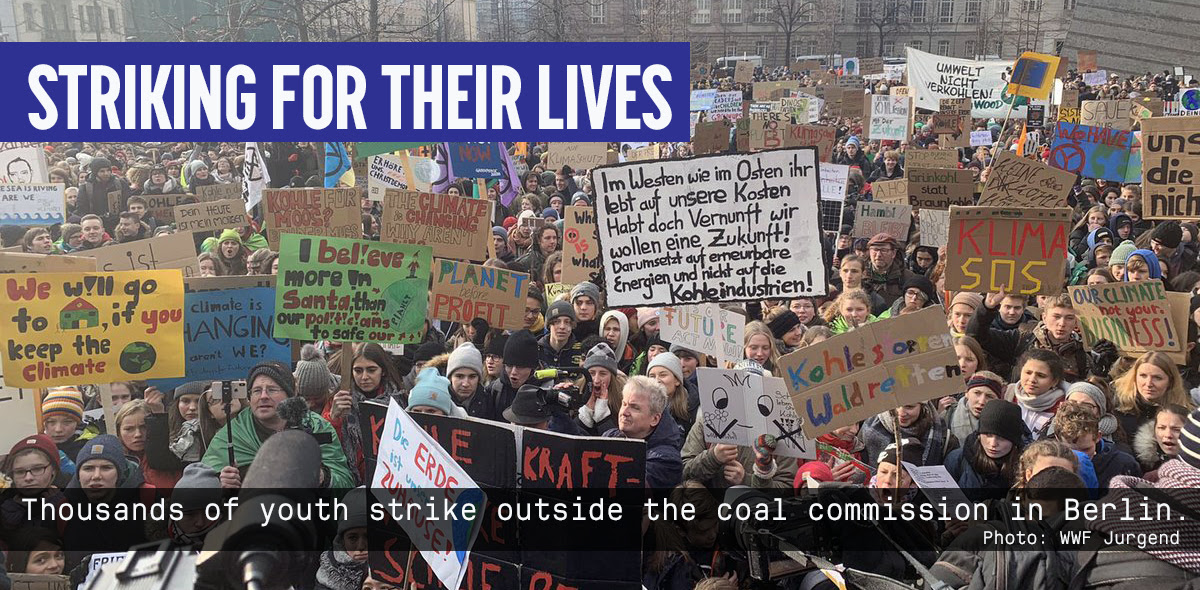
FOSSIL FREE NEWS: STRIKING FOR THEIR LIVES AND MORE...28JAN19

FOSSIL FREE NEWS from 350.org. Though this video and related story are included in this newsletter watch this deeply moving and powerful Dutch video first, it is amazing......

Writing on the Wall

Fossil Free Digest


Turns out we were right to start the year on a hopeful note. We've already seen some amazing steps forward in 2019: from a cancelled gas pipeline, to youth leading on-point actions, like this one outside of Germany's commission to sort out the end of coal in the country.

But plenty of contrasts abound: from record inequality to record temperatures, we've got our work cut out for us. As blistering heatwaves took their toll in Australia these past weeks, tens of thousands of students were simultaneously marching in snow-dusted streets in Europe.

One thing's clear – we have to keep making our movement heard. Can you please share Fossil Free News with a friend to spread the word?:

Share with a friend

Enjoy the news,
Nicole

P.S. Thanks to the 1,000+ of you who filled out the survey from the last edition. I'll be digging through all you feedback over the coming weeks!

In Case You Missed It

As the Davos World Economic Forum kicked off in Switzerland, Oxfam published a new reminder of the scale of inequality we must address: just 26 billionaires now control 50% of the world's wealth. Greta Thunberg and Christiana Figueres, the former UN climate commission chief, were there urging strong climate action from world leaders. But Greta's climate strike at Davos was outshone in Brussels, where an astounding 35,000 youth took to the streets Wednesday, and 70,000 came out Sunday. And in Berlin on Friday, as the German coal commission neared an agreement on how to phase out coal in the country, thousands more students held a strike outside the meeting demanding an end to fossil fuels. Germany's deal sets a 2038 end date for coal, but it's not ambitious enough.


In Australia, ferocious heatwaves have driven home the urgency of the fight to keep global warming below 1.5˚C. Temperatures have neared 50˚C (122˚F) in some parts of the country, with bushfires tearing through more than 63,000 hectares of Tasmania's natural landscape. Australians have been urged to stay indoors and stay hydrated, with communities coming together to look after local wildlife and check in on elderly and vulnerable neighbors. People are vowing to take action now to avoid this becoming the new normal. If you haven’t seen it yet, this clip showing the dried outback that’s making farming nearly impossible has gone viral.


In Spain and France, communities celebrated as a major gas pipeline through the eastern Pyrenees, MidCAT-STEP, was scrapped after years of grassroots resistance. Groups pressured local authorities along the pipeline route, among other tactics, until energy regulators finally rejected it. It's a big win for activists across Europe who are challenging the fossil fuel industry's notion that gas is a necessary 'transition fuel'. The decision has even motivated the European Investment Bank to reconsider its policy to fund other gas infrastructure 'projects of common interest' in Europe. They're right to do so. The region where the dud pipeline was planned is already a leader in community renewable energy projects; investment would be much better spent on projects like these than more fossil fuel infrastructure. Hopefully the win can inspire others resisting gas elsewhere right now, like the Tuxpan-Tula pipeline in Mexico or gas exploration in Zanzibar.


In South Africa, a coalition of environmental justice groups is blocking plans for a new coal mine in a protected wetland area in Mpumalanga. The company behind the mine, which would have a 15-year life span and exacerbate the effects of climate change in one of the world's most sensitive regions, had their request to appeal the decision thrown out by a High Court and were ordered to pay the groups' legal costs. Further north, in Kenya, there've been positive reports of new solar projects on the way, following the president's announcement last month to move the country towards 100% renewable energy. They'll also have to tackle pollution from motorcycles in the capital Nairobi; solar-powered bikes can help fill the gap.

The Inside Story


A major aim of campaigns to go Fossil Free is to stop and ban all fossil fuel infrastructure. In King County, Washington, the county council just passed one of the strongest fossil fuel bans in the country. It works with a moratorium on all new development and then leverages a land use code to effectively ban infrastructure, like storage tanks or refineries. In this interview with 350 Seattle, learn more about how the community developed broad-based support for the ban and brought it to the local government (and check out the awesome video explainer too). Bans like this have also been passed in other communities in the region, and are helping secure a healthy climate future for all.  

The One to Watch

In the Netherlands, a local group of artists has been staging powerful performances at cultural institutions to pressure them to break their ties with fossil fuel companies, namely, Shell. And they've been winning – following an amazing campaign consisting of six performances throughout 2017 and 2018, culminating in an art storm, the Van Gogh Museum ended its 18-year sponsorship with Shell, and two other museums in The Hague quickly followed. The group has announced that its next target will be The Concertgebouw (Concert hall). The Concertgebouw is the last cultural institution on Amsterdam's main museum square, the Museumplein, with a fossil fuel sponsorship. Watch and share their performance for a Fossil Free Museumplein.


Have Your Say 

This week, consider forwarding this edition to a friend so we can get our message further. And remember, you can always browse old editions and direct people to sign up here.

Forward to a friend


And once again, I want to thank all the readers who filled out the survey with their thoughts on Fossil Free News. Your participation is what makes this movement so great. You can still give your feedback before the end of the month.

That's all for now. I'll be back in your inbox in two weeks with more! 

10 October 2014

FOREIGN POLICY EDITOR'S PICKS 6-10OKT14


Monday, October 6
Welcome to Editors' Picks, FP's round-up of the day's best articles.

Today, we look Ebola’s devastating impact on Guinea’s society, the anti-Hong Kong rant going viral in China, and the Most Interesting Man in the World’s cause célèbre.
1
FROM THE MAGAZINE: Ty Carter won a Medal of Honor in Afghanistan. Now he has one more enemy to fight: PTSD. FP’s Yochi Dreazen writes about the battle at home in an age of endless war: Read more
2
FEAR AND LOATHING IN GUINEA: FP contributor Peter Tinti reports from the dangerous heart of the Ebola outbreak in Guinea. As the virus spreads, the disease isn't just killing people, it's threatening to tear the country apart: Read more
3
NOT LOST IN TRANSLATION: "A muddle-headed toddler leading a blindfolded donkey"? Tea Leaf Nation translated China’s viral anti-Hong Kong rant that compares protesters to peasant farmers: Read more
4
THE MOST INTERESTING MAN IN THE WORLD: He doesn't always take on humanitarian causes... but when he does, the husky, tuxedoed Don Juan from the Dos Equis commercials wants to rid the world of landmines: Read more
5
ARMING THE ISLAMIC STATE: How did the Islamic State get so many U.S. weapons? Read the report on how the militants got locked and loaded in Iraq and Syria: Read more

Tuesday, October 7
Welcome to Editors' Picks, FP's round-up of the day's best articles.

Today, we look at previously classified cables that show how the United States undermined Kurdish forces, Pyongyang’s looming nuclear threat, and how Occupy Central can learn from Tahrir Square.
1
THE KURDISTAN CABLES: Contributor Jake Hess uncovers previously classified State Department documents that show how the U.S. tried to engage and undermine the Kurdish fighters protecting Kobani. An FP exclusive: Read more
2
PHOTOS OF THE DAY: They fled their homes, but their husbands and sons stayed to fight the Islamic State. Andrew Quilty photographed Syrian women who fled from Kobani in a refugee camp just over the Turkish border in Suruç: Read more
3
SILENT, BUT DEADLY: Kim Jong Un is missing and Pyongyang is quiet, but a quiet North Korea is still a dangerous North Korea. Five reasons why: Read more
4
"FAILURE IS THE BEST TEACHER": A veteran of Egypt’s own uprisings offers his advice on what Hong Kong's Occupy Central protesters can learn from Cairo’s Tahrir Square: Read more
5
RUMBLE IN THE PENTAGON: Should senior military officers resign in protest if Obama disregards their advice? The latest from Shadow Government: Read more

Wednesday, October 8
Welcome to Editors' Picks, FP's round-up of the day's best articles.

Today, we look at Turkey's political game in Kobani, the boom of anti-gay laws across Africa, and China's strange and powerful farming militia.
1
WHILE KOBANI BURNS: As the Islamic State advances on Kobani, Kurdish officials say they have been betrayed by the Turkish government. FP’s David Kenner reports: Read more
2
THE CLOSETED CONTINENT: 38 out of 55 African countries have laws punishing sodomy. FP’s Suzanne Nossel writes that it might get worse before it gets better: Read more
3
CHINA'S MILITARY-FARMING COMPLEX: One of China's more peculiar organizations just turned 60: A vast farming militia that cultivates cotton, tomatoes, and dabbles in mining and textiles -- when it's not fighting terrorism: Read more
4
HANGMAN'S JUSTICE: The new Afghanistan is meant to be a better place for women, but the execution of five men in a gang-rape case is no victory for human rights in the country: Read more
5
"THERE’S GOING TO BE FAILURES": After weeks of Syrian Kurdish fighters holding back the Islamic State's advance, the Pentagon says Kobani could fall into the militant group's hands: Read more

Thursday, October 9
Welcome to Editors' Picks, FP's round-up of the day's best articles.

Today, we look at what's holding up the U.S. response to Ebola, Hong Kong’s untamed protest art, and the would-be kingmaker in Ukraine's upcoming elections.
1
ONE COMMITTEE AT A TIME: The Pentagon is deploying troops to West Africa to combat Ebola, but a key Senate committee isn't ready to fund the mission just yet. FP’s John Hudson and Kate Brannen report: Read more
2
THE STRAPPED AND THE FABULOUS: Swedish clothing retailer H&M is ensnared in a pseudo-scandal and accused of ripping off the uniforms of female Kurdish fighters: Read more
3
THUG POLITICS, KIEV: Ukraine's parliamentary elections are heating up. Meet Oleh Lyashko, the radical populist who could play kingmaker in the post-Maidan political order: Read more
4
THE ART OF RESISTANCE: It's spontaneous and participatory -- and the state can't control it. Tea Leaf Nation analyzes Hong Kong’s protest art: Read more
5
INFECTED COMMUNITIES: Health workers aren’t the only ones fighting Ebola. Hip-hop artists, imams, and radio personalities are beating back the deadly virus. FP contributor Peter Tinti reports from Guinea: Read more

Friday, October 10
Welcome to Editors' Picks, FP's round-up of the day's best articles.

Today, we look at why Turkey won't lift a finger to save Kobani and how Assad's PR nightmare is now Obama's.
1
KIDS THESE DAYS: Has the Nobel Committee done Malala a disservice by giving her the Peace Prize? FP’s Elias Groll writes on how the award could end up hurting her cause: Read more
2
STUCK IN THE MIDDLE: Turkey can’t seem to make up its mind about who’s the bigger enemy: the Islamic State or the Kurds. FP’s David Kenner reports from Istanbul: Read more
3
SPEAKERS FOR THE DEAD: The Syrian Observatory for Human Rights, the quintessential resource for documenting the Assad regime's mass atrocities, is no longer just a PR nightmare for Damascus. It's also one for the U.S. military: Read more
4
IT RHYMES WITH SICKHEAD: You can drink at a soccer game, you can fight at one, and you can certainly swear at one -- just don't call Putin dirty names: Read more
5
A LANDMARK CASE: Kenya's president is charged with inciting ethnic violence that killed thousands. Now he's about to talk his way out of it like it's a parking ticket: Read more


27 October 2012

Poachers Decimate Tanzania's Elephant Herds &In A Tanzanian Village, Elephant Poachers Thrive 25OCT12

ELEPHANTS are being slaughtered for their ivory, the killing grounds are mostly in Tanzania and Kenya, the customers are mainly mainland Chinese enabled by the greedy and corrupt government of the prc. One can almost sympathize with the poachers in Africa doing the killing, they live in extreme poverty and actually realize very little of the profits from their crimes. Corruption and lack of resources dedicated to protecting endangered species allows the illegal trade in ivory to flourish, especially in Tanzania. BUT this trade would not exist if the government of the prc shut down the ivory industry there, a step they are unwilling to take. So elephants continue to be slaughtered for their tusk, and we will watch as their numbers are reduced to the point they face extinction just as so many other species we have destroyed. From NPR....
Tanzania has been identified as the leading exporter of illegal ivory in recent years. An estimated 10,000 elephants are being slaughtered in the country annually. Here, elephants walk in the Serengeti National Reserve in northern Tanzania in 2010.
Enlarge Tony Karumba/AFP/Getty Images Tanzania has been identified as the leading exporter of illegal ivory in recent years. An estimated 10,000 elephants are being slaughtered in the country annually. Here, elephants walk in the Serengeti National Reserve in northern Tanzania in 2010.

"The word 'ivory' rang in the air, was whispered, was sighed. You would think they were praying to it." — Joseph Conrad in Heart of Darkness
Conrad wrote more than a century ago, when there were no laws against shooting elephants. If anything, today's restrictions on the ivory trade have only increased its value.
The slaughter of elephants and the seizure of illegal ivory have soared to their highest levels in decades. A voracious market in Asia and chaotic wildlife protection in much of Africa have put elephant herds at risk throughout the African continent, particularly in Central and East Africa. Poachers are gunning down whole families, oblivious to game scouts.
A key battleground is Tanzania, one of the world's last great repositories of elephants. Perhaps 70,000 to 80,000 elephants roam this nation's immense sanctuaries, amounting to perhaps a quarter of all African elephants.
In colonial times, the Tanzanian island of Zanzibar held the largest ivory auctions in the world. Today Tanzania has regained that infamy. Those public auctions have been replaced by underground networks of smugglers, but Tanzania remains a leading source of ivory.
From 2009 to 2011, the country was the leading exporter of illegal ivory in the world. Thirty-seven percent of all elephant tusks seized by law enforcement came from Tanzania, with neighboring Kenya a close second.
On Saturday, customs officials in Hong Kong announced the seizure of nearly 4 tons' worth of ivory hidden in two containers shipped from Indian Ocean ports in Tanzania and Kenya.
Whether the ivory is merely transshipped through Tanzanian ports or plundered from its parks is a point of contention.
Few Protections For Elephants
Conservationists say Tanzania has for years been one of Africa's worst elephant slaughterhouses. They blame authorities who are unable or unwilling to control poaching and trafficking. The government acknowledges there is a problem and says reforms are under way.

"There's an enormous slaughter of elephants going on in Tanzania right now. Things are out of hand," says Iain Douglas-Hamilton, who has been studying and protecting elephants in Africa for 47 years. "There's no protection in numbers for elephants any more than there was for bison in the last century when they were all wiped out in America. So people shouldn't kid themselves."
Wildlife rangers in Tanzania came across this elephant that had been killed for its ivory. Tanzania says it wants to prevent the slaughter of elephants, but rangers are poorly paid and are responsible for monitoring vast game reserves in the East African country.
Enlarge Courtesy of African Wildlife Trust Wildlife rangers in Tanzania came across this elephant that had been killed for its ivory. Tanzania says it wants to prevent the slaughter of elephants, but rangers are poorly paid and are responsible for monitoring vast game reserves in the East African country.
Tanzania had been curiously mute over the massacre of its elephants. But recently, an avuncular, white-haired member of Parliament offered this grim assessment.
"Thirty elephants per day. At the end of the year, you're talking about 10,000 elephants killed," says James Lembeli, chairman of Parliament's Natural Resources Committee and a former National Parks official. "Move around this country where you have populations of elephants: carcasses everywhere."
In Search Of Dead Elephants
I decided to go see for myself.

Two Masai tribesmen in tire-tread sandals use elaborate whistling to herd their cattle. They know this landscape of dry thorn brush and tawny grass intimately. So they lead us to a recent elephant kill on the Tanzania-Kenya border.
We walked up on the carcass of a dead elephant. It was killed sometime last month. All that's left is a great leathery hide, gray on the outside, pink on the inside, decomposing on the savanna.
The poachers hauled off the tusks. The villagers came and cut away all the meat, and took the head and bones. The scene is being repeated again and again across Tanzania.
The poachers come in all types in Africa these days. The Democratic Republic of Congo recently accused Ugandan soldiers of machine-gunning elephants from a military helicopter. Some poachers track jumbo elephants on foot for days like big-game hunters. Others use high-tech shortcuts.
Robert Waltenburg manages Lake Chala Safari Camp, a small, private game reserve where we found the carcass. It's one of eight elephants killed here in recent weeks.
Social Media Help Poachers
Waltenburg believes his clients unintentionally guide poachers to their targets by posting photos of elephants with big tusks on social media, which are monitored by resourceful poachers.
"It's so easy to research on the Internet, just type in 'elephant sightings' in this region. Things will pop up," Waltenburg says.
There's an enormous slaughter of elephants going on in Tanzania right now. Things are out of hand. There's no protection in numbers for elephants any more than there was for bison in last century when they were all wiped out in America.
Reliable numbers of killed elephants are hard to come by. According to the MIKE program — Monitoring the Illegal Killing of Elephants — poachers are responsible for 60 to 90 percent of elephant deaths in Tanzanian wildlife reserves. National parks like the Serengeti are better protected.
Like other African countries, Tanzania is losing its elephants to poverty, poor administration and corruption.
First, a pair of big tusks is a year's income to a subsistence peasant.
Second, wildlife rangers are ill-paid, and punishment for a convicted poacher can be as little as a $13 fine.
Third, individuals inside the Tanzania Ministry of Natural Resources and Tourism have been selling out the nation's heritage that they were supposed to protect.
Wildlife Officials Implicated
In the past few months, the minister and top officials in the Wildlife Department were sacked for their roles in two scandals: taking bribes for the assignments of hunting blocs and allowing 116 live wild animals to be loaded onto a jumbo jet and smuggled out of the country to Qatar.
The new minister, a former diplomat named Khamis Kagasheki, gets high marks from wildlife advocates. In his office in Dar es Salaam, Kagasheki is asked whether people in this building helped the poachers.
"You know," he says with a deep sigh, "there has been, of course, there's been corruption."

His concern is echoed by an outspoken tour operator, Pratick Patel.
"I think a lot more firing needs to be done. We know for a fact, the whole industry knows for a fact, that a lot of the wildlife department are involved, very much involved in poaching in the game reserves," Patel says. "Unfortunately, the Wildlife Department has, to some extent, been operating like an independent company."
Kagasheki admires his northern neighbor, Kenya, where anti-poaching laws and the Wildlife Service are much tougher on elephant killers. Kagasheki says he is trying to turn around the culture of the ministry he took over five months ago.

"What I'm saying is we have to be stringent. We have absolutely no choice. These people are killing innocent animals with impunity. And when you look at these elephants, beautiful beasts," he says.
Conservationists are dubious of Tanzania's commitment to elephants.
This month, Tanzania notified the Convention on International Trade in Endangered Species that the country would like to sell off its 100-ton stockpile of confiscated ivory and downgrade the protection of elephants.
The government says a one-off ivory sale will raise millions for wildlife protection. Conservationists say ivory sales just fuel the slaughter of more elephants.
http://www.npr.org/2012/10/25/163563426/poachers-decimate-tanzanias-elephant-herds?ft=3&f=1001&sc=nl&cc=nh-20121025

In A Tanzanian Village, Elephant Poachers Thrive

Poaching is rife in Tanzania game reserves. This elephant was killed, and its tusks taken, at the Lake Chala Safari Camp, a small, private reserve near Mount Kilimanjaro in northern Tanzania.
Enlarge John Burnett/NPR Poaching is rife in Tanzania game reserves. This elephant was killed, and its tusks taken, at the Lake Chala Safari Camp, a small, private reserve near Mount Kilimanjaro in northern Tanzania.

An insatiable demand for ivory in Asia is fueling a massive slaughter of elephants across Africa. As NPR's John Burnett reports, one of the worst poaching hot spots is Tanzania. In this story, he visits an ivory poacher's town that sits next to a major game reserve.
It's midday in Mloka, a cheerless village that is the gateway to one of Africa's greatest nature sanctuaries, the Selous Game Reserve, which is larger than Switzerland and has vast numbers of giraffes, zebras and hippos in addition to elephants. The sun is stultifying, and the streets are lifeless, but business is booming for the poachers in Mloka.
Two poachers agreed to talk about their illegal work in the courtyard of a low-cost guesthouse in Mloka, where laundry hangs on a line and prostitutes slip in and out of rooms.
A 46-year-old elephant killer who gives his name as Mkanga slouches in a plastic chair.
"Ivory buyers come to Mloka and look for us. They say they want 200 kilograms [440 pounds] of ivory, can you arrange for that? The businessmen are mainly Chinese," he says.
"After getting a down payment, I look for some boys to hire as porters. We bring flour, sugar, beans and water with us," he adds. "We cross into the game reserve at night, but after that we can move in the daytime because there is no one there."
Tracking Elephants To Watering Holes
The second poacher, who gives his name as Salma Abdallah, is 35 and wears a dirty Dallas Cowboys jersey.
"Elephants fear for their lives so it's not easy to spot them," he says. "We'll walk for five days or more. We find them when they go to drink water in the afternoon or go to a forest to feed."
Abdallah says he goes out with about 10 guys, each with a different role.
"I am the shooter," he says.
Asian demand for ivory fuels the illegal poaching of elephants in Africa. A leading source of ivory is Tanzania, including these tusks confiscated in 2009 in Haiphong, Vietnam.
Enlarge STR/AFP/Getty Images Asian demand for ivory fuels the illegal poaching of elephants in Africa. A leading source of ivory is Tanzania, including these tusks confiscated in 2009 in Haiphong, Vietnam.
"While we're out, we'll shoot an impala or wildebeest for food, dry the leftover meat and bring it back to the village to sell," he adds.
Both poachers have poisoned elephants with pesticide-spiked pumpkins or other fruit, but they said that method is inefficient.
They use large-caliber hunting rifles. After the kill, they hack off the tusks with an ax. They usually take six to eight elephants per trip.
Scientists tell us that elephants have death rituals. They will, for instance, cluster around a dead individual and touch the carcass with their trunks, and then return much later to caress the bones.
Mkanga, the first poacher. is asked if he knows that elephants mourn their dead. He shifts in his chair, adjusts his Safari Beer cap, and smirks.

"Sometimes when they have a funeral, it's like a party for me," he says. "You shoot one, and before he dies the others come to mourn for the one who is injured. And so I kill another one, and kill another one."
Big Money In A Poor Place

"Sometimes when I finish my business and I'm back at my house and I've gotten paid, I do feel like I've done something bad," he adds. "But when I don't have money to pay for my children's school fees or anything to eat, I say, 'Yeah, the game reserve is my shop. Let me go to the shop and kill.' "
Local sources say elephant tusks fetch about $60 a kilo (2.2 pounds). That's $12,000 for a 200 kilogram (440 pound) consignment of ivory in a country where the per capita income is $125 a month.
Wildlife activists, government officials, safari operators and poachers say the elephant herds of the Selous are being systematically wiped out.
They confirm a 2010 report by the Environmental Investigation Agency, in London, which points to the Selous as one of Africa's worst elephant killing fields. DNA tests conducted on nearly 1,500 tusks seized in 2006 at seaports in Taiwan and Hong Kong traced them to elephants in the Selous and neighboring Niassa Reserve in Mozambique.
Tanzania's natural resources minister, Khamis Kagasheki, was brought in five months ago to clean up his notoriously corrupt agency, strengthen protection for game reserves and crack down on poachers. He says Mloka will be one of his first targets.
"The biggest poaching community is protected by the leadership in Mloka, this I know," he says. "And believe me, I sent them a message, I'm going to move after them."
In the first week of October, rangers reportedly shot two poachers inside the reserve. Mloka residents were so furious they temporarily blocked the road and wouldn't let tourists in or out.
Meanwhile, Mkanga, the poacher, insists he has given up poaching and gone back to farming. He's asked if he cares whether his four children might not be able to see a wild elephant.
"Yeah, sure," he says distractedly, "that would be very sad."
http://www.npr.org/2012/10/25/163629043/in-a-tanzanian-village-elephant-poachers-thrive