Spain edited Donald Trump out of the picture of their World Cup trophy lift 


BUCKNACKT'S SORDID TAWDRY BLOG We should not be a journey to the grave with the intention of arriving safely in an attractive & well preserved body, but rather to skid in sideways, chocolate, bier or wein in hand, body thoroughly used up, totally worn out and screaming "WHOO-HOO, WHAT A RIDE!!!!!!"

DURING our semiquincentennial, our 250th anniversary, it is appropriate to remember our friends and allies who were instrumental in our winning our independence from the British. It is true the French and Spanish both had ulterior motives in supporting our revolution, but the bottom line is the war for independence might have gone on longer than it did or we might have ended up not becoming politically independent from the UK until 1982 along with Canada. This from Smithsonian Magazine reminding us of Spain's help in gaining our independence. It is followed by an article from The Daily Beast documenting another of NOT MY pres drumpf's/trump's tantrums, this one at the NATO summit in Ankara, Turkey because Spain's Prime Minister Pedro Sánchez will not kow-tow to him and is not an ass licker like NATO's Secretary General Mark Rutte is. Thank you Spain and Prime Minister Pedro Sánchez!
Quick facts: Other Spaniards who fought for the Americans

Featuring a portrait of Gálvez has long been on Caragol’s wish list. In 2025, the Portrait Gallery secured a long-term loan of the painting from Iberdrola, a Spanish energy company that boasts a rich collection of art. Iberdrola also oversees the Unveiling Memories project, which promotes greater recognition of Spanish and Hispanic contributions to American independence.
Gálvez’s portrait was painted by José Nicolás de Escalera, a late-18th-century Cuban artist known for his religious pieces and likenesses of eminent figures. In the work, Gálvez looks resplendent in a brocaded Spanish military uniform with embroidered sleeves that signify his recently awarded rank of lieutenant general. Pinned to his left breast is a cross that he received when he was knighted by Charles III of Spain in 1777. Gálvez holds a letter from his father, Matías de Gálvez, congratulating him on an earlier military promotion.
Matías, captain general of Guatemala and later viceroy of New Spain, wrote to his son, saying, “The happiness of your conquests is due to God and your advancement to the king; be thus grateful to both majesties to count on the blessing of your loving father.”
The younger Gálvez had ascended to the governorship of Louisiana in 1777, at age 30. Louisiana was crucial to the Spanish Empire’s fortunes and imperial desires, says Larrie D. Ferreiro, a historian at George Mason University and the author of Brothers at Arms: American Independence and the Men of France and Spain Who Saved It. In the late 18th century, New Orleans was the focal point for Spanish merchants transporting goods from the Caribbean. Spain wanted to maintain control of the Gulf, as well as shipping up and down the Mississippi River.
But the British were encroaching on this territory through fortified outposts in Baton Rouge, Mobile and Pensacola, all located in the recently formed colony of British West Florida.
The French had a vested interest in trade along the Mississippi, too. After losing the Seven Years’ War a decade and a half earlier, France had ceded most of its North American colonies to the British. Now, the French wanted revenge.
France and its ally Spain moved in lockstep when it came to Britain. Thanks to spies in New Orleans and elsewhere, “they knew that the Americans were eventually going to rebel against the British,” Ferreiro says. The European nations’ plan “was to foster unrest and supply the Americans.” Doing so would distract British forces and “keep the British on the back foot,” the historian adds.
Initially, Gálvez helped facilitate the transfer of supplies and munitions up the Mississippi to the rebels. Then, in June 1779, Spain declared war on Britain. Gálvez recruited a band of soldiers, including Cubans, Mexicans, Spaniards, Creoles, Acadians, Native Americans and free Black Americans, to fight alongside him. Later that year, the men marched up to Baton Rouge, where they routed the British from their outpost. Then in 1780, Gálvez and his troops captured Mobile—another important British holding—after a two-week siege.
Pensacola was the last target standing. A major port for the British Empire’s Caribbean trade, the town was a “dagger in the heart of Spanish trade,” Ferreiro says.
The Spanish wanted Pensacola for themselves, and Gálvez “was their guy,” the historian explains—not necessarily because of his military experience, but because he could be trusted, in the absence of formal direct communication, to carry out the wishes of the king. “He knew what the crown was after,” Ferreiro says.
In March 1781, Gálvez and his multicultural band of troops sailed into Pensacola Bay. At the end of the two-month-long siege, the British surrendered.
Gálvez’s victory bought George Washington time to plan the Continental Army’s attack on Yorktown, Virginia, in the fall of 1781. After their defeat at Pensacola, the British no longer had “much in the way of naval forces in the Caribbean,” Ferreiro says—a fact that allowed the French to move much of their fleet from that region up to the Chesapeake Bay to assist the rebels.
The sieges in British West Florida and Virginia “really have to be thought of in the same paragraph, if not the same sentence, because the victory at Yorktown really was the result of the victory at Pensacola,” even if Gálvez himself wasn’t present for the British surrender at Yorktown, Ferreiro says.
Gálvez and his contributions to the American Revolution are perhaps best known in the South, where cities, streets and plazas are named in his honor. Overall, however, the Spanish military leader has not been as widely acknowledged as many other Europeans who fought alongside the Americans, such as the Marquis de Lafayette.
In 2014, Congress granted Gálvez honorary citizenship, recognizing his key role in helping to establish the U.S. That same year, a portrait of him was hung in the Senate Foreign Relations Committee room. It was painted by the Spanish artist Carlos Monserrate and is a modern reproduction of a circa 1784 Gálvez portrait attributed to Mariano Salvador Maella.
Caragol says that this later portrait was likely inspired by the de Escalera painting now on display at the Portrait Gallery. By 1784, Gálvez had become a heroic figure in Spain, briefly returning home after the Revolution’s end, only to be recalled to America and eventually serve as the viceroy of New Spain. He died of an illness in Mexico City in 1786, at age 40.
The de Escalera painting was essential in establishing Gálvez’s image, says Caragol. Now, visitors can view that portrait in person and gain a clearer sense of what Gálvez represents.
Caragol says that she hopes viewers gain an understanding of the Revolution “in broader terms,” realizing that the fight for independence wasn’t solely an American cause. In truth, people from all over the world offered the patriots assistance in overthrowing the British.
President Donald Trump erupted at one of America’s closest allies after it defied his demands to ramp up military spending.
NATO partners Spain and the U.S. have been at odds over defense spending and the war in Iran.
Trump has called on NATO members to increase their defense spending to 5 percent of their annual GDP by 2035, but Spain is the sole NATO member yet to sign up to that target—a decision Trump called “terrible.”
Spain increased defense spending from 1.4 percent of GDP in 2021 to 2.1 percent in 2025, according to the Stockholm International Peace Research Institute, but it still trails most of its European allies.
Madrid also declined to allow the U.S. use of its airspace and military bases for operations linked to the conflict with Iran, putting it increasingly at odds with Washington.
Trump stepped up the feud this week during a press conference with NATO Secretary General Mark Rutte at the NATO summit in Turkey.
“Spain is a wasted cause. We don’t want to do any trade business with Spain anymore,” Trump declared.
“Spain is a terrible partner in NATO. They don’t participate, they don’t pay. I don’t want to have anything to do with Spain. Cut off all trade with Spain, please, including visits… Watch them come running back,” he said, appearing to address Treasury Secretary Scott Bessent.
“We don’t have to trade with them. I don’t want to do any more trade with them, alright? Immediately. Don’t talk to them, they’re hopelessly bad people.”
Trump added, “Let’s see how hostile they remain when they call up and they, ‘Please, please. We want to trade with you, sir. We want to trade with you, sir.’ They make so much money with us and we’re going to see that they make a lot less. I want no business with them.”
Rutte responded by reminding Trump that Spain had increased its defense spending, while signaling that more work lies ahead. “You got Spain to pay 2 percent. They spent, they made a huge step in last year,” Rutte told the president, before adding that there were still “issues we have to solve” with Spain.
It is not the first time Trump has threatened to cut off trade with Spain.
A previous threat from Trump in March failed to produce any major fallout, with commercial ties between the U.S. and Spain carrying on uninterrupted.
It is also unclear how Trump plans to unilaterally cut off trade with Spain, and even if he is able to follow through on his remarks, it would likely have little impact on Spain’s economy.
Spain does not rely heavily on the United States for trade. In 2025, about 4.9 percent of Spain’s exports went to the U.S., worth roughly €18 billion ($20.5 billion).
The U.S., meanwhile, exported about €23 billion ($26.2 billion) worth of goods to Spain, meaning the U.S. operates a large trade surplus with Spain.
And while Spain is the world’s second-most popular tourist destination after France, welcoming a record 96.8 million international visitors in 2025, only a small portion of those tourists come from the U.S.,
In 2024, 4.2 million American tourists visited Spain.
Despite Trump’s remarks, the Spanish government sought to downplay the dispute, with a spokesperson for socialist Prime Minister Pedro Sánchez saying relations with the U.S. remain strong across economic, cultural, and social ties, Reuters reported.
Spain’s Health Minister Monica Garcia, however, fired back at Trump.
“We are a sovereign, democratic country that defends multilateralism and peace,” she said on X. “What’s terrible is confusing diplomacy with bullying.”


ART or graffiti? Or erotica? Check out the below and you decide.....
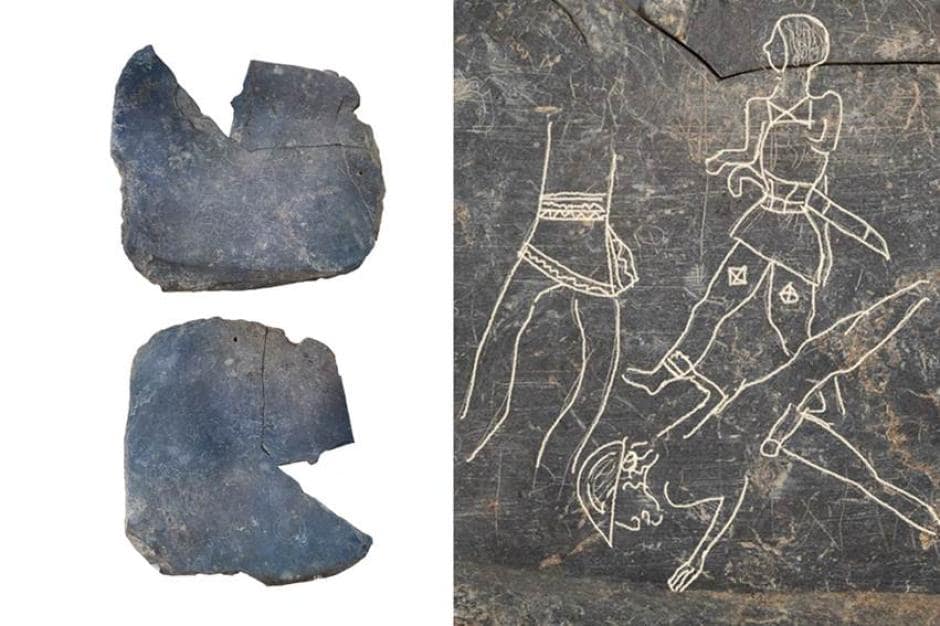
Scenes of Warriors from 6th Century BC on a Slate Plaque Discovered at Tartessian Site in Spain
Archaeologists representing Spain’s National Research Council (CSIC) excavating at the archaeological site of Casas del Turunuelo have uncovered a slate plaque about 20 centimeters engraved on both sides where various motifs can be identified.
The slate plaque includes drawing exercises, a battle scene involving three characters, and repeated depictions of faces or geometric figures. According to early indications, this rare find in Guareña (Badajoz, Spain) may have supported the engraver as they carved designs into pieces of wood, ivory, or gold.
The new campaign has also made it possible to discover the location of the east door that gives access to the Stepped Room, excavated in 2023 and known for the discovery of the first figured reliefs of Tartessos.
The Tartessians, who are thought to have lived in southern Iberia (modern-day Andalusia and Extremadura), are regarded as one of the earliest Western European civilizations.
The Late Bronze Age saw the emergence of the Tartessos culture in the southwest of the Iberian Peninsula in Spain. The culture is characterized by the use of the now-extinct Tartessian language, which is combined with local Phoenician and Paleo-Hispanic characteristics. The Tartessos people were skilled in metallurgy and metalworking, creating ornate objects and decorative items.
The team from the Institute of Archaeology of Mérida (IAM), a joint center of the Spanish National Research Council (CSIC) and the Junta de Extremadura, directed by Esther Rodríguez González and Sebastián Celestino Pérez, is responsible for these archaeological excavations.
At a press conference, the team of CSIC experts highlighted the importance of the discovered slate plaque, which shows four individuals identified as warriors, given their decorated clothing and the weapons they carry.
Initial indications, though they require further investigation, point to the piece being a jeweler’s slate, a material that would have supported the artist while they engraved the motifs on pieces of wood, ivory, or gold.
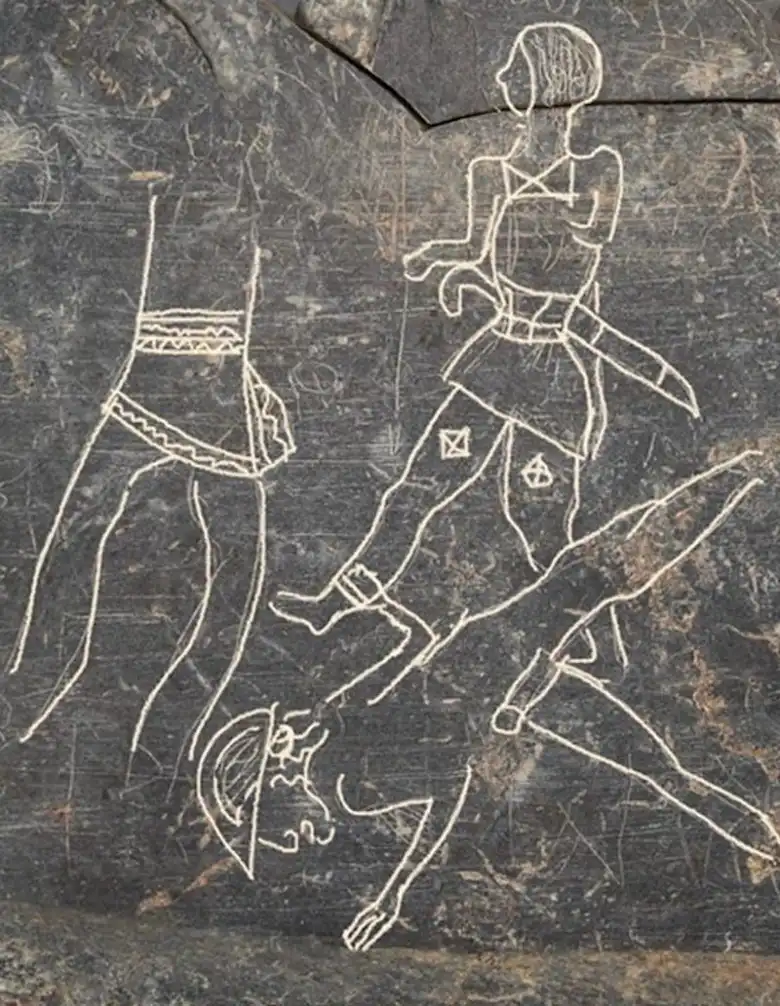
“This discovery is a unique example in peninsular archaeology and brings us closer to understanding the artisanal processes in Tartessos, previously invisible, while also allowing us to complete our knowledge of the clothing, weaponry, or headdresses of the depicted characters, as they proliferate with details,” says Esther Rodríguez.
This documentation complements the finding made in the previous campaign, where the documentation of several faces allowed, for the first time, admiration of how the society of the 6th-5th centuries BC wore their jewelry.
The researchers also worked on the eastern gate, which they identified in 2023. Based on the nature of the documented architectural remains and the discovery of the building’s east door in the center of a monumental facade more than three meters high, the research team believes that this door confirms the main access to the building on its eastern end, which retains its two constructive floors. The door links the Stepped Room to a large slate-paved courtyard, which has a cobblestone corridor in front of it. This corridor separates the main body of the building from a set of rooms where interesting material lots have been recovered.
Additionally, the archaeological materials recovered from the adjoining rooms located in front of said access suggest that it is the production or artisanal area of the building. The finding of the outside rooms devoted to various artisanal activities is also noteworthy since it sheds light on societal issues that were unknown during this time period and strengthens Tartessos’ artisanal identity.
“Our efforts will now focus on studying the recovered remains, both from the face reliefs and the ivories. As for the archaeological work at the site, our goal for the next campaign is to delineate these production areas that seem to extend, at least, along the entire eastern side of the site. In parallel, we will begin to open the rooms flanking the main space, which have an excellent degree of preservation and can help us define the functionality of the building,” said Sebastián Celestino.
Cover Photo: Scenes of warriors from the 6th-5th centuries B.C. engraved on a slate plate. Photo: CSIC
 | ||
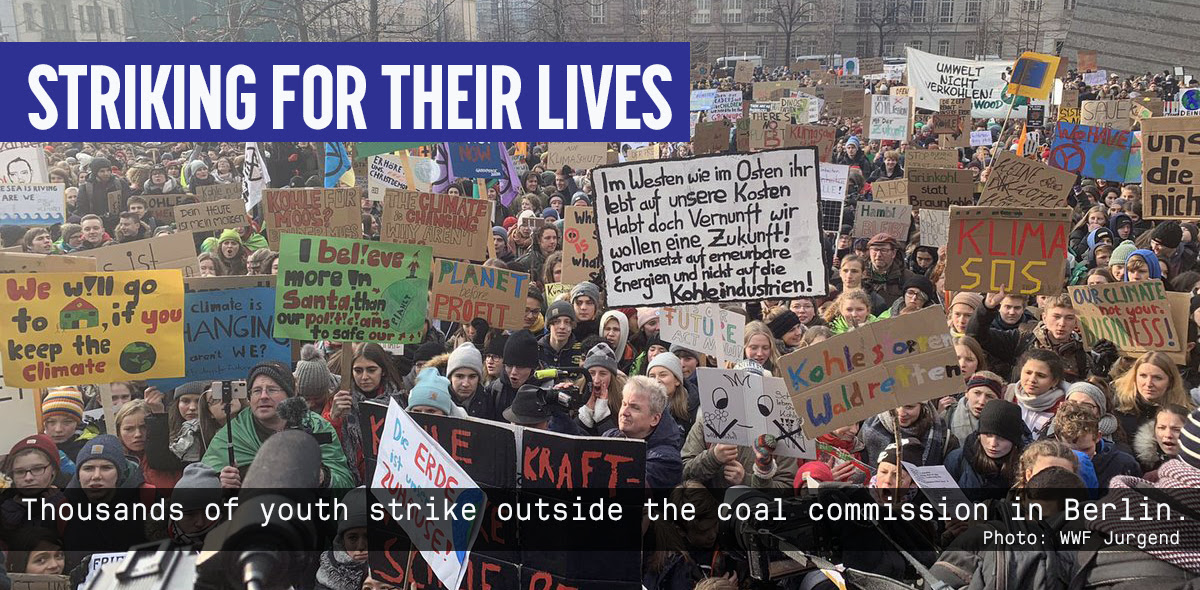 Turns out we were right to start the year on a hopeful note. We've already seen some amazing steps forward in 2019: from a cancelled gas pipeline, to youth leading on-point actions, like this one outside of Germany's commission to sort out the end of coal in the country. But plenty of contrasts abound: from record inequality to record temperatures, we've got our work cut out for us. As blistering heatwaves took their toll in Australia these past weeks, tens of thousands of students were simultaneously marching in snow-dusted streets in Europe. One thing's clear – we have to keep making our movement heard. Can you please share Fossil Free News with a friend to spread the word?:
Enjoy the news, Nicole P.S. Thanks to the 1,000+ of you who filled out the survey from the last edition. I'll be digging through all you feedback over the coming weeks! In Case You Missed ItAs the Davos World Economic Forum kicked off in Switzerland, Oxfam published a new reminder of the scale of inequality we must address: just 26 billionaires now control 50% of the world's wealth. Greta Thunberg and Christiana Figueres, the former UN climate commission chief, were there urging strong climate action from world leaders. But Greta's climate strike at Davos was outshone in Brussels, where an astounding 35,000 youth took to the streets Wednesday, and 70,000 came out Sunday. And in Berlin on Friday, as the German coal commission neared an agreement on how to phase out coal in the country, thousands more students held a strike outside the meeting demanding an end to fossil fuels. Germany's deal sets a 2038 end date for coal, but it's not ambitious enough. In Australia, ferocious heatwaves have driven home the urgency of the fight to keep global warming below 1.5˚C. Temperatures have neared 50˚C (122˚F) in some parts of the country, with bushfires tearing through more than 63,000 hectares of Tasmania's natural landscape. Australians have been urged to stay indoors and stay hydrated, with communities coming together to look after local wildlife and check in on elderly and vulnerable neighbors. People are vowing to take action now to avoid this becoming the new normal. If you haven’t seen it yet, this clip showing the dried outback that’s making farming nearly impossible has gone viral.  In Spain and France, communities celebrated as a major gas pipeline through the eastern Pyrenees, MidCAT-STEP, was scrapped after years of grassroots resistance. Groups pressured local authorities along the pipeline route, among other tactics, until energy regulators finally rejected it. It's a big win for activists across Europe who are challenging the fossil fuel industry's notion that gas is a necessary 'transition fuel'. The decision has even motivated the European Investment Bank to reconsider its policy to fund other gas infrastructure 'projects of common interest' in Europe. They're right to do so. The region where the dud pipeline was planned is already a leader in community renewable energy projects; investment would be much better spent on projects like these than more fossil fuel infrastructure. Hopefully the win can inspire others resisting gas elsewhere right now, like the Tuxpan-Tula pipeline in Mexico or gas exploration in Zanzibar.  In South Africa, a coalition of environmental justice groups is blocking plans for a new coal mine in a protected wetland area in Mpumalanga. The company behind the mine, which would have a 15-year life span and exacerbate the effects of climate change in one of the world's most sensitive regions, had their request to appeal the decision thrown out by a High Court and were ordered to pay the groups' legal costs. Further north, in Kenya, there've been positive reports of new solar projects on the way, following the president's announcement last month to move the country towards 100% renewable energy. They'll also have to tackle pollution from motorcycles in the capital Nairobi; solar-powered bikes can help fill the gap. The Inside Story A major aim of campaigns to go Fossil Free is to stop and ban all fossil fuel infrastructure. In King County, Washington, the county council just passed one of the strongest fossil fuel bans in the country. It works with a moratorium on all new development and then leverages a land use code to effectively ban infrastructure, like storage tanks or refineries. In this interview with 350 Seattle, learn more about how the community developed broad-based support for the ban and brought it to the local government (and check out the awesome video explainer too). Bans like this have also been passed in other communities in the region, and are helping secure a healthy climate future for all.
The One to Watch
In the Netherlands, a local group of artists has been staging powerful performances at cultural institutions to pressure them to break their ties with fossil fuel companies, namely, Shell. And they've been winning – following an amazing campaign consisting of six performances throughout 2017 and 2018, culminating in an art storm, the Van Gogh Museum ended its 18-year sponsorship with Shell, and two other museums in The Hague quickly followed. The group has announced that its next target will be The Concertgebouw (Concert hall). The Concertgebouw is the last cultural institution on Amsterdam's main museum square, the Museumplein, with a fossil fuel sponsorship. Watch and share their performance for a Fossil Free Museumplein.Have Your SayThis week, consider forwarding this edition to a friend so we can get our message further. And remember, you can always browse old editions and direct people to sign up here.
 And once again, I want to thank all the readers who filled out the survey with their thoughts on Fossil Free News. Your participation is what makes this movement so great. You can still give your feedback before the end of the month. That's all for now. I'll be back in your inbox in two weeks with more! |