NORTON META TAG

Showing posts with label Germany. Show all posts

20 August 2023

Germany’s far-right party is more popular than ever — and more extreme 18AUG23


" If AfD is the answer, how stupid is the question? "

HOPEFULLY the popularity of the AfD is just protest "voting" and not a move towards fascism like politics in Hungary and to a lesser but still disturbing extent in Poland, Florida and Texas. That members of extreme right wing political parties have visited Russian occupied Ukraine should be a warning to Germans of the kind of government these people want to impose on Germany and the devastating, destructive and criminal results of electing a fascist German government.  This from the Washington Post.....

Germany’s far-right party is more popular than ever — and more extreme

August 18, 2023 at 4:00 a.m. EDT

Loveday Morris is The Washington Post's Berlin bureau chief. She was previously based in Jerusalem, Baghdad and Beirut for The Post. Twitter
Kate Brady is a researcher and reporter based in The Washington Post's Berlin bureau. She has been at The Post since early 2023 and has been reporting from Germany for the best part of a decade. Twitter


BERLIN — Maximilian Krah, the newly elected top candidate of the far-right Alternative for Germany for the European elections, doesn’t believe in watering down political messages to win centrist votes.


Hailing from what analysts describe as the party’s ethno-nationalist wing, he has described Pride Month as “disgusting,” is a proponent of deporting immigrants and peppers his speech with allusions to white-supremacist conspiracy theories.

“We have become clearer in what we what we want and what we think,” the 46-year-old rising star of the far right said of his party, known by its German acronym AfD. “We have more of the Trumpian style of communication.”


Germany’s far right stokes new grievances for voters: Mask rules and vaccine mandates

Far-right experts say his recent election as lead candidate to represent the party in the 2024 European Parliament elections was just another sign of the AfD’s increasing radicalization.

But while the party is becoming unpalatable as a partner even to some of Europe’s most radical right-wing populists, it is attracting a record number of German voters.

In recent months, the AfD has surged to become the second strongest political force in the country after the opposition Christian Democrats, polling at around 21 percent, ahead of all members of the country’s liberal governing coalition.

Buoyed by the cost-of-living crisis and immigration angst, its rise has caused soul-searching for a country still mindful of its Nazi past. And for the conservative Christian Democrats, which are leading the polls, the increasing temptation to cooperate presents an existential dilemma.

The AfD is in a process of “progressive radicalization” and is “very, very far to the right” in comparison to other far-right parties in Europe, German political scientist Wolfgang Merkel said. “The strange thing so far is that this radicalization has not been punished in voter polls.”

Members of the German citizen initiative “Grannies Against the Right” hold up placards during a demonstration against the far-right Alternative for Germany in Magdeburg in July. (Ronny Hartmann/AFP/Getty Images)

While other European far-right parties, including Italian Prime Minister Giorgia Meloni’s Brothers of Italy, have toned down and turned their focus to courting more centrist conservatives, the AfD stands apart.

“The experts and pundits always tell us that if you want to have better election results, you have to give up your positions, you should become a more centrist style party,” said Krah, who has eight children by three women and also dishes out dating advice for German men on his TikTok channel.

“We are not the kind of singer that asks what your audience wants and then sings a song,” he said, speaking via Zoom from Brussels. “We have a clear ideology.”


Far-right German party members to tour Russian-held regions of Ukraine

At the European Union level, even Hungarian populist Prime Minister Viktor Orban last year said he was “forced to sacrifice relations with the AfD on the altar of good international relations” while far-right Italian politician Matteo Salvini has indicated he’s looking for more centrist allies.

“The AfD is openly radicalizing, whereas other European populist parties have gone the other way,” said Benjamin Höhne, a political scientist at the University of Münster. “They have a hardcore extremist core, but around the party they try to give a normal image. But not in Germany. Still, it works for them.”

At the summit in Magdeburg over weekends in late July and early August, 600 candidates vied to represent the party and adopt an election program that branded the European Union a “failed project.”

Guest speakers included Bulgarian right-wing extremist Kostadin Kostadinov, who fondly referred to the alliance between Germany and Romania during both world wars and called for Germany to take “its rightful place as a great power, and not only in Europe.”

One would-be candidate is being investigated by authorities after making homophobic slurs during his speech.

Thomas Haldenwang, the head of Germany’s domestic intelligence agency, accused speakers of spreading “right-wing extremist conspiracy theories,” including the “great replacement theory,” which holds that elites are plotting to replace White Europeans with non-White populations.

“It is already apparent that people who have attracted attention in the past with positions that are not compatible with our free democratic basic order will be part of the AfD delegation in the upcoming European Parliament,” he said.

The party has so far failed to overturn a decision by the agency to put it under surveillance, with a Cologne court ruling in March last year that there were “sufficient indications of anti-constitutional endeavors within the party” to justify its monitoring.

The summit and the nomination of Krah “complete the transformation” of the AfD from its early iteration when it was an anti-euro party to “a clearly extremist far-right party,” said Johannes Kiess, a researcher on right-wing extremism at the University of Leipzig.

Krah rejects the notion that the party is becoming more extreme or that he’s to the right of it, while at the same time espousing the “remigration” — or effective deportation — of refugees and defends the “great replacement theory” as being fact.

The idea that immigrants are replacing ethnic Germans is “a description” of the situation rather than a conspiracy theory, said Krah, who also doesn’t see an issue with saying that Germany should reclaim its rightful place in the world.

“Germany is a country in a crisis, and it’s not just an economic crisis. It’s also an identity crisis,” he said. “It’s a crisis where Germans forgot to be proud of their own fathers and grandfathers. Mothers and grandmothers.”

Members of the AfD, from left, include Leif-Erik Holm, Maximilian Krah, Alexander Gauland and Joerg Urban. (Sean Gallup/Getty Images)

The AfD’s record-high position in the polls comes amid brimming dissatisfaction with Germany’s ruling three-party coalition, led by Chancellor Olaf Scholz’s center-left Social Democrats.

It also comes on the back of multiple crises, including the pandemic and war in Ukraine that have boosted populists Europe wide.


Kremlin tries to build antiwar coalition in Germany, documents show

Krah puts the party’s success down to the population’s distain for liberal policies on climate, gender and LGBT issues, immigration and the war in Ukraine, saying established political parties have no answer to real issues German face.

Analysts, however, chalk much of the party’s gains up to protest voting. In polls, voters can express their dissatisfaction “risk-free,” said Merkel, the political scientist. “And the strongest way to express this is to vote for the most radical political formation.”

He estimates around half those saying they will vote for the party are protest voters. “Polls are not election results,” he said.

But with European elections only nine months away and votes in the eastern German states of Brandenburg, Saxony and Thuringia — where the AfD is polling around 10 points higher than the national average — set for fall of next year, the poll numbers have caused alarm.

A continued slow economy and high inflation could help the AfD, said Höhne, the analyst. “When people can buy their house and their car and they can go on vacation, it’s easier to support democracy.”

Germany still remains behind other countries in Europe when it comes to teaming up with the far right. Former Italian prime minister Silvio Berlusconi brought Meloni into government as a minister in 2008, but such alliances are still a political taboo in Germany.

But the party’s increased success makes it difficult for others to make viable political coalitions without them. However, recent comments by Friedrich Merz, the leader of the Christian Democrats, hinting that his party could work together with the AfD at a political level appear to be “testing the waters,” said Kiess.

And for the moment, Krah and his colleagues exude a confidence. “The right wing is on rise,” he said. “And that’s Europe wide.”

29 January 2019

FOSSIL FREE NEWS: STRIKING FOR THEIR LIVES AND MORE...28JAN19

FOSSIL FREE NEWS from 350.org. Though this video and related story are included in this newsletter watch this deeply moving and powerful Dutch video first, it is amazing......

Writing on the Wall

Fossil Free Digest


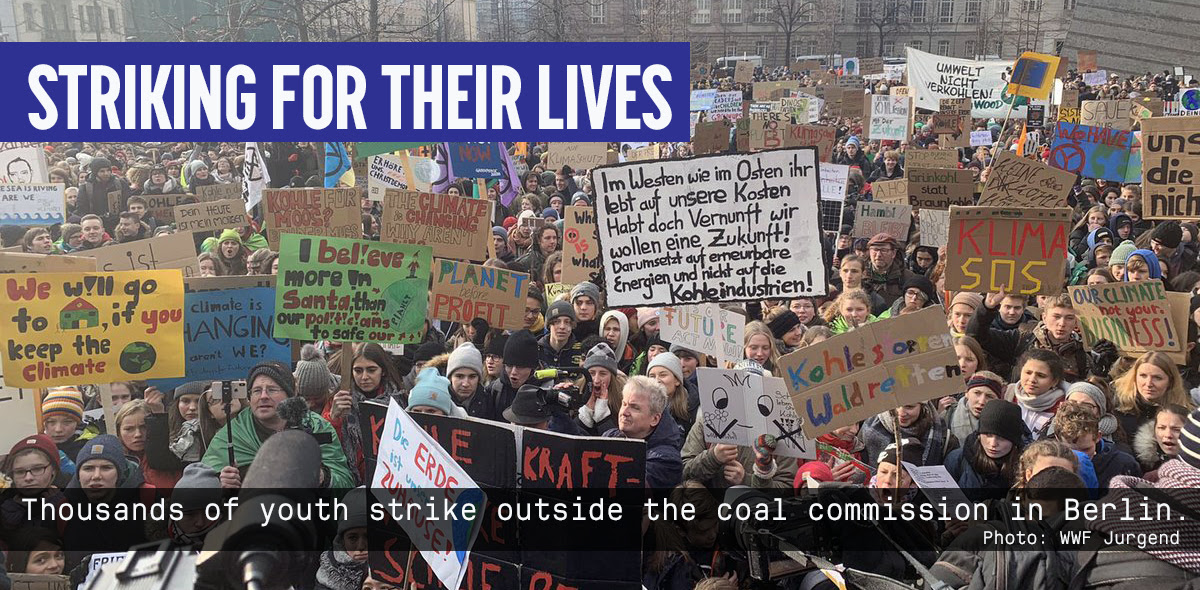
Turns out we were right to start the year on a hopeful note. We've already seen some amazing steps forward in 2019: from a cancelled gas pipeline, to youth leading on-point actions, like this one outside of Germany's commission to sort out the end of coal in the country.

But plenty of contrasts abound: from record inequality to record temperatures, we've got our work cut out for us. As blistering heatwaves took their toll in Australia these past weeks, tens of thousands of students were simultaneously marching in snow-dusted streets in Europe.

One thing's clear – we have to keep making our movement heard. Can you please share Fossil Free News with a friend to spread the word?:

Share with a friend

Enjoy the news,
Nicole

P.S. Thanks to the 1,000+ of you who filled out the survey from the last edition. I'll be digging through all you feedback over the coming weeks!

In Case You Missed It

As the Davos World Economic Forum kicked off in Switzerland, Oxfam published a new reminder of the scale of inequality we must address: just 26 billionaires now control 50% of the world's wealth. Greta Thunberg and Christiana Figueres, the former UN climate commission chief, were there urging strong climate action from world leaders. But Greta's climate strike at Davos was outshone in Brussels, where an astounding 35,000 youth took to the streets Wednesday, and 70,000 came out Sunday. And in Berlin on Friday, as the German coal commission neared an agreement on how to phase out coal in the country, thousands more students held a strike outside the meeting demanding an end to fossil fuels. Germany's deal sets a 2038 end date for coal, but it's not ambitious enough.


In Australia, ferocious heatwaves have driven home the urgency of the fight to keep global warming below 1.5˚C. Temperatures have neared 50˚C (122˚F) in some parts of the country, with bushfires tearing through more than 63,000 hectares of Tasmania's natural landscape. Australians have been urged to stay indoors and stay hydrated, with communities coming together to look after local wildlife and check in on elderly and vulnerable neighbors. People are vowing to take action now to avoid this becoming the new normal. If you haven’t seen it yet, this clip showing the dried outback that’s making farming nearly impossible has gone viral.


In Spain and France, communities celebrated as a major gas pipeline through the eastern Pyrenees, MidCAT-STEP, was scrapped after years of grassroots resistance. Groups pressured local authorities along the pipeline route, among other tactics, until energy regulators finally rejected it. It's a big win for activists across Europe who are challenging the fossil fuel industry's notion that gas is a necessary 'transition fuel'. The decision has even motivated the European Investment Bank to reconsider its policy to fund other gas infrastructure 'projects of common interest' in Europe. They're right to do so. The region where the dud pipeline was planned is already a leader in community renewable energy projects; investment would be much better spent on projects like these than more fossil fuel infrastructure. Hopefully the win can inspire others resisting gas elsewhere right now, like the Tuxpan-Tula pipeline in Mexico or gas exploration in Zanzibar.


In South Africa, a coalition of environmental justice groups is blocking plans for a new coal mine in a protected wetland area in Mpumalanga. The company behind the mine, which would have a 15-year life span and exacerbate the effects of climate change in one of the world's most sensitive regions, had their request to appeal the decision thrown out by a High Court and were ordered to pay the groups' legal costs. Further north, in Kenya, there've been positive reports of new solar projects on the way, following the president's announcement last month to move the country towards 100% renewable energy. They'll also have to tackle pollution from motorcycles in the capital Nairobi; solar-powered bikes can help fill the gap.

The Inside Story


A major aim of campaigns to go Fossil Free is to stop and ban all fossil fuel infrastructure. In King County, Washington, the county council just passed one of the strongest fossil fuel bans in the country. It works with a moratorium on all new development and then leverages a land use code to effectively ban infrastructure, like storage tanks or refineries. In this interview with 350 Seattle, learn more about how the community developed broad-based support for the ban and brought it to the local government (and check out the awesome video explainer too). Bans like this have also been passed in other communities in the region, and are helping secure a healthy climate future for all.  

The One to Watch

In the Netherlands, a local group of artists has been staging powerful performances at cultural institutions to pressure them to break their ties with fossil fuel companies, namely, Shell. And they've been winning – following an amazing campaign consisting of six performances throughout 2017 and 2018, culminating in an art storm, the Van Gogh Museum ended its 18-year sponsorship with Shell, and two other museums in The Hague quickly followed. The group has announced that its next target will be The Concertgebouw (Concert hall). The Concertgebouw is the last cultural institution on Amsterdam's main museum square, the Museumplein, with a fossil fuel sponsorship. Watch and share their performance for a Fossil Free Museumplein.


Have Your Say 

This week, consider forwarding this edition to a friend so we can get our message further. And remember, you can always browse old editions and direct people to sign up here.

Forward to a friend


And once again, I want to thank all the readers who filled out the survey with their thoughts on Fossil Free News. Your participation is what makes this movement so great. You can still give your feedback before the end of the month.

That's all for now. I'll be back in your inbox in two weeks with more! 

04 August 2017

German Social Media Regulation Inspires Repressive Regimes 3AUG17

Das Grundgesetz für die Bundesrepublik Deutschland ist die Basis der parlamentarischen Demokratie. 23. Mai 1949
IT is shocking and disturbing that the German Bundestag passed a law so repressive. The Grundgesetz " emphasizes the protection of individual liberty in an extensive catalogue of human and civil rights " , so one has to wonder how this law imposing censorship can be allowed considering German Basic Law " The German Constitution (i.e. the Basic Law of the Federal Republic of Germany) unmistakably outlines the presumption of innocence. " Not only does this law violate the civil liberties of the German people, it also provides justification for authoritarian governments around to world to "legalize" the censorship of their own people. For the sake of democracy, human rights and civil liberties we have hope the Bundestag will revoke this law or that it will be found unconstitutional by the German courts. From Human Rights First ......

German Social Media Regulation Inspires Repressive Regimes


August 03, 2017
By Adam Nagy
Passed on June 30, a new German hate speech law imposes heavy fines on social media companies that fail to swiftly remove prohibited content. Its proponents have lauded the bill as effectively combating hate speech while protecting freedom of expression for all on the internet.
In fact, it may have the opposite effect on an international scale.
Critics of the German law—which civil society organizationsthe affected companiesindependent experts, and other groups have opposed—argue that it will result in sweeping censorship. Social media platforms, they say, will err on the side of caution and remove acceptable content rather than remain liable and risk hefty fines. Furthermore, the privatized enforcement of hate speech law will allow censorship without procedural protections—namely, the right to due process, an appeal, and laws that are decided through democratic processes.
Although it’s an open question whether the law will survive the scrutiny of Germany’s Constitutional Court, less democratic states will be emboldened by the German model. Russia has already demonstrated this effect.
The ink had hardly dried on Germany’s law before the Russian Duma advanced an almost identical bill. The move validated concerns from various human rights advocates that passage of the German law would inspire similar statutes in repressive regimes, thereby providing a veneer of legitimacy to authoritarians seeking to further limit free expression online.
Repressive regimes use numerous tools to quell dissent and punish political opponents through the courts. In Russia, draconian statutory restrictions on speech, both online and offline, have greatly expanded in the wake of mass protests that began in 2011.
But for all the legislation passed to crack down on dissent, repressive regimes have yet to gain any semblance of legitimacy. Russian censorship laws are routinely condemned by democracies around the world, and are scrutinized by regional human rights bodies such as the European Court of Human Rights.
Laws that hold internet platforms liable for the actions of their users allow repressive regimes to deflect scrutiny and gain legitimacy. Under the constant threat of enormous fines or a ban, companies are left to do the dirty work of censorship; meanwhile, the authorities keep their hands clean. The highly politicized, vague, and broad definitions of illegal speech ensures that companies can be forced into line at any point if governments decide they don’t like some particular content.
The passage of these laws in a country like Germany—an international leader in both human rights and combating extremism—fractures a united front on this issue, making it harder for social media companies to lobby against such laws. It also allows politicians to accuse their external critics of holding their country to an unfair double standard.
Passing such laws in a country like Germany—an international leader in both human rights and combating extremism—fractures a united front on this issue, making it harder for social media companies to lobby against restrictive laws. It also allows politicians to accuse their external critics of holding their country to an unfair double standard.
Almost a century ago, Supreme Court Justice Louis Brandeis wrote: “If there be time to expose through discussion the falsehood and fallacies, to avert the evil by the process of education, the remedy to be applied is more speech, not enforced silence.”
The internet has changed the way we communicate, but it has not changed this golden principle. In an open society, prohibitions on speech should remain a final, not a first, resort.
Censorship will not change hearts and minds. If anything, it breeds feelings of victimization that reinforce extreme ideologies and hatred. A long-term strategy against extremism and hate online will require attacking its symptoms and its root causes through a myriad of technological, norm-shaping, and legal interventions.
We urge the German legislature to reconsider this politically expedient solution to a complex problem, and to adopt a policy that neither harms legitimate speech nor emboldens autocracies around the world.
Germany should support the development of new technologies, educational and norm-reinforcement projects, and increased access to existing legal remedies. It can do so by bolstering sustained consultation between civil society, industry, and policymakers, and by strengthening the capacity of individuals and civil society to engage in counter-speech and educational campaigns.

24 March 2017

A Food Festival Celebrates The Rebirth Of Jewish Life In Berlin 24MAR17

nosh_berlin_poster_final.png


ONE thing that can bring almost anyone together is food. How long will it be before meals and festivals like these can be organized in Israel and the West Bank and Gaza? Or in the Ukraine? Lebanon? Sudan? N. Ireland and Ireland, Bosnia-Herzegovina and Serbia? From +NPR .....

A Food Festival Celebrates The Rebirth Of Jewish Life In Berlin

March 24, 20172:19 PM ET
Last Friday night, the Berlin bookstore Shakespeare and Sons hosted a Sabbath dinner as part of the pre-kickoff activities for Nosh Berlin, the German capital's first Jewish food festival. Guests at the bookstore included many non-Jewish Germans who purchased tickets.
Veronica Zaragovia for NPR
Inside a Berlin bookstore on a recent Friday night, an unusual scene unfolded. Thirty people sat around a long table, sharing Israeli-Moroccan dishes like matbucha (a side of roasted red peppers and tomatoes), ptitim (a toasted pasta shaped in little balls) and a modern twist on the traditional challah or egg bread — a vegan one filled with dry fruits, quinoa, herbs and pomegranate juice.
They were celebrating the end of the week and the beginning of a day of rest, known as the Sabbath in Jewish communities. While observant Jews commonly have a Sabbath dinner on Friday nights called Shabbat, many of the guests were non-Jewish Germans who purchased tickets.
The Shabbat celebration in the book store was a pop-up dinner organized by a new Israeli business called Kiddush in conjunction with the March 19 start of Berlin's first-ever Jewish food week celebration called Nosh Berlin.
Other Nosh Berlin events include a discussion about German-Jewish coffeehouse culture of the 1920s and dinners featuring Yemeni, Persian and Roman Jewish recipes.
Moroccan-Israeli dishes and challah are served at a Jewish Sabbath pop-up dinner party hosted at a Berlin bookstore, part of the festivities surrounding Nosh Berlin, the city's first Jewish food festival.
Verónica Zaragovia for NPR
"Food is always a warm and welcoming way to approach a culture," says Laurel Kratochvila. She teamed up with food writer Liv Fleischhacker to organize Nosh Berlin to unite Jews and non-Jews of all backgrounds.
Since the Holocaust led to the extermination of some 6 million European Jews, Germany has striven to encourage its citizens to understand the history of what happened. "We were taught a lot about the Second World War and the Holocaust, and that leads to a feeling of enough-is-enough at some point," says Fleischhacker. She wants people to learn about different aspects of German Jewish life, not only the tragedy. "I think there needs to be a bit of a modernization, a youthfulness to it — a different approach."
The organizers, both of whom are Jewish, also want to stir Jewish pride in Berlin.
A close up of ruggelach, cookies popular among Jews of Ashkenazi, or Eastern European descent, that were among the Jewish food items sold by the Fine Bagels food stall at Berlin's historic market hall, March 19, 2017. This was part of Nosh Berlin, the first Jewish food festival in the German capital.
Verónica Zaragovia for NPR
"Jews shaped Berlin before the Holocaust," Fleischhacker says. "There should be a celebration of the past and of the future."
Before the Holocaust, Jews didn't really open up restaurants serving food labeled as "Jewish." Jews were well integrated, certainly in cities. "There is no such thing as German-Jewish culture," says Cilly Kugelmann, program director of the Jewish Museum in Berlin. "German Jewish culture is mainstream culture. It's classical music, it's [Johann Wolfgang von] Goethe and [Friedrich] Schiller. It's not an ethnic culture."
Also, German Jews didn't eat the Jewish foods that Jews from Eastern Europe did — Ashkenazi foods like matzo ball soup or blintzes (crepes with cheese.) They ate mostly German food. Sometimes it's even hard to distinguish the two. Germans, for example, eat fried potato pancakes and call them Kartoffelpuffer. Jews call them latkes.
Still, the Nazis ensured Jews had a hard time eating Jewish food, anyways. When they seized power in 1933, one of the first laws they passed banned the kosher slaughter of animals.
In the post-War era, Jews did go into the restaurant industry, "but definitely not kosher food because you wanted to make money," explains Kugelmann, whose own parents owned a restaurant and only cooked kosher food at home. "And you had so few Jews here that you would never be able to make money with a kosher food restaurant."
Not until the 1970s did the Jewish community start to grow in any measurable way, with the first wave of Jews coming from the former Soviet Union, where Judaism, like all religions, was oppressed. That immigration to Germany lasted through the USSR's breakup in the early 1990s.
Thousands of Israelis have moved to Berlin in the last five to 10 years. Some cite as motivation the high cost of living in Israel; others say they disagree with Israeli politics. Some of these immigrants qualify for German citizenship if their German Jewish ancestors were persecuted by the Nazis. In 2015, the German government estimated that about 4,000 Israelis live in Berlin, but other estimates suggest there are up to 20,000, according to the American Jewish Committee Berlin.
Yuval Belhans of the Kiddush Shabbat pop-up project is one of them, and so is his business partner, Maayan Meir. Meir thinks serving Jewish food has been rare here until recently because "people don't like to mix guilt and food," she says. But she says the more that Israelis move here and open restaurants, the more normal it will seem.
Kratochvila of Nosh Berlin is optimistic that the Jewish food scene will evolve beyond the basics. "The more you have, the more exciting it gets," she says. "You can't stay at a base level if you have competition."
Jews will likely keep moving here. The city is welcoming, despite an increase in anti-Semitic acts in recent years. The Berlin Police Department records anti-Semitic acts according to their political motivation. In the first half of 2015, the department logged 62 incidents by right-wing groups. In 2016, it went up to 64. While no one knows the cause for sure, during this time, media reports covered anti-Semitic remarks made by members of the extreme-right party Alternative for Germany, which had been gaining public support.
Another entity in Berlin that tracks anti-Semitic acts is called the Department for Research and Information on Anti-Semitism. Last month, it reported anti-Semitic attacks increased by 16 percent from 2015 to 2016, but it has a much broader definition of anti-Semitic acts and can't be compared directly with the police department's data.
One of the vendors at Berlin's food hall during Nosh Berlin, the German capital's first food week, sold cholent, which he dubbed "Jewish soul food." March 19, 2017
Verónica Zaragovia for NPR
Cilly Kugelmann of the Jewish Museum points out that food weeks like this one do more than sell food. They are educational. That appeals to Kratochvila of Nosh Berlin, who hopes to make this an annual event.
"I wouldn't dream of calling the cuisine here homogeneous — there's a really diverse food scene in Berlin," she says. "But this is a component of the food landscape that's been sort of removed from it by history, that should be growing here."
Judging by the turnout for Nosh Berlin so far, people are enthusiastic about Jewish life here. By Sunday evening, all but one of the Shabbat dinners lined up for this Friday had sold out.

Veronica Zaragovia is a public radio reporter who lives in Berlin and is a fellow with the Robert Bosch Foundation. You can find her on Twitter @verozaragovia and on Instagram @veronicazaragovia.